Jump to ratings and reviews
Rate this book

Melting Point

Rate this book

Melting Point fuses prose and poetry, realism and literary inventiveness, in dealing with the absurdity of humanity. It’s fourteen stylistically diverse stories, flirt with irony, paradox and enigma.

The most striking thing about Magarian’s collection is its range of interests, the multiplicity of the worlds evoked, and the extreme contrasts among its characters: a feted, reclusive writer; a seductive murderess with a fondness for Bourbon and fellatio; a thief obsessed with a Toulose Lautrec print; a fruit and vegetable merchant who has a genius toddler; and a deep sea diver who can only be free from clumsiness when she is submerged in water.

Stories and characters flow from these molten moments in a series of fictions that touch on ecstasy, excess and the elemental.

211 pages, Paperback

Published June 15, 2019

Loading...
Loading...

About the author

Baret Magarian

7 books28 followers

Ratings & Reviews

What do you think?
Rate this book

Friends & Following

Create a free account to discover what your friends think of this book!

Community Reviews

5 stars
11 (52%)
4 stars
7 (33%)
3 stars
1 (4%)
2 stars
2 (9%)
1 star
0 (0%)
Displaying 1 - 15 of 15 reviews
Profile Image for Paul Fulcher.
Author 2 books2,028 followers
August 9, 2019
Melting Point by Baret Magarian is published by the wonderful Cromer-based independent Salt Publishing - wonderfully my direct-from-the-publisher copy came with a bookmark, a postcard with a hand-written note of thanks, and a little bag of salt.

And the book itself was equally a delight. Melting Point consists of 14 stories over 211 pages, The varied and striking style is best described by a quote from the author himself (from https://thesighpress.com/portfolio/am...
I write about many different things and in many different registers. I like to stretch writing and to stretch genres and contexts and stories. I am always trying to cram in as much as possible, to find a way of making a sentence malleable and dexterous, so that it’s working beyond the capacities of a normal sentence. ... I am constantly overwhelmed by the sheer force of sensory perception and by the details, clamour, richness and terrors of this world ... I want to uncover the self beyond the self, the I beyond the I. I am always watchful for the existence of a shadow self.
.I am not sure if the author would recognise the comparison, but as a benchmark, Deborah Levy is one comparison (Hot Milk in particular).
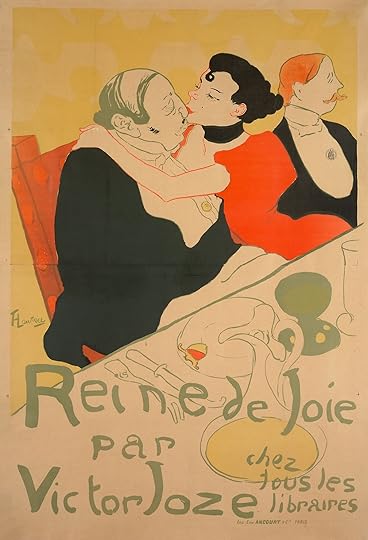
The first story Crime and Bread, has the main character captivated by Toulouse-Lautrec's 1892 poster Reine de joie which she plots to steal:

description

The Watery Gowns tells of Kirsten, an Englishwoman, one of a team of 3 divers on a Greek island:

Every now and then a weirdly shaped fish, a tapered apparition road and passed by and then twos and threes followed, perfect replicas of each other, clones, recurring moments: their gauzy, distorted forms made the divers think the sea contained more mysteries than any earthly realm. The truths and feedings to be found down there could not be communicated to anyone who had not experienced that dark luminous abyss, that underwater garden.

clumsy out of the water, she isa different person when she dives (underneath everything was lighter, friction was robbed of its power to hurt), until a transcendent experience, one of several in these stories, gives her the confidence she lacked.

The Rich and The Slaughtered is set in the RAC club:

‘I’ll tell you a story that contains the secret of the world,’ said the Professor, his eyes intense and more piercing than usual, so that it seemed as though someone, while the Professor’s back had been turned, had inserted drops into his eyes to make them glow more brilliantly; he seemed to have acquired the bearing of a feted theatrical actor, he had entered into a parallel existence, more defined, more memorable, more crystalline. His hand reached for the glass of brandy that his companion had poured for him a short while earlier as they sat in leather armchairs and viewed the familiar scene before them in the comfort of the Royal Automobile Club, where bankers and barristers and retired colonels roamed.

and looks back on a previous dinner at the club, featuring such a wonderful dismissal that I'm tempted to save it for future use myself:

Madam, you will forgive me I hope for leaving this party, but having witnessed the coarseness of which you are capable I find myself too nauseated to breathe the same air as you or to remain seated at the same table.

Meltdown, again in a very different register, features a troubled and disillusioned school teacher (he concluded that ... the world was destined to go on marching into darkness; a mad, demented death march ruled by the iron rhythms of cruelty and barbarism, striking out its metallic beat for time immemorial) taking his revenge on the world by playing a diabolical piece on a monstrously over-sized church organ.

The Fever, starts seemingly as a tale of smuggling in the Mojave Desert, before bringing into play a the latest novel of a reclusive writer:

He is the Elvis of literature. As I said, he craps caviar and pisses pink champagne. He’s as eccentric as Howard Hughes and as classy as a Ferrari. He writes prose of a beauty that makes grown men weep and women squirt. He is the Alpha and the Omega, the final word in Final Words, the Writer whose every phrase gets emblazoned onto the fabric of consciousness as surely as if it were a laser beam. This wizard, this charmer, this old-style magus doesn’t sit around and wait for the Muse to descend, he doesn’t chew tobacco or sip whisky and pass away an idle hour, he’s a machine, a writing machine, a precision machine squeezing out master works like chickens lay eggs.

and then takes a different, more other-wordly, turn altogether, all within less than 20 pages.

A striking collection, recommended.
3 reviews
August 30, 2019
Baret Magarian new book of short stories, "Melting Point," attests to his rich, inventive and global imagination. But more than his artistic gifts, he is also a writer of rare wit, compassion and soul.

Throughout the book we encounter lives struggling against the harsh disorder of the world around them and the indeterminate chaos of the universe. yet each and every one of his characters strives for a foothold on the tectonic shifts of life itself.

Whether it is the ironic twist of fate that bring two disparate lovers together at the hospital bedside of a once beautiful and idealized woman in the short story, "Alba," or the sudden emotional eruption and threat of murder and violence in a seemingly idyllic setting that spiritually bonds two sisters together in "The Opiate Eye of the Buddha, there is in the resolution of all the stories a momentary stay against "the slings and arrows of outrageous fortune.

Throughout the stories we are acutely aware of the author's moral sensibility, as in the politically powerful "cri de couer"against the depraved indifference of the wealthy and powerful in "The Rich and the Slaughtered," or in the disturbing, vivid collage of mankind's obsession with war and cruelty in "The Mosque of Cordoba" which ends with an act of restorative compassion.

The style and substance of the stories range from the vividly realistic encompassing Magarian's closely observed details of many cultures to the subtly speculative forays into the future.

It is a haunting and memorable collection, timely and timeless.

Robert Karmon

Profile Image for Virginia Moffatt.
Author 12 books23 followers
July 28, 2019
‘I’ll tell you a story that contains the secret of the world,’ says a character in 'The Rich and the Slaughtered' , one of many fine stories in Baret Magarian's collection, a memorable encounter with a journalist at the table of the rich and privileged. While the sentiment fits that particular story perfectly, it also seems to me to be an excellent summation of the book as a whole. Magarian's vivid imagination takes us from Cornwall to Cordoba, Florence to Greek Islands, Sri Lanka to an American motel via multiple genres as he ponders on the nature of humanity and our purpose on this planet. In 'Crime and Bread' a thief is haunted by a short story of cause and effect, that changes her attitude to her original theft, the intriguing 'Island' centres on a mysterious woman telling a tale of travelling into the future, in a story that seems to be in some kind of time loop itself, while in 'The Meltdown', the world's unkind response to a man's desire to help others drives him into an act of insanity that shakes the entire town. The moving 'Alba' and comic 'The Balls' both have original takes on infidelity, while my favourite 'The Mosque of Cordoba' is a brilliant reflection on the possibilities for violence and compassion that lie within everyone of us. Good short story collections are hard to find, and one as original as this deserves a wide audience. I highly recommend this one, and I know that I will be returning to it again and again.
Profile Image for Lee Foust.
Author 11 books231 followers
February 20, 2020
Another great book by Anglo-Armenian author Baret Magarian, who now lives here in Florence, Italy.

I loved this collection of stories for its amazing scope--it takes you all over the world, through several literary genres, makes you laugh, terrifies, inspires, and ultimately prods our humanity by taking us through the trials and tribulations of so many fascinating characters. It's a horrifying cliche to say that there's something in it for everyone, but I don't think I've ever read a short story collection by a single author with so much creative diversity, with so very much, so many different angles and styles, events and places--even if every tale here clings to that center of humanity that makes us want to weep--either with tears of laughter or sorrow--for the poignant moment of truth in some wonderful human being's life.

Bravo, Baret! Melting Point is a stupendous achievement.
Profile Image for Mairi Byatt.
1,042 reviews2 followers
July 20, 2019
Stunning, beautifully crafted and so compulsive, literally could not put it down, wish there was more stars! Highly recommended.
Profile Image for Ross Jeffery.
Author 28 books366 followers
September 26, 2019
‘Melting Point’ is an odd collection, to say the least. Though here, ‘odd’ isn’t to be taken as a negative, rather, what makes ‘Melting Point’ so strangely enjoyable is its oddities – it’s whispered moments of surrealism and shouted moments of the humorous absurd. Magarian is a lyrical author, who fuses and blends his prose in twists and turns of imagery and imagination. At times it’s a lot to stomach, you almost hanker for a simple sentence. But perhaps that’s the beauty of Magarian and ‘Melting Point’, in that, nothing about it is really all that simple.

The theme that threads itself through each piece is that of humanity – of life and all that it harbours. Yet whilst the theme is a constant, no two stories are the same, and the imagination from which Magarian unearths each piece is a joy. Nothing is quite what it seems and nothing is repeated, not at least, in a narrative sense, nor in genre. Sci-fi bleeds into surrealism which bleeds into drama which bleeds into the downright strange – you get the idea. The characters contrast, though there is the sense that all their lives are somehow connected by the bewilderment that is life.

Fourteen stories feature, and whilst I could harp on about each, the stands out of the collection examine the range of Magarian’s ideas. ‘The Watery Gowns’ sees the otherworldly make itself known. Kirsten is a diver – someone who only feels truly ‘complete, truly whole and peaceful’ in the ‘underwater chambers’ of the sea. The prose here is gorgeous.

‘Underwater everything was lighter, friction was robbed of its power to hurt, weight was dissipated. Maybe that was why she loved to dive…’.
It’s Magarian at his descriptive best. Kirsten decides to dive out to a local shipwreck alone where unexplained magic reveals itself to her. As she sets her hands passes her hands through a tear in the hull ‘she was engulfed in a reverberating sound […] she was deafened, stupefied.’ The power of the moment changes her, proven something to herself that she cannot know. It opens her up to something new, though just like Kristen, we’re never quite sure what, other than the sensation of placing her ‘hands inside a shipwreck.’ Magarian has the knack for capturing slices of unexplainable life where everything in you realises and recognises a change – what? We can’t always know. It’s a wonderful piece.

Elsewhere absurdity of some degree takes hold. ‘Clock’ and ‘The Ball’s visit both, the latter climaxing to a comical ending, though the reveal that leads to a ‘backdrop of blood and madness in the midst of dishes of spaghetti and polenta’ is quietly heart breaking. The protagonist Salvatore – a man who ‘touched his balls’ to ward of evil, learns that the child that has changed his life for the better isn’t actually his. Melancholic as it is, it also begs the question many of us face, and a situation many fall victim too – using another’s existence as reason to better yourself. What happens then, when you realise that the other is no property of yours?

Magarian questions life constantly, and never more in ‘The Rich and the Slaughtered’ and ‘Erasing the Waves’. The former is a dinner of the wealthy which ends in a reveal – ‘Lady Rathmere began scolding the waiter, telling him off for not giving the wine enough time to breathe’ What pettiness, what indulgence […] here we are seated amidst absurd levels of comfort and luxury […] and there, at the polar opposite, in scattered places throughout the world, a dark, dismal hell exists’. ‘What a blood-soaked mess is life. It’s all so unnecessary.’ Well, quite.

‘Erasing the Waves’ ponders similar musings of life. Two friends meet – one a journalist, another a famous Hollywood star. They go out to dinner and explore the vapidness of celebrity and what it means to be known. Though at times it appears elaborate for the sake of it, Aaron, the celebrity in question, offers worthy points of contest. He is stabbed and for whatever reason, it rejuvenates his career – ‘Maybe there was a connection between that night and the subsequent flowering of my career. Or maybe there wasn’t’. And that’s true of everything is it not? Is it all coincidence or was it meant to be? We can’t ever know. Again, the prose is lyrical, and again you almost wish Magarian would take pause for a moment. Although, maybe I don’t wish for that at all.

The final two pieces ‘The Fever’ and ‘The Opiate Eyes of the Buddha’ close ‘Melting Point’ out in fitting style, again presenting us with more questions than answers about life, though the latter tale offers more concrete conclusions than the other thirteen stories.

‘The Fever’ is a strange tale that takes its surroundings and turns them, well, into a sort of weird fever dream. Our protagonist is trusted with a package that he has to transport to Los Angeles. At first, it’s a mystery as to what lays inside, and whilst the reveal that the package is in fact a transcript falls somewhat flat at first, Magarian pulls it back when you realise the author has ‘the CIA and the FBI’ opening files on him. Suddenly, the transcript is more potent. Yet from then on the tale falls into a heady mix of dream and reality – ‘drenched mixture of unreality and mental depletion’ as our unnamed protagonist makes it to a motel. Bizarre moments occur, all resulting in the question that has been posed in different forms throughout the collection – ‘What was I doing with my life? What kind of life was it?’.

‘The Opiate Eyes of the Buddha’ pulls into a similar realm, though the bizarre is swapped for heady reality. Two English sisters – Katherine and Katja, are in Sri Lanka. One is decidedly more cynical about life than the other. They question the forces around them – ‘maybe it’s the legacy of the famous tsunami’ – but on the surface everything is smooth. Buddhism is thread in brief moments, a taxi driver for the sisters explaining ‘Buddhist they believe your actions in this life are deciding your next life, so we try to be good, try to be kind, so in next life we do not return in bad form’. It’s a known message; actions have consequences, and actions lead the sisters into a maelstrom a few pages later when a local mob/gang show up at their hotel on Christmas Eve and leave it bloody, to say the least. Katherine takes the lead to save them both, and then once again questions are begged – ‘How do you explain it? Divine intervention? Why were we spared?’. Yet the ending is more concrete and serves as a fitting moment to close out ‘Melting Point’. Many times has Magarian posed the unanswerable, but here Katherine makes a discovery. ‘She perceived in a grateful moment that she had been snatched perhaps from a life of perpetual questioning and wandering, there on that beach, on that arrival or departure point that the night had propelled them towards, two young women, stumbling, uncertain, but touched by beauty, and, finally, by grace’. The piece is one of the strongest in the collection, the prose passionate – the narrative once again authentic.

Magarian has a unique voice that makes ‘Melting Point’ so utterly readable. Expected the unexpected – and though at times I felt some pieces were clipped too short of a truly meaningful ending, ‘Clock’ and ‘The Visitation’ the only two I would truly ascribe that assessment to – overall the collection is authentic and imaginative. There is little chance you could predict where Magarian’s pieces might end up; a skill many writers I would hope would wish to possess.
2 reviews
November 11, 2020
Supreme writing skills to start with, followed by amazing content and linguistic richness and knowledge. Baret Magarian has an extensive capacity to describe whatever he aims to describe in an almost effortless and very comfortable way. As this is a collection of short stories, it is normal that different stories may resonate with different readers and this is indeed the beauty of reading the MELTING POINT.

The gamut of locations, characters, domains, locations, situations, feelings and emotions, I found staggering. There is a universal truth coming out of there but it’s so superior and steamy that it evaporated in front of my eyes as in a miracle, a wonderful feeling, rarely experienced in writing these days.

Of course I have my favourite stories, chosen due to their degree of effortless writing and conveying of storytelling for the human condition, I almost cried at the power of ALBA, tremored in a Hitchcockian fashion reading THE FEVER, started doing mathematical modelling after reading CRIME AND BREAD, transposed and dreaming in reading THE MOSQUE OF CORDOBA, fearing for the worse reading THE WATERY GOWNS, the CLOCK, the BALLS, ERASING THE WAVES… THE MELTDOWN and the OPIATE EYES OF BUDHA… amazing story telling.

The writer moves comfortably between genres in an almost cinematic way, His writing is very visionary and optical at the same time. Everything can be imagined, people can be almost sketched down in paper, locations are vibrating and the readers stress an enjoyment, balanced perfect elevates the reading experience. Yes, sometimes the writing may seem technical, like in ISLAND, the RICH AND THE SLAUGHTERED, THE VISITATION and the CHIMERA. But even in these stories, one can but admire the writing and lose oneself in the melting point of writing at the temperature that one can emerge willingly in intense and awesome storytelling. One of the best books that I read in the last 5 years…
Profile Image for Jackie Law.
876 reviews
July 22, 2019
To be clear from the outset, I didn’t get on with the style of writing in this short story collection. It is published by the mighty Salt Publishing so I started with high expectations. The stories are varied and eclectic. There are fine ideas yet I struggled with their execution. I will try to explain.

The opening tale, Crime and Bread, initially struck me as quirky. Imagery is a key feature as the reader is introduced to the protagonist, a female, who states

“But life only makes sense to me when I’m burning the candle at both ends, I can’t stand that dullness, when things go stale, I can’t stand that grey area. I need sequins, raisins, spices from Morocco, French wines. What would they say if they saw me tail-spinning out of control, intravenous needles hanging from me”

So, she is looking for adventure.

She shares her dreams, then a story she is reading that she phones a friend to discuss. She sees a poster in a window that she wishes to own. Rather than purchase it, something not beyond her means, she plans to steal. The narrative follows her thoughts, actions and their consequences. The language is rich and sensuous. The reader is left to make what they will of a nebulous denouement.

I moved on to the second offering, The Watery Gowns, which explores the transformative power of confronting personal fears. The protagonist, a female, is staying in a Greek villa offered to her for a few days by parents of a friend. She goes diving with locals. She borrows their little boat to get closer to the rusting remains of a shipwrecked freighter. Again, the language is rich in description and imagery. The female’s emotions are heightened by every experience.

In Erasing the Waves the language becomes more crude in places. Two men meet after many years. They had been good friends at university. One is professionally successful while the other is frustrated by the anxiety caused by their less than successful freelance career. Conversation veers in a variety directions.

“He said nothing. For the first time I had a fear of the evening going wrong or ending in recrimination or tension, which was not what I wanted.”

This story has sections of extended dialogue, as do others in the collection. These felt stilted.

The next tale, Island, is clever, mind-bending even, but I didn’t enjoy reading it. The men, with their sexual preoccupations, are stereotypes. The women’s bodies are described in detail. I grew bored at the party attended due to the characters’ shallow behaviour.

“I have a rather pessimistic view of the world at the moment. People eat shit, they watch and listen to shit and, above all, they talk shit. The average person is so stupid they probably wouldn’t be able to define what stupidity means.”

There is a futuristic element that is well done but then fell flat, perhaps deliberately. I was disappointed that a section I enjoyed was included for a valid reason but not pursued.

The variation in writing style affected flow and engagement – a disjointed narrative that even the rich language couldn’t compensate.

The Mosque of Córdoba offers beauty, calm and peace juxtaposed with hatred, murder and horror.

“What things had to happen to a man, what disfigurement had to take place for him to be willing to have his limbs scattered, for him to be willing to massacre and maim others? What false and grotesque heaven had been promised to him, had been sold to him […] for him to be willing to swear everlasting allegiance to a god synonymous with evil, hatred and murder?”

The author is presenting interesting and timely points but plot development stutters. Characters are shoe-horned in for effect.

The Chimera is another example of an interesting idea – again futuristic – spoiled for me by a sexual thread that felt unnecessary.

The Rich and the Slaughtered is an example of a real world problem being explored but in a structure I couldn’t engage with. Set in London’s RAC Club, a dinner is being recounted. It presents the self-entitlement of the privileged.

“The moment seemed to be indicating that all was as it should be once again and that the skeleton of social injustice had been shoved back once more where it belonged – in the cupboard marked Irrelevant.”

The themes are worthy but the fractured telling doesn’t quite come together.

The Meltdown takes a playful stab at modern architecture, and offers up an extreme case of a clash of musical tastes. The protagonist is a village schoolmaster with an interest in world cultures and history. He cannot understand those who are content.

“Would Marjorie Bowles, the local pharmacist, one day realise that life was not merely waking and working and supper and television, that another music played somewhere”

By now I realised that each of the stories in the collection offered not just one plot or one theme – that the frequent changes in direction were deliberate. This didn’t work for me as a reader.

I didn’t enjoy The Balls which felt predictable and, again, presented man driven by sex, and woman as an object to be attained and then owned. The characters lacked nuance and depth.

The Visitation has fishermen pondering on what could be living beneath their vessels after a grotesque creature is swept ashore. These men have accepted the horrors they live alongside, gossiping inanely of such things as a twelve year old relative who is pregnant. They fear the consequences of the natural more than the man made.

Alba introduces yet another beautiful young woman, as if love can only be offered to the aesthetically pleasing. She muses

“Sometimes I think you are in love with a sense of me as someone else, sometimes I think you don’t know me at all”

According to the metaphors employed, men only value what they can have sex with and looks are key. A ‘bovine woman’ is described as reading an ‘airport novel’ – terms employed as derogatory.

Again, in The Fever

“She was on the wrong side of forty, with depleted features and a beaten-up body, but not unattractive, not without a certain 3am allure”

I wondered if this tale, an American road trip, was intended as a pastiche.

The final story in the collection also jumped between plot threads, stilted dialogue and vivid imagery. Two sisters are travelling together in Sri Lanka. The horror of an evening changes their life view.

Aware that I am sensitive to what I regard as unnecessary sexual description, that I prefer my fiction to be character driven, this collection may simply not have been targeted at me. I won’t be retaining it for rereading.
1 review
December 22, 2019
I could talk about the author’s kaleidoscopic melange of literary approaches or his deft use of allegory. I could describe to you how his lush descriptive style or crisp dialogue move his stories right along. Indeed I began this review as an exhaustive analysis of all those things reviewers tend to do, dissection of every minute nuance and turn of phrase to a fare-thee-well.

This collection can certainly stand up to the scrutiny, but this book is more than that. It’s more than the sum of its parts in a much simpler way. To the point, Magarian has written damn good stories that seize your attention from the outset, “I’ll tell you a story that contains the secret of the world.” (The Rich And The Slaughtered) and cleverly carry you to their conclusion, “So there was a kind of happy ending to the whole sorry bloody mess, I suppose” (The Balls). The stories are cynical, hopeful, comedic, bizarre, ironic and hopeful. He inhabits his characters in a way that allows them to live and breath and naturally develop in very short order. Above all, each story is fun to read and gives us a glimpse into the author’s own conflicted moral view of the world, but always with at least the hope of redemption.

I think that I shall be returning to this collection repeatedly in the future. I highly recommend others to do the same.
1 review
September 7, 2019
A fantastic variety of short stories in this unique book by Baret Magarian. He transports you into another world for a short time and keeps you gripped with interest in what is about to happen next in each of a wide variety of stories. He creates a vivid picture of exactly what he wants to describe and gets the picture clearly in your head. There is a good balance between humour, suspense, philosophy and social behaviours while keeping a sense of reality throughout. It is easy with this book to gain some reading pleasure when life can be so busy. This book can give you a short escape for half an hour or so. Each story is unique. I enjoyed reading each one. My favourite though was Clock. However The Meltdown, The Visitation and Island were also three other ones that were worth reading for a second time and a great way to escape from the day. Everyone!.... you should get this book for a quick escape. Read one story and find yourself transported into a different place. Library’! Cafes! Hotels! .... you should stock this for the customers as they are more likely to sit stay and return again. Brilliant writer.!
4 reviews
May 14, 2024
These are sizzling, unexpected stories – this is the kind of short-story collection that leaves you feeling you’ve travelled to a multitude of different places and vicariously lived all sorts of lives. The stories are stylistically bold and often grapple with Big Philosophical Questions, but at the same time they’re funny, engaging and moving. ‘The Balls’ is especially brilliant – a rollicking tale about one man and his testicles. Great stuff!
Profile Image for Justo.
Author 2 books5 followers
Read
December 13, 2023
Imaginative, clever, funny book (and shocking sometimes). Good literature. Prepare to immerse yourself in the eternal struggle between what is and what should be.

"Instead of being given a medal, which he thought he deserved for finally doing something good and right and noble, he was splattered in buckets of filth and slandered and vilified by foul-mouthed, vindictive cowards."
Displaying 1 - 15 of 15 reviews