Jump to ratings and reviews
Rate this book

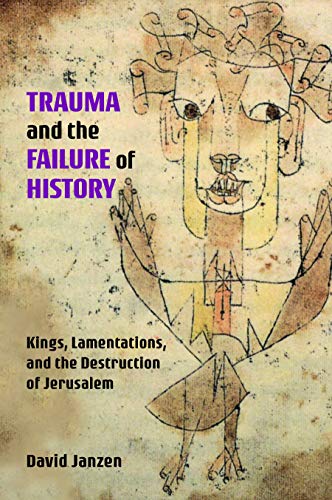
Trauma and the Failure of History: Kings, Lamentations, and the Destruction of Jerusalem

Rate this book

A theoretical and exegetical exploration of trauma in the Hebrew Bible


David Janzen discusses the concepts of history and trauma and contrasts the ways historians and trauma survivors grapple with traumatic events, a contrast embodied in the very different ways the books of Kings and Lamentations react to the destruction of Jerusalem. Janzen’s study warns that explanations in histories will tend to silence the voices of trauma survivors, and it challenges traditional approaches that sometimes portray the explanations of traumatic events in biblical literature as therapeutic for victims.


Features:


Exploration of history as a narrative explanation that creates a past readers can recognize to be true
Examination of how trauma results in a failure of victims to fully experience or remember traumatic events.
A case for why the past is a construction of cultures and historians

David Janzen is Associate Professor of Hebrew Bible at Durham University in the United Kingdom. He is the author of numerous academic monographs on the Deuteronomistic History and Persian period biblical literature, including The Violent Gift (2012), a study of the Deuteronomistic History through the lens of trauma theory.

Kindle Edition

Published August 2, 2019

13 people want to read

About the author

David Janzen

30 books4 followers

Ratings & Reviews

What do you think?
Rate this book

Friends & Following

Create a free account to discover what your friends think of this book!

Community Reviews

5 stars
2 (66%)
4 stars
1 (33%)
3 stars
0 (0%)
2 stars
0 (0%)
1 star
0 (0%)
Displaying 1 - 2 of 2 reviews
Profile Image for Brandon Grafius.
Author 16 books11 followers
January 5, 2023
Fascinating book. Janzen posits a dichotomy between history, which tries to shape events through narrative structure, and trauma, which resists being placed within a narrative context. For Janzen, history (like the Book of Kings) can never provide an accurate picture of trauma in the way that a book like Lamentations does.
Profile Image for Brian LePort.
170 reviews14 followers
May 17, 2023
If much of the Jewish Tanakh/Christian Old Testament can be understood as apologetic for the god of Judah after the events of the Babylonian Exile, then what catches my attention are the voices of dissent. For example, the Book of Proverbs with its emphasis on wisdom can be interpreted rigidly, almost mathematically, to read that those who do well in life must be the ones who lived by the guidance of divine wisdom while those who struggle must be the fools. Then comes along the author of the Book of Ecclesiastes and overthrows that whole ideology by pointing out that it’s too simple/simplistic.

The Deuteronomistic impulse is to justify the divinity while blaming the humans for what happened during the Exile; it’s to warn how the people shouldn’t behave if they want to avoid a repeat. That impulse is found in the Book of Kings where the blame for the Exile sits on the shoulders of the people—and as Janzen observes, specifically the people, not the royalty of the House of David. But the Book of Lamentations, which sometimes tries to fall in line and echo the rationale found in the Kings, but often simply can’t, is evidence of a dissenting voice.

In Trauma and the Failure of History, Janzen presents “history” as a narrative about past events that attempts to explain them and provide a true presentation and interpretation. The Book of Kings is such a work. It narrates past events leading to the Exile as a way of explaining “how did we get here”.

But trauma can’t make simple sense of what’s been experienced. There’s no metanarrative that comforts. Trauma doesn’t explain the past because in a sense the past is present, the effects linger. For Janzen, this is what we find in the Book of Lamentations. This texts fails to explain what happened to Jerusalem because it simply grieves what happened to Jerusalem.

I highly recommend this book, especially for those who are interested in the internal conversation found in the Hebrew Bible around topics related to theodicy.
Displaying 1 - 2 of 2 reviews

Can't find what you're looking for?

Get help and learn more about the design.