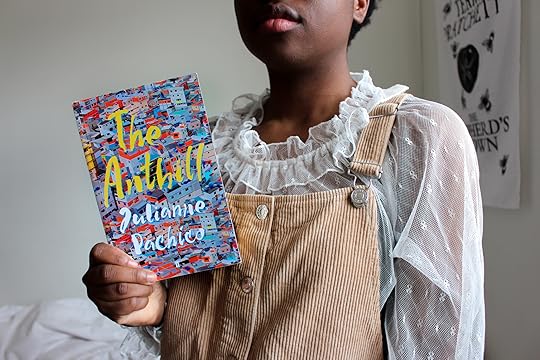
Linda returns to Colombia after twenty years away. Sent to England after her mother's death when she was eight, she's searching for the person who can tell her what's happened in the time that has passed. Matty - Lina's childhood confidant, her best friend - now runs a refuge called The Anthill for the street kids of Medellín. But her long-anticipated reunion with him is struck by tension. Memory is fallible, and Linda discovers that everyone has a version of the past that is very, very different.
Julianne Pachico was born in 1985 in Cambridge, England. She grew up in Cali, Colombia, where her parents worked in international development as agricultural social scientists.
In 2004 she moved to Portland, Oregon, where she completed her B.A. at Reed College in Comparative Literature. In 2012 she returned to England in order to complete her M.A. in Prose Fiction at the University of East Anglia in Norwich, where she was a recipient of UEA's Creative Writing International Scholarship.
She is currently completing her PhD in Creative and Critical Writing at UEA on a fully funded fellowship. She had a short story on the long list for the Sunday Times Prize, and is also the only writer to have two stories in the 2015 anthology of the Best British Short Stories. Her short stories have been published by The New Yorker, Lighthouse, Litro, Shooter Literary Magazine and Newwriting.net, among others. She holds dual citizenship in the U.S. and the U.K.
When I read the blurb about a young woman’s return to her own roots, travelling to Columbia to reside at a daycare refuge for street kids named Medellin, I thought I’m gonna read a haunted thriller/horror story like the claustrophobic and tense premise of “ Orphanage/El orfanato” which is one of my favorite Spanish thriller movies. But this novel is a drama, facing your pasts and your heritage story. Even though there are so thriller, mystical vibes and elements his inside, they are just blended in the story and we barely catch or notice them.
There are so many sensitive and heavy issues in this story including abuse, rape, sexual assault. So when I expect a ghost story, I get an earth shattering, disturbing, effectively heartbreaking drama. The story starts with Maria Carolina a.k.a. Lina’s arrival to Medellin after 20 years later. She left the place after her mother’s death and directly sent to boarding school in England. But we perfectly see she couldn’t find her cultural and identical place for herself in England and now she barely finds her roots, having hard time to connect with her childhood memories and restrained secrets.
As soon as she connects with Mattias, her best childhood friend, who is also headman of Anthill, she decides her return but their reunion wasn’t like as she’s planned. Mattias acts cold, distant, keeping everything to himself: he is not the same boy she knows. And of course during her stay in Medellin, Lina finds more herself and her friend she’s planned for. The secrets, the restrained memories confuse her mind: hallucination merge with childhood memories. As she learns more about her past, her true reality starts to crumble into pieces.
I don’t want to give more spoilers but I may say this is well-written, complex, intriguing, dramatic story tells about a young woman’s searching for her true identity and overcoming her own past demons. I’m cutting some stars for false advertisement (I was so keen to read a horrific ghost story but the blurb misdirected me!) but I’m rounding up my 3.5 stars to 4 because of the good writing and volatile, intriguing story-line!
Having left Colombia for the UK at the age of eight, Maria Carolina (Lina) returns to Medellín after a 20-year absence. She reconnects with her childhood best friend, Mattías, and begins volunteering at his children's refuge, The Anthill. There's an instant momentum to the narrative – it's so swift, you feel like you're running to catch up; there are unsettling undercurrents, and it always seems like there's something just beyond the edge of the frame. This rhythm effectively imitates Lina's disorientation as she tries to navigate a familiar-yet-strange environment. Mattías is a manic, mildly frightening presence, determined to reveal nothing about himself, yet seeming to have too much empathy for others, so that it gets in the way of actually doing good. Lina is continually displaced – she's assumed to be an outsider by most Colombians, but flashbacks show us she never felt she belonged back in England, either. Both seem somehow incomplete; broken-mirror reflections of one another.
The original blurb for The Anthill (reworded since I first heard about the book) led me to assume it would have a stronger element of magical realism and/or horror than it does. I was imagining a novel-length version of a Mariana Enríquez story, and it isn't quite that; Yara Rodrigues Fowler's Stubborn Archivist, a novel about fractured identity and confronting trauma, is a better comparison. It's an absorbing story – more because of the details of Lina's day-to-day tasks and conversations than the buried secrets in the background – and Pachico paints a vivid and startling picture of her setting.
I received an advance review copy of The Anthill from the publisher through NetGalley.
This is an unforgettable yarn about assimilation, privilege, and how good intentions go awry for two childhood friends, Lina and Matty, separated by continents and 20 years apart.
Lina's father, allegedly alcoholic and wealthy has plucked her out of poverty in Colombia to have a privileged Western Education in the UK.
As she becomes an adult, her dissertation on Gothic Literature put on the backburner from writer's block, she decides to return to Medellin, Colombia to be with her old childhood friend Matty, "That's why I made you, Matty. You whispered it against the dark, I made you out of dirt...so I wouldn't be lonely".
The two couldn't be anymore further apart in terms of ideals and lifestyle choices. Matty has built a commune of all sorts called The Anthill, where it serves as both a sanctuary and school for underprivileged children.
His teachers and workers happen to be westernized volunteers who are helping him do his work down there believing what they are practicing is right.
Ms. Pachico writes in shifting narratives that pervade the text. From Lina to Matthias; to third person, that seems to create a sense of chaos and loss of identity for everyone involved in The Anthill.
Medellin, The Anthill, as well as flashbacks set in England make the book surreal and of this earth at the same time. The bittersweet idealism of youth pervades the text that turns into a horrifying battle of wills that escalate in child abuse, violence, and self destruction, "Is this how it feels to be an adult? The pleasure of being decisive, of knowing one's place in the world? As opposed to nauseous with uncertainty?"
Also in order for a place like The Anthill to get funding, there is the suggestion that Matthias allows the evangelical church to fund the Anthill, in exchange of giving the children both food and prayer which is a sad indictment of how impoverished communities seem to revert back to old patriarchal structures in order to survive.
This is a wholly original and thrill ride of a novel that shifts back and forth between idealism, and of love, and misspent youth. What a great last novel to finish off 2020.
I kept going at this because I thought surely there was a point to it, a twist or a reveal that is an explanation of what has gone on. But no, it falls between a literary piece that doesn't depend on its plot, and a usual mysery novel. Pachico works hard to establish a scenario; 28 year old Lina returns to her birthplace of Medellín for the first time in 20 years to volunteer at The Anthill, a school / refuge founded by Matty, who Lina’s mother had raised with Lina in Colombia years ago. There are issues of class, drug wars and violence, but has plot inconsistencies, underdeveloped characters, and awkward second-person narration. At best its uneven; I just about hung in with it, others I suspect will not.
I was lucky enough to get an advanced reading copy of this book, and what an incredibly moving and fantastic book it is. Set in Medellín in Colombia, it follows the story of Lina (half British, half Colombian), who left the city at the age of 8 for England, and is returning twenty years later to reconnect with her childhood friend/adopted brother she left behind. Her friend, Matty, now runs a voluntary after-school clubhouse in the barrio called the Anthill where Lina goes to volunteer.
I shan't say anymore, because I don't want to give away spoilers, but I will say that the book is unique, original, and inventive in the way it tells this story of loss and growth. The characters are all so vividly drawn, and human, and I felt myself getting extremely attached to and emotional about them all. The tone of the book spans a wide range of themes: black comedy, atrocity, childhood trauma, rebirth, growth, humour, laughter, death, loss, hope.
Medellín is a beautiful city, and I was lucky enough to visit last year. What this book also does so well is to juxtapose the city's new vibrant and touristic image with its difficult and bloody past. I constantly found myself questioning: How does a society recover from the wounds of conflict? How do we live alongside those we disagree with? How do we forgive (and can we ever)? And is it better to forget?
Here are some lines I particularly loved:
You'll never get the same story twice from anyone here. People are tricky in this country, my dear. If you stay here long enough, you'll see. People will do and say things to get whatever. Nothing is ever straight; nothing is clear. That's just the way things are.
But what exactly is so good about bringing out what's hidden? Doesn't looking into the light cause your eyes to burn?
I would thoroughly recommend this book to anyone interested in learning more about Colombia and its history, particularly that of Medellín.
“It’s a romanticised view - the idea that it’s our unique experiences that define us - the idea that, if we have enough special, authentic experiences, that those experiences will make us exceptional, singular individuals. And that’s to be valued above all else.”
The Anthill by Julianne Pachico is a tender rumination on trauma of war, loss of loved ones and the struggle of one’s identity and alienation that follows Maria Carolina’s journey of returning to Colombia after twenty years away in England. There, she met her childhood bestfriend who now runs a refuge centre called The Anthill for the street kids of Medellin, Colombia.
Pachico’s way of storytelling is lyrical and surreal, I honestly don’t what to make of it until now. It’s raw, messy, visceral whilst being beautifully written and strangely gripping. Despite being a bit confusing, I loved how open ended the story was which leave the readers a lot of rooms for personal interpretation of the story. It’s important to note that even though this book is classified as a horror book, I feel like it’s more fitting to fall under magical realism ghost genre, in the sense that there’s no literal ghost in the story but it feels like there is one.
The author gives us a glimpse into the world of voluntourism and how if we are not careful with it, we might perpetuate unethical and exploitative poverty porn and cause more harm than good to the community, especially to the children - “How desirable it all was! The dirty, filthy energy of these countries and their shitty buses! How authentic!” The writing also grapples with the issue of rising femicide in Colombia which in the words of Shauna, is the most sexist country she has ever lived in and she couldn’t believe how much the men hate women.
Overall, The Anthill is a difficult story to read and even more difficult to grasp. This is a story that hovers between reality, imagination and interpretation of the readers. I also hope more people discover, read and talk about the book because…my god, I loved it. Thank you Times Reads for sending me the the book in exchange for an honest review. This book is available at all good bookstores all around and possibly at your local library.
A deeply flawed but interesting hodgepodge; OR a queer mix of genres, deliberately stylistically dysfunctional?....
This was picked by a member of our Book Group; and it provoked one of the most wide-ranging, intriguing debates we have ever had (and we have had MANY lively, wide-ranging debates over 9.5 years).
I, personally, think it was not some high theory-throughthegenres-made-fiction; but a valiant attempt just to do too much. That said, ultimately, I liked it (amidst the sea of PH.d in Creative writing almost self-satirical imagery); for ideas, genre-mixing, portrayal of macro and micro social-psychological disintegration, it was effective....
super interesting premise to me, but when reading it everything was so vague. like vague to the point that sometimes i thought matty might not be real and maybe this person just carried an imaginary friend super duper past it’s expiration date.
a lot of the perspective shifts happened without me realizing, and i’d have to go back a few pages with the knowledge of the change and start over. i don’t feel like i’m a person who needs every narrator change to be labeled or anything, but this made me feel like i am. maybe this was to underline the feeling that matty and lina are deeply entwined people, almost the same person, but that’s not what i really got from it.
why was lina mostly referred to as the new volunteer? she’s p much the main character of the story.
this book had so much promise and i was incredibly excited for the opportunity to read it, and i am devastated to ever give a book that was so interesting to me a bad review. ultimately, this book was not it for me, and i didn’t look forward to picking it up again. bummer
I disliked this so much that I can’t help wondering if I’d missed the point somewhere along the way. It felt like a complete mishmash of styles and concepts and whenever I thought I was spotting a consistent theme or motif, something new was thrown in and I had to start all over again. I still couldn’t understand (or maybe by that point just didn’t care to try and understand) how everything came together by the end. It’s rare for me to get such a reaction to a book (and I found it readable enough to get to the end which is when it slipped down from a 2 for me) so again it’s entirely possible that it just pushed all of the wrong buttons for me.
I feel like it has been a while since I picked up a book almost blind and found it totally refreshing in that it is different from anything else I've read in recent memory, but The Anthill achieved exactly that. All that said, I am almost certain that this book won't be for everyone as it has some horror elements and there's a constant unsettling sense of something being just a bit off which creeps into many moments across the course of the novel and the plot is a bit meandering in that it's unclear what everything is leading to at times. Rating only rounded down because I found the second half a tiny bit less satisfying than the earlier sections.
This is a tough book to review. It was also a tough book to read. It was filled with trauma, anger, tragedy, and more anger. It was a visceral experience and I had to put it down more than once to catch my breath.
This book was realistic but at the same time, nearly an imagined experience when strange things began to happen. I was personally hoping for a bit of magical realism but that never quite happened.
I'm still glad I read this book - just be prepared for raw writing that never lets the reader forget what childhood trauma and secrets will do to a person when they begin searching for the truth.
I am giving this book 3.5 stars because of the subject matter and the limited number of people I would feel good about recommending it to.
Thank you to NetGalley and the publisher for a gifted copy of this book in exchange for my honest review.
Basics Author: she/her Genre: literary fiction, horror (elements of) Setting: Anthill (daycare refuge) in Medellin, Colombia Lina (fMC): who grew up in Colombia for her first 8 years then moved to England Matty (mMC): Lina's childhood best friend in Colombia Plot: Lina travels back to Colombia to reunite with her childhood bestfriend, Matty
Pros + horror elements (seen around the edges of the plot for most of the books) + vibes: fish-out-of-water, viscerally gross, something creepy lurking just out of view + themes: return to roots, childhood trauma, poverty, redemption, acceptance + The Anthill itself was so fully realized and explored. I loved all of the scenes at the Anthill between Lina, Matty, long-time volunteers, and the kids. The kids tore my heart a little. + Matty was so fascinating to me. What he went through, how he lived with and in-spite-of Lina/her family, and how he lives now all gripped me. I wish it'd been from his POV only because I hated Lina and being in her head. + lots of grey characters with complex trauma backgrounds + slight creature feature/magical realism + viscerally gross with sweat, stink, blood, vomit, etc.
Cons - there is a good, maybe even great, book somewhere inside this sloppy mess - it was extremely frustrating because it oscillated between glimmers of excellence (think Monstrilio) and complete heavy-handed drivel - I only finished this because I was buddy-reading it (I'm glad I finished it). If I'd been reading on my own I would've DNFd ~40% because nothing was happening and the writing was so choppy. - Lina is insufferable. I hated being in her head. I wish it'd been written in Matty's POV instead.
Similar Vibes: Monstrilio by Gerardo Samano Cordova (Mexico) & Dogs of Summer by Andrea Abreu (Italy)
TW: Colombian cultural upheaval/war/killings, murder, gore, childhood trauma, child endangerment, poverty, child stealing, families torn apart, white savior complex, violence, vomit
Thanks to NetGalley and the publisher for this arc, which I received in exchange for an honest review. I'll post that review upon publication.
Updated 5/12/20:
3.5 stars
Reading this book was a visceral experience for me. It's beautifully written, and the imagery and pain are so powerful. For me, both were so intense that found myself both anxious and nauseous at time while reading.
Pachico explores childhood trauma in a way that feels incredibly realistic. Though the trauma does not belong to the reader, it's easy to react as if it does. We're so far inside of Lina's head, uncertainty, hallucinatory moments, memories, and nail ripping, that it feels almost too connecting at times.
It's hard for me to rate this novel because I see a great deal of artistic value in its construction, themes, and general concept, but I struggled so much while reading it. Perhaps that last fact makes this work even more compelling and fulfilling of its purpose. On the other hand, there were aspects of this work - including but not limited to every discussion of child abuse, rape, and torture as well as every second describing fingernails - that resulted in a lot of emotional trials for me.
A beautiful book in theory but an incredibly gut wrenching read personally.
The Anthill is raw; raw anger, raw hurt, raw want of being understood of being seen.
Unfortunately, the story telling here was sloppy, which perhaps was intentional, for life is sloppy, filled with loose ends, and unexplained happenings, and glimpses of understanding before once again being plunged into darkness.
It hurts my heart so say that I cannot think of a single person that I would recommend ‘The Anthill’ to. It felt more like a writing exercise as part of anger therapy than a novel to be read by others.
Thank you the NetGalley for an advanced copy of The Anthill in exchange for my honest reivew.
On the face of it, this is a simple story: Columbian-born Lina returns to the land she left as a child and becomes a volunteer in a refuge for street kids, run by her childhood friend Matty. It has some sharp satire about the nature of volunteering, and is gritty and shocking in places. The problem I found with it was the secondary horror aspect, involving a strange and monstrous presence from the past. Although inventive, this strand just didn't seem to gel, and took me out of the story instead of pulling me further in.
This one had such a promising start! I really liked the opening few chapters, they drew me right in to the plot. But then it started to unravel and unfocus. I think this is one that is mismarketed (it's pitched as a spooky ghost story which led me to believe I could expect a thriller/horror sort of thing when it's really a quiet examination of childhood trauma and memory). It never really regained my full attention once it was lost, it just petered out.
Creepy, weird, jagged, prickly, dark, occasionally confusing (but I'm ok with fiction that doesn't feel the need to explain everything! If you are not, then this is probably not the book for you). An important look at the contradictions facing Medellin right now. An exploration of memory, inequality, and the homo sappy blues.
Received this book free in a goodreads giveaway. Giving it 2 stars because I was able to finish it. Story line was very hard to follow, I didn’t enjoy it.
So weird and different, but in a way that worked for me (and that I staunchly defended in book club). Elements of postmodern LatAm lit, plus critiques of voluntourism = my cup of tea.
Alright, ill start with a short summary. The story is about Lina and Mattias. Lina, who was born and raised in Colombia but moved to England when she was 8, decided to come back to Colombia and pay a visit to her childhood best friend/sort of brother, Mattias. Mattias runs a community center that has loads of volunteers, the Anthill. Lina, although forcibly, becomes the new volunteer. The story (mostly) follows Lina rediscovering Colombia.
I was very intrigued by the concept of this book. Orginally my roommate picked up this book for our ‘Colombian month’ in which we consume media/content from a new country in an attempt to discover more about its culture, customs etc. With this in mind, I hoped to get to know more about Colombia’s history but was left with disappointment. Although this could be a wrong assumption on my part, the book didn’t explore as much of Colombian history and the undergoing process after times of conflict as I wouldve liked. On the contrary, it touches upon a lot of different things without going into depth about any of them. We get the storyline of Mattias and Lina, Mattias and the Anthill, the volunteers, the children at the Anthill, Lina’s parents, Mattias’ childhood and troubled (disordered?) personality. This could have been such a powerful book if it just had a little bit more focus. In this instance, its clear that this is a debut novel. And once again, maybe i just went into it with the wrong expectations but the whole Mattias storyline about him being lowkey psychotic did not have to be in the book in order for it to be interesting. Give me more about the the Anthill and what it does for the community. It touched briefly upon the volunteers and the idea of ‘white saviourism’, which is such an intersting topic that could have been explored more!! Or Tomas his backstory and him actually being rich?! Gabriela living on the streets. The idea of children as unreliable narrators, once again, so powerful. Instead we focus on Mattias in a closet. Also Lina’s anxiety is not really elaborated. Of course, not everything has to be explained in a book. However, imo these core ideas were worth diving into more.
The writing style also took some time getting used to. I especially found it annoying that she wrote her thoughts in parentheses.
Regardless, I still think its a book worth reading. Like i said, the concept is very interesting. Its easy to read and you learn a thing or two, but thats about it.
Now om to my favourite part, quotes!!
“What a joy it is to be a volunteer who ‘knows’ how things work, where things are, what things are like. What a pleasure to belong (…).”
“You seem to be the ‘Colombian childhood’ representative, and Colombia itself seems to be an amusing if brief chapter in Emma’s globetrotting life (…).”
“He talks very earnestly and straightforwardely about his childhood in Colombia: he uses terms like ‘trauma’ and ‘PTSD’, and talks about how much safer everything is, now that the war is over. He makes it sound so straightforward, a clear cut story of cause and effect: enemies and victims, with a decisive ending. The country has moved on; the past is a completed chapter, a closed book. (…) [H]e’s gone abroad every summer for the past eight years, running the service trips: Peru, Ecuador, India. And now Colombia. A new addition to the list of acceptably safe countries.”
“You’ll never get the same story twice from anyone here. (…) People will do and say things to get whatever. (…) And especially with you, honey. You need to be careful in this place. It’s a different world. The bluntness of it. -Actually, Lina says, sighing, i grew up here. -Yes, Tomás’s grandmother says. But you’re not from here.”
“It’s funny - you’d think that memory is a safe place, something desirable. That the past is a comforting location you can always return to - childhood as the only homeland, the one true nation we can all migrate to.”
This entire review has been hidden because of spoilers.
I was quite impressed by Pachico's debut novel, "The Lucky Ones", and was eagerly looking forward to her sophomore effort, but this was a disappointment on various levels. The premise is promising enough - a Colombian/British woman returns to Medellin, her birthplace, 20 years after she fled to England with her father after her mother's sudden death. She arrives to work as a volunteer at a community center (the titular Anthill) in a particularly poor, rugged part of the city, a center run by a man with whom she has a unique and unfinished history..
But the execution is sorely lacking here. It feels like this book didn't even have an editor (or if it did, he/she was far too kind). There are at least half a dozen instances of a character vomiting as a plot point or reaction to what happens. This, in addition to an abundance of blood and other fluids described in unnecessary, off-putting detail at many points throughout the story. There are various instances of completely unnatural physical contact between characters (and it's not my lack of cultural awareness - I didn't live in Colombia as long as Pachico herself did, but I was there for several years, and it's just odd). There is the requisite, two-dimensional cast of "gringos searching for meaning in a developing country, accepting poverty as a proxy for authenticity" which doesn't add anything to the novel. And there is a climax that is so odd and unfulfilling that I had to read it twice and yet I still don't know if it was a metaphor (and if so, for what?) or meant to be literal (and if so, what the actual fuck?).
It really seems like the author took many of her unresolved issues, added a bit of fictionalized intrigue, and made a weird attempt at cooking it all up into a novel. Oh well. Maybe she'll bounce back in her third book.
reading all of the reviews on this really made me chuckle just seeing how desperate everyone is to have spoon fed, concise, easy to follow stories with comprehensive endings that tie everything together in a nice, neat bow. whereas the anthill starts as a sandcastle of unrecognizable shape, and disintegrates in on itself until it’s nothing but a mass of wet sand. one of my qualms with modern literature is every author is in a hurry to explain themselves to you, to give you a story that you can nod your head and go on about your day once you’re finished with it. something with a wild eyed twist that shocks you and lingers in your mind. i, for one, hate over explanation. i think that Pachico trusts her audience to be smart enough to take this tale as what it is, and that is messy and violent and uncomfortable yet intimate and exciting all at once. This is written like a mass of poems combined, so much of a whirlwind it will give you whiplash. i loved every fucking second of it. it made my entire body react, like i was vibrating, teeth gritting and eyes wide as i tried to drink it all in. it’s been a while since a book has made me feel this way. the confusion and malice of it are so intensely reflective of how life can be, how growing up in a world you can’t remember because it pains you too deeply can be. mattias and lina clashed and melted together simultaneously, struggling to figure out where one ends and the other begins, and the prose executed in order to get to that feeling was just sublime. i’m awestruck. truly a once in a lifetime masterpiece.
I read this book in a day and couldn’t put it down. It was completely unnerving because of the confronting nature of the story: as it’s in second person we feel like we have lives Maria Carolina’s life.
I think this book is true to the blurb, it promises a vague past with Lina/carolina/Maria Caroline/the new volunteer struggling with her identity because she cannot begin to piece together her mothers actions, Mattys life and her own place in this world.
I like the changing names because it felt like she was still struggling to figure herself out- as well as the new volunteer being used to show how she felt incapable in her role at the anthill.
Mattias character was difficult to piece together immediately. The way he imitates other people around him to try change him and maybe feel less disgusted by his own skin. When we see him and Lina meet for the first time in two decades he lies to her to see what she is like after all this time- so as a reader we feel put off by him. At the beginning he feels manic but productive and kind. Yet the more Lina pushes to reconnect with her lost life and heritage he begins to unravel. He starts getting violent and we soon realise that when they were together in school he also lashed out to protect her. I think the sections where it’s mattys inside thoughts speaking to Lina are intriguing to be able to piece him out before Carolina was an intresting perspective as we spend part of the book inside Carolina’s thoughts then a few pages a part as this damaged and hurt boy who was left behind by his hostage family. He seemed much more unhinged than first thought. However, by the end as his past is revealed we can understand his behaviour and Linas feeing of tremendous guilt over her mothers and fathers actions as well as her childhood obbession of matty. The relationship between them seems to be reflected in the Gabriella and Tomas.
I like that Lina gets to know the Colombia that matty was taken from- the community that forms despite the danger that is hanging thick in the air of Colombia. Lina comes from a wealthier family and one that had to leave Colombia after her mother dies in a car accident- I do think she either killed herself or this sudden burst or manic energy she gets before she’s hit by a car was caused by her depression. Both her mother and father are horrible people and completely failed Carolina and matty. I think that maybe they should have been able to put more blame on them and what they did- leaving a child they practically adopted to the streets of Colombia all why knowing his mother never wanted to give him up.
By the end I was shocked when Lina had been carrying around the photo with matty and his real mum with her adress and that she always wanted him- she could’ve given him everything he ever needed and she took that away from him which I think shows that she maybe always wanted to keep that piece of Colombia, which was represented by Mattias, to herself. Maybe if he never reunited with his mum and everything in Colombia remained the same time could stay still and maybe she could pick everything up when she returned. Or maybe Lina didn’t want him to have what she had lost and subconsciously she knew he had something to do with her mums assassination.
When matty begins to change because of Lina I felt really uncomfortable and scared for the children. He changes everything at the anthill and it seems to loose it’s identity like matty does when he is with Lina. After the drunken night out I didn’t except it to be a massive pivot in the story but everything changed. After that maryluz and Shauna are fired and we loose two very experienced and great characters at the anthill which the kids miss their presence immediately. I think Matty does this because he just wants that life back when it was him and Lina against the world and nothing could stop them and their imagination but he then invites the church into the Anthill- which he previously had completely rejected. It feels as though he invites Lina’s mother back into their life and the author begins to develop on the earlier ideas of volunteerism and the in genuine nature of the temporary volunteers and the eventual damage they cause- the limiting of self reliance and local knowledge and resilience is abandoned. When they leave and the pastor says good bye Lina is sick infront of him and I think that is finally her guilt bubbling out of her after rejecting that sick feeling through out the story and when finally faced with someone just like her mother.
Things I didn’t like: The vagueness- some points about wether the stinking boy was real or not or if he represented the poor and abused children invisible to the foreigners and ignored by the Colombians
No speech marks- I did manage to get through it without hating the no speech marks however i enjoy reading sally Rooney so I didn’t struggle to much however sometimes the thoughts were hard to distinguish from the speech.
Underdeveloped characters- I kept wanting to get to know maryluz better understand her attraction to matty and maybe her back story behind Linas first impressions. However, I understand the focus wasn’t on her but I thought she was important to Linas reconnecting to her heritage as she could help her figure out the meaning of her femininity and Colombian heritage that her mother (definitely not her father)could never give her. I also wish that Mattys character change could have been either prolonged or lengthen it seemed so sudden but maybe that was because of his trauma it was a tipping point?
The ending- the open ending is fine, it means I could put the book down and really think about what it meant to me. However, I wanted to actually see some positive change for matty and Lina- I enjoyed seeing her help the anthill back to its former glory but I wanted for matty to actually meet his mum not just end suddenly.
Things I really liked: Linas anxiety was really prevalent through out the stories and it was intresting to be able to follow her Mind in her tangled mess of memories.
The way we could explore Colombias history and see into its future as well- it exposed the damage the country had experienced but also what that then reflected onto the population with children coming off the worst- frightened, alone and angry.
I really enjoyed the fact that adventure tourism into struggling areas in the name of development was exposed. Privileged people chasing the thrills of not being in familiar and safe landscape but then hoping onto the plane back home with their powerful passports- where as people like Matty are left to rot or adapt quickly
This entire review has been hidden because of spoilers.
This book was really hard to rate because the things I liked, I really liked, and the things I didn't, I really didn't. So, it's basically a high-2, low-3 kind of book. I'm also not a thriller/horror literature fan, so there's also that. It wasn't really my thing.
Maria Carolina is returning to her native Colombia in an attempt to find herself and her past after suffering from an identity crisis in London, where she's lived and studied since she was 8 years old. She's also looking for Mattias, her childhood friend, who now runs the Anthill, a community after-school center that serves the local, impoverished children. But both of them have secrets and questions about both their past and the past of their war-torn country, secrets that keep threatening to spill out no matter how hard they try to hold them in. Nothing here is entirely what it seems.
So, what I really liked about this book was the cultural introspection, the psychology, and the symbolism. It asks a lot of questions of the reader, inviting them to reconsider their thoughts and perceptions about those in different circumstances from them. It captures the difficulty of being a Third-Culture Kid, someone who's grown up in two different cultures, yet belongs to neither. It's fabulous at peeling back the layers of collective trauma, and it uses a lot of great literary techniques to ramp up the tension and keep you wondering what's really going on. I enjoyed these pieces of it.
However, it's very, very dark. I found it mildly triggering for my own PTSD, so be careful with it. Lots of language, drinking, violence, and trauma. I'm not entirely sure what its overall underlying message is, though it definitely has some minor themes that I appreciated. I wasn't quite sure what the author was trying to say with it though. The conflicts don't really end or resolve, more just change. This is also the first book I've encountered that doesn't use quotation marks at all for conversations. I'd heard this was a trend that some authors are doing. I don't like it. It was hard to tell the difference between what was being said and what was being thought, and it made the tone of voice feel bland. I don't know why the author chose to do it that way. I don't think it adds to the narrative at all, and in many cases it severely detracts.
Overall, I'm not sure I'd recommend it (unless you're into the social horror genre?). I think what it has going for it can be found in better places. I liked the pieces that I mentioned above, but as a whole I didn't enjoy the book, and I don't feel like it helped me in any way.
At the tender age of 8 under circumstances she can't really remember, Lina left Colombia behind. Now she's back and trying to reconnect with her childhood friend Matty, who has grown up to run an organization that's part daycare, part sanctuary for the children of Medellín. Lina, adrift in her life, has come to Medellin to find an answer to herself, an anchor to keep herself from floating away. Instead, she finds herself an outsider in the country of her birth, trying to recapture a feeling of belonging that may be gone forever.
Complicated and messy, the Anthill is an engrossing novel. While I was only partially sold on the initial concept, I was drawn further into the world. The Anthill follows Lina's rhythm, pulling you into her disassociation and forcing you to look at the world through her anxieties. It's an effective way to connect us to the main character even as it the book begins referring to her as the "new volunteer".
One thing to note is that even though it was recommended to me as a horror novel, it's not one. There are horrific aspects and the disassociation I mentioned gives things an eerie quality, but if you're looking for horror int he sense of monster attacks or psychopathic murderers stalking co-eds, this is not the right book for you.
Instead it's a ghost story. A modern day, ghost story about us and the things that we do to ourselves, to the people around us, and to our dreams in order to feel something.
My mind kinda exploded trying to figure what’s actually happening in this book. It’s so confusing yet engrossing, I couldn’t put it down. It all started with 28 years-old Maria Carolina, trying to reconcile back with her childhood life by returning to Medellin, the place that she had left 20 years ago. There, she agreed to become one of the volunteers at the Anthill, a refugee place founded by her childhood best friend, Matty, that offered an after-school program for the underprivileged, street kids. But not long after that, strange things happened. The appearance of a mysterious ’visitor’ that had always been seen by the kids started to rattle her life.
The Anthill gave you the insight to explore the aftermath of war that left most of its people to deal with trauma, poverty and violence. I really loved how this book opened another window for me to learn the history of another country that I have never read before, which is the history of the Colombian. Even though it was not as nuanced as other books, it's a great start for me to learn something new.
However, I found this book to be quite unsettling in terms of its story-telling. Sometimes, it came out as lyrical and with the presence of a sinister figure (which I still haven’t found the answer to who he really was), it was a real challenge trying to decipher how they’re related to one another. And I felt that this book was lacking in providing me the depth to its themes.
My review might not convince you to pick this book, but if any of you guys want to give it a try, I truly encourage it especially to those who enjoyed reading mystery books. It could be you who can unfold the mystery behind this book.
Thank you Times Reads for sending me a copy of The Anthill in return for an honest review. This book is available in all good bookstores.
Once I got started on this book, I found that I couldn’t put it down.
This book is a horror story, has a lot of unexplained twists and turns, and jumps point of views very rapidly... and these are all things that I don’t like in books.
But there’s something about The Anthill that pulled me in from the very beginning. It’s a raw book; it’s a difficult book; it’s a book that both feels extremely real and unreal all at once. Reading this book was a visceral experience for me: I often got chills down my spine, or felt my stomach twist and turn, or had my heartstrings tug at the most heart wrenching and heart warming scenes. It pulled me in enough that it affected me, and reading such a powerful book during these days isn’t for everyone.
Again, this wasn’t an easy book to read, but it was one that I am happy I picked up this year. I really, really wish that the book had answered more of my questions, but I guess that it really drove home the point that sometimes, life just won’t give you the answers that you are looking for, no matter how much you want them.
Basically, I see a bunch of literature students get together someday to analyze the heck out of this book.
I’d like to thank Bond Street Books for the free copy of this book in exchange for an honest review. The Anthill was published just a few weeks ago - it’s ready for purchase.






















![Profile Image for Rei ⭐ [TrulyBooked].](https://i.gr-assets.com/images/S/compressed.photo.goodreads.com/users/1244675895i/2390727._UX200_CR0,33,200,200_.jpg)

