

What do you think?

Forest Hills Bootleg Society
Set in 2005, this gorgeously illustrated, funny, and honest graphic novel follows four teens who stumble into an illicit anime DVD-burning business that shakes up their conservative small town…and their friendship.
When Brooke, Kelly, Maggie, and Melissa buy a bootleg anime DVD at a gas station, they get much more than they bargained for with Super Love XL, a risqué move featuring—among other things—a giant mecha who shoots lasers out of her chest. The four girls are horrified (and maybe a little fascinated). It’s so unlike anything they’ve seen, would probably shock everyone else in their town, and definitely would take over their extremely conservative Christian school. That’s when they have the idea to sell copies to local boys…for twenty dollars a pop.
At first, everything goes perfectly, with the friends raking in cash—pretty soon they’ll even have enough money to buy the matching jackets they’ve always dreamed of! But as the market for mildly titillating anime DVDs grows, the girls realize they’ll need new material. On top of figuring out how to replicate their first success, there’s growing tension within the group. Brooke and Kelly’s romance is on its last legs, and hurt feelings are guaranteed when Melissa starts falling for one of them.
Will the four girls’ shared history be strong enough to see them through this upheaval? Or will they learn that some things can only end in heartbreak?
When Brooke, Kelly, Maggie, and Melissa buy a bootleg anime DVD at a gas station, they get much more than they bargained for with Super Love XL, a risqué move featuring—among other things—a giant mecha who shoots lasers out of her chest. The four girls are horrified (and maybe a little fascinated). It’s so unlike anything they’ve seen, would probably shock everyone else in their town, and definitely would take over their extremely conservative Christian school. That’s when they have the idea to sell copies to local boys…for twenty dollars a pop.
At first, everything goes perfectly, with the friends raking in cash—pretty soon they’ll even have enough money to buy the matching jackets they’ve always dreamed of! But as the market for mildly titillating anime DVDs grows, the girls realize they’ll need new material. On top of figuring out how to replicate their first success, there’s growing tension within the group. Brooke and Kelly’s romance is on its last legs, and hurt feelings are guaranteed when Melissa starts falling for one of them.
Will the four girls’ shared history be strong enough to see them through this upheaval? Or will they learn that some things can only end in heartbreak?
230 pages, Hardcover
First published September 27, 2022
Ratings & Reviews
Friends & Following
Create a free account to discover what your friends think of this book!
Community Reviews
Displaying 1 - 30 of 309 reviews
![Profile Image for s.penkevich [hiatus-will return-miss you all].](https://i.gr-assets.com/images/S/compressed.photo.goodreads.com/users/1735525095i/6431467._UX200_CR0,11,200,200_.jpg)
October 17, 2022
The struggles to become yourself is a battle beset by the society around you, and Forest Hills Bootleg Society is a refreshing yet emotionally heavy graphic novel that pulls no punches. Written by Dave Baker and gorgeously illustrated by Nicole Goux, this YA graphic novel is a well-crafted investigation into how kids are often set up to fail and internalize their bitterness while still trying to rise to the challenge. Set in 2005 and truly embodying the era—having been the age of the characters in 2005 added to the enjoyment, personally, but it is not necessary—this has an emotional resonance like a lower-stakes Requiem for a Dream substituting drugs for pirated anime, told in a really unique text-heavy style that is all aimed towards a well-executed and inevitable conclusion. I see how the ending would not work for others, and it does leave you feeling rather empty inside, but I sort of loved it for that. Smart, funny and artistically stunning, you’ll be feeling all the feelings in Forest Hills Bootleg Society.
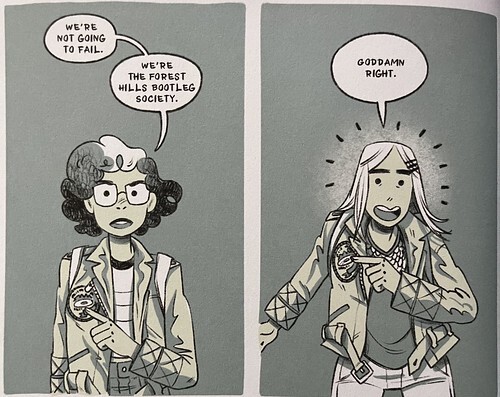
Forest Hills Bootleg Society
When a shady bootleg anime deal turns up with an erotic anime instead of the expected Hayao Miyazaki films, teenage friends Brooke, Kelly, Melissa and Maggie plan a path to financial success selling pirated anime dvds to their classmates at a private religious school. It is easy to root for this inclusive cast of characters—complete with a heart-wrenching queer love triangle—and their illicit acts feel like authentic rebellion and desperation when set against the backdrop of their small, conservative town. Their success brings them new attention from the popular kids, and the whole thing feels like a rickety bike picking up speed on a downhill, rattling itself apart towards impending disaster. The blunt and bleak realism here casts a heavy tone over the narrative, which manages to perform best under this emotional weight rather than be bogged down by it. Through smart writing that delivers humorous dialog and authentic interpersonal dynamics that strike out straight into your heart, as well as a dynamic plot, it somehow manages to avoid wilting in its own melodrama and be all the more beautiful from it, like moonflowers that only bloom at night.
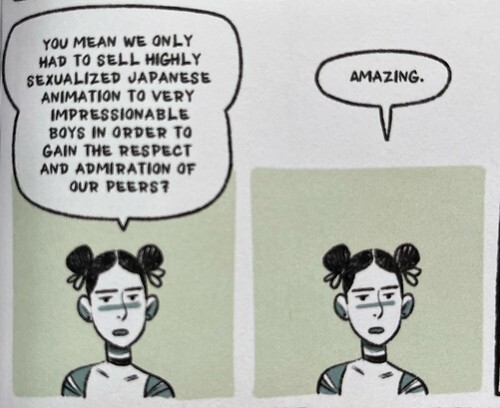
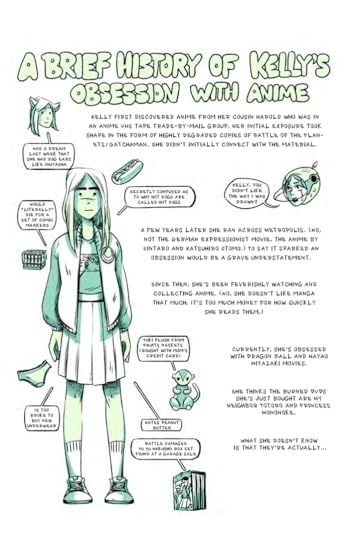
What this book does best is navigate the story within the larger context of Forest Hills itself, using a lot of interruptive text that succinctly peers into the biographical context of both major and background characters to present the local society as a mosaic of those in it. We get detailed histories of the major characters, told through lists of anecdotes that make for nuanced and lively emotional and psychological portraits of them. But through the collective weight of all the personal insights, we see a society riddled with trauma (both fresh and generational), racism, poverty, broken dreams and bad decisions in an economically depressed city that is crumbling as it tumbles towards the Great Recession. I found this to be a really unique and charming technique, all the more so invested in it juxtaposed with my recent readings of Annie Ernaux who has perfected the investigation of how the norms and judgements of a society interact with an individual’s psyche. This is a story of the four girls, but it is also the story of Forest Hills itself.
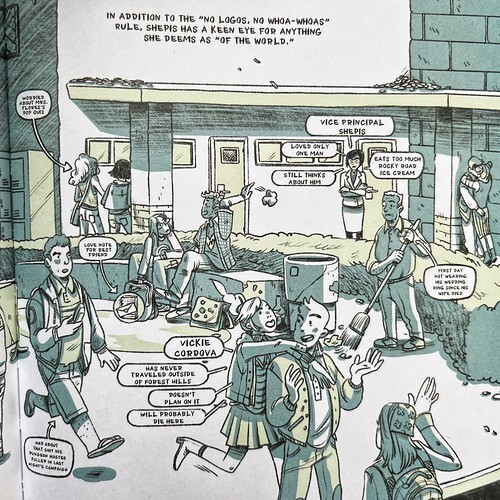
Example of how biographical interjections help shape a narrative style that is larger than the plot.
There is a deep irony that the most oppressive forces of customs and standards are enforced on the teens through religion by some of the most broken adults. We see the religion in this society used less as a space for personal growth and spirituality and more as a weapon to restrict, repress and control. But, like Leia warns in Star Wars: A New Hope, the more they tighten their grip the more people slip through their fingers, lashing out at the emotional bruising done to them. We see these characters, major and minor, as so bogged down by their fractured lives and the shortcomings of the adults that they seem doomed to fail. If this book feels hopeless, it is only because it is asking you what hope do people in these situations have? This is especially relevant as three of the four protagonists are queer women of color in a very white, conservative and patriarchal society. While their narrative works really well, and takes you through some teenage nostalgia complete with selfish and cruel popular kids and local hangouts, I have to say the side-plot with the bully, Hank, being a bully do to his repressed queerness and general lack of self-worth (that seems to be part of a larger struggle going on off the page), seems a bit tacked on and either too present or not present enough to be effective. Small one-two scene hits such as another boy dealing with anger problems and family issues work much better due to the dynamic simplicity of their presentation.
But what really won me over here was the ending. While I see why this will likely not work with others, to me it was perfect. I really like when people attempt this style. The whole book is leading to it, showing you how everyone has everything working against them, showing how dreams are shattered in this town, and it is done abruptly and with gut-wrenching finality. It’s 2005, this is how it was. Life is coasting along and suddenly someone’s dad is laid off, your parents found your bag of weed, your upper-classmen friend that you sort of idolize because he was always nice to you at practice is suddenly reported dead in Afghanistan, or a suicide rocks the town. It’s swift and sad and perfectly encapsulates the message of the book. I’m not going to lie, its really heavy and really weighs you down, but its also very real and the quick snapshots of the future paints a sad reality that we all have failures at times, not everyone is a success or gets a happily-ever-after, but most importantly that this is okay because that is how life works. You just have to make the best of it. Not every book needs to be escapist and while this one certainly is not feel-good and I do tend to dislike tidy endings, I think this one really worked and was a bold and beautiful choice.
Forest Hills Bootleg Society is a real win. I can’t wrap this up without just mentioning how much I REALLY love the art here. The simple color scheme, a dulled neon sort of greenish-yellow and a blue-grey combo, also helps build the tone. The character design is great too. This a really heavy book with a lot of triggering content, so readers beware, but if this is something you enjoy or are interested in, I would really recommend this. Thanks to hope for quite literally slamming this down on my desk and saying I would love this, you were correct (bring back recommended by shoutouts, please, goodreads?). This is a book where not everything works out, but also a book that reminds you everyone is hurting inside in some ways and that, perhaps, we should all give each other a bit more grace. A bleak but beautiful graphic novel.
4.5/5
Forest Hills Bootleg Society
When a shady bootleg anime deal turns up with an erotic anime instead of the expected Hayao Miyazaki films, teenage friends Brooke, Kelly, Melissa and Maggie plan a path to financial success selling pirated anime dvds to their classmates at a private religious school. It is easy to root for this inclusive cast of characters—complete with a heart-wrenching queer love triangle—and their illicit acts feel like authentic rebellion and desperation when set against the backdrop of their small, conservative town. Their success brings them new attention from the popular kids, and the whole thing feels like a rickety bike picking up speed on a downhill, rattling itself apart towards impending disaster. The blunt and bleak realism here casts a heavy tone over the narrative, which manages to perform best under this emotional weight rather than be bogged down by it. Through smart writing that delivers humorous dialog and authentic interpersonal dynamics that strike out straight into your heart, as well as a dynamic plot, it somehow manages to avoid wilting in its own melodrama and be all the more beautiful from it, like moonflowers that only bloom at night.
What this book does best is navigate the story within the larger context of Forest Hills itself, using a lot of interruptive text that succinctly peers into the biographical context of both major and background characters to present the local society as a mosaic of those in it. We get detailed histories of the major characters, told through lists of anecdotes that make for nuanced and lively emotional and psychological portraits of them. But through the collective weight of all the personal insights, we see a society riddled with trauma (both fresh and generational), racism, poverty, broken dreams and bad decisions in an economically depressed city that is crumbling as it tumbles towards the Great Recession. I found this to be a really unique and charming technique, all the more so invested in it juxtaposed with my recent readings of Annie Ernaux who has perfected the investigation of how the norms and judgements of a society interact with an individual’s psyche. This is a story of the four girls, but it is also the story of Forest Hills itself.
Example of how biographical interjections help shape a narrative style that is larger than the plot.
There is a deep irony that the most oppressive forces of customs and standards are enforced on the teens through religion by some of the most broken adults. We see the religion in this society used less as a space for personal growth and spirituality and more as a weapon to restrict, repress and control. But, like Leia warns in Star Wars: A New Hope, the more they tighten their grip the more people slip through their fingers, lashing out at the emotional bruising done to them. We see these characters, major and minor, as so bogged down by their fractured lives and the shortcomings of the adults that they seem doomed to fail. If this book feels hopeless, it is only because it is asking you what hope do people in these situations have? This is especially relevant as three of the four protagonists are queer women of color in a very white, conservative and patriarchal society. While their narrative works really well, and takes you through some teenage nostalgia complete with selfish and cruel popular kids and local hangouts, I have to say the side-plot with the bully, Hank, being a bully do to his repressed queerness and general lack of self-worth (that seems to be part of a larger struggle going on off the page), seems a bit tacked on and either too present or not present enough to be effective. Small one-two scene hits such as another boy dealing with anger problems and family issues work much better due to the dynamic simplicity of their presentation.
But what really won me over here was the ending. While I see why this will likely not work with others, to me it was perfect. I really like when people attempt this style. The whole book is leading to it, showing you how everyone has everything working against them, showing how dreams are shattered in this town, and it is done abruptly and with gut-wrenching finality. It’s 2005, this is how it was. Life is coasting along and suddenly someone’s dad is laid off, your parents found your bag of weed, your upper-classmen friend that you sort of idolize because he was always nice to you at practice is suddenly reported dead in Afghanistan, or a suicide rocks the town. It’s swift and sad and perfectly encapsulates the message of the book. I’m not going to lie, its really heavy and really weighs you down, but its also very real and the quick snapshots of the future paints a sad reality that we all have failures at times, not everyone is a success or gets a happily-ever-after, but most importantly that this is okay because that is how life works. You just have to make the best of it. Not every book needs to be escapist and while this one certainly is not feel-good and I do tend to dislike tidy endings, I think this one really worked and was a bold and beautiful choice.
Forest Hills Bootleg Society is a real win. I can’t wrap this up without just mentioning how much I REALLY love the art here. The simple color scheme, a dulled neon sort of greenish-yellow and a blue-grey combo, also helps build the tone. The character design is great too. This a really heavy book with a lot of triggering content, so readers beware, but if this is something you enjoy or are interested in, I would really recommend this. Thanks to hope for quite literally slamming this down on my desk and saying I would love this, you were correct (bring back recommended by shoutouts, please, goodreads?). This is a book where not everything works out, but also a book that reminds you everyone is hurting inside in some ways and that, perhaps, we should all give each other a bit more grace. A bleak but beautiful graphic novel.
4.5/5

March 30, 2022
Oh, Forest Hills Bootleg Society.. you broke my heart.. you were doing so well, and then you fumbled it at the end. I'm okay with a downbeat ending, I really am, sometimes a little realism in fiction can make the whole thing sparkle. But here the ending feels like it comes out of nowhere, it leaves no real opening for hope and/or change, and it makes me question what the whole point of this book was.
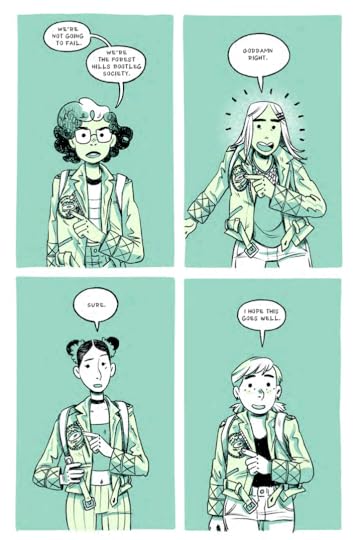
Before the end, it's a beautifully told slice of life comic, about four school-going girl friends, three of them in the same school. These are Christian schools, and the book plays around with that - questions are asked about religion, but always in a respectful way (at least that's what I think, and I'm pretty secular, so who knows).
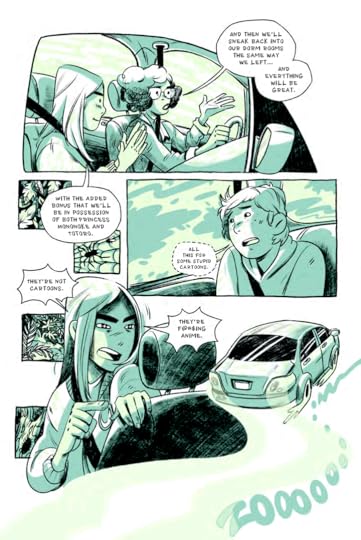
Two of them are secretly in a kind-of relationship. The comic does this lovely thing, where there'll be arrows pointing at characters, informing us about their histories, their peculiarities, their secrets.. it's basically what is easy to do in prose, transferred to comic. There are moments when the whole thing is paused for a page, and we get some more info about how a character has been dealing with their family, or with their religious background, and they're written with real heart and humour.
The art is as great as the writing (probably better, it doesn't fumble anywhere), there's a real tenderness to the characterisations.
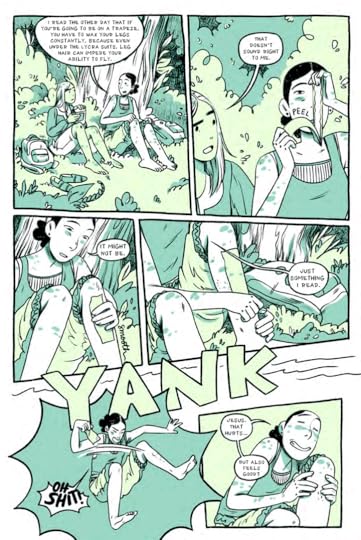
So you get really involved with these characters' lives, and then it all kind of goes out like a wet fart. And that's such a shame. The only thing that can save us now, is a sequel.
(Thanks to Atheneum Books for Young Readers for providing me with an ARC through Edelweiss)

December 23, 2022
A tedious, dull and depressing story about a high school friendship group starting to collapse under romantic entanglements and the quick-money scheme they've hatched to sell pirated, racy anime videos around their Christian boarding school.
Characters are introduced in little info dumps that seem cute at first but quickly become annoying once every single side character gets the same treatment. Why should I care that a kid we see once in the cafeteria is right-handed? Why would I even want to know his name?
The main characters and art are engaging, I only wish the creators had come up with something equally engaging for them to do and hadn't cluttered
and slowed the story with so much unnecessary garbage.
Characters are introduced in little info dumps that seem cute at first but quickly become annoying once every single side character gets the same treatment. Why should I care that a kid we see once in the cafeteria is right-handed? Why would I even want to know his name?
The main characters and art are engaging, I only wish the creators had come up with something equally engaging for them to do and hadn't cluttered
and slowed the story with so much unnecessary garbage.
October 21, 2021
I actually really loved this graphic novel. I was pleasantly surprised at how rich the story was. We meet our protagonists on the cusp of trying to be something else, struggling to fit in and keep together, and we follow them through the bootleg scheme that eventually leads to the crumbling of their friendships. Along the way, we get these really cool moments where you see snippets about other characters on the page - not even characters who speak! - that made the story feel so layered and rich despite mainly centering around the four girls. It doesn't end with a ton of hope, which I appreciated - it's a very reflective story about the complications of being a teenager and growing up.
prev. review: I read "set in 2005" and a part of me died. THAT WASN'T THAT LONG AGO.
prev. review: I read "set in 2005" and a part of me died. THAT WASN'T THAT LONG AGO.
March 2, 2024
Hate.
The amount of rage I felt reading this is unreachable.
WHY DOES THIS SAY IT'S A HISTORICAL FICTION. 2005 WAS NOT EVEN 20 YEARS AGO.
The amount of rage I felt reading this is unreachable.
WHY DOES THIS SAY IT'S A HISTORICAL FICTION. 2005 WAS NOT EVEN 20 YEARS AGO.

December 9, 2023
This YA graphic novel had a lot of potential that it didn't live up to, sadly. There was too much explaining what was going on rather than showing it, the ending was rushed and weirdly pessimistic, and I felt like I never really got a handle on the characters. The events that should have had emotional weight and impact just didn't. I liked the art though, and the concept of these teen girls accidentally stumbling into selling sexy anime DVDs.

March 7, 2022
(Full disclosure: I received a free e-ARC for review through Edelweiss.)
How it started: four besties embarking on a(n almost) carefree road trip to a gas station creepily located in the middle of nowhere.
The goal: Buy some bootleg copies of Princess Mononoke and Totoro.
The snag: An errant copy of Super Love XL, complete with a giant mecha shooting lasers out of her giant boobs.
How it ended: a side hustle selling home-burned copies of risque anime to their hormone-addled peers at Forest Hills Christian Academy (and public school).
Best friends Kelly, Brooke, Melissa, and Maggie just wanted to earn enough money to buy matching new jackets, and maybe eat out at Shiver Me Burgers on occasion. Instead their newfound cash flow made them the target of every bully at school; ate at the consciences of the more devout members of the Forest Hills Bootleg Society; tore apart longtime friendships; and, yes, landed them in an ocean of hot water with the 'rents and school administration.
It was a wild trip, though, wasn't it?
There's so much to love about FOREST HILLS BOOTLEG SOCIETY: the diverse cast of characters; all the nerdy goodness; all the queer goodness (it almost feels as if everyone at Forest Hills Christian Academy is gay, but in truth I think I'm just not used to seeing more than one or two queer characters in a book); the focus on female friendships and insecurities; and OF COURSE the GORGEOUS artwork.
The various asides and character summaries felt kind of cool and edgy at first, but these devices are used so often that it got a bit tedious after a while (just a bit - I mean, do we really need to know who's right- vs. left-handed?).
That said, I was fully ready to give this bad girl four stars ... until I reached the end. Like, wtf was that? No spoilers, but suffice it to say that I can't remember the last time I felt so cheated by a lackluster ending. (TROUBLE GIRLS? THE ANIMALS IN THAT COUNTRY? idk.) Grim, uninspired, pointless. It almost made me wish I'd never picked this book up. (Almost. Again, did I mention the artwork?) Do yourself a favor and just stop reading when the adults barge into Brooke's room, mkay.
How it started: four besties embarking on a(n almost) carefree road trip to a gas station creepily located in the middle of nowhere.
The goal: Buy some bootleg copies of Princess Mononoke and Totoro.
The snag: An errant copy of Super Love XL, complete with a giant mecha shooting lasers out of her giant boobs.
How it ended: a side hustle selling home-burned copies of risque anime to their hormone-addled peers at Forest Hills Christian Academy (and public school).
Best friends Kelly, Brooke, Melissa, and Maggie just wanted to earn enough money to buy matching new jackets, and maybe eat out at Shiver Me Burgers on occasion. Instead their newfound cash flow made them the target of every bully at school; ate at the consciences of the more devout members of the Forest Hills Bootleg Society; tore apart longtime friendships; and, yes, landed them in an ocean of hot water with the 'rents and school administration.
It was a wild trip, though, wasn't it?
There's so much to love about FOREST HILLS BOOTLEG SOCIETY: the diverse cast of characters; all the nerdy goodness; all the queer goodness (it almost feels as if everyone at Forest Hills Christian Academy is gay, but in truth I think I'm just not used to seeing more than one or two queer characters in a book); the focus on female friendships and insecurities; and OF COURSE the GORGEOUS artwork.
The various asides and character summaries felt kind of cool and edgy at first, but these devices are used so often that it got a bit tedious after a while (just a bit - I mean, do we really need to know who's right- vs. left-handed?).
That said, I was fully ready to give this bad girl four stars ... until I reached the end. Like, wtf was that? No spoilers, but suffice it to say that I can't remember the last time I felt so cheated by a lackluster ending. (TROUBLE GIRLS? THE ANIMALS IN THAT COUNTRY? idk.) Grim, uninspired, pointless. It almost made me wish I'd never picked this book up. (Almost. Again, did I mention the artwork?) Do yourself a favor and just stop reading when the adults barge into Brooke's room, mkay.

October 5, 2022
Liked the premise of the story but the delivery was lacking. Way too many tiny speech bubbles sharing an info-dump's worth of random factoids on every single character, whether they're important to the story or just standing in the background. It was overwhelming and took away from the main cast, who I felt like we barely got to know.
The ending reminded me of movies where it just peters out...and the main character meanders off into the distance and the camera pans out without a resolution. It was frustrating and without even enough time skip epilogue to get additional character development or a hint of how we were supposed to interpret what had happened to the cast.
On the other hand, I was originally quite interested in the characters and wanted to see more of their life at their boarding school and their small town! I would've been happy to wander about on more of their outings, bonding over bowling and arcades or just seeing the changes they made over the year. The drawing style was cute and minimalist and I wish I could've enjoyed this more!
The drama of the DVD burning and the scandalous anime was...not interesting despite having lived through the similar time.
The ending reminded me of movies where it just peters out...and the main character meanders off into the distance and the camera pans out without a resolution. It was frustrating and without even enough time skip epilogue to get additional character development or a hint of how we were supposed to interpret what had happened to the cast.
On the other hand, I was originally quite interested in the characters and wanted to see more of their life at their boarding school and their small town! I would've been happy to wander about on more of their outings, bonding over bowling and arcades or just seeing the changes they made over the year. The drawing style was cute and minimalist and I wish I could've enjoyed this more!
The drama of the DVD burning and the scandalous anime was...not interesting despite having lived through the similar time.
This entire review has been hidden because of spoilers.

October 22, 2022
I wanted more from this one. The art was good but the colouring was monotone. I think it would have been more appealing with some colour. The ending left me sad and unsatisfied. I liked the girls and their relationships but it didn't really go anywhere. It made me laugh a few times but not enough . This book wasn't bad by any means it just wasn't as engaging as it could have been.

June 30, 2023
Cluttered. One needn't peruse more than a dozen pages to find the word that best articulates the indelicate disarray of FOREST HILLS BOOTLEG SOCIETY. Chatty narration. Clumsy lettering. Overindulgent worldbuilding. Coming-of-age stories are often messy in their own right, but this is just a messy story. The apparent eagerness to cram a low-key adventure full of "interesting" information never marries its righteous equivalent to what actually qualifies as necessary.
This graphic novel's weaknesses rest in the creative team's many presumptions on the part of the reader. The difficult and sad truth of FOREST HILLS BOOTLEG SOCIETY is that it's a lovingly drawn book with clever and comparatively relatable characters. However, the creative team attempts to wean readers onto the sleepy suburban proclivities of Forest Hills, California, U.S. through myriad, decadent character charts, irrelevant city maps, unavailing side conversations, and other narrative quirks — none of which carry information that is especially relevant to the book's actual story. The graphic novel has, in effect, a lot of clutter.
Readers need to know Brooke and Kelly are awkward lesbian teens with no real clue how to invest in a serious relationship. That's important stuff. Brooke is achingly codependent and constantly hunting for belonging. Kelly is an impatient otaku who, like most teens, accidentally wields her worldly ignorance in an effort to grow up too fast. However, readers will be hard-pressed to pry out these details in time to make sense of them. Why? Because the book actively distracts far more than it informs. Do readers care that a random side character is reading the diary belonging to an unknown tertiary character's sister? Do readers need to know the city's largest office building was constructed in 1987? Do readers need to waste time reading a full page detailing "a brief history of a textiles manufacturing plant" to supplement a passing reference to an idiot celebrity's overpriced jacket?
Readers need to know that "lawful good" Maggie is the prototypical, god-fearing good girl destined for corruption the instant she's fed praise. Readers need to know that Melissa, despite being the friendly foursome's smartest character, is completely lacking in direction and motivation. That's important stuff. Maggie's working-class household contrasts her vehement religious piety, which itself contrasts her friends' curse-laden joke-telling despite their attending a private school across town. Melissa, meanwhile, is at war with puberty and has no one to talk to about it. But, again, one must peel away the narrative nonsense to discern what's worthy of attention. Do readers care about the daily hygiene habits of a character who appears only twice in the whole book? Do readers need to know that almost all of the named adult characters are ensconced in dishonest or illegal partnerships? Do readers need to know multiple, unenlightening details about a character with a lisp who comprises less than one-eighth of a page?
FOREST HILLS BOOTLEG SOCIETY is difficult to read. Not because its characters are irredeemably dumb (alas, all teenagers are), but because there's so much noise that one finds the reading experience that much harder to endure to enjoy the good stuff.
The book's four protagonists form a small ring of bootleg sales between the city's two high schools. The girls prioritize kitschy, sultry anime romps clearly designed for wayward adults, and make some good scratch in the process. But Brook's hunger for status (and the attention of anyone of status), Kelly's ascension as a loudmouthed Japanophile, Maggie's impoverished Christianity, and Melissa's roving insecurity frequently clog the gears of the girls' comical money-making enterprise. Sure, it'd be nice if they had enough money to get matching jackets and all, but what about that cool-people party invite? What about hanging out at the local burger joint? What about building out their personal hobbies?
These trials and tribulations crisscross and overlap with assorted coming-of-age dilemmas. For example, one character questions her sexuality when she realizes she might gain more camaraderie from a girl with similar problems than from elsewhere. Further, another girl's impetuosity gives her group of friends its trademark, kick-butt ambiance, yet wreaks havoc on her personal relationships when push comes to shove. If FOREST HILLS BOOTLEG SOCIETY were a more calculated, prose novel, instead of a frenzied graphic novel, then these and other characters would have flourished more earnestly.
Visually, the book pulls together smart and charismatic character designs that gift readers, occasionally, a qualitative nuance of the relational dynamics buried beneath everything else. Introverted Maggie is short with stubby legs, covers herself with layers, and generally looks confused most of the time. Brooke, whose worst habit is trying too hard, is overly expressive, excitable, and has trouble sitting still. Hilariously, Kelly, the anime fan, is the graphic novel's only character without a dimensional nose.
FOREST HILLS BOOTLEG SOCIETY is more consumable graphically than it is on purely narrative terms, but by degrees. The character art is great and the book's varying page compositions is solid, but the title's occasional merging of the script's chaos with visual chaos is inevitable. Sometimes, one finds these graphic interludes build out the scene quite well, as with filmstrips or a collage of inset panels that serve as makeshift montages, or when the reader encounters six consecutive panels without dialogue to emphasize social alienation. But most of the time, instead of integrating readers into the scene, the opposite happens, as with the various maps of the town, almost all locations of which are irrelevant; or with the book's multiple folio inserts, containing a full-page of character, family, or city background information of little or no value; or through one-on-one panel conversations overloaded with dialogue; or with dozens of character-intro word balloons packed with worthless information.
The clutter, again, makes this graphic novel a difficult book to read. One cannot be blamed for burrowing through the first dozen pages, sighing in exhaustion, and rationalizing the book just isn't worth the energy. The arcs these characters traverse and the problems they face tiptoe on the edge of plausibility given how thoroughly and how often the details that matter are drowned out by the details that don't. For example, does it matter that the popular girl is constantly skimming money from her friends? Maybe. Does it matter that domestic infidelity and domestic abuse are rampant in this little nook of American suburbia? Possibly. But readers will never know, because they can't get away from the stringent, clumsy, and deliberate indulgences of the creative team's hard-worldbuilding notes to finally reach the more credible, valuable experiences necessary for character growth.
Another example rests in the inconsistent treatment of curse words. Most curse words in FOREST HILLS BOOTLEG SOCIETY are swapped with grawlixes, the typographical symbols and markings that replace individual letters. Grawlixes are not uncommon, by any measure, but for some strange reason, FOREST HILLS BOOTLEG SOCIETY goes overboard. Most of the characters in this book use profanity, and most other characters don't care. Yet, for some reason, most curse words are censored. Even further complicating the matter, the censorship is inconsistent. Why are exceedingly common words like bitch and dyke censored, while tits isn't? Sometimes, shit is scrubbed in all its forms, but sometimes, it isn't. Elsewhere, harmless or worn-out turns of phrases like shitface, slag, asshole, and pussy are censored. In some cases, the disembodied narrator's speech is censored, which defies logic. In other cases, the grawlixes work a little too well, rendering the original (implied) profanity completely indecipherable. It's a mess.
One might assemble an argument to use grawlixes to muffle some etymologically benign but culturally (regionally) agitated words (e.g., cunt), but the graphic novel's awkward and mercurial application of substitute letters, in such raucous abundance, pulls one out of the story incredibly quick. Whether a consequence of author preference, editor preference, publisher mandate, or as a victim of corporate zealotry on the part of book distributors, the end result is a subpar reading experience.
FOREST HILLS BOOTLEG SOCIETY is a difficult read. Inconvenient and querulous highlights frequently distract readers from absorbing an otherwise curious tale of "kids being kids," teenagers who may or may not be coming into their own. This graphic novel cannot get out if its own way. Readers learn so many details about the characters and the city at the heart of this story, but almost all of those details go nowhere or have no fundamental bearing on the arc of the narrative itself.
And for what details do exist, they persist in fits and starts, leaving inexplicable plot holes to linger. For example, the story takes place in 2005, yet none of the characters have access to the internet or cable television. Further, anime's popularity in the U.S. at this time was significantly more saturated than the graphic novel implies. Kids driving to an out-of-town gas station to purchase random DVDs from a drugged-out loner makes for a good laugh, but is impractical when, in 2005, anime can be easily purchased in music stores, malls, and specialty film shops all across the country; regularly appears on standard and cable TV; and seasonally invades local popular culture (e.g., Why don't the characters know they live extraordinarily close to the largest anime convention on the continent?).
This graphic novel's weaknesses rest in the creative team's many presumptions on the part of the reader. The difficult and sad truth of FOREST HILLS BOOTLEG SOCIETY is that it's a lovingly drawn book with clever and comparatively relatable characters. However, the creative team attempts to wean readers onto the sleepy suburban proclivities of Forest Hills, California, U.S. through myriad, decadent character charts, irrelevant city maps, unavailing side conversations, and other narrative quirks — none of which carry information that is especially relevant to the book's actual story. The graphic novel has, in effect, a lot of clutter.
Readers need to know Brooke and Kelly are awkward lesbian teens with no real clue how to invest in a serious relationship. That's important stuff. Brooke is achingly codependent and constantly hunting for belonging. Kelly is an impatient otaku who, like most teens, accidentally wields her worldly ignorance in an effort to grow up too fast. However, readers will be hard-pressed to pry out these details in time to make sense of them. Why? Because the book actively distracts far more than it informs. Do readers care that a random side character is reading the diary belonging to an unknown tertiary character's sister? Do readers need to know the city's largest office building was constructed in 1987? Do readers need to waste time reading a full page detailing "a brief history of a textiles manufacturing plant" to supplement a passing reference to an idiot celebrity's overpriced jacket?
Readers need to know that "lawful good" Maggie is the prototypical, god-fearing good girl destined for corruption the instant she's fed praise. Readers need to know that Melissa, despite being the friendly foursome's smartest character, is completely lacking in direction and motivation. That's important stuff. Maggie's working-class household contrasts her vehement religious piety, which itself contrasts her friends' curse-laden joke-telling despite their attending a private school across town. Melissa, meanwhile, is at war with puberty and has no one to talk to about it. But, again, one must peel away the narrative nonsense to discern what's worthy of attention. Do readers care about the daily hygiene habits of a character who appears only twice in the whole book? Do readers need to know that almost all of the named adult characters are ensconced in dishonest or illegal partnerships? Do readers need to know multiple, unenlightening details about a character with a lisp who comprises less than one-eighth of a page?
FOREST HILLS BOOTLEG SOCIETY is difficult to read. Not because its characters are irredeemably dumb (alas, all teenagers are), but because there's so much noise that one finds the reading experience that much harder to endure to enjoy the good stuff.
The book's four protagonists form a small ring of bootleg sales between the city's two high schools. The girls prioritize kitschy, sultry anime romps clearly designed for wayward adults, and make some good scratch in the process. But Brook's hunger for status (and the attention of anyone of status), Kelly's ascension as a loudmouthed Japanophile, Maggie's impoverished Christianity, and Melissa's roving insecurity frequently clog the gears of the girls' comical money-making enterprise. Sure, it'd be nice if they had enough money to get matching jackets and all, but what about that cool-people party invite? What about hanging out at the local burger joint? What about building out their personal hobbies?
These trials and tribulations crisscross and overlap with assorted coming-of-age dilemmas. For example, one character questions her sexuality when she realizes she might gain more camaraderie from a girl with similar problems than from elsewhere. Further, another girl's impetuosity gives her group of friends its trademark, kick-butt ambiance, yet wreaks havoc on her personal relationships when push comes to shove. If FOREST HILLS BOOTLEG SOCIETY were a more calculated, prose novel, instead of a frenzied graphic novel, then these and other characters would have flourished more earnestly.
Visually, the book pulls together smart and charismatic character designs that gift readers, occasionally, a qualitative nuance of the relational dynamics buried beneath everything else. Introverted Maggie is short with stubby legs, covers herself with layers, and generally looks confused most of the time. Brooke, whose worst habit is trying too hard, is overly expressive, excitable, and has trouble sitting still. Hilariously, Kelly, the anime fan, is the graphic novel's only character without a dimensional nose.
FOREST HILLS BOOTLEG SOCIETY is more consumable graphically than it is on purely narrative terms, but by degrees. The character art is great and the book's varying page compositions is solid, but the title's occasional merging of the script's chaos with visual chaos is inevitable. Sometimes, one finds these graphic interludes build out the scene quite well, as with filmstrips or a collage of inset panels that serve as makeshift montages, or when the reader encounters six consecutive panels without dialogue to emphasize social alienation. But most of the time, instead of integrating readers into the scene, the opposite happens, as with the various maps of the town, almost all locations of which are irrelevant; or with the book's multiple folio inserts, containing a full-page of character, family, or city background information of little or no value; or through one-on-one panel conversations overloaded with dialogue; or with dozens of character-intro word balloons packed with worthless information.
The clutter, again, makes this graphic novel a difficult book to read. One cannot be blamed for burrowing through the first dozen pages, sighing in exhaustion, and rationalizing the book just isn't worth the energy. The arcs these characters traverse and the problems they face tiptoe on the edge of plausibility given how thoroughly and how often the details that matter are drowned out by the details that don't. For example, does it matter that the popular girl is constantly skimming money from her friends? Maybe. Does it matter that domestic infidelity and domestic abuse are rampant in this little nook of American suburbia? Possibly. But readers will never know, because they can't get away from the stringent, clumsy, and deliberate indulgences of the creative team's hard-worldbuilding notes to finally reach the more credible, valuable experiences necessary for character growth.
Another example rests in the inconsistent treatment of curse words. Most curse words in FOREST HILLS BOOTLEG SOCIETY are swapped with grawlixes, the typographical symbols and markings that replace individual letters. Grawlixes are not uncommon, by any measure, but for some strange reason, FOREST HILLS BOOTLEG SOCIETY goes overboard. Most of the characters in this book use profanity, and most other characters don't care. Yet, for some reason, most curse words are censored. Even further complicating the matter, the censorship is inconsistent. Why are exceedingly common words like bitch and dyke censored, while tits isn't? Sometimes, shit is scrubbed in all its forms, but sometimes, it isn't. Elsewhere, harmless or worn-out turns of phrases like shitface, slag, asshole, and pussy are censored. In some cases, the disembodied narrator's speech is censored, which defies logic. In other cases, the grawlixes work a little too well, rendering the original (implied) profanity completely indecipherable. It's a mess.
One might assemble an argument to use grawlixes to muffle some etymologically benign but culturally (regionally) agitated words (e.g., cunt), but the graphic novel's awkward and mercurial application of substitute letters, in such raucous abundance, pulls one out of the story incredibly quick. Whether a consequence of author preference, editor preference, publisher mandate, or as a victim of corporate zealotry on the part of book distributors, the end result is a subpar reading experience.
FOREST HILLS BOOTLEG SOCIETY is a difficult read. Inconvenient and querulous highlights frequently distract readers from absorbing an otherwise curious tale of "kids being kids," teenagers who may or may not be coming into their own. This graphic novel cannot get out if its own way. Readers learn so many details about the characters and the city at the heart of this story, but almost all of those details go nowhere or have no fundamental bearing on the arc of the narrative itself.
And for what details do exist, they persist in fits and starts, leaving inexplicable plot holes to linger. For example, the story takes place in 2005, yet none of the characters have access to the internet or cable television. Further, anime's popularity in the U.S. at this time was significantly more saturated than the graphic novel implies. Kids driving to an out-of-town gas station to purchase random DVDs from a drugged-out loner makes for a good laugh, but is impractical when, in 2005, anime can be easily purchased in music stores, malls, and specialty film shops all across the country; regularly appears on standard and cable TV; and seasonally invades local popular culture (e.g., Why don't the characters know they live extraordinarily close to the largest anime convention on the continent?).

January 24, 2023
Dave Baker and Nicole Goux really nail the high highs and low lows of being a teenager. Of course, in the case of the Forest Hills Bootleg Society, being a teenager comes with the added baggage of being queer in a Christian boarding school. So, the "lows" are more like "despair" and the highs are more like "feeling okay." Suffice it say, this book doesn't provide too many warm fuzzies.
And I think that's why I loved it? It's a detail-oriented look at a weird time in the lives of four young women. One (Kelly) is into anime and recently discovered a source for bootleg anime DVDs (this is circa 2004). The others (Brooke, Melissa, Maggie) aren't so into anime, but are intrigued by the idea of selling copies of the unexpectedly pornographic bootlegs to horny Christian boys. They can, y'know, buy some sweet jackets with the proceeds.
Mo' money, mo' problems, as they say. The business both enlivens the girls' friendship and divides them. Forest Hills Bootleg Society focuses less on action and dialogue and more on emotion. Nicole Goux's artwork stuns in this aspect. You fully experience the wild ups and downs of teenage life.
Also key to the tale: the odd milieu of small town America that's enriched by the many, many asides highlighting the inner lives of secondary (and tertiary) characters. Some might find these asides silly and unnecessary; I found them essential. Without such authorial oddities, Forest Hills Bootleg Society would be just another YA graphic novel. Instead, it's a proudly weird book with essentially a non-ending. Give it a try, it just might touch a nerve.
And I think that's why I loved it? It's a detail-oriented look at a weird time in the lives of four young women. One (Kelly) is into anime and recently discovered a source for bootleg anime DVDs (this is circa 2004). The others (Brooke, Melissa, Maggie) aren't so into anime, but are intrigued by the idea of selling copies of the unexpectedly pornographic bootlegs to horny Christian boys. They can, y'know, buy some sweet jackets with the proceeds.
Mo' money, mo' problems, as they say. The business both enlivens the girls' friendship and divides them. Forest Hills Bootleg Society focuses less on action and dialogue and more on emotion. Nicole Goux's artwork stuns in this aspect. You fully experience the wild ups and downs of teenage life.
Also key to the tale: the odd milieu of small town America that's enriched by the many, many asides highlighting the inner lives of secondary (and tertiary) characters. Some might find these asides silly and unnecessary; I found them essential. Without such authorial oddities, Forest Hills Bootleg Society would be just another YA graphic novel. Instead, it's a proudly weird book with essentially a non-ending. Give it a try, it just might touch a nerve.

Did Not Finish
March 12, 2023DNF'd on: March 11th, 2023
DNF'd at: Page 122 (54%)
Unfortunately, Forest Hills Bootleg Society was another miss. However, I have really been struggling to connect with coming-of-age graphic novels for the last few weeks so this may be more a reflection of my headspace at the moment than the quality of this book in particular. This graphic novel follows a group of anime-loving high schoolers in a Christian boarding school. The girls after accidentally acquiring hentai begin selling copies of it to their peers to enormous success.
One of my biggest problems with this book was its style. I felt constantly overwhelmed by superfluous text as I was reading this story. Author Dave Baker often filled the page with quirky character details in text boxes and splash pages. While more justified for our four lead characters this tendency to overexplain with text was used to an aggravating degree. This book gives us the full names and personality details of minor side characters with little to no dialogue or plot relevance to the story. While I can't say this made Forest Hills a complete slog it was often tedious.
Nicole Goux's illustration style was also a little too busy for my taste. Her pages were filled with details I could imagine another reader loving to take in but, like the text, it just overwhelmed me. Despite that her illustration and colouring overall were solid. Her modern style is reminiscent of webcomics and felt appropriate for this coming-of-age narrative.
Thematically I think Forest Hills Bootleg Society could connect with people. Baker and Goux explore being closeted in a small town, religious guilt, first love, and the messiness of female friendships. However, I, unfortunately, didn't quite connect to the story like I hoped I would. Honestly. outside of the art style, I can't exactly pin down what I didn't like about this book. All I can say is halfway through it I paused to ask myself if I truly cared to find out how the story would unfold and the honest answer was no.
DNF'd at: Page 122 (54%)
Unfortunately, Forest Hills Bootleg Society was another miss. However, I have really been struggling to connect with coming-of-age graphic novels for the last few weeks so this may be more a reflection of my headspace at the moment than the quality of this book in particular. This graphic novel follows a group of anime-loving high schoolers in a Christian boarding school. The girls after accidentally acquiring hentai begin selling copies of it to their peers to enormous success.
One of my biggest problems with this book was its style. I felt constantly overwhelmed by superfluous text as I was reading this story. Author Dave Baker often filled the page with quirky character details in text boxes and splash pages. While more justified for our four lead characters this tendency to overexplain with text was used to an aggravating degree. This book gives us the full names and personality details of minor side characters with little to no dialogue or plot relevance to the story. While I can't say this made Forest Hills a complete slog it was often tedious.
Nicole Goux's illustration style was also a little too busy for my taste. Her pages were filled with details I could imagine another reader loving to take in but, like the text, it just overwhelmed me. Despite that her illustration and colouring overall were solid. Her modern style is reminiscent of webcomics and felt appropriate for this coming-of-age narrative.
Thematically I think Forest Hills Bootleg Society could connect with people. Baker and Goux explore being closeted in a small town, religious guilt, first love, and the messiness of female friendships. However, I, unfortunately, didn't quite connect to the story like I hoped I would. Honestly. outside of the art style, I can't exactly pin down what I didn't like about this book. All I can say is halfway through it I paused to ask myself if I truly cared to find out how the story would unfold and the honest answer was no.
April 2, 2022
ARC
3.5 rounded down
Forest Hills Bootleg Society is a charming slice of life graphic novel following 4 friends running a bootleg-hentai racket at their very conservative Christian schools. Entertaining, charming, and really well illustrated with masterful use of limited color.
The pacing of this graphic novel was really well done, and i think that this is the department in which it receives 5/5 stars from me. The story very gently introduces characters who are forced to stomach micro aggressions daily in a way that is nuanced! Something I have found is not easy to do, that this author-artist pair does well. The relationships are also interesting and realistic. I was in similar circles like these in highschool (minus the conservative christian schooling) and i feel like i knew at least one real person reflected in each character, main cast or otherwise.
I wish the ending wasnt rushed, considering how well-paced i felt the rest of it was. It felt a little anti-climactic, and didnt resolve a lot of things for me to truly enjoy or appreciate it.
A small spoiler follows involving a negative point:
The biggest negative for me however, is something that has just become tired in regards to bullying and queerness. “That boy bullies the gay kid because hes secretly gay and is projecting his insecurities on his victim.“
While this does happen in real life, its something thats been beaten to death, and I am repelled by this trope. I think, if this subplot had been better fleshed out, it would not have left such a bad taste.
It also is worth mentioning that sometimes, a homophobe is just a homophobe.
Making fun of, mocking, or challenging the sexuality of a homophobe for being secretly gay makes the homophobe act even more violently homophobic faster than it would convince them to form a critical thought about their actions. Please stop perpetuating this rhetoric, as it is inherently dangerous for queer youth especially. This aside, it was a pleasant read.
3.5 rounded down
Forest Hills Bootleg Society is a charming slice of life graphic novel following 4 friends running a bootleg-hentai racket at their very conservative Christian schools. Entertaining, charming, and really well illustrated with masterful use of limited color.
The pacing of this graphic novel was really well done, and i think that this is the department in which it receives 5/5 stars from me. The story very gently introduces characters who are forced to stomach micro aggressions daily in a way that is nuanced! Something I have found is not easy to do, that this author-artist pair does well. The relationships are also interesting and realistic. I was in similar circles like these in highschool (minus the conservative christian schooling) and i feel like i knew at least one real person reflected in each character, main cast or otherwise.
I wish the ending wasnt rushed, considering how well-paced i felt the rest of it was. It felt a little anti-climactic, and didnt resolve a lot of things for me to truly enjoy or appreciate it.
A small spoiler follows involving a negative point:
The biggest negative for me however, is something that has just become tired in regards to bullying and queerness. “That boy bullies the gay kid because hes secretly gay and is projecting his insecurities on his victim.“
While this does happen in real life, its something thats been beaten to death, and I am repelled by this trope. I think, if this subplot had been better fleshed out, it would not have left such a bad taste.
It also is worth mentioning that sometimes, a homophobe is just a homophobe.
Making fun of, mocking, or challenging the sexuality of a homophobe for being secretly gay makes the homophobe act even more violently homophobic faster than it would convince them to form a critical thought about their actions. Please stop perpetuating this rhetoric, as it is inherently dangerous for queer youth especially. This aside, it was a pleasant read.

December 29, 2022
I like the art style, and the little side bubbles of information about each character give me Scott Pilgrim vibes. I also really liked all of the little anime references throughout the story (I've added some to my watch list), and the way Kelly kept having to correct everyone who called them cartoons. I really enjoyed this book up until the ending, which was ok, just a bit disappointing. I didn't realize until I got to the author's note at the end that these two also created Everything is Tulip, so that seems to be their thing. I feel like they always leave me with a kind of pessimistic view of humanity.

September 28, 2023
Mid-aughts nostalgia in a really cool form!
Four friends come across anime with adult content and sell DVDs of it to other students.
The thing I really liked about this was the style. Every once in a while, the creators introduce a character by giving them a big chunk of a page and sidebar-ing facts about them. I love art like this.
There are periodic incidental captions that relay things about the context that may or may not have connotations for the plot at hand. Mostly not.
Also, lovely queer content.
Limited color palette with tones of blue, green, black and white.
Super fun!
Four friends come across anime with adult content and sell DVDs of it to other students.
The thing I really liked about this was the style. Every once in a while, the creators introduce a character by giving them a big chunk of a page and sidebar-ing facts about them. I love art like this.
There are periodic incidental captions that relay things about the context that may or may not have connotations for the plot at hand. Mostly not.
Also, lovely queer content.
Limited color palette with tones of blue, green, black and white.
Super fun!

January 15, 2023
Stars: 4/5
Book TWs: Homophobia, homophobic slurs
-- edited after a realization
If anyone knows anything about me, it's that I love graphic novels. I never read them, but I love them. So when I went to the library yesterday, I checked the graphic novel section for once in my life. And to my surprise, they had something there that caught my interest. "Forest Hills Bootleg Society" seemed like a good, quick, fun read about four girls and anime bootleg business. What it didn't seem like was the second half of the story.
This graphic novel is a good 3.5 star read with an extra half star for diversity. I mean, come on, who doesn't love a book where 3/4 main characters are queer poc. Sign me up for that anytime.
"Forest Hills Bootleg Society" made my heart soar. And then it ripped it out of my chest and crushed it to nothing like I was in an episode of "Once Upon a Time," leaving me insanely confused and only feeling bad for Brooke. No, seriously, the other three MCs become super punchable.
Set in 2005, "Forest Hills Bootleg Society" is a slice-of-life graphic novel about four girls and their highly secret anime bootlegging business. They sell sexual animes to horny boys to get money for cool jackets. Funny but interesting plot. However, about halfway through the story, it just became girl drama. Like the first half of the story never existed and the main goal was to make everyone get pissed off at (what felt like) totally out of character girl drama. I signed up for a cool plot, not "Keeping Up With the Kardashians' for God's sake.
Although, if we excuse the poor writing in the second half, this really was a nice story. The illustrations were beautiful, and each character had a well thought out personality. Nobody existed in the background-- not without purpose, anyways. The four main characters were all fun to get to know. Realistic personalities, realistic lives, realistic friend dynamics. But again, all of that was blown away in the second half.
Loose ends were kept loose, the tied ends felt like they were in the wrong knots, and the whole story fell apart come the last 60 or so pages. However, that's how it was for the lives of the characters, too. None of them got closure. And neither did the reader. This was a good book, but it definitely needs a sequel to make it seem good to those who don't dig deep and analyze every little detail.
But overall? I'd recommend this as a read to fill up someone's yearly goal. It's a quick read, just not a great one. It was fun, but not as promising as it looked. The only thing that could possibly make this better is a sequel. If it doesn't get one, this rating might go down to just plain 3.5 stars. Fun story with too many loose ends.
Book TWs: Homophobia, homophobic slurs
-- edited after a realization
If anyone knows anything about me, it's that I love graphic novels. I never read them, but I love them. So when I went to the library yesterday, I checked the graphic novel section for once in my life. And to my surprise, they had something there that caught my interest. "Forest Hills Bootleg Society" seemed like a good, quick, fun read about four girls and anime bootleg business. What it didn't seem like was the second half of the story.
This graphic novel is a good 3.5 star read with an extra half star for diversity. I mean, come on, who doesn't love a book where 3/4 main characters are queer poc. Sign me up for that anytime.
"Forest Hills Bootleg Society" made my heart soar. And then it ripped it out of my chest and crushed it to nothing like I was in an episode of "Once Upon a Time," leaving me insanely confused and only feeling bad for Brooke. No, seriously, the other three MCs become super punchable.
Set in 2005, "Forest Hills Bootleg Society" is a slice-of-life graphic novel about four girls and their highly secret anime bootlegging business. They sell sexual animes to horny boys to get money for cool jackets. Funny but interesting plot. However, about halfway through the story, it just became girl drama. Like the first half of the story never existed and the main goal was to make everyone get pissed off at (what felt like) totally out of character girl drama. I signed up for a cool plot, not "Keeping Up With the Kardashians' for God's sake.
Although, if we excuse the poor writing in the second half, this really was a nice story. The illustrations were beautiful, and each character had a well thought out personality. Nobody existed in the background-- not without purpose, anyways. The four main characters were all fun to get to know. Realistic personalities, realistic lives, realistic friend dynamics. But again, all of that was blown away in the second half.
Loose ends were kept loose, the tied ends felt like they were in the wrong knots, and the whole story fell apart come the last 60 or so pages. However, that's how it was for the lives of the characters, too. None of them got closure. And neither did the reader. This was a good book, but it definitely needs a sequel to make it seem good to those who don't dig deep and analyze every little detail.
But overall? I'd recommend this as a read to fill up someone's yearly goal. It's a quick read, just not a great one. It was fun, but not as promising as it looked. The only thing that could possibly make this better is a sequel. If it doesn't get one, this rating might go down to just plain 3.5 stars. Fun story with too many loose ends.
August 22, 2022
(4.5, rounded up) When I added this as a current read, I skimmed a review that said the ending was a fumble, which made me apprehensive. After finishing it, I disagree with that assessment.
Was the ending sad? Yes. As was a lot of the book. But it didn’t come out of no where. I felt the ending held it’s own with the rest of the book. Throughout the novel, we get glimpses into many characters who are, in the grand scheme of the book, extras. We get introduced to them and then we never see them again. We also get small glimpses into side characters and their vices and their insecurities and their sh*tty decisions and the fact that, in the end, everyone is trying. Do we get resolutions to any of these issues brought up? No. Was it sad? Yeah. But it is real.
That is how I felt about the ending and about the whole book. If you’re looking for a feel-good YA graphic novel, this isn’t that. But it is so real, and I felt that connection—this felt like a reflection of real life. We are left feeling like we don’t have closure, which is probably how every single character felt at the close. There is no happy ending, as is the case in many people’s lives.
But it isn’t just a sad book. It depicts so well many topics: the ups and downs of faith, the conflicted feelings teens have about themselves, their family, their friends, their sexuality, their place in the world, their futures. This graphic novel touched on these real feelings teens (and even adults!) go through on the daily, in an early 2000s setting.
Was the ending sad? Yes. As was a lot of the book. But it didn’t come out of no where. I felt the ending held it’s own with the rest of the book. Throughout the novel, we get glimpses into many characters who are, in the grand scheme of the book, extras. We get introduced to them and then we never see them again. We also get small glimpses into side characters and their vices and their insecurities and their sh*tty decisions and the fact that, in the end, everyone is trying. Do we get resolutions to any of these issues brought up? No. Was it sad? Yeah. But it is real.
That is how I felt about the ending and about the whole book. If you’re looking for a feel-good YA graphic novel, this isn’t that. But it is so real, and I felt that connection—this felt like a reflection of real life. We are left feeling like we don’t have closure, which is probably how every single character felt at the close. There is no happy ending, as is the case in many people’s lives.
But it isn’t just a sad book. It depicts so well many topics: the ups and downs of faith, the conflicted feelings teens have about themselves, their family, their friends, their sexuality, their place in the world, their futures. This graphic novel touched on these real feelings teens (and even adults!) go through on the daily, in an early 2000s setting.
October 6, 2022
Well… I sure wasn’t expecting that. That’s for sure.
In a small California town, a group of friends realizes they can make money off of bootlegging saucy anime to hormonal boys. Now this is 2005, so this is before it’s easily accessible on the internet. We all burned CD’s of our favorite movies so that we didn’t have to buy them. Oh! Cut it out! We all did it. I was just smart and got rid of mine. 😉
Three of the friend group go to a Christian boarding school (which was my first groan of the reading journey… why God?) and one goes to Public school, but is a practicing Catholic. 2 of the girls are dating, which yaaaaaay for queer love… but the whole group feels super toxic and chaotic and unhealthy as a whole.
There were things I liked and things I really disliked. As a whole, the book was interesting, but I couldn’t finish it in one sitting. I had to take a break because certain points felt a little relentless.
I will say this… I like that the ending was much more realistic. I don’t want to say anything that’ll give away anything important, but that was the thing I enjoyed the most.
3.5
In a small California town, a group of friends realizes they can make money off of bootlegging saucy anime to hormonal boys. Now this is 2005, so this is before it’s easily accessible on the internet. We all burned CD’s of our favorite movies so that we didn’t have to buy them. Oh! Cut it out! We all did it. I was just smart and got rid of mine. 😉
Three of the friend group go to a Christian boarding school (which was my first groan of the reading journey… why God?) and one goes to Public school, but is a practicing Catholic. 2 of the girls are dating, which yaaaaaay for queer love… but the whole group feels super toxic and chaotic and unhealthy as a whole.
There were things I liked and things I really disliked. As a whole, the book was interesting, but I couldn’t finish it in one sitting. I had to take a break because certain points felt a little relentless.
I will say this… I like that the ending was much more realistic. I don’t want to say anything that’ll give away anything important, but that was the thing I enjoyed the most.
3.5
October 13, 2022
This was such a wonderful story that I wish I’d had as a queer kid dealing with my own religious trauma. The artwork was gorgeous, the little blurbs about the characters were fantastic (loved the call outs of which hand was dominant for most of the characters). Also I burned hundreds of CDs and having that be the focal point just brought me back to what it was like growing up in the late 90s/early 00s.
Also the ending felt very realistic to my own experiences, so while it was sad (I’m only a little mad it made me tear up), it made sense to me. Overall I just really enjoyed everything about it
Also the ending felt very realistic to my own experiences, so while it was sad (I’m only a little mad it made me tear up), it made sense to me. Overall I just really enjoyed everything about it
October 20, 2022
There's a lot I like about this - the premise, the art, the number of 90s/early 2000s anime references - but I feel the need to echo just what a bummer the ending is. Sure, that's how it goes sometimes, maybe most of the time, but in just the time that this quick read has gotten you attached to its characters, it splits them apart into their own sorrowful corners. It's hard to call it a love letter to anime when anime, by proxy, destroys the bond between them.
This entire review has been hidden because of spoilers.
May 17, 2023
wow okay I was in for a fun story about friendship and anime and I did get that but I also got that feeling of emptyness and sadness at the end and all friendship are not meant to last and sometimes you from a dark place to another dark place, just a different one. Being a teenager is hard.
(sidenotes I adored all the details and the little things about charaterization alongside the story it was great and nicely done)
(sidenotes I adored all the details and the little things about charaterization alongside the story it was great and nicely done)

December 15, 2021
I liked the concept of this graphic novel, and the art style is really nice, but in general I found it needlessly morose. There are some funny things and light hearted parts, there are characters to get connected too, but the overall feeling is heavy in a way I wasn't expecting and didn't connect to. I also found the amount of extra footnote-esque details really distracting.

January 19, 2023
Between the cover and the blurb, I had high hopes for Forest Hills Bootleg Society. The color palette is gorgeous but there were two major elements of the book that didn't work for me. The detailed, description-heavy panels interspersed with the story kept distracting me from the narrative. I also kept wanting more character development done by showing rather than telling.

September 17, 2023
Well-written female ensemble and sly humor make this a one-sitting read.

January 15, 2024
j’ai mal au coeur

September 6, 2023
Language: PG13+ (17+ swears, 0 "f"); Mature Content: PG13+; Violence: PG13+
I stopped reading because I am not a fan of the crass humor and that the story is driven by sexual content.
The mature content rating is for mentions of drugs and alcohol, innuendo, illegal activity, partial nudity, mentions of sex, and implied masturbation outside the illustrated frames. The violence rating is for motions of suicide.
I stopped reading because I am not a fan of the crass humor and that the story is driven by sexual content.
The mature content rating is for mentions of drugs and alcohol, innuendo, illegal activity, partial nudity, mentions of sex, and implied masturbation outside the illustrated frames. The violence rating is for motions of suicide.

September 30, 2024
That was weird and unsatisfying.
Rep: sapphic
Rep: sapphic

October 12, 2022
oh this was just perfect

January 8, 2023
There were a whole lot of secondary and tertiary characters to keep straight, and their own intriguing stories were only hinted at. Albeit, that felt like a pretty accurate reflection of the many people you meet in school.
The overviews of Forest Hills made the town itself feel like a character. The "maps" made it feel like this was one story of Forest Hills, the place and the people. Like I could pick up another Forest Hills book that would center on other characters and the Bootleg Society would only be tertiary characters in that story.
I really enjoy the "brief history" asides about the different characters.
I found the end of this book realistic. I wouldn't call it a happy ending, but that didn't detract from my enjoyment of the story.
The overviews of Forest Hills made the town itself feel like a character. The "maps" made it feel like this was one story of Forest Hills, the place and the people. Like I could pick up another Forest Hills book that would center on other characters and the Bootleg Society would only be tertiary characters in that story.
I really enjoy the "brief history" asides about the different characters.
I found the end of this book realistic. I wouldn't call it a happy ending, but that didn't detract from my enjoyment of the story.
April 28, 2023
Woo boy, this book did not meet my expectations at all.
Rating is a star and a half because I did enjoy the art and narration style (which info-dumped a lot).
The authors inserted quite a few subplots that never went anywhere: I could go on, really, but maybe there's a point? I'm not sure yet.
There's a lot to unpack and I haven't even mentioned the main plot and characters yet. I want to hug them! The religious trauma they have is so sad and not fair at all.
They're girls who still need to grow up and I wish they could be supported better just ugh. They aren't good at friendships, relationships, knowing they're being taken advantage of, etc because they are still children. (Another point made by the authors I think).
I wish the bootleg DVDs they were selling was something fun! A stand against censorship or something! Not pointless racy films for boys to jerk off to so the girls can get money for cool jackets. Give them Sailor Moon or... anything else please.
Art was nice, the color palette worked most of the time (thinking about those pants being the same color as her skin). The panels were placed beautifully, and I did like the one author's essay at the end about creating stories.
The story ended too soon, and in the middle of the climax. The girls didn't receive much growth
Gist: One and a half stars. Nice art but story was cut too soon and full of holes. The characters needed more growth... and Hank just really needs a hug.
Displaying 1 - 30 of 309 reviews