What do you think?
Rate this book


272 pages, Paperback
First published November 4, 2014


our youth-obsessed society in fact wages war against the youth it presumably worships. It may appear as if the world now belongs mostly to the younger generations, with their idiosyncratic mindsets and technological gadgetry, yet in truth, the age as a whole, whether wittingly or not, deprives the young of what youth needs most if it hopes to flourish. It deprives them of idleness, shelter, and solitude, which are the generative sources of identity formation, not to mention the creative imagination. It deprives them of spontaneity, wonder, and the freedom to fail.Here Harrison has articulated a host of my own inchoate ruminations. Over the last few years I've watched the San Francisco I loved disappear, replaced by the purr of high-tech buses pouring back into the city from Silicon Valley late at night, dropping serious twenty-somethings onto almost deserted streets, streets that used to throng with hippies, drag queens, activists and artists. I marvel at millennials buying condos in this unaffordable city; then I remember how I survived my 20s & 30s on temp jobs, surrounded by a wealth of friends, books, bars and cafés, when conversations (and much else) wandered into the wee hours. I don't envy the young, any more than they would envy me.
From childhood’s hour I have not beenBut Poe's poem does not stop after "still" – instead after an em dash it wends its way into real weirdness:
As others were—I have not seen
As others saw—I could not bring
My passions from a common spring—
From the same source I have not taken
My sorrow—I could not awaken
My heart to joy at the same tone—
And all I lov’d—I lov’d alone—
Then—in my childhood—in the dawn
Of a most stormy life—was drawn
From ev’ry depth of good and ill
The mystery which binds me still.
From the torrent, or the fountain—Poe was haunted. For a generation that grew up with Jim Morrison and Jimi Hendrix, that's apparent – but maybe this is a point Harrison doesn't want to press too hard.
From the red cliff of the mountain—
From the sun that ’round me roll’d
In its autumn tint of gold—
From the lightning in the sky
As it pass’d me flying by—
From the thunder, and the storm—
And the cloud that took the form
(When the rest of Heaven was blue)
Of a demon in my view—
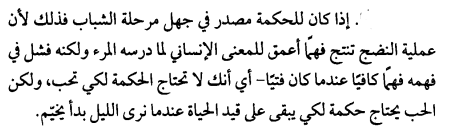
Such is the paradox of human age in the cultural sphere: we get younger by becoming older. One of the blessings of the human condition, which is otherwise tragic and fraught with afflictions of every sort, is that, once it gets underway, the learning process never comes to an end, or at least never need come to an end.Harrison also cites a poem by D.H. Lawrence, which concludes with the line "Thought is a man in his wholeness, wholly attending." Surely he has described himself.
A nation can build for the future, invest in the future, and undertake industrial, social, or technological projects for the future, yet if it does not find ways to metabolize its past, it remains without genuine prospects. That means that its youth remains largely stagnant, culturally speaking. The greatness of Western civilization, for all its disfiguring vices, consists in the fact that it has repeatedly found ways to regenerate itself by returning to, or fetching from, its nascent sources. The creative synergy between Western wisdom and Western genius has always taken the form of projective retrieval—of birthing the new from the womb of antecedence. Thus retrieval, in this radical sense, has little to do with revival and everything to do with revitalization.Note how Harrison linguistically performs his own thesis by embedding the business cliche “creative synergy” within a much longer history, without which the west’s own reckless impetuosity, signaled by the dire MBA-speak phrase, would be difficult to comprehend. Harrison’s revenge upon his polemical enemies is, in the classic way of philosophy, to circumscribe them within his own larger consciousness. As David W, Price writes in the review linked in my first sentence, “Harrison has written a book that enacts what it describes, one which boldly explores new ideas through revitalizing the past.”
These recurring ruptures in the cultural continuum—ruptures that bring about “dark ages” of destitution, oblivion, and institutional collapse—seem frequent enough to lend at least allegorical credence to Plato’s parable about heavenly declinations. Today we have the privilege of seeing this volcanic process at work up close, in Technicolor, as it were, as the entire Christian-humanist civilization that slowly consolidated itself in the wake of Rome’s collapse unravels before our eyes. It was said of President James Garfield that in moments of boredom or to amuse his friends he would take a pencil in each hand and compose sentences in Greek and Latin at the same time. If one considers that, as a student, Thomas Jefferson used to translate the Greek Bible into Latin, and vice versa, one realizes to what extent the “heavenly declinations” have unleashed their fury upon the American political class of late. It was not so long ago that a university professor in the classroom would typically leave Greek and Latin quotes untranslated. Then he began to provide translations for the Greek but not the Latin. Nowadays he must tell students that there were once such things as the Greek and Latin tongues, that there was once a place called Athens, and so forth. Shortly the professor won’t know even that much. Or he’ll know it, in a way, but not what to make of it, and when you don’t know what to make of something you eventually forget about it.One way to prevent such regression is to write and to read books such as Juvenescence.
Why these periodic ruptures in the cultural continuum? In the Timaeus Plato attributes Greek rejuvenilization to heavenly declinations, yet we should keep in mind that civilizations are brought down not only by external enemies or natural forces but sometimes collapse from within, by virtue of their own heaviness. Our age shows that a loss of cultural memory can come about despite—or maybe even because of—an excessive remembering and cataloguing of the past. The more historical knowledge we accumulate—the more we overload the vast data banks of our digital memory with information about the past—the more its essential legacies slip through the cracks of our living memory. We should also bear in mind that the more our cultural memory begins to crack, the more vulnerable we become to heavenly declinations, that is, to nature’s fluctuations and eruptions. Youth has several virtues, yet providing for the future is not one of them.