This oversized paperback collection of the Buck Rogers serial comic originally appeared in newspapers around the country over half a century ago. Never before collected in book form, you can now follow the adventures of Buck and his friends as they defeat evil-doers from around the galaxy! Contains dozens of complete story lines, so you won't be left hanging. Printed in small numbers by a small publisher almost 40 years ago, this title has become a highly sought-after collectors' item.
Had The Collected Works of Buck Rogers in the 25th Century been anything near complete, this would be a five-star gem of a book. Considered longitudinally, the Buck Rogers serial itself is a treasure trove, a daily newspaper adventure strip in the style of the Perils of Pauline, its eponymous protagonist constantly leaping from frying pan to fire. While the work skewed in later years toward the juvenile (especially the Sunday color spreads), over its more than 40-year run the strip represents an attempt to imagine a world 500 years in the future while struggling to keep pace with the protean 20th Century. In the forgotten pages of this classic work, readers will find echoes of the Stock Market collapse, the Great Depression (fantasies about gold-hoarding Atlantis dwellers), World War II (with Nazis as ruthless, brutal tigermen of Mars who first threaten war and ultimately commence invasions of Earth-Europe and later Jupiter-Russia; Imperial Japan as suicidally treacherous monkeymen from Planet X, their environs littered with era-appropriate "Kilroy was Here" graffiti), and a pre-SALT Cold War nuclear era (lots of espionage and mad-scientific atomic tinkering), to say nothing of the Space Race and whatever equivalents its artist might have had to salute the first humans to walk on the face of the moon.
Unfortunately, this particular compendium offers up only a small portion of the first half of Buck Rogers' reign, and proceeds to deliver it as a collation error, leaving off days, months, and in some cases whole years of content, the entirety out of chronological order. This was sufficiently irksome that I went and compared Wikipedia's chronological listing of published strips with this book's table of contents, so I can state precisely that the book I'm reviewing includes only D001-003, D005, D009, D031, and scattered strips taken from D045, D056, and S26 in no discernable order. In other words, after leading off with a breathless introduction by 1969 Ray Bradbury, my hard copy intersperses strips from 1928 with disorganized chunks of varying lengths from 1931, 1939, 1946, and 1949. It's disorienting to say the least. Fortunately, it turns out there's a far better way to introduce yourself to the world of Buck Rogers online (click to find the first five years of strips), and I'm here to tell you that it's absolutely worth reading.
First entering print at the height of the flapper era, the serial chips away at its inherent chauvinism by introducing time-traveler Rogers and Wilma Deering (and their traitorous foils Killer Kane and Ardala) as equals. Rogers emerges in a post-apocalyptic world that very much anticipates Planet of the Apes, only with Mongols in the place of simian overlords. It's Orientalist, but if you hang in there long enough, you'll find the racism tempered to mere exoticism upon the revelation that the Mongol Empire is in fact heavily factionalized, the despotic antagonists acting independently of and in opposition to the central ruler (and other Mongol subgroups) -- a narrative sophistication that generates opportunities galore for near-constant crosses, double-crosses, and orthogonal plot twists.
Despite hilarious anachronisms (chiefly, the biplanes and zeppelins of its earliest strips, to say nothing of the slangy dialogue and the aforementioned "Kilroy" graffiti to be found in strips of the mid- to late- '40s), the Buck Rogers serial pretty quickly evolves beyond Earth's confines and dimensions into the requisite rockets and raybeams of contemporary science fantasy adventure. Considering the strip's longevity and the real-life technological advances with which the strip coincided, it should come as no surprise that its authors frequently proved prophetic, as with this 1929 depiction of the modern-day drone: (Click the link to view the original.)
Of course, the work affords fanciful inventions aplenty, but the strip is self-consciously grounded more in science fiction than in fantasy, taking care to call its readers' attention to easily overlooked consequences of basic physics and biology: recoil; energy expenditures necessary to achieving escape velocity; variations in atmospheric pressure encountered relative to sea level and overall mass on Earth, other bodies in the solar system, and in the vacuum of space; changes in an ecosystem arising from abandoning farming in favor of synthetic food production; sociological impacts of doubling and trebling human lifespans via imprisonment in self-sufficient hyperhygienic bubbles, etc. Perhaps the most shocking example of a science-influenced plot element occurs in Rogers' very first space adventure, "Tiger Men of Mars," a storyline from 1930 that also required its characters to accustom themselves to the weightlessness of freefall. As a last-ditch attempt to bring about Mars' downfall, Rogers' team quite literally retards the orbital speed of one of its satellites. The resulting environmental cataclysm is graphically (and somewhat accurately) depicted as obliterating the entire biosphere of the planet. Our solution is genocidally extreme, but hey kids, with a little application of scientific ingenuity, just look what you can accomplish! (Click the link to view the original.)
Dubious ethics aside, there's every reason for Goodreaders to rush straightaway to sample the tremendous Rogers resource to be found online. And for those more skeptical among you who prefer lingering over my loving words, I think I can seal the deal with a last pair of images. Look at this early cover illustration of Arthur C. Clarke's brilliant Rendezvous with Rama, a story of human first contact/exploration of "the other," in the form of an enormous, interstellar, cylindrical bioship.
Now look at this Buck Rogers strip, which precedes it by more than 40 years. (Click the link to see the original.)
Get thee hence. There are better worlds than this.
Buck Rogers was the first great hero of the spaceways, premiering in Amazing Stories in 1928 and becoming a comic strip icon a year later. He was the subject of film, novels, comic books and had his own television series. It used to be that anyone who went to a science fiction film or read a science fiction book was liable to be teased for liking "That Buck Rogers stuff." This big book is a collection of some of the best of his sequential art appearances in the newspapers of the 1920's- '40s, representative of Nowlan & Calkins' best known brainchild. There are a lot of differences between newspapers then and now (does anyone now even see a newspaper?), primarily that the old ones were much, much larger, and there was room for detailed action drawings -and- great big word balloons filled with description and dialog. One of the modern improvements is that the old stories sometimes accurately reflected the racist and sexist attitudes of the time. Personally, I always preferred Flash & Dale to Buck & Wilma, but I can't dispute his historical influence and importance. This book includes a nice introduction by Ray Bradbury from 1969, and a delightful Buck autobiography by Nowlan and Calkins from 1932. Without Buck and Flash, there never would have been Captain Kirk or Luke Skywalker.
This was hard to get through. The artwork wasn't bad but the writing is so dated it comes off as intensely dull. Not to mention the increase in overt anti-Japan racism that coincided with Pearl Harbor. Not unexpected but very uncomfortable.
I've never written this about a book before, but the editing of this book could have been much better.
I am a scifi fan, though, and this interested me as representative of scifi storytelling of its era. To the point of poor editing choices, the selections from the comic strip are presented out of sequence, alternating stories from the 1930s and the 1950s. To add to the confusion, there is never an explanation for "what has gone on before" which would have provided helpful context for several of the stories, and perhaps make a more enjoyable reading experience. One story has an important plot point being that some mysterious entity has changed the Earth's axis of rotation, but when Buck Rogers comes across the device used to do this it is seemingly unrelated to the ongoing storyline at that point. It may be related, but how is a reader new to Buck Rogers to know?
Other elements are equally frustrating. One item is a list of important characters appearing throughout the strip's existence, but some of these do not even appear the stories included in the book. There are some slapdash essays from the sons of the creators which are less informative than they are self=promotional. The next to last item in the book is a proposed reformed alphabet, numbering system, and calendar that make little sense and has no apparent relationship to the Buck Rogers strip other than be an invention of the book's editor.
Despite the silliness of the usually not-very-scientific science fiction with its notable variety of rays (sleep rays, heat rays, disintegration rays, cyonic rays...whatever cyonic rays are, among others) and the seemingly random sometimes nonsensical plotting, the action is nonstop and the art is sometimes good. Buck Rogers does have the honor being one of the early science fiction works I've read to have a device reminiscent of a cell phone. In this instance, it is the rarely used but often useful radiophone.
Investigating reports of unusual phenomena in abandoned coal mines near Wyoming Valley, Anthony Rogers ends up in a cave-in that keeps him suspended in sleep for over four hundred years - and when he wakes, he finds himself in a world of strange creatures and exciting new technologies. Dille will keep science fiction fans entertained with these enjoyably cheesy and suspenseful adventures as each comic in this grand collection expands his colourful realm. Will Buck be able to adapt to his new surroundings in time to survive?
I read this book in 1971 as a teenager, and enjoyed it very much then. This review is only for the sequence "Martians Invade Jupiter" that is a finalist for the Retro Hugo Award. I give this particular story 2 stars.
A little disclaimer: this book does not include the entire "Martians Invade Jupiter" story. I estimate it contains about half of the story, ending sometime in 1942. But there is more than enough to get the gist. This is a very thinly disguised account of the U.S. versus the Axis Powers in World War 2. Buck Rogers goes on various combat missions to fight Martians who are stand-ins for the Japanese. The Martians are drawn in a very racist manner, with racist language used by Buck and his allies to describe them (and broken English is spoken by the Martians). There are all kinds of patriotic messages interwoven into the narrative. It's interesting that when Buck uses tricks and decoys to defeat the enemy, he is lauded, but when the Martians do the same thing they are called cowards. At one point, Buck's girlfriend Wilma Deering accidentally get her molecules rearranged so that she gains weight. The strip makes much of her fatness, when she is shown to be only slightly more plump than usual. But she essentially goes crazy, thinking that Buck cannot love her anymore, and goes out on a solo, presumably suicide, mission. The bottom line is that what appealed to (primarily) youngsters of the 1940s is now seen as racist and chauvinistic. The artwork is fairly crude, especially by today's standards, with lots of unnecessary verbiage. Still, hypothetical Hugo voters in 1944 would probably have enjoyed Buck Rogers a great deal and would likely have nominated it.
Historically significant compilation of the early Buck Rogers newspaper strip in a hardcover large scale volume. This includes some of the Sunday color segments, several of the early artists and a forward by Ray Bradbury. Its fascinating to see what they thought "the future" might be like back in the early 30's. Buck Rogers was one of the first space age characters whose success resulted in many others being created like Flash Gordon. This compendium of story lines was originally published in 1969 before there were very many of these sorts of compilations, much less graphic novels so prominent today. I especially enjoyed the varying art (including costume) styles over the years which represented their eras. It's a great time capsule of cartoon/comic sequential art in the era when there weren't many heroes (only Tarzan and Buck then Dick Tracy later ...Superman created 10 years after Buck). Anti-gravity backpacks, rocket ships, invasions from Mars, flying cowboys and mad scientists. Lots of action and femme fatales.
Originally published in 1969, this immense volume is an historical artifact in itself, and the first introduction many of us had to the character. The art is showcased well, and the early 1929 strips are presented in their entirety. I always preferred Calkins' and Nowlan's story to Flash Gordon, with more relatable storylines and less distracting artwork.
Where the volume falls down is in the later strips. The editor felt the need to touch on various arcs over the course of decades, so chapters sometimes begin after an adventure has begun, and frequently end with the storyline unresolved, which is very distressing!
Additionally, the vociferous racism (primarily towards Asians) is very difficult to take, and the sexist characterisation of Wilma Deering (who starts off competent if a bit emotionally flighty but who turns into a complete ninny in later years) has not aged well at all.




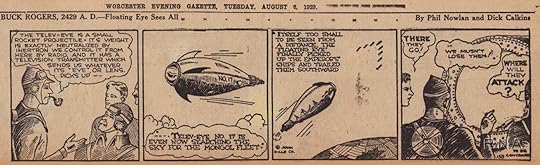 (Click the link to view the original.)
 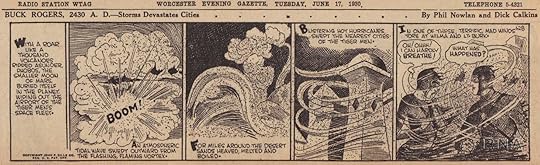 (Click the link to view the original.)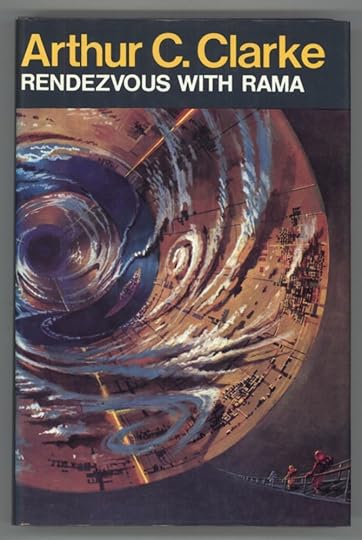
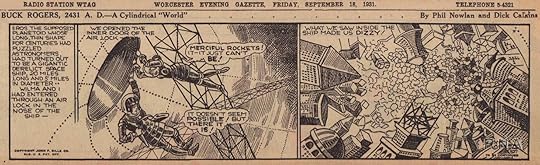 (Click the link to see the original.)


