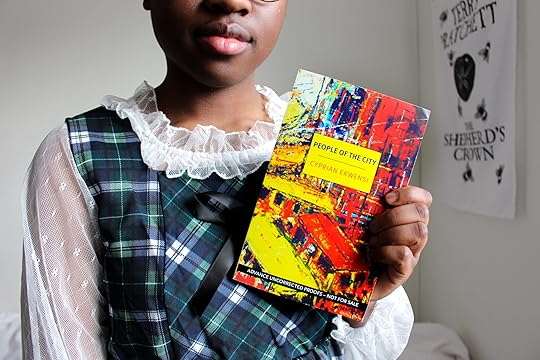
A vivid coming-of-age tale set in a big Nigerian city about a young man trying to make his way as a journalist and band leader in the big city.
When People of the City was published in 1954 it was immediately acclaimed as the first major novel in English by a West African to be widely read throughout the English-speaking world. People of the City tells the story of a young crime reporter and dance-band leader in a great West African city who comes to see that what he can do for the developing country in which he lives is more important than the considerable and varied personal pleasures he can find in the hectic life of the city. Ekwensi's delicious first book has the swagger, bravado, and elation of the great bands of West Africa.
One gets the unpalatable impression that the late Cyprian Ekwensi was somewhat undermined as a writer. Yet he was outstanding and beloved by countless readers. He published many excellent novels, including Jagua Nana, Jagua Nana's daughter, Beautiful feathers, Iska, Survive the peace, Burning Grass, and lots of other fiction for children. Indeed, People of the City was published many years before Achebe's Things fall apart. This novel raises many questions, but mainly about survival in the (Nigerian) city over 60 years ago, and multi-faceted, intriguing characters. The main protagonist, Amusa Sango is both a journalist, and leader of a (music) band. Think about it, isn't such a combination highly unusual? So Sango is a striking young man, pulling out all the stops to survive. He is not a bad man by any standards, but he has to confront certain odds and challenges - he is accused of being melodramatic by his (media) superiors, but his approach here seems human, humane and practical, considering the violence that extirpates the life of his fellow young man. The city itself is brilliantly portrayed, the desperation, the wiles of many women. We see the challenges/problems that go with polygamy as exemplified by Sango's landlord. Life is a continuum and though the action here is anchored on many decades ago, is it not the same even now? How do we expect women, young women, to survive in cities, since the reality is that only very few of them can be gainfully employed? There is a lot of drama and melodrama here, but such constitute the warp and weft of life. Those who attempt to compare and contrast Ekwensi and Achebe often miss the point; Achebe is world-famous for depicting pre-colonial African (Igbo) land, whereas Ekwensi is world-famous for focusing on city life, its ravages on the citizens, especially on women. This is a sociological treasure as we are afforded glimpses into early modern major city (ies) in west Africa.
This was one of the first novels published by any black African writer, and shows what an exciting writer Cyprian Ekwensi was. Even from the very first chapter, our interest is aroused. The main character Amusa, is both a journalist and leader of a music band (what a combination). Early in the morning, an attractive young lady (Aina) visits him in his room. Amusa, though he had been enamoured with her a night earlier, has apparently moved on quite coldly; the woman, naive in her own way becomes inarticulate - and the next thing we hear is that she has gone elsewhere to steal clothing, and a mob wants to stone her to death! In the same chapter, we are briefly introduced to Amusa's landlord who comes across as a young (younger) man too... and he already has MANY wives living in the same house ! Hence from the beginning we take in the zest, the "immorality" of the city in question... and of course we want to read on. Let it never be suggested that Mr Ekwensi was not a very good writer....
My first proper introduction to African literature was through the novels of Nadine Gordimer, and later on with a little bit through the works of one or two authors of South African origin. But in all these books, exclusively, the writer was from the 'white' section of the society and from the upper classes. I had not yet been initiated into the works of Chinua Achebe,and had yet to read a work from the author of the 'black' section of the society. Cyprian Ekwensi, although a much less 'honoured' name from this section, has been my first introduction to African, particularly West African literature, and this book deserves to be a bestseller in all aspects (and which it probably was in 1954, when it was first released). This book is a keeper; fast moving, and compulsively readable narrative, interspersed with interesting characters like the protagonist, Amusa Sango, who is a no-nonsense crime reporter in a big newspaper as well as a dance-band leader. It has all the elements that make it eligible for an interesting film script; indeed a film that deserves to be a blockbuster. This book is one of the better releases from NYRB this summer.
This excellent book reads like one of those gritty noir crime thrillers movies and it's got the main ingredients: A femme fatale that is nothing but trouble A dashing but somewhat hapless young man caught in the ebb of the city A villain (or two) Money Crime Sex Doomed love Parties Music Beautiful women And of course, a redemption. I relished every sentence. Nobody wrote post-colonial urban novels like Ekwensi did.
A good novel by an author that deserves more attention. Quite enjoyable, although at times it is very clearly a first novel. There is much drama with little significance, something that Ekwensi would handle better in Jagua Nana—the only other work I've read by him thus far. My favorite aspect of his writing is his unique portrayal of sexuality as a driving force of human interaction.
Fine, early novel by Ekwensi. Convincing picture of the underbelly of a Nigerian city many decades ago; and the plight of diverse ordinary, private denizens. The focus is on Amusa Sango, who somewhat loves the good life. Though why two separate female characters in this work had to be dubbed Beatrice 1, and Beatrice 2 perturbed me...
Written and set in 1950s Lagos the story follows Amusa Sango, a young man seeking his fortune in the city as a journalist and jazz band leader. It's a short read that speaks to the specificity of Lagos and Nigeria and the more universal story of a young person moving to the big city for something better. Had a lot of plot and not a lot of plot at the same time?
People of the City (1954) van Cyprian Ekwensi is een van de eerste moderne Nigeriaanse romans in het Engels en vormt een levendig portret van het stedelijke leven in West-Afrika tijdens de late koloniale periode. Het verhaal speelt zich af in een naamloze stad die sterk doet denken aan Lagos, waar moderniteit, ambitie en morele onzekerheid voortdurend met elkaar botsen.
De roman volgt Amusa Sango, een ambitieuze misdaadverslaggever en bandleider die probeert naam te maken in de stad. Hij wil sociaal stijgen, succes behalen en tegelijk zijn morele integriteit behouden. Toch blijkt al snel dat de stad hem voortdurend verleidt en onder druk zet. Amusa is geen heldhaftig personage, maar juist iemand die laveert tussen ambitie en zwakte, charme en opportunisme. Zijn innerlijke onzekerheid maakt hem herkenbaar, maar ook problematisch.
Een van de meest aangrijpende verhaallijnen is zijn relatie met Aina. Wanneer zij beschuldigd wordt van diefstal en publiekelijk vernederd wordt, grijpt Amusa niet in. Haar gevangenschap en kwetsbare positie tonen de hardheid van het stadsleven en leggen tegelijk Amusa’s morele tekortkomingen bloot. Aina blijft als een schuldgevoel op de achtergrond aanwezig en benadrukt hoe individuele keuzes verstrekkende gevolgen kunnen hebben.
Naast deze persoonlijke verhaallijn geeft Ekwensi via Amusa’s werk als journalist een inkijk in de duistere kanten van de stad. Moordzaken, zelfmoorden en geweld tonen een samenleving waarin armoede, hebzucht en sensatiezucht samenkomen. De journalistiek wordt niet alleen gepresenteerd als middel tot waarheidsvinding, maar ook als onderdeel van een systeem dat profiteert van drama en schandaal.
Een centraal thema in de roman is de stad als morele jungle. Enerzijds biedt zij kansen: roem, geld en vrijheid. Anderzijds brengt zij onzekerheid, verleiding en moreel verval. De stad “verslindt” mensen die niet sterk genoeg zijn om weerstand te bieden. Dit spanningsveld wordt versterkt door de tegenstelling tussen traditie en moderniteit. Waar schrijvers als Chinua Achebe zich richten op het traditionele dorpsleven, laat Ekwensi juist de opkomende stedelijke middenklasse zien, met haar nieuwe waarden, consumptiecultuur en sociale dynamiek.
Ook seksualiteit en gender spelen een belangrijke rol. De roman was destijds controversieel door de openlijke beschrijving van relaties en verlangens. Vrouwen worden soms stereotiep neergezet, maar tegelijkertijd toont Ekwensi hun kwetsbaarheid binnen een samenleving waarin macht en reputatie ongelijk verdeeld zijn.
Het verhaal is episodisch opgebouwd en bevat veel dialogen. Dit maakt het boek toegankelijk en levendig. Deze stijl past goed bij de chaotische en dynamische stad die hij beschrijft.
Aan het einde van de roman trouwt Amusa met Beatrice, wat een voorzichtige hoop op stabiliteit suggereert. Toch voelt dit einde niet als een definitieve oplossing. De onzekerheid blijft, en de stad blijft een gevaarlijke omgeving waarin succes nooit gegarandeerd is.
People of the City blijft relevant omdat het thema’s aansnijdt die nog steeds herkenbaar zijn: urbanisatie, sociale druk, ambitie en de invloed van media. Ekwensi laat zien hoe de moderne stad zowel kansen als risico’s biedt, en hoe individuen voortdurend moeten balanceren tussen succes en morele integriteit. Is een belangrijke en levendige roman die inzicht geeft in het Lagos van de jaren vijftig. Ook in de tijdloze worsteling van mensen die proberen hun weg te vinden in een snel veranderende wereld.
The reader will enjoy looking into this unnamed city set in Africa where anything can happen. The story centers around Amusa, a ladies man. He tries to get ahead with his career as a reporter and music on his own in the big city, but there is a constant setback, if not because of the arrogant Lajide, then it was because of Amusa's wandering eyes.
The story addresses sex, love, lust, politics, social class, and one individual that brings with her a whole set of problems.
People Of The City by Cyprian Ekwensi was a fun read.
Say what you want, but Ekwensi crafts a beautiful tale in People of The City about change. I find Sango transformed at the end of the book, willing to start a new life. People of The City also paints a neat picture of what Lagos was like in those days. It is very nostalgic. It would seem that everyone in the city who wasn't cheating or stealing or foreign was getting impoverished. Is this the Nigerian experience?
Ekwensi was a Nigerian author, studying in Britain at the time he wrote these tales, originally for radio plays for his fellow Nigerians in Britain. Nigeria was still a British colony at the time, 1954, but it was in the process of establishing independence, doing so in 1960. The City referred to is Lagos (although never called that), where Britain had first established itself, in order to stop the slave trade that had been established there. It soon was an important port for all colonial trade from western Africa.
But much like any port city, Lagos had its share of riff-raff and those just trying to get by. There is a definite film noir vibe with these folk. Take Beatrice, who has found her way to the City, to find work and a better life. She happens to meet up with an old friend from the country, who shares quarters with some musicians from a local jazz band.
“You want to hear my bad luck story?” she asks him. “Well, I couldn’t find a place in the city. My work has to go on, so what did I do? I took my things to the railway station and deposited them in the Left Luggage Office, and here I am! . . . Do you sleep at the station too?
Not yet. I am now a hanger-until I can find a place. My First Trumpet has invited me to share his little room with him.”
“Is not easy”, Beatrice said.
There is a man, Lajide, who is wealthy, and wouldn’t mind adding her to his collection of wives (she would get her own house!). But she runs afoul of a couple of gangsters, gets beaten up, and has to leave town. Some people aren’t distressed by this turn of events.
Somewhere in the compound of Twenty Molomo Street, his wives were chanting and wiggling their hips in triumph.
An African classic that focuses on the post-colonial urban experience. Protagonist Amusa Sango moves from the impoverished countryside to the unnamed city (presumably Lagos, Nigeria) to make his fortune. He becomes a rising-star crime reporter for the West African Sensation and enjoys moderate success as the leader of a high-life band.
In contrast to other novels in this mold, such as Balzac’s Lost Illusions, we don’t follow Sango’s struggles to rise. Things are already going his way when we first meet him. Here, the focus is on his efforts to continue to rise. More particularly, we follow Sango’s efforts to prevent himself from falling back down as things — women, landlord, wayward friends, politicians, mothers — start tugging at him.
The writing is clean and breezy. Actually, it may be too clean and breezy to the point where the author relies a bit much on out-from-left-filed (deus ex machina) solutions to quickly wrap up story lines. On the whole, though, I still found it an enjoyable read and kept on rooting for Sango.
This is an entertaining novel about a man’s time in vibrant Lagos and the women that fall at his feet.
Ekwensi was clearly a man with wandering eyes, specifically to women’s chests, as that particular part of the body seems to be quite important to him throughout the book. It’s a little clumsy, but we forgive that for the story, which involves mostly his hero, Amusa Sango, bopping around Lagos, suffering misfortune, losing more money than he earns, and giving us a showcase of his people and culture.
Not an incredible book by any means, but still glad I read it just to experience the feeling of haplessness in 40s-50s Lagos.
wrongdoing is the stuff of a life; owning it is the core of growth. if the epigraph of this novel is any indication—"wrongdoing is a hill; everyone mounts his own and descries that of another"—Ekwensi sees the city almost as an inhibitor to growth. knowledge of the possibilities that lie around the corner of bustling city streets makes a new day of wrongdoing feel, well, new, divorced from the previous days. because this time, you really might make it, find your love, find your next step, find your independence. but where would all the strivers go without the beacon of false positivity that is the City?
i really can’t make up my mind on if i liked this or not. there were moments that described the city so beautifully and i craved being there in that moment. there were other moments that made me so frustrated over Sango’s actions and lack of accountability/direction (maybe this was the time of the 50s?). i guess to sum it up: the writing was fantastic but the plot was not so much.
I enjoyed the way Ekwensi's writing style mimicked the fast-paced nature of the city he is describing. I loved the prose of this book, however I wish it had been a bit longer and delved deeper into some topics.
Bohemia in Lagos! Length (100 pages) was excellent: tight set of characters / motifs commenting on the struggle to self-actualize in a volatile metropolis. A more capitalist and heterosexual Rent? A - dare I say it - more raw & passionate Great Gatsby?
Bounced around with the character names too much for me. Not a book I could get into. Ramped up towards the end which is far too late to up my score rating. One positive note is you wouldn't know how old the book is from the writing.
Of interest to those involved with the history of African literature. I found the plot uninteresting and the writing under developed. I really wish there was more description.
One of those books where everything keeps going wrong for our protagonist despite his best plans. Concerned with a middle class where even when everything goes wrong and you're left homeless and jobless, there's somehow still enough opportunity to get back on your feet.
This rating does not have anything to do with the quality of the writing, I just never understood Amusa Sango and who he is and why he existed. He confused me and frustrated me at the same time.