Jump to ratings and reviews
Rate this book

Que el bien os acompañe

Rate this book
An NYRB Classics Original

Few writers had to confront as many of the last century’s mass tragedies as Vasily Grossman, who wrote with terrifying clarity about the Shoah, the Battle of Stalingrad, and the Terror Famine in the Ukraine. An Armenian Sketchbook, however, shows us a very different Grossman, notable for his tenderness, warmth, and sense of fun.
      
After the  Soviet government confiscated—or, as Grossman always put it, “arrested”—Life and Fate, he took on the task of revising a literal Russian translation of a long Armenian novel. The novel was of little interest to him, but he needed money and was evidently glad of an excuse to travel to Armenia. An Armenian Sketchbook is his account of the two months he spent there.
      
This is by far the most personal and intimate of Grossman’s works, endowed with an air of absolute spontaneity, as though he is simply chatting to the reader about his impressions of Armenia—its mountains, its ancient churches, its people—while also examining his own thoughts and moods. A wonderfully human account of travel to a faraway place, An Armenian Sketchbook also has the vivid appeal of a self-portrait.

144 pages, Hardcover

First published January 1, 1965

78 people are currently reading
2903 people want to read

About the author

Vasily Grossman

58 books979 followers
Born Iosif Solomonovich Grossman into an emancipated Jewish family, he did not receive a traditional Jewish education. A Russian nanny turned his name Yossya into Russian Vasya (a diminutive of Vasily), which was accepted by the whole family. His father had social-democratic convictions and joined the Mensheviks. Young Vasily Grossman idealistically supported the Russian Revolution of 1917.

When the Great Patriotic War broke out in 1941, Grossman's mother was trapped in Berdychiv by the invading German army, and eventually murdered together with 20,000 to 30,000 other Jews who did not evacuate Berdychiv. Grossman was exempt from military service, but volunteered for the front, where he spent more than 1,000 days. He became a war reporter for the popular Red Army newspaper Krasnaya Zvezda (Red Star). As the war raged on, he covered its major events, including the Battle of Moscow, the Battle of Stalingrad, the Battle of Kursk, and the Battle of Berlin. In addition to war journalism, his novels (such as The People are Immortal (Народ бессмертен) were being published in newspapers and he came to be regarded as a legendary war hero. The novel Stalingrad (1950), later renamed For a Just Cause (За правое дело), is based on his own experiences during the siege.

Grossman's descriptions of ethnic cleansing in Ukraine and Poland, and the liberation of the Treblinka and Majdanek extermination camps, were some of the first eyewitness accounts —as early as 1943—of what later became known as 'The Holocaust'. His article The Hell of Treblinka (1944) was disseminated at the Nuremberg War Crimes Tribunal as evidence for the prosecution.

Grossman died of stomach cancer in 1964, not knowing whether his novels would ever be read by the public.

Ratings & Reviews

What do you think?
Rate this book

Friends & Following

Create a free account to discover what your friends think of this book!

Community Reviews

5 stars
427 (34%)
4 stars
507 (40%)
3 stars
247 (19%)
2 stars
45 (3%)
1 star
11 (<1%)
Displaying 1 - 30 of 195 reviews
Profile Image for Hugh.
1,293 reviews49 followers
December 8, 2019
A rather charming oddity, much lighter in tone and substance than anything else Grossman wrote - so although it is an easy read anyone starting with this one will see nothing of the power and humanity of his great novels (Life and Fate, Everything Flows and Stalingrad).

This is a travelogue of a journey Grossman took as part of a project to "translate" an epic modern Armenian novel (from a rougher word for word translation in Russian - Grossman knew almost no Armenian).

Grossman was already suffering, both from the "arrest" of the Life and Fate manuscript and from the illness that killed him a couple of years later.

Grossman is not above self parody, and there is an element of picaresque at play, along with the history and landscape writing common to most travel books.
Profile Image for Steve.
441 reviews581 followers
Read
July 20, 2014


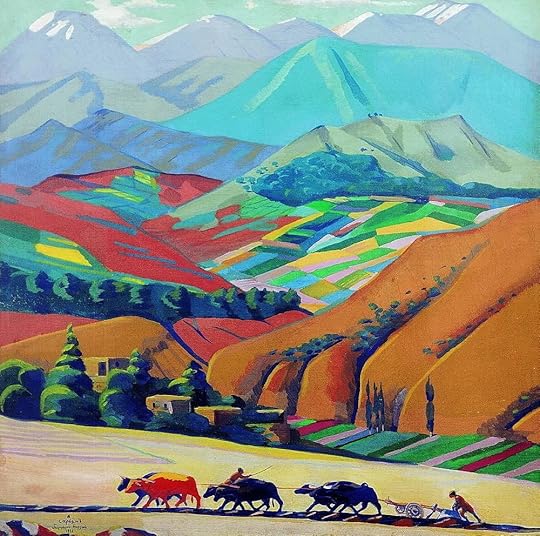
- Martiros Saryan (1880-1972) "Armenia's national artist"

What a coincidence - just a few days after reading Burton Watson's charming The Rainbow World, I happen to read Vasily Grossman's An Armenian Sketchbook. I love little stories of real, existing human beings told by people who still love our sad little species.(*) And since, in my view, there is no real love without close and illusion-free acquaintance, such love is tempered with a clear knowledge of our trivialities, our inconsistencies, our envious and selfish nature, our striving for recognition and dominance, of the whims and accidents we set up as eternally correct and universal customs and ways, of our all too frequent readiness to injure, maim and kill each other, and our oh so readily produced rationalizations for such acts, this love is often expressed with wry irony and various degrees of sadness and poignancy. And so it is in this book.

Shortly after the Soviet machinery of mind control confiscated the manuscripts of Grossman's Life and Fate in 1961, including all associated appurtenances like typewriter ribbons (!) - a blow that struck Grossman so hard that his friends and family attest that he aged 20 years in a few weeks - it threw him a bone: he was to "translate" on the basis of a literal translation provided by another person a 1,420 page Armenian novel about "the setting up of a copper smelting plant" ! (**) And he was to do this in Armenia, so that he may consult with author and literal translator.

Off he went. He needed the money, he needed the work, and he needed the distance from a marriage that was reaching a breaking point.

Not exactly propitious circumstances, and the sight of a 60 foot bronze statue of Stalin lording it over the Armenian capital of Yerevan when he arrived after a days' long train ride from Moscow wasn't particularly promising, either.(***) But he finished the translation and then immediately started writing these memoirs while still in Armenia.

I don't know how good that Armenian novel is, but this accounting of his experiences in Armenia, the people he met, and the meditations on topics varying from nationalism to bread are splendid, all interwoven with allusions to Russian literature and history.(****) The comments he makes on nationalism should be read by everyone. His empathetic irony is turned on everything, including, often enough, himself.

As an example, in one passage he is discovering the city for the first time and

creating my own special Yerevan - a Yerevan remarkably similar to the Yerevan in the external world, a Yerevan remarkably similar to the city present in the minds of the thousands of other people walking about on the streets, and, at the same time distinct from all these other Yerevans. It was my own Yerevan, my own unrepeatable Yerevan. The autumn leaves of the plane trees rustled in their own peculiar way; its sparrows were shouting in their own peculiar way.

Not an unknown attitude to take. A little later

Lord and creator, I wander through the streets of Yerevan; I build Yerevan in my own soul. Yerevan — this city that the Armenians tell me has existed for two thousand and seven hundred years; this city that was invaded by both Mongols and Persians; this city that was visited by Greek merchants and occupied by Paskevich's army; this city that, only three hours earlier, did not even exist at all.

Again, by no means unknown. At the same time, however, some chickens and turkeys are being carried by their feet:

These little heads must be swollen and painful, and the birds arch their necks in order, at least slightly, to reduce their sufferings. Their round pupils look at Yerevan without reproach. There, too - in the birds' confused and spinning heads - a city of pink tufa is coming into being.

And then nature calls, and as the call becomes more urgent he thinks of his only contact in Yerevan:

I've heard that Armenian intellectuals are fond of gossip. I can't burst into the apartment of one of the masters of Armenian prose and trample people underfoot as I dash towards the water closet. I'd never be able to live it down - people would be joking about this throughout my stay in Armenia. No, it was out of the question.

As a universally familiar form of desperation arises, the final deflation of the solipsistic balloon takes place among scrub bushes at the end of a tramline.

Happiness. Do I need to describe this feeling? For thousands of years poets have been striving to convey on paper the nature of happiness...

Irony, empathy, sharp observation, an impression of a country most of us know little about, a panoply of persons one would otherwise never meet. That's enough to get me into a book.

Grossman (1905-1964) rejected the demands made by the censors for changes in the manuscript of this text (among others, the passages on Stalin and nationalism were not well received); it was finally published whole in 1988.

(*) Though I can well understand those authors who are so disappointed in, so disgusted with, so repulsed by, so despairing of humankind that the reader's mind, heart and stomach all churn at the sight of their characters.

(**) Personally, I'd be headed for the top of the nearest high building.

(***) Could one jump off of that statue?

(****) Details are generously provided in a section of Notes at the back of this NYRB edition.

Rating

http://leopard.booklikes.com/post/933...
Profile Image for Ken.
Author 3 books1,238 followers
Read
August 21, 2018
Supposedly unlike anything Vasily Grossman has written, but it's all one to me because I've never read anything by Vasily Grossman. Rather I wanted to learn a little bit about Armenia, which I know only tangentially through discussions of, say, Noah and his famous ark, and through discussions of genocide throughout the world.

In any event, it's a very straightforward style and you get an insight both into the man (a Russian) and the Armenian culture, which he admires. His tour of the land took place around 1960, only a few years before his death to kidney cancer. In fact, there's mention of "pain" in his body and, it turns out, this was the source of it.

Hey. Even a few black and white pictures in the back! A bonus. I learned something.
Profile Image for Steven Godin.
2,782 reviews3,365 followers
April 30, 2023

'When we began to climb the loops of the mountain road, the setting sun suddenly lit up dozens of snowy peaks and the sharp white light of day yielded to an improbable wealth of colors and hues. This was extraordinary, beautiful, truly wonderful—the quiet evening, the deep shadow of the valley, and pine trees that seemed black in the twilight while the mountains’ summits and upper slopes turned blue, purple, copper, pink, and red. Each summit had its own particular light, and they all came together to form a single miracle, a miracle it was impossible to look at without deep emotion. In the presence of this excessive beauty I felt close to panic, even to terror. The snowy summits seemed perfect in their rounded contours, against a pale-blue sky, and their colors—vital and clean, simultaneously tender and bright like African flowers, hot, even though they were born of winter sunlight on cold snow—filled the air with a music that did not infringe upon the deep silence. At moments like this, it seems something improbable is about to happen, some radical transformation of people, a transformation of one’s whole internal world and of everything all around.'
Profile Image for Sergio.
1,340 reviews129 followers
June 12, 2025
- Libro acquistato a Dicembre 2022 -
Questo libro é una raccolta composta da otto racconti più la cronaca di un viaggio fatto dallo scrittore in Armenia: inevitabilmente le otto composizioni scritte in periodi diversi e di argomenti distinti non raggiungono nell'insieme la perfezione di "Vita e Destino" e "Stalingrado" ma sono una lettura attraente per formarsi un'idea più particolareggiata dello scrittore russo.
Guardando le singole composizioni non si può fare a meno di giudicare un capolavoro il racconto che apre questo libro, "Il Vecchio Maestro", la cronaca privata e collettiva di un villaggio russo caduto in mano alle truppe tedesche durante la seconda guerra mondiale: un racconto emozionante e coinvolgente con punte di grande lirismo.
Della stessa qualità altri racconti come "Fosforo", "La Strada" e "In Periferia" e un piccolo gradino più sotto "La Madonna Sistina", "L'Inquilina", e "Mamma".
Infine la lunga esposizione della regione armena, la sua storia, la sua geografia e il suo folklore in "Il bene sia con voi", racconto/cronaca di un viaggio dell'autore in quella regione periferica della Russia stretta tra Turchia e Iran, animata nel tempo da moti di rivolta e indipendentismo e colpita da persecuzioni, repressioni e genocidio: un racconto che svela anche i pensieri e l'indole di Grossman che sradicato dalla sua vita russa si ritrova lontano da casa a fare i conti con la sua anima e le sue contraddizioni.
Profile Image for Rafa Sánchez.
461 reviews108 followers
October 31, 2020
Este libro es el testamento intelectual de Vasili Grossman (frente al testamento político de "Todo fluye"), sin personajes de ficción mediantes, el autor nos sumariza vívidamente sus ideas sobre el ser humano, el nacionalismo, el antisemitismo, la libertad, la cultura y, un tema central en su obra, la bondad innata del ser humano capaz de vencer y desmentir con un acto nimio a las peores ideologías totalitarias. Para los lectores devotos de Grossman, esta obra crepuscular en primera persona es una joya. La traducción de Marta Rebón es, como siempre, insuperable.
Profile Image for Anna.
2,109 reviews1,014 followers
June 19, 2017
Here is further evidence that non-fiction soothes the soul. Vasily Grossman is known for his stunning writing on monumental tragedies of the 20th century: the holocaust, the Eastern Front, Stalinism. ‘An Armenian Sketchbook’ appears to be a simple travelogue, written after Grossman spent some time there translating an Armenian epic. Although it contains some witty pen portraits and lyrical descriptions of vistas, it is really a book of profound reflections on life by a man who has seen the absolute worst of humanity yet has not lost hope for our species. The introduction and appendices note that during his time in Armenia Grossman was ill, his marriage was breaking down, and his masterpiece Life and Fate (one of my favourite novels of all time) had been ‘arrested’. I hadn’t previously come across the detail that post-confiscation Grossman had to sign a document stating that he had no further copies of it. Thus, if it had ended up published outside the USSR, Grossman and his family would have been at serious risk. During the Armenian trip, Grossman was presumably reconciling himself to the fact that his best work would never be published or appreciated. It is a minor tragedy in comparison with the subject matter of Life and Fate that Grossman did not live to see its brilliance praised, but a tragedy nonetheless. Still, ‘An Armenian Sketchbook’ makes clear that his more Soviet-friendly work, including his journalism, was admired and remembered even in obscure mountain villages.

Needless to say, the writing throughout the sketchbook is wonderful. Whether he is describing the beauty of a mountain, the fear of death, or the search for a toilet, Grossman has an exquisite way with words. (My compliments also to the translators, Robert and Elizabeth Chandler.) He returns several times to the importance of the worlds we each create for ourselves through our unique perceptions and creativities, clearly mourning his seemingly lost novel:

Perfect worlds do not exist. There are only the funny, strange, weeping, singing, truncated, and imperfect universes created by the gods of paintbrush and musical instruments, the gods who infuse their creations with their own blood, their own soul. When he looks at these worlds, the true Lord of Hosts, the creator of the universe, probably cannot help but smile mockingly.

[...]

We have the right to ask the divine mocker this question: in whose image and likeness was humanity created? In whose image were Hitler and Himmler created? It was not men and women who gave Eichmann his soul; men and women merely made an Obersturmbannfuhrer’s uniform for him. And there were many other of God’s creations who covered their nakedness with the uniforms of generals and police chiefs, or with the silk shirts of executioners.

We should call on the Creator to show more modesty. He created the world in a frenzy of excitement. Instead of revising his rough drafts, he had his work printed straightaway. What a lot of contradictions there are in it. What a lot of typing errors, inconsistencies in the plot, passages that are too long and wordy, characters that are entirely superfluous. But it is painful to cut and trim the living cloth of a book written and published in too much of a hurry.

And so we leave the village.


Reading anything by Vasily Grossman is a salutary reminder that, terrible as the 21st century might seem at this moment, by this point in the 20th the world was in the midst of a war thought to end all wars and Russia was convulsed by revolution. There is still time to learn from the last century’s mistakes. Grossman witnessed some of the worst crimes perpetrated by humans against other humans, yet he still thought that people were capable of goodness, even greatness, and that there was beauty in the world. And he had a gift for placing that beauty in its context:

But when you look at these black and green stones, you realise at once who cut them. The stonecutter was time. This stone is ancient; it has turned black and green from age. What shattered the mighty body of the basalt were the blows struck by long millennia. The mountains disintegrated; time turned out to be stronger than the basalt massifs. And now all this no longer seems like a vast quarry; it is the site of a battle fought between a great stone mountain and the vastness of time. Two monsters clashed on these fields; time was the victor. The mountains are dead, fallen in battle. They have been felled by time just as mosquitoes, moths, people, dandelions, oak and birch are felled by time. Defeated by time, the dead mountains have been turned to dust. Their black and green bones lie scattered on the field of battle. Time has triumphed; time is invincible.


Descriptions like these actually remind me of Mervyn Peake, who also witnessed the concentration camps in his capacity as an official war artist. Stones battling time take me straight back to Gormenghast, another all time favourite book.

The most powerful moment in ‘An Armenian Sketchbook’ is an anecdote in which Grossman seems to be having a panic attack and imagines himself to be dying. He concludes his account with this:

All this leads me to think that this world of contradictions, of typing errors, of passages that are too long and wordy, of arid deserts, of fools, of camp commandants, of mountain peaks coloured by the evening sun is a beautiful world. If the world were not so beautiful, the anguish of a dying man would not be so terrible, so incomparably more terrible than any other experience. This is why I feel such emotion, why I weep or feel overjoyed when I read or look at the works of other people who have brought together through love the truth of the eternal world and the truth of their mortal “I”.


That’s why I read this book; indeed that’s why I read at all.
Profile Image for merixien.
671 reviews657 followers
April 26, 2023
Yaşam ve Yazgı’nın ardından Vasili Grossman’ın yazdığı her şeyi okumak istiyorum. Taşlar Ülkesine Yolculuk da yazarla ikinci buluşmamdı.
Kitapta anlatılanlardan önce bu kitabın neden bu kadar özel olduğuna dair bir-iki şey söylemek istiyorum. Taşlar Ülkesine Yolculuk sanırım kendisinin yazdığı son eser. Zira kitabı 1963 yılında tamamladıktan sonra 1964 yılında mide kanserinden ölüyor ki kitapta Ermenistan yolculuğunda yaşadığı mide ağrılarını da okuyorsunuz zaten. İkinci önemli nokta ise- ki mide ağrılarını dahi anlatmasından görüleceği üzere- Grossman’ın en açık ve kişisel kitabı. Hayatının en büyük eseri Yaşam ve Yazgı’ya el konulmuş ve hayattayken herhangi bir yerde yayınlanması engellenmişken -bu psikoloji eşliğinde- Ermenistan’a bir edebi çeviri için yaptığı iki aylık seyahatin notlarını okuyorsunuz. Notlarındaysa bu sefer hiçbir kurgusal karaktere ihtiyaç duymadan bütün açık yürekliliği ve yılgınlığıyla; milliyetçilik, anti-semitizm, totaliter rejimlerin insan üzerindeki etkileri, özgürlük ve insan olmak üzerine düşüncelerini kendisini asla maskelemeden anlatıyor. Yaşam ve Yazgı’da da Taşlar Ülkesine Yolculuk’ta da en sevdiğim noktalardan birisi bu zaten. Grossman ne kendisini yansıttığı karakterlerde ne de direkt kendi ağzından konuştuğunda kişiliğini yüceltmeden; iyisi, kötüsü ya da zayıflıklarıyla sıradan bir insan olarak var olabilmesi. Yalnız bir ölümden korkusunu, insanların onun hakkındaki düşüncelere olan hassasiyeti, Sovyet sansürünün acılığına karşılık-tıpkı Ştrum gibi-bir anda Stalin’i savunmaya geçebilme karmaşasını, tanıştığı insanlara yönelik hayal kırıklıklarını ya da Moskova’da olmayan bir zenginlikle karşılaştığında hissettiği düşüşü bütün dürüstlüğüyle anlatıyor. Bir de bu kitapla anladım ki Vasili Grossman her ne kadar kaderi ve kariyeri savaşın karanlığına hapsolmuş ve “savaşı ve toplama kamplarını en gerçek haliyle yazan yazar” olarak tanınsa da aslında gördüğü ve ruhuyla hissettiği her şeyi okuruna yaşatarak anlatan muazzam bir yazar. Bu kitabı okuduğunuzda Ermenistan’ın taşlarla kaplı yamaçlarını, Sevan Gölü’nü, Ağrı(Ararat) Dağı ve Alagöz(Arakadz) Dağı’nı görmeye dair büyük bir istek ve özlem duyacaksınız.
Profile Image for Kavita.
846 reviews458 followers
December 5, 2018
Vasily Grossman, after the confiscation of his Life and Fate by the KGB, decided to follow in the footsteps of other Russian authors and journey to Armenia, on the pretext of translating a book by an Armenian author, Martirosyan. The book resulting from his trip is An Armenian Sketchbook, which is an apt name indeed. The novel is a mishmash of sketches of life in Armenia, Grossman's own views on life, philosophical musings, and the author's activities in the country.

The book is a look at Armenia purely from a Soviet perspective. The country acquired a different culture as part of the Soviet Union, and this is what Grossman experienced during his stay. From the discussion on Stalin's statue in Yerevan to meetings with the old party members, it has a very distinct outlook, which I enjoyed. I am rather tired of travelogues repeating the tired cliches of the British or the Americans.

The novel, slim as it is, covers a lot. It cannot specifically be labelled a travelogue, as I believe there is a lot of philosophical musings in it, including on the killing and eating of animals, the existence of the Soviet Union, the historical relevance of Armenia, and so on. There are however, snippets of life in the country, hidden among these ramblings, and they are somewhat connected, so that I was never quite lost or bored.

One funny thing is that the author kept repeating that he spoke no Armenian, but he was there to translate an Armenian book. I am not sure how he even achieved it. He did explain he was a literary translator as opposed to a literal one. But can one translate anything without grasping the beauty of the written word in the original language? Hmmm ... That's something I have never come across before!

A straightforward travelogue this is not, but if you want to be surprised, then you must follow the paths Grossman explores in this sketchbook. The structure of the novel is slightly reminiscent of Bruce Chatwins In Argentina, but much better in the writing, the content, and in joining the threads of the narrative together. Unlike with Chatwin, I never got bored with Grossman's writing, no matter what he was discussing.

I did enjoy this book a lot and its most outstanding feature was that it was different! It might not have worked for a longer book, but at only about 130 pages, the words don't become redundant.
Profile Image for Jim.
2,409 reviews795 followers
July 30, 2014
I, who have always loved books on travel, had never heard of An Armenian Sketchbook. Yet, as I started reading Vasily Grossman's book, I saw that this was not only one of the greatest of all travel books -- on a par with Patrick Leigh Fermor, Sir Richard F. Burton, and the great E. Lucas Bridges, author of The Uttermost Part of the Earth -- but also a great work of literature in its own right.

Arriving in Yerevan, the capital of Armenia, Grossman is not met at the railroad station, but must find his way through a city not knowing a word of the local language -- and all this time with a painful need to urinate. I know this feeling, having urethral strictures as a result of some medical orderly's inept attempt to catheterize me forty-eight years ago. Although I have experienced this same feeling myself, many times, I had never seen it expressed in writing.

Grossman was to die two years later of kidney cancer. At several points, he meditates on his own mortality, on good and evil, and other basic topics. Here he is after having been unimpressed visiting the head of the Armenian church, and supremely impressed by a genuinely good peasant:
True goodness is alien to form and all that is merely formal. It does not seek reinforcement through dogma, nor is it concerned about images and rituals; true goodness exists where there is the heart of a good man. A kind act carried out by a pagan, an act of mercy performed by an atheist, a lack of rancor shown by someone who holds to another faith -- all these, I believe, are triumphs for the Christian God of kindness. Therein lies his strength.
Again and again, I find myself reading passages that are the equal of the best I have read anywhere.

Grossman was sent to Armenia in 1960 after the Communist authorities had confiscated the text of his great masterpiece Life and Fate. He was to produce a translation from the Armenian of a novel by Hrachya Kochar. Bear in mind: Grossman did not know any Armenian. So for him this was an existential journey that resulted in a book whose Russian title was Dobro van , or "Good on you!" -- a general blessing, a feeling which the author felt from the bottom of his capacious heart.
Profile Image for James Murphy.
982 reviews24 followers
February 25, 2013
In 1962, Vasily Grossman, the author of the controversial WWII novel (in the Soviet Union), Life and Fate, which dared to suggest the Soviet military might be as savage as the German, traveled to Armenia. This record of his journey is a delightful celebration of the human spirit he found there. Above everything Grossman admired about Armenia was its people, the peasants of this mountain republic who've endured the stoney hardships of pulling a living from resistant earth. As he writes the events of his visit the primary focus is the people, whether fishing for trout in a cold mountain-locked lake, reading to curious children in a school, or, as in the last chapter, attending a wedding whose joy can't be diluted by the numbing poverty of the families. For Grossman these people stride proudly over the rocky paths and they shoulder back against mountains which tower over everything they do. One reason he likes them is they accept him. Even though he's obviously a Russian outsider he can so easily fit himself into their days. He enjoys them and they enjoy his curiosity and the mutual enjoyment allows vodka to flow on every page. He admires the land itself, dominated by Mt. Ararat, because of its fundamental link with the beginnings of all things and all history. Along the way Grossman, keen observer of human nature, is able to translate what he sees in the Armenian people into insight about peoples everywhere, giving him opportunity to write long digressions about habit, about how the human mind writes the world and our relation to it, about the joys of simple lives and how the inner beauty of people like these Armenians allows man to make everything valuable in life out of such stoney hardship. His penetrating understanding of the land and people combine with his elegant prose to unite the inchoate and the universal. A beautiful read.
Profile Image for Baris Ozyurt.
915 reviews31 followers
May 25, 2020
"Ermenistan'a geldiğimde gördüğüm ilk şey taştı ve ülkeden taşın görüntüsü zihnime kazınmış olarak ayrıldım. Bir insanın yüzündeki her detayı değil de, sert çizgiler, uysal gözler, belki de kalın ve ıslak dudaklar gibi karakterini ve ruhunu en iyi yansıtan birtakım özellikleri hatırlarız sadece. Bana göre Ermenistan'ın karakterini ve ruhunu Sevan Gölü'nün mavisi, kayısı bahçeleri, üzüm bağları, Ararat Vadisi değil de taş yansıtıyordu.

Toprağın üzerinde böyle dağınık halde duran bu kadar çok taş görmedim hiç. Halbuki Ural Dağları' nı, Kafkasya'nın uçurumlarını, Tanrı Dağlarının kocaman taşlarını gördüm. Ermenistan'da sizi etkileyen şey vadilerdeki taşlar, dağ tepeleri, dik yamaçlar, karlı tepeler değil. Sizi sarsan şey yerde uzanan dümdüz taşlar, taştan çayırlar ve tarlalar, taştan bozkırlardır.

Taşın başlangıcı ve sonu yok. Düz, kalabalık ve çaresiz bir şekilde yerde uzanıyor. Sanki binlerce, on binlerce, milyonlarca taş ustası burada gece gündüz, uzun yıllar, yüzyıllar, binyıllar boyunca çalışmış. Kamalar ve baltalarla koca dağları parçalara ayırmış, kale duvarlarının, barakaların, tapınakların inşasında kullanmak üzere enkaz getirmiş olmalılar. Bu devasa taş ocağının kalıntılarından öyle yüksek bir dağ yaratabilirdiniz ki doruklarında kar hiç eksik olmazdı. Bu taş ocağından o kadar çok yapı taşı çıkarılabilirdi ki, bunlarla üç bin yıl önce kumlar tarafından yutulanından tutun da bugün Atlantik Okyanusu'nun öbür yakasında vızıldayıp duran gökdelenlere kadar sayısız Babil Kulesi dikebilirdiniz.

Ancak bu siyah ve yeşil taşlara baktığınızda onları kesip yontan taş ustasının kim olduğunu anlayabilirsiniz. Zaman! Bu taş alışılmadık bir şekilde eski, yaşlılıktan kararmış ve yeşile dönmüş gibi. Bu bazaltın devasa bedeni binlerce yılın darbeleriyle parçalara ayrılmış. Dağlar birbirinden ayrılmış, zaman bazalt kütlelerin karşısında galip gelmiş. Ve bütün bunlar artık devasa taş ocağından başka bir şey değil. Burası taştan kocaman bir dağ ile zamanın sonsuzluğunun karşı karşıya geldiği bir savaş alanı. İki canavar bu alanda çarpışmış ve zaman galip gelmiş. Dağlar ölmüş, zamanla olan savaşta yenik düşen sivrisinekler, güveler, insanlar, karahindibalar, meşe ve huş ağaçlan gibi yenik düşmüş. Zamanın bozguna uğrattığı ölü dağlar toz haline gelmiş, yerde uzanıyor, iskeletleri etrafa yayılmış, siyah ve yeşil kemikleri yenik düştükleri savaş meydanında duruyor. Zaman galip gelmiş, zamanı yenmek mümkün değil.

Bazen bu garip ve korkunç krallıkta toprak yaşamı değil de ölümü doğuruyormuş gibi gelir. Burada yabangülü, kızılcık ve ot yerine topraktan siyah taşlar çıkar. Burada nisan ve mayıs ayları, çiçek değil, sadece taş doğurur. Taş, toprağın rahminden fışkırır ve yüzeyi kaplar. Somurtkan ve kayıtsız güçler, bereketli üst toprak tabakasından oluşan yaşamın ince ve hassas kumaşının, ağır madenlerden ve ermiş kayalardan oluşan bu kozmik ölü dünyayı zar zor örttüğünü hatırlatır bize. "(s.90)
Profile Image for Débora Sofia.
222 reviews19 followers
August 29, 2021
Participação no projecto #lermaisnãoficção.
Não sei porque demorei tanto tempo para descobrir este autor.. Grossman faz um relato impressionante sobre a sua viagem à Arménia. E a sua escrita é maravilhosamente soberba!
Ansiosa para ler "Tudo Passa" e "Vida e Destino" 🤍
Profile Image for Ivan.
360 reviews52 followers
Read
December 23, 2017
Nove scritti. Alcuni sono racconti sul periodo bellico, come “Il vecchio maestro” e sulla persecuzione nazista agli ebrei; altri sul periodo staliniano ante e dopo guerra, sul clima di terrore e insicurezza collettiva durante le grandi purghe, le ineguaglianze sociali, l’alterigia, la grettezza, l’insensibilità, la rapacità di cui ancora sono impastate le relazioni umane nella società del socialismo realizzato. Sono i leitmotiv che verranno trattati ampiamente nel capolavoro di Grossman “Vita e destino”. Altri scritti sono divagazioni, riflessioni morali e filosofiche sul bene e sul male presenti nella vita e nella storia di ogni uomo e di ogni collettività. Particolarmente elaborato è lo scritto “La Madonna Sistina”, ove i volti, gli sguardi e l’abbraccio tra la Madre e suo Figlio sono immagine e “modello” di ogni donna, bambino, uomo perseguitato e mandato a morte. Nello sguardo che scorre vicendevole tra Maria e Gesù c’è tutta la dolcezza e l’amarezza, l’amore e sofferenza che di ogni essere umano. Non per niente Maria e Gesù sono ebrei, i primi ebrei dello Shoah, se mi è lecito dire forzando un po’.
L’ultimo brano, il più corposo, di più di cento pagine, intitolato “Il bene sia con voi”, è quasi un diario di viaggio o dei ricordi sul soggiorno fatto da Grossman in Armenia tra il 1962 e il 1963 per una traduzione in russo dell’opera di un letterato armeno. È la scoperta della società e del popolo armeno, la sua storia antichissima e tragica, la sua cultura e civiltà severa e sobria. Anche qui corrono a gogò i parallelismi, tra il popolo armeno, l’antico Urartu degli Assiri, l’Ararat di biblica memoria, che ha dovuto farei conti con la modernità e con il genocidio perpetrato dai Turchi tra il 1915 ed il 1920, e l’altro popolo martire, quello antichissimo degli ebrei, di Israel. C’è un continuo scavo, una costante indagine e un implicito confronto tra i due, non solo della storia, ma delle relazioni umane, della cultura, delle personalità, degli usi e costumi, delle tradizioni antichissime. Il cristianesimo monofisita conservatosi con tenacia fortissima nel mare dell’Islam, non può che rimandare alla fede ebraica della Torah che ha resistito per duemila anni dopo l’esilio.
Un paesaggio a volte lunare e grandioso tra le montagne coperte di ghiaccio e le distese verdi e nere di ossidiana e basalto, l’aria tersa, cristallina, la luce purissima e la vita organica, la vita umana, il miracolo della vita, come una pellicola finissima e fragile sulla materia cieca e inerte. “La roccia preme per uscire dal ventre della terra e ne riempie la superficie; forze cupe e indifferenti ci ricordano come la mussolina finissima del limo della vita, riesca appena a coprire il globo defunto, la sfera morta del cosmo, lavorata al tornio con minerali pesanti e rocce versate dalle montagne . ciò dimostra quanto siano fortuiti, fugaci l’azzurro e il verde del paradiso terrestre. Ciò dimostra quanto sia cupa la terra senza artifici e leziosaggini, senza schiamazzo di uccelli, senza l’acqua si colonia dei fiori in primavera e in estate, senza la cipria dei pollini”. La bellezza e unicità della vita, di ogni vita, la vita umana intessuta di relazioni e affetti, irrorata e riscaldata da gesti di amore e di amicizia, è forse questo il vero miracolo, il bene che circola ovunque e anima e salva il mondo. Non a caso il racconto si conclude con una festa di nozze in cui lo sposo e la sposa sono di due villaggi diversi. La festa, la musica, la gioia, l’amicizia, il buon cibo condiviso, le bevute fatte insieme, tutto rinsalda e rianima, anche se non può coprire interamente il ricordo doloroso e la sofferenza. La madre dello sposo che piange alle nozze: “Non piangono perché il figlio si sposa e lascia la madre, piangono perché infinite sono le perdite e le sofferenze toccate in sorte agli armeni, perché non si può non piangere sulla fine tremenda dei propri cari durante il massacro armeno, perché non c’è gioia che possa far dimenticare la sofferenza di un popolo e la terra sorella che si stende sull’altro versante dell’Ararat. Il tamburo, però, rulla vittorioso, assordante, il viso del musicista nasuto è irrimediabilmente allegro: la vita, la vita di un popolo che cammina sulla pietra, va avanti comunque”.
Il commiato di Grossman dall’Armenia e dagli armeni, ma anche da noi, è quanto di più bello e struggente si possa dire: “Che le montagne immortali si riducano pure a scheletri, l’uomo esiterà in eterno. Vogliate dunque accettare queste poche righe di un traduttore dall’armeno che non conosce l’armeno. È probabile che molte cose io le abbia dette malamente, non come avrei dovuto. Ma le abbia dette male o bene, le ho comunque dette con amore. Barev dzes-il bene sia con voi, armeni e non armeni”.
Profile Image for Padmin.
991 reviews57 followers
February 24, 2019
Adelphi ha raccolto nel volume “Il bene sia con voi!” racconti e appunti di viaggio che Vasilij Grossman scrisse nei suoi ultimi anni.
E’ una produzione disomogenea, ma tutti quanti i testi sono legati da un comune denominatore, e cioè la limpida, immensa forza morale dell’autore. Cerca sempre, Grossman, in ogni sua opera, la bontà d’animo, la carità, la bellezza.

Scrive nel testo più lungo che dà il titolo alla raccolta: «La bontà autentica non conosce forma e formalità, non si cura di concretizzarsi nei riti, nelle immagini, non cerca la forza del dogma; sta dove c’è un cuore buono. Credo che il buon Dio dei cristiani celebri la sua vittoria anche nella bontà dei pagani, nello slancio di carità del non-credente, dell’ateo, nella benevolenza di un eterodosso». E nella conclusione: “E’ probabile che molte cose io le abbia dette malamente, non come avrei dovuto. Ma che le abbia dette male o bene, le ho comunque dette con amore. Barev dzes –il bene sia con voi, armeni e non armeni!”.
“Il bene sia con voi!” è infatti un lungo reportage di viaggio in Armenia, compiuto su invito di uno scrittore locale di cui Grossman è il traduttore. Sui luoghi visitati incombe l’Ararat, quasi un padre per questo popolo fiero e indomito, descritto con una partecipazione e un affetto che trasudano da ogni pagina.
Il paesaggio è fatto di pietra e luce, ma tra le pietre e grazie alla luce spuntano magicamente frutti impensabili.
Poi naturalmente ci sono le persone, dalle più umili a quella che potremmo definire l’intellighenzia di Erevan, sino al katholikòs della chiesa armena.
“Non mi sono mai inchinato di fronte a nulla e nessuno. Ma non posso che inchinarmi di fronte ai contadini armeni che durante una festa di nozze hanno voluto parlare del supplizio degli ebrei nell’èra di Hitler e del nazismo, dei lager in cui i nazisti uccidevano donne e bambini!”.

Dei pogrom nazisti contro gli ebrei ucraini Grossman parla anche nel primo, sublime racconto, “Il vecchio maestro”.
In una città occupata dai tedeschi si avvicina la resa dei conti. All’interno di un piccolo quartiere periferico, tra condomini che vivacchiano giorno per giorno presagendo la catastrofe, emergono i lati più oscuri dell’essere umano quando si sente minacciato: rancore e opportunismo innanzitutto.
Solo Vajntraub, il medico, e l’anziano maestro Rozental non recedono dalla rettitudine e vanno incontro al loro destino, ognuno a suo modo.
Il novantenne maestro ebreo, avviandosi alle fosse comuni, porta in braccio la piccola Katja chiedendosi “come posso tranquillizzarla?”. Ma proprio in quel momento “nel silenzio improvviso che era sceso, il vecchio sentì la sua voce:
‘Maestro’ disse ‘non guardare da quella parte, se no ti spaventi’ e come una madre gli coprì gli occhi con le sue manine”.
Profile Image for Ian.
979 reviews60 followers
March 19, 2016
I have never been lucky enough to visit the ancient land of Armenia, but I don't think you need to have in order to appreciate this short but beautifully written memoir.

The particular circumstances of Grossman's visit to Armenia are discussed in the introduction and I won't repeat that discussion here. Suffice to say it took place shortly after the KGB "arrested" his novel "Life and Fate", which was Grossman's Magnum opus and a work into which he had poured his life and soul. He had been devastated by what happened and also began to suffer from illness during the trip, almost certainly the early stages of the cancer that was to end his life a few years later. Although his cancer was not yet diagnosed, in the book's introduction it is suggested Grossman may have sensed he was nearing the end. After reading the memoir I would agree. Although he occasionally seems to be in a whimsical mood (mainly early on in the text) much of the book has a reflective, wistful feeling to it, as if Grossman wanted to set down everything that was most important to him. The sadness of the Armenian Genocide also features throughout. When Grossman visited Armenia only 46 years had passed since the Genocide and the younger survivors were still in their fifties and sixties. The Holocaust was of course even more recent and it is clear that (as a Jew) Grossman felt a certain affinity with the Armenians as a result of the shared experience of genocide. The last chapter of the book is particularly affecting.

A book that is short but perfectly formed.
Profile Image for Louise.
1,843 reviews384 followers
March 26, 2014
From his first day in Yerevan to his last vignette, a wedding at Mount Aragats, Vasily Grossman's glimpses of life in Armenia of 1962 hold your interest.

You feel enriched after each page of this book, whether it is describing the trout on Lake Sevan, Arutyun's sons, the Geghard monestary or Grossman's thoughts on nationalism the writing has both insight and beauty.

The book is brief making every word work.

A year or so ago I saw the film http://herefilm.info/ which (despite a very iritating love story) shows the beauty of Armenia, its stone and landscape, exactly as Grossman describes it.

Highly recommended.
Profile Image for Elizabeth (Alaska).
1,567 reviews552 followers
June 9, 2019
Future plans include reading both his newly translated Stalingrad and his better known Life and Fate, but I'm not quite ready to read either of them. And then I learned of this and decided it was perfectly timed for reading this summer. In 1961, Grossman had just finished Life and Fate and submitted it to the Soviet censors. Not only did they not approve its publication, but chose to confiscate his remaining manuscript, all carbon paper and even his typewriter ribbons.

Grossman was left looking for an immediate income. An opportunity presented itself to translate an Armenian novel and he took himself to that country. This book is both a travelogue and a memoir of the few months he was there. There are observations about the country - he observes in more than one instance what a stony country it is. He observes the people. This chain, the life of the nation, was unbreakable. It brought together youth and maturity, and the sadness of those who would soon be leaving life. This chain seemed eternal; neither sorrow, nor death, nor invasions, nor slavery could break it. He also talks about Mount Ararat and Lake Sevan. Interspersed are comments about his own outlook on a variety of subjects, as well as his own well-being.

When I was a child, we had a neighbor, and a friend of my brother, who was of Armenian descent. I remember my mother shaking her head and saying "what they did to the Armenians ..." In 1915, the Ottoman government systematically exterminated the Armenian population of Asia Minor. Between 1 and 1.5 million Armenians were killed. Near the end of this book, Grossman, of Jewish heritage, observes how the Armenians were in sympathy with the Jews in the aftermath of WWII. It is no wonder.

I read a review recently where the reviewer said she appreciated a book rather than liked it. I'm glad I read this. I don't always want to know something of an author before reading one or more of his important works, but in this case I'm glad I have. There is an introduction by the translator Robert Chandler in this edition that provides a brief biography that was valuable and put this book in context. This translator and his wife Elizabeth are the same translators of his two major works. I was doubly glad to see that and to know those will be more readable because of them. Still, it's hard for me to rate this higher than a strong 3-stars as it felt raw and unpolished.

Profile Image for Steven R. Kraaijeveld.
558 reviews1,923 followers
December 22, 2016
"But the supreme human gift is beauty of soul; it is nobility, magnanimity, and personal courage in the name of what is good. (97)
Vasily Grossman possessed this gift. I fell in love with him, to put it dramatically, after reading his magnificent novels Life and Fate and Everything Flows (the former, especially, is very great and far too little read). I decided to read An Armenian Sketchbook next, which is his account of the time he spent in Armenia in 1961, working on a translation of an Armenia novel into Russian. It is a travel diary, memoir, self-portrait, and personal testament all blended together, written shortly before he died of cancer (and perhaps with the knowledge, at some level already, that he would not live long). Grossman recounts his time in Armenia, the people he met there, and the places he visited. The Sketchbook is a touching and personal work; Grossman gets carried away with his descriptions here and there, but he makes up for it with passages of real beauty. His humanity shines through in many places, and some of his reflections left me close to tears; I think it is a rare gift for a writer to make you miss him.
Profile Image for Simone Invernizzi.
256 reviews27 followers
February 2, 2024
4.5

Prima di ogni altra cosa, devo dire quanto io ami perdutamente Vasilij Grossman, la sua magistrale scrittura e i suoi straordinari romanzi. Mi mancano solo tre libri per completare tutte le sue opere, e già la sola idea di aver letto quasi tutto di questo autore, mi deprime. Credo che ad un certo punto li rileggerò tutti da capo.

Nel 1961, Vasilij Grossman (1905-1964), dopo che il KGB aveva confiscato la sua epica e monumentale dilogia composta da “Stalingrado” e "Vita e destino", intraprende un viaggio in Armenia, dove era atteso per tradurre in russo l'opera di un autore locale, Martirosjan. Durante il soggiorno a Erevan e nei dintorni, Grossman annota le sue impressioni di viaggio, che diventano il fulcro di un racconto di oltre cento pagine, da cui prende il titolo questo volume edito da Adelphi. Oltre a descrivere in maniera eccezionale luoghi e persone, tanto da farti venire voglia di prendere una valigia e partire per l’Armenia, Vasilij Grossman getta uno sguardo ampio sul mondo in generale.
Lo scrittore riflette infatti sulle etnìe, sulle migrazioni e sull’idea di superiorità del carattere nazionale che i popoli – in questo caso i russi – devono necessariamente abbandonare per riuscire a dimostrare la propria dignità e grandezza. Una pia illusione questa, come i cinquant’anni successivi hanno ampiamente dimostrato. Con un tono ironico e disilluso, riflette sulle esperienze di una vita che si avvicina ormai alla conclusione, tanto che "Il bene sia con voi!" può essere considerato una sorta di testamento dello scrittore. Grossman infatti morirà tre anni dopo per un cancro allo stomaco, senza sapere che in realtà i manoscritti della sua dilogia sono stati salvati e portati all’estero, dove verranno pubblicati anni dopo.

Gli altri otto racconti presenti in questo volume spaziano in modo eterogeneo tra il 1943 e il 1963. Per bellezza della prosa e profondità degli argomenti trattati spiccano sicuramente “Il vecchio maestro”, un durissimo racconto ambientato tra gli ebrei di un'Ucraina occupata dai nazisti; “La Madonna Sistina”, che è una riflessione ispirata al ritorno in Germania del dipinto di Raffaello trafugato dai sovietici, che evocando l'orrore dell'Olocausto, lo confronta con l'immagine di una giovane madre che tiene il figlio tra le braccia, esattamente come nel famoso dipinto di Raffaello. “La Madonna è entrata a piedi nudi, a passo lieve, nella camera a gas, stringendo il figlio tra le braccia…”

Bellissimo anche “Fosforo” in cui Grossman rievoca la sua vita da studente a Mosca e i suoi amici, “una studentesca aristocrazia spirituale”, che sarebbero tutti poi divenuti brillanti scienziati, artisti, filosofi ed economisti; tutti tranne uno: il figlio di un modesto guardaboschi ebreo, Krugljak, collega di facoltà di Grossman; un uomo buono, generoso, semplice ed impacciato e quindi anche vittima degli scherzi della allegra brigata di amici.

Altri racconti descrivono invece la dura vita in Russia durante lo stalinismo, caratterizzata da egoismo, corruzione e timore delle repressioni. In "Riposo eterno", il cimitero diventa una metafora della società, mentre tenero e divertente è “La strada”, in cui la mostruosità della guerra è raccontata attraverso le vicissitudini di un mulo in servizio a un reggimento d’artiglieria italiano.

Se volete leggere Vasilij Grossman e siete spaventati dalla mole del suo capolavoro assoluto (la dilogia formata da Stalingrado + Vita e Destino), potete inziare da “Tutto scorre…” e “L’inferno di Treblinka”.
Profile Image for Lauren .
1,833 reviews2,548 followers
April 5, 2022
A "twilight" travelogue of Armenia by the famous war reporter and novelist, Vasily Grossman. His travels took place in the early 1960s, written just few years before his own death.

Poetic passages and philosophical musings weave right along with descriptions of Armenian lakes and mountains, dinnertime conversations, and late-night feasts and drinking sessions.

It's both charming and weighty; Grossman, a Ukrainian Jew, finds a somber and tragic kinship with the Armenian people who were also subjects of ethnic-based genocide in the 20th century.
Profile Image for Emma Deplores Goodreads Censorship.
1,417 reviews2,009 followers
March 24, 2019
This is a vivid little book, as much a platform for the author’s musings on a variety of subjects as it is a travelogue. Grossman was a Jewish writer in the Soviet Union who had just had his masterwork confiscated by the authorities, when he traveled to Armenia to work on a “translation” of an Armenian novel. (He was actually cleaning up a literal translation into literary Russian, and did not in fact speak Armenian at all.) This short book is more essay collection than straight travel narrative; Grossman reflects on the landscape, on various people he meets and experiences he has, and on aspects of life in general that interest him.

At the beginning I enjoyed this book, appreciating the immediacy of Grossman’s writing and the thought-provoking subjects he touches on, but I found myself losing patience as I went on, and ultimately this book fell on the back burner.

Here’s an example of one of the passages that struck me, from a section in which Grossman wonders why the view of a beautiful lake doesn’t strike a chord of wonder within him:

For a particular scene to enter into a person and become part of their soul, it is evidently not enough that the scene be beautiful. The person also has to have something clear and beautiful present inside them. It is like a moment of shared love, of communion, of true meeting between a human being and the outer world.

The world was beautiful on that day. And Lake Sevan is one of the most beautiful places on earth. But there was nothing clear or good about me – and I had heard too many stories about the Minutka restaurant. After listening to the story of the lovesick princess, I asked, “But where’s the restaurant?”

. . . .

Or was it the thousands of paintings I had seen? Were they what poisoned my encounter with the high-altitude lake? We always think of the artist’s role as entirely positive; we think that a work of art, if it is anything more than a hack job, brings us closer to nature, that it deepens and enriches our being. We think that a work of art is some kind of key. But perhaps it is not? Perhaps, having already seen a hundred images of Lake Sevan, I thought that this hundred-and-first image was just one more routine product from a member of the Artists’ Union.


And here’s a passage that made me want to roll my eyes, thinking that the author puts altogether too much faith in his own feelings and perceptions:

But I repeat: there are many ways through which one can recognize that someone believes in God. It is not just a matter of words, but also of tones of voice, of the construction of sentences, of the look in a person’s eyes, in their gait, in their manner of eating and drinking. Believers can be sensed – and I did not sense any in Armenia.

What I did see were people carrying out rites. I saw pagans in whose good and kind hearts lived a god of kindness.


Why Grossman would think he could recognize Christianity from a person’s gait and syntax, of all things, especially cross-culturally, and why he is so confident in this ability that he can declare a country devoid of real Christians, I have no idea.

At any rate, this is a well-written little book that ranges over a wide variety of topics. Ultimately, I’d have liked it better if it had contained more about Armenia and less of the author’s pontification. But I did learn more about the country than I knew before, which was not much. (Judging from the selection of books shelved on Goodreads as “Armenia” – almost none of which are set there – I had the vague impression that the country had come into being only after the Armenian genocide. As it turns out, it is an ancient country with a long history and unique language.)
Profile Image for Missy J.
628 reviews107 followers
February 2, 2021
This was my first encounter with Vasily Grossman. I have never heard of him before, much less read any of his books. He was born in Ukraine to a Jewish family and became a journalist and was known to be very critical of the Soviet Union, comparing it even to Hitler's Nazi Germany.

"An Armenian Sketchbook" was written two years before his death and is a reflection of the two months Grossman spent travelling and working in Armenia (he was on a mission to translate an Armenian book into Russian). He describes Armenia as a country of stones and pagans. Even though Armenia has embraced Christianity, he loves how tolerant they are due to their pagan past. He comments on their appearance, their churches and their relationship to the Soviet Union. He attends an Armenian wedding and contemplates about the Armenian genocide, which always reminds him of the Jews who died during World War 2.

To me, it was like plunging into really icy waters. I didn't know anything about the author and I don't know much about Armenia, except that they suffered a genocide in Turkey at the turn of the 20th century. I'm glad I learned about this author, but it was hard to connect to his writing. At least I learned something new.
Profile Image for Felix.
348 reviews361 followers
December 25, 2021
This is a beautiful evocation of both a certain time and and a certain place. Grossman's Armenia is a place rooted through history to the same physical geography and the same cultural practices and the same cyclical historical traumas. It is a unique place, with a unique geography. But this very specific place is only one side of the coin, because An Armenian Sketchbook is also a story of a very specific historical moment: the Khruschev thaw and the slow dismantling of Stalin's legacy.

And I suppose what this book is about, if it is about any one thing, is the intermingling of these two very distinctly different things: the unchanging weight of the ages on a people, and the transient moment of 1960. The great edifices that were built to venerate Stalin are falling, but the real culture, that which actually matters, bubbles on unseen beneath the surface. The politics, and the physical constructions of Armenia are temporary and transient things, but the weight of history and tradition is an eternal, ever-present force.

This is a really fantastic memoir, and a beautiful piece of travel writing. I know that Grossman was having a hard time during this period of his life, but perhaps a part of that hardship might have been a blessing in disguise. Without it, he might never have travelled to Armenia to help to translate an epic novel about the construction of a coal power plant. And then he might never have seen this country, had these experiences, and we might never have gotten An Armenian Sketchbook.
Profile Image for Kaya Tokmakçıoğlu.
Author 5 books95 followers
November 15, 2018
Çok az sayıda yazar, Stalingrad Savaşı ve Yahudi Soykırımı hakkında Vasili Grossman'ın açıklığıyla yazdı; 20. yüzyılın kitlesel trajedileriyle yüzleşmek zorunda kaldı. Öte yandan "Taşlar Ülkesine Yolculuk", bize, samimiyeti ve detaycılığıyla dikkat çeken, çok farklı bir Grossman gösteriyor. "Yaşam ve Yazgı"yı yayımlatamamasıyla birlikte Ermenice yazılmış uzun bir romanının Rusça çevirisini gözden geçirme görevini üstlenen Grossman, para ihtiyacını ve Ermenistan'a seyahat etme "bahanesini" edebi bir yolculuğa dönüştürmüş. "Taşlar Ülkesine Yolculuk", Yerevan ve çevresinde geçirdiği iki ayı anlatıyor. Grossman'ın en kişisel yapıtlarından biri kanımca. Ermenistan'ın dağları, eski kiliseleri, halkı hakkında okuyucusuyla sohbet ederken, kendi düşünceleri ve ruh halleri üzerinde de derin bir gözlemde bulunur. Yaklaşık 60 yıl önceden süzülen bir otoportre...
Profile Image for Nancy.
Author 4 books134 followers
February 26, 2013
Loved this book. Beautiful, humane, intelligent and insightful. Cannot recommend it highly enough.
Profile Image for Marco Freccero.
Author 20 books69 followers
October 12, 2018
È una raccolta di racconti che spazia dal 1943 sino agli anni Sessanta. Questo ci permette di seguire l'evoluzione dello scrittore, e non è solo un'evoluzione di stile. È qualcosa di più esteso e radicale, che si può quasi toccare con mano nel racconto "La Madonna Sistina”. Una storia breve e potentissima grazie alla quale l'autore dichiara la sua fede nella persona. E lo fa con un dipinto di Raffaello Sanzio che lui aveva visto a Mosca dopo la seconda Guerra Mondiale. Il dipinto apparteneva alla città di Dresda, Germania, dove si trova adesso, ma dopo la fine del conflitto l’Armata Rossa lo aveva portato a Mosca, dove era rimasto sino al 1955.

Prima di restituirlo alla città tedesca, le autorità sovietiche allestirono una mostra per permettere alle persone di conoscere questa, e altre opere. E qui dobbiamo fermarci per forza, e chiederci perché un ebreo, comunista, ateo, scelga una figura così centrale del cristianesimo, la Madonna appunto, per confermare la sua fiducia nell'essere umano.

Grossman nasce nel 1905 in Ucraina, in una città dove gli ebrei sono la maggioranza. Quando il potere dello zar viene finalmente rovesciato, Grossman non esita un istante e aderisce al comunismo. Lui crede nel progetto di un mondo nuovo e di un uomo nuovo che il comunismo intende realizzare. Scoppia la Seconda Guerra Mondiale e si arruola. Sarà il corrispondente dal fronte, dove resterà per oltre 1000 giorni, per il giornale Stella Rossa. Grossman si era già fatto notare per alcune opere, e al fronte diventa il beniamino dei soldati.

Grossman assiste a tutte le fasi del conflitto. La liberazione di Mosca; l'assedio di Stalingrado; la liberazione del suolo russo dall'invasore tedesco e italiano, e poi l'avanzata sino a Berlino, dove la volontà di distruzione aveva trovato istituzioni e uomini determinati. Ma prima di Berlino, Grossman era entrato con l'Armata Rossa nel campo di concentramento di Treblinka, e aveva visto l'opera di quella volontà, tesa alla distruzione. Una volontà che conosceva bene, perché i nazisti erano entrati nella sua città natale, Berdyciv, e in 3 giorni avevano fucilato 30.000 ebrei, tra i quali anche sua madre.

Quello che sbalordisce è che Grossman di fronte a un tale orrore pianificato e realizzato, rivendica il diritto alla bontà. E utilizza un quadro di un pittore italiano come una sorta di nuova tavola della legge. Come se volesse dire: dal momento che i 10 comandamenti di Dio a Mosé non hanno successo, forse questo, forse la bontà, la bellezza, ci possono riuscire.

Terminato il conflitto, in Russia l'antisemitismo riprende vigore. E la sua scrittura schietta e sincera diventa prima scomoda, nel giro di qualche anno pericolosa.

Uno scrittore schietto, avverso alla retorica, con uno sguardo sempre rivolto agli umili, vicino alle persone e lontano dalle autorità. Autorità che dopo aver sconfitto il nazismo alimentano l'antisemitismo, e stroncano sul nascere qualunque voce appena critica. Grossman comprende che cosa succede al suo sogno comunista, vede cosa succede a Boris Pasternak, lo scrittore de Il dottor Zivago che aveva osato rompere l'incantesimo del comunismo svelando il suo cuore nero.
Profile Image for António Dias.
173 reviews19 followers
April 26, 2022
É curioso como pode nascer em nós a curiosidade por uma viagem feita há sessenta anos por um jornalista/escritor que "conheci" em 'Um Escritor na Guerra', à Arménia, uma terra perdida de pedra, que foi aplacando as atrocidades do Império Otomano, primeiro, e do Regime Soviético, depois?
Não sei, mas a verdade é que por vezes, as coisas de pouca importância ganham cor e mostram-nos como pode ser apaziguador vermos retalhos da vida, tal como ela é.

Vasily Grossman sofreu muito em vida. Estas notas de viagem foram escritas um a dois anos antes de morrer, de cancro, triste depois de ver os seus livros censurados (não chegaria a saber que, mais de vinte anos após a sua morte, 'Vida e Destino' seria publicado na Suiça. trazido por dissidentes soviéticos na clandestinidade).

Estes apontamentos têm tantomais valor para mim por, com o passar dos anos, formarem não só um conjunto de impressões de viagem (um tipo de literatura que não me aquece), mas um documento histórico, um texto que retrata uma época (triste) de um regime (ainda mais triste). Se a viagem à Arménia fosse hoje estou certo de que não leria este livro. Assim, mostram-me a força da Literatura: algures há sessenta anos, um homem viajou pela terra esquecida de pedra e ossos, à sombra do monte Ararat, para nos deixar estas impressões. Simpes mas sinceras.
Displaying 1 - 30 of 195 reviews

Can't find what you're looking for?

Get help and learn more about the design.