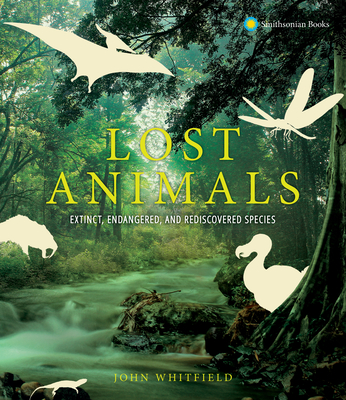
Meet the incredible animals that have disappeared due to competition, mass extinctions, hunting, and human activity.
Lost Animals brings back to life some of the most charismatic creatures to inhabit the planet. It captures the imagination with more than 200 incredible photographs, artworks of fossils, and scientific drawings of charming creatures like dodos, paraceratherium (the largest land mammal), spinosaurus (the biggest carnivorous dinosaur), placeoderm fishes (the sharks of their day), and more!
Lost Animals is a captivating documentation of evolution and extinction. Each chapter focuses on a specific time in Earth's history, from the Cambrian explosion (the most intense surge of evolution the world has ever experienced) to present times, with profiles of the key species that lived then. From long extinct animals to Lazarus species--animals that were thought to be extinct before being rediscovered--this book takes readers on a journey through Earth's natural history, highlighting the world's biggest animal losses and its moments of conservational hope.
Lost Animals: The Story of Extinct, Endangered, and Rediscovered Species is a fantastic and gorgeous book by John Whitfield and published through the Smithsonian Institute. This book contains gorgeous pictures and detailed descriptions of some of Life's most interesting and amazing creatures. The book starts in the Cambrian, and works its way up to the endangered species of modern times. Some fascinating creatures abound, from a massive Rhinoceros that towered above the trees, to a five eyed shrimp-like creatures that looked so strange, a panel of scientists burst out in laughter upon seeing it. The book also looks at some of human's earliest ancestors, and discusses how modern humans may have interbred with other species of humans to create roughly what we are today. The world of the past looked so much different, and this book excels at not only showing us the wonder and mystery of prehistory, but also made this reader speculate of humanities place on this Earth, the niches we inhabited, and the way our brains developed to serve us in gathering and hunting food, and how this applies to and is completely related to how we live our modern lives. Modern humans are only 10000 years old, a blip in the evolutionary timescale - we have not developed much past what we would have been as a symbiotic part of the ecosystem. Even so, the way we gather, think and act has had such an impact on this Earth, that it is posited we are ushering in a sixth extinction event, and we may have been responsible for the disappearance of mega-fauna in the recent past. All in all, a fantastic read. Quick, engaging, great pictures, and some fascinating commentary.
Given the subject matter, not a book for anyone suffering from severe FOMO. Much like our exploration of the limitless expanse of space, travelling back through our distant past serves just as much to highlight what we don’t know as what we do. Fascinating stuff regardless.
Lost Animals: The Story of Extinct, Endangered and Rediscovered Species by John Whitfield is a gorgeous coffee table style book. It is a captivating documentation of animal life, evolution and extinction from prehistory to present day.
It is broken up into 6 major sections: Early Animals Onto Land The Age of the Dinosaurs The Rise of Mammals The Arrival of Humans The Last Millennium
Each section has a brief introduction, with the time period that it is covering followed by some of the creatures that inhabited the world during this time. On each brief summary of the creature in question there is the period of time it lived, where it lived and the size as well as an illustration, photo or visual depiction of what it (may have) looked like. Great book to page through for curious minds!
A lovely big coffee table type book that I though was going out of style. Not really useful as a reference book, or a photo book, or as stories of lost animals. Not sure why the author chose certain species and not others. But I enjoyed leafing through, reading the information, looking at the renderings of lost creatures. Probably the ape/monkey section interested me most.
Loved this book. It gives an overview of some of the species that have been and gone or are in danger of extinction, from the Cambrian to the present. The illustrations are lovely although some are sad, like the Tasmanian tiger or the dodo. The text is informative but it's not meant as an in-depth scientific book.
I loved this book! I’m a hopeful future archaeologist and this book was a great introduction to many species and eras that I hadn’t explored yet! I loved the layout and the material, it was a wonderful experience and I will have this book proudly on display!
Too much stuff about human ancestry for my tastes, would've been better if the whole book was half the size it was and double the pages so more animals (and why not even plants) would've fit in the book. Pictures were nice though.
The book is informative and it's great easy reading but it is veryyy simplified and concise, only mentioning some key fossil discoveries. It was great up until the point it said the Huia was an extinct Hawaiian bird species - it's not, it was a New Zealand endemic bird. A slight oversight but the book lost a little bit of credibility for that. This is more of a book for paleontology enthusiasts and kids/teens as opposed to a textbook to reference from. Filled with plenty of illustrations though which I love.