

What do you think?

Los templarios: Auge y caída de los guerreros de Dios
La historia definitiva de la Orden del Temple
Jerusalén, 1119. Tras la violencia de la Primera Cruzada, un pequeño grupo de caballeros en busca de redención decide fundar una nueva orden religiosa con el objetivo de proteger a los peregrinos cristianos en sus viajes a Tierra Santa. Desde este humilde origen, los templarios crecerían durante los siguientes dos siglos hasta convertirse en la orden religiosa más rica y poderosa de la cristiandad. Su espectacular final, cuando un rey envidioso los acusó de herejía, blasfemia y orgías, no hizo sino acrecentar su leyenda, que perdura hasta nuestros días.
Dan Jones aborda la trepidante historia de la Orden del Temple, entrelazada con las cruzadas en Tierra Santa y en España, y crea con su elegante prosa un retrato fidedigno y vívido de los templarios, desde sus combates ataviados con sus icónicas túnicas blancas con una gran cruz roja, hasta la sofisticada red financiera que tejieron en toda Europa, donde gozaron de notables privilegios y del favor de reyes, nobles, papas y emperadores.
Esta es una historia épica de guerra, religión, dinero y poder, cuyo sorprendente desenlace, el famoso viernes 13 de 1312, constituye uno de los momentos más fascinantes de la historia medieval.
Jerusalén, 1119. Tras la violencia de la Primera Cruzada, un pequeño grupo de caballeros en busca de redención decide fundar una nueva orden religiosa con el objetivo de proteger a los peregrinos cristianos en sus viajes a Tierra Santa. Desde este humilde origen, los templarios crecerían durante los siguientes dos siglos hasta convertirse en la orden religiosa más rica y poderosa de la cristiandad. Su espectacular final, cuando un rey envidioso los acusó de herejía, blasfemia y orgías, no hizo sino acrecentar su leyenda, que perdura hasta nuestros días.
Dan Jones aborda la trepidante historia de la Orden del Temple, entrelazada con las cruzadas en Tierra Santa y en España, y crea con su elegante prosa un retrato fidedigno y vívido de los templarios, desde sus combates ataviados con sus icónicas túnicas blancas con una gran cruz roja, hasta la sofisticada red financiera que tejieron en toda Europa, donde gozaron de notables privilegios y del favor de reyes, nobles, papas y emperadores.
Esta es una historia épica de guerra, religión, dinero y poder, cuyo sorprendente desenlace, el famoso viernes 13 de 1312, constituye uno de los momentos más fascinantes de la historia medieval.
512 pages, Hardcover
First published September 19, 2017
About the author
Dan Jones
81 books6,091 followersDan Jones is a NYT bestselling author and broadcaster. His books, which include The Templars, Henry V, The Plantagenets and Powers & Thrones, have sold more than 2 million copies and are published in 23 languages. He is the author of the Essex Dogs novel trilogy. Dan writes and hosts the popular weekly Sony Music Entertainment podcast This Is History. He has presented dozens of television documentaries, including the popular Netflix series Secrets of Great British Castles, and has executive produced and consulted on a number of films and television shows including Anne Boleyn (Channel 5/Sony Pictures Television) and Knightfall (A+E/History). His journalism has appeared in the New York Times, Wall Street Journal and Washington Post; for a decade he was a columnist for the London Evening Standard. He is a Fellow of the Royal Historical Society and in 2025 was appointed to the Board of Trustees of Historic Royal Palaces.
Ratings & Reviews
Friends & Following
Create a free account to discover what your friends think of this book!
Community Reviews
Displaying 1 - 30 of 1,299 reviews

September 5, 2017
When you read non-fiction, you (hopefully) learn something about the world around you (if you don’t, you might want to consider finding better non-fiction to read, unless you’re Stephen Hawking reading a Physics for Dummies book).
Sometimes, though, you also learn something about yourself. That something might be the fact that you scream like a wolf whose leg just got severed by a steel trap when you get a paper cut trying to flip through those damn picture pages they stick in the middle of the book, or it might be the fact that you cry like a paid Victorian mourner when you read something tragic (like the fact that Michael J. Fox’s middle name is, in fact, Andrew, and he just made up the J).
Or, it just might be the fact that, as you’ve gotten older, and as the world around you grows increasingly dark and intolerant, you’ve lost some of your appetite for reading about a time when the world was, well, very dark and intolerant.
There was a time—a time that peaked around 15 years ago—when I was obsessed with medieval history. Knights, castles, Dark Ages, Crusades, Templars…all were grist for my mind mill (incidentally, I do not recommend the bread that gets made from that mill; it tastes a little bit like salty lamentation mixed with bitter regret…not too bad with butter, though, especially if it’s honey butter…mmmm…honey butter).
In recent years, however, though my thirst for a good historical tome remains undiminished, I’ve taken less and less pleasure in visiting medieval times (though I still adore theme restaurant Medieval Times, if only because I find drinking out of tankards while consuming an entire turkey leg and lustily rooting for a dirty-goateed “knight” whose accent strongly suggests an origin in ye olde southern tip of Maryland highly satisfying). In a world where religion (inexplicably) continues to tear us apart and we try to destroy or harm that which we define as “other,” it depresses me to read about us doing exactly that some 700 years ago—the only difference is that now we have access to weapons that can kill a LOT more people with considerably greater efficiency.
Despite that, I decided to pick up The Templars: The Rise and Spectacular Fall of God's Holy Warriors, if only because that lovably saucy lot of grail-guarding, cross-trampling, belly button-kissing miscreants has always stoked the fires of my imagination (check that: legends, tall tales, and conspiracy theories about the Templars have mostly fired my imagination; outside of the Templars downfall, their true history is less fascinating). I’ve read a few books about the Templars, and I’d put Jones’s book in the upper echelon—it’s cogent, comprehensive, and well-crafted, even if it drags on occasion. It’s well worth the time to read—and it will take some time, as it’s a dense book—if you’re a medieval history buff or Templar aficionado.
As I watched the world burn around me (literally, in the case of California) as I read, however, I just couldn’t muster up the same enthusiasm I could once conjure for scenes of brave knights riding boldly into battle on mighty steeds, intent on vanquishing the infidel. For one, I now realize that there was absolutely no rational reason for vanquishing said infidels, and “infidel” is all a matter of perspective. Not a single death that resulted from the Crusades on any side of a battle was warranted, and I read accounts of those conflicts now not as stirring epics but rather as sad and horribly displays of small-mindedness.
And then I just get frustrated and want to start kicking knights in the knuts, only to think better of it on account of my sensitive toes.
Suffice it to say, this is an objectively well written and conceived book. But, I’m not sure I want to dive back into the world of the Templars—or any of their contemporaries—anytime soon.
Maybe I’ll turn my attention to the Founding Fathers. They always…wait, they did what? To whom??
Sigh.
Back to fiction I go…
Sometimes, though, you also learn something about yourself. That something might be the fact that you scream like a wolf whose leg just got severed by a steel trap when you get a paper cut trying to flip through those damn picture pages they stick in the middle of the book, or it might be the fact that you cry like a paid Victorian mourner when you read something tragic (like the fact that Michael J. Fox’s middle name is, in fact, Andrew, and he just made up the J).
Or, it just might be the fact that, as you’ve gotten older, and as the world around you grows increasingly dark and intolerant, you’ve lost some of your appetite for reading about a time when the world was, well, very dark and intolerant.
There was a time—a time that peaked around 15 years ago—when I was obsessed with medieval history. Knights, castles, Dark Ages, Crusades, Templars…all were grist for my mind mill (incidentally, I do not recommend the bread that gets made from that mill; it tastes a little bit like salty lamentation mixed with bitter regret…not too bad with butter, though, especially if it’s honey butter…mmmm…honey butter).
In recent years, however, though my thirst for a good historical tome remains undiminished, I’ve taken less and less pleasure in visiting medieval times (though I still adore theme restaurant Medieval Times, if only because I find drinking out of tankards while consuming an entire turkey leg and lustily rooting for a dirty-goateed “knight” whose accent strongly suggests an origin in ye olde southern tip of Maryland highly satisfying). In a world where religion (inexplicably) continues to tear us apart and we try to destroy or harm that which we define as “other,” it depresses me to read about us doing exactly that some 700 years ago—the only difference is that now we have access to weapons that can kill a LOT more people with considerably greater efficiency.
Despite that, I decided to pick up The Templars: The Rise and Spectacular Fall of God's Holy Warriors, if only because that lovably saucy lot of grail-guarding, cross-trampling, belly button-kissing miscreants has always stoked the fires of my imagination (check that: legends, tall tales, and conspiracy theories about the Templars have mostly fired my imagination; outside of the Templars downfall, their true history is less fascinating). I’ve read a few books about the Templars, and I’d put Jones’s book in the upper echelon—it’s cogent, comprehensive, and well-crafted, even if it drags on occasion. It’s well worth the time to read—and it will take some time, as it’s a dense book—if you’re a medieval history buff or Templar aficionado.
As I watched the world burn around me (literally, in the case of California) as I read, however, I just couldn’t muster up the same enthusiasm I could once conjure for scenes of brave knights riding boldly into battle on mighty steeds, intent on vanquishing the infidel. For one, I now realize that there was absolutely no rational reason for vanquishing said infidels, and “infidel” is all a matter of perspective. Not a single death that resulted from the Crusades on any side of a battle was warranted, and I read accounts of those conflicts now not as stirring epics but rather as sad and horribly displays of small-mindedness.
And then I just get frustrated and want to start kicking knights in the knuts, only to think better of it on account of my sensitive toes.
Suffice it to say, this is an objectively well written and conceived book. But, I’m not sure I want to dive back into the world of the Templars—or any of their contemporaries—anytime soon.
Maybe I’ll turn my attention to the Founding Fathers. They always…wait, they did what? To whom??
Sigh.
Back to fiction I go…

October 27, 2017
”It was exactly a century since Hugh of Payns had established the Order of the Poor Knights of the Temple of Solomon in Jerusalem. Those one hundred years had seen the Templars transformed from indigent shepherds of the pilgrim roads, dependent on the charity of fellow pilgrims for their food and clothes, into a borderless, self-sustaining paramilitary group funded by large-scale estate management.”
Hugh of Payns
HUGH OF PAYNS, doesn’t the name itself evoke some chainmail wrapped Conan the Barbarian or He-Man type character? The order had certainly changed from the days of Hugh by the time of that fateful date of October 13th, 1307, but as I read through Dan Jones’s account of their history, I’m left with the feeling that, though they became more bankers than shepherds, their original cause of returning the Holy Land to Christian control still remained their primary goal.
Hugh saw a need for knights to protect the pilgrims who were flocking to Jerusalem after the First Crusade liberated that city in 1099. These pilgrims were being routinely slaughtered, sometimes by the hundreds, by roving bands of bandits. Hugh and a handful of knights saw it as their Christian duty to protect these defenseless Christians.
The Knights Templar are born.
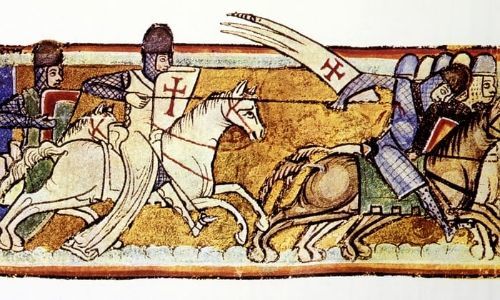
The Crusades were expensive frolics in the Middle East, not only in financial terms but in loss of life. Frederick II of Prussia dilly dallied as long as he could from fulfilling his vow of going on crusade. Only after being excommunicated did he finally go on the Sixth Crusade. He was much more concerned with pursuing the pleasures of life than he was about rescuing the Holy Lands. Richard the Lionheart of England enjoyed being on campaign. Reading about his life is a story of war since the age of 16. While on the Third Crusade, he became very ill, but he still had his men bring him out on a stretcher so he could launch crossbow bolts at the enemy. A man’s man certainly, a natural leader of men. The crusader king who plays such a large role in the spectacular fall of the Knights Templar is Philip the IV of France.
We will come back to him.
The Knights Templar were simply fearless. They took their roles as knights of God very seriously. They lived in poverty so they could better serve their God. The order itself was far from poor, as money from lands they acquired by donations or by investment were piling up an impressive income. They fought to the death with strict rules governing them to stay in place around their flag until the final knight fell. This happened too often, as their opponents were also ferocious fighters led by celebrated and, in many cases, ruthless leaders, such as Zengi, Nur al-Din, Saladin, and Baybars. By the late 13th century, the Templar power waned as interest in the Crusades faded in Europe after several Christian defeats at the hands of the Muslims.
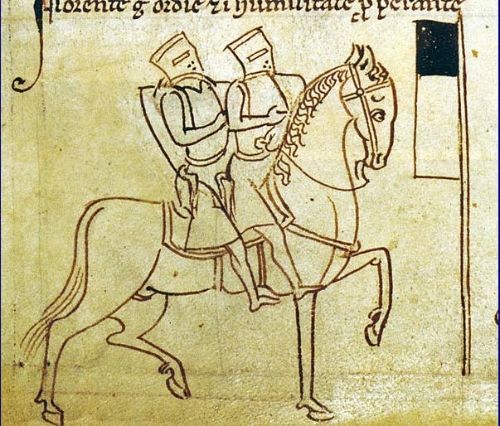
The symbol of two knights on a horse were often used by the Templars to show their poverty and piety. The Piebald flag led them into battle.
The Knights Templars lived by 25 decrees, which mostly seemed to focus on matters of sex. ”Declarations were made against sins including adultery, sodomy, bigamy, pimping, prostitution, theft and sexual relations with Muslims, for which the prescribed punishments ranged from penance and exile to castration and nose slicing.” I always think of Jack Nicholson’s nose in Chinatown whenever I see nose slicing mentioned in the history books I read. *Shiver* Oh, and women, they are just bad news. Templars were not even allowed to hug or kiss their own mothers for fear of...contamination???
They were men dedicated to their service.
So, Philip the IV, or Philip the Fair as he was called because he was tall, well proportioned, and attractive (I just want to be clear that Fair referred to his appearance, not to his actions), was desperate for money. He was a spendthrift. He’d already kicked the Jews out of France and confiscated their property and took over collecting the money that had been lent by the Jews to other Frenchmen. He had angered the Catholic Church by trying to impose a tax upon the clergy. He had borrowed money from rich merchants and had them expelled from France so he could confiscate their property...oh, and not have to pay back those loans. Another organization that he owed a lot of money to was the Templars. They had financed his attempts at Crusade, and those sums were massive amounts. Much more than what Philip would ever want to pay back.
Philip couldn’t just expel the Templars like he did the Jews and the Lombard merchants. They were servants of the Pope, but since he owned Clement V, he knew he would get his way. On October 13th, 1307, the Templars were arrested on charges of heresy, which they naturally denied.
Denials are not a problem.
”The papal Inquisition largely employed the mendicant preaching orders--the Dominicans and Franciscans--as inquisitors. These men tended to combine solid knowledge of approved Church teachings with a self-selecting interest in sufferings of the flesh and, occasionally, an outright taste for violence. In 1307 they knew what they were doing, and they knew what they were looking for.”
Confessions had to match the accusations.
No man is immune to torture, but I must say those Templar Knights were strong and brave to the end. Philip the Fair does not escape this treachery unscathed. Jacques de Molay, the last Templar grand master, casts a final curse upon those who condemned his Order. ”Let evil swiftly befall those who have wrongly condemned us - God will avenge us.”

Dan Jones is a very engaging story teller. I have enjoyed his books on the Plantagenets, as well as his historical TV documentaries. He had me swinging a sword at the gates of Jerusalem and looking with disdain at an dishonorable King of France. I knew a lot about the Templars, but Jones really filled in some gaps for me and added to my overall knowledge and respect for the order. After finishing this book, I picked up the book Monsieur by Lawrence Durrell, and the character who has just “killed” himself described himself as the Last Templar Knight. I love it when stuff like that happens.
If you wish to see more of my most recent book and movie reviews, visit http://www.jeffreykeeten.com
I also have a Facebook blogger page at:https://www.facebook.com/JeffreyKeeten

Hugh of Payns
HUGH OF PAYNS, doesn’t the name itself evoke some chainmail wrapped Conan the Barbarian or He-Man type character? The order had certainly changed from the days of Hugh by the time of that fateful date of October 13th, 1307, but as I read through Dan Jones’s account of their history, I’m left with the feeling that, though they became more bankers than shepherds, their original cause of returning the Holy Land to Christian control still remained their primary goal.
Hugh saw a need for knights to protect the pilgrims who were flocking to Jerusalem after the First Crusade liberated that city in 1099. These pilgrims were being routinely slaughtered, sometimes by the hundreds, by roving bands of bandits. Hugh and a handful of knights saw it as their Christian duty to protect these defenseless Christians.
The Knights Templar are born.

The Crusades were expensive frolics in the Middle East, not only in financial terms but in loss of life. Frederick II of Prussia dilly dallied as long as he could from fulfilling his vow of going on crusade. Only after being excommunicated did he finally go on the Sixth Crusade. He was much more concerned with pursuing the pleasures of life than he was about rescuing the Holy Lands. Richard the Lionheart of England enjoyed being on campaign. Reading about his life is a story of war since the age of 16. While on the Third Crusade, he became very ill, but he still had his men bring him out on a stretcher so he could launch crossbow bolts at the enemy. A man’s man certainly, a natural leader of men. The crusader king who plays such a large role in the spectacular fall of the Knights Templar is Philip the IV of France.
We will come back to him.
The Knights Templar were simply fearless. They took their roles as knights of God very seriously. They lived in poverty so they could better serve their God. The order itself was far from poor, as money from lands they acquired by donations or by investment were piling up an impressive income. They fought to the death with strict rules governing them to stay in place around their flag until the final knight fell. This happened too often, as their opponents were also ferocious fighters led by celebrated and, in many cases, ruthless leaders, such as Zengi, Nur al-Din, Saladin, and Baybars. By the late 13th century, the Templar power waned as interest in the Crusades faded in Europe after several Christian defeats at the hands of the Muslims.

The symbol of two knights on a horse were often used by the Templars to show their poverty and piety. The Piebald flag led them into battle.
The Knights Templars lived by 25 decrees, which mostly seemed to focus on matters of sex. ”Declarations were made against sins including adultery, sodomy, bigamy, pimping, prostitution, theft and sexual relations with Muslims, for which the prescribed punishments ranged from penance and exile to castration and nose slicing.” I always think of Jack Nicholson’s nose in Chinatown whenever I see nose slicing mentioned in the history books I read. *Shiver* Oh, and women, they are just bad news. Templars were not even allowed to hug or kiss their own mothers for fear of...contamination???
They were men dedicated to their service.
So, Philip the IV, or Philip the Fair as he was called because he was tall, well proportioned, and attractive (I just want to be clear that Fair referred to his appearance, not to his actions), was desperate for money. He was a spendthrift. He’d already kicked the Jews out of France and confiscated their property and took over collecting the money that had been lent by the Jews to other Frenchmen. He had angered the Catholic Church by trying to impose a tax upon the clergy. He had borrowed money from rich merchants and had them expelled from France so he could confiscate their property...oh, and not have to pay back those loans. Another organization that he owed a lot of money to was the Templars. They had financed his attempts at Crusade, and those sums were massive amounts. Much more than what Philip would ever want to pay back.
Philip couldn’t just expel the Templars like he did the Jews and the Lombard merchants. They were servants of the Pope, but since he owned Clement V, he knew he would get his way. On October 13th, 1307, the Templars were arrested on charges of heresy, which they naturally denied.
Denials are not a problem.
”The papal Inquisition largely employed the mendicant preaching orders--the Dominicans and Franciscans--as inquisitors. These men tended to combine solid knowledge of approved Church teachings with a self-selecting interest in sufferings of the flesh and, occasionally, an outright taste for violence. In 1307 they knew what they were doing, and they knew what they were looking for.”
Confessions had to match the accusations.
No man is immune to torture, but I must say those Templar Knights were strong and brave to the end. Philip the Fair does not escape this treachery unscathed. Jacques de Molay, the last Templar grand master, casts a final curse upon those who condemned his Order. ”Let evil swiftly befall those who have wrongly condemned us - God will avenge us.”

Dan Jones is a very engaging story teller. I have enjoyed his books on the Plantagenets, as well as his historical TV documentaries. He had me swinging a sword at the gates of Jerusalem and looking with disdain at an dishonorable King of France. I knew a lot about the Templars, but Jones really filled in some gaps for me and added to my overall knowledge and respect for the order. After finishing this book, I picked up the book Monsieur by Lawrence Durrell, and the character who has just “killed” himself described himself as the Last Templar Knight. I love it when stuff like that happens.
If you wish to see more of my most recent book and movie reviews, visit http://www.jeffreykeeten.com
I also have a Facebook blogger page at:https://www.facebook.com/JeffreyKeeten

August 26, 2019
"Often the end fails to equal the beginning."
Medieval proverb
A proverb that perfectly chronicles the rise and fall of The Templars, a monastic order combined with the profession of the soldier. Divided into four parts, the reader follows the Templars from the beginning when they were just small group, seeking approval and rules, from the Pope, to the end when they were rich and powerful. Powerful and rich enough to become the object of a take down engineered by the French monarch, Phillip the Fair.
Though I did wish for more information on the daily lives of the Templars, I did learn much about their battles, their accumulation of wealth and status, and how they lost and regained these, over and over again. What a horribly bloody time, beheadings, constant wars with Saladan and a changing Christiandom. At one time they were basically given carte blanche from Popes and Kings. Bankers, holding the money of the same. Interesting and informative, narrated very well by the author himself.
Medieval proverb
A proverb that perfectly chronicles the rise and fall of The Templars, a monastic order combined with the profession of the soldier. Divided into four parts, the reader follows the Templars from the beginning when they were just small group, seeking approval and rules, from the Pope, to the end when they were rich and powerful. Powerful and rich enough to become the object of a take down engineered by the French monarch, Phillip the Fair.
Though I did wish for more information on the daily lives of the Templars, I did learn much about their battles, their accumulation of wealth and status, and how they lost and regained these, over and over again. What a horribly bloody time, beheadings, constant wars with Saladan and a changing Christiandom. At one time they were basically given carte blanche from Popes and Kings. Bankers, holding the money of the same. Interesting and informative, narrated very well by the author himself.

August 15, 2019
I knew very little about the Templars when I went into this book. One’s perception of a non-fiction book is influenced by what you know beforehand and one’s personal preferences.
I have found The Templars: The Rise and Spectacular Fall of God's Holy Warriors to be informative, clear and well structured. It moves forward chronologically, starting with the origin of the Order of the Knights Templar--in 1119 the French knight Hugues de Payens spoke with King Baldwin II in Jerusalem about establishing an order of men to assist and protect the pilgrims flowing into the Holy Lands. Crusade by crusade, each siege and battle are depicted in detail. The book concludes with King Philip IV’s and Pope Clement V’s crushing of the order during the years 1307 to 1314. By the third decade of the 14th century the order ceased to exist, except in myths and literature. In the epilog, even this is discussed. The Arthurian tales and poems begun by Chrétien de Troyes and Wolfram von Eschenbach live on today in contemporary works. Dan Brown’s The Da Vinci Code is but one example. Consider what has been written about Richard the Lionhearted and the Third Crusade!
The book is split into four parts—Pilgrims, Soldiers, Bankers and Heretics. This follows the development the order as it altered with time. The first three parts are all tied directly to the crusades and military engagements. The fourth and last part is concerned with the order’s ultimate destruction and end. Heretics was the section I liked best. In this part, the focus shifts from the military to international political, financial and religious causes behind the order’s demise.
I found the copious details depicting sieges, battles and gruesome beheadings, i.e. the military engagements, tiring. Names and places became a blur. The battles are grisly. Listening, I could not quickly flip to a map. These are available in the printed book.
Am I glad I read the book? Definitely! With the knowledge I have now I probably would enjoy it even more with a second reading. It is difficult to learn about so many people and events all at once. It helps to recognize who is who. Each reading gives you more.
When discussing contentious topics and when different views are voiced, the author examines the veracity of opposing views. I appreciate this. He explains pedagogically, and he is clear.
The author, Dan Jones, narrates the audiobook, and he does this very well. Few authors can both write a good book and then read it well too. His narration has the perfect speed and is consistently easy to follow. I have given the narration four stars.
I feel this book is a good choice not only for those new to the field but also those readers who wish to build on their previous knowledge concerning the crusades, the involvement of the Roman Catholic Church, the Templar and Hospitaller Knights and the leaders reigning during the 1100s to 1300s, the two centuries when the Templars held sway.
I have found The Templars: The Rise and Spectacular Fall of God's Holy Warriors to be informative, clear and well structured. It moves forward chronologically, starting with the origin of the Order of the Knights Templar--in 1119 the French knight Hugues de Payens spoke with King Baldwin II in Jerusalem about establishing an order of men to assist and protect the pilgrims flowing into the Holy Lands. Crusade by crusade, each siege and battle are depicted in detail. The book concludes with King Philip IV’s and Pope Clement V’s crushing of the order during the years 1307 to 1314. By the third decade of the 14th century the order ceased to exist, except in myths and literature. In the epilog, even this is discussed. The Arthurian tales and poems begun by Chrétien de Troyes and Wolfram von Eschenbach live on today in contemporary works. Dan Brown’s The Da Vinci Code is but one example. Consider what has been written about Richard the Lionhearted and the Third Crusade!
The book is split into four parts—Pilgrims, Soldiers, Bankers and Heretics. This follows the development the order as it altered with time. The first three parts are all tied directly to the crusades and military engagements. The fourth and last part is concerned with the order’s ultimate destruction and end. Heretics was the section I liked best. In this part, the focus shifts from the military to international political, financial and religious causes behind the order’s demise.
I found the copious details depicting sieges, battles and gruesome beheadings, i.e. the military engagements, tiring. Names and places became a blur. The battles are grisly. Listening, I could not quickly flip to a map. These are available in the printed book.
Am I glad I read the book? Definitely! With the knowledge I have now I probably would enjoy it even more with a second reading. It is difficult to learn about so many people and events all at once. It helps to recognize who is who. Each reading gives you more.
When discussing contentious topics and when different views are voiced, the author examines the veracity of opposing views. I appreciate this. He explains pedagogically, and he is clear.
The author, Dan Jones, narrates the audiobook, and he does this very well. Few authors can both write a good book and then read it well too. His narration has the perfect speed and is consistently easy to follow. I have given the narration four stars.
I feel this book is a good choice not only for those new to the field but also those readers who wish to build on their previous knowledge concerning the crusades, the involvement of the Roman Catholic Church, the Templar and Hospitaller Knights and the leaders reigning during the 1100s to 1300s, the two centuries when the Templars held sway.

July 2, 2020
Os Cavaleiros de Cristo
Templários — quem foram eles?
Heróis, Mártires, Bandidos, Criminosos, Hereges, Pervertidos, Vítimas, Subversivos, Guardiões do Santo Graal, Viajantes do Tempo... são múltiplas e variadas as formas como são descritos e apresentados estes guerreiros religiosos.
Começaram como um humilde grupo de escolta de peregrinos à Terra Santa e acabaram como uma organização rica, influente e poderosa. Financiaram guerras, ergueram castelos, arrasaram cidades, coroaram Reis...
Intitulavam-se Cavaleiros de Cristo (se Cristo soubesse, era bem capaz de ressuscitar outra vez!!), envergavam uniformes brancos (que significavam pureza e castidade total) e a cruz vermelha que ostentavam simbolizava o sangue em seu nome derramado. Eram uma horda de assassinos consentidos, pois chacinar “pagãos sem crença” ou “inimigos do Filho da Virgem Maria” era “um ato merecedor de louvor divino e não de condenação”.
“Não a nós, ó Senhor, não a nós, mas ao teu nome dá glória, pelo teu amor e fidelidade.”
Numa narrativa que informa e entretém, Os Templários relata uma história onde a Verdade supera a Lenda. Desfrutem da viagem!
Templários — quem foram eles?
Heróis, Mártires, Bandidos, Criminosos, Hereges, Pervertidos, Vítimas, Subversivos, Guardiões do Santo Graal, Viajantes do Tempo... são múltiplas e variadas as formas como são descritos e apresentados estes guerreiros religiosos.
Começaram como um humilde grupo de escolta de peregrinos à Terra Santa e acabaram como uma organização rica, influente e poderosa. Financiaram guerras, ergueram castelos, arrasaram cidades, coroaram Reis...
Intitulavam-se Cavaleiros de Cristo (se Cristo soubesse, era bem capaz de ressuscitar outra vez!!), envergavam uniformes brancos (que significavam pureza e castidade total) e a cruz vermelha que ostentavam simbolizava o sangue em seu nome derramado. Eram uma horda de assassinos consentidos, pois chacinar “pagãos sem crença” ou “inimigos do Filho da Virgem Maria” era “um ato merecedor de louvor divino e não de condenação”.
“Não a nós, ó Senhor, não a nós, mas ao teu nome dá glória, pelo teu amor e fidelidade.”
Numa narrativa que informa e entretém, Os Templários relata uma história onde a Verdade supera a Lenda. Desfrutem da viagem!

November 29, 2017
A great treatment of a truly spectacular legend/horrorshow.
The story of the Templar Knights is gloriously varied, complex, courageous, insane, praiseworthy, mysterious, and tragic. It's primarily a history about the five Crusades and chivalry, but it becomes a harrowing monstrosity by the time King Phillipe enacts his vendetta against the Order.
I simplify. There's two hundred years worth of fascinating and edge-of-the-seat crusader action going on here as well as a farce of a trial that cut the head off of the first International Bank that the Templars had become for the sake of stealing its wealth.
Of course, all the Templars COULD have been telling the truth after years of torture in dungeons extracting confessions that they were kissing bejeweled bearded heads and penises before and after spitting and trampling across the cross. But... Yeah... That's reasonable.
Dan Brown does a damn good job with the narration, adding bright anecdotes wherever he could.
My only complaint is the summary single-line dismissals in the epilogue for ALL "What Happened Afterward" theories. Whole popular books like Holy Blood, Holy Grail: The Secret History of Jesus, the Shocking Legacy of the Grail, The Da Vinci Code, and even Umberto Eco's satire Foucault's Pendulum were given nothing more a few words equivalent to a spit and a trample.
The first was a genuine investigation that might not have panned out with further study, the second was a popular novel that leaves the decision to believe on us, and the third was a funny, sharp-as-nails tongue-in-cheek satire making fun of ALL conspiracies while being erudite at the same time.
Dan Jones could have just kept his history focused on the actual history rather than mentioning, rather dismissively, a rather enormous library of works devoted to the mystery of the Templar Knights and "What Happened Afterward". His opinions in the epilogue are just that. Unsubstantiated opinions. Literally. Single-line dismissals. It mars what was otherwise a fantastic recounting of factual history, even if a lot of the history remains mysterious and missing.
History does require a narrative for us to make sense of it. What Jones left out was the immense amount of learning, from science to history, the exchange of cultures between these two Holy War combatants across the centuries. We are also missing any possible deeper significance to what amounts to the bankrupting of whole nations to retake the Holy Land during a time of plague. It reads like nations preparing for the Olympics or a bloody Football League. WHY would so many resources be thrown at this Search for the Holy Grail?
Oh, wait, see what I did there? I used a metaphor for the whole purpose of the Crusades to illustrate that for a lot of the people there, it was LITERALLY the Search for the Holy Grail.
Narrative. See? Skip the narrative and all you have are a bunch of Monks With Swords aiming to get killed for the Glory of God. Nothing more. It doesn't exactly inspire my imagination. I'm sure the motivations were as varied among the Templars as they would be across any person alive.
Anyway. lol
The story of the Templar Knights is gloriously varied, complex, courageous, insane, praiseworthy, mysterious, and tragic. It's primarily a history about the five Crusades and chivalry, but it becomes a harrowing monstrosity by the time King Phillipe enacts his vendetta against the Order.
I simplify. There's two hundred years worth of fascinating and edge-of-the-seat crusader action going on here as well as a farce of a trial that cut the head off of the first International Bank that the Templars had become for the sake of stealing its wealth.
Of course, all the Templars COULD have been telling the truth after years of torture in dungeons extracting confessions that they were kissing bejeweled bearded heads and penises before and after spitting and trampling across the cross. But... Yeah... That's reasonable.
Dan Brown does a damn good job with the narration, adding bright anecdotes wherever he could.
My only complaint is the summary single-line dismissals in the epilogue for ALL "What Happened Afterward" theories. Whole popular books like Holy Blood, Holy Grail: The Secret History of Jesus, the Shocking Legacy of the Grail, The Da Vinci Code, and even Umberto Eco's satire Foucault's Pendulum were given nothing more a few words equivalent to a spit and a trample.
The first was a genuine investigation that might not have panned out with further study, the second was a popular novel that leaves the decision to believe on us, and the third was a funny, sharp-as-nails tongue-in-cheek satire making fun of ALL conspiracies while being erudite at the same time.
Dan Jones could have just kept his history focused on the actual history rather than mentioning, rather dismissively, a rather enormous library of works devoted to the mystery of the Templar Knights and "What Happened Afterward". His opinions in the epilogue are just that. Unsubstantiated opinions. Literally. Single-line dismissals. It mars what was otherwise a fantastic recounting of factual history, even if a lot of the history remains mysterious and missing.
History does require a narrative for us to make sense of it. What Jones left out was the immense amount of learning, from science to history, the exchange of cultures between these two Holy War combatants across the centuries. We are also missing any possible deeper significance to what amounts to the bankrupting of whole nations to retake the Holy Land during a time of plague. It reads like nations preparing for the Olympics or a bloody Football League. WHY would so many resources be thrown at this Search for the Holy Grail?
Oh, wait, see what I did there? I used a metaphor for the whole purpose of the Crusades to illustrate that for a lot of the people there, it was LITERALLY the Search for the Holy Grail.
Narrative. See? Skip the narrative and all you have are a bunch of Monks With Swords aiming to get killed for the Glory of God. Nothing more. It doesn't exactly inspire my imagination. I'm sure the motivations were as varied among the Templars as they would be across any person alive.
Anyway. lol

October 21, 2017
Clear, readable history

May 17, 2018
Non nobis, Domine, non nobis, sed nomini tuo da gloriam!
Not unto us, o Lord, not unto us, but unto your name grant glory!
The Knights Templars is perhaps the most well-known military order of the medieval era. The Templars traces their origins in the aftermath of the First Crusade to their rise to spectacular rise as a feared & respected elite military force in the Holy Lands & the royal courts across Europe and to their eventual disbanding & persecution almost 200 years later.
The Knights Templars, formed in 1119 by the French knight Hugues de Payens, as a small group of knights seeking a purpose in the violent aftermath of the First Crusade. Their main purpose was to protect the Christian pilgrims visiting Holy Land from bandits who preyed upon pilgrims. Soon they had the sanction of the Pope and patronage of the major Kings of Europe. What began as a charity,dependent protective detail for European pilgrims and Christian holy sites, rapidly became the central figure across two centuries of Christian Europe’s holy war against the Islamic world. From the Second Crusade to The Seventh, the book covers all key events and battles forming part of the Crusades. The entire story from Templar's humble beginnings (1119–1144); their rise as military power (1144–1187); the consolidation of their economic, military, political, and social power (1189–1260); and finally their fall from grace (1260–1311). Though it revolves around role of the crusaders, other key figures of the Crusades like Richard the Lionhearted, Saladin to Frederick II and King Philip IV of France, all play an important role in the narrative. A short epilogue touches on the lasting cultural influence of the Templars.
The most striking part about this book is the extensive & in-depth research. The book contains several photos, maps and first-hand accounts from the times that help it make for a wonderful read. Jones explores centuries within a few hundred pages in an insightful way. If you know nothing of the Templars except what you have seen in movies or read in popular fiction, Jones offers up a delightful dose of reality that is no less fascinating than the myths surrounding this famed group.
Having said that, the narration often jumps from one crusade to another, skipping few years in between and hence feels a bit disjointed. The book starts in the aftermath of the First Crusade. So if you have little or no knowledge of The Crusades, you may feel a bit lost, especially in the earlier chapters. Jones categorically refuses to talk about: the dubious, the sensationalist and the paranormal. So if you looking to know more about the modern day myths surrounding the Templars, you will be disappointed and perhaps this book is not what you are looking for. Also, you may need some basic knowledge about the crusades to appreciate this book fully.
Overall The Templars can serve as a good introduction to the history of the Knights Templar. It can also provide a fresh look at familiar events for those who are well versed in the history of the Order. This is an engrossing examination of a period whose conflicts are still reverberating today.
Not unto us, o Lord, not unto us, but unto your name grant glory!
The Knights Templars is perhaps the most well-known military order of the medieval era. The Templars traces their origins in the aftermath of the First Crusade to their rise to spectacular rise as a feared & respected elite military force in the Holy Lands & the royal courts across Europe and to their eventual disbanding & persecution almost 200 years later.
The Knights Templars, formed in 1119 by the French knight Hugues de Payens, as a small group of knights seeking a purpose in the violent aftermath of the First Crusade. Their main purpose was to protect the Christian pilgrims visiting Holy Land from bandits who preyed upon pilgrims. Soon they had the sanction of the Pope and patronage of the major Kings of Europe. What began as a charity,dependent protective detail for European pilgrims and Christian holy sites, rapidly became the central figure across two centuries of Christian Europe’s holy war against the Islamic world. From the Second Crusade to The Seventh, the book covers all key events and battles forming part of the Crusades. The entire story from Templar's humble beginnings (1119–1144); their rise as military power (1144–1187); the consolidation of their economic, military, political, and social power (1189–1260); and finally their fall from grace (1260–1311). Though it revolves around role of the crusaders, other key figures of the Crusades like Richard the Lionhearted, Saladin to Frederick II and King Philip IV of France, all play an important role in the narrative. A short epilogue touches on the lasting cultural influence of the Templars.
The most striking part about this book is the extensive & in-depth research. The book contains several photos, maps and first-hand accounts from the times that help it make for a wonderful read. Jones explores centuries within a few hundred pages in an insightful way. If you know nothing of the Templars except what you have seen in movies or read in popular fiction, Jones offers up a delightful dose of reality that is no less fascinating than the myths surrounding this famed group.
Having said that, the narration often jumps from one crusade to another, skipping few years in between and hence feels a bit disjointed. The book starts in the aftermath of the First Crusade. So if you have little or no knowledge of The Crusades, you may feel a bit lost, especially in the earlier chapters. Jones categorically refuses to talk about: the dubious, the sensationalist and the paranormal. So if you looking to know more about the modern day myths surrounding the Templars, you will be disappointed and perhaps this book is not what you are looking for. Also, you may need some basic knowledge about the crusades to appreciate this book fully.
Overall The Templars can serve as a good introduction to the history of the Knights Templar. It can also provide a fresh look at familiar events for those who are well versed in the history of the Order. This is an engrossing examination of a period whose conflicts are still reverberating today.

October 20, 2017
Dan Jones is fast becoming one of my go-to authors on all things medieval. His previous books that I’ve read all cover British medieval history, from Henry I through the end of the Wars of the Roses. With “The Templars” he takes his pen and gives the reader a reasonably complete overview of the “Warrior Monks – The Poor Fellow Soldiers of Christ and of the Temple of Solomon, AKA the Templars. The narrative mainly unfolds chronologically with a few sidetracks. The author traces their history from the beginnings in 1119 as protectors of pilgrims to the Holy Land after the First Crusade to the Pope dissolving the order in 1312 after Phillip, the King of France, engineers their downfall in order to gain control of their wealth, roughly 200 yrs.
Any history of the Templars has to cover their military campaigns, Mr. Jones does not stint in this regard. He looks at how they became the Shock Troops of the Medieval Christian Armies in the Holy Land. Their discipline was something that most European armies of the era did not have. They followed the orders of their leaders to a fault, sometimes leading to disaster and sometimes to glory. The author looks at how a relatively few Templars, at their height there were appox 2000 knights, were able to hold the many castles guarding the invasion routes to the Holy Land and become the backbone of the Crusader Armies.
In addition to telling the story of their operations in the Holy Land, Mr. Jones also looks at what they were doing in other parts of Europe, esp the Iberian Peninsula. In telling this story, he looks at the beginnings of the Reconquista.
While not as in depth as the military side of the order, the author does look at how the Templars became the prototype for international banking. As the order gained power and more importantly prestige and wealth, travelers were able deposit their wealth at one Templar Facility, be issued a note and have that note redeemed at another, making the transporting of wealth both safer and easier.
As the crusades wound down and Christian defeats led to the end of the Christian kingdoms, the author looks at end of the order. With the fall of Acre in 1291 and the end of the formal Christian Kingdoms in the Outremer, the Templars were basically left without a purpose. Mr. Jones tells the story of the attempts to end the order. However, by this time they were much too powerful and rich to go quietly into the night. There were numerous attempts by church authorities to merge the two warrior orders – the Templars and the Hospitallers, but neither would agree to it. Finally a cash strapped King of France with a puppet for a pope was able to successfully press his charges of heresy, sexual impropriety among other things. Beginning of Friday, 13 Oct 1307, King Phillip arrested all the Templars n France he could get his hands on. In keeping with medieval “justice” they were tortured until confessing to the charges. After several years in captivity, many of the French Templars were finally burned at the stake and many recanted their confessions as they burned alive. Probably most famously the Grand Master after recanting his confession, and while tied to stake prophesied that he would shortly meet both the King and the Pope before God. The Pope dies about 1 month later and the King in less than a year. I found the story of the end of the order fascinating. The Pope did not want to accede to the Kings demands and actually absolved the Templars of all heresies. He was unable to temper the Kings wrath however. One other thing, the King did not get the Templars riches. When his troops attempted to seize the supposed wealth, it was nowhere to be found.
In addition to the important events in the history of the Templars, the author does a good job of explaining how they were organized, what oaths they took - including chastity and poverty, their manor of dress, and general the life they lived. In looking at how the order was organized, the author also looks at how the responsibilities were distributed between the major ranks of the order – Knight, Sergeants and Chaplains. The first two bearing arms and the last being ordained priests, responsible of the member’s spiritual welfare.
All in all this is a very well researched narrative. It is also very readable. Mr. Jones has a gift for making long ago history come alive. I highly recommend this and would rate it 4+ stars.
Any history of the Templars has to cover their military campaigns, Mr. Jones does not stint in this regard. He looks at how they became the Shock Troops of the Medieval Christian Armies in the Holy Land. Their discipline was something that most European armies of the era did not have. They followed the orders of their leaders to a fault, sometimes leading to disaster and sometimes to glory. The author looks at how a relatively few Templars, at their height there were appox 2000 knights, were able to hold the many castles guarding the invasion routes to the Holy Land and become the backbone of the Crusader Armies.
In addition to telling the story of their operations in the Holy Land, Mr. Jones also looks at what they were doing in other parts of Europe, esp the Iberian Peninsula. In telling this story, he looks at the beginnings of the Reconquista.
While not as in depth as the military side of the order, the author does look at how the Templars became the prototype for international banking. As the order gained power and more importantly prestige and wealth, travelers were able deposit their wealth at one Templar Facility, be issued a note and have that note redeemed at another, making the transporting of wealth both safer and easier.
As the crusades wound down and Christian defeats led to the end of the Christian kingdoms, the author looks at end of the order. With the fall of Acre in 1291 and the end of the formal Christian Kingdoms in the Outremer, the Templars were basically left without a purpose. Mr. Jones tells the story of the attempts to end the order. However, by this time they were much too powerful and rich to go quietly into the night. There were numerous attempts by church authorities to merge the two warrior orders – the Templars and the Hospitallers, but neither would agree to it. Finally a cash strapped King of France with a puppet for a pope was able to successfully press his charges of heresy, sexual impropriety among other things. Beginning of Friday, 13 Oct 1307, King Phillip arrested all the Templars n France he could get his hands on. In keeping with medieval “justice” they were tortured until confessing to the charges. After several years in captivity, many of the French Templars were finally burned at the stake and many recanted their confessions as they burned alive. Probably most famously the Grand Master after recanting his confession, and while tied to stake prophesied that he would shortly meet both the King and the Pope before God. The Pope dies about 1 month later and the King in less than a year. I found the story of the end of the order fascinating. The Pope did not want to accede to the Kings demands and actually absolved the Templars of all heresies. He was unable to temper the Kings wrath however. One other thing, the King did not get the Templars riches. When his troops attempted to seize the supposed wealth, it was nowhere to be found.
In addition to the important events in the history of the Templars, the author does a good job of explaining how they were organized, what oaths they took - including chastity and poverty, their manor of dress, and general the life they lived. In looking at how the order was organized, the author also looks at how the responsibilities were distributed between the major ranks of the order – Knight, Sergeants and Chaplains. The first two bearing arms and the last being ordained priests, responsible of the member’s spiritual welfare.
All in all this is a very well researched narrative. It is also very readable. Mr. Jones has a gift for making long ago history come alive. I highly recommend this and would rate it 4+ stars.

November 9, 2017
The book covers the founding of the Templars from its spectacular fundraising to its tawdry end. In between you see how the Templar’s mission changed from protecting pilgrims in the Holy Land to warfare and then to banking and financial services. Assembly of all this material is to be saluted if only for the logistics of finding and reading its primary sources in so many languages.
Most of the book is about the Templar’s role in the Crusades and the many colorful participants on all sides. If you are a fan of medieval battles, there is a lot here for you. Sieges, skirmishes, fool-hardy bravery and military maneuvers are covered in detail. There is a bit (not often told in these histories) as to what is done with prisoners: some become slaves of the capturing army, some are sent away to be sold as slaves, some are tortured and high value POWs are both feted and tormented until they are ransomed.
The focus on the Crusades leaves a lot unexplored. On p. 63 there is an impressive map of Templar properties. These are hardly mentioned until the end where there is an outline of their confiscation. How were these properties managed? How centralized or decentralized was their administration? I presume some were recruiting centers, how did that work? How did one move up the Templar ranks? How did their proceeds get stored and transported, particularly to the Holy Land. How did the Templars at these locations interface with their respective communities and monarchies? There is very little on the role of women.
While there Is a lot here I felt I was losing the forest for the trees. The book is chronological but the episodes are only loosely tied together. There is very little to prepare you for the abrupt end which had to be a generation or so in the making. Were Philip IV’s criticisms, particularly of the sexual acts founded? I presume Philip IV was not acting alone: did descendants of those noble families who had donated their estates to the Templars want their land returned?
Reading this was sometimes a chore but I stayed with it because I wanted to know about the Templars and Dan Jones has assembled a lot of information.
There are 4 appendices: Brief citations on the participants; the Popes, and the Kings and Queens of Jerusalem and Masters of the Order of the Templars. The maps are very good. There are color plates, the most impressive being the tunnels under the docks of Acre. Between the Index and the list of participants I was able to find information when I needed a refresher (often). The best analyses are in the Introduction and the Epilogue.
Most of the book is about the Templar’s role in the Crusades and the many colorful participants on all sides. If you are a fan of medieval battles, there is a lot here for you. Sieges, skirmishes, fool-hardy bravery and military maneuvers are covered in detail. There is a bit (not often told in these histories) as to what is done with prisoners: some become slaves of the capturing army, some are sent away to be sold as slaves, some are tortured and high value POWs are both feted and tormented until they are ransomed.
The focus on the Crusades leaves a lot unexplored. On p. 63 there is an impressive map of Templar properties. These are hardly mentioned until the end where there is an outline of their confiscation. How were these properties managed? How centralized or decentralized was their administration? I presume some were recruiting centers, how did that work? How did one move up the Templar ranks? How did their proceeds get stored and transported, particularly to the Holy Land. How did the Templars at these locations interface with their respective communities and monarchies? There is very little on the role of women.
While there Is a lot here I felt I was losing the forest for the trees. The book is chronological but the episodes are only loosely tied together. There is very little to prepare you for the abrupt end which had to be a generation or so in the making. Were Philip IV’s criticisms, particularly of the sexual acts founded? I presume Philip IV was not acting alone: did descendants of those noble families who had donated their estates to the Templars want their land returned?
Reading this was sometimes a chore but I stayed with it because I wanted to know about the Templars and Dan Jones has assembled a lot of information.
There are 4 appendices: Brief citations on the participants; the Popes, and the Kings and Queens of Jerusalem and Masters of the Order of the Templars. The maps are very good. There are color plates, the most impressive being the tunnels under the docks of Acre. Between the Index and the list of participants I was able to find information when I needed a refresher (often). The best analyses are in the Introduction and the Epilogue.

Read
July 8, 2019Well, that was depressing. A tour of the atrocities of the 12th to 14th centuries, with religious fanaticism, wholesale murder, torture, 'holy war', greed, self-righteous lunacy and just a lot of bloody awful people.
It's a very solid history, well written, and I feel better informed, but the grind of colonisation, murder, treachery, war isn't really relieved by any grace in the tale. There's no great poetry or art or stories of things achieved or forward strides for humanity in any of it, it's just grubs writhing in an endless night. Heavily armed grubs. What a dismal indictment of human nature it all is. This is not the book's fault; the author does a fine job. It's just reality that sucks.
Informative yet unedifying.
It's a very solid history, well written, and I feel better informed, but the grind of colonisation, murder, treachery, war isn't really relieved by any grace in the tale. There's no great poetry or art or stories of things achieved or forward strides for humanity in any of it, it's just grubs writhing in an endless night. Heavily armed grubs. What a dismal indictment of human nature it all is. This is not the book's fault; the author does a fine job. It's just reality that sucks.
Informative yet unedifying.
September 18, 2020
About time I read a non-fiction book. And given that many of the fiction books I have read or films seen have used the Templar’s as a theme it was required for real information. Umberto Eco’s - Foucault’s Pendulum was the final catalyst. Dan Jones (don’t mix up with Dan Brown - but another Templar storyteller) has a nice historical narrative style. Reminds me of one of my mates Dave currently doing a War Studies Master. Hadn’t realised how badly most of the Crusades had fared. Due largely to to donkeys leading lions. Nothing to do with the Templar’s however. The sad end of the movement is recounted well. But I suppose sad may be the wrong description of a violent bunch. To be fair little to separate the Muslim ‘heathens’ and the opposing forces. This book will lead me into my next read nicely.

August 18, 2021
The Poor Fellow-Soldiers of Christ and of the Temple of Solomon, also known as the Order of Solomon's Temple, the Knights Templar or simply the Templars, were a Catholic military order founded in 1119 to help protect pilgrims visiting the Christian sights in the Holy Land.
They ceased to exist with the death of their 23rd and last grand master, Jacques de Molay, on 18th March 1314 although The Templars were dissolved by order of Pope Clement V in 1312 under enormous pressure from the French King, Philip the Fair. The 'Fair' refers to his good looks rather than any sense of fair play towards his fellow humans or indeed towards all animals.
The gradual rise and steep fall of The Templars is brilliantly detailed in this book. If you're hoping for a book about The Holy Grail, Oak Island, and The Turin Shroud, then you should perhaps look elsewhere, as The Grail is only mentioned three times, in the appendix. The Templars became very wealthy landowners and money-lenders, making enemies as a result, including Philip The Fair, which is why he had the order arrested on Friday, 13th October 1307.
There were other military orders in the Holy Land at the same time, such as the Hospitaller's and The Teutonic Knights, but the Templars were the most revered by their fellow Christians and formed the core fighting unit of the forces known as Crusaders.
It seems The Templars were let down by bad decisions made by their highest leaders at important times including at The Horns of Hattin in 1187, La Forbie in 1244 and al-Mansurah in 1250. Sometimes knowing when to fight and keeping a cool head is more important than fighting for the sake of it.
The Battle of Hattin took place on 4 July 1187, between the Crusader states of the Levant and the forces of the Ayyubid sultan Saladin. It is also known as the Battle of the Horns of Hattin, due to the shape of the nearby extinct volcano.
The Muslim armies under Saladin captured or killed the vast majority of the Templars fighting in the Crusader forces. As a direct result of the battle, Saladin became the eminent military power in the Holy Land, re-conquering Jerusalem and many of the other Crusader-held cities. These defeats prompted the Third Crusade in 1189, one of whose leaders was Richard The Lionheart.
La Forbie in 1244 was as decisive a defeat as Hattin and signified the end of the Crusaders' offensive military power. Over 5,000 Crusaders died and only 33 Templars, 27 Hospitallers, and three Teutonic Knights survived.
At Al-Mansurah, the Crusaders were conned into fighting in a city they didn't know the layout of and then had to escape across the River Nile. King Louis IX of France was taken prisoner.
When you read about these military disasters, it makes you wonder whether some of the intelligence applied in The Templars' financial and property dealings couldn't have been used in their military campaigns. The situations as described all scream 'trap' and yet the Crusaders including The Templars piled in until it was too late.
They ceased to exist with the death of their 23rd and last grand master, Jacques de Molay, on 18th March 1314 although The Templars were dissolved by order of Pope Clement V in 1312 under enormous pressure from the French King, Philip the Fair. The 'Fair' refers to his good looks rather than any sense of fair play towards his fellow humans or indeed towards all animals.
The gradual rise and steep fall of The Templars is brilliantly detailed in this book. If you're hoping for a book about The Holy Grail, Oak Island, and The Turin Shroud, then you should perhaps look elsewhere, as The Grail is only mentioned three times, in the appendix. The Templars became very wealthy landowners and money-lenders, making enemies as a result, including Philip The Fair, which is why he had the order arrested on Friday, 13th October 1307.
There were other military orders in the Holy Land at the same time, such as the Hospitaller's and The Teutonic Knights, but the Templars were the most revered by their fellow Christians and formed the core fighting unit of the forces known as Crusaders.
It seems The Templars were let down by bad decisions made by their highest leaders at important times including at The Horns of Hattin in 1187, La Forbie in 1244 and al-Mansurah in 1250. Sometimes knowing when to fight and keeping a cool head is more important than fighting for the sake of it.
The Battle of Hattin took place on 4 July 1187, between the Crusader states of the Levant and the forces of the Ayyubid sultan Saladin. It is also known as the Battle of the Horns of Hattin, due to the shape of the nearby extinct volcano.
The Muslim armies under Saladin captured or killed the vast majority of the Templars fighting in the Crusader forces. As a direct result of the battle, Saladin became the eminent military power in the Holy Land, re-conquering Jerusalem and many of the other Crusader-held cities. These defeats prompted the Third Crusade in 1189, one of whose leaders was Richard The Lionheart.
La Forbie in 1244 was as decisive a defeat as Hattin and signified the end of the Crusaders' offensive military power. Over 5,000 Crusaders died and only 33 Templars, 27 Hospitallers, and three Teutonic Knights survived.
At Al-Mansurah, the Crusaders were conned into fighting in a city they didn't know the layout of and then had to escape across the River Nile. King Louis IX of France was taken prisoner.
When you read about these military disasters, it makes you wonder whether some of the intelligence applied in The Templars' financial and property dealings couldn't have been used in their military campaigns. The situations as described all scream 'trap' and yet the Crusaders including The Templars piled in until it was too late.

February 26, 2022
Dan Jones does an amazing job of drawing from all available information, delivering the reader an entertaining and subjective narrative. Many people hold strong opinions on the crusades; Jones has been able to navigate through the cultural, intellectual, and moral climate we live in today in writing this book.
I am convinced that after reading Dan Jones account of The Templars , we are in a golden age of historical authors. To whom I refer would be Simon Sebag Montifore, William Dalrymple, Victor Sebestyen, Andrew Roberts, Margaret McMillan, Adrian Goldsworthy, and Ron Chernow.
These scholary historians are the guardians who have dedicated their lives to recording history.
I am convinced that after reading Dan Jones account of The Templars , we are in a golden age of historical authors. To whom I refer would be Simon Sebag Montifore, William Dalrymple, Victor Sebestyen, Andrew Roberts, Margaret McMillan, Adrian Goldsworthy, and Ron Chernow.
These scholary historians are the guardians who have dedicated their lives to recording history.

May 9, 2018
From their idealistic, religious, humble beginnings in Jerusalem after its capture during the First Crusade in 1119, for the initial task of protecting pilgrims on their journey to the Holy Land, to end up being dissolved by the jealousy of King Phillip IV of France (who needed money from his campaigns against the Jews), then this book contains probably the best, quasi-neutral account I have read of the Templars, or Knights of the Temple of Solomon as they were originally known as (due to holding the Temple Mount in Jerusalem). A military order - the first of its kind - it held 'rules' to be allowed into the organisation: chastity; no finery in clothes; regular prayers; subservience to Christ and a whole host of other, almost monastic precepts. Warrior 'monks' - a religious military order which later would include The Hospitallers and Teutonic Knights - would be a general term to describe them, whose legacy in the Levant (or Outremer) over the next near two-hundred years created a lasting legacy on their almost mythological status which lasts to this day. They also operated independently of Rome and European Monarchies and were granted this privilege and independence from the Pope. By at least middle of the thirteenth century, because of their slowly growing wealth gained from the Levant and the Crusades, then their property in France, England and so on made them almost an International Banking Institution who would lend money to various Monarchies (such as the French Kings) and help raise and organise various new Crusades. In many ways they were the first 'International Bank', and the Templars wealth towards the beginning of the fourteenth century, gained through honest means it seems, drew attention from the the French King, Phillip IV, who needed to raise money for his campaign against the Jews in France.
Dan Jones' narrative history covers the years from the First Crusade and the formation of The Templars right up until 1314, when the last master of the order, a certain James De Molay was burnt at the stake for heresy, thus ending near two-hundred years of the monastic military order. An incredibly readable, page-turning, informative and gripping account, it also deals with the orders failures and losses too, such as the Battle of Hattin (1187) during the Third Crusade, whereby Saladin completely routed the Crusader forces and re-took Jerusalem (beheading most of both the Hospitallers and Templars who were captured), as well as some frighteningly poor Crusades (in fact most of the Crusades called after the Third - Richard the Lionheart and Saladins era) that failed rather abysmally. See my review of Thomas Asbridges 'The Crusades' for a more in-depth history of what happened to subsequent Crusades. The Templars were not just specifically a military order however; they owned substantial property in Spain, France, England, Cyprus etc, and helped finance, as I mentioned, other Crusades and bankrolled various European Monarchs. Which leads us to the unkindness and blatant jealousy of the French King Phillip IV. This monarch needed to raise funds for various conflicts he was embroiled in, as well as his campaign to expel Jews from France. He fabricated heretical accusations directed at the order, and appealed to the Pope of that time, Clemence V - who was almost under control by Phillip - to castigate them and seize the Templars substantial property (with the pretext of not wanting to take their land away, instead he claims he put them on trial for heresy - lies it appears). Also, possibly, due to the loss of the Levant and Outremer after the fall of Acre, the last Crusader fortress, in 1291, there possibly could have been some misgivings towards the orders, seen in the move to try and amalgamate all three military orders, Hospitallers, Teutonic Knights and the Templars, which was opposed by the Templars. Whatever the reasons, King Phillip had the Templars rounded up, tortured, tried and some were burnt at the stake, such as the last Master, James de Molay in 1314 after seven years in captivity. I used to believe that it was the Popes doing that dissolved the order, but the main architect was Phillip IV who then, by the sounds of things, browbeated the Pope into supporting the heretical claims.
A good, interesting read. The Templars legacy of course lies in popular culture right through to modern times; in literature, such as Dan Browns 'Da Vinci Code', through to computer games such as 'Assassins Creed', the Templars still hold a sort of mythology, some of which is quite sinister (some secret order that survived their dissolution) and so on, which in reading Dan Jones book knocks down most of the 'secret society' allegations. I do recommend. 5 stars.
Dan Jones' narrative history covers the years from the First Crusade and the formation of The Templars right up until 1314, when the last master of the order, a certain James De Molay was burnt at the stake for heresy, thus ending near two-hundred years of the monastic military order. An incredibly readable, page-turning, informative and gripping account, it also deals with the orders failures and losses too, such as the Battle of Hattin (1187) during the Third Crusade, whereby Saladin completely routed the Crusader forces and re-took Jerusalem (beheading most of both the Hospitallers and Templars who were captured), as well as some frighteningly poor Crusades (in fact most of the Crusades called after the Third - Richard the Lionheart and Saladins era) that failed rather abysmally. See my review of Thomas Asbridges 'The Crusades' for a more in-depth history of what happened to subsequent Crusades. The Templars were not just specifically a military order however; they owned substantial property in Spain, France, England, Cyprus etc, and helped finance, as I mentioned, other Crusades and bankrolled various European Monarchs. Which leads us to the unkindness and blatant jealousy of the French King Phillip IV. This monarch needed to raise funds for various conflicts he was embroiled in, as well as his campaign to expel Jews from France. He fabricated heretical accusations directed at the order, and appealed to the Pope of that time, Clemence V - who was almost under control by Phillip - to castigate them and seize the Templars substantial property (with the pretext of not wanting to take their land away, instead he claims he put them on trial for heresy - lies it appears). Also, possibly, due to the loss of the Levant and Outremer after the fall of Acre, the last Crusader fortress, in 1291, there possibly could have been some misgivings towards the orders, seen in the move to try and amalgamate all three military orders, Hospitallers, Teutonic Knights and the Templars, which was opposed by the Templars. Whatever the reasons, King Phillip had the Templars rounded up, tortured, tried and some were burnt at the stake, such as the last Master, James de Molay in 1314 after seven years in captivity. I used to believe that it was the Popes doing that dissolved the order, but the main architect was Phillip IV who then, by the sounds of things, browbeated the Pope into supporting the heretical claims.
A good, interesting read. The Templars legacy of course lies in popular culture right through to modern times; in literature, such as Dan Browns 'Da Vinci Code', through to computer games such as 'Assassins Creed', the Templars still hold a sort of mythology, some of which is quite sinister (some secret order that survived their dissolution) and so on, which in reading Dan Jones book knocks down most of the 'secret society' allegations. I do recommend. 5 stars.

November 10, 2017
A very thorough insight into the Templars, really good, you need to know some background story, though. Highly recommended to those who are into medieval history.

November 21, 2018
I think everyone has heard the name Templars at some point in their lives. Some people know more about them, some less, and some even know actual facts. Personally, I have been fascinated with this topic for a long time. One reason is the historical context of the Crusades, the struggle between two major religions (technically three). I love ancient history more but knights in general have a certain allure because it's interesting where the truth lies between them being portrayed as chivalrous saviours and stinking raping brutes.
Dan Jones has written a few other history books and seems to be well known amongst historians. I have his book about the Plantagenets but haven't gotten around to reading it. I was therefore very pleasantly surprised when starting this book because he's one of the young and enigmatic authors managing to simultaneously give us as much information as possible in a very readable way. He's also aware of the problem between historical accuracy and readability (he says so in the foreword).
The book is divided into 4 parts:
1) Pilgrims, ca 1102 - 1144
2) Soldiers, 1144 - 1187
3) Bankers, 1189 - 1260
4) Heretics, 1260 - 1314
Then we get the Epilogue "The Holy Grail" as well as extensive appendices.
In between, there are several pictures of paintings, frescos and statues


as well as character depictions

and photographs of still-existing sites significant in the Templar's history

oh, and maps - you know how I love those.

Each part goes into detail about the Templar's surroundings as much as the order itself. Probably also because we often only have hearsay instead of the order's own records (the last record disappeared when the Ottoman's took Cyprus).
In the end, and the author makes that clear when talking about conspiracy theories as well as the Templar's depiction in pop culture etc, there will always be a certain mystery about these men. For anyone who didn't know yet: we have Friday the 13th as the supposed day full of misfortune because of them. Because it was Friday 13th, 1307 when the decision was made to go after the Templars and when James de Molay, along with his brothers, was arrested. It is NOT the day he was burned at the stake for begin a heretic (that was several years later after extensive incarceration and torture) but details such as this usually get muddled.
The context makes it clear that the Templars were neither saints nor sinners. Instead, they were a great idea (protection for pilgrims) come to life with some rules that were definitely convoluted and - to a modern mind - almost ridiculous. However, it was one of those rules that got them killed / disbanded in the end - showing that it wasn't just the Templars who were a bit bonkers but the world in general back then! Yes, I'm talking about celibacy and potential homosexuality (sodomy, they called it). However, for centuries they showed that despite their rules they were able to adapt and change (to some degree) which can be seen most prominently in them first being bodyguards, then an elite military force in wars, then even bankers and diplomats. I was surprised to find out that it wasn't just the latter that led to their downfall: the threat they represented as a formidable fighting force stronger than most royal armies was another strong reason.
Heartbreaking is how people originally trusted the Templars; they were revered even. Yet these same people turned on them in a heartbeat.
As for the actual crusades ... the only thing I can say is that blame can be laid on everyone's feet. Neither the Christians nor the Muslims were squeamish in how they treated people. They wanted something, they went for it. They disemboweled and hacked to pieces people of all faiths, age groups and gender and often did so to a staggering extent. The distinction I usually allow is if someone actually enjoyed such acts. Killing 6000 people in one day (long before the invention of guns and grenades) is bad enough, but relishing the sound, sight and smell and participating in disgusting practices with the corpses? NOPE. And here, we apparently had more Muslim leaders culpable than Christians (no, it's not just Christian scholars trying to push an agenda). The whole intimidation and terror tactic based on the reputation of being "barbaric" was far more common in Muslim states than in Christian/Jewish ones, culturally (and is to this day). I will, however, not be drawn into a discussion about who "owns" the lands that are still so feverishly contested to this day. It is interesting, though, how the Templars saw it as their duty to also protect Jews and not just Christians. Until the Jews, too, became "unpopular" and "had to go". So, basically, we're talking about opportunism more than actual faith - at least in certain circles.
Anyway. What can be proven is how the order came to be, how it grew, how disciplined a fighting force they often were, how they extended their influence and how they became rich. It can also be proven how the supposedly "pure soldiers of God" were suddenly "dirty and sick", accused of the foulest crimes against the very same God. Moreover, the extensive (and type of) torture they underwent is on record as well. Given enough time, even the strongest and most galant break. So they burnt or gave (probably false) confession or fled or someone made sure they'd "disappear".
The only solace one might take is that the grand master's curse seems to have worked considering how the then king of France and other culprits in this farce of an "investigation" died within a year of burning de Molay. Was it God? Or someone acting on his behalf? Or just good old coincidence? We'll never know.
This book was filled to the brim with historical facts but presented in an exceedingly enjoyable way that made learning the names, places and dates easy and fun. The audiobook I listened to during my hours of commuting was narrated by the author himself and his enthusiasm was palpable.
Dan Jones has written a few other history books and seems to be well known amongst historians. I have his book about the Plantagenets but haven't gotten around to reading it. I was therefore very pleasantly surprised when starting this book because he's one of the young and enigmatic authors managing to simultaneously give us as much information as possible in a very readable way. He's also aware of the problem between historical accuracy and readability (he says so in the foreword).
The book is divided into 4 parts:
1) Pilgrims, ca 1102 - 1144
2) Soldiers, 1144 - 1187
3) Bankers, 1189 - 1260
4) Heretics, 1260 - 1314
Then we get the Epilogue "The Holy Grail" as well as extensive appendices.
In between, there are several pictures of paintings, frescos and statues
as well as character depictions
and photographs of still-existing sites significant in the Templar's history
oh, and maps - you know how I love those.
Each part goes into detail about the Templar's surroundings as much as the order itself. Probably also because we often only have hearsay instead of the order's own records (the last record disappeared when the Ottoman's took Cyprus).
In the end, and the author makes that clear when talking about conspiracy theories as well as the Templar's depiction in pop culture etc, there will always be a certain mystery about these men. For anyone who didn't know yet: we have Friday the 13th as the supposed day full of misfortune because of them. Because it was Friday 13th, 1307 when the decision was made to go after the Templars and when James de Molay, along with his brothers, was arrested. It is NOT the day he was burned at the stake for begin a heretic (that was several years later after extensive incarceration and torture) but details such as this usually get muddled.
The context makes it clear that the Templars were neither saints nor sinners. Instead, they were a great idea (protection for pilgrims) come to life with some rules that were definitely convoluted and - to a modern mind - almost ridiculous. However, it was one of those rules that got them killed / disbanded in the end - showing that it wasn't just the Templars who were a bit bonkers but the world in general back then! Yes, I'm talking about celibacy and potential homosexuality (sodomy, they called it). However, for centuries they showed that despite their rules they were able to adapt and change (to some degree) which can be seen most prominently in them first being bodyguards, then an elite military force in wars, then even bankers and diplomats. I was surprised to find out that it wasn't just the latter that led to their downfall: the threat they represented as a formidable fighting force stronger than most royal armies was another strong reason.
Heartbreaking is how people originally trusted the Templars; they were revered even. Yet these same people turned on them in a heartbeat.
As for the actual crusades ... the only thing I can say is that blame can be laid on everyone's feet. Neither the Christians nor the Muslims were squeamish in how they treated people. They wanted something, they went for it. They disemboweled and hacked to pieces people of all faiths, age groups and gender and often did so to a staggering extent. The distinction I usually allow is if someone actually enjoyed such acts. Killing 6000 people in one day (long before the invention of guns and grenades) is bad enough, but relishing the sound, sight and smell and participating in disgusting practices with the corpses? NOPE. And here, we apparently had more Muslim leaders culpable than Christians (no, it's not just Christian scholars trying to push an agenda). The whole intimidation and terror tactic based on the reputation of being "barbaric" was far more common in Muslim states than in Christian/Jewish ones, culturally (and is to this day). I will, however, not be drawn into a discussion about who "owns" the lands that are still so feverishly contested to this day. It is interesting, though, how the Templars saw it as their duty to also protect Jews and not just Christians. Until the Jews, too, became "unpopular" and "had to go". So, basically, we're talking about opportunism more than actual faith - at least in certain circles.
Anyway. What can be proven is how the order came to be, how it grew, how disciplined a fighting force they often were, how they extended their influence and how they became rich. It can also be proven how the supposedly "pure soldiers of God" were suddenly "dirty and sick", accused of the foulest crimes against the very same God. Moreover, the extensive (and type of) torture they underwent is on record as well. Given enough time, even the strongest and most galant break. So they burnt or gave (probably false) confession or fled or someone made sure they'd "disappear".
The only solace one might take is that the grand master's curse seems to have worked considering how the then king of France and other culprits in this farce of an "investigation" died within a year of burning de Molay. Was it God? Or someone acting on his behalf? Or just good old coincidence? We'll never know.
This book was filled to the brim with historical facts but presented in an exceedingly enjoyable way that made learning the names, places and dates easy and fun. The audiobook I listened to during my hours of commuting was narrated by the author himself and his enthusiasm was palpable.

July 21, 2019
The Templar is the most famous chivalric order among those created around or in the wake of the Crusades, yet their fame has been due to more fiction than facts. With this book, historian Dan Jones provides perhaps the fullest account to separate facts from fiction and tell the stories of the Templar in a complete, straightforward, and engaging manner, from their creation at the Temple of Solomon, their days of glory and ordeal at the Holy Land, and their spectacular downfall at the hand of a greedy monarch. Before started reading it I was promised that the book would be, among other things, "entertaining". Instead of being entertained I become emotionally invested and find myself sympathetic to a group that existed hundreds of years ago and to which I share no connection (I'm not even Christian), and that speaks volume about Dan Jones' ability to communicate this amazing story to his readers. I am familiar with the author's other works, namely those on the Plantagenets and the War of the Roses, and while I have greatly enjoyed them, I think this book is my favourite of all. As of the writing of this review, Jones' new book "The Crusaders" is a few months away from release, and I am eager to see this time what he - whom I now look to as an authority on medieval Europe history - has in store.

August 2, 2017
(Note - I received an advanced copy of this book through NetGalley).
Dan Jones (author of recent greats such as "The War of the Roses" and "The Plantagenets") delivers yet again with another absolutely spectacular work, and possibly his best to date. From their humble origins to their great fall, from Jerusalem to burning pyres in France, Jones takes readers through a grand history of the Knights Templar. His is a chronicle that offers focuses not merely on the military exploits of these legendary knights in the Holy Land, but also by extension covers in fine detail the vast commercial empire that they built in the west and made them such tempting targets at their end, and nearly the full history of the Outremer Crusader states. In other words, his history is a fully and magnificently comprehensive one, and as usual for his works is presented in a way that does not overwhelm the reader with the sheer breadth of information packed in its pages, but rather keeps them fully engaged with his captivating narrative style.
After being utilized for countless pseudo-histories and conspiracy theories of every shape and size, the Templar Knights now have a written champion in the this book, which does them and their order full justice. In a passionately-crafted work built on historical sources and not mere speculation or shoddy, biased-from-the-start scholarship, Jones shows that the Templars don't need mystery or myth to make them objects of interest. Their genuine history is clearly more than enough to keep their memory alive and make them rightfully remain a focus of fascination and enthusiasm long after their passing.
Dan Jones (author of recent greats such as "The War of the Roses" and "The Plantagenets") delivers yet again with another absolutely spectacular work, and possibly his best to date. From their humble origins to their great fall, from Jerusalem to burning pyres in France, Jones takes readers through a grand history of the Knights Templar. His is a chronicle that offers focuses not merely on the military exploits of these legendary knights in the Holy Land, but also by extension covers in fine detail the vast commercial empire that they built in the west and made them such tempting targets at their end, and nearly the full history of the Outremer Crusader states. In other words, his history is a fully and magnificently comprehensive one, and as usual for his works is presented in a way that does not overwhelm the reader with the sheer breadth of information packed in its pages, but rather keeps them fully engaged with his captivating narrative style.
After being utilized for countless pseudo-histories and conspiracy theories of every shape and size, the Templar Knights now have a written champion in the this book, which does them and their order full justice. In a passionately-crafted work built on historical sources and not mere speculation or shoddy, biased-from-the-start scholarship, Jones shows that the Templars don't need mystery or myth to make them objects of interest. Their genuine history is clearly more than enough to keep their memory alive and make them rightfully remain a focus of fascination and enthusiasm long after their passing.

February 25, 2019
Really loved this book, maybe not quite as much as other Dan Jones books I've read, but I definitely recommend him when it comes to history. He's very good at finding the storyline in order to make it an entertaining read for nonfiction.
August 22, 2019
This is a thorough history of the Medieval Order of the Knights Templar which lasted for nearly two centuries. Although this ecclesiastical order, for a time, wielded great economic, political and military power, it was its military campaigns in the Crusades for which it was best known. This book focused most of its attention on the bloody details of these battles. I am glad to have learned so much about this chivalric order which has taken on legendary status in popular culture.

October 17, 2017
This is an excellent non-fiction research and historic study of the Templars. That class of oath / vow declared warrior men who were originally formed to ensure the safety of pilgrim participants (Christian) who traveled to see the physical locations in which Jesus was born, lived, and died.
This is a nearly perfect example of something I have noted within nearly all historic non-fiction. That the more focused the attention to one issue, one class, one battle, one document etc. that the better the outcome to the value of the book's precision to the reality of the past situations. It needs to be tightly focused on smaller fields of study. Not in multitude of factors or huge overreach theories for entire societal systems or multi national locations. In other words, the more closely narrowed the field of inquiry, usually the better the product.
And in this case- the perfection of connecting to the 2 century length (it was comparatively short lived as such a powerful class/ entity) of Templar actualization and influence is just that precise.
It is not easy read. It took me multitude times longer to complete than the "normal" book. There is so much crosscut change in both situational Templar actions and their power and influences aside from the physical acts of defense/offense.
There are probably more myths and conspiracy factor theories in full blown detail that abound about Templars than even some modern day groups of power centered players who summer "wood camp" in secret society identity. This book clears up many of those assumed suppositions.
I was most surprised at how fast they evolved to the banker and money centering roles that existed near the end of their two century passages.
Excellent work. Dan Jones is a terrific interpreter of research without being bias loaded, IMHO. I note that other reviewers want "analysis". This satisfies me immensely in that it is NOT analyzed but reported to minutia. That's the best history. Not slanted history.
This is a nearly perfect example of something I have noted within nearly all historic non-fiction. That the more focused the attention to one issue, one class, one battle, one document etc. that the better the outcome to the value of the book's precision to the reality of the past situations. It needs to be tightly focused on smaller fields of study. Not in multitude of factors or huge overreach theories for entire societal systems or multi national locations. In other words, the more closely narrowed the field of inquiry, usually the better the product.
And in this case- the perfection of connecting to the 2 century length (it was comparatively short lived as such a powerful class/ entity) of Templar actualization and influence is just that precise.
It is not easy read. It took me multitude times longer to complete than the "normal" book. There is so much crosscut change in both situational Templar actions and their power and influences aside from the physical acts of defense/offense.
There are probably more myths and conspiracy factor theories in full blown detail that abound about Templars than even some modern day groups of power centered players who summer "wood camp" in secret society identity. This book clears up many of those assumed suppositions.
I was most surprised at how fast they evolved to the banker and money centering roles that existed near the end of their two century passages.
Excellent work. Dan Jones is a terrific interpreter of research without being bias loaded, IMHO. I note that other reviewers want "analysis". This satisfies me immensely in that it is NOT analyzed but reported to minutia. That's the best history. Not slanted history.

Read
July 26, 2022Just finished reading The Templars, which is about the holy warriors of the church during a portion of the medieval period. Very interesting, especially regarding all of the politics that dictate how many significant events in history came about, even when the general population had no idea about what was actually acting as a catalyst during these times of significant political change.
The Templars were active in the crusades from the 12th century, and then were disbanded in 1312, so not as long as many other orders, but in that time they built a reputation that has survived and given them an almost mythical quality. I was particularly interested in their origins, and how it appears that they had to prove themselves to become established.
Dan Jones does a very good job of making sure the flood of information is not overwhelming, and also takes the timer to explain what the consequences of certain decisions were, especially when it regards the hegemonic values of the medieval period, which at times appears to alien to readers today.
Full Review to Come
The Templars were active in the crusades from the 12th century, and then were disbanded in 1312, so not as long as many other orders, but in that time they built a reputation that has survived and given them an almost mythical quality. I was particularly interested in their origins, and how it appears that they had to prove themselves to become established.
Dan Jones does a very good job of making sure the flood of information is not overwhelming, and also takes the timer to explain what the consequences of certain decisions were, especially when it regards the hegemonic values of the medieval period, which at times appears to alien to readers today.
Full Review to Come

August 30, 2022
The Knights Templar might be one of the most misunderstood and bastardized group in history. Yes, they were knights (well some of them) and they wore a white tunic with a red cross.
Almost every other popular thought on them is wrong. Let’s hit the highlights!
They were founded to fight in wars against non-Catholics. No, they were founded to protect pilgrims in the Holy Land.
They were all knights. No, 90% of them worked in support of pilgrims going to the Holy Land either as escorts or “bankers.”
They were secretive. No, they wore their tunics ALL the time when awake. They also loved ridiculously long beards.
They were rich. The Order of the Knights Templar was because it acted as a bank. Actual Templars took a vow of poverty.
They were corrupt and were destroyed because of it. No, the King of France owed them too much money and thought it was easier to frame them and have them all killed. He was right, apparently.
While I am sure my list above is very exciting, read the actual book. Dan Jones is very good at this.
Almost every other popular thought on them is wrong. Let’s hit the highlights!
They were founded to fight in wars against non-Catholics. No, they were founded to protect pilgrims in the Holy Land.
They were all knights. No, 90% of them worked in support of pilgrims going to the Holy Land either as escorts or “bankers.”
They were secretive. No, they wore their tunics ALL the time when awake. They also loved ridiculously long beards.
They were rich. The Order of the Knights Templar was because it acted as a bank. Actual Templars took a vow of poverty.
They were corrupt and were destroyed because of it. No, the King of France owed them too much money and thought it was easier to frame them and have them all killed. He was right, apparently.
While I am sure my list above is very exciting, read the actual book. Dan Jones is very good at this.

February 7, 2018
Well it was nice to read a nonfiction book after all the YA I have been reading lately, Also the Templars have always been an interesting topic to me. I associate them with the crusades and all the militaristic life that was such a big part of the 13th century both in Europe and the Middle East. This book also gave me some new insights into the order and its demise , For one I thought that after the ordeal they went through in France the order was done for , but no . The Order of the Temple continued on England , Spain, Italy and Cyprus for some time after that , but in a very weak role. It was absorbed by the Hospitallers and its possessions ended up in the hands of the Pope. All in all it was a very interesting book and easy to read. There are some graphic scenes but nothing you wouldn't expect from a book dealing with such a topic.

October 15, 2024
A very fun, and accessible, broad strokes retelling of one of the most influential and intriguing martial orders in history. Dan Jones does a great job of detailing the Knights Templar’s humble beginnings as pilgrims to The Holy Land, to zealous crusaders, to their eventual demise at the behest of inquisitorial accusations. He also does a great job of remaining as unbiased as possible, giving both the Christians and the Muslims credit for their deeds, and not muddying the details of the atrocities that both sides committed against one another.
If you like history, and you like knights, check this one out, I reckon it’s a great starting point for someone looking to dip their toes into non-fiction.
If you like history, and you like knights, check this one out, I reckon it’s a great starting point for someone looking to dip their toes into non-fiction.

October 26, 2017
The Templars left a legacy behind them that is shrouded in myth, so Jones’ unveiling of the Order’s true history is a fascinating read. Well researched, well written, and full of larger than life characters. Covers a lot of ground in a very short amount of time- 200 years in just over 300 pages. A lot of names to keep straight, but the notes in the back of the book help with that.

June 9, 2018
It's just too big of a topic for 400 pages. While Jones does a good job of giving a high level view there's really very little in the day to day of the Templar body especially in regards to the crusades in the east. It did give me a lot of ideas for follow up topics I want to read about and refreshed my memory on a lot of this history.
I do confess that every time the name Antioch was uttered in the back of my head.........the counting of the number shall be three, not four, not two unless then proceeding to three, five is right out........
I do confess that every time the name Antioch was uttered in the back of my head.........the counting of the number shall be three, not four, not two unless then proceeding to three, five is right out........

January 21, 2021
There's a few bits here that you need a background knowledge to properly understand, so it's not the best introduction for a layman. Other than that it's a solid look at a fascinating topic.

October 22, 2017
As more and more pilgrims traveled to the Holy Land in the Middle Ages, they found themselves easy prey for bandits and warlords residing along the routes from Europe. So, in 1120 the Knights of the Templar were founded. These knights would take a vow of poverty and chastity similar to other Christian orders; however, these knights would be able to murder pagans on behalf of the Christian cross. In addition to protecting the pilgrim routes, they were soon helping Christian kings on Crusades to reclaim the Holy Land from Moslem insurgents. The Knights Templar proved to be the Crusades’ fiercest warriors.
Highly admired for their exploits and the honorable vows they espoused, the Templars received gifts to support their efforts from all over Europe. As a result, they became large landowners and holders of great wealth. Before long, they became key bankers for European Kings and Popes. One of those kings who was heavily in debt to the order was Philip IV of France in the 1310s. He decided to obliterate his debt by destroying the order by any means necessary—spurious propaganda, confessions as the result of extreme torture, intimidation of ecclesiastical leaders, and ultimately the genocide of the entire order. He was helped by the ambivalence of other European leaders to the whole idea of going on further Crusades, the primary purpose of the Templars at this point. They preferred to focus on strengthening their own power and the economies in their own countries. The Christian fervor to fight in the Holy land had passed.
Jones has done an amazing amount of research throughout Europe and the Middle East to obtain contemporaneous accounts of the Templars’ history. Further, he has written a highly readable account of the two hundred year period that the Templars’ influence reigned supreme. Recommend.
Highly admired for their exploits and the honorable vows they espoused, the Templars received gifts to support their efforts from all over Europe. As a result, they became large landowners and holders of great wealth. Before long, they became key bankers for European Kings and Popes. One of those kings who was heavily in debt to the order was Philip IV of France in the 1310s. He decided to obliterate his debt by destroying the order by any means necessary—spurious propaganda, confessions as the result of extreme torture, intimidation of ecclesiastical leaders, and ultimately the genocide of the entire order. He was helped by the ambivalence of other European leaders to the whole idea of going on further Crusades, the primary purpose of the Templars at this point. They preferred to focus on strengthening their own power and the economies in their own countries. The Christian fervor to fight in the Holy land had passed.
Jones has done an amazing amount of research throughout Europe and the Middle East to obtain contemporaneous accounts of the Templars’ history. Further, he has written a highly readable account of the two hundred year period that the Templars’ influence reigned supreme. Recommend.
Displaying 1 - 30 of 1,299 reviews