

What do you think?

Andromeda #1-2
The Andromeda Anthology
In addition to being the man who coined the term 'the Big Bang', world-renowned astronomer Sir Fred Hoyle also produced a fine body of science fiction. The Andromeda Anthology contains the acclaimed duology A for Andromeda and The Andromeda Breakthrough, co-written with John Elliot.
The close-knit group of scientists who work at the new radio telescope are shocked to receive a mysterious signal from the heart of the Andromeda galaxy. Working with mathematician Christine Jones, Dr John Fleming interprets the signal as the instructions to build a super-computer. When the computer begins to relay the information it receives from Andromeda, scientists find themselves possessing knowledge previously unknown to mankind, knowledge that could threaten the security of human life itself.
The close-knit group of scientists who work at the new radio telescope are shocked to receive a mysterious signal from the heart of the Andromeda galaxy. Working with mathematician Christine Jones, Dr John Fleming interprets the signal as the instructions to build a super-computer. When the computer begins to relay the information it receives from Andromeda, scientists find themselves possessing knowledge previously unknown to mankind, knowledge that could threaten the security of human life itself.
- GenresScience FictionFiction
394 pages, Paperback
First published October 29, 2020
About the author
Fred Hoyle
116 books184 followersProfessor Sir Fred Hoyle was one of the most distinguished, creative, and controversial scientists of the twentieth century. He was a Fellow of St John’s College (1939-1972, Honorary Fellow 1973-2001), was elected a Fellow of the Royal Society in 1957, held the Plumian Chair of Astronomy and Experimental Philosophy (1958-1972), established the Institute of Theoretical Astronomy in Cambridge (now part of the Institute of Astronomy), and (in 1972) received a knighthood for his services to astronomy.
Hoyle was a keen mountain climber, an avid player of chess, a science fiction writer, a populariser of science, and the man who coined the phrase 'The Big Bang'.
Hoyle was a keen mountain climber, an avid player of chess, a science fiction writer, a populariser of science, and the man who coined the phrase 'The Big Bang'.
Ratings & Reviews
Friends & Following
Create a free account to discover what your friends think of this book!
Community Reviews
Displaying 1 - 22 of 22 reviews

Read
February 3, 2024
There are thousands of alien sci-fi stories in books and movies, which say so much about how gullible and ignorant about the physics and the complexities of space travel, we are.
If one day we’re to make contact with alien intelligence living "out there", it will be through SETI (Search for Extraterrestrial Intelligence) contact. Curiously, science fiction has seldom used SETI as an option, probably because a real radio SETI conversation will take centuries if not thousands of years but that would be a much shorter time frame if compared with any physical travel through space.
In 1896, Nikola Tesla proposed an idea for using his wireless electrical transmission system to communicate with hypothetical beings on Mars.
In 1960, the so-called Project Ozma was launched, which aimed to search for artificial radio signals from stars located nearby.
In 1961, the BBC launched a TV series titled "A for Andromeda," which depicted a successful example of SETI efforts. The series was written by cosmologist Fred Hoyle, in collaboration with author and television producer John Elliot, and was later made into a book.
The Andromeda Anthology was published in 1962 but was conceived years before evidently, and it's composed of two books: "A for Andromeda" and " Andromeda Breakthrough". Published independently they form a single book put together in this edition.
Sir Alfred Hoyle was an eminent scientist; He was mainly an astronomer who formulated the theory of stellar nucleosynthesis. He also holds controversial stances on other scientific matters, in particular, his rejection of the "Big Bang" theory (a term coined by him on BBC Radio) in favour of the "steady-state model", a debate that is not over yet and he defended the Panspermia theory as the origin of life on Earth. He spent most of his working life at the Institute of Astronomy at Cambridge and served as its director for six years.
Despite the obvious flaws and short-cut scientific solutions, the scope of this little book is impressive.
Hoyle and Elliot toyed with the fear of outer space attack and colonization. The main theme of this book, at its core, is the possible human extinction, due to an alien "Lebensraum" throughout space.
According to several scientists, there were, so far as we know, 5 extinction events: Ordovician-Silurian (440 million years ago), Devonian (365 MYA); Permian-Triassic (250 MYA); Triassic-Jurassic (210 MYA); and Cretaceous-Tertiary (65 MYA).
Sir Hoyle warns us of potential threats to humanity and outlines some ways by which we could be wiped out of the Universe. But this book is about much more than mankind being exterminated.
Exploring the works of Charles Babbage (the "father" of computers), Augusta Ada Lovelace (née Byron - yes, the poet Lord Byron) and Alan Touring, Hoyle hints in this book at the birth of Artificial intelligence.
"I can foresee a time when we'll create a higher form of intelligence to which in the end, we'll hand over. And it'll probably be an inorganic form." However, despite James Lovelock (another "monster" of science) stating that we are already extinct and the next step in the evolution of intelligence in the Cosmos will be the AI, Hoyle agrees with Lovelace in the sense that both didn't believe in a truly independent AI; They believed that artificial intelligence cannot generate anything original without being taught by human input. This belief still holds true today as AI becomes more prevalent in our daily lives. Despite advancements, all algorithms still require inputs in the form of human-generated content (usually sourced from the internet) before any AI can answer a question or create a piece of writing, such as a poem.
The movies "Species" and "Contact" borrow, from this book;
The idea of a radio signal - an ingenious concept to crosse the cosmological distances without some fancy "light hypervelocity" device - with a blueprint embedded code to build a sentient machine that would work as a modern Horse of Troy and the DNA "formula" to clone an alien. Hoyle talked about The Human Genome Project and "Dolly" decades before those two events.
Not satisfied with the massive implicit ramifications and possibilities already mentioned, the duo of authors added to the "fire" the anticipated birth of the Mafia Global corporations that are permeating all sectors of societies today, warning to the fact that the errors of politicians are expensive and businessmen do their best to profit from them.
And for the "grand finale", in the last chapters of the book, we have a tackle to global weather being blown out while we can hear the ticking of the Doomsday Clock, singing to us that if WWIII starts it will take 7 minutes to end.
In my opinion, this book warns us of the dangers of our behaviour and motivations based on greed and blind stupidity. To the fact that we do not rely on logic to guide our lives, but rather on our senses which are deceitful and pleasure-oriented only; Our animal instincts just drive us and we spend our time competing with each other in a kind of Lemming survival course. Sometimes, the cleverer ones start thinking "outside the box" to get an edge over the rest, the problem is that thinking outside boxes can sometimes result in thousands of young men and women getting buried in them.
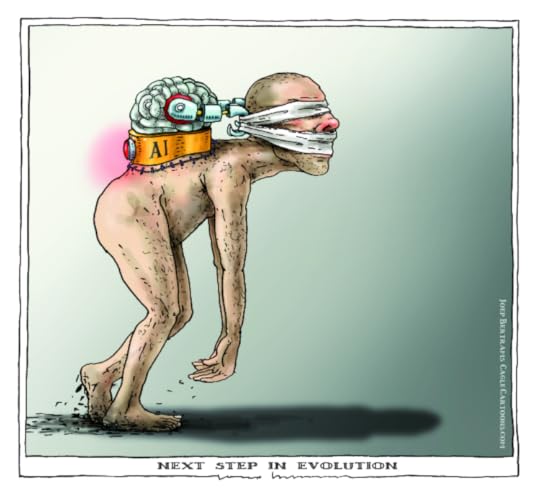
That makes me think that after the Homo Habilis, the Homo Erectus, and the Homo Sapiens if we are the next step in "Evolution" then we should be called Homo Stultus...
September 20, 2026
The ideas are very interesting - and also apt for our own time. However three stars only because of the casual sexism and racism and also because the writing was less than stellar.
A message is received from the direction of the andromeda galaxy which contains the instructions to build an advanced computer. This instrument provided instructions to build a “human” who assists with programming and communication with the instrument. The motivation for these activities becomes clearer with the telling but whether completely benign or malignant is a matter of interpretation.
A group of interesting ideas not completely brought to their potential through the writing.
A message is received from the direction of the andromeda galaxy which contains the instructions to build an advanced computer. This instrument provided instructions to build a “human” who assists with programming and communication with the instrument. The motivation for these activities becomes clearer with the telling but whether completely benign or malignant is a matter of interpretation.
A group of interesting ideas not completely brought to their potential through the writing.

September 2, 2022
Un groupe de scientifiques découvrent un message transmis depuis le coeur de la galaxie d’Androgène, donnant des instructions pour la construction d’un ordinateur, qui leur donne des informations possiblement bien trop puissantes pour l’humanité.
J’étais hyper hypée par ce livre, et le scénario est vraiment intéressant … Malheureusement, ça n’est pas aussi fun et cool qu’il y parait. L’histoire est un peu convolue, avec des allers retours pas franchement obligés et assez farfelus (notamment avec le pays fictif du moyen orient, c’était assez wtf), sans compter les modifications des personnages entre les deux sous tomes - le docteur Flemming notamment est radicalement différent entre la première et la seconde partie de l’histoire. Les références à Orphée et aux mythes classiques sont sympas, le livre en soi est relativement facile à lire, mais ça n’est pas non plus un livre dingue, et franchement, il est assez oubliable … ce qui est dommage avec un prémisse pareil.
J’étais hyper hypée par ce livre, et le scénario est vraiment intéressant … Malheureusement, ça n’est pas aussi fun et cool qu’il y parait. L’histoire est un peu convolue, avec des allers retours pas franchement obligés et assez farfelus (notamment avec le pays fictif du moyen orient, c’était assez wtf), sans compter les modifications des personnages entre les deux sous tomes - le docteur Flemming notamment est radicalement différent entre la première et la seconde partie de l’histoire. Les références à Orphée et aux mythes classiques sont sympas, le livre en soi est relativement facile à lire, mais ça n’est pas non plus un livre dingue, et franchement, il est assez oubliable … ce qui est dommage avec un prémisse pareil.

September 20, 2025
This 1962 SF novel, A for Andromeda, is an interesting artefact; it's the novelisation of the popular 1961 BBC serial of the same name, but most of the episodes have now been lost, and so we can only access the story through this version. When scientists developing a new radio telescope pick up a mysterious signal from the vicinity of the Andromeda galaxy, they use the information received to build a super-computer (which, delightfully, is still programmed by means of punched cards). The computer instructs them to grow a biological organism which acts as its interface to the outside world, and takes the form of a beautiful young woman whom they name Andromeda, or André. I first encountered A for Andromeda in an academic article that focused on how alien women are often antagonists in early Cold War British SF, from the hilariously-titled Devil Girl From Mars (1954) to Unearthly Stranger (1963). However, I liked the poignant ending of this novel, which leaves Andromeda's fate, agency and ties to humanity open to interpretation. In fact, I didn't go on to read the sequel included in this omnibus, Andromeda Breakthrough, because I thought this uncertainty was so well done. The other female characters are also very well-treated given the age and genre of this novel. Although I'm not sure it gets a Bechdel pass, we have no fewer than three women in the cast who contribute to the plot and have sensible things to say. (One of them does end up dead, but so do a lot of men, so I didn't think this was a particular problem - as Judy, who keeps finding the bodies, comments ironically, 'I see them all die'.) The traces of A for Andromeda's origins as a TV programme are very clear. Until the final sequences, it's very dialogue-heavy, and I soon gave up on keeping track of the secondary cast. But read as a fun thriller, it delivers.
July 12, 2021
Ahead of its time in concept with only a few technicalities such as computer speed and memory having aged. Seems like blueprint for Carl sagans “contact”

May 25, 2026
This volume contains two novels, “A for Andromeda” and “Andromeda Breakthrough”. Both are 1962 novelisations of original BBC television series broadcast in 1961 and 1962. They were written up by the screenwriters, one of whom was the astronomer who coined the term “big bang”, even if it was in derision, and the other a major producer.
“A for Andromeda” is a froth of tropes and condescending misogyny. However, in view of the date of publication, this is the original fount of most if not all of those tropes, which have been redone time and time again ever since. The technological cutting edge shown in this book is endearingly quaint: the alien supercomputer still works on punchcards. But despite aging badly in most respects, this book is actually terrifyingly prescient of the present day. The notion of aliens sending knowledge that turns out to be catastrophic (as in any gift from the Devil, this is so old an idea) and the notion of a human / alien hybrid might be the big showpieces of the story (redone in the “Contact” and “Species” movies), but for a book this old to have such a firm grasp of genetic engineering is truly impressive. More impressive yet is the depiction of the human response to a vastly superior computer: this anticipates the current frenzy around artificial intelligence. It is the complacency of humans that provides the AI with its power; it is the willingness of humans to hand over all thinking, all responsibility, to a machine in the expectation of easy profit or easy gratification that makes the AI indispensable and the humans enslaved. Yes, the machine in this story shows signs of psychosis (as does current AI), but it is not actively able to control humans. It is the humans who willingly give the machine everything it needs. This is exactly the issue with AI today: it’s being pushed by unscrupulous businesses, easily bought politicians, and ego-driven scientists and influencers. And it’s being lapped up by the lazy, unthinking masses. This book calls for a Luddite response before it is too late. Other than that, is it a good read? Well … you can tell this derives from a TV script. It’s slightly incoherent as long as there’s a bit of espionage, a bit of murder, a bit of boy gets girl (only a bit as she has some agency), a bit of class and privilege tomfoolery, and some really odd reactions to things and idiotic decisions, just to have some dial in next time dramatic escalation that ends up going nowhere. So the answer to the question is … not really. But it gallops along and is very readable: I read it in a single sitting as it doesn’t tax the brain and it doesn’t much matter if you muddle up who’s doing what and who’s saying what as it’s all very shallow. A solid three star read in all nevertheless.
“Andromeda Breakthrough” is a straightforward technothriller with a world domination evil corporation, a hired killer and assorted minions, an unstable Middle Eastern country as the megalomaniac’s lair, a femme fatale, lots of chases and escapes and betrayals and reversals, etc. It’s more solidly written than the first book, more descriptive than reliant on dialogue, and it ramps up the tension nicely. But the sci-fi aspect of the story gets forgotten for most of it. The alien computer recreated as a result of espionage is just any other technological gizmo standing in as the ultimate weapon. It’s a James Bond story with boffins. At least the misogyny is much reduced as we have a very effective female villain and the female biologist of volume one becomes a full-on protagonist in volume two, in fact she’s the lead character by half way through. And then, when you’ve got used to the switch in genre, there’s a jaw-dropping bit of sci-fi myth making: a world threat suddenly appears, a global environmental disaster that rides roughshod over all the thriller plot lines, and it has its origins in the actions of the protagonists in volume one. They caused the disaster through their dogmatic or careless actions and must fix it as well as face their culpability. That’s powerful storytelling in itself, but then this story shows that this environmental crisis (as well as the possibility of military mutual annihilation) are examples of the Great Filter theory which was formulated *decades* after the publication of this novel, as an answer to the Fermi Paradox. This is the idea that the cosmos is not full of civilisations as it statistically should be because most civilisations reach a point of self-annihilation before they can colonise space. In this novel, the Andromeda message is a catalyst, a test sent out into the cosmos to see if primitive civilisations like earth should be spared from the Great Filter. The reaction to the message, be it refusal (as with our protagonists) or misuse (as with the evil corporation) or full acceptance of the possibilities, determines the civilisation’s fate. Needless to say, planet Earth comes close to annihilation, but our protagonists take a good look at themselves, what they have done and why, and finally accept the proper path when they realise the future is in their hands rather than being dictated by alien overlords. This is a surprisingly philosophical take on the alien gift trope. That makes for a satisfying read. I’m scoring this second novel three stars even though it is better than the first in many ways and worthy of more, but I am not sure that I would read it again. If I do the score will rise.
“A for Andromeda” is a froth of tropes and condescending misogyny. However, in view of the date of publication, this is the original fount of most if not all of those tropes, which have been redone time and time again ever since. The technological cutting edge shown in this book is endearingly quaint: the alien supercomputer still works on punchcards. But despite aging badly in most respects, this book is actually terrifyingly prescient of the present day. The notion of aliens sending knowledge that turns out to be catastrophic (as in any gift from the Devil, this is so old an idea) and the notion of a human / alien hybrid might be the big showpieces of the story (redone in the “Contact” and “Species” movies), but for a book this old to have such a firm grasp of genetic engineering is truly impressive. More impressive yet is the depiction of the human response to a vastly superior computer: this anticipates the current frenzy around artificial intelligence. It is the complacency of humans that provides the AI with its power; it is the willingness of humans to hand over all thinking, all responsibility, to a machine in the expectation of easy profit or easy gratification that makes the AI indispensable and the humans enslaved. Yes, the machine in this story shows signs of psychosis (as does current AI), but it is not actively able to control humans. It is the humans who willingly give the machine everything it needs. This is exactly the issue with AI today: it’s being pushed by unscrupulous businesses, easily bought politicians, and ego-driven scientists and influencers. And it’s being lapped up by the lazy, unthinking masses. This book calls for a Luddite response before it is too late. Other than that, is it a good read? Well … you can tell this derives from a TV script. It’s slightly incoherent as long as there’s a bit of espionage, a bit of murder, a bit of boy gets girl (only a bit as she has some agency), a bit of class and privilege tomfoolery, and some really odd reactions to things and idiotic decisions, just to have some dial in next time dramatic escalation that ends up going nowhere. So the answer to the question is … not really. But it gallops along and is very readable: I read it in a single sitting as it doesn’t tax the brain and it doesn’t much matter if you muddle up who’s doing what and who’s saying what as it’s all very shallow. A solid three star read in all nevertheless.
“Andromeda Breakthrough” is a straightforward technothriller with a world domination evil corporation, a hired killer and assorted minions, an unstable Middle Eastern country as the megalomaniac’s lair, a femme fatale, lots of chases and escapes and betrayals and reversals, etc. It’s more solidly written than the first book, more descriptive than reliant on dialogue, and it ramps up the tension nicely. But the sci-fi aspect of the story gets forgotten for most of it. The alien computer recreated as a result of espionage is just any other technological gizmo standing in as the ultimate weapon. It’s a James Bond story with boffins. At least the misogyny is much reduced as we have a very effective female villain and the female biologist of volume one becomes a full-on protagonist in volume two, in fact she’s the lead character by half way through. And then, when you’ve got used to the switch in genre, there’s a jaw-dropping bit of sci-fi myth making: a world threat suddenly appears, a global environmental disaster that rides roughshod over all the thriller plot lines, and it has its origins in the actions of the protagonists in volume one. They caused the disaster through their dogmatic or careless actions and must fix it as well as face their culpability. That’s powerful storytelling in itself, but then this story shows that this environmental crisis (as well as the possibility of military mutual annihilation) are examples of the Great Filter theory which was formulated *decades* after the publication of this novel, as an answer to the Fermi Paradox. This is the idea that the cosmos is not full of civilisations as it statistically should be because most civilisations reach a point of self-annihilation before they can colonise space. In this novel, the Andromeda message is a catalyst, a test sent out into the cosmos to see if primitive civilisations like earth should be spared from the Great Filter. The reaction to the message, be it refusal (as with our protagonists) or misuse (as with the evil corporation) or full acceptance of the possibilities, determines the civilisation’s fate. Needless to say, planet Earth comes close to annihilation, but our protagonists take a good look at themselves, what they have done and why, and finally accept the proper path when they realise the future is in their hands rather than being dictated by alien overlords. This is a surprisingly philosophical take on the alien gift trope. That makes for a satisfying read. I’m scoring this second novel three stars even though it is better than the first in many ways and worthy of more, but I am not sure that I would read it again. If I do the score will rise.

October 30, 2020
A government project is hijacked by a message from beyond the stars. A series of computer instructions allows the development of a new form of intelligent life who delivers a miraculous enzyme that can heal the world. Or destroy it.
Hoyle and Elliott's 'Andromeda' novels are thought provoking and worth reading, even though they show their age.
Hoyle and Elliott's 'Andromeda' novels are thought provoking and worth reading, even though they show their age.
March 25, 2026
Overall a pretty good book. I think 3.5 would be fair, too good for 3 but perhaps a little long-winded for 4. It often feels that the characters are repeating the same things over and over, and that not much is changing, but I think that's probably the point of the book in the first place!
June 21, 2026
reasonable sci fi but not dated well, still interesting as a window into the past(of the writers!)
August 21, 2022
I thought the book was overall good but not amazing science fiction. It's written well and I like the characters overall. I am familiar with the TV series having seen the surviving episode. I enjoyed the second novel less than the first, I found it intriguing but the latter part in the middle Eastern (I forget) country / African I found less interesting. Though the bacteria threat is a major global threat it didn't hook me in the same way as the computer/ Andromeda conflict. Im guessing they changed the characters a bit in the second Andromeda breakthrough because I didn't quite believe in Fleming softer side / love for Andromeda. I preferred his colder portrayal which though unsympathetic I believed in more. Later near the end of the Andromeda breakthrough Daway comments upon why has Fleming's view of Andromeda changed ... And I just didn't feel it was developed very well... Certainly not the romance this may have been partly due to the removal of Judy A in the second story who has an important role in the first book. I'm guessing she was taken out of the TV series of the Andromeda breakthrough but this is never explained. If she was killed off I'd have found that more believable. As a lover of classics I loved the classical references in the first story. I don't remember so many in the second if any. The Orpheus influence of Fleming going into a cave and Andromeda disappearing behind him like Eurydice I loved.. though dark I enjoyed the dark possibility of Andromeda's tragic drowning in a deep pool as the end of the first story in a similar way to the tragedy at the end of Vertigo. The ending of A for Andromeda is a cliff hanger I guess (the second story) I did enjoy have it continues seamlessly from Andromeda's supposed death though.
This entire review has been hidden because of spoilers.

November 21, 2024
This volume contains two books - 'A for Andromeda' and 'Andromeda Breakthrough'. There was much about the stories that I found quaint. The whole setting was quite dated, more cutting edge for the 1960s than half a century later. The technology was dated, the attitudes were dated, and Great Britain still had an Empire to utilise. I can see that all sitting awkwardly to a modern reader, who would naturally assume that the US would be the technological leader. It shows how much ground the UK has lost in sixty years, which is where the dated feel originates.
And yet, despite all of this, there is the germ of an interesting idea within the book. It starts with a heavenly scan of random noise. Parts of the noise assume a regular pattern. That pattern develops into a more regular message. There is a question about deciphering the message. Once that is resolved, the message contains a DNA pattern which, after a couple of abortive attempts, forms into Andromeda - a synthetic life form created by a DNA code transmitted from a different galaxy. Who sent the message and why they did so is a core mystery of the book. It isn't solved. What is of far more interest is what the authorities do with the boon they are given.
Needless to say, the authorities seek to use Andromeda to enhance their military and commercial power. The scientists are fairly keen on destroying Andromeda - they don't know her purpose - whilst the politicians and bureaucrats seek to use her. Naturally, news of this leeks out and Andromeda becomes a captive to commercial interests. I was hardly surprised when the plot led to the commercial interests facilitating the end of the world. That bit was reasonably unrealistic, and I found it hard to accept that. However, as a plot device it allowed the hero to save the world and for a resolution to be reached.
This was an entertaining book that provided a light read. It was reasonably well written and the plot flowed along quite well. The science may have been cutting edge in the 1960s when it was written, but it felt a bit dated now. I did enjoy the book, though, and would recommend it to others as a light bedtime read.
And yet, despite all of this, there is the germ of an interesting idea within the book. It starts with a heavenly scan of random noise. Parts of the noise assume a regular pattern. That pattern develops into a more regular message. There is a question about deciphering the message. Once that is resolved, the message contains a DNA pattern which, after a couple of abortive attempts, forms into Andromeda - a synthetic life form created by a DNA code transmitted from a different galaxy. Who sent the message and why they did so is a core mystery of the book. It isn't solved. What is of far more interest is what the authorities do with the boon they are given.
Needless to say, the authorities seek to use Andromeda to enhance their military and commercial power. The scientists are fairly keen on destroying Andromeda - they don't know her purpose - whilst the politicians and bureaucrats seek to use her. Naturally, news of this leeks out and Andromeda becomes a captive to commercial interests. I was hardly surprised when the plot led to the commercial interests facilitating the end of the world. That bit was reasonably unrealistic, and I found it hard to accept that. However, as a plot device it allowed the hero to save the world and for a resolution to be reached.
This was an entertaining book that provided a light read. It was reasonably well written and the plot flowed along quite well. The science may have been cutting edge in the 1960s when it was written, but it felt a bit dated now. I did enjoy the book, though, and would recommend it to others as a light bedtime read.
July 18, 2025
The introduction said it is a page-turner.
I can vouch for that claim.
Originally, I was going to give a 2 star rating.
Mainly due to the second story repetitive scenes.
A for Andromeda is a dialogue rich story from beginning to end.
Instead of having everything described the characters spoke what they were doing to each other.
My reader response in me kicked in when reading The Andromeda Breakthrough.
I was pulling for Fleming the whole two stories.
God, I felt his frustration when dealing with others on the project.
I'm surprised he waited to destroy the computer at the end of A is for...
He had ample time in the interim to do that within the first few chapters.
I can vouch for that claim.
Originally, I was going to give a 2 star rating.
Mainly due to the second story repetitive scenes.
A for Andromeda is a dialogue rich story from beginning to end.
Instead of having everything described the characters spoke what they were doing to each other.
My reader response in me kicked in when reading The Andromeda Breakthrough.
I was pulling for Fleming the whole two stories.
God, I felt his frustration when dealing with others on the project.
I'm surprised he waited to destroy the computer at the end of A is for...
He had ample time in the interim to do that within the first few chapters.
This entire review has been hidden because of spoilers.
February 8, 2026
3.5* for A for Andromeda and 2.5* for Andromeda Breakthrough. The former is defo the more interesting across character development, plot, and sci-fi concepts. It turns into a page turner but I enjoyed it a fair bit. The latter just felt unnecessary with at least half the book not going anywhere.
Across both I don't think there was anything too radical idea wise- they focus on means vs ends and ignorance vs bliss as core ideas without saying anything unique (though in the former book they are at least more subtly handled). I thought the exploration of capitalism and politics was fairly lazy and uninteresting.
By no means a bad duo of books but would have liked a bit more from both
Across both I don't think there was anything too radical idea wise- they focus on means vs ends and ignorance vs bliss as core ideas without saying anything unique (though in the former book they are at least more subtly handled). I thought the exploration of capitalism and politics was fairly lazy and uninteresting.
By no means a bad duo of books but would have liked a bit more from both

July 31, 2024
Beware of Greeks bearing gifts, or in this case an advanced civilization broadcasting technical blueprints from their home world somewhere in the Andromeda galaxy. Reminiscent of D. F. Jones' Colossus Trilogy with just a touch of Shelley's Frankenstein this two-volume novelization of the old BBC series mixes hard science and shady political intrigue in an entertaining Doomsday thriller with enough of a twist to make me feel like I didn't waste the ten days it took to read it.

May 5, 2023
Two amazing books form a thrilling tale of a first-contact scenario and its repercussions. For a story written in the 50s, it was so ahead of its time that you can see its influence in the ensuing decades. Fast-paced and inventive, there is never a dull moment and it remains a page-turner until the very end. Highly recommended for fans of science - fiction or even of a good adventure.
April 29, 2023
Interesting sci-fi. It's not a perfectly constructed novel, but it's got some great ideas and is far from the shonkiest thing I've read.

October 28, 2023
Quick paced but really dated, you can tell the second book really was a stretch to make the TV adaptaion

April 17, 2024
(3.5) - idk I was just left a bit ... Meh about it all. The first book was better in my opinion.

August 12, 2024
Based on a quite interesting idea. But too many unrealistic or unbelievable plot twists.
December 29, 2024
Ahead of its time in concept with only a few technicalities such as computer speed and memory having aged. Seems like blueprint for Carl sagans “contact”
December 26, 2025
Judy died on the way back to her home planet

April 5, 2026
The first story was a great read, although I did find Fleming rather up himself. The second started off well, but got into all sorts of uninteresting characters in a foreign land. I didn't realise the book came after the TV Series, maybe that explains it.
Displaying 1 - 22 of 22 reviews