Jump to ratings and reviews
Rate this book

The Light Years

Rate this book
Before Hisako Saski is even born, her parents make a deal on her behalf. In exchange for a first-class education and a boost out of poverty, Hisako will marry Adem Sadiq, a maintenance engineer and self-styled musician who works the trade lanes aboard his family's sub-light starship, the Hajj.

Hisako is not happy when she finds out about the plan. She has little interest in the broken branch of physics the deal requires her to study, and is not keen on the idea of giving up her home and everything she knows to marry a stranger.

Sparks fly when Adem and Hisako meet, but their personal issues are overshadowed by the discovery of long-held secrets and a chance at faster-than-light travel.

File Science Fiction [ E=mc2 | Happy wife, Happy life | Marital Bliss | Light Years Away ]

327 pages, Kindle Edition

First published February 11, 2020

199 people are currently reading
1196 people want to read

About the author

R.W.W. Greene

19 books90 followers
R.W.W. Greene is the author of "The Light Years" (Feb. 2020)," "Twenty-Five to Life" (Aug. 2021), "Mercury Rising" (May 2022), and "Earth Retrograde" (Oct. 2023), all from Angry Robot Books. Member of SFWA.

Ratings & Reviews

What do you think?
Rate this book

Friends & Following

Create a free account to discover what your friends think of this book!

Community Reviews

5 stars
146 (24%)
4 stars
221 (37%)
3 stars
156 (26%)
2 stars
48 (8%)
1 star
14 (2%)
Displaying 1 - 30 of 139 reviews
Profile Image for Richard Derus.
4,170 reviews2,263 followers
August 24, 2021
I RECEIVED A DRC OF THE BOOK FROM THE AUTHOR. THANKS, ROB!

My Review
: I wasn't eager to read this book...I don't like being mean to people, and a first novel about relativistic space travel wasn't likely to excite me in a good way...but Rob asked me to read it in an unrefusable way: "I'll take my chances."

Major respect for that, dude.

So here I am reviewing it and recommending it for #Booksgiving. That's unusual for a first novel. A first novel with a casually bisexual male lead, a culture of selling unborn brides to traders on sub-light freighters that function like planets with clashing cultures. And I'm recommending it?

Yes. It's trenchant. I sat still for a minute after reading the teenaged ruminations of the bride bought for male lead, Adem, on learning the boy she was about to mess around with was her unmet fiancé's fanboy. That needs a bit of unpacking...which I do on my blog, Expendable Mudge Muses Aloud.
Profile Image for Jason Pettus.
Author 20 books1,452 followers
November 25, 2019
This wasn't bad enough to officially be thought of as a "bad book;" but the whole time I was reading it, I kept thinking of that line Homer says to Ricky Gervais during that one episode of The Simpsons -- "You take forever to say nothing!" It's particularly bad in this case, because this is supposed to be a science-fiction novel, regarding an arranged marriage that will be perceived to take place in 25 years from the standpoint of the newborn infant wife growing up on a stationary planet, but only one year from the perspective of the deep-space trader groom who zooms around the galaxy at time-bending almost-light-speed. The problem? Nothing actually happens for the vast majority of the book, until a packed finale that simultaneously feels overly delayed and too rushed, a clear case of Greene getting an idea for the beginning and ending of a decent short story, then unwisely thinking he could just throw 40,000 words of filler in between and call it a novel.

Also, I must admit that I'm not much of a fan of social-realist sci-fi like is the case here (ugh, I get it, the space refugees are space poor and live in their space slums while dressed in their space rags), and am especially annoyed when it feels like an author is going through a checklist of #MeToo tropes, not because he's sincerely into them but because his publisher gave him a memo of details to be awkwardly inserted into the manuscript wherever convenient ("#7: Make sure a main character is in a loving gay relationship! #8: Have a minor character identify with third-gender pronouns!"), so to not be screamed at by Woke fangirls at his Conoconocon panel discussion six months later. I'm all for these kinds of additions when they feel organic to the story, but not when they feel randomly plunked down for the sole purpose of calling attention to themselves; and that plus a story that goes nowhere and accomplishes nothing for 90 percent of its page count left me feeling deflated by the end, a book that at least is not badly written (and thus is at least getting a middle-of-the-road score from me) but still not one I recommend to others.
Profile Image for Rachel (TheShadesofOrange).
2,887 reviews4,798 followers
January 17, 2021
4.0 Stars
This was a wonderful piece of slow burning science fiction. Given the premise, I originally thought this was going to be a romance, but it definitely was not. Instead, this novel focused on the development of the two main characters as they grew up and came to terms with their roles within their pending martial contract. 

While the main plot centered around a male/female pairing, I was happy to see that relationships are all sexual orientation and genders were shown as normal in this imagined future. Likewise, this novel showed ethnic diversity shown through the colonial descendants of earth.

The worldbuilding was subtle, but very well done. Even though it was set in a spacefaring future, I like that humanity still held collective memories of life on earth.

This novel felt accessible for new scifi readers while still having enough "meat" for more seasoned readers like myself. The science and technology were described in simple, digestible terms for the readers without ever being "dumbed down" for the audience. The most complicated ideas in this book were the ones revolving around light speed travel and time relatively in space. As long as readers can grasp the basics of these concepts, they will be able to enjoy this novel.

In terms of narrative, this one was very slow paced without much action or suspense. Yet I was happy to say that I was completely immersed the entire time reading this novel. The strength of the novel really came from the characters. I found both perspectives to be well fleshed out and relatable individuals. I particularly enjoyed following the girl over the years as she grew into a smart young woman.

Overall, I really enjoyed this one and would absolutely recommend it to a wide variety of readers, including those that don't regularly read science fiction. This is simply a great story that addresses universal themes about humanity than span both time and space.

Disclaimer: I received a copy of this book from the publisher, Angry Robot Books. 
Profile Image for Charles.
616 reviews118 followers
July 20, 2025
Hard-ish, dystopian, space opera. Human traders, traveling at c, in millennia-old ships, using lost technology knit together the dystopian societies of the human diaspora living on marginally habitable planets.

description
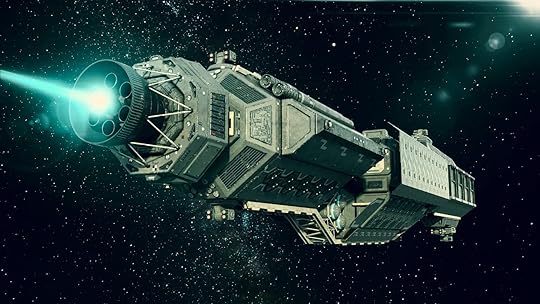
The millennia old, trader ship Hadjj boosts up to near-light speed for the decades (planet-side relative) long flight to the Euro-settled colony of Gaul.

My dead tree copy was a scant 293 pages with a US 2020 copyright.

R.W.W. Greene is a Science-Fiction Writer, Recovering Journalist and Teacher. He's the author of four novels of science fiction in series and standalone. I have read a few of the author’s books. The last being Twenty-Five to Life (my review).

TL:DR

A solar flare sterilizes the solar system to out beyond the Mars colony. A barely interstellar capable Earth evacuates some of the population in freeze sleep, at under the-speed-of-light to the barely habitable planets of nearby stars within reach of the available technology. The privileged leave first, and receive first mover advantage at humanities new homes.

Centuries pass. In the scrabble for survival and a disaterous war, a lot of technology is lost.

The crews of the huge, Evac-ships remain in space, becoming heredity traders providing commerce and transportation between the new worlds. The Evac-ships grow to be a 1000-years old (planet-side relative), and fewer every century.

Hisako Saski was the child of refugees of a failed colony. Her parents lived in a camp on the colony world of Gaul. They badly wanted a child, but couldn't afford the license. In-utero she becomes the paid-for, gene-spliced and educated to-order contract wife to the 20-something, Chief Engineer Adem Sadiq of the Sadiq-hereditarily owned and operated trading vessel Hadjj. Contract and partial-payment, in-hand, Hisako’s family was lifted out of poverty and onto the lowest rungs of the stratified, and controlled society of Gaul.

Twenty-four years planet-side, and one year ship-side, the Hadjj returned to Gaul for their: near-genius, starship power systems PhD-trained, crewmember and Adem Sadiq’s new wife.

A story of: time dilation, poverty, arranged marriage, and the effect on families of choices made with their children’s welfare in-mind. The story had good bones, but a slow start, and mid-story pacing problems that resulted in a rushed, unsatisfactory ending.

The Review

This is the second of three books by Greene I liked. All of Greene’s stories are dystopian. This one reminded me of Alastair Reynold's Revelation Space series’ light huggers which feature interstellar travel at near-light speed and the resulting time dilation effects. Particularly, how relativistic speeds affect travel times and the perceptions of time for travelers compared to those on-planets experiencing time moving faster than shipboard.

Full disclosure, I'm a fan of the rarely occurring genre of hardish, space opera, in addition to dystopian cyberpunk science fiction. Both sub-genre's are limping along on life support at the fringes of modern sf. This book checks those two boxes with panache.

Greene is a polished author. The book was written in the smooth, slightly too, overdone-style of the MFA-badged author. The writing was technically good. Prose was written in a clear fashion. I did not find any typographical or grammatical errors and only a few repetition errors.

Both dialog and descriptive prose were good. In particular, Greene being an ex-educator, Saski ‘s school years had a strong sense of verisimilitude. Dialog was “contemporary”. I thought I caught a strong Gen-Z accent in it? In places I found the story amusing, although I never laughed-out-loud. The descriptive narrative was good. Although, I did note some hand-waving and a few minor technical errors. The author overtly sidestepped the explanation of Einstein's theory of special relativity explaining time dilation and star travel. That was fine by me. I get it. Fans of the less technically rigorous Standard Sci-Fi Setting should just consider "Time Dilatation" to be like Portal Magic. As in Greene’s other book’s, I really liked the dialog and descriptive prose. It was: wry, savvy, technical, and also profane. However, profanity was “in the right measure”. While I thought the book started-out slow, it picked-up and I liked what I read. Then I didn't.

The book contained alternating chapters for the protagonists Saski and Sadiq. When they were in the same scene together, the POV switch could be vertiginous. Having read a few of the author’s books, it’s becoming obvious of his preference for female characters.

Assuming a Three Act structure, the first act proceeded slowly. Saski’s chapters predominated. Her’s were longer and (I thought) better written than Sadiq’s. For such a short story in length, I thought Greene spent too much prose on developing her father’s character, whilst her mother had greater character longevity. It was in the Third Act that the Pacing Problems appeared. While the character’s chapters were generally short, the final chapters were brief, and almost summary in nature. The last 25-pages amounted to a sprint to the end, with some peculiar twists that felt more outlandish than inappropriate. For example there was a Diabolus ex Machina . This was also a short book at less than 300 pages. Frankly, considering the average length of a contemporary SF novel is now >400 pages, I was willing to give him another 50-pages for a better HFN-ending. That ending also leads me to speculate if Greene is going to have a second book using these characters? I think that if Greene had had a better editor, this book would have been slimmer at the front and wider at the rear?

Saski was the author’s favorite. Her’s was the better development. The reader follows her from about the age of four to 24. Greene leans heavily on the Poverty Tropes with her. For example, The Penny Amongst Diamonds takes her though to uni. In uni he switches to her resentment towards the trader’s AdoptMarry-In-A-Prodigy trope. She's in conflict with both society (Woman against Gaulish society) and her lack of agency. Her Goal In Life was ambiguous and limited by circumstances. Saski was also a musical prodigy through better genetic engineering. I thought this was well developed and quiet interesting. However like her father’s development, it wasn’t leveraged, and just languished at the end of the story.

Sadiq, was a: spacer, Mr. Fix-It, and son of the ship’s Captain. Initially, he was more a follower than a leader. He was prepared to do his duty for the family. However, being ship-born, he was unprepared for a resentful, near-genius, planet-side wife. With as much as he had to work with, Greene didn’t do much with the opportunity of this character. Sadiq’s plate was full keeping a millennium old ship, chock-full of not completely understood tech running, and abetting family politics by supporting his Captain mother’s machinations. He also was a musician of some small, interstellar fame, although not of the same water as his gene spliced, wife-to-be, skill-wise. More effort put into the development of “this other protagonist” would have made a better story.

Both Saski and Sadiq’s mothers fit prominently in the story. The symmetry between them, and the very different influence they had on their children was one of the better parts of the book. Saski ended-up being rebellious, and Sadiq obedient. However, early in the story both mothers play antagonist-roles with Saski leading to her character's development. Another observation here, is how often character’s mothers appear in Greene’s stories.

The antagonists here are the colonial oligarchic society, and the evil Rakin Sadiq. Throughout the human settlements, elite groups, based on wealth, family ties, and social status rule ran the colonies. This sets up for the dystopian conditions on-planet, particularly with regard to refugees from failed colonies. Refugees occupied the lowest tier of colonial society. Uncle Rakin was an unimaginative incarnation of the Evil Uncle with some Creepy Uncle thrown in for Saski’s sake. He was a shipboard member of the Sadiq family, perpetually in conflict with the Captain. Interestingly, Saski was not a great beauty. (That was not a contractual requirement.) The lecherous Uncle Rakin figured considerably in the too pat ending.

The story contained: sex, drugs, and rock'n roll in an agreeable amount and form, at least for me. Both Saski and Sasiq were bisexual. They both had regular, inventive sex with a small, but ample number of partners. All the sex was tastefully done, and of the fade to black variety. Alcohol, and synthetic drugs were consumed. Imported beer, home-distilled ethanol and maker-pharma were popular amongst the Hadjii’s crew. There was even a pub serving intoxicants aboard. Music references were appropriate for the 3000’s era. However, there was a strong retro-interest in colonial societies for late 20th and early 21st century music. (The Beatles were mentioned.). Greene put more thought into the music aspect of world building than most authors of a novel with future history. Previous novels by him were similarly endowed with queer characters and what is now contemporary music or “Classic’ rock.

Violence was: physical, blunt and edged weapons, and futuristic firearms. On the Hadjj characters did virtual running and gunning for entertainment. The description was surprisingly good. Sadiq was a master of unarmed combat. Wounds, wounding and death was not graphic. Both the protagonists proved to be moderately resilient. Body count was high, due to a terrorist incident. Otherwise, it would have been very low.

Locations of the story were: shipboard, in very large space stations over three colony planets, and planetside on the colony of Gaul. Gaul was a majority European Union colonized planet, but recently had been diluted by an influx of refugees. Gaul’s atmosphere was a work of terraforming in-progress. It utilized a lot of cheap, refugee, unenfranchised, labor vs. rare, expensive automation to keep folks breathing. (Queue the Dystopia for Gaul.) All of the planetary locations were urban. Space scenes were shipboard, or in mall-like spaces inside superstructure constructs. I noted that Greene had a small, technical, regard for mass.

This story was a mild techno-fest. Ancient automation and AI was available. They had sexbots. In major cities everyone had access to an immersive, free VR. A lot of food was synthetic or vegan. "Real food", like Beef, poultry and pork were unknown except to the Uber-wealthy. Some native species on the colonies was edible. “Maker" printers produced most consumer goods, like clothing and spare parts for tech repairs. High quality and handmade products were avidly sought after. Communications, including data was ubiquitous on planet and on ship. Folks ranged in spectrum from completely wired with implants to the poor who were lucky to have a computer handset. However, in general Greene's futurism was very good, and credible.

A problem I had was with the millennium-old trader vessels. They were just: huge, very old, and required constant repair. Sometimes the legacy ship systems failed and the tech for their repair didn’t exist. Hopefully, that was within proximity of a colony.

However, nothing created by the hand-of-man, given the level-of-tech and high complexity sketched-out by the author lasts a thousand years. Especially under the strain of regular near-c accelerations. (Metal fatigue of primary structural components would have claimed all the ships hundreds of years earlier.) In addition, the rate of colonial societal change Greene described was miniscule over a thousand years. It was like the colonies were in a perpetual Dark Age, but with a: modicum of high-tech, higher education, and the resources of multiple solar systems to draw upon. Human societies have never stayed as still as Greene describes over 1000-years.

Summary

This story was a cyberpunkish space opera. It reminded me of Vernor Vinge's A Deepness in the Sky and House of Suns by Alastair Reynolds.

I liked most of it. The theme of traders who appear to be immortal compared to their family’s remaining planet-side, due to relativistic speeds was the best part for me. Folks having an interest in space travel that reeks of STEM and Einstein’s Theory of Special Relatively will like it.

That the main characters in the story were mostly women, and written by a man also interested me. I think a woman might find fault with them, but who’s to say that LGBTQIA+ women may be more like Greene’s vision in 1000-years?

However, the more I like a book the more critical I become. According to the author, this book morphed-out of a short story. The story had ‘good bones’, but led to disappointment in the end. An extra 30-50 pages would have smoothed-out the third act. A culling of underused plot elements would have helped too. Frankly, I would have given him an additional 50-pages for a better story.

If you’ve grown tired of space operas embedded in the Standard Sci-Fi Setting written by authors who have no sense of time or distance in space, and equate physics with “being like magic, but with math” you're going to like this. It’s dystopian, but only if you’re a refugee or maybe an immigrant? It also has a large dollop of 'relations' contact. Greene is a journeyman author, taking trad sf themes (like light-speed travel) and blending them with contemporary ones (like arranged marriage). This story was hip, dense, and technically solid in most places. It has something for crusty, old, hard sf readers as well as squishy "The Feels" younger readers.

Recommended.
Profile Image for Hirondelle (not getting notifications).
1,321 reviews353 followers
December 6, 2023
SF, a thousand years in the future, earth diaspora, near relativity trade ships in between solar systems, with inevitable time dilation effects between the ships and the system they visit. Arranged, marriage (contract?) between a baby and a crew member, dual timelines, and archane leftovers of previous superior tech human civilization and truly unequal society in one of the planets.

I do not even remember how this book came under my radar, but it is sf, the concepts were interesting, it has ingredients (see above...) I wanted to read about. And it is nicely enough written, scene by scene, but it is just surface scratching, lots of stereotypes around and hanging together with spit.

I do not understand the economics of this world or even the main setup, that the captain of any ship would need to "buy", contract, spouses for some of her (their? in general) family since crew actually needs to pay into becoming crew and there are lots of interested candidates (so why is it so expensive? Supply-demand?). There is spoilerific reason for this case (because our ship are the GOOD guys) but still, seems common in this universe, so that there agencies devoted to mediate it. And just an example of something which makes little sense and is just there as props (as do the terrorists and politics and so on. The generic stereotyped politics are particularly clumsy). And then nothing much is done with well, nothing much, nor the relationship between characters (any characters. Warning, this is not a romance) or exploring larger scopes. I do not usually say books are too short but this feels like unfilled potential and underserviced in ideas.
Profile Image for Holly (The GrimDragon).
1,179 reviews282 followers
November 8, 2020
"The drummer began an awkward solo, and the girl picked up a bottle of water. She drained it and flung it at the audience. She picked the song back up with a riff that sounded like post-argument sex and screamed into the microphone. She was rail thin, her hair cut into a wedge. She had more tattoos than Johnny.

'I think I just came,' Ramona said.

I nodded, utterly entranced by the girl on the stage. She took up all the room and light."


The Light Years is the debut novel by R.W.W. Greene.

Set 1,000+ years from now in the 33rd century, after the fall of Earth. Humanity left in search of colonizing unspoiled planets. Wealthy families (Traders) travel through space visiting other worlds, while the poor fight to live on their respective stationary planets.

Traders are known as immortals, because while they are out exploring other galaxies, they are only aging a year for every 24 that goes by planetside.

The captain of the Hajj starship, Maneera Sadiq, arranges a marriage for her son with a young poor couple in exchange for money that will help them out of poverty, as well as a paid in full education for their unborn daughter. The deal requires the bride to study in specific fields set by the contractor, which best benefit the business. Incidentally, these traits can be genetically altered (spliced) to enhance the skill set of the individual. As you do.

Adem Sadiq is a maintenance engineer aboard his family's ship. He's also a musician known as The Spaceman, who plays and records songs from Earth and releases the videos out into space.

He is to be married a year after signing the contract, leaving him with little time before his life as he knows it will change. Meanwhile, over two decades will pass in Gaul before his next visit to receive his payment.

Hisako Saski is that payment.

She learns early on that she has been sold into marriage, which of course brings up many complex feelings. She becomes combative and confrontational, unable to come to terms with the fact that she is basically just a cash cow for her parents. She resents the fact that every choice has been chosen for her future. She is forced to study obsolete technology, which she has no interest in whatsoever. Plus there's the small fact that she has been promised to some strange spaceman who she has never event met. Although she is increasingly bitter about the circumstances, it's complicated because she has lived a more privileged life growing up than she ever would have otherwise, but her freedom has been taken from her, as she had no choice in the deal that was brokered before she was even born.

The story follows both Adem and Hisako as they navigate through life and alternating periods in time, as we watch Hisako grow up and become a member of the ship.

Little do they know that Maneera has bigger plans in store for Hisako, which include obtaining technology on how to achieve faster-than-light travel.

"The attorney's eyes widened. 'I'm sure. Are there any other skills and interests you would like her to acquire? Cooking? Materials recycling, perhaps? BDSM?'"

Although the book is relatively short, there is a lot of story told here as we get to know these characters. It was a nice change of pace, allowing me to fully sink into the worldbuilding, which felt similar to Snowpiercer crossed with The 100. Greene has written a dark, quirky, sepia-coated atmosphere with a backing soundtrack of yearning, lust, joy, rage and love. And pure, unadulterated passion.

The Light Years is an exploration on poverty, arranged marriages, equality and freedom. It lays the groundwork for what I hope will be a sequel. FINGERS CROSSED!

R.W.W. Greene has written a family drama in space that feels like a modern classic.

Highly recommended!

(Big thanks to Angry Robot Books for sending me a finished copy in advance!)
Profile Image for Kara Babcock.
2,110 reviews1,595 followers
August 16, 2020
Relativity can be awful sometimes. You get in your spaceship, leave a planet, and you come back a few months later only to find that years have passed and your family is old or dead and all your plants died because YOU COULDN'T WATER THEM LIKE I ASKED, KEVIN?

Anyway, most science fiction stories use a trope, like faster-than-light travel, to avoid dealing with relativity. Not so R.W.W. Greene. In The Light Years, the time dilation effect is embraced as a principle plot device. I received a free copy of this book from NetGalley and Angry Robot in exchange for a review.

Adem Sadiq needs a wife. Well, he doesn’t need one. But his mother, captain of the Hajj, wants him to get one who is knowledgeable in the physics of an extinct culture, the United Americas. So he contracts with a couple who will have a child, and then when the Hajj returns to that planet in 20 or so years relative, the child will be old enough to marry him. It’s very creepy, and if it were a straight-up romance I might have to throw my Kindle across the room. Fortunately and unfortunately, The Light Years is more of a time-dilated thriller with a hint of odd-couple comedy thrown in, and I guess that’s ok.

My major issue with the book is that the main characters take so long to bake I felt like I’d aged 20 years. Adem has very few defining qualities for the first half of the book. We just kind of … exist alongside him. Eventually we learn he likes playing music and he has an overly-developed conscience. Yay for defining characteristics! Other than that, however, he’s just so bland. Hisako is a little better—we literally see her grow up from a baby to a young woman, so she kind of has to have character development—but the snapshot effect means we seldom see her grapple with issues on that micro level. And since, as I said before, the whole “I arranged for your creation” thing is extremely creepy, I’m glad the romance angle doesn’t actually land hard, because that would make things worse.

Similarly, the principal antagonist is very one-note in his moral development. We get it: he’s a profit-driven bad guy who doesn’t respect human rights, whereas Adem and most of his family are upstanding, moral people. There’s nothing inherently wrong with this dynamic, but like Adem himself, it’s just a little bland. The tension created by the structure of the Hajj’s shareholders isn’t sufficient by itself to keep me interested.

The Light Years is at its most interesting when Greene pulls back the curtain on the wider universe he’s designed and invites us to consider the side effects of relativistic inter-system travel. The cycle of political unrest on various planets and the social inequity is very fascinating. I dig the amount of thought Greene has put into this world, as well as the time taken to craft the story itself. However, the actual style in which the story gets told? Doesn’t work great for me.

Creative Commons BY-NC License
Profile Image for keikii Eats Books.
1,079 reviews55 followers
January 30, 2020
To read more of my reviews, check out my blog at keikii Eats Books!

Quote:
"It's not just a word," she said. "You are not shit. Our daughter is not shit."
"It takes shit to make flowers," Joao said, "and my life is a garden full of them."

Review:
This is not a romance.

Perhaps most of my disappointment in The Light Years was wrapped up in that simple sentence. This is not a romance, and the blurb made it sound that at least some of the book would be devoted to romance. In reality, maybe only 5% was devoted to that concept.

There are two characters that share screen time. Adem Sadiq is a a technician aboard the trade ship, Hajj,and the son of the ship's captain, Maneera Sadiq. He cares for the others he meets, and has a heart of gold. Just incredibly kind and good natured, and is more willing to help others than help himself. For fun, he likes recording old Earth songs and releasing them into space for others to find, though he would never even think of advertising it. He likes his life, he is very content.

Hisako Saski is the woman that Adem's mother bought him as a wife before she was even born. Yes, you read that correctly. Hisako starts off a child, and we learn about her world, Gaul, through her. She learns from an early age she is destined to become married to an spaceman and that she will one day have to go away and leave her parents behind and they will grow old and die while she stays the nearly same. Due to this, Hisako grows up to be combative and standoffish. She doesn't really like authority. And she really, really does not like that some outsiders paid for everything and she still suffers on a world full of people going hungry and dying in poor labor conditions while she is going to a rich school and never has to worry about food.

Gaul is not a thriving place. It is a hard world to live on, and only some of the people live well. Due to the failing of other planets, Gaul and many other planets are full of refugees. Hisako's parents were refugees and the only reason they were allowed to have her was to sell her in marriage. Refugees camps, not enough food, hard labour, and terrorists. All things Hisako grow up with knowing about, but not really seeing too much of. Her parents protected her as best as they could.

All things the Traders aboard the trading ship and Adem don't really know anything about. Due to near light speed, while over 20 years pass for Hisako, only a year or so passes for Adem. The Traders feel almost above planetary problems because by the next time they roll around, everything will have changed again. They act like everything is one big game.

And the trade ship the Hajj, and her captain, Maneera Sadiq, have lofty goals above planetary problems. They're after a lost spaceship full of technology they have long since forgotten how to produce themselves. Even their trade ships are beyond them to make, and repairing it is proving more difficult and getting impossible. Maneera is looking to get ahead of the rest of the other Traders and make a profit. This is why she paid for a wife for Adem and specifically required Hisako to study a branch of math and science that is all but useless.

Until now, that it isn't useless anymore.

If these bits to the story in my review sound disjointed and that they don't really come together in the end, well... neither did they in the book, either. There was a lot of setup, and the book never really settled into the story. I wasn't just disappointed in the lack of romance, or the fact that Adem and Hisako don't really meet up at all until halfway through the book (really). And that I have no idea what this blurb means by "Sparks fly", since they mostly ignore each other.

I was disappointed because while there were some cool concepts, especially when it came to the sci-fi, they just never really amounted to anything. Gaul's problems are never really addressed, except in a possibility. The science fiction and spaceship experiments mostly accomplish the initial goal of warp drive, but none of any of the other implications amount to anything after they were introduced in the story. There was more time spent on the crooked uncle of Adem than there was on exploring the implications of what it would mean for the ship to have warp drive when others wouldn't, which amounted to about a paragraph worth of material.

Just.. A lot of setup, not a whole lot of story. I have no idea if The Light Years was planned as part one of a series. In a lot of ways it feels like it was. There is just so much left unaccounted for that so much time was spent building up. I liked the concept,the execution just fell flat.

ARC received from Angry Robot on Netgalley. This did not affect my review.
Profile Image for Ana.
227 reviews8 followers
March 7, 2020
(Edit 3/6: 3 stars) (3.5) This was quite the ride! I was super interested in the premise but was VERY hesitant after the first few chapters. Thankful I ended up really enjoying this overall! I think the ways in which culture was shown to have changed and morphed was really interesting and realistic, and I was impressed with a lot of the commentary that happened throughout and definitely enjoyed that. My two complaints would be pacing and characterization. I get very attached to just about every character I read about but I felt at arm’s length from the entire cast of this which was unfortunate. I did care about learning about this but I definitely wasn’t emotionally involved. The other problem was up until literally 90% I thought this was a series. This isn’t a super long book but because of the way pacing was done, after having read the end it feels long. I think this could have been a really interesting duology if pacing had continued in the same way as the first 75% because that did sour the experience for me a bit. Overall I did enjoy it, and will 100% keep this author in mind in the future, but I don’t think this will be something I’ll come back to. (I do also want to say that the poetry involved was AMAZING and his students did a great job!)
♥️📖✨ Advanced Reader Copy received from Netgalley and Angry Robot in exchange for an honest review! ✨📖♥️
Profile Image for Nynniaw.
178 reviews25 followers
January 21, 2020
So. The Light Years. Honestly, from the moment I first read the premise of this book I was a little enthralled. The idea it wanted to explore were ones I had not as of yet encountered in my admittedly limited scifi reading. Specially the time dilation aspect, and the human relations aspect tied to it.

Unfortunately, The Light Years proved to be a slow-burn book that never really got past the slow part. It never really burned bright, or wholly took into the sky with rushing heat, but sometimes it felt like it was awfully close to, and even when it didnt, it behaved like a cosy enough ship you could not help but laze in.

Two things work against The Light Years. The first is an almost complete lack of gravitas in the way the story progresses. Most of the chapters feel like slice of life episodes from some scifi anime. They are almost all rather dull, disconnected, and what happens in one is for the most part irrelevant to the others. At nearly no point is there any manner of suspense in our tale. Everything is related in a somewhat disappointing matter of fact tone.

The second thing has a lot to do with the first, but is related more to the characters themselves. Over and over we see glimpses of Hisako or Adem's life, but these glimpses never seem to drive at anything that contributes to the central plot. Sure, we learn things about them, but mostly we trapsize about the characters for what feels like no other point but to get past the chapter.

The few really exciting points, like the exploration of the derelict ship, Hisako's trip to La Mer, among others, are defused by the author in what feel like very anticlimactic ways that not only rob the story of potential excitement but also sort of invalidates the characters experiences.

I kind of feel like maybe the book just needed more space to spread its wings, so to speak. It seemed like the author wanted to explore a lot of things, but either just wasn't afforded the space to do so, or didn't have the self confidence to do it fully, either of which might account for the compressed feeling of the narrative.

It's a shame, because I really wanted to like the story, but as it is, it hardly feels like I read the story promised by thr book's blurb.
Profile Image for Reese Hogan.
Author 6 books42 followers
March 25, 2020
I’ve always loved stories about time advancing differently for people who travel close to the speed of light, and The Light Years is an ideal example of a book in this genre. An engineer living on a spaceship that travels almost as fast as light appears practically immortal to the rest of the universe. He is the oldest of three siblings, but the next youngest is now older than him due to living on land for a time, and the youngest is long dead of old age. Now in his mid-twenties, he makes an arranged marriage with a person who’s not even born yet. Eleven months later, he returns to a twenty-four year-old wife with mods to make her a brilliant scientist. This book was lighthearted with very likable characters, but cool concepts that made me stop and think. In short, exactly what I was looking for, and a welcome read during darker times. Well-worth checking out!
Profile Image for Chantaal.
1,301 reviews253 followers
July 5, 2022
I do this thing at the bookstore on weekends, where I'll browse the shelves and pick up anything that catches my eye, or heard about online. Then, I'll sit with a drink in the store cafe, read the first chapters of everything I grabbed, and buy 1-2 books that intrigued me the most. The Light Years was one I picked in this way, as I was super intrigued by the idea the story put forth.

Adem lives and works on a trading ship, and thus spends a lot of time in space, where relativity means months in space is years on planets. During one planetside trip, he "buys" himself a wife from a couple who just got pregnant. In exchange for a bride, his family pays for gene therapy and ensures the baby has a good life and good education, and pulls the family up out of grinding poverty. Hisako is Adem's future bride, and we follow both her as she grows up and Adem as he spends months in space coming to grips with the idea of being married soon.

It's a great premise, but unfortunately the book falls short in execution.

The pacing was awful. Adem and Hisako don't even meet until halfway through the book, and then there are tons of short time jumps (1 month, 3 months, etc) once Hisako is on the ship with Adem and his family/crew. The first half of the book took so long to say absolutely nothing, too. I understood what the author was trying to do in giving breathing room to themes of poverty and rebellion (both societal and teenage), but it just seemed to go nowhere. Especially once Hisako is on the ship.

I think the character work was pretty decent; I got a good idea of who Hisako was as she grew up. While some aspects of her characterization felt shallow, I liked seeing her grow. Adem not as much, but I enjoyed seeing how his family and ship life worked.

The author has some great ideas in world building here too, and I truly enjoyed that aspect of this book the most. Lots of different concepts and themes sprinkled throughout the book gave me a clear idea of how humanity got to this place, and of course we aren't any much better in the year 3000s than we are in the 2000s.

Overall this is a solid novel with a few stumbling blocks that dragged the excitement down for me. I think R.W.W. Greene has some interesting sci-fi ideas, and seeing as this was a debut novel I'll definitely try out his other books.
Profile Image for Online Eccentric Librarian.
3,400 reviews5 followers
December 3, 2019
More reviews at the Online Eccentric Librarian http://surrealtalvi.wordpress.com/

More reviews (and no fluff) on the blog http://surrealtalvi.wordpress.com/

In many ways, this feels very much like a throwback to 1970s sci fi - complete with all the 'hippie' ideals where you get to stick it to 'the man' (greedy corporate types), save the poor, strive for peace, be liberal and relaxed, live communally, experience many sexual partners of both genders, get wasted frequently, and play some music at the same time. But that is tempered with the 2019 themes of inclusiveness, refugee crises, gender equality, etc. As such, it feels very manufactured and with an agenda so strong as to make this a social piece rather than an exciting sci fi adventure. The first half of the book is as listless as the main characters and then we finally get action near the end that is too abrupt to be organic.

Story: In an era of relativity travel, the Hajj (a family owned trader ship) will spend a year traveling while 24+ years will pass on the planets they visit each time. It means that staying on the ship is the only way to grow up with your family; if anyone leaves, they will be elderly or already dead by the time you get back to them. When the current captain of the Hajj makes a contract with a young poor couple to wed their children (one unborn daughter and the captain's son), a year will pass for Adem Sadiq but 24 for Hisako before they actually meet. A smart captain is always planning for the future and her actions in the present will bear fruit in surprising ways in the future as we follow Adem and Hisako life until the event happens.

The world building here is your typical "people fled Earth and established colonies based around their cultures." Of course, in this book, the Americans and the Middle Easterns got into a war and blew each other up, leaving a lot of refugees. The refugee 'problem' is becoming an issue and the author suggests that governments are sending out squads pretending to be refugee terrorists in order to blow up or kill off refugee camps blamelessly. At the same time, people want to get their hands on the technology that the Americans had - planet killers and light speed travel that for some reason, was completely destroyed in the 2-day war that saw both sides eliminated and never found again. If the Hajj had lightspeed travel, they could become very profitable instead of always running on the margins (since they refuse high profit runs such as slaver ships and instead do low profit runs helping refugees, natch).

Into this world, we follow alternating POVs of Hisako and Adem - the betrothed. Adem is a carefree guy who is the son of the captain/matriarch, a musician whose videos go out on the web, and who is a jack-of-all-trades keeping the ship running. He spends most of the book ruminating on his approaching nuptials (he is to be married only a year after the contract is made, and to a woman that wasn't even born yet). He is dealing with an uncle who wants to eject the family's liberal views, run high profit missions, and take over the ship from the captain, Adem's mother.

Hisako, meanwhile, has her story told through short snippets of her life, starting from her early years and going through her life until 24, when she is to be married. She resents the situation and refuses to accept that a) she'd be an 'illicite' and have to live on the streets otherwise; b) it meant she had her high education paid for and would have a future; c) she only had to stay married to Adem for 2 years to fulfill the contract; and d) her parents would have continued to live in abject poverty without it. Because of the above, it's hard to appreciate her rebelliousness and churlishness toward the situation. We learn of her parents' tribulations, her father's drinking and getting involved with the wrong people, and her mother having to suffer through it all.

Both of Aden's and Hisako's lives are pretty mundane: playing music, enjoying various partners, dealing with home life and situations. It doesn't really make for much sci fi, the premise of which comes in at the last 20% or so. As well, because we are beaten over the head with the 'live and let live' themes, save the people, etc., it felt more like a manifesto wrapped in sci fi trappings. Adem was bland and unremarkable for a lead character and Hisako spends most of the time rebelling or wasting time. It was hard to see them as "the guy who knows the ship so well, he can fix anything" or the girl who was "gene spliced to be a near genius and can play 8 instruments." Instead, it was "I got screwed over because 2 years of my future were contracted" and "I probably should stop having sexual partners because I'm guilty about my upcoming marriage." Meanwhile, both spend most of the book playing instruments or talking about their life in a band or putting music vids up on the web. Not very sci fi.

The book is not poorly written but yes, the agenda is so thick as to make this feel either like a statement piece or a Marty Stu. Wikipedia says that the hippie movement was about " harmony with nature, communal living, artistic experimentation particularly in music, and the widespread use of recreational drugs" and this pretty much sums of the book (just exchange drugs for alcohol here). As such, the book can feel very inert and very one-dimensional. Reviewed from an advance reader copy provided by the publisher.
13 reviews
December 29, 2021
When I first picked up The Light Years, I knew right away it would be a page turner. The concept of a space traveler awaiting a bride who has not been conceived piqued my curiosity and quickly lured me into a world that was unlike any I'd ever read about or imagined. Despite the poverty, worker exploitation and abject suffering of this world, I was intrigued. Most of my fascination was due to the edgy characters, wry humor and experimental physics. Adem, the MC, was charming in his own way and his crafty crew members and science-savvy mother/captain add even more spice to an already quirky story. The tension aboard the ship and the subdued chemistry between Adem and his wife (once they meet) make the world created by R.W.W. Greene seem even more real. Meanwhile, the reader must traverse a series of thrilling, faster-than-light, travel scenes, tortured yet clever conversations and troubled back stories. I loved every minute of this unique novel. It's one of a kind.
Profile Image for Michael.
1,237 reviews44 followers
November 15, 2024
The Light Years by R.W.W. Greene is a Space Opera set in the far future where mankind has spread to the stars. One might conclude from the back cover blurb that this is a sci-fi romance but it definitely is not. Instead, the story focuses on the development of the two main characters, Hisako Saki and Adem Sadiq, as one grows up and the other returns at the appropriate time to fulfill their marriage contract. Things are not quite what they seem, however. It was stipulated as part of the marriage contract that Hisako would study physics. She will soon find out that her new husband and his family expect her to help them solve the mystery of FTL space flight. The storyline has many unexpected plot twists and turns. It only has a little action but you won't miss it in this great novel.
Profile Image for James.
112 reviews2 followers
November 22, 2019
This was a good read.

Merchants ply their trades throughout the galaxy and when they come back to their planet, they have only aged the length of their voyage but planet side, people age in years or decades.

Traders are referred to as immortals and make long range plans including contracting for marriages to assist their businesses - here a marriage contract requires the future bride to study specific topics that will benefit the owners of a merchant ship. Ancient technology is scattered throughout the universe (a warp drive built by the Americas) and obtaining this technology can lead to nefarious plots.

Great and very interesting world building - I can't wait to see more. The characters are well written and relationships between characters are also very strong.

However, there was not much plot to the story and it seems like this book is laying the groundwork for things to come, which appears to be promising.
Profile Image for Reid Edwards.
184 reviews3 followers
December 5, 2019
This was the kind of novel that I always hope to stumble across - fantastic world-building with just enough fiction blended in to make the SF aspirational-esque, vivid and enthralling characters who have their own motivations and voices, and a plot line with enough bends to keep you interested in continuing the story to the end. You can tell the author has some understanding of both music and politics, and is writing to his strengths. Greene does a great job building the characters during their changes in relative time, taking the effort to build their layers and growth step by step. The best thing I can say is that when I finished The Light Years, I immediately hoped there would be a sequel. If there is not, I will definitely keep my eyes out for anything else Greene does in the future.
Profile Image for Ginger Smith.
Author 2 books26 followers
April 17, 2020
RWW Greene’s The Light Years was a fascinating trip into the virtually immortal lives of people who travel the stars and the people who are left behind on broken worlds. I found the characters immediately compelling from the opening pages - Hisako and Adem’s multifaceted personalities kept me engaged as a reader to find out how it all turns out for them. It’s also evident that the author has a broad knowledge of many cultures, and he’s not afraid to tackle timely social issues. All in all, this is a thoughtful book that will appeal to many, and I fully enjoyed it.
Profile Image for Dan Hanks.
Author 6 books120 followers
May 23, 2020
Loved it. Wonderfully epic, but very intimate science fiction tale of an arranged marriage set across time and space. A little like The Forever War, in that it showcases human struggles with relativity, but with an even more personal and deeply felt focus. Beautiful writing too. I'm not normally one to ask for sequels where they're not needed, but I'd love to spend more time with these richly drawn, very human characters in this universe if I could.
Profile Image for Scott - Book Invasion.
237 reviews75 followers
January 25, 2022
I honestly didn’t know a lot going into this book (by preference) so right from the get go the story was very intriguing and engaging. This story plays with 2 different POVs and takes place in the 3200s where space elevators are common and trade ships frequent the galaxy. The major metropolis here is saturated with the poor living in shanty-towns bordered by the elite and upper-class.

The first POV is a soft spoken spaceship-born maintenance worker named Adem. Adem lives onboard the Hajj, his family’s trading vessel. The story opens up with Adem navigating through one of these shanty-towns (that used to be nice place 50 years prior) to meet a ‘matchmaker’ to finalize the details to his arranged marriage. Here we learn that in this world, those who traverse space only age a year for every 24 that elapse on-planet. So prior to Adem’s next mission with his family aboard the Hajj, he arranges his marriage the parent’s of his unborn bride.

The next POV is that of the parents (briefly) and of the child Hisako, and while Adem is traversing the galaxy and investigating the ruins of a legendary ship, we watch at Hisako grows up from a child to a woman, and finally meeting her husband.

I enjoyed Adem’s family and their motives. His mother was a very interesting character and his sister Lucy also played a strong role. I really enjoyed the mission they were embarking on and the implications of what they find. It played really well to fill in more of the backstory of this world.

This story was rich in both space-faring excitement, and rich world-building in the town of Versailles City. We watch the coming-of-age of Hisako and how her life is impacted by this arranged marriage and the resentment she harbors for her parents. The author beautifully illustrates the hardships and unease that both parties feel while also providing a strong supporting cast in Adem’s family as well as Hisako’s rough life lessons in trust and friendship. We also get an homage to the classic music of earth as Adem becomes quite the viral music sensation by posting videos of him covering some Elvis, Johnny Cash, Elton John.

Greene puts together a satisfying storyline of wormholes and space travel all while placing dangers and emergencies through the book to keep the pace up. There are dynamic relationships both sexual and familial through the story as well, and while they’re only peppered in here and there, you never get too smothered with the details.

The Light Years a really solid sci-fi read all around; character driven with peppers of action and tense moments. It has the best of both worlds as far as the space-ship based intrigue, and domestic drama spread throughout. It will appeal to many audiences if you’re new to scifi or not.
Profile Image for Shrike58.
1,452 reviews23 followers
June 27, 2024
Up front, I have some basic structural issues with this book that the blurb basically papers over, in that the real focus isn't Hisako Saski as the back cover implies, it's Adem Sadiq, and it's more about the clever scheme Sadiq's family has come up with to go wreck diving on a lost warship; they just need the right person to be the lead technician on the project. Still, I'd also call a lot of this novel clever, as Greene is playing with the implications of an interstellar civilization that has lost its cutting-edge technology. Think C.J. Cherryh filtered through Becky Chambers. However, clever is not necessarily involving, and a lot of this novel is very draggy. Still, I liked it well enough to move on to Greene's most recent novels; I just figured that I'd start with his first book to get a base line.
Profile Image for Maryam.
535 reviews30 followers
April 7, 2020
Review first published on The Curious SFF Reader

Set in a future where humankind left a dying Earth to reach the stars, The Light Years follows Hisako Saski and Adem Sadiq, two people forced to marry to fulfill the wishes of their respective families.

The Sadiq own The Haji, a sub-light ship used to carry goods between planet. While this ship is very valuable, it’s getting old and the family cannot afford to lose it. The captain has a plan to transform it by using the remains of a warship powered by a lost technology. To do so, she needs the help of a physic scientist well-versed in the subject.

Hasiko Saski’s parents decided she was going to marry into the Sadiq family before she was born. This alliance is the only way for her to have a good education and a relative peaceful life on Freedom, a planet that is slowly yet surely succumbing to a civil war.

Hisako learns about the arranged marriage as a child and she’s definitely not pleased about it. Especially because one of the requirements is that she must obtain a PhD in United America- a long lost civilization- physics.


I didn’t expect this book to be what it was. With the synopsis, I thought it was going to be a kind of enemies to lovers’ space romance with a bit of political maneuvering thrown into the mix. It wasn’t, but it doesn’t mean I didn’t enjoy the story. On the contrary, I was pleasantly surprised to read a fascinating story following two protagonists trying to live their best life in a world that is falling apart.

The worldbuilding was wonderful. Basically, in this future, if you’re not wealthy enough, you cannot have children. If you still decide to have children, you have to either abandon them in the street, indenture yourself to buy the right to keep them or, legally bind them to a company or a family.

In the case of Hisako, a marriage contract was the only solution for her parents to provide her with a good life – food, a home outside of the refugee camp of Freedom and education. The only requirement of the contract was that she spent 2 years working on the ship.

This book follows each character and we get to see how they experience time and life very differently. The story starts with Adem visiting Freedom to sign the marriage contract when Hisako isn’t even born. He then returns on the Haji to continue his work on the trade ship. The Haji is traveling almost at the speed of light so while he is traveling from planet to planet, his relative time is not moving at the same rate as Hisako’s. Which means that for the first part of the book, we follow Hisako’s first 24 years of life, which represents only a couple of months for Adem.

It created a very interesting dynamic: the two characters have very different approaches to the arranged marriage and we get to see how they deal with it in their own way and for different lengths of time.

I also really enjoying discovering the reasons for this unlikely alliance and how business-like it was for Adem’s family. At the same time, I feel like I wanted the two characters to get along because I could feel like I knew them so well. However, I could definitely understand the frustration each party had for one another, especially when they first meet.

I just have to reiterate that this is not a romance story, I think the blurb is pretty misleading, it’s not lying per say but if you decided to pick up the book because of that, you might feel deprived from what you wanted. I didn’t mind because this book had a lot of elements that I found fascinating. It was however, definitely slow and character-driven. The plot is not groundbreaking and not a lot of things happen.

I didn’t find it boring at all because I had way too much fun learning about the world and the characters but I think it’s worth mentioning. For me, it shares a lot of similar traits to A Long Way to a Small, Angry Planet by Becky Chambers. To be honest, I actually liked this more than Chambers’s works because the structure and the themes explored in this book were more interesting to me.

If you are looking for a quiet science fiction story with two interesting characters who are just two good human beings trying their best, I would definitely recommend The Light Years. I hope Greene will write other books or stories set in this world because I will be reading them.

Four stars.


I received a copy of this book from Netgalley in exchange for an honest review. My thanks to Angry Robot. All opinions are my own.
Profile Image for Aaron McQuiston.
594 reviews21 followers
February 15, 2020
"The Light Years" is different than what many people will probably want. If you are looking for an action packed space adventure, this is not it. If you are looking for action and mystery set in space, this is not it. What "The Light Years" does, and does well, is tells a story of a family, the Sadiq family who run a trade ship, is in the black but just barely, and has figured out that they need a new engineer for a plan they have to get faster and richer. The son, Adem, the ship’s maintenance engineer and musician, is betrothed to marry a Hisako Saski before she is even born. The two plots meet in gene modification and splicing. I like that this novel rotates between Adem and Hisako because these two need to be the strongest characters and they are. Time works differently between Adem on the ship and Hisako growing up on the planet, and what is two years for Adem is enough time for Hisako to be in her twenties before she enters the ship. These two different ways that time passes is really an interesting concept, and one that is handed well. I also like the personalities. Adem is kind of a quiet guy who likes to work on things with his hands and make videos of him singing old earth songs and broadcasting them into the unknown, not knowing that many people collect his music files and is only known as “Spaceman.” Hisako has her own musical abilities, plays five instruments, starts a band and tries to get away from the idea that her entire life has been bought and paid for by the Sadiq family. When these two personalities meet, I hoped for more sparks, as does the family, but the route that Greene takes is satisfying and unpredictable. Instead of getting into an action/adventure story, Greene uses “The Light Years” to unfold a family drama with two strong main characters and a great amount of social commentary. I do not know if this is a stand alone novel or one that is the start of a series, but I am satisfied with the experience either way. The pages fly by, and I really did become invested in the characters and the story. This is what I demand from any good book. I am interested to see what is next.

I received this as an ARC from NetGalley in exchange for an honest review.
Profile Image for Tim Hicks.
1,786 reviews136 followers
August 27, 2020
Good for a first novel. Tackles a subject not much addressed so far, and even those who have addressed it have looked at the impact of time-dilating travel on ordinary people.

Be aware that this is NOT in the shoot-em-up space-battle genre, although a planet does get blowed up real good offstage. It develops, shall we say, andante.

I wasn't surprised to read that Greene plays guitar. Musician authors always make sure you know it. But all is forgiven, because Greene named a key ship the Christopher Hadfield -- after the Canadian astronaut who took a guitar into space.

I found it odd that Adem. in the 3200s, specializes in music of the 1960s and 1970s. We aren't told when they started travelling, but it clearly wasn't 2030. How did he not end up playing music from the 2140s or the 2980s? And how is a 3200s night club pretty much the same as a 1970s one?

OK, the characters, except one or two, are laid-back totally cool, man, and nice, and hey man wanna have sex. Far out.

But the plot is solid, the classic "something valuable is there and only I know about it" plot, but when mixed with the interesting "we're going to need an X in 20 years" thread, it works.

We skimmed right over the androids, as if they were no big deal, everyone knows about them -- except no one else has one so how do WE know all about them? I can only conclude that they used to be common, and what they can do was once thought ordinary.

I'll read another by this author.
Profile Image for John Rennie.
617 reviews10 followers
November 9, 2022
This book is a lot of fun, and you'll like the characters, but it is a straightforward and unsophisticated story that could have come from the golden age of SF rather than 2022. I feel as though I grew up (in the 1970s) reading books like this.

There is some moderately interesting world building, but everything feels a bit stereotyped. The traders are all good, the poor are all good (at heart) and the rich elite are all bad - and there's even a wicked uncle.

The plotting is rather naive as well. The discovery of the Christopher Hadfield is implausibly convenient for the author's plot development.

If this sounds a bit negative let me emphasise that the book is a fun read and I did enjoy it. It's just that there have been far more sophisticated SF books published in the last few years.
Profile Image for Annarella.
14.2k reviews165 followers
March 1, 2020
An excellent sci-fi with a great world building and fascinating characters that are well developed.
The writer is a talented storyteller and I was fascinated by the world building and the voice of the different characters that creates an entertaining and engrossing plot.
I hope this is the start of a series because I want to know more and travel with these characters.
In any case I look forward to reading other stories by this writer.
It was an excellent read, highly recommended.
Many thanks to the publisher and Edelweiss for this ARC, all opinions are mine.
Profile Image for Matt Shaw.
269 reviews9 followers
February 21, 2021
Greene presents a richly-developed SF world and populates it with characters variously coarse, nuanced, dull, clever, musical, and sometimes desperate. Best of all, he patiently lets the characters speak for themselves; The Light Years wants a patient reader because it is a slow-building story dependent upon its characters rather than a story in which stock characters react to plot points. For me, at least, that made it a pleasure to read, especially since the two main p-o-v characters (Adem and Hisako) live deeply different lives for much of the book and speak with divergent voices.

A big note, and one I'm surprised to see absent in other reviewer comments: the debt this book owes, consciously or unconsciously, to Samuel R. Delany is staggering. A great deal of the cultural, sexual, and socioeconomic diversity in TLY that may seem pedantic in light of current events is presented such that it screams to me of Delany's work in the 1960s and '70s. Hardly a flaw, it's a great way to deal with what's current, projected into the future, guided by a voice from the past.

While satisying the core plot issue, this book leaves many other issues open-ended, many questions hanging, and this reader wanting more. I admit that never-ending series irritate me and the trilogy as a publishing standard is overdone, but I'd gladly pay for a sequel or two. Greene is a new SFF author to watch out for.
Profile Image for Flesha.
578 reviews3 followers
March 7, 2020
This story was science fiction light. Adem has been a generalist on his family's starship, the Hajj. Hisako, was offered to him in an arranged marriage before she was born. Time progresses differently on the starship and after Hisako finishes college and it is time for the wedding the two are about the same age. When a wormhole offering faster-than-the-speed-of-light travel is discovered things get mighty complicated.

There were parts of the story in which I got totally sucked in and other parts that I wasn't sure of the relevance. The characters were fairly well fleshed out, I especially liked Adem's dad Dooley. In some ways, this story seemed like a throwback to a simpler time set in a more complex universe.
Displaying 1 - 30 of 139 reviews

Can't find what you're looking for?

Get help and learn more about the design.