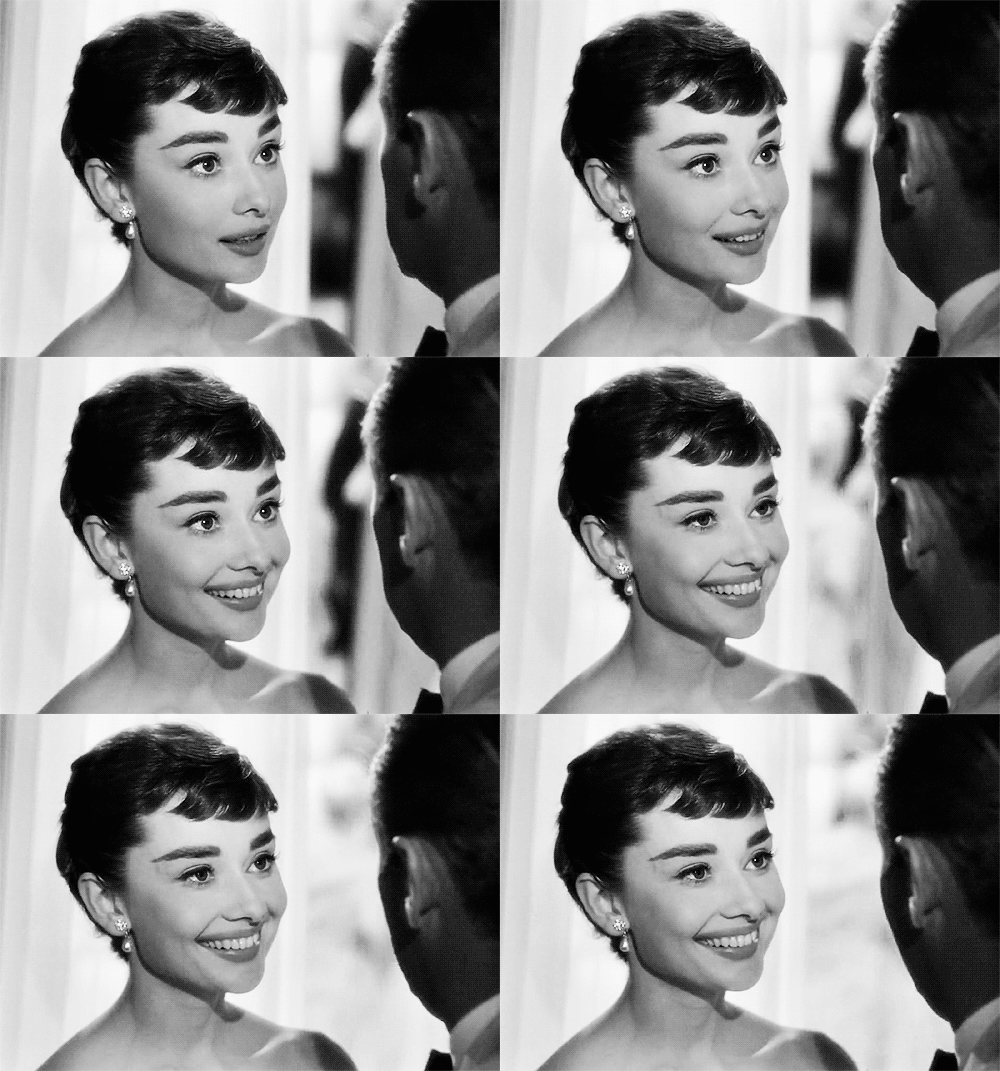
Twenty-five years after her passing, Audrey Hepburn remains the most beloved of all Hollywood stars, known as much for her role as UNICEF ambassador as for films like Roman Holiday and Breakfast at Tiffany’s. Several biographies have chronicled her stardom, but none has covered her intense experiences through five years of Nazi occupation in the Netherlands. According to her son, Luca Dotti, “The war made my mother who she was.” Audrey Hepburn’s war included participation in the Dutch Resistance, working as a doctor’s assistant during the “Bridge Too Far” battle of Arnhem, the brutal execution of her uncle, and the ordeal of the Hunger Winter of 1944. She also had to contend with the fact that her father was a Nazi agent and her mother was pro-Nazi for the first two years of the occupation. But the war years also brought triumphs as Audrey became Arnhem’s most famous young ballerina. Audrey’s own reminiscences, new interviews with people who knew her in the war, wartime diaries, and research in classified Dutch archives shed light on the riveting, untold story of Audrey Hepburn under fire in World War II. Also included is a section of color and black-and-white photos. Many of these images are from Audrey’s personal collection and are published here for the first time.
Robert Matzen is the author of eight books, including the bestsellers Mission: Jimmy Stewart and the Fight for Europe and Fireball: Carole Lombard and the Mystery of Flight 3, which won the 2015 ‘Biography of the Year’ Benjamin Franklin Award and earned praise from the Smithsonian Institution.
His forthcoming Dutch Girl: Audrey Hepburn and World War II, involved three years of intense research and several trips to the Netherlands, where Audrey spent the war. He worked in close consultation with Luca Dotti, Audrey Hepburn's younger son, and with many Dutch citizens who survived the war with Audrey in the town of Velp.
Robert has appeared on the BBC, Talk Radio Europe, Radio Russia, and many U.S. television and radio outlets, including NPR. His previous print work includes many articles about classic films and national bylines for the Wall Street Journal and other news outlets. His work as a filmmaker earned national awards and his feature documentary about George Washington, When the Forest Ran Red, is a genre classic that premiered on PBS in 2001. He is a former communications professional for NASA, where he spent 10 years.
When I think of Audrey Hepburn I picture the beautiful, iconic movie star who always appeared so regal, no matter what role she played. I love many of her movies - Breakfast at Tiffany’s, Charade, My Fair Lady, to name a few. I also knew about her work with UNICEF later in her life, but I didn’t know much more about her than that. If you’re looking for the story of her Hollywood years, this is not it. This book details her earlier life in the Netherlands when it was occupied by the Nazis. From the age of eleven through sixteen, she experienced hunger and bombings, the pain of loss, watching trains filled with Jews being transported. While both of her parents were Nazi sympathizers, Hepburn helped care for wounded, courageously played an active part in the resistance, dancing ballet to raise money for the resistance. Two things that impacted her life forever were abandonment by her father and the war. Perhaps it was the war that influenced her work with UNICEF, traveling the world to bring attention to poor children. “The war made me resilient and terribly appreciative of everything for everything that came afterward. I felt enormous respect for food, freedom, for good health and family.”
I listened to the audio book of this and I still have to get used to that feeling of being read to rather than reading and the narration here seemed a little dramatic to me. However, the book appears to be well researched and the author has done a great job of depicting the war years that Audrey Hepburn lived through. Before I listened to this book, I certainly admired Audrey Hepburn, the actress. After finishing it, I gained a respect for Audrey Hepburn as a human being.
I made it over halfway, but DNF'd this one when it was clear this was a bait and switch. Audrey Hepburn's name and image was put on the cover to sell copies.
This was a very dry, repetitive narrative with a lot of filler about the Nazi occupation in the Netherlands. It's not that these stories aren't worthwhile, but to title a book Dutch Girl, and put an image of Audrey Hepburn on the cover, one would expect the book's main focus to be Audrey Hepburn, and it was not. Her family stories are told but it is not the central theme and often the connection is thin.
This would have worked better as a magazine article instead of a full-length book.
* I received a copy of the book vis Edelweiss. All opinions are my own.
As a young girl, watching Audrey Hepburn in the many movies she made, I found her to genuine, graceful and classy. Didn't have any idea of who she was nor what she went through before her movie career. This book centers on that time, a time when a young girl was caught in Hitler's scourges.
She was living in the Netherlands when Hitler invaded, at first things moved slowly, but soon the effects could be felt by all. She loved ballet, took lessons and became quite good. She would eventually dance in fundraisers, where the money was turned over to the Dutch resistance. She saw many atrocities, saw many starve to death, but one particular act, the death of someone close to her would haunt her. In fact, she never really got over what she experienced during that time.
Not only does this wonderfully portrayed her early years, but does an excellent job showing Hitler's plans in the Netherlands. So a deft portrayal of someone who would grow up to impact many on the screen, but also a more than adequate historical. The many who would not give in and fought Hitler and his plans with the utmost bravery. The book does cover some of Audrey's later film career, but only when her future was impacted by her past. Very well done.
The narrator Tavia Gilbert was very clear and concise. A pleasing narration.
An interesting, well written and well researched account of Audrey Hepburn and her experiences through five years of Nazi Occupation of the Netherlands. Some readers who may be more interested in her film career might be a little disappointed in this one as it delves more in the Audrey’s life through the war in the Netherlands which was fascinating to read and after with her movie career and her work with Children and UNICEF.
I really enjoyed this book because it chronicles her war Experiences as a participant in the Dutch Resistance, working as a doctor’s assistant and her ballet career. The book focuses on the effect that the war had on Audrey Hepburn and her family. We also learn quite a lot about her mother and father who were Nazi sympathizers at the beginning of the war. The Nazi’s occupation and atrocities in the Netherlands is very well detailed and very well researched in this book.
I rarely read books on Film stars and their careers as I am not really a movie person but who could resist this one on the iconic Audrey Hepburn and especially with such an interesting upbringing which I knew nothing about. I listened to this book on Audio and the narration was satisfactory and was accompanied by a PDF file of photographs and maps which was helpful. However I did find it quite a challenge to keep track of all the characters and names and this might have been easier for me had I had a physical copy of the book. Overall I really enjoyed the book and am delighted I took the advice of my Goodread’s friend Diane to pick this one up as it was insightful and quite a page turner.
I am glad to have read Dutch Girl: Audrey Hepburn and World War II by Robert Matzen, so I am giving it three stars. It covers Audrey Hepburn’s (1929-1993) entire life. She is famed both as an actress and humanitarian in her role as Goodwill UNICEF Ambassador. The book’s central focus is however, as the title indicates, her experiences in Velp and Arnhem, Holland, during the Second World War. Clearly, memories of the war years were the impetus behind her active participation in the humanitarian endeavors of her later years. The death and destruction she saw and the hunger she herself endured shaped her.
Audrey, referred to by her family as Adriaantje, was born in Brussels, Belgium. Her father was English and her mother Dutch. In 1935, when Audrey was six, her father abandoned the family. Audrey felt dumped and discarded, of no importance to her father. She was enrolled in a school in England, her two elder brothers sent off to schools in The Hague. With her father gone, the tie between mother and daughter became ever stronger. Her mother, prevented from becoming a dancer herself, pushed this as a goal for her daughter. In England, Audrey was enrolled in ballet school. Subjects other than dance held little interest for her. When the war began her mother brought Audrey home to her parents in Arnhem. Her belief was that Germany would sidestep neutral Holland. Her mother’s family, although no longer wealthy, was of Dutch nobility; she was the daughter of Baron Aarnoud van Heemstra, formerly mayor of Arnhem and Governor of Dutch Suriname. Audrey’s ballet tutelage continued in Arnhem, now under the instruction of Winja Marova. Of course, Hitler did invade--in 1940.
It is here with the German invasion that the story truly takes hold. Her uncle is taken as hostage and killed. After his death, she, her mother and her widowed aunt move to Velp to live with her grandfather. Operation Market Garden, the Battle of Arnhem, the national railroad strike leading to the cutting off of food and fuel supplies and the “hunger winter of 1944-45” are depicted in vivid detail. Reading of the famine is grueling. While the background information about the families, the years leading up to Germany’s invasion of Holland and Audrey’s marriages and later career in film and work with UNICEFF are all covered, the central focus of the book are Audrey’s years of young adolescence, 1940-1945 during the war. This is primarily a book about the Second World War in Holland, seen through the eyes of one who lived through it as a child.
As a star ballet pupil, Audrey’s first performances were for the Germans; she was applauded and praised. Her mother’s, as well as her father’s, support of the fascist movement and the Nazis is brought out into the open. Her mother’s sentiments and view of the party do appear to have changed during the war; actions are pointed out to demonstrate this. The family hid a British soldier in their house. Had this been discovered they would have been killed. Audrey held dance performances to raise money for the Dutch Resistance.
After the war her mother’s Nazi sympathies were questioned. Was she a collaborator? Well, her pro-German activities up to 1942 cannot be denied. Nonetheless, it was decided that she had done nothing to harm the country. Of course, in the years after the war, collaboration would be considered a stain, scarcely beneficial for her daughter’s career, and it was through her daughter that Audrey’s mother aimed to fulfill her own unfulfilled dream of becoming a dancer. After the war, as little as possible was to be said about earlier Nazi support. Audrey’s career demanded this. Audrey was never an outspoken person. She was aloof and would remain aloof. On completion of the book you do not feel you really know her. She lets no one in.
Audrey is never criticized –we are told of her work for the Resistance, of her ballet, of her hospital work, how she moved from dancing to acting in the years after the war and her subsequent engagement in UNICEF. Episodes are thrown in about what she saw visiting Somalia in 1992 during its Civil War, its famine and its refugee situation. The point is obviously to draw a connection between her experiences and theirs. However, the flashforwards make the flow disjointed. The same occurs with episodes about her acting career.
The author of this book writes in an overly demonstrative fashion. He peppers war scenes with “booms”. Lines such as those shown below annoy me:
“Every second the thump, thump, thump of the cannons could be heard.”
“…and no one so much as breathed.”
“More and more death rained down.”
“Then………BOOM!”
“Arnhem, medieval fortress of old, one of the most beautiful cities of all Europe and home of Audrey Hepburn Rustin’s dance career, was being destroyed brick by brick.”
The prose style is too overly dramatic for my taste. I prefer that deeds and events be allowed to speak for themselves.
Tavia Gilbert narrates the audiobook. Her narration further emphasizes the cinematic tone of the author’s words. I do not like her narration, but given that I could hear every word, I have given it two stars. The PDF file that accompanies the audiobook is very good. I appreciate that it was included! It contains clear maps, photos of the family, their residences, stage performances, newspaper articles and scenes from the war.
This book is about Hepburn’s early years in Europe during the war. It has a foreword by her youngest son Luca Dotta. She had always been very introverted, a quiet, shy girl. Probably more so after her parents split and her father wasn’t around anymore. but the ballet lessons she loved so much finally helped her become more expressive outwardly. Her mother, Baroness Ella Van Heemstra was very pro-German before the war began and had met Hitler a couple of times during their many travels. But then Audrey’s father had walked out when she was 6. They were both taking it hard but Audrey was really worried about her mother.
Elle put Audrey in a school and found her some ballet classes in London, but when war became imminent her mother had her brought to the always previously neutral Netherlands to live. It was hard for Audrey because she didn’t speak the language there and so didn’t understand a word of what they were saying at school. The only thing that made it bearable for her was that her mother was able to get her into ballet classes again. She grew up as Adriaantje (little Audrey) Van Heemstra, but after the Germans moved in she became known as the English-sounding Audrey Hepburn-Ruston. Ella is good at organizing events, especially if it will be something that will offer a chance to show her daughter’s talent. But she’s lacking in showing warm feelings to Audrey, who is so needing them. Audrey can’t understand why Ella is still friendly with the Germans, who are being so cruel to their Jewish friends. Though, as time goes on and her mother can no longer ignore what’s going on, she does stop socializing with them, etc. But this will cause problems for Audrey throughout the rest of her life.
About halfway through the book, near the end of the war, it begins speaking from Audrey’s later perspective, done in italics, where she returns to the Netherlands and reminisces about the war, married and a star. This appears off and on through the book. It’s well researched and reads well. This is for those interested in the old star biographies, and WWII. My thanks for the advance electronic copy that was provided by NetGalley, author Robert Matzen, and the publisher for my fair review.
Wonderful NF book that reads like Fiction! About the beginning of Audrey Hepburn’s life. Moving to the Netherlands and the difficult life growing up in the Dutch world during WW2. Her start as a dancer that evolved into being a movie star. The book goes on to talk about the physical, emotional and psychological scars that were endured during that time. Goes through Ms Hepburn’s life until her death of abdominal cancer. Known still as Hollywoods most beloved actress.
I have put off reading for a long time. This was the perfect book to get me refocused off of current events in my local community.
I was deeply disappointed in this bait-and-switch book aimed at fans of Audrey Hepburn. This was an overwhelmingly and excessively detailed book about WWII, specifically in the Netherlands, and oh, Audrey Hepburn was there too! If the author's goal was to impress us with all the minutia, then he succeeded. However, most people looking to read a book stated to be about Ms. Hepburn during the War aren't going to be impressed. They, like myself, are going to be angry. Additionally, for a book that is non-fiction, I was surprised at the assumptions Mr. Matzen made about what people were thinking, especially at moments right before they died and had no way to let others know. That sounds more like historical fiction than non-fiction. Another issue I had with the book was the writing style that many times felt immature and too casual for the topic. "Then came more good news. Food!" This doesn't sound appropriate when you are discussing people who have survived the Hunger Winter. I have other examples, but I hope only one is needed. The vast swings from casual story telling to in depth details about only tangentially related events (or events not even related other than they took place during the War), did nothing to improve my impression of the book. Either the book should be edited to about 40% of what it is now and truly focus on Ms. Hepburn, or it should be renamed something that does not imply Ms. Hepburn is the central theme. I debated giving this book 1 star; however, despite my disappointment with the book, it was very informative and I always like learning new things. I just expected to learn things about Audrey Hepburn not the entire history of the Netherlands.
Thanks to NetGalley and GoodKnight Books for a copy of this book. My opinions and review are my own.
The book has been marketed as telling the story of Audrey Hepburn's young years during World War II in which she lived in Arnhem, developing her skills as a dancer and working as an agent for the underground. While this is true in parts, it primarily chronicles what life in that town (the town of "a bridge too far") was like for the inhabitants and the transformations wrought by invasion, occupation and liberation. Such devastating affect on Audrey and members of her family was truly immersive, but the author's obvious high regard for Audrey is apparent with every description and episode, imbuing all with a great deal of affection. Her mother's history was remarkable, being enraptured by Hitler, even meeting him in 1935 and being a believer until some time into the occupation. Later in life during interviews as an adult, Audrey didn't talk about this aspect of her family history. In fact, she sublimated a lot of the horror and deprivation and tamped it down inside. That changed in 1946 when she first came across Anne Frank's diary. The similarities she and Anne shared went straight to her heart, and provided her with what became her most important mission later in life, that of the protection and welfare of children via UNICEF. The reader thus comes away with a deeper understanding of why Hepburn projected such empathy especially for children,
However, I found the book on the whole to be quite repetitious in parts and much more of a history than a biography.
I received an ARC from NetGalley in exchange for an honest review.
Audrey Hepburn is such an iconic actress and I've seen so many of her films multiple times. Outside of her films though I didn't know much about her life, especially as a young woman growing up during WWII in Europe. This biography from Robert Matzen is a fascinating read if you're interested in her life. I learned so much about her and I can definitely say that I have a newfound respect for her knowing what she went through. Audrey and her family lived through the Nazi occupation of the Netherlands and witnessed the terrible events of the war first hand, including the Hunger Winter of 1944-45. I knew nothing about her parents going in and their story is just as interesting given all of the circumstances. One thing that I didn't expect was the close connection between Audrey and Anne Frank - they were almost exactly the same age and lived fairly close to one another, but their lives were very different. It's easy to see how she grew to become the woman she did especially when it comes to work with children and UNICEF.
Biography of Audrey Hepburn’s life offstage, focused on her early years in the Netherlands during WWII. She and her family endured the Nazi occupation, the execution of her uncle, and starvation during the Winter of 1944-1945. Her mother was initially a supporter of the Nazis, but soon became disillusioned. Early in the occupation, Audrey continued to pursue her passion for the ballet, and later switched to teaching children to dance. Audrey played a role in the resistance – delivering pamphlets and running errands for a doctor.
The first half is stronger than the second. I enjoyed hearing about her family background, her interest in ballet, and what life was like in the Netherlands during the occupation. It becomes a bit repetitive and less focused toward the end. I listened to the audio book, read by Tavia Gilbert. She does a competent job, but her narrative style is overly dramatic for a book of non-fiction.
Wow, I really didn't realise how interesting the WW2 / Audrey Hepburn combo would be when I first picked up this book. I'm pretty shocked at some of the things I have read.
Audrey's parents were particularly interesting, her father was British and was considered a traitor and spent most of the war in a British prison. Her mother, Dutch, actively supported and met Hitler on many occasions, and even wrote about it in a fascist newspaper, something that followed her for a lifetime and had many implications.
What really struck a cord with me though was the connection to Anne Frank. Anne and Audrey were born weeks apart, the same age, just 60 miles away from each other and how different their lives were. I was amazed that Anne wrote in her diary an event in which Audrey's uncle was murdered. Audrey was called upon many a times to play Anne is various films which she always turned down.
Overall I enjoyed this however in true non fiction style it's a dry read.
A look at WWII in the Netherlands - specifically Arnhem and Velp - through the lens of Audrey Hepburn. Every chapter starts with one of the rare quotes by Hepburn about her experiences during the war, but the chapters heavily focus on the details of the war itself. Matzen really tries to immerse the reader in the terrifying experiences, perhaps to the extent of fabricating people’s thoughts and feelings. This book would be best loved by someone who is fond of Hepburn and is also interested in what happened in the Netherlands during WWII. Hepburn fans might be disinterested in the war detail and WWII buffs might be annoyed by the Hepburn emphasis.
DNF @50%. Listening to this book became tedious with all its repetitiveness, so instead of torturing myself, I gave up the fight.
Started off strong. Really enjoyed the history of the war in Holland and the history of Audrey’s family. But then it waned and I got annoyed at a comparison to Anne Frank and I was done. No rating as I did not finish it.
Impressive biography about the Dutch war years of Audrey Hepburn and its impact on the rest of her life.
Meticulous researched which I can state, as being Dutch myself, with a certain amount of authority. Not only gives this a good insight in Audrey Hepburn herself, but also the impact of the German occupation on Dutch society.
In the forward, the author claims to have all this never before known knowledge about Audrey's life during the war. However, it did not appear that anything--or at least very little--was revealed about Audrey's life during that time in this book. Audrey did speak about her life during the war--most chapters start with a quote from her about it--but she spoke about it very rarely because it caused her such pain. What the author more accurately did was put what little we know about her into a wider historical context. So when Audrey was taking dance classes or when her uncle was killed, the author spends a lot of time explaining what else was happening in the war around Europe. There are entire chapters where Audrey is not mentioned AT ALL while the author goes off on these tangents. While the context is of course relevant, it is given far too much precedence in a story that is supposed to be about Audrey Hepburn.
The largest value this book has is the chapter that talks about Audrey and Anne Frank. That was fabulous and should be its own book. Audrey and Anne were the same age, living in the same country at the same time--but their lives took wildly different paths. And yet, they intertwined. Audrey read Anne's diary many times during her life and later met Anne's father Otto. It was an incredibly fascinating chapter and would love to see this fleshed out. Why "Audrey and Anne" has not already been made into a book and movie is very surprising to me.
Mr. Matzen has taken bits and pieces from other biographies of Audrey Hepburn plus from Dutch historical archives and put them all together to, for the first time -- according to Audrey's youngest son -- explain just what happened to her during the WWII years in Holland that had such an impact on her life. Her son, in the Forward of the book, was grateful he finally is able to have a deeper understanding of his mother, since she would seldom talk about the war years, five years out of her life when the Nazis occupied Holland. Not only were the citizens starved and bombed, her Uncle was killed by firing squad. The war made her the person she became, and it haunted her as well.
This story is more interesting because we can picture the always-thin woman in movies such as Serena (my favorite) and Breakfast at Tiffany's (my least favorite). The story, to me, was less interesting because of the manner in which it was revealed. There were parts about her childhood, and then she would be filming Roman Holiday, then back to her childhood and again fast forward to her marriage to Mel Ferrar and her love of children. This resulted in many phases being covered repeatedly. In the end, though, I do understand the woman better now and have a greater empathy for what any victims of war experience.
FTC Disclosure: I received a complimentary copy of this book from NetGalley. These are my honest thoughts.
This book was amazing. I learned more about my favorite vintage actress than I ever knew previously. There were moments of levity that lightened the sober tone of the account of Audrey Hepburn’s childhood and teenage years. It’s amazing what people can survive when they band together through tough times. I never imagined how much horror Miss Hepburn had to endure during WWII. My heart breaks for her after the fact. I see now more than ever why she turned down the role of Anne Frank when offered it during the early years of her movie career.
Fans of Audrey Hepburn or researchers of WWII would benefit from reading Dutch Girl. I’ll be purchasing a copy of this one at some point, because I’ll definitely be reading it more than once.
Content: expletives and profanity (light for general market), war violence (mostly handled without gory details)
Dutch Girl: Audrey Hepburn and World War II - Robert Matzen Biographies are not usually my thing, and biographies of celebrities even less so. Most peoples lives are terribly interesting, and the risk of learning something truly off-putting is high. So for the most part I'm a enjoy their art or athleticism or moment in history and move on, unknowing.Like much of humanity who's seen her movies, I like Audrey Hepburn: so lovely, so stylish, willing to use her fame and popularity on behalf of the world's most desperate children. But I knew pretty much nothing about her life. Until recently I didn't know she was from the Kingdom of the Netherlands or that she had been associated with the Resistance during the war. Audrey Hepburn: Girl Spy sounds great but it rather overstates the case. Matzen doesn't oversell it. He's quite clear that she spent most of the war shy, lonely, and only interested in dance.What her wartime experiences illustrate isn't tales of great daring and glamour, but the quiet day to day heroism of people under occupation, trying to carry on with their lives despite deprivations and ever-present danger. There are interesting similarities between this and A Castle in Wartime. The Nazis were keen on holding hostages. Hepburn's family was not rich, but her mother was a Baroness and a fool. She was very keen on fascism and Nazis and Hitler's great charm right up until the Netherlands were invaded and people she cared for started dying. Hepburn's mother had rather a bad time of it after liberation when her earlier warmth to the occupiers was closely examined. While it is morally important to prosecute war criminals I'm not sure that it is any sort of deterrent and certainly shaming women for attention received from the occupiers is just mean and vindictive.War is hell. It is particularly hell for the women and children starving and freezing in bombed-out cities like Arnhem or Aleppo. It's not surprising the Hepburn would become an ambassador for children for UNICEF. She never forgot what she had lived through and what it meant to her to receive aid at a most desperate time. In her honor I am donating to UNICEF today on behalf of all the children who have been refused a home or help when they needed it to survive. Donations made today will be tripled.Library copy
Dutch Girl documents the life of Audrey Hepburn during her years in the Netherlands which includes the torrent episodes of World War 2. At times the book comes across as a history book about the Netherlands and WWII and the story of a would be actress who would steal the hearts of the world in her adulthood.
The novel does not really go into her films or life after she had become a star. It does however document an important part of world history and the part she played in these events and her family, mainly her mother’s role with Nazi’s and the change of attitude once the Germans invade the Netherlands. It is a very interesting novel and I was captivated by the way Matzen is able to weave the two stories together. The story of the Netherlands is more interesting and tends to overshadow the story of Hepburn.
The novel can be described as a thinly disguised book selling on the life of a movie star but delivering a historical account of Germany and Netherlands. I personally found it to be about a family and their involvement during the War and it gave the war a personal face through their experiences. This is where the novel does amazingly well.
There will be a bit of disappointment who are expecting a straightforward biography. This will probably be the thorn in the books side because this is more a book about the war and a girl who will grow to be one of the most iconic film stars of her generation. This is really an extraordinary book that if it was dressed up as a WW2 book, I probably would have bypassed it on the shelves but as it was a biography, it kept me interested and engrossed in the history. I learned about an awkward girl and her family during a terrible time in history, I was able to empathise with life during this time period.
My hats are off to Matzen and it is pure ingenious on how he was able to give me a history lesson disguised as a biography of a film star and show me the human story behind historical events. This is a winner and one of the hardest reviews to write. Highly recommended.
I have always loved Audrey Hepburn's films. She just shines on the screen...so beautiful, so poised and talented. I learned years ago about her charitable work through UNICEF. She was a kind and giving person, as well as intelligent and talented. This book talks about Audrey's life before Hollywood...the years she lived under the Nazi occupation of Holland.
I never realized how much she went through during World War II in the Netherlands. My respect for her has increased so much since I finished reading this book. She worked as a doctor's assistant, witnessed brutality, hunger and death, and survived it all. This book is not about Audrey as an actress....it is about her life prior to all of that. Her film career is mentioned only in passing. This book is about Audrey's years growing up during the war and how those experiences shaped who she became as an adult. Her life is so much more than her Hollywood career!!
This is the first book by Robert Matzen that I've read. He has also written books about Carole Lombard, Jimmy Stewart and Mulholland Farm...an infamous house owned by Errol Flynn. I'm definitely going to read his other books, starting with the one about Jimmy Stewart's war service: Mission (on my TBR shelf already).
**I voluntarily read an advanced readers copy of this book from GoodKnight Books via NetGalley. All opinions expressed are entirely my own.**
*I received this book from the publisher to read in exchange for an honest review. All opinions are my own*
While the premise of this book caught my attention (I love Audrey Hepburn!), I struggled to get into this book as the amount of people mentioned and events pulled away from me enjoying getting to know Audrey's childhood. I may have tried to read more, but unfortunately the thought of it every time I needed to read it, made me cringe. So I decided to leave it after many struggles to get into it. I still recommend this book as I know it holds a lot of historical and fascinating references to this time in history and for some readers it may just be what they're looking for :)
In 1989 Audrey Hepburn, in her last movie, played an angel in Steven Spielberg's, "Always." At the time I thought what a perfect piece of casting. In my mind, I always felt that of all the Hollywood starlets she was the one who looked like a divine, angelic, being.
In 1993, at the age of 63, Ms. Hepburn passed away. For the previous 5 years I was following her new career as a UNICEF ambassador visiting war torn countries where children were starving, such as Ethiopia, El Salvador, the Sudan, Somalia, etc. She had not only played an angel but was a living, breathing angel.
Mr. Matzen's biography, "Dutch Girl: Audrey Hepburn and World War II,"is a meticulously researched book about a young Audrey Hepburn, ten to fifteen years old, her family, friends, and all the people of the Netherlands living under Nazi occupation between the years of 1940-1945. It was never easy during any part of the occupation, but it was especially brutal during the last year.
After the Normandy invasion in June of 1944, many people came to believe that the war was just about over. The Allies had finally landed in Europe and even though the fighting to retake Paris and France had been fierce there was even greater optimism that the war would end soon, especially in the Netherlands and Belgium. While the French celebrated their liberation, after previously forming the Vichy government in collaboration with the Nazis the war intensified as the Nazis tightened their hold on the Netherlands. (The French believed why fight while others will do the fighting for you. When asked about the sudden disappearance of all their Jewish neighbors, they simply replied, "Well no one told them to be Jewish.." Of course, I am only half joking. The French Resistance was very instrumental to relaying important information to the allies and without their help the bloody invasion of Normandy would not have happened. Many of the French Resistance groups were lead by courageous women)
The Germans, ever resourceful, developed what they called the V1 and V2 flying bombs (vengeance bombs) that could travel 150 miles and were launched from the coast of the Netherlands and could hit targets as far away as Britain and France. These bombs were brutal weapons and the Nazis were going around telling everyone that the war would soon turn around and be in the Germans favor.
They were right about one thing, they were brutal, but their malfunction rate was exceptionally high, exploding in mid-air and landing on the towns of the Netherlands causing tremendous and deadly damage. Dead civilians were spread out across the towns of Velp and Arnhem where Audrey and her family took to the basement for months. People were starving to death, yet Audrey and other youths like her carried messages from the hospital to individuals that the doctors thought the Germans were hunting down. She helped out at the hospital and took care of dying children and children whose families were wiped out. She continued to walk the streets until the Germans picked her up and threw her in the back of a truck with other young girls. Once the truck started moving she jumped out of the truck and ran back to the basement where they hid a British serviceman from the Nazis.
What Audrey did during the war was exceptional but it was no different than what most children her age and younger did. But what she experienced during the entire war, along with everyone else, would stay with her for the rest of her life. Her older brother Otto, who she was very close to, was taken to a forest and shot with four other men in retaliation for a bombing at the railroad station which they had nothing to do with.
I have had the fortune, sadly, to know many gentlemen who fought in World War II, survived Nazi concentration camps, fought in Korea, and Vietnam. Except for one, I had known them all for a long time before they ever told me about their experiences. I imagine their confidence in me came from our many talks about current events and my knowledge of history. When they finally did confide in me it was like they were transformed back to that time. Unless one has been in combat one has no idea what it is like. I don't care how many books you read, or monuments and historical sites you might have visited, you will never know what it is all about unless you have lived it.
Ms. Hepburn never gave many interviews and she was quite adept at dodging any questions about the five years she spent under Nazi occupation. If forced to answer about her experiences, she would say that "What I experienced so did many, many others."
Audrey Hepburn is best remembered for her starring roles in films—such as Breakfast at Tiffany's,Roman Holiday, and My Fair Lady—and for her work as a Goodwill Ambassador for UNICEF. But what is known about her life during the years of World War 2? In Dutch Girl, Robert Matzen reveals the terrors and triumphs young Audrey experienced during the Nazi occupation of the Netherlands.
Part biography, part WWII history of specific areas of the Netherlands, Dutch Girl is a fascinating book. I didn't know very much about Audrey Hepburn prior to reading this. The little I did know was about her films and humanitarian work—and that knowledge was scanty, at best.
Audrey was the daughter of Joseph Ruston and Baroness Ella van Heemstra. In the mid-1930s, Joseph and Ella became involved with the British Union of Fascists, and were intrigued by Nazism, going so far as to travel to Germany where they met Hitler. Joseph abandoned the family shortly thereafter.
Knowing war was on the horizon, Ella and her children moved to Arnhem—and, later, Velp—where much of the van Heemstra family resided, hoping that the Netherlands would remain neutral as they had during the first World War. Sadly, this was not to be. The Nazis invaded the Netherlands the following year. The Nazi occupation lasted five years, leaving death and destruction in its wake.
These were the years that molded Audrey Hepburn into the person she became. During this time, she studied dance, and gave her first performances. She felt the horror of the execution of a beloved family member. She watched as Jewish people were loaded into railcars, never to be seen again. She felt the heartache of failed liberation, and suffered the agony of slow starvation. She experienced the dangers of participating in the Dutch Resistance. She felt the terror of battles being fought close to her home. And finally, at long last... she felt the indescribable joy of the Germans being forced out when help arrived.
Audrey Hepburn survived the war, but she was forever changed by it.
I almost didn't read this book, but I'm so glad I changed my mind. It's outstanding in every way, and I highly recommend it.
I'm surprised to see some people complaining because this book isn't about Audrey Hepburn the movie star. The title refers to her as a girl in WW2, there's a picture of a girl on the cover, and the book description is clear that the focus is on her experiences in the Netherlands during the war. I chose the book precisely because of its focus on her experiences as a girl during the war and I wasn't disappointed.
Before reading this book, I hadn't known that Hepburn's mother was a Baroness, or that her parents were among the many European society people in the 1930s who were enamored of fascism. Like most of the famous Mitford family from England, Hepburn's parents visited Germany and met Hitler. The Baroness's warm feelings for the Nazis evaporated only when the German tanks rolled in. She thought they'd all be happy Aryans together and Germany would respect the Netherlands's neutrality, as they had in World War I.
By the time war broke out, Audrey's father was long gone. Her parents split when she was very young and he didn't show much interest in maintaining a relationship with her. Her mother was not a warm person, so Audrey had problems with self-confidence. Her childhood experiences didn't help much. She was shuttled around England and various Dutch towns, and even her name was changed to suit the sympathies of wherever they were living. What mostly sustained Audrey was dance. She had a passion for ballet that her mother strongly supported.
Author Robert Matzen vividly describes Audrey's experiences during wartime occupied Netherlands. It's a strange mix of normalcy, with extended family and dance, and privation and danger. As was the Germans' normal practice, the Netherlands was stripped of its resources, and the Dutch people's meager rations only got worse as the war went on. It reached the point where Audrey had hunger edema and was in danger of serious long-term health consequences, perhaps even death.
Arthur Seyss-Inquart was appointed governor of the Netherlands under the occupation and, rather than trying to cultivate the Dutch, he stomped on them with both jackboots. Any actions of resistance resulted in prominent Dutch citizens being shot, including one of Audrey's beloved uncles. Conscription of the Dutch for forced labor was common and many went underground to avoid conscription, including members of Audrey's friends and family. Her mother was now anti-Nazi and her family, including Audrey, provided assistance to the resistance where they reasonably could.
This book does include some description of Audrey's adult life, but for specific purposes relating to her childhood. Matzen describes Audrey's strong support of UNICEF because it stemmed from her own wartime experiences with oppression, privation and near-starvation. He also goes into her marriages and children a bit because it's associated with her yearning for familial love. Finally, he writes about her reticence to discuss her personal history with gossip writers. He argues that because it was important to cover up the Baroness's political past, Audrey tried to discuss her youth as little as possible.
I give the book three stars because GR says that means "I liked it," and that's how I feel. It's a solid, well-researched read.
One critique I have that definitely keeps this from getting four stars from me is Martzen's stretching to draw parallels between Audrey Hepburn and Anne Frank. What they have in common is that they were living in the Netherlands during the war and they were about the same age. He describes Audrey as horrified by seeing Jews being rounded up and put onto trains leaving the Netherlands, and as being emotionally overwhelmed when she read Anne Frank's diary after the war. I believe that, but he wants to make them practically twins and I think it's tone deaf at best to suggest that there are strong links between the wartime experiences of Anne Frank and Audrey Hepburn. As challenging as life was for Audrey, she never had to experience the existential dread that the Jewish Anne Frank did. And, of course, Audrey never had to experience being transported and murdered, along with most of her friends and family.
I listened to the audiobook. The narrator was OK, except she pronounced Anne Frank as On Fronk. Irritating.
First, I had already heard that this was a history, not a biography, so I think that really improved my expectations for this read. It starts with pre-war family history and details a lot of the dynamics leading up to the war. I was surprised to hear how Audrey’s mother had initially supported Hitler before seeing the ugly side of his plans for the world.
One of my favorite parts was learning how Audrey coped with the issues of war by dancing even when she was too starved to succeed and by reading. I was pleasantly surprised to hear that one of her two favorite authors was E. Phillips Oppenheim, since he is also one of mine but is mostly forgotten nowadays.
Thanks to the publisher for a free reading copy. A favorable review was not required.
What a resilient woman Audrey Hepburn was! Dutch Girl by Robert Matzen guides the reader through young Audrey’s traumatic childhood as she and her family survived the cruelty of WWII. Matzen however, concentrated mostly on this portion of Hepburn’s life and gave much less information to her adult life, this was unfortunate. I also was very disappointed in the way the book was concluded, it felt like a very rushed ending.
When my mother wanted to teach me a lesson about life she never used stories about her career. She always told stories about the war. The war was very, very important to her. It made her who she was. ~ Luca Dotti, youngest son of Audrey Hepburn
Breaking out at the height of the studio era, World War II indelibly impacted Hollywood’s stars as much as it did the movie going public. Author Robert Matzen has highlighted three dynamic instances of this in a WWII trilogy that began with Carole Lombard and her tragic death, continued with Jimmy Stewart’s service as a bomber pilot and concludes with his latest book Dutch Girl: Audrey Hepburn and World War II.
Dutch Girl is a somber and rich book, filled with meticulous detail and compassion. Matzen does a superb job of weaving together an exploration of the searing impact of the war upon the adolescent Audrey, or Adriaantje as she was endearingly known to her family, and the history of the German occupation and subsequent Allied advancement into Holland. The onslaught the country endured is chronologically depicted yet always brought back to the story of this particular girl, in this time. Throughout, the actor remains a lilting, inspirational presence.
The book is graced with an introduction by Hepburn’s son Luca Dotti, who also agreed to a sit-down interview with the author, provided photos and in essence his blessing to the project. His enthusiastic endorsement brings heightened legitimacy, a sense even further solidified by conversational chapter notes. The breadth of Matzen's research is admirable and awe-inspiring. Yet the book is never dry nor disinterested in the tale of its dual subjects, that of the battering of the Netherlands, and the young Audrey who later became its most cherished and famous celebrity. Most telling are passages that relate Hepburn’s struggles with hunger during the final year:
The last winter, the so-called ‘hunger winter’ was the nearest I could come to saying I’ve seen starvation… Children were always rummaging in the dust bins and people were dying of hunger and cold.
Dutch Girl is a stirring and remarkable read, thoroughly researched and compelling. It is highly recommended for Audrey admirers (you haven't read all of this before!), classic film fans and history lovers. A special thank you to Smith Publicity Inc, the author and NetGalley for providing me with an ARC of this book.
This is a book about Audrey Hepburn but not the movie star person who we got to see in Breakfast at Tiffany's, My Fair Lady and many other Hollywood Films. This is the young Audrey who was a teenager during the years of the Nazi occupation of her homeland. It reads more like a history book of the war in the Netherlands than it does as a biography of a Hollywood icon and was a well researched look at how Audrey grew up and how it affected her later life.
When Audrey was 11 years old, the Germans began their occupation of the Netherlands. As a child, life didn't change much for her but as time went on and the restrictions gotten worse her life began to change and she had to give up her much loved ballet lessons. In 1944, her life took a turn for the worse when the Allies started bombing the town that she lived in. She and her family spent much of their time in the cellar of their home hoping to survive while bombs exploded all around them. Following that came the 'hunger winter'. There wasn't enough food and many people starved to death. Audrey commented that this was the first time she had ever seen starvation of such a large scale. She had a lot of determination to go from a starving young girl to a Hollywood icon in such a short period of time.
The author of this book worked with the members of Audrey's family plus did considerable research and found out things about Audrey's early life that her family didn't know - that her father was a Nazi agent and her mother was pro-Nazi for the first two years of the occupation. Audrey’s own reminiscences, new interviews with people who knew her in the war, wartime diaries, and research into classified Dutch archives shed light on the riveting, untold story of Audrey Hepburn's life during World War II.
I found this book to be a very well researched and interesting book about a Hollywood icon and how her early life affected the rest of her life when being a UNICEF ambassador and visiting poor places in the world were more important to her than her life in Hollywood.
Thanks to the publisher for a copy of this book to read and review. All opinions are my own.
If Audrey Hepburn was a puzzle, then there was a good one-third that had always been lost to the outside world. We may have seen a few pieces in biographies and a handful from her sons' books and interviews, but there was still something wanting. With Dutch Girl, we finally see just how much we had been missing.
This is not a biography for a casual fan, or someone new to Hepburn fandom and looking to learn more about her in general. Granted, you learn so much about what made Audrey Hepburn who the world "discovered" once Roman Holiday was released, but I feel that you should have a decent overview of the arc of her life before digging into this book. It focuses specifically on Audrey's formative years in England and the Netherlands, coming of age in a brutal war, and gives details on what she experienced in a level of detail never before seen.
There is so much to digest in these roughly 350 pages, and it's taken a while to get my thoughts into something coherent. I've read all the books available on Audrey and felt that I knew quite a lot about her, but this book is nothing short of startling. The absolutely exhaustive research done on the ground in the Netherlands unearthed a trove of documents never before shown, plus private diaries to add a level of detail to everyday life in an occupied country during a savage war. While every biography of Audrey Hepburn says she barely survived World War II, we never before saw how she survived, let alone what it cost her to come out the other side.
Even her children were stunned by the final results of this research, and her son Luca Dotti said as much in the foreword (he was also kind enough to share with the author his own research, plus previously unseen family photos).
Forcing myself to cut this review short, would I recommend this book? In a heartbeat. Is it a necessary piece in learning more about Audrey Hepburn? Absolutely.