
What do you think?
Rate this book

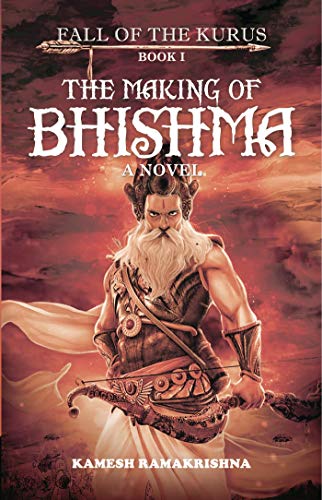
Book I: The Making of Bhishma, portrays the world of Hastinapura as its rulers try to manage the crisis. It explores the impact of this conflict on the life of Devavrata (Bhishma), eldest son of Shantanu, ruler of Hastinapura. His mother had committed suicide since the Kavi Sangha's one-family-one-child policy has required her to sacrifice seven of her children. Subsequently, Devavrata is disinherited so Shantanu can marry Satyavati, who demands the Kavi Sangha policies not apply to her. In a moment of anger, Devavrata vows to remain celibate. On the death of his father, he and Satyavati are compelled to rule as co-Regents for her underage sons – Chitrangada and Vichitravirya. But Devavrata is unable to prevent Chitrangada's murder by the invading Shakas. His subsequent actions to protect the borders of Hastinapura earn him the cognomen Bhishma (The Terrible). A secret love affair with Amba is cut short when she disappears. Vichitravirya dies just before his sons are born and Devavrata once again becomes co-Regent for his nephews, Dhritarashtra and Pandu. He narrates much of this story on his deathbed, as a prisoner of the sons of Pandu; other narrators fill in what he could not have known. At the end of his life, Devavrata muses over all that he gave up and left unmade in his own life while he built the Kuru Empire – an empire over which the Great War was fought.
About Author:Kamesh Ramakrishna grew up in Bombay (Mumbai). On graduating from IIT-Kanpur, he went on to obtain a Ph.D. in Computer Science from Carnegie-Mellon University, Pittsburgh, specializing in Artificial Intelligence. He has since worked as a Professor and Software Engineer; receiving some patents; a software architect for some foundational products; a CTO for a start-up; and in recent years, a Consulting Software Architect. For over twenty years Kamesh has been an avid student of history, archaeology, science and philosophy, drawn to the latent interconnections between these disciplines. His interests have had a tremendous influence on this book, the core ideas underlying which have been previously published in two peer-reviewed journals – The Trumpeter (Canada), and The Indian Journal of Eco-criticism. Kamesh lives with his family in Massachusetts, USA
498 pages, Kindle Edition
Published August 7, 2019


