Jump to ratings and reviews
Rate this book

Lords of Sipan: A True Story of Pre-Inca Tombs, Archaeology, and Crime

Rate this book
The true story of a priceless archaeological discovery and the high-stakes crime that followed, from the author of the bestselling A Cast of Killers. When Dr. Walter Alva, director of the Bruning Museum in Peru, received an urgent call from the police, he had no idea that he would soon be in charge of excavatinghat his life would soon be in grave danger. Color photos; maps and illustrations.

256 pages, Hardcover

First published October 1, 1992

12 people are currently reading
130 people want to read

About the author

Sidney D. Kirkpatrick

13 books17 followers
Books and book publishing have long been an important part of life in the Kirkpatrick family. My grandfather and namesake was a senior editor at McGraw-Hill for thirty-five years. My mother, Audrey Kirkpatrick, was a short story writer, and studied under Vladimir Nabokov at Cornell University. Katherine Kirkpatrick, my younger sister, is a former book editor at Macmillan and the author of five historical novels. My older sister, Jennifer Kirkpatrick was a writer and researcher for National Geographic.

I was born in Glen Cove, New York, on October 4, 1955, and grew up in Stony Brook, on the north shore of Long Island. While attending the Kent School, in Kent, Connecticut, I won writing awards for poetry and journalism. Throughout my high-school years, and during college, I wrote several hundred articles for Long Island newspapers and became a stringer for Associated Press.

At Hampshire College, in Amherst, Massachusetts, I majored in Chinese language and history. After graduation in 1978, I lived in Hong Kong, Taiwan, and Japan, where I taught ESL, directed and produced a short television documentary, and acted in two low-budget action films.

I completed my education in 1982 with an MFA from New York University’s Tisch School of the Arts, where I worked on several short films with classmates Spike Lee and Ang Lee, and optioned my first screenplay. While attending NYU, I wrote and directed "My Father The President" which won the 1982 American Film Festival and a CINE Golden Eagle. This film has since become a perennial favorite at over 1000 schools, libraries and museums across the country, and can be seen daily at the Theodore Roosevelt Birthplace at 28 East 20th Street, in New York City, and a the Sagamore Hill National Historical Site in Oyster Bay, New York.

The success of "My Father The President" caught the attention of film director Harrison Engle, who hired me to associate-produce a two hour television special, "The Indomitable Theodore Roosevelt," which starred George C. Scott. This film premiered on CBS in 1984, won a prestigious CINE Golden Eagle, and was nominated for an Emmy.

I moved to Los Angeles in 1982 and continued working with Harrison Engle, with whom I produced several short films for the Television Academy Hall of Fame, which included film biographies of Milton Berle, Norman Lear, Edward R. Murrow, and Lucille Ball.

The inspiration for my first book came in 1983, while I was collecting material at the Directors Guild of America for a film tribute to King Vidor, the legendary director of over seventy-six motion pictures. In the midst of organizing Vidor’s papers, I came across a locked strong-box containing the details of Vidor’s investigation of the 1922 murder of director William Desmond Taylor. Biographers A. Scott Berg and Edmund Morris were instrumental in helping me to obtain a publishing contract with E.P. Dutton. "A Cast of Killers," released in 1986, was on the best-sellers list for sixteen weeks, and was hailed as “mesmerizing” by author Anne Rice in a featured review for the New York Times Book Review.

After writing “A Cast of Killers,” I worked at Paramount Studios with screenwriter Robert Towne. Another screenwriter I worked with was Larry Ferguson, with whom I developed an action and adventure screenplay, “One Deadly Summer.” This film project, based on the true story of marine scientist Richard Novak’s one man war against Medellin drug lord Carlos Lehder, was optioned for actor Harrison Ford by Cinergi Films. Later retitled “Turning The Tide,” and co-written with author Peter Abrahams, it was published by Dutton in 1991 and excerpted by Readers Digest in 1992.

Research on my third book, "Lords of Sipán," was begun in 1991 in a small village on the north coast of Peru where I traced the contents of a looted pre-Inca tomb as it entered the black market in stolen antiquities. From Peru I traced the artifacts to London, New York, Beverly Hills, and

Ratings & Reviews

What do you think?
Rate this book

Friends & Following

Create a free account to discover what your friends think of this book!

Community Reviews

5 stars
58 (43%)
4 stars
49 (36%)
3 stars
20 (15%)
2 stars
6 (4%)
1 star
0 (0%)
Displaying 1 - 19 of 19 reviews
Profile Image for Bettie.
9,976 reviews5 followers
December 5, 2015


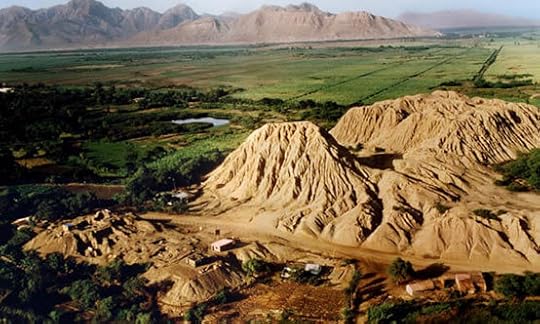
Description: In January 1987, archaeologist and museum curator Dr. Walter Alva was asked to examine a collection of strange artifacts found in the home of a poor grave robber on Peru's remote north coast. The subsequent police inquiry traced the cache to an ancient pyramid at Sipan, where looters had plundered a royal tomb of a little-known civilization called the Moche. This ransacking of the New World's richest archaeological discovery devastated Alva, who had been conducting a ten-year crusade to protect Peru's monuments of the past. What he did not know was that the looted artifacts had already been smuggled out of Peru and into England for re-transport to Los Angeles, where they would be sold to wealthy art collectors and dealers. At Sipan itself, the police, fearing for his safety, were demanding that Alva abandon his search for objects the looters might have missed. His own colleagues were also urging him to leave, believing he was wasting precious resources on an excavation doomed to failure. In the midst of this crisis, Christopher Donnan, the world's most respected Moche scholar, arrived with much-needed cash, supplies, and encouragement, along with the news that the precious artifacts were already in the hands of collectors and dealers. Donnan's information proved correct, for in the months to come, looted artifacts reached the hands of Los Angeles Museum of Art trustee Ben Johnson and Nobel Prize-winning physicist Murray Gell-Man. In fact, many of the objects would soon go on display at the prestigious Santa Barbara Art Museum. Meanwhile, U.S. Customs agents had begun an investigation into the smuggling operation, and in March 1988, their unprecedented seizure of pre-Columbian antiquities sent shock waves through the art world. When reports of the raid reached Peru, Alva was having a celebration of his own. The pyramid at Sipan was not the burial place of a single Moche lord but was, like the Valley of Kings of ancient Egypt, a necropolis containing many lords.


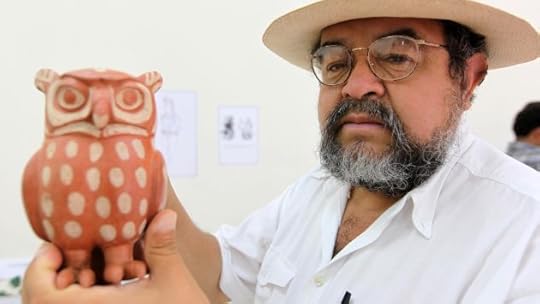
Walter Alva

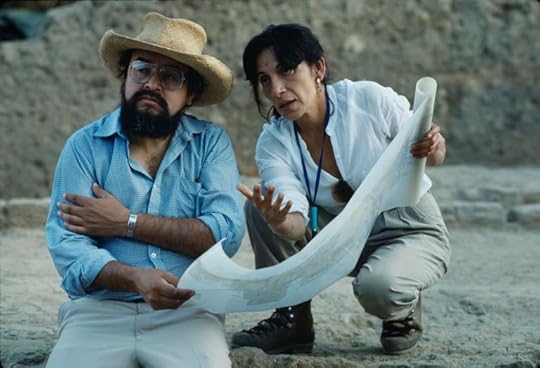
Walter with his archaeologist wife, Susan
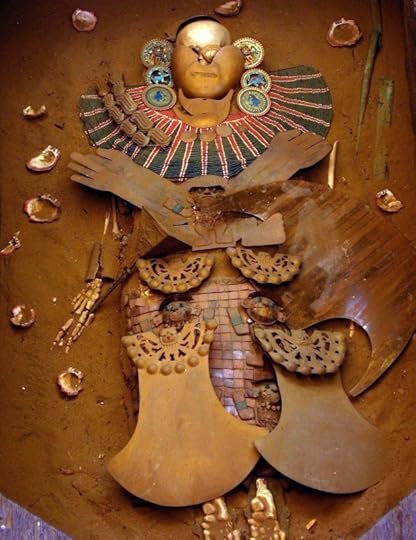


What an eye-scorching adventure, complete with a side-order of underworld art crime. Walter himself, such a humble upright soul with a reckless streak of doggedness running through, which is how we are able to view these treasures today.

In the epilogue it states that Alberto Jaime became Huaca Rajada's official tour guide. Neat turnaround.
Profile Image for Michael Gerald.
398 reviews56 followers
January 25, 2015
When I was a kid, fired up by the Indiana Jones movies, I wanted to become an archaeologist. I thought that being an archaeologist meant having swashbuckling adventures.

Later, I learned that archaeology is a serious field of study and involves conducting careful research, both in a university and in the field.

But when I first read a condensed version of this book in Reader's Digest, I learned that archaeology is a serious discipline and also an adventure. Then just this year, I found a rare hardcover copy of the book at Booksale in SM North EDSA in Quezon City. I said rare because it's already out of print; it was published in 1992.

Lords of Sipan is the true story of how an ancient Peruvian site held the remains of a king and other officials and other citizens of a civilization that preceded the Inca, the Moche. But one of the ancient site's secrets was first uncovered not by archaeologists, but local grave robbers called huaqueros. But it was a good thing that the authorities soon learned of the crime. Though some of the tomb's treasures soon found their way to unscrupulous dealers, smugglers, and buyers, the rest were saved by the police, some decent locals, and Dr. Walter Alva - the latter one of the greatest archaeologists in recent memory.

Dr. Alva and his staff and allies worked to preserve what remained of the looted tomb's contents and something more - the intact tombs of two other officials buried in the place called Huaca Rajada.

But it is not just the true story of uncovering and studying an ancient civilization. The book also tells how US authorities tried to recover most, if not all, of the looted artifacts that were in the hands of smugglers and shadowy buyers in the US. Though the legal cases soon became complicated and protracted due to delaying tactics and legalese by lawyers of the buyers/thieves, some of the treasures were soon confiscated and eventually returned to Peru, where they belong.

362 reviews12 followers
June 26, 2023
This nonfiction book has a heroic Walter Alva who rushes to save Peru's Moche artifacts from being plundered by an international antiquities trade. This professor faces death threats from local looters who sell the gold funeral relics of the Ancients and stir up a violent mob at the excavation site. There is also a local politician who tries to make election year points by accusing Alva of stealing and a jealous rival doing much of the same. The archaeologists win in the end with the locals seeing the importance of his work. What I found interesting was how the book demonstrates that there is no honor among thieves since the looters and their buyers cheat each other. A smuggler got a pittance of $2500 for getting a million in gold relics into the US and ratted out his employers. The widow of the ringleader of a gang of looters was nearly cheated of her share by his family. This was a true adventure story.
1,223 reviews167 followers
November 27, 2017
How Stolen Peruvian Gold Sold, Told

Archaeological thrillers are not exactly a dime a dozen, especially if they happen to be true. Tomb robbers, museum directors, scholars, agents, dealers, gallery owners and collectors all interact here in an exciting tale relating how various people vied to dig up, sell or buy ancient Peruvian artifacts. A few wanted to preserve the items for the nation (Peru), some wanted to obtain knowledge of the Moche culture which existed in northern Peru for many centuries up to 700 A.D, but many wanted to make a tidy profit. Somebody got shot, a few wound up in jail, there was a stand-off with angry villagers, the US government and the Customs Service became involved, there was a series of raids in California, and some fabulous treasures were found at several locations on the dry coastal plain of northern Peru. Written in an exciting style, fluctuating between the excavation process and the dubious practices of the dealers in looted objects, gallery owners, and collectors, Fitzpatrick tells the story of Huaca Rajada, a site occupied by three huge pyramids containing millions of bricks, and---as it turned out---immensely rich burials of Moche lords. Though the story of the excavation dominates, you can't fail to learn quite a lot about the Moche and their art during your reading, which, given the tense style, will be quick. I'm sure that archaeologists working on Peru may feel this book neglects their scientific findings to some extent. It's not meant to be an academic study. However, your interest in the subject cannot help but be stimulated by the fascinating tale and you will come away with a better appreciation of the struggles of nations around the world to control their own national heritages.
2,131 reviews7 followers
March 27, 2013
A good book detailing how a Peruvian Archaeologist helped save an ancient Mochan tomb from tomb raiders. The raiders had started to plunder the tomb but with minimal help and a lot of pluck Walter Alva is able to save the site and find the first intact Mochan royal burial. The parallel story line covers the smuggling and sale of Peruvian artifacts to well heeled Western investors.
Profile Image for Vicky P.
146 reviews8 followers
May 4, 2018
I was lent this book by a good friend who specializes in antiquities trafficking and provenance issues as a 'must-read', and boy was that ever an understatement.

Not only did this book do a phenomenal job of covering the basic considerations from all sides of the issue that has arisen of trafficked antiquities illegally leaving their countries of origin and ending up halfway across the world (a journey that usually starts in a poor nation and ends in a rich one), but it also told a riveting story that would thrill even someone uninterested in archaeology. There is drama, there is well-researched information, there is heart. It took me a while to read this book because I had to pause and put the book down after every chapter - there was always something new and dramatic that happened and I have never rooted harder for anyone in a nonfiction book than I rooted for Dr. Alva, senior archaeologist.

I highly recommend this book to literally everyone. There's something in it for everyone. Go read it. Now.
Profile Image for Shari.
94 reviews2 followers
August 11, 2021
Although the writing isn’t the best, the book is well worth reading by anyone interested in art, archeology, Peru and her history, or if you just like a good adventure story. The tale of the discovery, excavation and saving of these amazing burial sites is fascinating. I learned so much from this book and expect to follow down rabbit holes (or Moche burial tombs) to learn more in the coming months.

Not long ago, I asked another nerd how best to begin learning about Peru’s Pre-Colombian cultures. He said “forget the term “Inca”, and research the vast multitude of cultures that existed in Peru.” So, I start with the Moche and these amazing burial sites.
Profile Image for Alice.
1,190 reviews38 followers
July 23, 2023
True Archaeology Adventure

Excellent research covering the discovery of Moche Royal Burials in Peru. It starts with tomb robbers , illicit sales of plunder, and a sincerely brave Archaeologist stopping the plunder and sales, risking his life with irate villagers, jealous superiors, greedy foreign smugglers and a bunch of rich, elite, privileged people including some museums who were the recipients of the crimes committed. Our USA justice system has been 2 tiered for a very long time as this went down in 1988/89. Kudos to Drs. Alva and Donnan and the US Customs. A black eye for California Justice.
Profile Image for Kami.
564 reviews37 followers
January 18, 2019
Dry at parts (so docked a star) but overall the story was fascinating. The archaeology would have held my attention to begin with but it was almost equalling interesting to learn about the smuggling and customs case. Dr. Alva seems quite intense and it made me laugh how his assistant ended up staying. I don't think I'd want to work on a dig either that I had to carry around a Mauser hand gun for protection!
32 reviews
December 17, 2020
Starts a little slow with some extremely necessarily background on archaeology and the people involved, then becomes a thrilling page turner that I couldn’t put down!!!
Profile Image for Meredith.
Author 1 book15 followers
December 2, 2015
As someone who has been to Peru and even to Manchu Pichu, I was drawn to this story. It's heartrendingly similar to the Egyptian experience - priceless archaeology site, people who are wanting to survive, and the out country rich wanting to own this precious history, careless of how they play into ruining what we can learn about the history of the people of Sipan.

The writing is... alright, but lacks the skill with turning a phrase. Because of that, my own interest in the topic had to keep me engaged until the story finally picked up a momentum of its own.
Profile Image for Linda.
57 reviews
April 5, 2016
This book is "A true story of pre-Inca tombs, archaeology and crime.

I learned of this book through a course that I am listening too from the Great Courses. I really enjoyed reading about the work that is still ongoing in the archaeology of Peru. My only complaint with this book is it seemed that toward the end the author got tired of writing. It seemed suddenly it was just "The End" without some of the conclusions needing to be made. That being said however, it is a starting point for me to do more research and read more information on this exciting topic.
Profile Image for Debra B.
824 reviews41 followers
November 2, 2015
The storyline was interesting, but read like a dull history book. Making matters worse was the narrator. On the positive side, I learned a lot from this book and continue to find archaeology a fascinating subject. I could easily see this story in a Clive Cussler or James Rollins book!
Profile Image for Phil.
475 reviews
September 4, 2015
Quite an interesting book if one is interested in pre-Inca archeology. Fascinating procedures and discovery!
Displaying 1 - 19 of 19 reviews

Can't find what you're looking for?

Get help and learn more about the design.