

What do you think?

¿Por qué tantos hombres incompetentes se convierten en líderes?: (Y cómo evitarlo) (Gestión del conocimiento)
En este oportuno y provocativo libro, Tomás Chamorro-Premuzic hace dos preguntas impactantes: ¿Por qué a los hombres incompetentes les resulta tan fácil llegar a ser líderes? Y, ¿por qué es tan difícil que avancen las personas competentes (sobre todo, si son mujeres)?
Tras décadas de investigación rigurosa, Chamorro-Premuzic señala que, pese a que los hombres constituyan la mayoría de los líderes, tienen peores resultados en comparación con las líderes femeninas. De hecho, la mayor parte de las organizaciones equiparan el potencial de liderazgo con determinados rasgos de personalidad destructivos, como narcisismo y exceso de confianza. Es decir, estos rasgos pueden ayudar a que alguien sea seleccionado para un papel de liderazgo, pero son contraproducentes cuando la persona obtiene el puesto.
Cuando las mujeres competentes (y los hombres que no encajan en el estereotipo) no son tenidos en cuenta, todos sufrimos las consecuencias. El resultado es un sistema profundamente defectuoso que recompensa ser arrogante en lugar de humilde y ser gritón en lugar de sabio.
Tras décadas de investigación rigurosa, Chamorro-Premuzic señala que, pese a que los hombres constituyan la mayoría de los líderes, tienen peores resultados en comparación con las líderes femeninas. De hecho, la mayor parte de las organizaciones equiparan el potencial de liderazgo con determinados rasgos de personalidad destructivos, como narcisismo y exceso de confianza. Es decir, estos rasgos pueden ayudar a que alguien sea seleccionado para un papel de liderazgo, pero son contraproducentes cuando la persona obtiene el puesto.
Cuando las mujeres competentes (y los hombres que no encajan en el estereotipo) no son tenidos en cuenta, todos sufrimos las consecuencias. El resultado es un sistema profundamente defectuoso que recompensa ser arrogante en lugar de humilde y ser gritón en lugar de sabio.
224 pages, Kindle Edition
First published March 12, 2019
About the author
Tomas Chamorro-Premuzic
34 books114 followersDr. Tomas Chamorro-Premuzic is an international authority in psychological profiling, talent management, and people analytics. He is the CEO of Hogan Assessment Systems, Professor of Business Psychology at University College London (UCL), and visiting Professor at Columbia University. He has previously taught at New York University and the London School of Economics.
He has published 8 books and over 120 scientific papers (h index 41), making him one of the most prolific social scientists of his generation. His work has received awards by the American Psychological Association and the International Society for the Study of Individual Differences.
He is also the director of UCL's Industrial-Organisational and Business Psychology programme, and an Associate with Harvard's Entrepreneurial Finance Lab.
Over the past 15 years, he has consulted to a range of clients in financial services (JP Morgan, HSBC, Prudential), advertising (Havas, Fallon, BBH), media (Yahoo!, MTV, Endemol), consumer goods (Unilever, Reckitt Benckiser), fashion (LVMH, Net-a-Porter), and government (British Army, Royal Mail, National Health Service).
His media career comprises over 70 TV appearances, including the BBC, CNN, and Sky, and regular features in Harvard Business Review, the Guardian, Fast Company, Forbes, and the Huffington Post. He is a keynote speaker for the Institute of Economic Affairs and the co-founder of metaprofiling.com, a digital start-up that enables organisations to identify individuals with entrepreneurial talent. He lives in New York.
He has published 8 books and over 120 scientific papers (h index 41), making him one of the most prolific social scientists of his generation. His work has received awards by the American Psychological Association and the International Society for the Study of Individual Differences.
He is also the director of UCL's Industrial-Organisational and Business Psychology programme, and an Associate with Harvard's Entrepreneurial Finance Lab.
Over the past 15 years, he has consulted to a range of clients in financial services (JP Morgan, HSBC, Prudential), advertising (Havas, Fallon, BBH), media (Yahoo!, MTV, Endemol), consumer goods (Unilever, Reckitt Benckiser), fashion (LVMH, Net-a-Porter), and government (British Army, Royal Mail, National Health Service).
His media career comprises over 70 TV appearances, including the BBC, CNN, and Sky, and regular features in Harvard Business Review, the Guardian, Fast Company, Forbes, and the Huffington Post. He is a keynote speaker for the Institute of Economic Affairs and the co-founder of metaprofiling.com, a digital start-up that enables organisations to identify individuals with entrepreneurial talent. He lives in New York.
Ratings & Reviews
Friends & Following
Create a free account to discover what your friends think of this book!
Community Reviews
Displaying 1 - 30 of 197 reviews

April 11, 2019
Tomas Chamorro-Premuzic has asked a pertinent question and provided insight on how to fix the issue of incompetent people becoming leaders.
Although it focuses on why incompetent men become leaders, he identifies behaviours, traits and characteristics incompetent leaders have that many organisations can spot.
These behaviours are seemingly masculine and Tomas investigates why.
He also discusses how to pioneer competent leadership and encourage more females to step up - not by encouraging them to be like men, but showing them how to be the competent leader that organisations need.
Using the example of Auder Capital, Tomas describes how 2 women who were appalled by their colleagues approach to risk taking launched the company. Instead of blindly copying the status quo, they contributed in their own unique way.
But does assertiveness equate to leadership competence? This is a question I kept asking while reading the book. There are many indications that less assertive people are generally relied on to maintain the status quo and not necessarily relied on for pro activeness.
After detailing how organisations can crack the formula for effective leadership at the most detailed level, he teaches how to identify better leaders.
Although it focuses on why incompetent men become leaders, he identifies behaviours, traits and characteristics incompetent leaders have that many organisations can spot.
These behaviours are seemingly masculine and Tomas investigates why.
He also discusses how to pioneer competent leadership and encourage more females to step up - not by encouraging them to be like men, but showing them how to be the competent leader that organisations need.
Using the example of Auder Capital, Tomas describes how 2 women who were appalled by their colleagues approach to risk taking launched the company. Instead of blindly copying the status quo, they contributed in their own unique way.
But does assertiveness equate to leadership competence? This is a question I kept asking while reading the book. There are many indications that less assertive people are generally relied on to maintain the status quo and not necessarily relied on for pro activeness.
After detailing how organisations can crack the formula for effective leadership at the most detailed level, he teaches how to identify better leaders.

January 16, 2020
The title of this book grabbed my attention because I work with a pretty incompetent leader: a “manager” my co-workers and I often do our best to work around, rather than with, because he is at best useless and often actively harmful. In addition, he takes pride in being above knowing how to do anything on the office computer system; that’s for underlings. So if a problem comes up, he “solves” it by essentially running around the office shrieking with his hands in the air until someone else who actually knows what’s going on and what to do steps in and deals with it. Then he credits himself with having gotten the job done.
According to this book, about 75% of employees see their managers and bosses as being about as useful as this guy. The gendered title stems from the fact that most leaders, whether elected or promoted to their positions, are still male.
There’s a certain comforting thrill in reading the opening chapters of this book, and realizing that one’s own incompetent manager isn’t an isolated case. But it’s also very depressing, because the author is pretty certain that if you leave your current job in hopes of finding a better manager, you’ll probably just find yourself working under another Pointy Haired Boss.
Even more depressing: Most male leaders seem to get selected for their positions based on their belief in and loud proclamation of their own perception of their great abilities and competence. They aren’t necessarily required to demonstrate that they can work with people, or that they understand or care about the goals of the organization, or to put the achievements of the organization above their own individual pride and ambition.
The author’s suggested “fix” is that since women are actually expected to demonstrate competence before they are elevated to leadership positions, men should be demanded to meet the same requirements as women, rather than just demonstrating confidence.
This was an interesting premise, but it didn’t leave me with much hope for changes in my, or any other, workplace in the short run.
The most depressing sentence in this book to me was this: “A series of studies found that men’s careers tend to suffer when the men are friendly, empathetic, and agreeable.” So male a******s will continue to be rewarded at work for the foreseeable future, and nice, decent guys will continue to come in last right along with women.
The most sexist part of this book was actually about women and a long section asserting that women have higher EQ -- emotional intelligence -- than men. This may be true, but I would argue that this is more because women are commanded to behave emotionally towards other people than because it’s necessarily innate. The book points out that women are required to be seen as “confident, competent, and caring,” [emphasis added by me] and I know I’ve wasted a lot of energy in my life pretending to be caring when I really couldn’t have cared less. I am certain that if men were expected to be caring, they’d darned well learn to at least fake emotional intelligence as well. Instead they are punished for having it, so there’s an equally good chance that men who have high EQ are pretending they don’t.
Another assertion in this book that is definitely Junk Science and which really made me start questioning everything the author says was the assertion that testosterone affects people’s spatial intelligence and that men have better spatial abilities due to their higher testosterone levels. It goes on to say, “Women with high testosterone levels have better spatial abilities than men with low testosterone levels.” But -- men with “low” T levels have over 200 nanograms of T per deciliter of blood, and generally >240 ng/dl (normal for men is 240 to 950 ng/dl). Women with “high” T levels have less than 100 ng/dl, and generally <60 ng/dl! (Normal for women is 8 to 60 ng/dl.) There’s just no comparison when male “low” T is still 4 times female “high” T, so IMO something else is going on with the spatial intelligence. (The book also says that studies show that a single shot of T improves both men’s and women’s map-reading abilities on the spot, which I also question as to the actual cause and effect. If anyone reading this review knows anything deeper about these kinds of studies, please fill me in in the comments!) I wish the author had thought to investigate further, or had an interest in sports or transgender issues so he would know this kind of basic biology.
So I’m not sure reading this book gave me much insight other than “Men are rewarded for being arrogant, women are held to ridiculous standards of ‘competence,’ and somehow we need to manage to hold men to the same standards as women, but no one is really sure how to get there.”
To be fair, there are some useful charts in the book showing the difference between the kind of leadership you get from people who just want to be leaders for their own ambition, and people who actually want to run a team and a successful organization. Hopefully some actual business leaders will look at those and start to make some changes in their view of what makes a good manager.
According to this book, about 75% of employees see their managers and bosses as being about as useful as this guy. The gendered title stems from the fact that most leaders, whether elected or promoted to their positions, are still male.
There’s a certain comforting thrill in reading the opening chapters of this book, and realizing that one’s own incompetent manager isn’t an isolated case. But it’s also very depressing, because the author is pretty certain that if you leave your current job in hopes of finding a better manager, you’ll probably just find yourself working under another Pointy Haired Boss.
Even more depressing: Most male leaders seem to get selected for their positions based on their belief in and loud proclamation of their own perception of their great abilities and competence. They aren’t necessarily required to demonstrate that they can work with people, or that they understand or care about the goals of the organization, or to put the achievements of the organization above their own individual pride and ambition.
The author’s suggested “fix” is that since women are actually expected to demonstrate competence before they are elevated to leadership positions, men should be demanded to meet the same requirements as women, rather than just demonstrating confidence.
This was an interesting premise, but it didn’t leave me with much hope for changes in my, or any other, workplace in the short run.
The most depressing sentence in this book to me was this: “A series of studies found that men’s careers tend to suffer when the men are friendly, empathetic, and agreeable.” So male a******s will continue to be rewarded at work for the foreseeable future, and nice, decent guys will continue to come in last right along with women.
The most sexist part of this book was actually about women and a long section asserting that women have higher EQ -- emotional intelligence -- than men. This may be true, but I would argue that this is more because women are commanded to behave emotionally towards other people than because it’s necessarily innate. The book points out that women are required to be seen as “confident, competent, and caring,” [emphasis added by me] and I know I’ve wasted a lot of energy in my life pretending to be caring when I really couldn’t have cared less. I am certain that if men were expected to be caring, they’d darned well learn to at least fake emotional intelligence as well. Instead they are punished for having it, so there’s an equally good chance that men who have high EQ are pretending they don’t.
Another assertion in this book that is definitely Junk Science and which really made me start questioning everything the author says was the assertion that testosterone affects people’s spatial intelligence and that men have better spatial abilities due to their higher testosterone levels. It goes on to say, “Women with high testosterone levels have better spatial abilities than men with low testosterone levels.” But -- men with “low” T levels have over 200 nanograms of T per deciliter of blood, and generally >240 ng/dl (normal for men is 240 to 950 ng/dl). Women with “high” T levels have less than 100 ng/dl, and generally <60 ng/dl! (Normal for women is 8 to 60 ng/dl.) There’s just no comparison when male “low” T is still 4 times female “high” T, so IMO something else is going on with the spatial intelligence. (The book also says that studies show that a single shot of T improves both men’s and women’s map-reading abilities on the spot, which I also question as to the actual cause and effect. If anyone reading this review knows anything deeper about these kinds of studies, please fill me in in the comments!) I wish the author had thought to investigate further, or had an interest in sports or transgender issues so he would know this kind of basic biology.
So I’m not sure reading this book gave me much insight other than “Men are rewarded for being arrogant, women are held to ridiculous standards of ‘competence,’ and somehow we need to manage to hold men to the same standards as women, but no one is really sure how to get there.”
To be fair, there are some useful charts in the book showing the difference between the kind of leadership you get from people who just want to be leaders for their own ambition, and people who actually want to run a team and a successful organization. Hopefully some actual business leaders will look at those and start to make some changes in their view of what makes a good manager.

December 28, 2022
The short answer is that make characteristics are considered more favorable and that a man’s confidence is often mistaken for competence. Working in a predominantly male industry, I see this a lot. Another study also shows that if you talk a lot, you’re considered leadership material, even if you just spout BS. This too, I’ve seen a lot of. The answer is not to lower the standards to get more women in, but to hold men to the same standards as women. Easy peasy!

November 4, 2019
All the male leaders who really should read this book probably won’t. But I now have more sophisticated ways of silently judging them.

December 30, 2020
I feel kinda bad rating so poorly a book promoting women as leaders, but the content was generally poor, and occasionally the author promoted outright detrimental ideas, so one star it is. The target audience for this book is HR and people responsible for hiring; it's certainly of no use to a woman trying to gain a leadership position. The main message of the book is that there's no good system in place for identifying leaders, and instead the proxies that are currently popular are based on unrelated personality traits that rarely outlast the duration of an interview (confidence, charisma), and happen less in women, thus they are hired less. Instead, qualities more often found in women are good for leadership, and more often found in women leaders. I'd like to say that the main fix proposed by the author is to hire more women, but the author is not entirely consistent with even that simple message. In fact, there's little consistency throughout the book. Just don't bother reading it.
I have a lot of nitpicking with the book though, so if anyone is interested, here goes...
The good:
- There's this finding that while there are fewer women in leadership roles, they tend to be higher quality than their male counterparts. A reasonable explanation for this is that women have to be genuinely next level candidates in order to beat more mediocre men when the employers have implicit gender biases. The author promotes the idea that instead of trying to lower the bar for women to help them get hired, we should figure out ways to raise the bar to the same level for men (since in fact overall leadership has been found lacking). I think this is the most interesting message of the book, although honestly I don't know how feasible it is in practice. Annoyingly, the author forgets this point when talking about Clinton v Trump; saying that Clinton was described as cold, ambitious and robotic, which would never happen to a man. Great, but instead of saying that, wouldn't it be better to say that we should start considering those unacceptable traits for a male politician? Although the “ambitious” one is patently absurd for whatever gender.
- The author correctly points out that It's not correct to say that women lack confidence, rather we've been conditioned to not display confidence. I see it all the time in STEM science; women are very reluctant to say things like "I did this...", preferring the team "we", even though they literally did that thing entirely on their own. When I asked a friend why she did that, she said "it just doesn't feel right to say things like that"; this even after her (male) supervisor suggested using "I".
- I also think the author is correct in his main point that the proxies used during interviews are not effective predictors of good leadership. I think if the general population had a healthy respect for humbleness, someone like Trump wouldn't have been elected. In general, humbleness is good in leaders because it allows others to bring forth criticisms and suggestions for improvement. But an alternative could just be to foster an environment of feedback; I'm sure athletes and musicians can be very arrogant, but they have no problem having coaches shadow their every move.
The bad:
- The biggest “bad” that made me drop my rating from 2 to 1: the author repeatedly promoted data mining and AI of both work and private digital activity to determine potential good or bad leaders. At some point, even suggesting it could be useful to filter out narcissists by how many selfies they post on social media. There is so much wrong with this stance, and a lot of accessible books explaining it (e.g. Weapons of Math Destruction), even if common sense doesn't get you there. I mean, how could you even have the gall to tell someone they were rejected from a position because they posted too many selfies? You'd get sued in a heartbeat!
- In supporting the above-mentioned idea, the author writes: "Although some employees may object to having their data mined by algorithms, this makes sense for 2 reasons: first employees email traffic and other work related data are legitimate sources of information that signal how employees are performing. After all, work is what employees should be doing. Second, even if imperfect they are more likely to be more accurate and less biased when analyzed by a computer".
a) "Some people mind" is a very vanilla way of characterizing an invasion of privacy; how paranoid will that make employees, knowing their email count is going to affect their odds of a promotion? Instead of the more traditional metrics like quality of work?
b) The moment you introduce a proxy to measure something for decisions, that proxy becomes the target and you lose sight of the thing you were trying to filter out
c) Kinda need to back up an assertion like email traffic being a legitimate source of information; I have no reason to believe that
d) "Work" that can be easily quantified is most often already delegated to computers; the reason humans are employed at all is for everything that could not be algorithmically set up automatically. How do you expect any algorithm to correctly quantify the work a human does? Does the author have any idea what people actually do?
e) Maybe less obvious, but there is ample evidence out there to indicate that human biases permeate in algorithms, and no one is there to fix them or even notice them
- Author promotes the idea that overconfidence is always bad, and the only reason we evolved it was because it makes us feel good. First off, "feeling good" is not an end of evolutionary selection, it is a means. Second, there are actual advantages to being overconfident, in that it allows individuals to overcome doubts, and at least TRY. This point was completely overlooked by the author; day-to-day overconfidence, like any fiction, will be detrimental because it's not real. But when it comes to venturing out, taking a chance, it's the only way that's going to happen. A venture capitalist might not be too happy investing money if they knew for a fact a startup founder was overconfident, but so long as enough overconfident people try, enough will succeed. You miss 100% of the shots you don't take.
- On the flip side, the author argues that when competent people lack confidence, they will prepare more; ignoring the alternative of "not trying". This is the story of me with driving; I'm probably pretty average at it, or would be if I had bothered to drive for the past 8 years since I had a license, but I have 0 confidence in my ability to do so, and just opted for public transportation. So ultimately, I think it's still fair to say women could do with a little more of men's overconfidence. This gender imbalance in confidence hits early; a math tutor I recently met confessed she preferred teaching boys to girls, because they would actually ask questions and tried even if they knew they could fail.
- The chapters on psychopathy and narcissism were abysmal. They often read like horoscopes ("they're quick to blame others for their own mistakes"), and never really stressed that these are scales on which everyone in the world falls somewhere on, and not a binary, clinical thing. So he could flip between talking about literal psychopaths, and then cite research about psychopathic traits in the general population correlating with something else, which I only discovered by looking up the references. By not presenting the fact that these are scales, it obfuscates the very real possibility that there may be an "optimal dose" of narcissism or psychopathy that actually does make a good leader.
- Author attributed the success of psychopaths to our "inability to resist their charm", which doesn't square at all with how women lack success, since they definitely can be characterized as "charming".
- Author cites idea that when people are anxious, charismatic leaders are more likely to be chosen; it's a datapoint of 1, but I think Biden winning over Trump is a strong indication against that
- Chapter on charisma was especially bad, and it boils down to shifting goalposts when it comes to defining charisma itself; for the first 3/4 he provides no definition and literally calls it "undefinable", just puts it in contrast to unassumingness and humility. But then he indicates its entirely in the eyes of the beholder, and thus ends up representing white men by default. Then he provides a bullet point list provided by researchers on what they think charisma SHOULD be. Interestingly, this list was part of a study used to show that women, contrary to popular belief, are in fact MORE charismatic. I'd say it rather helps to say women are more charismatic when you define charisma with blatantly feminine statements like "uses emotional communication effectively", "nurturing employees potential". I mean, come on.
- The author misrepresented some of his citations. At some point the author asserts the universalness of the assumption that charisma is important to leadership, back when he’s still arguing it’s an overhyped trait in men, undefinable. But the reference he cites provides a very clear and positive definition of charisma as “broadly defined leadership dimension that reflects the ability to inspire, to motivate, and to expect high performance outcomes from others on the basis of firmly held core beliefs.” Which is inherently positive and hard to imagine anyone disagreeing with. There was nothing stopping him from providing this neat definition early on, even just to explain that everyone can have very different definitions of charisma, but lets work with this one…
- Author does not address the value of diversity; that there are (typically) male or female traits that are better for some situations than others, and the whole advantage of having both genders in leadership is you'll get a bit of both. He mentions a financial investment company founded by women in Iceland that chose a more "feminine" approach, and in fact were way more conservative in their investments. In 2008, they were the only company in the country to survive the financial crash unscathed. Great; but it was the "male" overconfident investments that drove forth centuries of innovation and risk taking in the first place. We need both mindsets in this world, they are not interchangeable or one better than the other.
- Along the same lines as above, author presents the case of Kalanick, ex-CEO of Uber, who had to be kicked out after fostering a toxic work environment and a sexual harassment scandal. Very true, but ignoring the fact that Kalanick was one of the founders of Uber; the company might not have existed without him! His attitude was certainly not sustainable long term, but hard to believe nothing in his personality was responsible for getting the company started.
- Big glaring discrepancy in the book: after several chapters about problems and possible solutions, author admits that interventions in leadership have mostly been failures. While it's nice to believe that he only promoted ideas proven to work, none of his earlier citations included successful intervention studies (in which a change in hiring or training program was implemented, and effects evaluated). Hard to take him seriously after that
- the author recommends introducing psychometric tests to the hiring process. This is stupid, because that's exactly what universities tried to do with SATs and intelligence, and instead deepened the divide between those that could hire a tutor and those that couldn't.
- When it came time to indicate what aspects really do correlate with good leadership, the answers are uselessly fluffy, vague, over-general and thus unhelpful.
- Somehow thinks that MIT students from the Sloan business school should have less gender bias than the average manager.
I have a lot of nitpicking with the book though, so if anyone is interested, here goes...
The good:
- There's this finding that while there are fewer women in leadership roles, they tend to be higher quality than their male counterparts. A reasonable explanation for this is that women have to be genuinely next level candidates in order to beat more mediocre men when the employers have implicit gender biases. The author promotes the idea that instead of trying to lower the bar for women to help them get hired, we should figure out ways to raise the bar to the same level for men (since in fact overall leadership has been found lacking). I think this is the most interesting message of the book, although honestly I don't know how feasible it is in practice. Annoyingly, the author forgets this point when talking about Clinton v Trump; saying that Clinton was described as cold, ambitious and robotic, which would never happen to a man. Great, but instead of saying that, wouldn't it be better to say that we should start considering those unacceptable traits for a male politician? Although the “ambitious” one is patently absurd for whatever gender.
- The author correctly points out that It's not correct to say that women lack confidence, rather we've been conditioned to not display confidence. I see it all the time in STEM science; women are very reluctant to say things like "I did this...", preferring the team "we", even though they literally did that thing entirely on their own. When I asked a friend why she did that, she said "it just doesn't feel right to say things like that"; this even after her (male) supervisor suggested using "I".
- I also think the author is correct in his main point that the proxies used during interviews are not effective predictors of good leadership. I think if the general population had a healthy respect for humbleness, someone like Trump wouldn't have been elected. In general, humbleness is good in leaders because it allows others to bring forth criticisms and suggestions for improvement. But an alternative could just be to foster an environment of feedback; I'm sure athletes and musicians can be very arrogant, but they have no problem having coaches shadow their every move.
The bad:
- The biggest “bad” that made me drop my rating from 2 to 1: the author repeatedly promoted data mining and AI of both work and private digital activity to determine potential good or bad leaders. At some point, even suggesting it could be useful to filter out narcissists by how many selfies they post on social media. There is so much wrong with this stance, and a lot of accessible books explaining it (e.g. Weapons of Math Destruction), even if common sense doesn't get you there. I mean, how could you even have the gall to tell someone they were rejected from a position because they posted too many selfies? You'd get sued in a heartbeat!
- In supporting the above-mentioned idea, the author writes: "Although some employees may object to having their data mined by algorithms, this makes sense for 2 reasons: first employees email traffic and other work related data are legitimate sources of information that signal how employees are performing. After all, work is what employees should be doing. Second, even if imperfect they are more likely to be more accurate and less biased when analyzed by a computer".
a) "Some people mind" is a very vanilla way of characterizing an invasion of privacy; how paranoid will that make employees, knowing their email count is going to affect their odds of a promotion? Instead of the more traditional metrics like quality of work?
b) The moment you introduce a proxy to measure something for decisions, that proxy becomes the target and you lose sight of the thing you were trying to filter out
c) Kinda need to back up an assertion like email traffic being a legitimate source of information; I have no reason to believe that
d) "Work" that can be easily quantified is most often already delegated to computers; the reason humans are employed at all is for everything that could not be algorithmically set up automatically. How do you expect any algorithm to correctly quantify the work a human does? Does the author have any idea what people actually do?
e) Maybe less obvious, but there is ample evidence out there to indicate that human biases permeate in algorithms, and no one is there to fix them or even notice them
- Author promotes the idea that overconfidence is always bad, and the only reason we evolved it was because it makes us feel good. First off, "feeling good" is not an end of evolutionary selection, it is a means. Second, there are actual advantages to being overconfident, in that it allows individuals to overcome doubts, and at least TRY. This point was completely overlooked by the author; day-to-day overconfidence, like any fiction, will be detrimental because it's not real. But when it comes to venturing out, taking a chance, it's the only way that's going to happen. A venture capitalist might not be too happy investing money if they knew for a fact a startup founder was overconfident, but so long as enough overconfident people try, enough will succeed. You miss 100% of the shots you don't take.
- On the flip side, the author argues that when competent people lack confidence, they will prepare more; ignoring the alternative of "not trying". This is the story of me with driving; I'm probably pretty average at it, or would be if I had bothered to drive for the past 8 years since I had a license, but I have 0 confidence in my ability to do so, and just opted for public transportation. So ultimately, I think it's still fair to say women could do with a little more of men's overconfidence. This gender imbalance in confidence hits early; a math tutor I recently met confessed she preferred teaching boys to girls, because they would actually ask questions and tried even if they knew they could fail.
- The chapters on psychopathy and narcissism were abysmal. They often read like horoscopes ("they're quick to blame others for their own mistakes"), and never really stressed that these are scales on which everyone in the world falls somewhere on, and not a binary, clinical thing. So he could flip between talking about literal psychopaths, and then cite research about psychopathic traits in the general population correlating with something else, which I only discovered by looking up the references. By not presenting the fact that these are scales, it obfuscates the very real possibility that there may be an "optimal dose" of narcissism or psychopathy that actually does make a good leader.
- Author attributed the success of psychopaths to our "inability to resist their charm", which doesn't square at all with how women lack success, since they definitely can be characterized as "charming".
- Author cites idea that when people are anxious, charismatic leaders are more likely to be chosen; it's a datapoint of 1, but I think Biden winning over Trump is a strong indication against that
- Chapter on charisma was especially bad, and it boils down to shifting goalposts when it comes to defining charisma itself; for the first 3/4 he provides no definition and literally calls it "undefinable", just puts it in contrast to unassumingness and humility. But then he indicates its entirely in the eyes of the beholder, and thus ends up representing white men by default. Then he provides a bullet point list provided by researchers on what they think charisma SHOULD be. Interestingly, this list was part of a study used to show that women, contrary to popular belief, are in fact MORE charismatic. I'd say it rather helps to say women are more charismatic when you define charisma with blatantly feminine statements like "uses emotional communication effectively", "nurturing employees potential". I mean, come on.
- The author misrepresented some of his citations. At some point the author asserts the universalness of the assumption that charisma is important to leadership, back when he’s still arguing it’s an overhyped trait in men, undefinable. But the reference he cites provides a very clear and positive definition of charisma as “broadly defined leadership dimension that reflects the ability to inspire, to motivate, and to expect high performance outcomes from others on the basis of firmly held core beliefs.” Which is inherently positive and hard to imagine anyone disagreeing with. There was nothing stopping him from providing this neat definition early on, even just to explain that everyone can have very different definitions of charisma, but lets work with this one…
- Author does not address the value of diversity; that there are (typically) male or female traits that are better for some situations than others, and the whole advantage of having both genders in leadership is you'll get a bit of both. He mentions a financial investment company founded by women in Iceland that chose a more "feminine" approach, and in fact were way more conservative in their investments. In 2008, they were the only company in the country to survive the financial crash unscathed. Great; but it was the "male" overconfident investments that drove forth centuries of innovation and risk taking in the first place. We need both mindsets in this world, they are not interchangeable or one better than the other.
- Along the same lines as above, author presents the case of Kalanick, ex-CEO of Uber, who had to be kicked out after fostering a toxic work environment and a sexual harassment scandal. Very true, but ignoring the fact that Kalanick was one of the founders of Uber; the company might not have existed without him! His attitude was certainly not sustainable long term, but hard to believe nothing in his personality was responsible for getting the company started.
- Big glaring discrepancy in the book: after several chapters about problems and possible solutions, author admits that interventions in leadership have mostly been failures. While it's nice to believe that he only promoted ideas proven to work, none of his earlier citations included successful intervention studies (in which a change in hiring or training program was implemented, and effects evaluated). Hard to take him seriously after that
- the author recommends introducing psychometric tests to the hiring process. This is stupid, because that's exactly what universities tried to do with SATs and intelligence, and instead deepened the divide between those that could hire a tutor and those that couldn't.
- When it came time to indicate what aspects really do correlate with good leadership, the answers are uselessly fluffy, vague, over-general and thus unhelpful.
- Somehow thinks that MIT students from the Sloan business school should have less gender bias than the average manager.

December 6, 2018
Thanks to Harvard Business Review Press and Netgalley for the advance review copy.
Once I read the title of this book, I knew I had to read it. Yes, it’s a little clickbait-y but it’s certain to grab attention and get people talking. In my current role my team and I work to develop leadership skills in our organisation, and we’re often left scratching our heads as to what these should be, how we can develop them and what the barriers to leadership are, particularly for women.
This book is quite unusual as it throws out the “fake it till you make it” advice that is often given to aspiring female leaders and eschews the type of “lean in” approach suggested by Sheryl Sanberg. It is peppered with current examples used to illustrate the points made and covers a wide range of topics current in leadership thinking such as self-awareness, resilience and emotional intelligence. It also touches upon some less discussed themes such as narcissism and psychopathy and argues that for no good reason these traits have been valued for leaders to possess.
The book is clearly well researched and draws from a wealth of evidence and studies. Particularly interesting was the research evidence around how there is really very little difference between the genders and the exploration around misunderstandings about confidence vs competence (“Competence is how good you are at something. Confidence is how good you think you are at something”) and how what is traditionally valued in business doesn't actually translate into tangible results and in many cases leads to team dysfunction and poor outcomes. The author argues that for women there is a Catch 22 where “traditional” leadership characteristics such as assertiveness are seen as masculine and unappealing for women to possess yet when women fail to demonstrate these traits they are seen and not having leadership potential.
The title will put some people off and anger others, it’s controversial. The book doesn’t really touch much on what the solutions might be, and it makes some bold claims e.g. “the best and most accurate measures of psychological capital are psychometric tests” but it certainly provides a lot of food for thought. If you take a look, you’ll see there is a lot of common sense here. I would particularly recommend this book for those involved in recruitment, leadership development and aspiring leaders both male and female.
Once I read the title of this book, I knew I had to read it. Yes, it’s a little clickbait-y but it’s certain to grab attention and get people talking. In my current role my team and I work to develop leadership skills in our organisation, and we’re often left scratching our heads as to what these should be, how we can develop them and what the barriers to leadership are, particularly for women.
This book is quite unusual as it throws out the “fake it till you make it” advice that is often given to aspiring female leaders and eschews the type of “lean in” approach suggested by Sheryl Sanberg. It is peppered with current examples used to illustrate the points made and covers a wide range of topics current in leadership thinking such as self-awareness, resilience and emotional intelligence. It also touches upon some less discussed themes such as narcissism and psychopathy and argues that for no good reason these traits have been valued for leaders to possess.
The book is clearly well researched and draws from a wealth of evidence and studies. Particularly interesting was the research evidence around how there is really very little difference between the genders and the exploration around misunderstandings about confidence vs competence (“Competence is how good you are at something. Confidence is how good you think you are at something”) and how what is traditionally valued in business doesn't actually translate into tangible results and in many cases leads to team dysfunction and poor outcomes. The author argues that for women there is a Catch 22 where “traditional” leadership characteristics such as assertiveness are seen as masculine and unappealing for women to possess yet when women fail to demonstrate these traits they are seen and not having leadership potential.
The title will put some people off and anger others, it’s controversial. The book doesn’t really touch much on what the solutions might be, and it makes some bold claims e.g. “the best and most accurate measures of psychological capital are psychometric tests” but it certainly provides a lot of food for thought. If you take a look, you’ll see there is a lot of common sense here. I would particularly recommend this book for those involved in recruitment, leadership development and aspiring leaders both male and female.

April 1, 2019
I enjoyed the first part of this book that outlined how many male leaders exhibit problematic qualities that detract from their leadership abilities. I’ve experienced this all too many times so it really resonated. However, I felt the second part of the book lacked any viable solution and all the suggestions seemed pretty off- the author even seems to suggest that more data mined from our online platforms could solve the problem. He even suggests that if one listens to aggressive music on Spotify this could mean they might be an aggressive leader. I would love a better follow up to this book that suggests tangible workplace reforms - going beyond just coaching.

May 9, 2021
Книжка мені здалась нудною і водянистою. Можливо, просто я не ЦА (напевно, найактуальніше її читати ейчарам). Автор згадує, що книжка виросла зі статті, і це відчутно. Одні й ті ж тези пережовуються багато разів: "зараз я розповім вам, чому впевнені в собі некомпетентні чоловіки стають лідерами, а скромних жінок ніхто не обирає" - і так сторінка за сторінкою. Приклади здаються поверхневими, і навіть посилання на статті й дослідження не дають відчуття ґрунтовності.

April 1, 2019
Even tough the title may be controversial, this book really talks about the real personality traits a good / competent leader should have independently of gender, ethnicity, etc.

July 9, 2025
i picked up this book purely because of the title – and surprisingly, it didn’t disappoint. it’s definitely clickbait, but in the best way possible. the final line of the book – “i’m grateful to all the incompetent men in leadership, because i’m sure they’ll be the number one reason this book sells” – is just brilliant. because yes, they did.
while everyone keeps going on about how difficult female managers are, my personal experience has been quite the opposite. in a world where leadership is still largely defined around male traits, being a woman at the table (if you can) is constantly a challenge. you’re expected to leave your femininity at the door – don’t be nurturing, don’t be supportive, be tough, be dominant, be confrontational – that’s what apparently makes a ‘leader’. the sad part is, the same flaws that would disqualify women often help men climb the ladder. and those women who do manage to rise often feel like they have to behave like a "man" to get there.
another thing – men overestimating their own skills is still seen as confidence. working in HR, i saw time and time again how highly competent women would ask for less money than less qualified men. if you’re not a very ethical HR person, it’s all too easy to just give women what they ask for – which is usually less than they deserve.
the reason i haven’t gone into the book itself much is because, while the author covers all of this beautifully and backs it with endless studies, it starts to feel a bit like junk science after a while. because measuring what makes a ‘good’ leader is close to impossible. social sciences get a lot of stick for this already and in this book, the overload of data doesn’t really strengthen the case. i’m sure for every study cited here, there’s one that says the opposite. i wish this had been approached more as a qualitative work, it would’ve felt more honest, somehow.
also, i saw this review on goodreads and had to laugh:
“all the male leaders who really should read this book probably won’t. but i now have more sophisticated ways of silently judging them.”
accurate.
while everyone keeps going on about how difficult female managers are, my personal experience has been quite the opposite. in a world where leadership is still largely defined around male traits, being a woman at the table (if you can) is constantly a challenge. you’re expected to leave your femininity at the door – don’t be nurturing, don’t be supportive, be tough, be dominant, be confrontational – that’s what apparently makes a ‘leader’. the sad part is, the same flaws that would disqualify women often help men climb the ladder. and those women who do manage to rise often feel like they have to behave like a "man" to get there.
another thing – men overestimating their own skills is still seen as confidence. working in HR, i saw time and time again how highly competent women would ask for less money than less qualified men. if you’re not a very ethical HR person, it’s all too easy to just give women what they ask for – which is usually less than they deserve.
the reason i haven’t gone into the book itself much is because, while the author covers all of this beautifully and backs it with endless studies, it starts to feel a bit like junk science after a while. because measuring what makes a ‘good’ leader is close to impossible. social sciences get a lot of stick for this already and in this book, the overload of data doesn’t really strengthen the case. i’m sure for every study cited here, there’s one that says the opposite. i wish this had been approached more as a qualitative work, it would’ve felt more honest, somehow.
also, i saw this review on goodreads and had to laugh:
“all the male leaders who really should read this book probably won’t. but i now have more sophisticated ways of silently judging them.”
accurate.
July 8, 2019
Why Do So Many Incompetent Men Become Leaders? I was apprehensive going into this book, thinking the title was just to get people to pick it up, plus it was written by a man which made me even more skeptical. But I was pleasantly surprised; Tomas Chamorro-Premuzic did a great job of explaining leadership, what makes a good leader, how people become leaders, etc. This book has a lot of research behind it and lots of studies to defend the positions given.
I liked that it started with a discussion of confidence vs. competence and how confidence is rewarded when competence should be what is rewarded. (I found it funny that a study in 2018, showed that of surveyed people 79% of men and 68% of women “considered themselves better –than-average drivers.”) It goes on to discusses many more topics, including: narcissism and psychopathy, EQ, charisma, intuition, ambition, coaching, and nature vs. nurture (“If we want an animal to climb a tree, we are better off finding a squirrel than training a fish.”).
I appreciated that the end goal was not just “hire more women,” but instead “hire the right leaders.” A short, quick read, but very informative and powerful. Highly recommended to anyone who is a leader, wants to be a leader, knows a leader or anyone really.
I liked that it started with a discussion of confidence vs. competence and how confidence is rewarded when competence should be what is rewarded. (I found it funny that a study in 2018, showed that of surveyed people 79% of men and 68% of women “considered themselves better –than-average drivers.”) It goes on to discusses many more topics, including: narcissism and psychopathy, EQ, charisma, intuition, ambition, coaching, and nature vs. nurture (“If we want an animal to climb a tree, we are better off finding a squirrel than training a fish.”).
I appreciated that the end goal was not just “hire more women,” but instead “hire the right leaders.” A short, quick read, but very informative and powerful. Highly recommended to anyone who is a leader, wants to be a leader, knows a leader or anyone really.

September 12, 2021
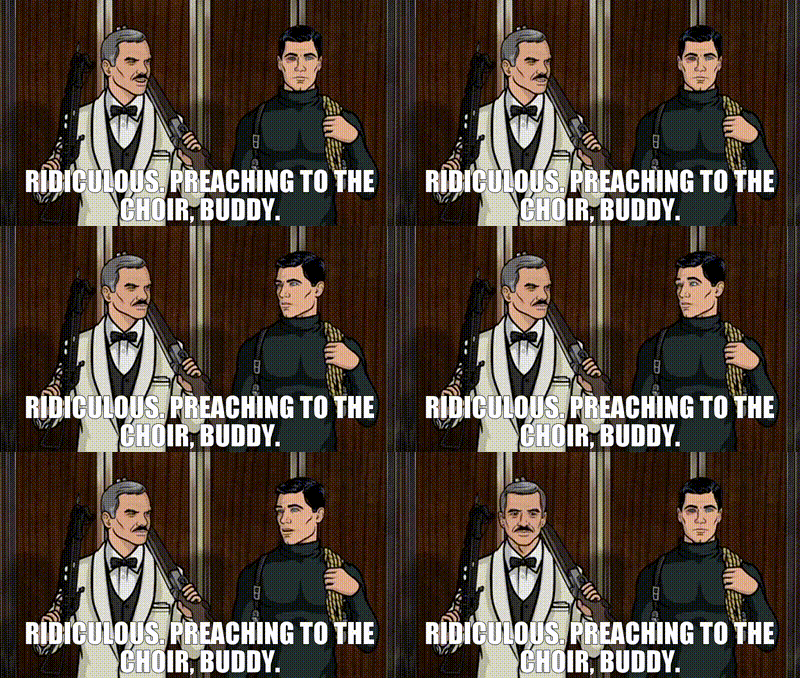
Succinct and felt like I was at church. Kept wanting to yell out words of praise such as, "Preach! Amen! Testify! Speak truth to power!"
November 21, 2019
An easy read as far as management litteraturen goes, and some good points to be taken. The best is by far the title, love leaving the book laying around on my desk at work.

Want to Read
July 1, 2022this book seems so FAMILIAR ...

Read
August 7, 2024Finally a book asking the right questions.
I really liked that this book actually did suggest ways to fix it (and they weren't to tell women to just believe in themselves and "lean in")
I really liked that this book actually did suggest ways to fix it (and they weren't to tell women to just believe in themselves and "lean in")
Read
April 24, 2021Key quote:
"[An] incorrect assumption--[that suggests a group lacking representation in leadership must somehow lack leadership potential]--is based on the illusions that current systems are meritocratic."
The author points out how many high functioning, Fortune 500 leaders he personally coached did rely upon nothing more than 'gut feeling' to evaluate senior leadership candidates. And gut feeling gives all the room you need for your biases to crawl in and stay there. And most of the biases are those of the dominant system, which is sexist to the surprise of no one.
Dispelling this illusion effectively, with specific examples that I can remember easily, is what I hoped to get out of this book and it delivered.
No author walks the perfect line and some chapters kinda chapped my brain, but in general I'd recommend the book. It provides good ammunition for arguments to levy against people who believe that business systems are fair or bias free.
Things that I enjoyed?
-Steve Jobs was a terrible leader. He led a company with radically good ideas that survived in spite of his terrible leadership qualities because the ideas were just that good and because he was very good at taking credit for every good idea that passed his way. We was still a terrible leader and a better leader with those ideas could have done even more.
-Taking apart the Google IQ debacle from years ago.
-Pointing out leaders miss their potential (and deliver fewer results) with fewer EQ type skills, but unfortunately quiet leaders with high EQ tend to get less press and therefore are invisible.
-Being skilled in a field and being a good leader who works in that field are very different.
People tend to be promoted upwards for excelling in a non-leadership quality (good accountant, good engineer, good librarian) which is relevant but becomes less so the higher up you go.
Lacking easy measures of leadership talent (which is usually due to laziness), we use generic traits that are de facto 'leadership traits': Extroverted/confident/pushy/risk-taking. These traits do not actually predict measurable positive results for an organization. if they happen, it is rarely a strong correlation.
-A great quote from a different author, Irwin Bernstein, brings all that home: "The plural of anecdotes is not data." So many people point to some random anecdote (like the success of Apple and it being led by a certain man with certain personality flaws) as some kind of scientific proof that these flaws make men good leaders.
***
Takeaways for me. I'm a white guy so there is every reason to believe I can fail upwards in spite of mediocrity compared to someone working harder than me, like every other white guy before me. Very easily. Statistically, this has already happened to me. There will be fewer people checking my record or scrutinizing me.
I need to practice getting out of the way of women colleagues, putting myself in positions were I can be scrutinized or to self-scrutinize. This was the reason I knew I needed to read this book. It me, and even if I try really hard for it not to be, it still me.
Scrutinize HR systems with no checks or balances. Whenever there is no formal rule about something, make one. It is going to fall back to 'gut instinct' in the absence of hard rules and that instinct is usually something sexist no matter who you are.
"[An] incorrect assumption--[that suggests a group lacking representation in leadership must somehow lack leadership potential]--is based on the illusions that current systems are meritocratic."
The author points out how many high functioning, Fortune 500 leaders he personally coached did rely upon nothing more than 'gut feeling' to evaluate senior leadership candidates. And gut feeling gives all the room you need for your biases to crawl in and stay there. And most of the biases are those of the dominant system, which is sexist to the surprise of no one.
Dispelling this illusion effectively, with specific examples that I can remember easily, is what I hoped to get out of this book and it delivered.
No author walks the perfect line and some chapters kinda chapped my brain, but in general I'd recommend the book. It provides good ammunition for arguments to levy against people who believe that business systems are fair or bias free.
Things that I enjoyed?
-Steve Jobs was a terrible leader. He led a company with radically good ideas that survived in spite of his terrible leadership qualities because the ideas were just that good and because he was very good at taking credit for every good idea that passed his way. We was still a terrible leader and a better leader with those ideas could have done even more.
-Taking apart the Google IQ debacle from years ago.
-Pointing out leaders miss their potential (and deliver fewer results) with fewer EQ type skills, but unfortunately quiet leaders with high EQ tend to get less press and therefore are invisible.
-Being skilled in a field and being a good leader who works in that field are very different.
People tend to be promoted upwards for excelling in a non-leadership quality (good accountant, good engineer, good librarian) which is relevant but becomes less so the higher up you go.
Lacking easy measures of leadership talent (which is usually due to laziness), we use generic traits that are de facto 'leadership traits': Extroverted/confident/pushy/risk-taking. These traits do not actually predict measurable positive results for an organization. if they happen, it is rarely a strong correlation.
-A great quote from a different author, Irwin Bernstein, brings all that home: "The plural of anecdotes is not data." So many people point to some random anecdote (like the success of Apple and it being led by a certain man with certain personality flaws) as some kind of scientific proof that these flaws make men good leaders.
***
Takeaways for me. I'm a white guy so there is every reason to believe I can fail upwards in spite of mediocrity compared to someone working harder than me, like every other white guy before me. Very easily. Statistically, this has already happened to me. There will be fewer people checking my record or scrutinizing me.
I need to practice getting out of the way of women colleagues, putting myself in positions were I can be scrutinized or to self-scrutinize. This was the reason I knew I needed to read this book. It me, and even if I try really hard for it not to be, it still me.
Scrutinize HR systems with no checks or balances. Whenever there is no formal rule about something, make one. It is going to fall back to 'gut instinct' in the absence of hard rules and that instinct is usually something sexist no matter who you are.

February 18, 2020
si se pudiese 3.75/4 lo haría.
Las razones por las que le pusé esa calificación es porque si bien es cierto que aborda hallazgos no tan fundamentados de otros autores (venga, si usted leyó Cómo trabajar para un idiota, seguramente identificará una buena parte de ese libro en esta versión), también es cierto que aporta cuestiones más interesantes.
Considero que es destacable aunque el autor se muestra bastante "humilde" con destacarlo poco en la portada, pero debería contemplar un mayor enfásis en dos puntos que me parecen fundamentales: el "estigma" del género (las mujeres por su género y empatía podrían ser mejores líderes que los hombres) y que el líder se selecciona por más de una razón de presencia, conocimientos y "talento".
Creo que, si bien en la sentencia del libro "(how to fix it)" guarda una serie de recomendaciones que son de extrema utilidad, también esa parte es la más fuerte y guarda una propuesta muy interesante ,no solo para seleccionar a los líderes desde el punto de vista organizacional, sino también desde el punto de por quien desea ser uno liderado.
Lo que no me gusta mucho (como en muchos artículos y libros de HBR) es la horrible referencia que se hace a otros autores. Utilizar el estándar APA es por mucho amigable y práctico para darle soporte a las ideas y afirmaciones.
Las razones por las que le pusé esa calificación es porque si bien es cierto que aborda hallazgos no tan fundamentados de otros autores (venga, si usted leyó Cómo trabajar para un idiota, seguramente identificará una buena parte de ese libro en esta versión), también es cierto que aporta cuestiones más interesantes.
Considero que es destacable aunque el autor se muestra bastante "humilde" con destacarlo poco en la portada, pero debería contemplar un mayor enfásis en dos puntos que me parecen fundamentales: el "estigma" del género (las mujeres por su género y empatía podrían ser mejores líderes que los hombres) y que el líder se selecciona por más de una razón de presencia, conocimientos y "talento".
Creo que, si bien en la sentencia del libro "(how to fix it)" guarda una serie de recomendaciones que son de extrema utilidad, también esa parte es la más fuerte y guarda una propuesta muy interesante ,no solo para seleccionar a los líderes desde el punto de vista organizacional, sino también desde el punto de por quien desea ser uno liderado.
Lo que no me gusta mucho (como en muchos artículos y libros de HBR) es la horrible referencia que se hace a otros autores. Utilizar el estándar APA es por mucho amigable y práctico para darle soporte a las ideas y afirmaciones.

August 22, 2025
Loved this book, loved the argument, loved the conclusion! So many great points to take away from it.
- When men are considered for leadership positions, the same traits that predict their downfall are commonly mistaken, even celebrated, as a sign of leadership, potential or talent consequently men’s character flaws help them emerge as leaders because they are disguised, attractive, leadership qualities
- Instead of treating leadership, like some kind of glamorous career destination or personal reward for reaching the top we should remember that leadership is a resource for the organization
- Since we all want better leaders, we should not lower our standards when we select women, but we should raise them when we select men
- The key goal of a good leader is not to get to the top of a group or an organization, but to help the team out performance rivals —> competence, and integrity rather than confidence and charisma
- It is not that we cannot change but rather we are not as committed to making those changes as we ought to be…. We don’t want change we want to have changed
- When men are considered for leadership positions, the same traits that predict their downfall are commonly mistaken, even celebrated, as a sign of leadership, potential or talent consequently men’s character flaws help them emerge as leaders because they are disguised, attractive, leadership qualities
- Instead of treating leadership, like some kind of glamorous career destination or personal reward for reaching the top we should remember that leadership is a resource for the organization
- Since we all want better leaders, we should not lower our standards when we select women, but we should raise them when we select men
- The key goal of a good leader is not to get to the top of a group or an organization, but to help the team out performance rivals —> competence, and integrity rather than confidence and charisma
- It is not that we cannot change but rather we are not as committed to making those changes as we ought to be…. We don’t want change we want to have changed

June 13, 2020
‘Men’ pada judul ternyata merujuk pada laki-laki. Jadi kalau judulnya diterjemahkan kira-kira jadi ‘Ngapa Sih Banyak Laki Nggak Becus Malah Jadi Bos Hhh?’ Laki nggak becus berusaha diselesaikan di salah satu bab yang mengajukan usulan untuk memperbanyak perempuan jadi pemimpin. Namun, ternyata simpulan akhirnya bukan di jenis kelamin melainkan....
Di buku ini bertebaran penelitian yang jadi referensi. Seperti biasa, yang diambil tentu hanya sepotong yang sesuai dengan topik/bab yang dibahas. Kalau punya waktu, akan lebih nampol kalau semua penelitian yang jadi daftar pustaka dibaca satu per satu supaya dapat konteks yang lebih komplit.
Di buku ini bertebaran penelitian yang jadi referensi. Seperti biasa, yang diambil tentu hanya sepotong yang sesuai dengan topik/bab yang dibahas. Kalau punya waktu, akan lebih nampol kalau semua penelitian yang jadi daftar pustaka dibaca satu per satu supaya dapat konteks yang lebih komplit.

May 19, 2021
Kirja oli paikoin sortua nais-mies-stereotypioihin, mutta pääasiallisesti hyvin esitelty, ainakin minulle uusi näkökulma miksi miehiä on niin paljon johtajissa. Vaikka kirja ei todellakaan lupaa nopeita ratkaisuja, se tuntuu paljon järkevältä kuin monet aiheeseen liittyvät ennakkoluulot - naisia ei kiinnosta johtaminen, naisilla ei ole itseluottamusta johtajaksi, "fake it till you make it"-asenne omahyväiseen johtajuuteen ja muutenkin karisma-myyttiin liittyvät asiat. Kirja oli myös melko kevyt ja nopea lukea, voin suositella.

April 23, 2025
Not sure if a sexist answer will solve a sexist problem, but the book does a good job of providing an explanation of why there are so many bad leaders.
Great information in the book, even though I do not necessarily agree with the authors ultimate solution. I did like many of the quotes: such as: “Whether a leadership fable is a success or failure depends on where you end the story.” & “Stories sell but data tells”
Great information in the book, even though I do not necessarily agree with the authors ultimate solution. I did like many of the quotes: such as: “Whether a leadership fable is a success or failure depends on where you end the story.” & “Stories sell but data tells”
March 4, 2020
Interesting and easy to read. Explains the title of the book well. Has so many examples of experiments. However; doesn’t recommend easy and effective solutions. The recommended solutions are good and hopefully we’ll get there button now sounds like utopia and the book doesn’t have the necessary realistic explanation of how to get there.
November 3, 2025
Brilliant book answering precisely- for instance- among many other fascinating issues- how Trump got to be where he is. So in part it’s a study of why women are stronger in character and generally smarter than men and how they’re punished for it. Just remember- “confidence” and “competence” are only just loosely related personality traits. Is this why they call a fraud a “confidence game”? Typical male over confidence suppresses whatever competence was there and and hides the lack thereof.

August 7, 2019
Read this book.
October 29, 2023
The title says it all… A great read from start to finish breaking down why so many incompetent people make it to positions of power by upholding the same systems that allowed them to get there in the first place. In a world lead by mediocrity this book provides a good opportunity to reflect on why and how this keeps happening.

August 9, 2020
Takes 180 pages to say very little. In essence: there are negative consequences for choosing leaders based on impressions rather than objective criteria. Author has a serious concern about the under-representation of women in leadership roles, but does not once mention factors outside the workplace such as time taken off of work to raise children—not even raising this to say it lies outside the scope of the book, let alone discuss policies about family leave or other relevant topics.
This had been recommended to me from a friend from a large Archdiocese, and certainly many a priest could be the poster-child for incompetent leadership, but most small dioceses have such slim pickings that almost every priest will become a pastor, regardless of our awareness of good traits for leaders. The "how to fix it" subtitle of the book is rather pessimistic about the possibility of leaders getting better at leading, and proposes the solution of choosing different candidates from among a pool of possible promotions. It thus does not apply to my particular interest, but even speaking more broadly, I would not recommend the book.
This had been recommended to me from a friend from a large Archdiocese, and certainly many a priest could be the poster-child for incompetent leadership, but most small dioceses have such slim pickings that almost every priest will become a pastor, regardless of our awareness of good traits for leaders. The "how to fix it" subtitle of the book is rather pessimistic about the possibility of leaders getting better at leading, and proposes the solution of choosing different candidates from among a pool of possible promotions. It thus does not apply to my particular interest, but even speaking more broadly, I would not recommend the book.

January 12, 2020
Disappointing. It starts off well but unfortunately turns into one of those vapid leadership books about halfway through. I feel like this was one of those books that gestated from a well-received HBR article or TED talk and was padded with enough generic content to make it justifiable for publication.

November 22, 2019
It was good halfway, but toward the end, I lose interest and just skimmed through it. The title was a clickbait guy, the content wasn't shaming any gender at all. The author was shaming anyone in any gender who were so full of themselves and get recognized by it.

April 27, 2021
My main take-away from ‘Why Do So Many Incompetent Men Become Leaders?: (And How to Fix It)’ is that we don’t need to set gender, or other, quotas so much as get a better idea of what good leaders look like. Some great ideas are set out in table 6.1 on page 123.

March 2, 2025
O carte nu că deosebit de actuală la acest moment, dar perfect și ideal de actuală, în contextul geopolitic de azi, cînd trump și putin distrug lumea (și sistemul internațional).
Utilizînd date, cercetări și alte instrumente din știință, autorul deconstruiește o mulțime de mituri populare despre leadership și lideri, despre comportamentul acestora, precum și credința că majoritatea liderilor, îmbrăcați "la costum", ar fi buni.
Începînd de la faptul că succesul unui individ (lider) în Statele Unite este corelat în proporție de 50% de familia (clasa socială) în care s-a născut, pînă la faptul că înălțimea unui individ contribuie la emergența sa în leadership (ajungerea lui într-o funcție de conducere) tot atît de mult ca și IQ-ul acestuia, autorul demontează pur și simplu fascinant cît de eronate sînt percepțiile și credințele noastre despre leadership.
Or, teza principală a acestei cărți, și un alt mit deconstruit de autor, e că bărbații ar fi mai buni lideri decît femeile, cînd este exact pe invers! Utilizînd mai multe descoperiri din știință, autorul demonstrează clar cum femeile, analizate din punctul de vedere al eficienței leadershipului, sînt lideri mai buni decît bărbații.
Și nu, aceasta nu e doar opinia autorului, ci un lucru binecunoscut demult deja în știința leadershipului, adică în cercul oamenilor care au studiat serios și științific leadershipul. Voi lăsa, simplu, aici, un citat de Gary Johns și Alan Saks din "Organizational Behavior": "What is most interesting about these findings is that those aspects of leadership style in which women exceed men are all positively related to leadership effectiveness, while those leadership aspects in which men exceed women have weak, negative, or null relations to leadership effectiveness".
Revenind la cartea dată, autorul se centrează în special pe 4 trăsături major răspîndite ale liderilor: încrederea în sine, narcisism, psihopatie și carismă, care contribuie la emergența liderilor toxici și abuzivi în funcții de conducere. Tomas demonstrează elocvent cum toate aceste trăsături de personalitate, răspîndite în special printre bărbați, sînt percepute de oameni ca fiind semne de "leadership potential" sau "true leadership", cînd ele sînt de fapt red flag-uri și indicii clare de leadership ineficient, și chiar mai rău, toxic.
Cartea nu este perfectă, existînd mai multe idei și constatări trase de păr (exagerate) ale autorului care ar putea fi, la rîndul lor, combătute cu ajutorul științei. Însă ea este excepțională în special datorită contextului actual în care trăim. Ori, cum scrie la final autorul: "Last, I am grateful to all the incompetent men who become leaders, for they will surely be the number one sales force for this book".
Precum și eu, care pot fi recunoscător acum lui trump, pentru că am recitit această carte (prima oară am citit-o în 2022).
Utilizînd date, cercetări și alte instrumente din știință, autorul deconstruiește o mulțime de mituri populare despre leadership și lideri, despre comportamentul acestora, precum și credința că majoritatea liderilor, îmbrăcați "la costum", ar fi buni.
Începînd de la faptul că succesul unui individ (lider) în Statele Unite este corelat în proporție de 50% de familia (clasa socială) în care s-a născut, pînă la faptul că înălțimea unui individ contribuie la emergența sa în leadership (ajungerea lui într-o funcție de conducere) tot atît de mult ca și IQ-ul acestuia, autorul demontează pur și simplu fascinant cît de eronate sînt percepțiile și credințele noastre despre leadership.
Or, teza principală a acestei cărți, și un alt mit deconstruit de autor, e că bărbații ar fi mai buni lideri decît femeile, cînd este exact pe invers! Utilizînd mai multe descoperiri din știință, autorul demonstrează clar cum femeile, analizate din punctul de vedere al eficienței leadershipului, sînt lideri mai buni decît bărbații.
Și nu, aceasta nu e doar opinia autorului, ci un lucru binecunoscut demult deja în știința leadershipului, adică în cercul oamenilor care au studiat serios și științific leadershipul. Voi lăsa, simplu, aici, un citat de Gary Johns și Alan Saks din "Organizational Behavior": "What is most interesting about these findings is that those aspects of leadership style in which women exceed men are all positively related to leadership effectiveness, while those leadership aspects in which men exceed women have weak, negative, or null relations to leadership effectiveness".
Revenind la cartea dată, autorul se centrează în special pe 4 trăsături major răspîndite ale liderilor: încrederea în sine, narcisism, psihopatie și carismă, care contribuie la emergența liderilor toxici și abuzivi în funcții de conducere. Tomas demonstrează elocvent cum toate aceste trăsături de personalitate, răspîndite în special printre bărbați, sînt percepute de oameni ca fiind semne de "leadership potential" sau "true leadership", cînd ele sînt de fapt red flag-uri și indicii clare de leadership ineficient, și chiar mai rău, toxic.
Cartea nu este perfectă, existînd mai multe idei și constatări trase de păr (exagerate) ale autorului care ar putea fi, la rîndul lor, combătute cu ajutorul științei. Însă ea este excepțională în special datorită contextului actual în care trăim. Ori, cum scrie la final autorul: "Last, I am grateful to all the incompetent men who become leaders, for they will surely be the number one sales force for this book".
Precum și eu, care pot fi recunoscător acum lui trump, pentru că am recitit această carte (prima oară am citit-o în 2022).
Displaying 1 - 30 of 197 reviews