Jump to ratings and reviews
Rate this book

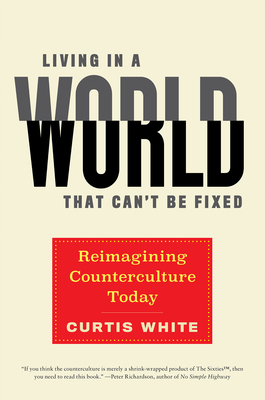
Living in a World That Can't Be Fixed: Reimagining Counterculture Today

Rate this book
“This is a book about counterculture, and that’s a problem . . . “

So begins Curtis White’s thrilling call for the revitalization of counterculture today.

The problem, White argues, is twofold: first, most of us think of counterculture as a phenomenon stuck in the 1960s, and, second, what passes as counterculture today . . . simply isn’t. Nevertheless, a reimagined counterculture is our best hope to save the planet, bypass social antagonisms, and create the world we actually want to live in. Now.

White—“the most inspiringly wicked social critic of the moment” (Will Blythe, Elle)—shows how the products of our so-called resistance, from Ken Burns to Black Panther, rarely offer a meaningful challenge to power, and how our loyalty to the “American Lifestyle” is self-defeating and keeps us from making any real social change.

The result is an inspiring case for practicing civil disobedience as a way of life, and a clear vision for a better world—full of play, caring, and human connection.

140 pages, Hardcover

First published November 5, 2019

11 people are currently reading
205 people want to read

About the author

Curtis White

33 books76 followers

Ratings & Reviews

What do you think?
Rate this book

Friends & Following

Create a free account to discover what your friends think of this book!

Community Reviews

5 stars
15 (23%)
4 stars
22 (34%)
3 stars
20 (31%)
2 stars
5 (7%)
1 star
2 (3%)
Displaying 1 - 16 of 16 reviews
Profile Image for W.D. Clarke.
Author 3 books349 followers
December 19, 2020
If hope is the thing with feathers, this book was a most rousant, rousing companion for that often lonely, one-way "flight through the emptiness of time" (Kundera, ULB). For though the title might at first glance seem to be suggesting that the world really can't be fixed, Curtis White doesn't mean that, quite. He means that we must live our lives as if its manifest wrongness can't be righted, at least not in our lifetimes. What can happen in our lifetimes, though, is a life made worth living by soaring off into the headwinds in spite of it all, to invent a counter-culture which stands out as a beacon for others who feel similarly drawn to such (not necessarily solitary) flight: to live our own lives where we find them, both in Thoreauvian solitude and in sustaining community, and as if we had already re-created the world such that it is now the kind of place in which, in our imaginations, we'd always longed to live. Paradoxically, this also means living without "hope" (without feathers!), then…(I'll try to explain)….

Toward the end of the book, White informs us that this slim volume has been but one way, one provisional attempt (out of many possible others) to perform the above, by engaging in what Robert Musil calls "Essayism":
Towards the end of the first volume of The Man Without Qualities, Robert Musil suggests that “we should live the history of ideas instead of the history of the world.” In Musil’s view, living the history of the world is circular and leads only to a repetition of the same mistakes made through violence and war at the expense of all living things. On the other hand, to live the history of ideas is open ended. The history of ideas is a dialogue or, better yet, a dialectic. It moves forward even if the world doesn’t. Perched as we are at the edge (if not the end) of that history, Musil suggests that we live through what he calls “essayism,” the “gliding logic of the soul,” which opens upon “possibility.” In ordinary terms, he’s saying, essentially, “Instead of repeating the same deadly errors of official history—instead of stepping forward as a soldier, instead of getting on the train as a Good German, instead of saluting the flag as a patriot, instead of going to work, instead of nodding in assent when addressed through all of our shared stupidities—why don’t we try something else, something that is more adequate to how we’d like to live?” As Musil writes:

To pass through open doors, it is necessary to respect the fact that they have solid frames…But if there is a sense of reality…then there must also be something we can call a sense of possibility…the possible includes not only the fantasies of people with weak nerves but also the as yet unawakened intentions of God.

In writing this book—my own adventure in “essayism,” my own attempt to create something living—I have been tempted at times to think that I should provide solutions. This is wrong. The critic’s job is to bring readers to a point where they are free of certain familiar errors about what is real or true or necessary, and where they are free to make their own way forward through an openness to possibility.
To that end, White offers us, in several dimensions, a partial critique of the world as we find it: we now live "out of place". Our world is simultaneously beset by the twin crises of the migrant and the domestic homeless, crises which have been either ignored or worsened by politicians on either end of the available "spectrum". Meanwhile, the chief first-world-problems of the privileged few (OK, 10%?) involve living "in the context of no context" (George Trow): globalized capitalism and social networks—GR excepted, of course ;)—lead us to
commit ourselves to economic and social processes (in education, work, health care, and housing) that are abstracted from the reality of where we are (nowhere, possessed by the Logic of Impersonal Forces), who we are (deluded and bloody-minded), and, most importantly, where and who we might prefer to be. George Trow’s “here” is a place, but it is not just a place; to be a place at all it has to be first imagined, richly imagined for both good and bad (emphasis mine).
Our power to truly live, then, comes from the imagination, which White not atypically finds in that "counterculture" initiated by certain strains of early Romanticism, when
To be a poet was in essence to say “fuck off” to everything about the world at that point—the monarchs, the nobility, the men of business, the endless wars, and the gross inequality. The Romantics were war dodgers, blasphemers, and communalists, which is why they lived in fear of prison under the “Sedition and Blasphemy” laws that the Tories established after the French Revolution as a means of controlling revolutionaries, pamphleteers, atheists, and poets
Counterculture, then, "is civil disobedience as a way of life", not a throwback way of life necessarily, but one which is "both impertinent and improvisational"—not atavistic, but truly artistic, in other words. The 60s got a lot of this right, and many of their improvisational experiments are still with us today. At their best, they not only managed to (as the cliché goes) think globally, but act locally, their celebrations of imagination and community led them to (in the words of poet May Sarton "think like a hero [so as] to behave like a merely decent human being."

If this all means living without a certain kind of hope, the "hope of reward" for our efforts, for "some particular result , it also means that we lessen the risk of falling into complete hopelessness and despair, as we are always improvising, always living in the moment. As for politics, then, though White does not go into it, I think that it means that it isn't electoral politics that'll save us, but on-the-ground activism and organizing— centered in who we are and where we live, in other words, but not restricted to that. That sounds like a fine place to start!

Finally, if this reviewer is left wanting even more from White's large brain than this short book delivers, it also reads like a companion piece to the equally excellent Spirit of Disobedience: Resisting the Charms of Fake Politics, Mindless Consumption, and the Culture of Total Work: though one could read either on their own without any issues, taken together so many of White's ideas chime back and forth in the imagination, that it is tempting to see them as having been planned with that in mind :)
Profile Image for Brian Griffith.
Author 7 books335 followers
January 25, 2021
White launches a fine rant condemning our heartless system, which is bent on wrecking the planet for profit while the winners escape with their profits to an ultra-tech paradise. I can appreciate where he comes from as an ex-hippie, and sympathize with his thirst for a counter-culture he can really celebrate. But for a while I thought he was gonna write all of us off as idiots so stupid that we deserve our impeding implosion. Fortunately though, White comes around to explaining the power of community and story. Maybe for most of the book he’s discussing movies and what futures they imply. Concerning attractive counter-cultures, he must confront the common story line that counter-cultures have all failed since the 1960s. He points out that after failing, they’ve usually risen again -- as we see with feminism, environmentalism, and damn good music. Maybe, White suggests, we should take a tip from the Bhagavad Gita and cut our concern with whether a movement fails: “Work [and play] without hope of reward.” As he cites Slavoj Zinzek regarding all the failures of counter-cultures in Russia, “Try again. Fail again. Fail better.”
Profile Image for David Wineberg.
Author 2 books870 followers
September 14, 2019
The most important concept in Living in a World That Can’t be Fixed is that of counterculture. Curtis White says counterculture is an ongoing process, not a Utopian state, endpoint or even goal. That it pops up differently in different eras is its signature. Its value is in keeping the stodgy middle way from stifling creativity in thought and in art. Far from the false camaraderie of social media and professional life, White quotes John Ruskin from 150 years ago: “There is no wealth but life.” That’s what counterculture understands best, White says.

This is a straightforward book of the Left, unabashedly so. White quotes all the usual suspects like Zizek, Badiou and Marx. Unfortunately, that means it is often simply more of the same. In particular, I did not appreciate his analyses of pop culture products – semi-recent films like Black Panther and television series for example. I had recently read Zizek’s (2019) autopsy of the film, and didn’t need to see it again here, this time from White’s perspective. Black Panther seems to be a goldmine for the Left to fill out books. Similarly, White’s ruminations over a little-known Netflix series is hardly proof of anything, much less anything profound or even true.

The most engaging section was on stupidity, which White has broken into flavors for the reader’s enjoyment. There’s convenient stupidity, sacrificial stupidity and inconvenient stupidity. All of them are arguable, cruel, and wrong, but White’s presentation is direct and challenging.

Wisely, White plays down his own role. He says his job is not to provide solutions to the banality, strictures and trappings of western life: “The critic’s job is to bring readers to the point where they are free of certain familiar errors about what is real or true or necessary, and where they are free to make their own way forward through an openness to possibility.”

From that safe space, White can ruminate at will. And while he does so well, it is not the most dramatic or thought-provoking book on the subject though it Is among the more passionate.

David Wineberg
Profile Image for aa.
76 reviews35 followers
May 3, 2021
After reading this, I wrote a letter to send to Curtis White but couldn't figure out how to get it to him. So, here it is. I'll just call it an "open letter" now:

Greetings.

My name is Yupa. I’m writing to you regarding your book, Living in a World That Can’t Be Fixed. I became aware of you and your books upon seeing one listed in the notes for “Fandom: Identities and Communities in a Mediated World, 2nd edition”.

I want to write to you about the possibilities and difficulties of counterculture. As someone who rejects this society and wants to life to look very different, I have spent time think about this.

I’ve observed that rejection of the normative culture or form of life is no longer fashionable, but “political awareness” seems to be increasing. In the lingo of the Sixties (which I’m probably butchering), everyone is a politico rather than a dropout, even the radicals who previously tried mixing the two.

I’ll admit that “normative culture” is an imprecise idea. For the sake of keeping this letter short, I’m basically referring to elements of the society that could not exist if there was no state or capitalism. So, I view compulsory labor and everything that rests on it as part of the normative culture.

I don’t believe computers, automobiles, and extensive division of labor would exist in a sustainable society. If there was no rent to pay or cops to push us around, I doubt people would do most of the labor to keep producing these things. So, I imagine a counterculture trying to build a life with these ideas in mind.

It doesn’t seem like people my age feel the same except for some anarchists. Even the social struggles that erupt now are in opposition to mistreatment within this society. They do not call for a new way of life. It doesn’t seem like people dislike the world now, they just don’t want to be excluded from it. This is understandable of course. Nobody should be killed by police or subject to premature death and misery the way marginalized people are. But I am curious why there is so little rejection of the society from the root, and I believe this reason is related to the dearth of counterculture.

You wrote that younger people don’t want to write code for Google. In my experience, that’s not true, even among those not in tech. People my age are stoked to learn coding because it’s both a marketable skill and gives them a sense of power. Being able to code mimics the feeling of creating something in the real world. I’ve heard people jokingly refer to coding as their magical power.

Though radicals and progressives don’t like Google, I think most people do. Or, if they don’t like it, they never say anything and still use its search engine despite plenty of alternatives. Besides that specific example, I’m not seeing the anti-work critique offered by the Situationists and Bob Black embodied among most peers. Sure, liberals want Amazon and McDonalds workers to be unionized, but there’s not a glimpse of opposition to work itself except among the “underclass” who already lack prospects.

Additionally, professional work culture has changed. Work is increasingly team-based, which means that slacking and other forms of resistance are seen as harmful to one’s co-workers and not the bosses. Hierarchies are still there, but middle management becomes less of a thing as time moves on. At my job, I have a “team leader” who essentially bottom-lines that things get done, but we are treated as autonomous people who take work initiatives as we see fit. They assume we self-police rather than need orders given to us all the time. While I get that most work isn’t like this, I think this transformation of work culture for professionals makes them feel more autonomous and less alienated at work.

Moving on to leisure time, the various social media platforms and contemporary forms of entertainment (Netflix, podcasts, YouTube, video games) meets people’s needs in ways that the culture probably did not in the Sixties. For one, there is constant amusement and entertainment. There is a flood of memes, videos, and other content to keep one occupied at all times and in many contexts. The culture is no longer boring the way the Situationists described it.

Another reason people don’t turn away from entertainment media is how “woke” everything is becoming. More people see themselves in the people on TV and in movies and are thus less alienated from it. Additionally, The Sopranos and The Wire ushered in an era of “Good TV” where the medium is more reputable than ever before. The only thing about TV that people are dissatisfied with now is that they’ll never have enough time to watch everything they want to!

YouTube, reddit, and social media generally offer opportunities for people to have discourse, however impoverished it might be. And, given how disconnected and atomized this society had become at the turn of the century, the internet is seen as gifting us with human connection, especially among marginalized people. Even to radicals I have to explain there are more options for life than this social media hellscape or isolated Nineties ennui.

Turning to the economy, I think its financialization discourages people from considering dropping out. The welfare state has been gutted and people get by with debt now, which enslaves them to work. I know my student loans are only reason I am working full-time at the moment. I think people are less thinking of how to get free and more how to get debt-free, which means they embrace work.

The cost of real estate is also a hindrance if we’re talking about living off the land. During the Great Recession, it was easy for me to live in a city with a bunch of friends in a house where most didn’t work. Now, housing prices have skyrocketed. This means people have more pressure to work full-time and land higher-paying jobs. Looking at past subcultures in contrast: the German Autonomen and NYC Lower East Side squatters in the eighties and nineties thrived when real estate prices were low and urban vacancy was high. (Discovering that a real estate market crash took place in the late Eighties gave me a new context to appreciate Linklater’s 1990 film “Slacker”)

It’s possible that, with the rich and middle-class flocking to the cities, some suburbs will see falling home values, and thus more vacancy and affordable rent. But since houses are many people’s primary asset, I think lingering homeowners will resist this pretty hard. Also, it’d be difficult to get away with experimental living there due to zoning regulations and more uptight neighbors.

Rural areas host possibilities but if there are no urban enclaves for people to meet and develop ideas and practices, I don’t see an actual counterculture developing. Or, if it does, it will probably involve the internet to connect like-minded countercultural dropouts. Personally, I would only want to live rurally only if it was relatively close to a city, since I can imagine going nuts only being around the same group of friends.

Another impediment to counterculture is how neoliberalism affirms people’s hobbies and interests in a way that I don’t think society did in the Sixties. People can be and look as kooky as we want now as long as we work and stay connected to the machine through phones and social media. If anything, society now encourages people to speak up constantly and “be ourselves.” With the internet, we live in an attention economy where everyone is trying to be noticed the most. It seems like, in the Sixties, people were discouraged from self-expression, which is partially what the counterculture reacted against.

Now, I’m no cheerleader for neoliberalism’s promises of individual freedom. They are not only limited, they actually produce a new, more insidious conformity. We can express ourselves, sure, but we become irrelevant, lonely, possibly without a job, and out-of-touch with our peers unless we have smartphones and social media. This society nudges us into conforming and using these technologies. The more invasive these technologies become, the more our activities are logged and monitored, creating a panoptic effect at minimum. The more connected we are, the more invasive the systems of control become. For example, when I have my phone on me at all times, my boss can always reach me. I know all that, I’m just pointing out the ways that culture preempts people from looking for something new.

All of this is to say, I agree with your call for counterculture, but there are barriers. Hopefully not insurmountable ones. Since you were around in the Sixties, I’m curious what you make of all of this.

Thanks,
Yupa
Profile Image for Kate.
1,284 reviews
April 19, 2020
Flannery O’Connor’s character Misfit proclaims, “She would have been a good woman if there had been someone there to shoot her every minute of her life.” White applies this characterization to the “inconveniently stupid” among us today. Read the short stories and the social criticism, and draw parallels of your own.

***

“In capitalist culture life does not live.” —TA

What humans aspire to is the pleasure of homeostasis.

Consider this dystopian vision. We get the Guaranteed Minimum Income we’re all supposed to want, and the economy then looks like this: the oligarchs take the profits through prodigious monopoly rents; robots do most of the work; the world is awash with cheap consumer goods; and we superseded humans have the privilege of paying for those goods with free money.

How do I remain rich even after the end of money and a habitable planet?

“One must think like a hero to behave like a merely decent human being.” —MA

“Delusion will last until it is about to become fatal, at which point an onset of sanity is certain.” —JKG
Profile Image for Heronimo Gieronymus.
489 reviews150 followers
October 11, 2020
Though I have been hitherto only very slightly aware of the existence of Curtis White, what cannot help but attract me to LIVING IN A WORLD THAT CAN’T BE FIXED: REIMAGINING COUNTERCULTURE TODAY, aside from its publication by Melville House, an imprint of which I am already fond, is very much announced in the book’s title; it is in fact pointedly twofold, consigned to the two opposing (though hardly oppositional) sides of that colon. Surely you see it. The title proper presents us with a problem and the subtitle on the other side of the colon begins already to delimit a space for a possible solution or set of mini, local solutions. Is the world beyond fixing? Only a person who throws around words with total heedless abandon would dare come on with a pitch for there ever having been anything like one unified and/or uniform “world” available for Grade A Cure-All. In fact, we have a number of pejorative terminologies for such people, one of which is “snake oil salesman.” That being said, there can not reasonably be any denying, I shouldn’t think, that in the 21st century a dynamic global citizenry increasingly existing under the umbrella of electronic / increasingly predatory post-Fordist capital, a climatological time bomb loudly ticking away, is increasingly aware of the precarity of far more than merely its labour, all this accompanied by increased tribalism/sectarianism, atomization, wholsesale depression, and regularized spasms of psychotic impotent rage. We are not suffering a shortage of authors or books by authors who are aware of this and willing to try their hand at a little depth analysis. As they should. I am not about to pretend that this is not legitimately the situation in which we basically find ourselves. White’s “world that can’t be fixed,” which can’t be fixed because it is nothing like one world with one collectively-agreed-upon episteme, is the same world that the Italian philosopher and social critic Franco “Bifo” Berardi is indexing in the title of his wonderful 2017 book FUTURABILITY: THE AGE OF IMPOTENCE AND THE HORIZON OF POSSIBILITY. Impotence is just another word for incapacity and the central incapacity in the Bifo is precisely a crisis in political theory that currently finds no way out of a quagmire and has to learn to maintain hope and some form of active mandate in the context of a broken world from within its great many broken social commons (especially the online ones) that simply cannot be fixed. Hopefully fairly clear for anybody except the most pie-eyed devotee of this or that ideological programming regimen, consciously so or otherwise: the comprehensive overhaul business is in fact a subcontractor for the nightmare modification industry. It is only fairly late in LIVING IN A WORLD THAT CAN’T BE FIXED that Curtis White really gets into the nitty-gritty of our unfixable global village—this being the meat and potatoes most especially of the fourth and fifth of the book’s seven chapters—and here as elsewhere the author comports himself as a lively rhetorician more than as a sober theorist. Anybody who is still with me here probably has a more than serviceable handle on the debased current condition of discourse and public life at the end of the second decade of 21st century, but many will also be impressed by the élan with which White blocks out his roving, compressed analysis. A broken world might tend to look like, for example: Steve Spaeth of West Bend, Wisconsin, who told his liberal sister, as reported in a GUARDIAN piece by Ed Pilkington, that if a civil war should prove forthcoming, “I would have no problem shooting you in the face,” or then there is conservative commentator Erick Erickson, who in response to a front page NEW YORK TIMES editorial breaking down the benefits of gun control, “forsook rebuttal and shot the page full of holes.” Since we cannot speak properly of ends on a polarized spectrum vis-à-vis antomization and division, suffice it to say that these two examples pinpoint one particular "pocket" of tribalistic barbarity. Our cities are increasingly disaster zones of rogue gentrification (White's beloved San Francisco foremost case in point). People argue and fight and believe in mad fantasies to which they cling in a manner increasingly fanatical. For White, the problem, as with so many abstracted ideals (such as the nation itself as some kind of transcendental category): "democracy" is itself a convenient lie, or “an empty talisman, a sort of gilded idol, behind which there are only myths and legends, piety, and the fear that if the fiction of democracy no longer stabilizes social discourse, some worse barbarity will take its place.” Far right movements worldwide certainly indicate that worse barbarities are indeed very possible, but they themselves doubtlessly pale next to the forthcoming horrors of climate disaster. “With a future made ever more unpredictable by climate change, sectarian violence, and economic inequality, we need to think of the places where we live, rather than the the nation that we mostly endure, as a primary if not exclusive focus for our work.” Like many thinkers and theorists before him, then, White would like us to consider the possibilities of a locally-global praxis that isn’t about fixing the world but rather about creative self-invention at the level of community or micro-collectivity, precisely the modus that has always been that favoured by counterculture(s). Before our problem is the world our problem is heterogenous difference and the intractability of individuals, especially those who rigidly conform to their programming. Much of the finest writing in LIVING IN A WORLD THAT CAN’T BE FIXED is cordoned off into three brief chapter-closing sections White calls improvisations, which he likens to guitar solos. The improvisation that closes “The Counter-counterculture,” aforementioned fifth chapter, considers the Japanese film series ZATOICHI, THE BLIND SWORDSMAN from the standpoint of its constituting an endlessly rehashed archetypal scenario in which a compromised peripatetic figure of vengeance travels a land lorded over by demons, meeting out vigilante justice. This world of demons is ultimately our world as it is now and has ever been. The demon realm currently looks a lot like the Putin methodology as elucidated in Adam Curtis’s eerily prescient 2016 film HYPERNORMALIZATION. This methodology involves a theatre of chaos lorded over by a cult of personality. Trump of course embodies this perfectly, “looming above" the rabble, in the phrasing of White, “like a deranged Thanksgiving parade balloon, urging them on.” The “them” over which Trump looms is a debased citizenry, whether on the progressive or reactionary ends of the spectrum (which is not properly a spectrum as such). “As overwhelming as natural catastrophe, there is human catastrophe, the catastrophe of character.” Much of this may already be imprinted into our very nature. Near the beginning of LIVING IN A WORLD THAT CAN’T BE FIXED: “It is the political economy of our biology. Although 98.6°F is our baseline body temperature, we are better understood as the warm-blooded mammal that thinks it could always be a little warmer. Or, as lifestyle entrepreneur Suze Yalof Schwartz has announced revealingly on her website Tall Skinny Rich, ‘Everyone can look a little taller, skinnier, richer.’” This is just a kind reminder that if the world cannot be fixed there never was any version of it that properly could be, certainly not in the way engineers fix design flaws such that an apparatus can subsequently perform its assigned function indefinitely. In order to rewind and get back to the whole matter of how counterculture might serve as an ideal model, I would like to first leap to the closing pages of White’s book and a precept the author borrows from the great Austrian writer Robert Musil, author of THE MAN WITHOUT QUALITIES, late in the first volume of which Musil insists we should “live in the history of ideas instead of the history of the world.” For White, this serves as a call to be mindful of the fact that “living in the history of the world is circular and leads only to the repetition of the same mistakes made through violence and war at the expense of all living things. On the other hand, to live the history of ideas is open ended. The history of ideas is a dialogue or, better yet, a dialectic. It moves forward even if the world doesn’t.” Now, while I would be inclined to argue that a dialogue is a far worthier model than the dialectic, and would never replicate this syntax directly, I note a number of very important things here. When Musil goes on to advocate for a spirit of “essayism” or a “gliding logic of the soul” this is very precisely somebody speaking my language, and it also happens to find Musil speaking something very close to the same language as Aldous Huxley, a man about fourteen years Musil’s junior whose work was largely dedicated to exploring what it might mean to live meaningfully in a world that cannot be fixed. This is all very valuable to consider, and White is to be commended for leading us there. I notice in the Acknowledgments that White, who was born in 1951 and is currently sixty-nine years of age, thanks two famous professors under whom he studied, namely the great literary “postmodernist” John Barth and the brilliant comparative literature / postcolonial studies scholar Gayatri Spivak. Spivak has regularly advocated for practices of “ab-use” which is not a violent adversarial position, but is rather, with its appropriation of the Latin prefix “ab,” meant to situate a field of critical study which 'makes use of' from below…which basically ends up effectively meaning a practice that is something like an “essayism” or “gliding logic of the soul.” Spivak has also regularly advocated for the ab-use of the European Enlightenment and shown special interest in useful models presented to us by the English Romantics, especially Wordsworth, Shelley, and Keats. It hardly seems unreasonable to surmise a direct influence when more or less right at the beginning of LIVING IN A WORLD THAT CAN’T BE FIXED Curtis White does basically this exact same thing in order to contextualize counterculture in terms of a germane historicity. Henry Mackenzie’s THE MAN OF FEELING (1771). Wordsworth, Keats, Shelley. Samuel Taylor Coleridge and Robert Southey. “What England offered was too limited, and the Romantics wanted something ‘oceanic,’ something with ‘the feeling of the eternal,’ as the French novelist Romain Rolland expressed it in a letter to a skeptical Sigmund Freud.” There will later, despite this initiatory cavil, be cause to likewise ab-use Freud when self-creation and Freud’s “coming-to-consciousness” are used to to oppose “culture-as-consciousness” counter to “cult-as-unconsciousness” with counterculture naturally serving as the only credible model for the former. Curtis White grew up in “a prefab East Bay suburb in the 1950s,” attracted by the psychedelic Renaissance in the Bay Area of the mid-to-late 60s, where he went off as soon as he could manage in pursuit of “originating passion.” A moment of promise, what Allen Ginsberg called the “Two Tribes:” “Berkeley’s socialists provided a critique of what we endured, and San Francisco’s counterculture provided an alternative.” In such ways are lives counter to the dominant model forged. Perhaps the specific nature of White’s initiation into critical thinking and alternative marginal communitarian living to a certain extent limit his purview. There will surely be those inclined to scoff at this privileged white man’s status as such, and such people, whatever their individual faults or critical limitations, will not in the strictest sense be talking nonsense. He makes certain proclamations that make me cringe. His drive-by textual analyses are routinely weak, such as his naive gloss on Nicolas Roeg’s formally radical but likewise haplessly naive WALKABOUT. When White writes about music I truly start to feel embarrassed for him. For current representatives of underground music he singles out three decent bands who play good though decidedly derivative rock music. Whatever the debatable value of indie rock might be, the bands mentioned absolutely belong to an insular and very much NOT REMOTELY utopian scene (take my word or not that I am in a position to know). It is all the more depressing to me as I am very much aware of superior models in the avant-garde music underground, especially insofar as concerns free jazz and non-idiomatic improvised music, the most crucial recent example here being Catalytic Sound, a cooperative that has been set up to support avant-garde musicians and their work. This all becomes maximally discomfiting when the lone passing mention of jazz in the entire book is supplemented by a footnote in which White shares his esteem for Jerry Garcia, Peter Green, and Alvin Lee. Sure, okay, all rad guitar players, but did Abbie Hoffman ever sound like more of an idiot than when he bragged that the counterculture ran rock bands instead of politicians? Do the words “co-option,” “conspicuous consumption,” and “drug overdose” mean anything to you? Other textual and/or cultural examples are more satisfactory, as when White makes the case for Agnès Varda and JR’s FACES PLACES (2017). Varda’s “sympathetic imagination” (practically a coinage right out of Spivak) sets out to engender art that shows you how you “should want to live, because the world it suggests is more intelligent, or more ruthlessly true, or more beautiful, or all of the above.” The world Varda shows is a little one, off to the side, and gloriously portable. She really is a terrific model; I couldn’t agree more. In general I am very much along with White when he argues for the powers of attraction over promotion, as well as for improvisation, impertinence, and the drop out ethos. He may also be on to something when he imagines a near future defined by pockets of ad hoc survivalist socialism responsive to crisis. Again, much of the best stuff here is in those three aforementioned chapter-concluding “improvisations.” I like most especially the second, which comes at the end of the third chapter and analyses the different kinds of stupidity outside of which no human phenomena operate. The countercultural ideal is to become “transcendentally stupid,” which means stupid from the standpoint of the dominant, as though too much an idiot to assimilate the commonplaces around which daily life is popularly organized. Transcendental stupidity rhymes a bit with what the French literary theorist Fernand Hallyn has written about metatropological irony: “The subject is placed in a transcendent position with respect to his discourse, but only to deny the possibility of making himself the guarantor of transcendence.” I know I for one need an instrumental irony that will serve me before I need a little team that might have me.
Profile Image for Sara.
342 reviews5 followers
February 11, 2022
A mix of profound insights and wisdom with particular critique of culture through (peculiarly chosen from my perspective) art, film, history, and literature. While I didn't care about the films that were dissected and critiqued, I did come away with some very interesting thoughts about how to live in this world.
Profile Image for Y.S. Stephen.
Author 3 books4 followers
November 6, 2019
Living In A World That Can't Be Fixed touches on the rot that is at the root of today's social, economic and political landscape. The author examines mainstream narratives of competition, individualism and compliance as parts of this rot that is causing unhappiness, destruction, and soul-poverty in the modern world. The book lifts up counterculture as one way of combating this rot and preaches the act of civil disobedience as a tool of freedom from cultural narratives that serves just a few.

WHAT I LIKE ABOUT THE WORK
Living In A World That Can't Be Fixed did a good job of analysing some of the causes of the world's present upheaval and the despair that comes with it. From climate problems to the rise of fanatics to the gradual decrease in empathy towards those less well-off, the book lifts the veil on how the opinions of a few get imposed on the many by way of money, indoctrination, tribalism, and deceit.

If you are looking for solutions to the problems laid down by the author or ways to start some sort-of counterculture program, this book offers none. This is, in fact, a genius move and in line with the spirit of counterculture that thrives on seeking your own way, filling up a gap within your community and coming up with your own preferred solutions. Like the author posited, "There is no best way to live and knowing that may be the best way to live."

ANY DISLIKES?
The book starts a bit slow and ponderous. However, pieces start to fall into place in the second chapter. This is not a book for speed-reading, at least if you want to get into the marrow of it.

WHO IS IT FOR?
People seeking inspiration to start anything revolutionary will benefit from the author's examples and analyses of successful as well as unsuccessful countercultural phenomena in the United States of America. Folks fed up with the current political climate in their respective countries might gain from some of the perspectives offered by the author.

Many thanks to Melville House for the review copy.
Profile Image for Mark Valentine.
2,073 reviews28 followers
February 2, 2020
"Delusion will last until it is about to become fatal, at which point an onset of sanity is certain."
--John Kenneth Galbraith

Reading White's brilliant pulse check on our culture has helped me improve my sanity. His reading is vast and the scope of his intelligence radiates in these pages, but what I value the most is his sharp, acerbic sentences. This man can write!

And his topic is utterly important. The skepticism needed to survive this age will require extreme courage. I recall H. D. Thoreau's rhetorical question and paradox: "What demon possessed me that I behaved so well?" White names the demon--mainstream culture. And he advocates a kind of resistance that belies #Resistance (itself a mainstream resistance).

I especially liked his concept of H+1, or homeostasis + 1. Since the balance of health requires homeostasis--a balance of what is good for us, all in moderation--then (the thinking goes) more must be better. Our culture, in essence, thrives on addiction--whatever is sold to us as being good, more is even better. To step off that track creates outcasts, loners, the unpopular, and misfits. Reading White helps give me the courage to step off the track and allow "the calm existence that is mine when I am worthy of myself."

To wit, the best act of counterculture resistance I can engage in requires me to be true to myself and know that I already belong on this planet; I do not need a culture to affirm that I already belong.
539 reviews11 followers
March 2, 2020
This one went downhill - way, way downhill - in a huge hurry. The opening chapter was a celebration of counterculture as a way of living with joy as a personal, experimental expression. Then it quickly deteriorated into dense, bullshit literary criticism. Along the way, it exercised in false equivalences about left & right in our unredeemable world. If he's just said "why don't we get drunk & screw", I'd have liked it better, but no such luck. He even had the effrontery to end this POS book with a quote from a Bergman film. Reminded me that on my first exposure to Bergman - it being "The Seventh Seal" - I remarked to my host & tormentor that I much preferred a Doris Day flick - any Doris Day flick. I still feel the same way.
Profile Image for Jen Tidman.
273 reviews
December 29, 2019
Meh, this one wasn't what I expected it to be and wasn't for me. I read it all and left it for a while to review... and now I can't remember anything about it!
Profile Image for Byram.
412 reviews1 follower
January 4, 2022
The title is bleak, almost makes you want to put it down before you even pick it up. But as a self-proclaimed counter-culturalist, White wants to convey from the get-go that our mechanisms of addressing mounting disagreement in an increasingly fractured and factioned society is not to appeal to people's better sense, or to scream more loudly, or to even risk over-platforming or over-ridiculing anybody. Instead he makes a case that we should devote ourselves to a counter-culture movement that is creative and that is alternative. That while we do exist in a system we all know is messed up and broken, that we should do our best to provide alternatives as a means of swaying opinion, or at the minimum not actively (or even passively) buy into the system hook, line, and sinker. Far from a field guide of how to do that, he makes a lot of astute points and observations of how art and lifestyle in counter-culture has become too appropriated, and how our inherent greediness for comfort and homeostasis-plus-one has made us blind to what should rightfully outrage us as humans. I think the one of the main reasons I didn't rate this higher, and this was mentioned on other reviews, is a section where he outlines types of stupidity that rein supreme (sacrificial stupid, transcendant stupid, the conveniently and inconveniently stupid). It's tongue in cheek, and nobody escapes the stupid moniker, but in an otherwise fairly even-handed and incising but otherwise non-judgmental approach to a heavy topic, this was jarringly disparaging. Short of that I think it's a good read to stimulate thinking, I'd recommend
Profile Image for Derek.
133 reviews
October 17, 2025
I'm glad someone is trying to answer these questions, but I sure wish that the answers were better. Most of the book is dedicated to critiquing the present moment (well, the present moment a couple of years ago, that is unfortunately still very relevant). Which, I know the present moment is bad, that's why I picked up a book claiming to reimagine counterculture today!

And then in the last chapter, where supposedly it will start proposing solutions, it basically just...decides that isn't its job? "The job of the critic is to tear down and make room for personal solutions to spring through" or something to that ilk. Which is SO insanely frustrating when the WHOLE book is dedicated to helping imagine better futures...and you can't be bothered to try to imagine a better future?

i feel like one of THE biggest issues with the present moment, with capitalist realism, literally is that we are inundated with negativity at every angle constantly. We all know about capitalist realism, we all hate capitalist realism, the world is going to shit, and none of us know what to do. This book is literally predicated on this, on daring to help the readers finally imagine what can be done - and the best it can come up with is "it's not really my job to tell you, but make art and form community and don't be fascist" - like that's it?

It isn't bad, I just wanted a lot more from this, especially since there's hardly any other contemporary books dealing with these questions.
42 reviews
February 28, 2020
His critique of the world's situation brings out a perspective you won't hear in mainstream talk - (because its mainstream), so that was worth thinking about. I was most struck by his H+1 and H-1 discussion, describing our need to Have one more and fear of Having one less. When it comes to solutions, he is big on counterculture but he really lost me with his critique of Wild Wild Country, the Netflix documentary about the Bhagwan Rajneesh cult in Antelope, Oregon. He thinks WWC failed to explore the good side of the cult, including why people were happy there, and criticizes those opposed to their actions as part of the problem in the world. As someone who lived not far from Antelope, its hard for me to see that a cult whose ignored land use laws, poisoned dozens of people, drugged homeless people to control them, and attempted murder can be held up as an example of an aspirational fix to the world's problems, or as an example of how media and the rest of us were unaccepting of different ways of life. I can't be the only ones who know of communes that worked, and there are surely better examples of intolerance that don't involve defending convicted felons.
This entire review has been hidden because of spoilers.
Profile Image for James.
1,227 reviews41 followers
February 9, 2021
A thoughtful and thought-provoking book about "counterculture," what it means, and what it could mean. The notion expressed in the title that the world can't be fixed is an interesting one and there's a lot to this discussion to digest, but sometimes it seems a bit questioning and scattered without offering much in the ways of solutions. Interesting food for thought, though.
Displaying 1 - 16 of 16 reviews

Can't find what you're looking for?

Get help and learn more about the design.