Nicholas Bornoff brings a long association and intimate knowledge to a country of contradictions and paradoxes that often bewilder Westerners but which Japanese take for granted. Isolated from the world until 150 years ago, Japan today comfortably blends old, new, East, West, tradition, and change. Bornoff describes the best ways to tackle Tokyo and such other must-see sites as Mount Fuji, Hokkaido and its national parks, imperial Kyoto, historical Nagasaki, and dozens of other major and lesser-known places. In-depth features discuss the fascinating contrasts between Japan's modern, cutting-edge technological facade and its ancient core, and highlight traditions such as Kodo drumming, the exquisite beauty of garden design, and the spirits and demons that animate Noh and kabuki theater. Numerous city walking tours, a hike through feudal Hagi, and a stunning array of photos and artwork compliment this exciting, insider's guide.
I never really manage to read a guide book 'properly'. I love the idea of a short one, but not its actual content. Longer ones intimidate me, and I rarely do anything more than eye them longingly... from a safe distance. If only I had my mom's discipline, when tackling them...
Having had my life-long dream of visiting Japan come true, I figured I might as well read a serious guide book for once in my life. I had bought one after all, albeit fully convinced I'd never have a reason to open it.
This Japan guide was... not a total waste of time. It didn't make me like guide books, nor was it an easy read. Still I can clearly recall several instances where I found myself getting seriously engrossed in it.
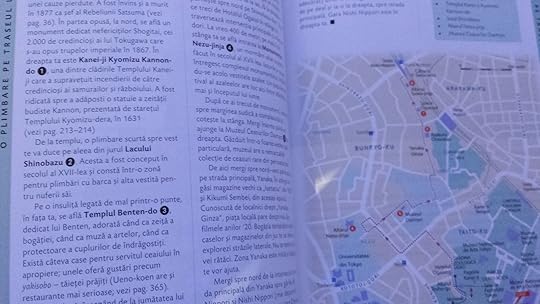
My favorite part of it were the suggested visiting routes. I liked following the trail using the numbered sights on the map, and would occasionally google images if a building or a park caught my attention.
The reading experience was a rather painful one though. Proof of this are the two months that took me to finish going through the book, despite having ambitioned myself to read from it EVERY. SINGLE. DAY. There were times when 2 pages were the absolute most I could stomach. It was just plain exhausting.
Score: 3/5 stars
Would I use this book as the sole source of information for a visit to Japan? No I have learned so much more from following JVloggers' random adventures on Youtube, along with several "Tips and Tricks" vlogs about Japan.
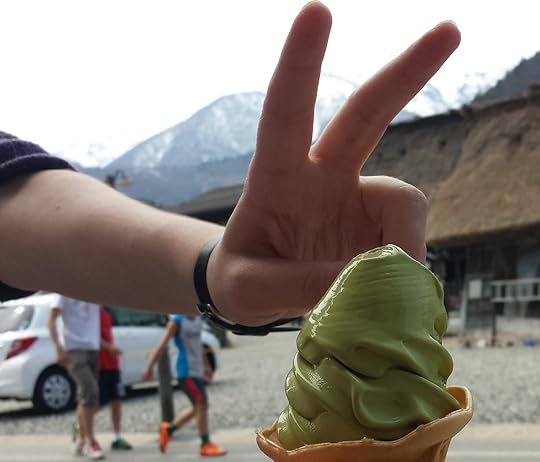
Romantically eating green tea ice cream, in Shirakawa-go village
The book does however, offers an excellent source in finding the most famous sights in each major city. It also comes up with suggestions for several additional things to see. Plus, it makes for an interesting contrast between the different regions (and sub-regions) in Japan.
It was totally worth the $3 that I paid for it at the second hand bookstore.
This book was indispensable for my Japan trip's planning. It's full of wonderful images and suggestions for everything from festivals, natural beauty, history and nightlife. If you're going to take a trip to Japan, this is a great place to start looking for travel ideas. I'm thinking of going to Hokkaido next time as well as northern Honshu, and of course Tokyo (again).
This National Geographic Edition is to persuade people to travel to Japan, and how great this country is as well as what a tourist can do while staying in Japan. The texts voice is centered around that persuasive tone and energetic tone. Students will be given a picture from this magazine (Some students may have the same picture). No text or hints about where or what the photo represents. They will then do the Gallagher strategy, Burning Questions. This will help activate background knowledge, and it will help students see how pictures and images have a voice without having an actually written text to accompany it. Once they have finished with the burning questions, I will give them the article it goes with and have them explore the Japanese culture according to their photo. They will write a short response about their photo, and why it is important to Japanese culture. We will end with talking about why the photos where added in and what cultural importance the students found on their picture. This is tell them why the editions added it in the magazine.
Great pictures, and is very well organized. I would have liked to see more selections on modern Japan though--it seems that virtually all the must-see spots in this book are temples and shrines and gardens and museums, which are less the sorts of things I'm interested in actually seeing when I go.
It's an interesting book with general information about traveling in Japan. The photos are beautiful. My favorite parts are the information about the culture and nature in Japan.
Great book and it covers pretty much all the stuff you can do in Japan. It was of great help specially in places where I didn't know anything about like Fukuoka or Beppu in Kyushu and it also helped me to choose my route in big cities like Tokyo and Kyoto. I'm not normally a big fan of "touristtic" guides but this one was the exception, plus the cultural facts and pictures were a good additon to the book.
It's a bit of a frustrating read, to be honest. Reading through it seems like someone tried to put the whole of Japan into one book. And while I get why you would want to do that, it shouldn't be the purpose of a travel guide.
Here's what i mean. When talking about architecture, especially the modern and contemporary one, you get references to about 20 buildings, maybe a sentence for each and 3 images for 3 of them. While that may be ok for other people, it just frustrated me to no end because I had to google for the rest of the 17 to get an understanding of why these buildings were mentioned in the first place and what they looked like. And that's essential when planning a visit to a foreign country. You need to know some essential pieces of info to be able to prioritize.
The same goes for the other topics listed in this book, like arts for instance. References to numerous painters and painting and no images to help you visualize the actual work and how the craft might have evolved through time. Again, lots of google-ing to be done. Same criticism goes for museums and other places etc. It would have been a lot better to have a top 10 interesting buildings spread across 5 pages with details on why the building is important, why you should go see it etc. And for some of the other place, there's instances where there are pictures that take up almost the whole page with "busy street" or "bridge on the way to X place" and not of the place itself or what it looks like on the inside.
Other annoying details just keep piling up (like referencing Japan's historical periods like this: "during the Heian period (see pp. 30-31)", instead of just mentioning the years for that time period) to make this a disappointing read. And I am very sorry, because I was definitely looking forward to learning about this beautiful country. I guess, this wasn't the guide for me.
L'etica del lavoratore giapponese prevede ardui anni di lavoro con pochissime ferie all'anno. La donna è come in India, sottomessa, si occupa della casa e dei bambini e il marito è obbligato, dopo il lavoro, a brindare con i colleghi di lavoro dopo una giornata di 10 ore di lavoro (media di due ore al giorno per giungere al posto di lavoro) dunque egli arriva la sera a casa, estenuato.
Un terzo delle donne studia all'università ma il numero delle donne in carriera è in aumento. Una società maschilista in cui comanda l'uomo. Poco è il tempo libero e per questo uomini e donne hanno poco dialogo, si è abituati ad uscire insieme a persone dello stesso sesso, naturalmente con la nuova generazione si cambia.
Un dialogo franco e diretto è considerato maleducato e disopportuno, per questo gli stranieri che arrivano a Tokyo per lavorare possono incontrare difficoltà nelle trattative e viceversa i politici che si recano all'estero non sono chiari.
Il passatempo preferito dei giapponesi è mangiare fuori negli innumerevoli ristoranti della città.
In seguito agli usi e costumi, troviamo la storia del Giappone, molto complessa e toccata da molti eventi marcanti come l'isolamento dagli altri paesi e dagli stranieri per piu' 200 anni, la seconda guerra mondiale, i bombardamenti atomici durante la guerra che hanno spezzato molte anime.
Sussegue la divisione delle città da visitare con percorsi diversi seguendo le mappe all'interno del libro. Questa guida è sicuramente di miglior utilizzo sul luogo che da casa per questo mi limito ad una lettura breve e qualche consultazione delle ultime pagine in cui si trovano molti consigli su come affrontare il viaggio, quando partire, come comportarsi con i giapponesi, le buone maniere ma anche locali e hotel divisa per gamma di prezzi.
This book is a great precursor for getting me prepared for Japan. The cultural traditions are so incredibly different than what we have in the US, it truly is necessary.
It packs in a lot of info - which is awesome - but is also a touch larger of book than I prefer. It's going to be stinking heavy to carry around with us!
And can I say that the ninja restaurant in Tokyo where waiters jump out of hidden doors in the floor sounds like an absolute delight? LoL!
This guide was not as good as other NG guides I had before. It does not have good summaries and it was difficult to find something that might interest you. It was hard to figure anything out or sort priorities unless you actually read the whole thing.
Mi aspettavo di trovare solo una breve descrizione della cultura giapponese e invece questa guida contiene parecchi approfondimenti, molto graditi. Non è al livello della Rough Guides ("Giappone"), ma almeno è più trasportabile ed aggiornata!
Beautiful photos. The text is informative and easily structured. Enjoyed reading the general parts about Japan the most. It did have quite a lot of typos.
Beautiful pictures and ideas but the book is sadly outdated. There have been some serious changes and also some things are closed or far more expensive nowadays.
Get out your magnifying glass. The print is so small which makes it very difficult to read. Very heavy book to carry on a trip. Lots of info of course.