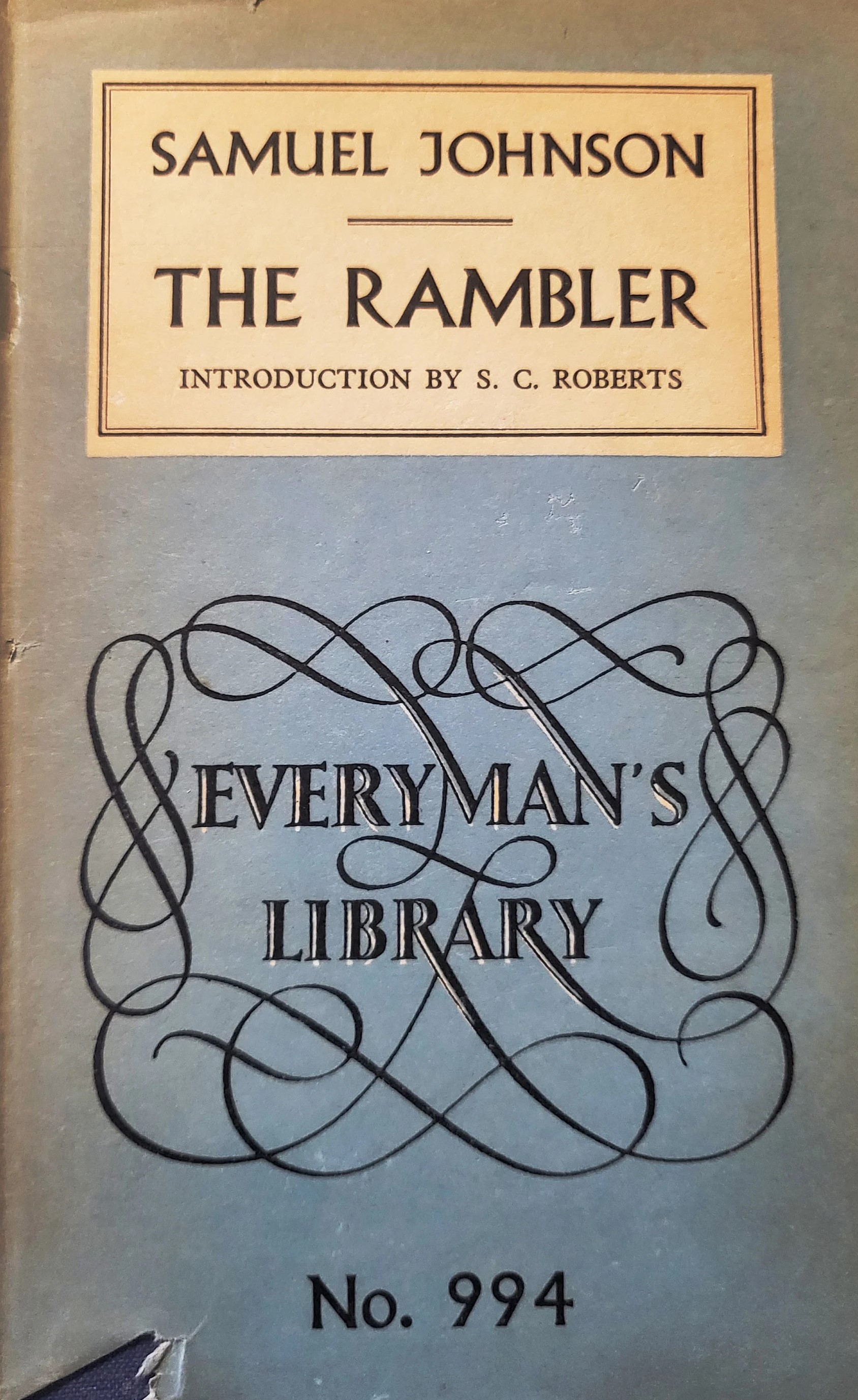
This selection of the Rambler essays is designed to show Dr. Johnson as both moralist and critic: as moralist in the philosophical and religious spheres, as critic of literature and manners. His moods range from the contemplation of eternal truth to the grim humour of his contemporary scene.
Beginning as a journalist on Grub street, this English author made lasting contributions to English literature as a poet, essayist, moralist, novelist, literary critic, biographer, and editor. People described Johnson as "arguably the most distinguished man of letters in English history." James Boswell subjected him to Life of Samuel Johnson, one of the most celebrated biographies in English. This biography alongside other biographies, documented behavior and mannerisms of Johnson in such detail that they informed the posthumous diagnosis of Tourette syndrome (TS), a condition unknown to 18th-century physicians. He presented a tall and robust figure, but his odd gestures and tics confused some persons on their first encounters.
Johnson attended Pembroke college, Oxford for a year before his lack of funds compelled him to leave. After working as a teacher, he moved to London, where he began to write essays for The Gentleman's Magazine. His early works include the biography The Life of Richard Savage and the poem "The Vanity of Human Wishes." Christian morality permeated works of Johnson, a devout and compassionate man. He, a conservative Anglican, nevertheless respected persons of other denominations that demonstrated a commitment to teachings of Christ.
After nine years of work, people in 1755 published his preeminent Dictionary of the English Language, bringing him popularity and success until the completion of the Oxford English Dictionary in 1905, a century and a half later. In the following years, he published essays, an influential annotated edition of plays of William Shakespeare, and the well-read novel Rasselas. In 1763, he befriended James Boswell, with whom he later travelled to Scotland; A Journey to the Western Islands of Scotland, travel narrative of Johnson, described the journey. Towards the end of his life, he produced the massive and influential Lives of the Most Eminent English Poets, which includes biographies and evaluations of 17th- and 18th-century poets.
After a series of illnesses, Johnson died on the evening; people buried his body in Westminster abbey. In the years following death, people began to recognize a lasting effect of Samuel Johnson on literary criticism even as the only great critic of English literature.
An extremely difficult book I chose to read for a couple reasons: I visited Samuel Johnson's home in Fleet Street, London - March, 2008 and wanted to read some of his famous works. Also, this book was mentioned as a favorite of Jane Austen's in one of her biography's I recently read. The word usage was hard to understand. Some of the entries I found myself skimming, just trying to get the main idea. It was a work of sheer will to get through the entire book. I am glad I read it though and plan on reading some of his other works.
He is, by far, one the better 18th century writers I have read. While there are many writers of merit, it is Johnson who uses all the flourishes and verbosity present in so many18th century literary efforts with a virtuosity that makes his writing incredibly approachable and readable. Give him a try.
As with most collections of essays, there were strikes and gutters. Overall, Johnson’s style is witty, light-hearted, and moralistic (but not in a pejorative way). Favorites from this collection include:
-On Looking Into Futurity -Criticism: An Allegory -Uses of Retirement -Miseries of Literary Eminence -The Arts of Self-Delusion -Mediocrity: A Fable -Death-bed School of Wisdom -Suspirius the Human Screech-Owl -Advantages of Living In a Garret -Folly of Cowardice and Inactivity -The Majority Are Wicked -The Study of Life -Mutability of Human Opinions
I have other selections from The Rambler on my shelves, and the complete set of essays on my iPad/Kindle, but this small hardback volume (in the Everyman's Library series) is the most convenient Rambler I have when I want to read a few of these essays. This time I read almost all of the selections - I did skip a few, and expect that only the most dedicated Johnsonians will want to read #152, "Criticism on Epistolary Writings," to choose an example of one of the essays I passed on.
I certainly enjoyed some of these essays more than others, but the best of them transcend Johnson's time and language and remain relevant today, since human nature is much as it always has been. Johnson was a moralist, among other things, and his moralizing is perhaps the least attractive of his qualities. But he he was a compassionate moralist, and his views on capital punishment and prostitution, among other topics, were quite enlightened for the time. The most entertaining and moving of these essays are those which are written in character, in the form of letters to the editor of The Rambler.
Johnson's language is dense, and often difficult for 21st-century readers. Every day, when I picked up the book, there was a short period of adjustment until I was used to the language again. But most contemporary readers have a similar adjustment process when reading Shakespeare; after a few paragraphs, you're back in that world.
These essays were written for a biweekly periodical, and as Johnson said in the last essay, "I have never been much of a favourite of the public." But when these essay were collected in book form, they made Johnson's reputation as much as any of his accomplishments until his dictionary was published a couple of years later. There is much here that has not held up well, but also much to enjoy.
Hell will be a scorcher for me as I have no excuse for bad choices after reading a fine as work as this. I thought Addison was the crème de la crème of moral, ethical, and spiritual instruction until I came across Johnson’s writings. It’s one thing to love his prose and the exalted realms in transports me to; it’s another to bite the lead bullet of adversity and live it out. I Shoutout those who do without the perpetual mandate of needing to be convinced.
After completing Dr. Johnson's Rasselas, I continued to read Rambler to my two secondary school children every day, not only to develop their love of the classics, but also to learn this very and probably most beautiful expression of language in his works.