Donald Richard DeLillo is an American novelist, short story writer, playwright, screenwriter and essayist. His works have covered subjects as diverse as television, nuclear war, the complexities of language, art, the advent of the Digital Age, mathematics, politics, economics, and sports. DeLillo was already a well-regarded cult writer in 1985, when the publication of White Noise brought him widespread recognition and the National Book Award for fiction. He followed this in 1988 with Libra, a novel about the Kennedy assassination. DeLillo won the PEN/Faulkner Award for Mao II, about terrorism and the media's scrutiny of writers' private lives, and the William Dean Howells Medal for Underworld, a historical novel that ranges in time from the dawn of the Cold War to the birth of the Internet. He was awarded the 1999 Jerusalem Prize, the 2010 PEN/Saul Bellow Award for Achievement in American Fiction in 2010, and the 2013 Library of Congress Prize for American Fiction. DeLillo has described his themes as "living in dangerous times" and "the inner life of the culture." In a 2005 interview, he said that writers "must oppose systems. It's important to write against power, corporations, the state, and the whole system of consumption and of debilitating entertainments... I think writers, by nature, must oppose things, oppose whatever power tries to impose on us."
Dr. Phelps: "Because we have to say something. Because language itself would be enormously impoverished if we didn't have disease to talk about." - Don DeLillo, The Day Room
This play was first performed in April of 1986. It was the first play DeLillo wrote that was published (Knopf) and performed. He had previously written a play called "The Engineer of Moonlight" (1979) which I'm still trying to locate. I think it might be in Amsterdam or London (that's an inside joke that you'll get after reading the play). Anyway, according to DeLillo "[The Day Room] is a play about performance and concealment. It explores secret levels of language, perception and identity."
The two-act play takes place in a hospital (Act 1) and a motel (Act 2). It is a bit more complicated than that, but I don't want to ruin the unveiling or the plot. Early DeLillo themes are here. Fixation with death. Paranoia. Language. Perception. Some of the lines are great:
They feel at home in the language of their disease.
If the gravity of the disease is not reflected in the terminology; the patient feels cheated.
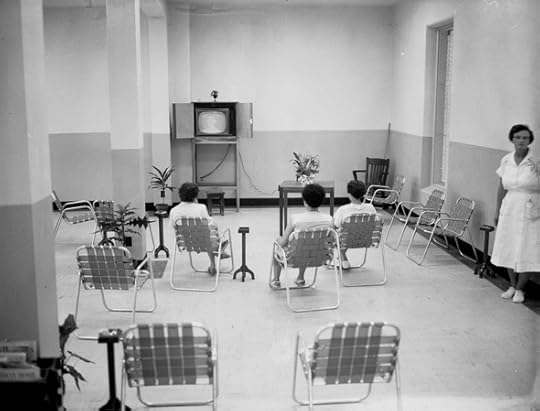
"Just so we all know, these are people who spend their days in a place called the day room. Paintee pure white, coat after coat after coat. Lonely monologues bouncing off the walls. People dragging through, day after day after day, with a kind of scuffling noise like half-drunk commuters trying to catch their trains."
I've spent, in my life, some serious time in hospitals and visited friends and family in a mental hospital a couple of times. DeLillo isn't trying to recreate those settings, exactly, but he does capture a bit of the language or vibe or absurd quality of places where friends, family and patients are surfing, often drugged-up, so close to death. There is a certain change to language after spending months in a room or a wing, partially drugged and floating inside your own head. When reality is difficult is make believe any more funky?
Example: A few years ago, I had a older friend who ended up in the psych ward of a nearby hospital. I was familiar with floor two of the hospital. It was a normal big city hospital floor of a middle of the road hospital. But the third floor was the psych ward. My friend ended up there after his meds went wacky and his eating and sleeping habits changed after the death of his wife. I felt bad. I went to visit him. We talked about a couple banal things, but quickly the conversation was dominated by his paranoia. The staff were watching him. Keeping tabs on him. Our conversations flirted and skipped all over the place. I was happy to dialogue with him. He was lonely. H was sick. He wanted to show me something. He sketched a giant phallus with a red crayon on his white, stiff hospital sheets. He talked about how big he was, and how the staff were always watching. He started to freak out. How could he hide this giant red phallus he drew on his flat sheet? I didn't want to see him get agitated, so I told him I could sneak it past the staff/guards. I untucked my Brooks Brothers dress shirt and literally wrapped a white sheet with a penis drawn on it around my waste. We said our goodbyes, I walked out of his room, past the nurses station, and out of the locked doors. I found an orderly and asked where the soiled linens were kept. He pointed to a nearby door. I opened the door, untucked my blue shirt, and put the sheet in the hospital's hamper, and smiled at the bewildered orderly. I pushed the down button on the elevator and escaped back into reality and the Arizona heat.
That experience felt a helluva lot like a Don DeLillo vignette at the time. It feels even more like this play now.
If you have to read a DeLillo play, though I don’t know why you would have to, I recommend this out of them all. It’s a whole lot of fun and reads like a Twilight Zone episode. That’s not a knock; I love that show, and the opportunity to see DD playing spooky is a good time. Written right after White Noise, it finds the Don at the height of his formidable powers. Oh, and the characters still speak somewhat like people actually talk somewhere on the planet—certainly a facet of his work that went extinct after Underworld. Recommended for fans of DeLillo or, I imagine, people that like discomfiting stories about mental institutions.
I would like to talk about the plot but that would imply spoiling it for others. If I attempt to pass by some details, the summary would not make sense. Suffice to say that I enjoyed this satirical play greatly. I particularly like how madness, a particular sort of madness, is portrayed. The only thing that I find to be lacking is a witty setting description.
La habitación blanca es una obra de teatro de Don DeLillo, inicia con 2 hombres en una habitación de hospital, uno por una dolencia y otro para un chequeo preventivo, esta parte es lo único normal de la obra.
A partir de ahí, la obra se vuelve delirante, caótica, y muy original. Las obras de teatro siempre nos sitúan dentro de un escenario y nos enlistan los personajes que veremos, lo cual hace que siempre tengamos en mente la ficcionalidad de lo que leemos, aquí hay elementos adicionales que refuerzan esta condición hasta que llega un momento que no sabemos donde empieza la actuación, o si es mentira o simplemente locura, como varias realidades sobrepuestas, como espejos que se proyectan unos a otros, dándonos vistazos que no sabemos ya interpretar entre una cosa y otra, un mundo onírico muy real y que de alguna manera representa eso que ya nos dijo Shakespeare, que todos somos actores en este teatro absurdo que es la vida.
Una obra nada fácil de leer y de encontrar la coherencia, pero que vale mucho la pena.
DeLillo is great to play intellectual games with your mind. After Point Omega, I can expect everything from him. I'm only not sure if he wants to disturb our ontology through epistemology or only our epistemology through our rationalism ? I'm not even sure if this play represents postmodernism. Maybe represents today's reality ? Analysed from a social optic and its depends on materialism and consumerism + fundamentally of other people's opinion and our try to mimic their ''great lives'' [Hell is other people, remember], the Day Room is a fact. The entire world is one big mental asylum, with infinitive wards and wings. Every one is a doctor, a nurse, a patient, a visitor of the patients , dependently the roles change in a determined moments. So, logically, if there are roles, it means that every one of us is an actor. Or a clown. In a play[s], or in a circus. Every one applauds , but as Kierkeegard said : ''A fire broke out backstage in a theatre. The clown came out to warn the public; they thought it was a joke and applauded. He repeated it; the acclaim was even greater. I think that's just how the world will come to an end: to general applause from wits who believe it's a joke.''
The Day Room is about how language and conversation are the prime lenses for the perception of our world. Language builds the differences between every character - our perception of what role they play, whatever desire they may have, is purely based on what they say. That is, until they are interrupted by someone who says something otherwise. Eventually locations begin to merge as well, and the function of place becomes blurred - almost nonexistent.
Overall, it is an odd play but a good one. Nothing I would put up there with DeLillo's best, but it is certainly far better than his lesser novels. Worth a read if you're interested in him and have never tried one of his plays.
Oh my god, this was the most bizarre/brilliant thing fucking ever. Something about Don Delillo's plays just fucking wins me over EVERY time. I've only read this one and "Valaprasio" by him, but both blew me away. I find myself laughing and wanting to make note of everything, because it's all so perfect and hilarious and I just want to eat his brain. I would LOVE to see this performed live..
Basically, this takes place in a hospital-kind of place; in the first act, no one is who they seem, and these two guys are having an extremely esoteric, awesome, conversation. There is a part about the soliplistic outlook that children have (things only exist when one is looking at it, streets vanish behind you because if you're not looking at them, there's no use for them) being ACTUALLY TRUE, which is fucking disturbing as shit, and creepy since I was just thinking about this kind of things the other day and talking about it with a friend (ie "what if there's nothing behind the fog" kind of thing..).
The second act centers around people in "The Day Room" which seems like the psych ward of a hosptial, but the people act as if they are in a motel, and DeLillo refers to it as a motel, so I guess it's both.. who knows. Anyway, these people are off to see, allegedly, a play that will change their life. They have more strange/amusing conversations.
Oh, and throughout the entire book people keep getting dragged away for pretending to be people they aren't..(and since it's a play, they are actually being dragged OFF STAGE, which I really like a lot).. ie a nurse and doctor come in.. they are titled "nurse" and "doctor".. and at first they play the role of nurse/doctor and then they start getting weird and another "nurse" and "doctor" come in and say "Oh, sorry, they escaped from the Day Room" and they escort them away. And then the new nurse/doctor start talking and you're like OH, this is the real nurse/doctor, obviously, and then THEY get escorted away, and it's all really silly and at the same time disturbing because DeLillo basically just constantly fucks with your perception of reality, via the way the confused characters in the play see the reality, and you just can't trust anything anyone says, which is maddening and awesome.
I really can't do this justice. I'm ranting but not getting the awesome across.
here's a little sampling that made me lol:
Desk Clerk: Want to see something weird? Maid : Okay The desk clerk points to a chair. Desek Clerk: What's that? Maid: A chair. He kicks the chair. Desk Clerk: If it's a chair, why did I kick it? Long pause. Maid: It must be something else. Long pause. Desk Clerk: Exactly Maid: Scary. Desk Clerk: Right.
AHAHAHAHHA. That is far from the most interesting/funny thing in there, I just don't know what to quote b/c I basically wanted to quote the entire book. Seriously.. when I read books I write down on the bookmark I use, the page numbers that have something on them I want to remember. Here's what I wrote for this book. (The book starts on page 5 and ends on 101):
So yes, i think that illustrates how much I liked it; that's more or less the entire book. I should just buy the book b/c I basically want to devour the entire thing.
Someone on my goodreads friends list please read this (it's a super quick read) and tell me if I'm just the most pretentious person alive and am reading way too much into this. I mean, I think DeLillo is obviously fucking brilliant, as illustrated through these plays, which are up there with Waiting for Godot in how much I love them (I'm noticing a trend.. I tend to like this philosophical nonsense-but-actually-super-meaningful speculation-type of thing).. but the one fiction book I read by him "The Body Artist" was pretty underwhelming. I mean, it could have been brilliant, but I'll openly admit I had no fucking idea what he was talking about/getting at, 90% of the time. This play, it had meaning though. At least I think so. I feel like I "got" it. And I have high hopes for "Underworld" which I'm reading now. I figure if he's going to ramble for 800 pages, he must have something interesting to say.. heh. And it has rave reviews.
Annnyway. I liked it.
Ohhh also also, and I haven't read a lot of plays, but I think this is my favorite stage direction of all time: "Note: In the motel sequence, an actor in a straitjacket functions as the TV set. He is the same actor who is cast as Wyatt in Act One"
HAH.
Everyone is posturing as someone else, including the TV set (who has some of the best lines in this play), who is played by a person. What the fuck, AWESOME.
ONE MORE quote, maybe my favorite thing the TV said (though it's hard to pick)"The robot's arm speaks a kind of arm language. This is the only language-(click)"....[later]..."This is the only language the arm understands. If we want to move the robot's leg, we enter a completely different subroutine."
That made me laugh. I think I'm just fucking weird. Eh.
Something tells me that this could have been better. It could have been cleaner.
Something tells me that I will think back on this play and like it more later.
Maybe I need to see it to really feel it. The flow, the interlocking strands between the first and second act, the circle ... they all are barely there, waiting to be pulled out, but that doesn't come through in a reading. It's something that needs to be watched.
I wonder if there is a better Second Act for this play hiding in the world somewhere. Because that's what it feels like ... that there's this great idea bubbling here ... but not a clear enough way to bring the idea forth. Or maybe I'm just being too picky.
"NURSE BAKER: You want desperately to believe in appearances. You want the simplest assurances. I understand completely. So many cruel deceptions. Is there anyone you can believe in? Are you talking to the person you think you're talking to? Is the person saying what you think she's saying? In this case, my case, all it takes is a glance. What is the difference, Mr. Budge, between you and me? Is it sex, or color, or age? The deepest difference is the most superficial. I'm wearing a uniform, you are not. I have authority, you do not. In all the muddle of the world, in the mixed signals, the clash, the banter, the thinking of one thing and saying of another, the saying of one thing and meaning of another, in all these lies and poems and civilizations, in all this razzle — it's the uniform that matters. The person in the uniform controls the facts. That's what uniforms are for. They prove that truth is possible. People who wear the same uniforms know the same things. People who wear different uniforms know different things and you can tell who knows what by the uniforms they wear. White means one thing, blue means another. You can see my authority with the naked eye. Look, right here, unmistakable, intact.”
The Day Room is a fun, intriguing surreal play split in 2 acts bonded by the elusive presence of one Arno Klein, DeLillo's own Godot. Act 1 takes place in the "day room" of the Arno Klein Psychiatric Wing, act 2 takes place within the confines of the Arno Klein Theater. Both scenes share the same tone of dread and imminent mystery you feel in nightmares, which always seem to end on the verge of uncovering a hidden truth; act 2 also seems to loop back on to the beginning of act 1, suggesting a cycle of existential angst. I enjoyed the writing and the absurdist humor better than I did anything I've read by DeLillo, for what it's worth, though I'd like to actually see it performed.
Un lavoro a tutto tondo del postmodernismo americano, prego di forti richiami letterari (Beckett, Ionesco, Pirandello). A mio parere, tuttavia, un lavoro molto e troppo "normale": rappresenta perfettamente un genere senza dare qualcosa di unico.
La discussione del sottile velo tra realtà, follia, teatro, realtà non riesce ad eccellere, lasciando ottimi exempla immersi in uno spazio di inconsistenza assurdista, senza essere alla grandezza dei grandi autori
Unnerving. This play makes me uneasy all over again about the blurs between sanity and insanity, and the seeming impossibility of communication.
If you’re into absurdism, it’s great. There’s even a scene where a man in a straitjacket plays the part of a television. If you’re not, well, you’ll be left with the uneasiness and semi-depression I felt in response 😆.
My first of Don DeLillo's. The sort of play I would want to watch live, and I would if it ever pops by! Still a very gripping read. The kind of short that serves, simple yet extremely satisfying. It has definitely captivated me to venture into more of the author's creations.
Nothing is what it seems in this postmodernist vaudeville where patients are treated by doctors who appear to be escaped mental patients who appear to be actors, or maybe even something altogether different. DeLillo shifts language itself in 6th gear and you feel it bursting at the seams. There's much joy in this play, and cyberpunk wisdom thrown around like pearls.
This is a script....sometimes they are hard to enjoy on paper so it may not be fair to give this only a two but it was hard to imagine this being great as a play. A 'dark comedy' but it didn't make me laugh!
I found it confusing and made no sense. It starts out well. I liked the interchange between the two characters . It just loses itself in the second half.
Would love to see this produced. One Flew over the Cuckoos Nest x Waiting for Godot? Maybe some Sam Shepherd? Absurdist but really taps into the themes of his fiction