Одного дня, коли все болить і з небес падають цвяхи, Анна перевертає світ догори ногами й бере тата з собою в мандрівку. Туди, де можна плавати з пташками й літати з рибами. Попри Маріанський жолоб і крізь Крабоподібну туманність, аж до самого дна, де закінчуються небеса.
Норвезький автор та ілюстратор Стіан Гуле неодноразово отримував міжнародні нагороди за свої дитячі книжки, зокрема за свою іншу книжку, «Літо Гарманна», він здобув Ezra Jack Keats New Writer Award, the German Youth Literature Prize та Bologna Ragazzi Award.
Ілюстрації книжки “Небеса Анни” виконані колажем, а сама книжка дуже обережно та поетично розповідає історію дівчинки Анни, яка втратила маму, та яка разом з татком збирається на останню з нею зустріч, і підбадьорує не тільки себе, але й оточуючих. Перекладена на 7 мов світу і високо оцінена світовою критикою.
Stian Hole (born 20 March 1969, in Tønsberg, Norway) is a Norwegian graphic designer, illustrator and writer of children's books. He has made numerous book covers and three picture books which have gained national and international recognition. His book Garmann's Summer earned him an Ezra Jack Keats New Writer Award in 2009. In 2009 he won the Nordic Children's Book Prize.
This is a surreal and very strange Norwegian book.
Ostensibly it's about a father and a daughter talking about what Heaven is like and what their wife/mother is doing there. One could surmise they are on the way to Anna's mom's funeral, but that's pure theory.
Now, when I say it like that, it sounds reasonable and clear, but the book is anything but reasonable and clear.
The pictures are gorgeous and surreal. Anna's dad's reflection in the lake is that of a rabbit. The opening end pages are of a sky raining rusty nails. The pictures are Salvador-Dali-type pieces of art.
The “story” makes no fucking sense.
Let's start at the beginning.
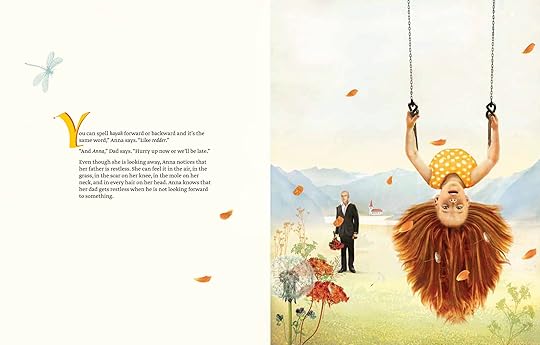
“You can spell 'kayak' forward or backward and it's the same word,” Anna says. “Like 'redder.'”
“And 'Anna,'” Dad says. “Hurry up now or we'll be late.”
Even though she is looking away, Anna notices that her father is restless. She can feel it in the air, in the grass, in the scar on her knee, in the mole on her neck, and in every hair on her head. Anna knows that her dad gets restless when he's not looking forward to something.
Here's the picture:
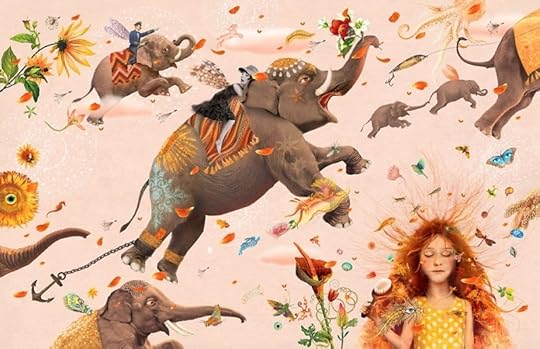
The whole book is like this. If you think it is going to get more understandable as you go on, you are WRONG. If anything it gets more confusing as Anna and her Dad have very abstract and bizarre conversations about God, while the pictures show stuff like floating elephants with anchors chained to their legs and strawberries hanging on fishhooks from the skies.
Here's an example of a page:
“Mom said birds were flowers that could fly, and that sunflower was the sun's little sister,” Anna says. “Look! Swallows are writing cursive letters in the sky. Maybe they're making shopping lists for us. And a recipe for strawberry tart.” Anna follows two swallows with her fingers.
Turn the page.
“Today there's someone in the sky sending down nails. That's not right, is it?” Dad says.
“No,” Anna whispers, “but tomorrow there might be strawberries and honey.”
o.O Are these two both on an acid trip? Do you know, the first time I read this, I thought Anna and her father were both dead and transported to a weird, other-dimensional version of “heaven.” That makes about as much sense as anything that's going on in this book.
Blah, blah, blah, then:
“Look, Dad!” There's a hole in the sky. Come on, let's jump!”
“Where are we going, Anna?”
“Far away, Dad. We're going to swim to the Mariana Trench, and then we'll fly through the Crab Nebula to a place where the sky is underwater.”
“Oh, right,” Dad says, but he doesn't really understand. He hesitates, but then he jumps after her.
I mean... WTF?
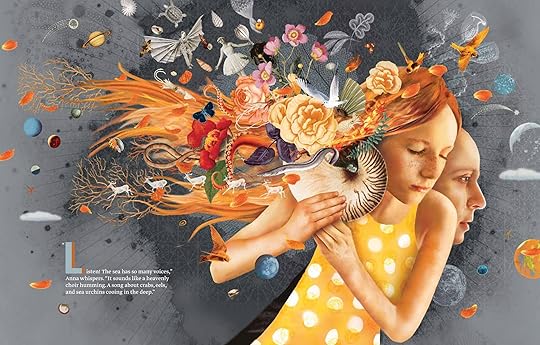
“Listen! The sea has so many voices,” Anna whispers. “It sounds like a heavenly choir humming. A song about crabs, eels, and sea urchins cooing in the deep.”
Just as strange is when she and her father discuss heaven.
“Can you fish for mackeral in heaven?” Anna asks. “And sleep in on Sundays?”
“I think you can take your socks off whenever you please, at any rate,” Dad answers.
“Like the President of the United States does,” Anna says.
“If you've got to look after everyone, you must have more arms than an octopus – and longer ones, too,” she adds.
o.O I think you're confused, and not just about the POTUS.
Tl;dr – ANYWAY. If you want to read this to children, be my guests. They LOVE surreal stuff and might even enjoy the doesn't-make-any-fucking-sense text. However, if you got this book in a misguided attempt to help your child deal with grief (it's labeled as a grief book) you are going to be very disappointed. May I recommend Boats for Papa or Grandma's Gloves instead? Both are excellent.
On the other hand, the pictures are gorgeous beyond belief and reading stuff translated from the Norwegian is fun. Norwegian translated into English has a distinct sound and flavor to it, as does Japanese translated into English. If you hand me a book translated from the Japanese, I can tell; if you hand me a book translated from the Norwegian I can tell. Each language has it's own unique sound and markers when translated into English. If you read enough translated books, you will be able to do this, too. :)
Enjoy, but this book will probably not help your child with grief at all.
Anna and her father are on the way to her mother's funeral. Anna daydreams on a swing before they leave. She daydreams about heaven and what her mother is doing there. She has questions about God -- what he does in heaven and what he does on Earth? Through Anna's imagination we witness a child dealing with the passing of her mother. The vivid applique photographs on colorful backgrounds brings the texts alive to the reader. I feel this book,though imaginative, might need further explanation by an adult to young children.
Чи є сенс уникати розповіді про сюжет та ідею дитячої книжки на кілька хвилин читання, якщо мій відгук все одно читають переважно дорослі? Останніх якраз навпаки більше має зацікавити дитяча книжка, якщо вони знають, про що вона.
Стіан Гуле – норвезький графічний дизайнер, ілюстратор і автор дитячих книжок.
«Небеса Анни» зроблена з фотографій та ілюстрацій, які складаються у дивовижної краси колажі. Вони незвичні. Для декого навіть дивні. Але відірватися неможливо.
За всю історію ми жодного разу не зустрічаємо слова «смерть» чи «похорон». Тому може бути неочевидним, що Анна з татом збираються вдома на похорон мами. Хоча про маму згадується в минулому, а Анна бере тата в мандрівку, під час якої фантазує, де мама зараз.
«Небеса Анни» написана дуже гарними метафоричними фразами (які, можливо, для дорослих звучать більше як метафори, а для дітей якраз вони – правда).
« – Чому той, хто розганяє хмари, здіймає хвилі й обертає планети, не придумає, як перетворити зло на добро? – питає Анна. – Бог мав би поставити собі поштову скриньку для скарг і запитань, – відказує тато».
Скандинави вміють розмовляти спокійно про смерть. Тому в їхніх трилерах такі детальні описи вбивств. У книжках герої навіть можуть посміятися з ситуації, коли усвідомлюють, що зараз помруть. Просто скандинави говорять про смерть з дитинства. Навіть в дитячій літературі.
Тому і питання, чи варто розмовляти з дітьми про смерть? Чи такі книжки, як «Небеса Анни» підготують дитину до смерті рідної людини? (Так-так, ніщо не може до цього підготувати, але все ж, можливо, слід від смерті таки буде інший?) Чи цю книжку читати варто тоді, коли дитина втратила рідну людину? Дитина зможе разом з Анною пофантазувати про чудову місцину, в якій могла опинитися та рідна людина. І це б допомогло дитині краще пережити втрату. Бо я б хотіла повернутися у часи, коли вірила, що всіх, кого втратила, колись побачу на небесах і розповім їм про своє прекрасне життя.
« – Сьогодні хтось там нагорі кидає з неба цвяхи. Так не має бути, – каже тато. – Ні, – шепоче Анна. – Але, може, завтра падатимуть полуниці з медом?»
4.5 Beautiful, poetic book about grief in the family while never mentioning death or grief. But it is there, tangible, like cloves falling from the sky and unbraided hair and no mother to braid it. And father is restless so Anna takes him on a journey through the sky towards the bottom of the sky into the sea where people are swimming and flying through water and where grandpa and mother read or garden in the library/garden of God. Beautifully told and painted, so subtle and complex but also so straightforward and minimalistic (in the best sense of the word). Enjoy your heavenly swim!
Анна разом зі своїм татом вирушають на похорон своєї мами. Однак цього зовсім не помітно на фоні яскравих, часто сюрреалістичних картинок із уяви, пам'яті Анни, тому прямої вказівки про страшну трагедію наче й нема. Так чи так, неймовірний малюнок наче розмиває трагедію дівчинки й водночас підкреслює невгамовний сум, який сублімується у фантазії та низці питань про рай, небеса, людей. Старі фотографії минулих лише підсилюють надто реалістичний стиль Гуле. Окремі моменти просто дуже чуттєві, але все ж тут перемагає малюнок. Здіймання в небеса, пірнання у морські глибини, накладання різних образів у колажі -- усе це виконано просто блискуче.
Водночас текст мені видається дещо штучним, далеким від емоційного переживання. Є з чим порівняти, бо інші книги Видавництва про втрату близьких резонують значно сильніше, просто вибивають землю з-під ніг. Мені зрозуміло, що автор зумисне так акуратно пише, немов торкається тонкої матерії (а смерть близьких, особливо матері, особливо для дівчинки -- це вкрай тонка річ), боючись її зруйнувати якимось необережним словом. Усе ж, це надзвичайно красива, яскрава й незвична історія, яку, напевно, не всі підлітки зчитають, бо норезький стиль письма Стіан Гуле доволі незвичний для українських читачів, але не виключено, що мною промовляє мій досвід. Точніше, відсутність такого досвіду, що в цьому разі лише є позитивом.
Annas Himmel is a story that dealt with death and grief. It's a hard topic but yet the author can picture it in a different way. To see the concept of heaven through the eyes of kids would be very interesting, and I am sure we would get a lot of interesting answers. In this case Anna's imagination is very wild and vivid. Which is kind of understandable if you try to put yourself as kids again. I enjoy this book and it is somehow touch me in a strange way. It's filled with strange (in a good way) illustrations, very wild and bold, but at the same time it's quiet and peaceful. I don't know if this make sense. Perhaps the message of grief that made it that way. All in all it's a book that could be enjoy by any ages :)
The book never explicitly states that Anna’s mother has passed away, but experienced readers can infer this if they parse through a surrealistic barrage of collaged imagery to see the typical belongings of an adult woman lying in a box on the floor, or Anna’s questions about heaven, or a quizzical sky with lots of people and animals floating by, prone, as if in eternal sleep. I’m not sure younger readers will have the background knowledge to catch the author’s drift.
That aside, this picture book is stunning. Visually arresting, it seems like a bizarre dream in the very best way. Photorealistic paintings of Anna and her father’s faces, hair, and clothes are masterful. Incredibly bright and vividly realistic Imagery that incorporates vintage photographs of bygone generations with digitally appliqued backgrounds and brightly saturated animals are astonishing. This is an illustrative masterpiece, but, especially when tied to the story, this book would be better appreciated by adult readers, which leaves me confused about the intended audience of this book.
Anna's Heaven is about a little girl waiting with her father to go to her mother's funeral. The book begins with her father admonishing her to, "Hurry up!" However, as the book progresses the father allows himself to follow Anna through her daydreams until she is ready to go to the funeral.
It is difficult to find books about children dealing with a mother's death and this book is one of the best. Anna is a dreamy girl who talks about her mother's death in an indirect manner, typical of young children. Anna's jumbled feelings are demonstrated in the lively, boldly colored, remarkable illustrations leaping throughout the pages. Her need to question God is explored in her fanciful questions and innocently wise comments.
The language in Anna's Heaven is beautiful. ( "Mom said birds were flowers that could fly, and that the sunflower was the sun's little sister," Anna says. "Today there's someone in the sky sending down nails. That's not right, is it?" Dad says. "No," Anna whispers, "but tomorrow there might be strawberries with honey." )
Though the story is sad, the conversation between father and daughter is beautiful. The illustrations are remarkable. This is a book that would definitely be worth keeping in mind. Just in case it needs sharing with someone special.
Marvelous illustrations and poetic text offer a philosophical pondering on death and its possible aftermath. A girl and her father each mourn the loss of her mother--his wife--and prepare to go, most likely for her funeral but possibly to resume life. The girl takes her father on a journey to her idea of Heaven where she imagines the woman weeding the garden or checking out books from the library. The first endpapers feature nails seemingly hurled through the skies and the last endpapers contain juicy strawberries, perfect images to represent how Anna and her father must surely be feeling. Coping with loss is never easy, but this book's meditative, yet somewhat celebratory nature may ease the pain a bit. Anna's Heaven looks life a place most of us would wish for our loved ones.
What a year Eerdman's is having! Here is another extraordinary picture book that speaks evocatively about grief. Extraordinary and unusual illustrations lend a surreal but ultimately peaceful and hopeful feel to the book. This is one to give both to thoughtful children AND adults coming to terms with less in their lives.
Прочитала цю книжку в українському виданні "Видавництва", купила для себе заради ілюстрацій, бо раніше сподобалося "Літо Гармана" цього автора. Книжка дуже сумна. Зате красива.
I loved this book. It shows the process of grieving when you lose a loved one. Anna helps her dad find peace by using her imagination. She imagines what she thinks heaven is like. Throughout the story, her and her father ask themselves questions about God and why he would do this to them. This is a common question Christians ask when they lose someone they love. However, Anna and her father realize that her mother is in such a better more beautiful place.
#SEL #death #older - beautifully illustrated book about a young girl and her father - it's inferred that the mother has died. Imaginative use of art and ideas.
This is a book about a girl named Anna, and her dealing with just losing her mom. Anna has questions about heaven and is trying to figure out exactly what happens after a person dies. I would have this book in my classroom library for the students to access on their own if they needed to read it.
Beautiful artwork, peculiar wording, undefinable target group, wonderful heroine: I admire Anna, who at her young age senses that her father is too tense, too fidgety to go through his late wife's funeral. So she ignores his demands to hurry up, shoves him head first into a dream journey of memory bits and sensations and and weaves strange images and weired tales about the heaven she imagines her mother to be landed in. When her father's mouth is able to form the beginning of a smile, her work is done and you glimpse a fleeting picture of her own pain before she declares herself to be ready to go.
I'm amazed by the illustrations in Anna's Heaven. They're beautiful and eerie at the same time, and perfectly fit the theme and otherworldly business of dealing with the death of someone close to you.
A very melancholy book--both in tone and visually, yet the text is filled with hope and lightness, even though the main theme is loss and death.
Right away upon opening this book there is a European sensibility about both the story and the images. A looseness that Americans typically don't employ. I love how the little girl's innocence and lightness helps pull the father out of his grief and into her place of play and hope. Her care for him is both tender and realistic...
Most of the illustrations are filled with beauty, imagination, and symbolism that help fill out the story. Two of the spreads I find a bit odd (where the daughter and father travel past this life and into the next), maybe even respectfully creepy. It's hard to say how some kids might see these pages--whether they will be alarmed by them, or simply shrug and not be bothered?
My favorite spread is Anna and her father at a lake. Birch trees and mountains border the image, and an empty boat sits waiting for adventurers. The lake is glassy calm, reflecting the sky, and Anna is stretched out on a rock, dipping her hand in the water. The father is preoccupied with tying his shoe. It's a perfect picture of the state of being of the two in the story, and it reads:
"If only Mom could come back and braid my hair," Anna sighs.
"Ah, if only she could," Dad says.
"One day while Mom was brushing her hair in front of the mirror, she said everything had two sides." Anna gives that some thought. "Do you think there's anything on the other side of the mirror?"
"I don't know, Anna, my sweet," Dad says, squeezing his eyes shut.
Трохи дивно ілюстрована книжка про втрату мами з великою кількістю метафор. Тато і донька Анна намагаються опанувати горе кожен у свій спосіб, в тому числі через стан дереалізації, з якого повільно виходять впродовж оповідання.
Losing a loved one is a profoundly difficult experience at any age, but it can be especially difficult to process as a young person. Anna's Heaven follows a young child and her father as they grapple with the death of their respective mother and wife.
This book's high point is the amazing and unique illustrations, which elevate a text that is at times touching and beautiful, and at others difficult to follow. My favorite parts are when Anna is describing the afterlife she imagines for her mother, from visiting heaven's library to weeding the gardens of paradise. However, the beginning of the book is perhaps too subtle in discussing the situation that has brought Anna and her dad to this moment. It hints at the fact that they have experienced loss, and I struggled to follow every metaphor and change of plane of reality. I would have appreciated a more explicit discussion of death from beginning to end.
Perhaps the translation from Norwegian to English failed to bring the full meaning of the original text into a new language, or perhaps Stian Hole's story was not as vibrantly successful as his illustration
When your world turns upside down, it may pay to look at it that way. Young Anna does just that — and takes her grieving father along — in the subtly worded and creatively illustrated "Anna's Heaven." Translated by Don Bartlett from the Norwegian, this picture-heavy and text-terse Eerdman's Book for Young Readers would make for an interesting parent-child reading time, especially in households dealing with a death of a loved one. The dialogue between father and daughter bounces between the realistic and magical, often terrific role modeling for parents trying to cope with the curveballs life throws. Stain Hole, both author and illustrator, includes interesting questioning of the role God plays in life's mysteries. "Why can't he who knows everything, who can pull and push and turn over clouds and waves and planets — why can't he invent something to turn bad into good?" Anna says. "God should hang up a mailbox for people to send questions and complaints," Dad answers. Take this journey to the upside-down world. Oh, and look for Elvis and Pablo Picasso in Anna's version of the hereafter.
Stunning surrealistic illustrations, but I doubt any child will understand this picture book. The non-linear text is a mish-mash of random thoughts. It's supposed to be a conversation between a father and daughter grieving over the death of the girl's mother, but there is no logical flow to the dialogue or any sensible reaction from the other person.
EXAMPLE:
"Look! Swallows are writing cursive letters in the sky. Maybe they're making shopping lists for us. And a recipe for strawberry tart." Anna follows two swallows with her fingers.
Then on the very next page: "Today there's someone in the sky sending down nails. That's not right, is it?" Dad says.
No grieving child will be comforted by this picture book imported from Norway, regardless of however beautiful the art may be. The pictures are also an unexpected collage of disparate images, and don't always reflect the text.
“Do you think that there’s anything on the other side of the mirror?” Anna questions her restless father about her mother’s death. Reflections (her mother’s ghost image follows the mountain’s contours, a teapot mirrors an elephant, Anna and father’s pond reflections) and the text’s opening palindromes underscore the mystery of dying. After Anna plunges into the sky, her grieving father follows her through fanciful wonderings about her mother’s whereabouts and doings. Soon they emerge, Anna ready to accompany him to church. Hole’s surreal photocollaged images haunt from opening endpapers where nails rain down until they accede to raining strawberries at the back.
Anna's imagination is very vivid. She imagines flying elephants. Her questions and observations capture what the inside of a child might be thinking like how can God keep an eye on everyone? Questions about why can't braid her hair. She winds up taking her father on this adventure with her.
This is a very unique book about a father and daughter - the mother has passed away, and it is clear that the father is struggling with that absence in his life. The positivism and imagination inherent to his daughter help to pull him out of his depression and into a happier place. The illustrations are dreamlike and interesting to look at - much time can be spent with this book. Be aware that there is discussion of God within the pages of this book.
The concept of Heaven is a hard one for young children to wrap their heads around. I picked this book up thinking it would approach the subject in a concrete way while keeping in mind the audience. This book ended up being so abstract for me that I'm really not sure who it was about. I'm not sure if things got lost in translation or not, but not a winner for me. Some of the illustrations were amazing while others were odd.
If Magritte, Dali and Bosch illustrated a children's book . . .
incredible art in this book from Norway's Stian Hole. Simply amazing -- so much to look at.
A father is sad; his daughter Anna asks unending questions about the nature of life and heaven and together they go on an imaginary journey (it seems implied that the mother has died).
Originally published in Norway English language translation by Don Bartlett Eerdmans 2014
Stian Hole has outdone himself in this absolutely stunning, emotional tribute to death. I had to sit and breathe for a minute after finishing it. It is utterly arresting, visually and textually moving, and altogether gorgeous. Each illustration is better than the last, but the one that grabbed my heart in vise is the one accompanying "Listen! The sea has so many voices!".