Jump to ratings and reviews
Rate this book

The Classics of Western Spirituality

Catherine of Genoa: Purgation and Purgatory, The Spiritual Dialogue

Rate this book
Catherine, who lived for 60 years and died early in the 16th century, leads the modern reader directly to the more significant issues of the day. In her life she reconciled aspects of spirituality often seen to be either mutually exclusive or in conflict. This married lay woman was both a mystic and a humanitarian, a constant contemplative, yet daily immersed in the physical care of the sick and the destitute.

For the last five centuries she has been the inspiration of such spiritual greats as Francis de Sales, Robert Bellarmine, Fenelon, Newman and Hecker. Friedrich von Hügel's famous Mystical Element of Religion was a study of the spirituality of Catherine.

Purgation and Purgatory is a collection of sayings on spiritual purification in this life and the next. The Spiritual Dialogue gives us a readable and coherent inner history of Catherine.

163 pages, Paperback

First published August 1, 1979

1 person is currently reading
186 people want to read

About the author

Catherine of Genoa

18 books11 followers
Saint Catherine of Genoa (Caterina Fieschi Adorno, 1447 – 15 September 1510) was an Italian Roman Catholic saint and mystic, admired for her work among the sick and the poor and remembered because of various writings describing both these actions and her mystical experiences. She was a member of the noble Fieschi family, and spent most of her life and her means serving the sick, especially during the plague which ravaged Genoa in 1497 and 1501. She died in that city in 1510.

Her fame outside her native city is connected with the publication in 1551 of the book known in English as the Life and Doctrine of Saint Catherine of Genoa.

She and her teaching were the subject of Baron Friedrich von Hügel's classic work The Mystical Element of Religion (1908).

Ratings & Reviews

What do you think?
Rate this book

Friends & Following

Create a free account to discover what your friends think of this book!

Community Reviews

5 stars
23 (33%)
4 stars
33 (47%)
3 stars
8 (11%)
2 stars
3 (4%)
1 star
2 (2%)
Displaying 1 - 13 of 13 reviews
Profile Image for Mir.
4,977 reviews5,330 followers
Read
June 28, 2017
I was supposed to read this for a college course, but I don't think I ever finished it. It probably made no difference, from an academic point of view; the introduction and notes, which takes up nearly half the pages, lay out all the key ideas. Insofar as I can recall:
-God is Pure Love and the complete fulfillment of the soul
-There is a lifelong struggle between Pure Love and self-love
-only by Grace can the soul win the struggle against self-love
And I think some part about completely surrendering to God's will to the extent that one can't even wish for things to be different than they are (wishing for the suffering of Purgatory to end, for example).

From her biographic sketch she seemed to have been an extremely complex and contradictory person. Empathetic and devoted to the sick, yet often wanting to be alone; melancholy yet ecstatic. She was at times unable to eat (not as a deliberate penitential behavior). The commentator suggests that she might have suffered from schizophrenia.

“Since I am determined to join myself to God, I find that I am also bound to be the enemy of his enemies. And since I find nothing that is more his enemy than the self that is me, I am constrained to hate this part of me more than any other.”

This wasn't one of my preferred books in this series. Those interested in her writing can also read Cardinal Manning's translation of her text on Purgatory for free, here: https://archive.org/details/TreatiseO...

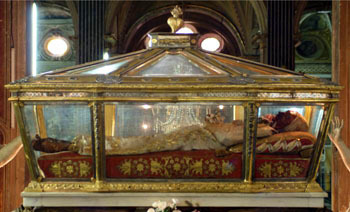
Here's her body in a church named for her:
Profile Image for Kathryn.
986 reviews3 followers
October 6, 2015
Summary: The works "Purgation and Purgatory" and "The Spiritual Dialogue" by St. Catherine of Genoa.

Why I Read This: I was listening to Fr. John Riccardo's talk on "The Four Last Things" and he talked about her vision of purgatory. I thought that I would read it for myself.

Review: There was a reason that the Lord put this into my life at this time, and it was not because of "Purgation and Purgatory". "The Spiritual Dialogue" was actually what hit me at just the right time in God's timing (at least the 1st part). I'm not sure if I would read it again, but it definitely came to me at the right time.
10.7k reviews35 followers
July 20, 2024
A 15TH-16TH CENTURY LAY MYSTIC DESCRIBES THE AFTERLIFE

Saint Catherine of Genoa (1447-1510) is an Italian Catholic mystic, admired for her humanitarian work among the sick and the poor; she was a laywoman, as well as married. The Foreword to this 1979 book states, "The works in this volume can most aptly be referred to as the 'teachings' of Catherine. Catherine herself wrote no books. Her 'works' were completed by about 1522, about twelve years after her death... These works are the works of her friends recounting what they heard from Catherine. It is in this way that they can be called her 'teachings.'"

She observed of souls in Purgatory, that "These souls cannot think, 'I am here, and justly so because of my sins,' or 'I wish I had never committed such sins for now I would be in paradise'... They cannot remember the good and evil in their past nor that of others... They see only the goodness of God, His mercy toward men." (Pg. 71) In contrast, "The souls in h___ have infinite blame and suffering; not as much as they deserve, but one that is without end. Those in purgatory simply suffer." (Pg. 74)

She suggests that one who dies in mortal sin "deserves an infinity of suffering in a time without end; God's mercy, however, brings it about that only the time has no limit but not the intensity of the suffering---that has a limit. In justice God could have imposed more suffering than He has." (Pg. 75) But happily, "As for paradise, God has placed no doors there. Whoever wishes to enter, does so." (Pg. 78)

She observes, "The goods of the earth do not lead to an increased taste for spiritual things." (Pg. 97)

More "mystic vision" than "spirituality," this work is still worth reading in this attractive edition.
Profile Image for Mozelle.
242 reviews2 followers
February 25, 2022
A different version of Purgatory than I was taught. Purgatory in her vision was were the soul united with God for purification. The soul willingly throws itself there upon death and realization of sin.
106 reviews
June 11, 2020
What Flannery O'Connor said: “Where the poet and the realist are truly combined you have St. Catherine of Genoa.” (Letter to A., 8 Dec. 1955)
Profile Image for Kathy B.
123 reviews
started-but-stalled
July 22, 2025
I was expecting something else I suppose. I just didn’t think it was going to be as difficult to understand her as it turned out to be. I left it on a shelf for a later time.
1,612 reviews24 followers
August 15, 2009
Beautiful mystical reflections from an early modern saint. Although Catherine was a member of the nobility, she spent most of her life caring for the poor and ill of her city. Catherine has been an inspiration to both Catholics and Protestants, according to the introduction, because of her deep spirituality and awareness of God's presence. Her writings mainly focus on the process of sanctification, and she is considered a forerunner of Saint John of the Cross and Saint Teresa of Avila.
Profile Image for Andrew.
669 reviews123 followers
August 3, 2012
The book carries a very thorough introduction (almost half the text) that excellently sets up the following works by Catherine. I particularly liked the Spiritual Dialogue; a far more pragmatic and rational mysticism than found in John of the Cross or Teresa d'Avila.
Profile Image for Wanda.
99 reviews
January 26, 2009
A very interesting book, although a bit scary, lol. The introduction mentions that the book should be meditated on, rather than thought through logically, which is a good point.
200 reviews2 followers
Read
February 24, 2018
Catherine, who lived for 60 years and died early in the 16th century, leads the modern reader directly to the more significant issues of the day. In her life she reconciled aspects of spirituality often seen to be either mutually exclusive or in conflict. This married lay woman was both a mystic and a humanitarian, a constant contemplative, yet daily immersed in the physical care of the sick and the destitute.
For the last five centuries she has been the inspiration of such spiritual greats as Francis de Sales, Robert Bellarmine, Fenelon, Newman and Hecker. Friedrich von Hügel's famous Mystical Element of Religion was a study of the spirituality of Catherine.

Purgation and Purgatory is a collection of sayings on spiritual purification in this life and the next. The Spiritual Dialogue gives us a readable and coherent inner history of Catherine.
Displaying 1 - 13 of 13 reviews

Can't find what you're looking for?

Get help and learn more about the design.