
What do you think?
Rate this book


312 pages, Hardcover
Published August 20, 2019


But attempting to silence convicts was futile. Informal language was a vital form of expression—approximately half of all convicts were illiterate. Sung, shouted, screamed and whispered, slang was also scrawled into bibles, stippled onto coins, scratched into cell walls and pricked into convicts' skin. — Simon Barnard
Okay so yes I did just read a dictionary almost cover to cover. I like colonial Australia, I like language and linguistics and I've read Barnard's other book on Australia as a penal colony. His writing is usually readable and well contextualised. Unlike his others which are aimed at younger audiences this one is aimed at adults, not researchers or academics (though they may get some aid from it) but more those that are interested in the period, the people and the language. It is well worth a read/browse even if just to see the origins of the Australian dialect.
What is interesting is how many of these words are still used in Australian English some 200 years later. Not just Australian English general criminal slang. Words like bolt, chiv, cleaned out, fence, nix, plant, out-and-out and yarn. Boned is kinda still used though possibly through a regain in popularity. Other words are still used but their meanings have changed. Even in this dictionary, you see the beginnings of dialect in the cant with the amount of the words for a single thing, ie watch Though watch is a homophone with the guard form and the timepiece of equal importance. Surprisingly or not quite a few of the words are derived from or are Romani/ Romany. They were called gypsies (viewed as a racial slur) while they were at the time and remain a global culture the Romani here are likely to be British. They like so many other cultures were ostracised at the time for their otherness and their unwillingness to conform. They are still treated poorly.
Barnard's paragraphs of facts and stories help modern readers to understand antiquated definitions. Conceptually none of them are difficult but there are nuances perhaps between the similar definitions. Anecdotes always help stories be told and understood. His cartoons add character to the book. They balance out well in what is in some cases some truly grim goings-on. References are made to some of the big names in Australian convict history/lore. Captain Moonlit (look I need to do more research on him, but damn that is walking a close line to labelling him queer), Kate Kelly, William Brodie (the inspiration for Robert Louis Stevenson's Strange Case of Dr Jekyll and Mr Hyde), Robert Callaghan and Thomas Jefferies.
The convict I had never heard of but might look into more because her story is young Mary Wade. Transported at 11 (or 13 stories differ) she is considered one of the colony's founding mothers. Some of these are people I think should be spoken about more. Like the roles convicts played in colonisation and our strong women. The entries remind me of why I love female convicts so much. There is a theory that the reason that Australians are the way they are as a culture, especially women, is that we come from those women like Ann Graham, Mary Wade and Mary Smith. Those convict women who worked hard, held their families together and gave birth in some of the worst situations. From convict women to convict brides to free settlers. Only amplified by those immigrants in the 20th century from matriarchal cultures.
I consider this book four of Simon Barnard's Tasmanian convict non-series. By age level Goalbird (a picture storybook, the biography of William Swallow), A–Z of Convicts in Van Diemen's Land (an illustrated encyclopedia for tweens), Convict Tattoos (cataloguing what tattoos convicts had, their significance and who some of them were, for high school students) and this one feels very much like it is for adults. There is some complexity in this that isn't in the others not least of all the language used by James Hardy Vaux. I have read and enjoyed all of them but one of my personal interests is transportation and convict life if it is a topic that appeals they won't disappoint.
Read for Autumn Readathon by Lilium 2021. Filling the prompt: "Nyctophilia: A book with black on the cover"
Can you find a cover with more black on it? The whole thing is basically black with silver writing.
A representative gif: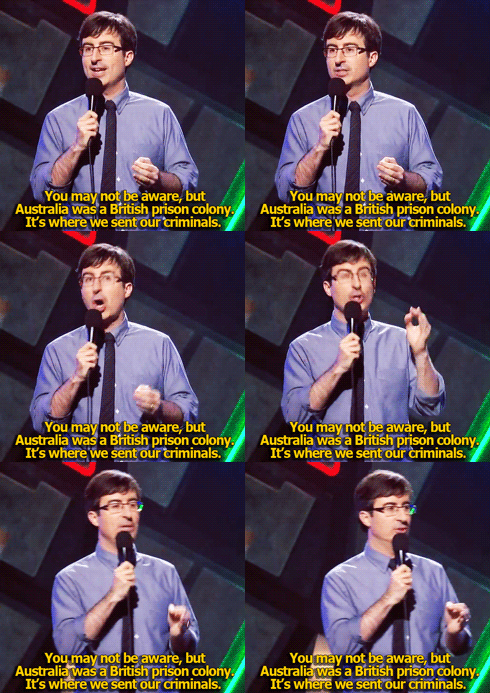
Side note this is formatted so poorly on Goodreads, but I guess at 34 words across three-plus lines it is exceptionally cumbersome to format. The title is so long because it's technically two. But it is possibly best formatted as James Hardy Vaux’s 1819 Dictionary of Criminal Slang: and Other Impolite Terms as Used by the Convicts of the British Colonies of Australia: with Additional True Stories, Remarkable Facts and Illustrations by Simon Barnard best referred to as James Hardy Vaux’s 1819 Dictionary of Criminal Slang (2019 edition).


