

What do you think?
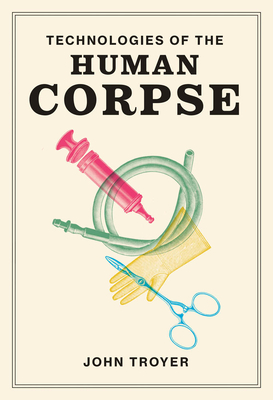
Technologies of the Human Corpse
“One of our greatest thinkers” on death presents a radical new approach to thinking about dying and the human corpse (Caitlin Doughty, mortician and bestselling author of Smoke Gets in Your Eyes ).
A fascinating exploration of the relationship between technology and the human corpse throughout history—from 19th-century embalming machines to 21st-century death-prevention technologies.
Death and the dead body have never been more alive in the public imagination—not least because of current debates over modern medical technology that is deployed, it seems, expressly to keep human bodies from dying, blurring the boundary between alive and dead. In this book, John Troyer examines the relationship of the dead body with technology, both material and the physical machines, political concepts, and sovereign institutions that humans use to classify, organize, repurpose, and transform the human corpse. Doing so, he asks readers to think about death, dying, and dead bodies in radically different ways.
Troyer explains, for example, how technologies of the nineteenth century including embalming and photography, created our image of a dead body as quasi-atemporal, existing outside biological limits formerly enforced by decomposition. He describes the “Happy Death Movement” of the 1970s; the politics of HIV/AIDS corpse and the productive potential of the dead body; the provocations of the Body Worlds exhibits and their use of preserved dead bodies; the black market in human body parts; and the transformation of historic technologies of the human corpse into “death prevention technologies.” The consequences of total control over death and the dead body, Troyer argues, are not liberation but the abandonment of Homo sapiens as a concept and a species. In this unique work, Troyer forces us to consider the increasing overlap between politics, dying, and the dead body in both general and specifically personal terms.
A fascinating exploration of the relationship between technology and the human corpse throughout history—from 19th-century embalming machines to 21st-century death-prevention technologies.
Death and the dead body have never been more alive in the public imagination—not least because of current debates over modern medical technology that is deployed, it seems, expressly to keep human bodies from dying, blurring the boundary between alive and dead. In this book, John Troyer examines the relationship of the dead body with technology, both material and the physical machines, political concepts, and sovereign institutions that humans use to classify, organize, repurpose, and transform the human corpse. Doing so, he asks readers to think about death, dying, and dead bodies in radically different ways.
Troyer explains, for example, how technologies of the nineteenth century including embalming and photography, created our image of a dead body as quasi-atemporal, existing outside biological limits formerly enforced by decomposition. He describes the “Happy Death Movement” of the 1970s; the politics of HIV/AIDS corpse and the productive potential of the dead body; the provocations of the Body Worlds exhibits and their use of preserved dead bodies; the black market in human body parts; and the transformation of historic technologies of the human corpse into “death prevention technologies.” The consequences of total control over death and the dead body, Troyer argues, are not liberation but the abandonment of Homo sapiens as a concept and a species. In this unique work, Troyer forces us to consider the increasing overlap between politics, dying, and the dead body in both general and specifically personal terms.
272 pages, Hardcover
Published April 7, 2020
Ratings & Reviews
Friends & Following
Create a free account to discover what your friends think of this book!
Community Reviews
Displaying 1 - 24 of 24 reviews

February 20, 2023
It’s too bad the author writes so poorly, because he actually had some very thought-provoking points to make hidden in this sesquipedalian, self-indulgent vanity piece. I just had to use a word like “sesquipedalian” to describe him, because he wrote like he was presenting a thesis to a Ph.D. review committee and wanted to sound like a really smart, deep thinker. Let’s look at some examples: “While American funeral practices had been historically quasi-homogenous…the emergence of HIV/AIDS produced whole new sets of postmortem rules and regulations that institutionalized extreme forms of homogeneity.” And: “Central here to Canguilhem’s observation that the normal is a simultaneous extension and exhibition of the norm, as well as his last point – that the normal is a polemical concept...” And: “Necroeconomies are fundamentally about how the postmortem biological potential of the human corpse, e.g., the dismembered dead body that produces multiple medical implants, etc. contributes to the ‘social economic, and political systems of productivity and power.”
As if that wasn’t enough, between each chapter was a page or two of his extremely bad poetry. His sister had just died, and while one can appreciate his attempt to express his grief through poetry, it added absolutely nothing to the book and was lousy poetry as well. Finally, when you take out 30 pages of preface and introduction, seven pages of simply inserting a copy of an End of Life and Funeral Planning form, 35 pages of endnotes, 13 pages of “works cited and consulted,” and all the poetry, there’s very little book left. Within those few pages, he was redundant and quoted others extensively, so there’s scarcely any original thinking of his own here. To further demonstrate how lazy and unoriginal he is, he admitted that when he was a Scholar in Residence at a museum in Brooklyn, almost all his public lectures involved his simply reading sections from a book written by somebody else.
As if that wasn’t enough, between each chapter was a page or two of his extremely bad poetry. His sister had just died, and while one can appreciate his attempt to express his grief through poetry, it added absolutely nothing to the book and was lousy poetry as well. Finally, when you take out 30 pages of preface and introduction, seven pages of simply inserting a copy of an End of Life and Funeral Planning form, 35 pages of endnotes, 13 pages of “works cited and consulted,” and all the poetry, there’s very little book left. Within those few pages, he was redundant and quoted others extensively, so there’s scarcely any original thinking of his own here. To further demonstrate how lazy and unoriginal he is, he admitted that when he was a Scholar in Residence at a museum in Brooklyn, almost all his public lectures involved his simply reading sections from a book written by somebody else.

September 17, 2021
You’ve heard this Benjamin Franklin quote before: “in this world nothing can be said to be certain, except death and taxes”. It's a cliché because it rings true - but how true is it? How stable is death? If death is an existential constant, shouldn’t it present itself as the same thing across time and space?
John Troyer’s recent MIT Press publication, Technologies of the Human Corpse, suggests that – although death may be inevitable at this moment in the human experience – its materiality is anything but certain. Deploying a wealth of examples throughout American history, Troyer explores some of the ways in which the exertion of technological control over the human body has changed both our understandings of death, and the bio-material facticity of death itself. “[…] [T]he logic of death that living humans believe to be so fixed”, he argues, “is actually quite malleable”.
Troyer’s work re-examines the human body and the human corpse as technologies themselves. Ontologically, every human body has the potential to become a human corpse, and this dual status as subject-object presents a range of technological possibilities for human beings as well. From the 19th-century taxonomic technologies that created the Bisga Man, to the more recent plastination methods introduced by Gunther von Hagens in the Body Worlds exhibits, Troyer brilliantly illustrates how humans have attempted to lock death in time by repurposing corpses as objects of complete control. Further examples are provided from history, such as the way that the HIV/AIDS crisis redefined the homosexual corpse as threateningly abject and chronically diseased, or the more recent developments in cadaverous biotechnologies, which blur life and death in the most curious of ways.
As all of these technologies change, so do our conceptual frameworks of life, death, and what it means to be fully human. Troyer’s approach to the history of death as an idea draws philosophical inspiration from the Continental tradition, particularly the writings of Michel Foucault, Gilles Deleuze, and Giorgio Agamben. Unfortunately, I have not read any of Agamben’s work myself, and so I have to take much of what Troyer is saying at face-value. However, Troyer is a very clear and eloquent writer, especially when paraphrasing other authors. He offers up a useful conceptual distinction from Agamben, which differentiates between biopolitics (i.e., political relations to life), thanatopolitics (i.e., political relations to death), and necropolitics (i.e., political relations to corpses). Those three concepts were really helpful in understanding the various uses and abuses of death and dying throughout time, and I’m sure I’ll come back to them in the future.
At the centre of all these advances in life and death lies a taught relationship between Man and Nature. Humans try to leave the realm of Nature through their practices of civilization, technology and medical science. The exertion of complete control over death and the dead body is an attempt to manipulate Nature, to freeze Nature, to transcend Nature. Troyer understands the teleological goal of these emergent practices as something like an attempt to realize and surpass Nietzsche’s Superman – a total transcendence of the Human as a category of being. The “death of death”, so to speak, and the broadening of the horizon of the human being.
Yet death perpetually calls us back, reminding us that we are Homo sapiens – the rational animal, perhaps, but still very much animal. For his part, Troyer believes that less death simply means more life, and – for a number of reasons – more life is not necessarily a good or desirable thing. Consider how living forever, or even a few years longer, might impact the Earth’s population, socio-economic inequality, food and water resources, climate change, infectious diseases, and so on. The prospect of eternal life would surely not free humans from the deterministic bonds of their biology, nor would it solve all of their existential problems. Rather, in all of our efforts to transcend and deny death, Troyer says, we are simply illustrating “[…] the face of Man drawn in the sand washing out to sea”. What a brilliant, thought-provoking book.
John Troyer’s recent MIT Press publication, Technologies of the Human Corpse, suggests that – although death may be inevitable at this moment in the human experience – its materiality is anything but certain. Deploying a wealth of examples throughout American history, Troyer explores some of the ways in which the exertion of technological control over the human body has changed both our understandings of death, and the bio-material facticity of death itself. “[…] [T]he logic of death that living humans believe to be so fixed”, he argues, “is actually quite malleable”.
Troyer’s work re-examines the human body and the human corpse as technologies themselves. Ontologically, every human body has the potential to become a human corpse, and this dual status as subject-object presents a range of technological possibilities for human beings as well. From the 19th-century taxonomic technologies that created the Bisga Man, to the more recent plastination methods introduced by Gunther von Hagens in the Body Worlds exhibits, Troyer brilliantly illustrates how humans have attempted to lock death in time by repurposing corpses as objects of complete control. Further examples are provided from history, such as the way that the HIV/AIDS crisis redefined the homosexual corpse as threateningly abject and chronically diseased, or the more recent developments in cadaverous biotechnologies, which blur life and death in the most curious of ways.
As all of these technologies change, so do our conceptual frameworks of life, death, and what it means to be fully human. Troyer’s approach to the history of death as an idea draws philosophical inspiration from the Continental tradition, particularly the writings of Michel Foucault, Gilles Deleuze, and Giorgio Agamben. Unfortunately, I have not read any of Agamben’s work myself, and so I have to take much of what Troyer is saying at face-value. However, Troyer is a very clear and eloquent writer, especially when paraphrasing other authors. He offers up a useful conceptual distinction from Agamben, which differentiates between biopolitics (i.e., political relations to life), thanatopolitics (i.e., political relations to death), and necropolitics (i.e., political relations to corpses). Those three concepts were really helpful in understanding the various uses and abuses of death and dying throughout time, and I’m sure I’ll come back to them in the future.
At the centre of all these advances in life and death lies a taught relationship between Man and Nature. Humans try to leave the realm of Nature through their practices of civilization, technology and medical science. The exertion of complete control over death and the dead body is an attempt to manipulate Nature, to freeze Nature, to transcend Nature. Troyer understands the teleological goal of these emergent practices as something like an attempt to realize and surpass Nietzsche’s Superman – a total transcendence of the Human as a category of being. The “death of death”, so to speak, and the broadening of the horizon of the human being.
Yet death perpetually calls us back, reminding us that we are Homo sapiens – the rational animal, perhaps, but still very much animal. For his part, Troyer believes that less death simply means more life, and – for a number of reasons – more life is not necessarily a good or desirable thing. Consider how living forever, or even a few years longer, might impact the Earth’s population, socio-economic inequality, food and water resources, climate change, infectious diseases, and so on. The prospect of eternal life would surely not free humans from the deterministic bonds of their biology, nor would it solve all of their existential problems. Rather, in all of our efforts to transcend and deny death, Troyer says, we are simply illustrating “[…] the face of Man drawn in the sand washing out to sea”. What a brilliant, thought-provoking book.

February 6, 2023
This doesn't even come close to living up to the title, but really, how could it? The title is glorious. The text is a slapdash affair that struggles to justify its own existence. Troyer is ostensibly using Foucault and Agamben to analyze the modern corpse and its uses. It's a plausible and interesting academic project, but unfortunately, the gown is empty here. There's a lot of jargon signifying little, and several of the chapters barely gesture at their subject before hastily concluding. It's for the best really, because even the few pages here on "what if we overcome death with technology hmmm??" is embarrassingly light on insight.
More unforgivable still is the miscellany that Troyer attaches to his presumably repurposed dissertation: there's the mawkish but relatable prefatory essay describing his sister's death, a chapter that is literally his introduction to another, probably better book, a handful of end-of-life planning worksheets tacked on at the end, and some of the most execrable mourning poetry I've ever had the misfortune of reading. I feel bad Troyer's sister died and I appreciate the willingness to humanize an academic subject, but good gawd a'mighty, it stinks worse than a ripe corpse in a hot car!
You'll also hear innumerable recitations of Troyer's bona fides as "Overlord of Death" that float probabilistically between "impostor syndrome" and "obtuse self-aggrandizement." My guy, I've heard enough about you. Let's roll up our sleeves and dissect the subject at hand, shall we? Alas, he never does, and I was left mourning the loss of such a beautiful title on a lifeless body of words. Probably 1.5/5 stars, but I'll round up as an act of condolence.
More unforgivable still is the miscellany that Troyer attaches to his presumably repurposed dissertation: there's the mawkish but relatable prefatory essay describing his sister's death, a chapter that is literally his introduction to another, probably better book, a handful of end-of-life planning worksheets tacked on at the end, and some of the most execrable mourning poetry I've ever had the misfortune of reading. I feel bad Troyer's sister died and I appreciate the willingness to humanize an academic subject, but good gawd a'mighty, it stinks worse than a ripe corpse in a hot car!
You'll also hear innumerable recitations of Troyer's bona fides as "Overlord of Death" that float probabilistically between "impostor syndrome" and "obtuse self-aggrandizement." My guy, I've heard enough about you. Let's roll up our sleeves and dissect the subject at hand, shall we? Alas, he never does, and I was left mourning the loss of such a beautiful title on a lifeless body of words. Probably 1.5/5 stars, but I'll round up as an act of condolence.

May 1, 2022
Though the preface to 'Technologies of the Human Corpse' is incredibly vulnerable and personal for the author, the rest of this piece is pretty heavy academic non-fiction...aside from the cringey poems that conclude each chapter.
That being said, the information conveyed in this book is well researched and presented. As it was released right before the global pandemic started in 2019, I would love to see a new edition printed with Troyer lending his insight via at least one added chapter relating to how the influx of biologically hazardous corpses in a digital age has effected the economic and athropological nature of the industry, and detailing the general sociological reprecussions.
While a casual reader might find 'Technologies' to be difficult to get through, readers with an academic interest in the socioeconomic, philosophic, and historical anthropology of the human corpse, will find this to be a fascinating read.
That being said, the information conveyed in this book is well researched and presented. As it was released right before the global pandemic started in 2019, I would love to see a new edition printed with Troyer lending his insight via at least one added chapter relating to how the influx of biologically hazardous corpses in a digital age has effected the economic and athropological nature of the industry, and detailing the general sociological reprecussions.
While a casual reader might find 'Technologies' to be difficult to get through, readers with an academic interest in the socioeconomic, philosophic, and historical anthropology of the human corpse, will find this to be a fascinating read.

March 9, 2021
morbidly fascinating stuff, especially the latter half of the book, specifically chapters 6 & 7 on thanato/necropolitics and patenting death, would have liked to read more about that
i thought the personal angle with the death of his sister lended a humanizing groundwork for the premise of the book but the poetry in between chapters was not the greatest
7/10
i thought the personal angle with the death of his sister lended a humanizing groundwork for the premise of the book but the poetry in between chapters was not the greatest
7/10
June 22, 2021
While I really enjoyed some of the concepts covered in the book, very good at getting me to explore other concepts that the author was interested in (biopolitics, necroeconomics, etc.). However, the way that John troyer would write sometimes made it seem like he liked the way his farts smell. Purposefully verbose sentences. It was great other than that, and his sad poetry about the death of his sister.

July 6, 2020
This sort of thing is my bag in a big way, and the bibliography hipped me to a lot of new material—but holy cow, the author did not have to introduce each chapter with his truly wretched poetry about his dying sister. That really took me out of it.
February 19, 2022
Each chapter had some interesting things to ponder, but the truly terrible poetry was jarring. I'm all for using writing as a tool to process grief, but you can keep it to a smaller circle than your widely published book.

July 16, 2026
Situationship who led me on bought me this book in 2024, and I finally read it two years later. I'd say it's a good book. But I feel like it's not enough to fully grasp the concept of death and how we got to where we are now in society when it comes to death and dying and what comes next when we are politically labeled as "dead," and after finishing the book I was left wanting to know more of what the book didn't cover. I do like how the author cited and mentioned several other books written by other experts on the subject. I've bought "The Craft of Dying" and am currently waiting for it to come in the mail because of this book.

May 7, 2022
So much information about death and dead bodies. I preferred the first half to the last. History of funerals, embalming, the handling and scare of AIDS/HIV corpses, and plastinatiion of bodies for exhibits. The book tends to read like a text book except for the forward the author writes about his life family and the poems at the end of each chapter about the death of his sister. I appreciated the emotion of the deaths of his loved ones. It softened the hard, technical facts and made a book on death more human.
This entire review has been hidden because of spoilers.

June 1, 2022
The poems about his sister's death and dying are sincere, emotional, and striking.
....The author stuck them in between chapters about waxy corpses posed in sexual positions and the cost of bones and organs in the body market.
For me, it ruined both aspects, having one interrupt the other. I understand why he did it- he talks about it in the introduction- but it made it difficult to ever be in the correct 'mindset' to really read either; both of which were interesting on their own. Combined- not so much. Sweet and savory don't *always* go together.
....The author stuck them in between chapters about waxy corpses posed in sexual positions and the cost of bones and organs in the body market.
For me, it ruined both aspects, having one interrupt the other. I understand why he did it- he talks about it in the introduction- but it made it difficult to ever be in the correct 'mindset' to really read either; both of which were interesting on their own. Combined- not so much. Sweet and savory don't *always* go together.

March 6, 2023
This was a 50 cent find at my local bookstore and as a follower of Caitlin Doughty’s YouTube channel as well as having read one of her books, her support of this book was the selling factor. An interesting study of the human corpse throughout the 1800s (sometimes earlier) through modern day and the potential future, the author takes us through the various sociological, political, biological, and spiritual components that make up a human corpse and all the ways our society’s definitions of death and live are ever evolving. Fascinating read!

April 6, 2023
I was expecting a book in line with Mary Roach’s Stiff, but instead found a philosophical dissertation combined with a personal story about grief. The author is an academic, so much of the writing reads like a textbook or scientific journal - interesting topics, but very dry. However, when he writes about his experience with his sister’s tragic death, there is much feeling. This should have been two different books, and I actually think this book would have been better if he had expanded on the personal story.

March 23, 2024
A collection of essays and poems about death, and the nuances between a body and a corpse (and all the things that go along with those definitions). Thought-provoking with a focus on a handful of topics, though some opinions were stated as fact (fair, I get it).
Reader be warned: these definitely feel like scholarly essays, with all the repetition that comes with those. (Or maybe it's just coming at the same points from different directions, but it is repetitive at times either way.)
The final question (from the CDAS apparently?) is a real doozy.
Reader be warned: these definitely feel like scholarly essays, with all the repetition that comes with those. (Or maybe it's just coming at the same points from different directions, but it is repetitive at times either way.)
The final question (from the CDAS apparently?) is a real doozy.
July 3, 2024
I liked a few chapters, particularly the Global Trade in Death, Dying, and Human Body Parts. Many other chapters of the book were hard to read, or at least the author's point was not entirely clear to me. I found myself constantly having to reread sentences, which was frustrating. This book was more like multiple academic essays about death complied together and less about development in death tech than the title led me to believe. It's not a bad book though, just not for me. I plan to donate this book for someone else to hopefully enjoy.

June 19, 2022
Some very thought provoking ideas are scattered throughout the book, but I found it to be a hard-to-read combination of terminology, data, and (in between chapters) poetry dedicated to the author’s sister. I was hoping for a more personal or reflective exploration of ideas about how the definitiva of death have evolved and how technology and politics are working to change death and the dead body even now. I got some of that but found that, for me, it was dry and hard to read.

November 21, 2023
Very academic discussions of the potential consequences of future and past changes in science and the repercussions for society. Became sort of a forced homage to the authors dead sister with strange poems throughout unrelated to the content. Quick read
September 25, 2020
A book that takes you into some strange but intriguing territory.

July 21, 2021
Doesn't fulfill on titular promise but does send in interesting directions
June 12, 2024
Very interesting read. I read it as part of my history of corpses class.i recommend this to anyone interested in how the death industry works as a whole.

August 4, 2024
Could have done without the poems lol

August 14, 2024
A fascinating and comprehensive approach to understanding death and dying and what shapes our cultural perception of such—I loved how personal he was able to make it as well. Will revisit!

December 21, 2024
Very specific book but fantastic topic explained clearly. Looking forward to reading other books he cites (and one he helped resurface and republish).

Read
July 4, 20251, 6-7
Displaying 1 - 24 of 24 reviews