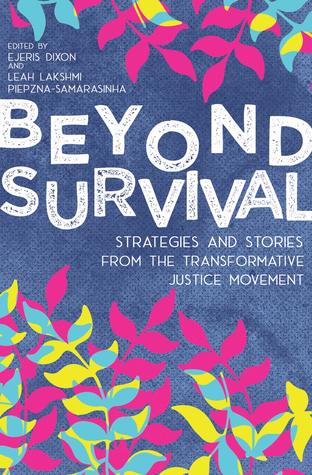
"Be here. Be all over the place. Be messy. Be wrong. Be bold in your hopefulness. Be confused in community. Be reaching past isolation. Be part of the problem. Be hungry for after. Be helpful in the midst. Be so early in the process. Be broken by belief. Be bolstered by brave comrades. Be unbelievably unready. Be alive."
"Many people have told us that when they think of transformative justice, they think it is “a really long process where people talk about what happened, cry, get overwhelmed, and eventually stop answering their emails.”"
This is an immensely cheering book - which I went into, and came out of, pretty cynical about community accountability processes. Transformative Justice is a set of practices much broader than community accountability, and there is some really interesting pieces here about community programs to protect from violence without police, sex worker organising for defence, as well as sexual and interpersonal violence prevention. A fair bit of the book does deal with community accountability processes, mostly with the problems they entail, and the reflections on this were just as much about the limitations as the successes (I particularly enjoyed Piepzna-Samarasinha's wry rejection of community accountability circles as an effective response to organised crime). There is much acknowledgement that sometimes there simply is no right answer:
"So then you have this tension of like, I don’t believe in activating the state, but I’m witnessing horrific violence, and I need to take an action that doesn’t lead to violence against me as the worker, and that doesn’t increase the violence against the people who are being harmed, and so now I’m in this conflict because I don’t believe in being complicit with the state, and this is the only solution that I have going, and I need to sit with how I resolve this effectively, but the truth is that there is no effective resolution for that tension."
The book's contributors often disagree with each other, and projects vary enormously in scale and intent. Some are reflective, others more like a "guide to a safe party" or mental health 101 (some of the latter frightened me in how it needed to articulate some basic things, including that most people in crisis are not better off in hospital).
The contribution by adrienne maree brown, is of course, astonishing in asking whether activist circles are on the right track at all: "But I also wonder: Is this what we’re here for? To cultivate a fear-based adherence to reductive common values? What can this lead to in an imperfect world full of sloppy, complex humans? Is it possible we will call each other out until there’s no one left beside us? I’ve had tons of conversations with people who, in these moments of public flaying, avoid stepping up on the side of complexity or curiosity because in the back of our minds is the shared unspoken question: When will y’all come for me? The places I’m drawn to in movement espouse a desire for transformative justice—justice practices that go all the way to the root of the problem and generate solutions and healing there, such that the conditions that create injustice are transformed. And yet … we don’t really know how to do it. We call it transformative justice when we’re throwing knives and insults, exposing each other’s worst mistakes, reducing each other to moments of failure. We call it holding each other accountable. I’m tired of it. I see it everywhere I turn. When the response to mistakes, failures, and misunderstandings is emotional, psychological, economic, and physical punishment, we breed a culture of fear, secrecy, and isolation. So, I’m wondering, in a real way: How can we pivot toward practicing transformative justice? How do we shift from individual, interpersonal, and interorganizational anger toward viable generative sustainable systemic change?"
In the end, while there is a lot of messy in this book, that so many people are engaging meaningfully with community solutions is just … happy-making. And the determination to look the problems in the eye is pretty good too.