

What do you think?

Finest Years
Preeminent military historian Max Hastings presents Winston Churchill as he has never been seen before. Winston Churchill was the greatest war leader Britain ever had. In 1940, the nation rallied behind him in an extraordinary fashion. But thereafter, argues Max Hastings, there was a deep divide between what Churchill wanted from the British people and their army, and what they were capable of delivering. Himself a hero, he expected others to show themselves heroes also, and was often disappointed. It is little understood how low his popularity fell in 1942, amid an unbroken succession of battlefield defeats. Some of his closest colleagues joined a clamour for him to abandon his role directing the war machine. Hastings paints a wonderfully vivid image of the Prime Minister in triumph and tragedy. He describes the ‘second Dunkirk’, in 1940, when Churchill’s impulsiveness threatened to lose Britain almost as many troops in north-west France as had been saved from the beaches; his wooing of the Americans, and struggles with the Russians. British wartime unity was increasingly tarnished by workers’ unrest, with many strikes in mines and key industries. By looking at Churchill from the outside in, through the eyes of British soldiers, civilians and newspapers―and also those of Russians and Americans―Hastings provides new perspectives on the greatest Englishman. He condemns as folly Churchill’s attempt to promote mass uprisings in occupied Europe, and details ‘Unthinkable’―his amazing 1945 plan for an Allied offensive against the Russians to liberate Poland. Here is an intimate and affectionate portrait of Churchill as Britain’s saviour, but also an unsparing examination of the wartime nation which he led and the performance of its armed forces. Max Hastings studied at Charterhouse and Oxford and became a foreign correspondent, reporting from more than 60 countries and 11 wars for BBC TV and the London Evening Standard . He has won many awards for his journalism. Among his bestselling books, Bomber Command won the Somerset Maugham Prize, and both Overlord and Battle for the Falklands won the Yorkshire Post Book of the Year Prize. After 10 years as editor and then editor-in-chief of the Daily Telegraph , he became editor of the Evening Standard , in 1996. A Fellow of the Royal Society of Literature, he was knighted in 2002.
Audio CD
First published September 3, 2009
About the author
Max Hastings
113 books1,818 followersSir Max Hugh Macdonald Hastings, FRSL, FRHistS is a British journalist, editor, historian and author. His parents were Macdonald Hastings, a journalist and war correspondent, and Anne Scott-James, sometime editor of Harper's Bazaar.
Hastings was educated at Charterhouse School and University College, Oxford, which he left after a year.After leaving Oxford University, Max Hastings became a foreign correspondent, and reported from more than sixty countries and eleven wars for BBC TV and the London Evening Standard.
Among his bestselling books Bomber Command won the Somerset Maugham Prize, and both Overlord and The Battle for the Falklands won the Yorkshire Post Book of the Year Prize.
After ten years as editor and then editor-in-chief of The Daily Telegraph, he became editor of the Evening Standard in 1996. He has won many awards for his journalism, including Journalist of The Year and What the Papers Say Reporter of the Year for his work in the South Atlantic in 1982, and Editor of the Year in 1988.
He stood down as editor of the Evening Standard in 2001 and was knighted in 2002. His monumental work of military history, Armageddon: The Battle for Germany 1944-1945 was published in 2005.
He is also a Fellow of the Royal Society of Literature.
Sir Max Hastings honoured with the $100,000 2012 Pritzker Military Library Literature Award for Lifetime Achievement in Military Writing.
Hastings was educated at Charterhouse School and University College, Oxford, which he left after a year.After leaving Oxford University, Max Hastings became a foreign correspondent, and reported from more than sixty countries and eleven wars for BBC TV and the London Evening Standard.
Among his bestselling books Bomber Command won the Somerset Maugham Prize, and both Overlord and The Battle for the Falklands won the Yorkshire Post Book of the Year Prize.
After ten years as editor and then editor-in-chief of The Daily Telegraph, he became editor of the Evening Standard in 1996. He has won many awards for his journalism, including Journalist of The Year and What the Papers Say Reporter of the Year for his work in the South Atlantic in 1982, and Editor of the Year in 1988.
He stood down as editor of the Evening Standard in 2001 and was knighted in 2002. His monumental work of military history, Armageddon: The Battle for Germany 1944-1945 was published in 2005.
He is also a Fellow of the Royal Society of Literature.
Sir Max Hastings honoured with the $100,000 2012 Pritzker Military Library Literature Award for Lifetime Achievement in Military Writing.
Ratings & Reviews
Friends & Following
Create a free account to discover what your friends think of this book!
Community Reviews
Displaying 1 - 30 of 199 reviews

July 30, 2024
Huge Responsibility, Big Decisions and Little Regret
I have to say, I was really surprised and impressed by this book. Having read other reviews it appeared at first that this might have been a dry slog. However I was wrong, Finest Years is a masterful and nuanced portrait of Winston Churchill during the most critical period of his career; his leadership of Britain during World War II. Known for his ability to balance rigorous historical research with vivid storytelling, Hastings delivers a compelling account that goes beyond the mythologized image of Churchill to present a more complex, and at times contradictory, leader. The book focuses on the five years when Churchill served as Britain's Prime Minister and war leader, from 1940 to 1945. Hastings captures the immense pressure and monumental challenges that Churchill faced from the moment he took office, just as Nazi Germany seemed poised to overrun Europe. The narrative is rich with detail, from the desperate Dunkirk evacuation to the Battle of Britain and the tense alliance with the United States and the Soviet Union.
A major strength of Finest Years is Hastings' ability to show Churchill as both an inspiring figure and a deeply flawed human being. He does not shy away from criticizing Churchill's strategic blunders, such as the ill-fated campaign in Norway or his obsession with the Mediterranean theater, which sometimes distracted from more pressing concerns. Hastings also explores Churchill's difficult relationships with his generals, who often chafed at his micromanagement and grandiose schemes. Yet, the book is also a celebration of Churchill's extraordinary qualities. Hastings highlights Churchill's indomitable spirit, his rhetorical genius, and his ability to rally the British people during their darkest hour. The famous speeches are given their due, but Hastings also pays attention to the less-publicized aspects of Churchill's leadership, such as his constant engagement with military and political details and his unyielding belief in ultimate victory.
Hastings’ portrayal of Churchill’s relationships with key figures, such as Franklin D. Roosevelt and Joseph Stalin, is particularly compelling. He provides insight into the complicated dynamics of the Allied leadership, emphasizing Churchill’s role as both a unifier and, at times, a source of tension. The book also does not ignore the impact of Churchill's decisions on the British Empire and its colonies, exploring how his views on empire and race sometimes clashed with the evolving post-war world. Hastings’ writing is both academically adroit and accessible, making complex military and political issues understandable without oversimplification. His use of primary sources, including diaries, letters, and firsthand accounts, adds depth to the narrative and offers readers a more intimate view of Churchill’s decision-making processes and the atmosphere in wartime Britain.
Sir Max Hastings does it once again with this exceptional study of Churchill as a wartime leader. I feel like I have never read a bad book by him, albeit I haven’t read them all yet, but I know I’m going to. He succeeds in painting a balanced picture of a man who was as much a product of his time as he was a shaper of history. This is a must read for those interested in World War II, Churchill, or leadership in crisis, Finest Years offers invaluable insights and a gripping narrative that captures the essence of what made Churchill’s wartime leadership both controversial and legendary.
I have to say, I was really surprised and impressed by this book. Having read other reviews it appeared at first that this might have been a dry slog. However I was wrong, Finest Years is a masterful and nuanced portrait of Winston Churchill during the most critical period of his career; his leadership of Britain during World War II. Known for his ability to balance rigorous historical research with vivid storytelling, Hastings delivers a compelling account that goes beyond the mythologized image of Churchill to present a more complex, and at times contradictory, leader. The book focuses on the five years when Churchill served as Britain's Prime Minister and war leader, from 1940 to 1945. Hastings captures the immense pressure and monumental challenges that Churchill faced from the moment he took office, just as Nazi Germany seemed poised to overrun Europe. The narrative is rich with detail, from the desperate Dunkirk evacuation to the Battle of Britain and the tense alliance with the United States and the Soviet Union.
A major strength of Finest Years is Hastings' ability to show Churchill as both an inspiring figure and a deeply flawed human being. He does not shy away from criticizing Churchill's strategic blunders, such as the ill-fated campaign in Norway or his obsession with the Mediterranean theater, which sometimes distracted from more pressing concerns. Hastings also explores Churchill's difficult relationships with his generals, who often chafed at his micromanagement and grandiose schemes. Yet, the book is also a celebration of Churchill's extraordinary qualities. Hastings highlights Churchill's indomitable spirit, his rhetorical genius, and his ability to rally the British people during their darkest hour. The famous speeches are given their due, but Hastings also pays attention to the less-publicized aspects of Churchill's leadership, such as his constant engagement with military and political details and his unyielding belief in ultimate victory.
Hastings’ portrayal of Churchill’s relationships with key figures, such as Franklin D. Roosevelt and Joseph Stalin, is particularly compelling. He provides insight into the complicated dynamics of the Allied leadership, emphasizing Churchill’s role as both a unifier and, at times, a source of tension. The book also does not ignore the impact of Churchill's decisions on the British Empire and its colonies, exploring how his views on empire and race sometimes clashed with the evolving post-war world. Hastings’ writing is both academically adroit and accessible, making complex military and political issues understandable without oversimplification. His use of primary sources, including diaries, letters, and firsthand accounts, adds depth to the narrative and offers readers a more intimate view of Churchill’s decision-making processes and the atmosphere in wartime Britain.
Sir Max Hastings does it once again with this exceptional study of Churchill as a wartime leader. I feel like I have never read a bad book by him, albeit I haven’t read them all yet, but I know I’m going to. He succeeds in painting a balanced picture of a man who was as much a product of his time as he was a shaper of history. This is a must read for those interested in World War II, Churchill, or leadership in crisis, Finest Years offers invaluable insights and a gripping narrative that captures the essence of what made Churchill’s wartime leadership both controversial and legendary.

March 14, 2019
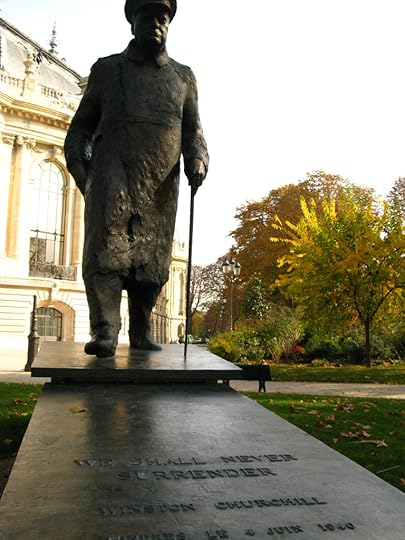
Winston Churchill statue outside "Le Petit Palais" in Paris
by Jean Cardot in 1998
Page 478 (my book)
In 1938, he seemed a man out of his time, a patrician imperialist whose vision was rooted in Britain’s Victorian past. By 1945, while this remained true, and goes far to explain his own disappointments, it had not prevented him from becoming the greatest war leader his country had ever known, a statesman whose name rang across the world like that of no other Englishman in history. Himself believing Britain great, for one last brief season he was able to make it so. To an extraordinary degree, what he did between 1940 and 1945 defines the nations’ self-image even into the twenty-first century.
This is a superb rendition of Churchill’s years in power during World War II.
As the author ably demonstrates Churchill was exuberant and full of vigour during this tumultuous period. Even after 1943, when the role of the U.S. became ascendant, Churchill’s voice and oratory kept Britain as an active participant.
Page 397
But without Churchill, his country would have seemed a mere exhausted victim of the conflict, rather than the protagonist which he was determined that Britain should be seen to remain until the end.
Max Hastings is very opinionated and presents us with several divergent views of Churchill. Churchill was so focused on the war effort that he lost touch with the “day-to-day” lives of his countrymen and their post-war aspirations. He had no plan for British lives after the war’s conclusion. This is unlike Roosevelt, who had a much wider vision of his country (the GI bill) and the world (the U.N.).
The author brings up the relationship between Churchill and Roosevelt and sees it as more fraught than the ample quotes of “friendship” that Churchill kept repeating. Roosevelt, although very gregarious, was very opaque in contrast to Churchill’s direct and emotional approach. Churchill needed and cajoled Roosevelt. Roosevelt likely found this tiresome.
Both however were duped by Stalin believing, for example, that they could rely on his agreements for the self-determination of eastern Europe.
Page 266
It is an outstanding curiosity of the Second World War that two such brilliant men as Winston Churchill and Franklin Roosevelt allowed themselves to suppose that the mere fact of discovering a common enemy in Hitler could suffice to make possible a real relationship [with Stalin] … But Americans [and British] … harbored delusions about their ability to make friends with the Russians.
The author discussed at length the incessant demands from the Soviets for a Second Front and how popular the Soviet regime was in Britain at that time. It is fortuitous that the landings in France were held off until 1944. The Allies, more so the Americans, were in no position militarily in 1942 or 1943 to make a viable landing on the French mainland. Churchill shares responsibility for this worthwhile delay until the build-up in troops and equipment was adequate. Many hard lessons were learnt at Dieppe (1942), and North Africa, Sicily, and Italy in 1942 and 1943.
Many of Winston’s errant ways were brought up. He was constantly badgering Turkey to join in with the Allies (this would just have been an additional supply burden). He had wild schemes to invade Norway and expand the war into the Balkans. These were spoken of endlessly and squashed at staff meetings.
Also, one comes away with the impression that Clementine, Churchill’s wife, was one of the few people that he would listen to. Only strong personalities, like Alan Brooke, could withstand his magnificent oratory and successfully challenge him. Churchill needed an audience and did much of the talking.
Churchill was constantly pressing his army, air force, and navy to do more. He was not one to delegate. And he had no qualms about dismissing generals that were, in his view, poor performers.
This book, like its subject, is full of vitality and resonates the full life of Winston Churchill during this epic time period.

October 21, 2012
This book describes the life and politics of Winston Churchill during the Second World War. It is a superb book and gave some new insights in the strengths and errors of Winston. It does not spare Winston; especially in the chapter about operation Accolade in the Egean see. But in the end the author comes to the conclusion that Winston- with all his faults - was the best man to lead England through the war.
It gave me some new insights about the relationship between Roosevelt and Churchill and the British and American chiefs of staff - it wasn't as good as it seemed to be.
It thought it was an excellent book - I have read multiple books on the topic of the Second World War and this one surely stands out.
It gave me some new insights about the relationship between Roosevelt and Churchill and the British and American chiefs of staff - it wasn't as good as it seemed to be.
It thought it was an excellent book - I have read multiple books on the topic of the Second World War and this one surely stands out.

October 28, 2014
This is the first book I have read about Sir Winston Churchill and I'm glad to have picked one written by Sir Max Hastings, another first. Sir Hastings is British, and many would expect him to therefore have a great command of the language, but not all British can write like him. His arsenal of vocabulary and elements of the language is impeccable. He was able to summon the right words and phrase them in ways that express precisely what he was trying to convey. It was not only on the one or two occasions when you would see the gems, it was peppered throughout the book. But I could have been too easily impressed, not being a native speaker.
Most readers probably knew Winston Churchill as the Prime Minister of Great Britain in the Second World War despite his service to the nation prior to and after that. For that reason, this book that focuses only on his years as Prime Minister is a good first book to read about him before moving on to other more comprehensive biographies. Instead of just the events, the author showed how the fortunes of the man rose as he led Britain as the sole nation to stand up against Hitler and fell as he found himself losing influence over the conduct of the war once the Americans entered the war and the Russians' fortune took a turn for the better.
The Americans' involvement in the war was featured throughout the second half of the book and it was important because the depth of America's involvement in the Second World War was in direct proportion to the decline in Churchill's influence over its conduct. One cannot help feeling a little indignant over the American's handling of their allies; it is easy to feel that when the British were suffering alone (and at one point was on the brink), the US was dragging its feet and seemed almost ready to let Britain meet its 'fate' in the hands of Hitler, and yet once they themselves were attacked, they were almost reckless in wanting to bring retribution to their enemies. But this narrative would be simplistic. The US is a huge country, and huge countries have huge buffers to shield them from what is happening around the world, even the eastern side of the country is rather different from its west, it is therefore hard to feel the urgency of things happening across the Atlantic. On top of that, the democratic system in the US probably mean that as much as the President himself wanted to enter the war, he would be up against many opponents.
I always put the US' involvement in Europe against the backdrop of the 'Europe first' policy. Japan was the one that violated the US, not the Germans, even though Hitler perplexingly declared war against the US after Pearl Harbor which was a sneak attack by his ally for which he received no prior notification. Selling the 'Europe first' policy to Americans in general would have been hard when it was Japan that they wanted to go after, and yet the Americans were persuaded. For that, Americans deserve credit.
The portrayal of Stalin was more straightforward, although there was nothing straightforward about him. Desperate at first, he emerged the master of real-politick as his own army prevailed over the Germans. His treatment of Churchill was harsh, not in the sense of being rude, but he knew exactly how to 'play' with Churchill. He probably had respect for Churchill in recognising that if anyone, Churchill could see through his own designs on Eastern Europe after the war. But he knew that Churchill had no chips with which to bargain and so would not be able to do anything about it. So he just led Churchill along, giving some hope whenever it suits him, and needling Churchill when he felt like it. I doubt Stalin had more respect for Roosevelt, he probably respected the US' industrial and therefore military might, but at the same time he was cordial with Roosevelt because he thought Roosevelt was not able to see through his ploy and was too idealistic in believing that post-war, countries would behave civilly.
The British lost a part of their empire to the Japanese in South East Asia, together with that a huge number of men (British and soldiers of the Commonwealth), materiel, and even the Prince of Wales. Yet Asia got just but a cursory treatment in the book. I do not think this is a deliberate omission on the part of Sir Hastings, rather I think it reflected the actual sentiments prevailing in Britain then. The enemies were at the gates of the home islands, and even though they did not manage to break through, the British suffered years of uncertainty, deprivation, humiliation, and endured many nights of German bombing. The war almost bankrupt the country and the people were weary, how would some faraway land matter? Sadly, if they prevailed over the Germans, they surrendered their initiatives in the colonies. It would be hard, if not impossible, to hold on to them when most British no longer wish to anyway.
It is hard not to like Sir Winston Churchill. People who worked for him had sometimes been harshly treated, but even they grew to like him. Although we can point to his rather unenlightened attitude towards imperialism, his magnanimity towards the vanquished (and even the French), his unselfish fight for the Poles, alone against Stalin, was really moving. Unfortunately, recognition of his tremendous qualities as a war leader does not automatically qualify him for another term as prime minister in a parliamentarian system. In his case it was not even because his party could not field enough good MPs to win over their constituencies, the electorate had comprehensively rejected him sensing his lack of interest in running the country as a peace-time prime minister.
At the end of the book Churchill was in the wild, very much alone, like how he was shown on the cover of the Vintage edition. Sir Alan Brooke wrote: ' It was a relief to get Winston home safely...I honestly believe that he would really have liked to be killed on the front at this moment of success." I do not know how to feel about this, there was a part of me that felt that this might just be the most fitting way and time to go. But then, how could I?
Most readers probably knew Winston Churchill as the Prime Minister of Great Britain in the Second World War despite his service to the nation prior to and after that. For that reason, this book that focuses only on his years as Prime Minister is a good first book to read about him before moving on to other more comprehensive biographies. Instead of just the events, the author showed how the fortunes of the man rose as he led Britain as the sole nation to stand up against Hitler and fell as he found himself losing influence over the conduct of the war once the Americans entered the war and the Russians' fortune took a turn for the better.
The Americans' involvement in the war was featured throughout the second half of the book and it was important because the depth of America's involvement in the Second World War was in direct proportion to the decline in Churchill's influence over its conduct. One cannot help feeling a little indignant over the American's handling of their allies; it is easy to feel that when the British were suffering alone (and at one point was on the brink), the US was dragging its feet and seemed almost ready to let Britain meet its 'fate' in the hands of Hitler, and yet once they themselves were attacked, they were almost reckless in wanting to bring retribution to their enemies. But this narrative would be simplistic. The US is a huge country, and huge countries have huge buffers to shield them from what is happening around the world, even the eastern side of the country is rather different from its west, it is therefore hard to feel the urgency of things happening across the Atlantic. On top of that, the democratic system in the US probably mean that as much as the President himself wanted to enter the war, he would be up against many opponents.
I always put the US' involvement in Europe against the backdrop of the 'Europe first' policy. Japan was the one that violated the US, not the Germans, even though Hitler perplexingly declared war against the US after Pearl Harbor which was a sneak attack by his ally for which he received no prior notification. Selling the 'Europe first' policy to Americans in general would have been hard when it was Japan that they wanted to go after, and yet the Americans were persuaded. For that, Americans deserve credit.
The portrayal of Stalin was more straightforward, although there was nothing straightforward about him. Desperate at first, he emerged the master of real-politick as his own army prevailed over the Germans. His treatment of Churchill was harsh, not in the sense of being rude, but he knew exactly how to 'play' with Churchill. He probably had respect for Churchill in recognising that if anyone, Churchill could see through his own designs on Eastern Europe after the war. But he knew that Churchill had no chips with which to bargain and so would not be able to do anything about it. So he just led Churchill along, giving some hope whenever it suits him, and needling Churchill when he felt like it. I doubt Stalin had more respect for Roosevelt, he probably respected the US' industrial and therefore military might, but at the same time he was cordial with Roosevelt because he thought Roosevelt was not able to see through his ploy and was too idealistic in believing that post-war, countries would behave civilly.
The British lost a part of their empire to the Japanese in South East Asia, together with that a huge number of men (British and soldiers of the Commonwealth), materiel, and even the Prince of Wales. Yet Asia got just but a cursory treatment in the book. I do not think this is a deliberate omission on the part of Sir Hastings, rather I think it reflected the actual sentiments prevailing in Britain then. The enemies were at the gates of the home islands, and even though they did not manage to break through, the British suffered years of uncertainty, deprivation, humiliation, and endured many nights of German bombing. The war almost bankrupt the country and the people were weary, how would some faraway land matter? Sadly, if they prevailed over the Germans, they surrendered their initiatives in the colonies. It would be hard, if not impossible, to hold on to them when most British no longer wish to anyway.
It is hard not to like Sir Winston Churchill. People who worked for him had sometimes been harshly treated, but even they grew to like him. Although we can point to his rather unenlightened attitude towards imperialism, his magnanimity towards the vanquished (and even the French), his unselfish fight for the Poles, alone against Stalin, was really moving. Unfortunately, recognition of his tremendous qualities as a war leader does not automatically qualify him for another term as prime minister in a parliamentarian system. In his case it was not even because his party could not field enough good MPs to win over their constituencies, the electorate had comprehensively rejected him sensing his lack of interest in running the country as a peace-time prime minister.
At the end of the book Churchill was in the wild, very much alone, like how he was shown on the cover of the Vintage edition. Sir Alan Brooke wrote: ' It was a relief to get Winston home safely...I honestly believe that he would really have liked to be killed on the front at this moment of success." I do not know how to feel about this, there was a part of me that felt that this might just be the most fitting way and time to go. But then, how could I?

October 4, 2010
The book lead me to the conclusion that while a war is never won by a single man, no matter how great, many a war must surely have been lost for lack of him. Winston Churchill was not a perfect man. He would not have been such a great man if he had been for isn't it more admirable to do great things despite your weaknesses? Perfection does not serve as inspiration. He did some terrible things. He did some amazing things. Through it all he was single human being facing sometimes terrible odds and managing to hold a country together through death and destruction and sometimes, despair.
Hastings shows the real complexities of the war, human and political. I hadn't realized how much of the burden was on the Russian army and therefore dependent for its success, at least partly, on Stalin's brutality and indifference to the loss of life. The Russian people were just cannon fodder to him. We owe much of the winning of the war to their sacrifices.
I also had not known about the great antagonism between the British and the Americans. The British resented the American's hesitation both in providing financial and material support and in entering the war. The Americans, in turn, sometimes thought that the British were making the world safe for British Imperialism. Knowing the war could not be won without American help, Churchill, to his great honor, and at sacrifice to his pride, wooed Roosevelt and the American people.
This is a complex story--well told and shown in all its complexity.
Hastings shows the real complexities of the war, human and political. I hadn't realized how much of the burden was on the Russian army and therefore dependent for its success, at least partly, on Stalin's brutality and indifference to the loss of life. The Russian people were just cannon fodder to him. We owe much of the winning of the war to their sacrifices.
I also had not known about the great antagonism between the British and the Americans. The British resented the American's hesitation both in providing financial and material support and in entering the war. The Americans, in turn, sometimes thought that the British were making the world safe for British Imperialism. Knowing the war could not be won without American help, Churchill, to his great honor, and at sacrifice to his pride, wooed Roosevelt and the American people.
This is a complex story--well told and shown in all its complexity.

March 14, 2020
The more you learn about Churchill, the easier it is to understand why he is and will probably forever be the foremost British man in history. There simply isn't anyone of his caliber. You might argue that just applies to modern British history - I kind of argue it applies to all of it. To be able to steer a broken ship through a hurricane while blindfolded must mean you are a sailor of incredible skill; to do it while your crew is in mutiny and yelling and screaming over each other is incredible to the point of being stupendous.
Churchill was very, very far from being a perfect man. He was obsessed with war - in fact there was no greater thrill for him in life - was racist, xenophobic and often times a down-right pig. He had the emotional capacity of a walnut, but the social one of a court's jester who reads every single face in the room before they've had time to fake it. He was absolutely the right man to take Britain through WWII. History is unable to deny him that.
Churchill was very, very far from being a perfect man. He was obsessed with war - in fact there was no greater thrill for him in life - was racist, xenophobic and often times a down-right pig. He had the emotional capacity of a walnut, but the social one of a court's jester who reads every single face in the room before they've had time to fake it. He was absolutely the right man to take Britain through WWII. History is unable to deny him that.

April 27, 2018
So the honest truth is that I didn't read all of this book. My son and I were listening to an audio book, but weren't able to finish it. We were in the midst of 1941 before Pearl Harbor. It was extremely interesting to see the war in detail from Churchill's perspective, especially after the recent movies: The Darkest Hour and Dunkirk. What a difficult position Churchill was in and what bravado to keep up morale and the determination of the English people to fight, all the while knowing that it would just be a matter of time if the United States continued to refuse to enter the war. I really would have been interested to read until the end, but my son is starting the study of post WWII, and I am in the middle of so many other book. My only problem with this book was the number of people referred to. My education on important people in British government at the time of WWII is nil. One person I definitely need to study is Charles de Gaulle. I highly recommend this book for anyone interested in Churchill or the British viewpoint of WWII.

January 20, 2018
”If the governance of nations in peace is best conducted by reasonable men, in war there is powerful argument for leadership by those sometimes willing to adopt courses beyond the boundaries of reason…”
- Max Hastings on Winston Churchill’s wartime leadership.
Max Hasting’s magisterial biography of Churchill during the Second World War almost rises to Churchillian standards of eloquence but maintains a clear-eyed focus, bereft of romanticism and remaining bracingly objective. Churchill is so monumental a figure that it’s hard to separate the man from the legend, but Hastings depicts an unvarnished hero, subject to numerous failings yet endowed with such strength of will and character that, in his estimate, Churchill “was one of the greatest actors upon the stage of affairs whom the world has ever known.”
Hastings pulls off an astonishing hat trick in this book – managing to make Churchill seem more human and likeable because of his failings, but at the same time holding him accountable for his mistakes. “His stubbornness was sometimes deployed in support of misjudged purposes,” particularly in the later years of the war, yet that very stubbornness was key to his success during the crucial years of 1940-41, when Britain stood completely alone.
Equally clear-eyed is Hasting’s assessment of the other two giants of the war, Roosevelt and Stalin. He offers interesting perspectives on the relationships between the three Allied leaders. Most tellingly, he depicts Roosevelt as rather shallow and not really capable of forming genuine relationships, standing in contrast to Churchill, who could be egoistical and unfeeling towards his staff but who at heart was something of a sentimentalist with romantic leanings, particularly in regard to the Empire and the fate of his “island home” (Britain).
Stalin, not surprisingly, is painted as utterly cold-blooded. Indeed, it might be said that he was most responsible for “winning” the war by sheer attrition – the Eastern front absorbed the brunt of Hitler’s campaign. Stalin, little caring what sacrifices were made by his people, played a ruthless long game with both the Nazis and the Allies – his sources inside both Britain and the U.S. ensured that he was always one step ahead.
The book contains some unorthodox views, particularly regarding Britain’s numerous failures during the early years of the war. While the miracle of Dunkirk and the heroic Battle of Britain are deservedly lauded, less salutary were the setbacks in Greece, the Aegean, Italy and Northern Africa. Churchill bore part of the blame, with his penchant for unrealistic and ill-conceived (but dashing) military maneuvers.
But, I confess, Hastings’ assessment of the British military, and indeed the fighting spirit of the British themselves, surprised me: quite simply, he deemed them a poor match for the Germans in almost every respect. Time and again, British generals failed to learn from their mistakes, most notably in committing troops to lost causes or, conversely, failing to commit enough troops to do much good.
Hastings is equally hard on the Americans, who, until Pearl Harbor, were of little help to the British and indeed managed to profit handsomely from Britain’s predicament. Churchill, who knew that Britain had no chance of defeating Germany without the United States joining in the war, persistently wooed Roosevelt and the United States despite repeated rebuffs. Far from the mutual admiration we like to imagine between the two nations, there was mutual distrust and dislike, perhaps best summarized in one British aide worker’s remark to the effect that "The Americans deserved Pearl Harbor.”
While that was perhaps an unusually harsh sentiment, Hastings makes it clear that the U.S. came out of the war in very good shape, certainly in contrast to Britain. In an article in The New York Review of Books, Hastings wrote:
“By 1945, not only was the United States victorious, its participation in the war had also been profitable. The nation was wealthier than ever. Britain’s defiance of Hitler, however, had rendered it bankrupt. The contrast between the two nations’ circumstances engendered deep British bitterness and envy, intensified by Congress’s abrupt termination of Lend-Lease, the program that had provided billions of dollars worth of material to Allied nations, the moment peace was declared.”
Another surprise lay in Hasting’s appraisal of the various resistance movements in Europe. He begins by presenting Churchill’s rosy views, laid out in an early wartime memo:
“ Subjugated peoples must be caused to rise against their oppressors, but not until the stage is set. The attack from within is the basic concept of such operations, and we should be able to do within a bigger way than had the Germans. They had but a few Quislings to help them, and we have whole populations. The patriots must be secretly organized and armed with personal weapons, to be delivered to them by air, if necessary.”
Hastings throws cold water on this notion, writing:
“France would not have been liberated one day later had the Maquis never existed. The case for resistance, though by no means a negligible one, rests upon its contribution to the historic self-respect of occupied societies, to national legend. The most baleful consequence of resistance was that it represented the legitimization of violent civilian activity in opposition to local regimes, of a kind which has remained a focus of controversy throughout the world ever since.”
Not to mention that Nazi reprisals inflicted heavy losses among civilians, and that "partisans armed by London shot prisoners, sometimes wholesale, murdered real or supposed collaborators and members of rival factions, and often supported themselves through institutionalized banditry." So much for the popular image of the heroic resistance fighter.
Still more interesting revelations concern Churchill’s lack of support for the D-Day campaign. Both Roosevelt and Stalin pressed for an invasion, but Churchill wavered (uncharacteristically) indecisively on where the invasion should take place. He favored several other routes, including through Italy. He also repeatedly sought, but failed to get, help for the Poles. As the war wound to a close, Churchill was no longer the driving force. The warrior was left on the sidelines.
Finally, Hastings assesses Churchill’s vision – or, more accurately, lack of vision, for post-war Britain. He clung to an antiquated ideal of Empire, not foreseeing the need for independence in many of Britain’s far-flung colonies, particularly India. The great unwinding of the Empire was looming, but Churchill seemed oblivious. Hastings, in an eloquent and forgiving passage writes:
”Churchill’s view of the British Empire and its peoples was unenlightened by comparison with America’s president, or even by the standards of his time. This must be set in the balance against his huge virtues. He excluded brown and black peoples from his personal vision of freedom. Yet almost all of us are discriminatory, not necessarily racially, in the manner and degree in which we focus our finite stores of compassion. In this, as in many other things, Churchill displayed mortal fallibility.”
In sum, this is a surprising and fresh look not only at Churchill, but at many of our fondly-held beliefs and myths about the war. While I’ve read many books on World War II, few have made such a strong impression on me or contributed as much to my understanding of it. While the focus is on Churchill, Hasting’s examination of “war from the top” makes clear how individual personalities – and clashes among these personalities – affected the conduct and outcome of the war. Churchill’s indomitable spirit presides over this wonderfully readable book.
(Note: I listened to an audio version of the book read by Robin Sachs, who did a brilliant job. It’s a testimony to both his performance and the richness of Hastings’ prose that for the first time I utilized the “bookmark” function in the Overdrive audio program to mark passages that I later returned to and transcribed. While I often shy away from tackling long audio books -- and this one ran in excess of twenty-five hours -- I was glad that I committed to listening to this book. It not only held my interest for the entire period, but left me eager to seek out other books by the author.)
Max Hasting’s magisterial biography of Churchill during the Second World War almost rises to Churchillian standards of eloquence but maintains a clear-eyed focus, bereft of romanticism and remaining bracingly objective. Churchill is so monumental a figure that it’s hard to separate the man from the legend, but Hastings depicts an unvarnished hero, subject to numerous failings yet endowed with such strength of will and character that, in his estimate, Churchill “was one of the greatest actors upon the stage of affairs whom the world has ever known.”
Hastings pulls off an astonishing hat trick in this book – managing to make Churchill seem more human and likeable because of his failings, but at the same time holding him accountable for his mistakes. “His stubbornness was sometimes deployed in support of misjudged purposes,” particularly in the later years of the war, yet that very stubbornness was key to his success during the crucial years of 1940-41, when Britain stood completely alone.
Equally clear-eyed is Hasting’s assessment of the other two giants of the war, Roosevelt and Stalin. He offers interesting perspectives on the relationships between the three Allied leaders. Most tellingly, he depicts Roosevelt as rather shallow and not really capable of forming genuine relationships, standing in contrast to Churchill, who could be egoistical and unfeeling towards his staff but who at heart was something of a sentimentalist with romantic leanings, particularly in regard to the Empire and the fate of his “island home” (Britain).
Stalin, not surprisingly, is painted as utterly cold-blooded. Indeed, it might be said that he was most responsible for “winning” the war by sheer attrition – the Eastern front absorbed the brunt of Hitler’s campaign. Stalin, little caring what sacrifices were made by his people, played a ruthless long game with both the Nazis and the Allies – his sources inside both Britain and the U.S. ensured that he was always one step ahead.
The book contains some unorthodox views, particularly regarding Britain’s numerous failures during the early years of the war. While the miracle of Dunkirk and the heroic Battle of Britain are deservedly lauded, less salutary were the setbacks in Greece, the Aegean, Italy and Northern Africa. Churchill bore part of the blame, with his penchant for unrealistic and ill-conceived (but dashing) military maneuvers.
But, I confess, Hastings’ assessment of the British military, and indeed the fighting spirit of the British themselves, surprised me: quite simply, he deemed them a poor match for the Germans in almost every respect. Time and again, British generals failed to learn from their mistakes, most notably in committing troops to lost causes or, conversely, failing to commit enough troops to do much good.
Hastings is equally hard on the Americans, who, until Pearl Harbor, were of little help to the British and indeed managed to profit handsomely from Britain’s predicament. Churchill, who knew that Britain had no chance of defeating Germany without the United States joining in the war, persistently wooed Roosevelt and the United States despite repeated rebuffs. Far from the mutual admiration we like to imagine between the two nations, there was mutual distrust and dislike, perhaps best summarized in one British aide worker’s remark to the effect that "The Americans deserved Pearl Harbor.”
While that was perhaps an unusually harsh sentiment, Hastings makes it clear that the U.S. came out of the war in very good shape, certainly in contrast to Britain. In an article in The New York Review of Books, Hastings wrote:
“By 1945, not only was the United States victorious, its participation in the war had also been profitable. The nation was wealthier than ever. Britain’s defiance of Hitler, however, had rendered it bankrupt. The contrast between the two nations’ circumstances engendered deep British bitterness and envy, intensified by Congress’s abrupt termination of Lend-Lease, the program that had provided billions of dollars worth of material to Allied nations, the moment peace was declared.”
Another surprise lay in Hasting’s appraisal of the various resistance movements in Europe. He begins by presenting Churchill’s rosy views, laid out in an early wartime memo:
“ Subjugated peoples must be caused to rise against their oppressors, but not until the stage is set. The attack from within is the basic concept of such operations, and we should be able to do within a bigger way than had the Germans. They had but a few Quislings to help them, and we have whole populations. The patriots must be secretly organized and armed with personal weapons, to be delivered to them by air, if necessary.”
Hastings throws cold water on this notion, writing:
“France would not have been liberated one day later had the Maquis never existed. The case for resistance, though by no means a negligible one, rests upon its contribution to the historic self-respect of occupied societies, to national legend. The most baleful consequence of resistance was that it represented the legitimization of violent civilian activity in opposition to local regimes, of a kind which has remained a focus of controversy throughout the world ever since.”
Not to mention that Nazi reprisals inflicted heavy losses among civilians, and that "partisans armed by London shot prisoners, sometimes wholesale, murdered real or supposed collaborators and members of rival factions, and often supported themselves through institutionalized banditry." So much for the popular image of the heroic resistance fighter.
Still more interesting revelations concern Churchill’s lack of support for the D-Day campaign. Both Roosevelt and Stalin pressed for an invasion, but Churchill wavered (uncharacteristically) indecisively on where the invasion should take place. He favored several other routes, including through Italy. He also repeatedly sought, but failed to get, help for the Poles. As the war wound to a close, Churchill was no longer the driving force. The warrior was left on the sidelines.
Finally, Hastings assesses Churchill’s vision – or, more accurately, lack of vision, for post-war Britain. He clung to an antiquated ideal of Empire, not foreseeing the need for independence in many of Britain’s far-flung colonies, particularly India. The great unwinding of the Empire was looming, but Churchill seemed oblivious. Hastings, in an eloquent and forgiving passage writes:
”Churchill’s view of the British Empire and its peoples was unenlightened by comparison with America’s president, or even by the standards of his time. This must be set in the balance against his huge virtues. He excluded brown and black peoples from his personal vision of freedom. Yet almost all of us are discriminatory, not necessarily racially, in the manner and degree in which we focus our finite stores of compassion. In this, as in many other things, Churchill displayed mortal fallibility.”
In sum, this is a surprising and fresh look not only at Churchill, but at many of our fondly-held beliefs and myths about the war. While I’ve read many books on World War II, few have made such a strong impression on me or contributed as much to my understanding of it. While the focus is on Churchill, Hasting’s examination of “war from the top” makes clear how individual personalities – and clashes among these personalities – affected the conduct and outcome of the war. Churchill’s indomitable spirit presides over this wonderfully readable book.
(Note: I listened to an audio version of the book read by Robin Sachs, who did a brilliant job. It’s a testimony to both his performance and the richness of Hastings’ prose that for the first time I utilized the “bookmark” function in the Overdrive audio program to mark passages that I later returned to and transcribed. While I often shy away from tackling long audio books -- and this one ran in excess of twenty-five hours -- I was glad that I committed to listening to this book. It not only held my interest for the entire period, but left me eager to seek out other books by the author.)
August 30, 2016
An entirely marvellous piece of work. Pretty much unique amongst the various books I have jotted down comments on: if I could award six stars anywhere, then this might well be the recipient. A remarkable combination of lucid and sympathetic writing, and a subject matter that electrifies.
I’ve never especially idolised Winston Churchill. A good man at the right time and so on, but I didn’t exactly turn to this book to reinforce pre-existing adoration.
All the same, the man that emerges from these pages is a Titan. I would defy anyone to think otherwise from the account given by Max Hastings. Even in the first 100 pages or so there were several instances where I found myself getting glassy-eyed at the picture he paints, such is the power to move of this book, and of the subject matter, and of the way he presents it.
It is a book of history of course, but the presentation is novel (and successful). MH writes it as a kind of turbocharged diary account of Churchill’s doings over those fateful five years. Huge chunks of England’s history are included therefore – but huge chunks are ignored too, as Winnie was the central, unremitting focus.
He achieves it in an extraordinarily vivid way too. History books tend to trot out the same useful but often tired quotations from politicians or newspapers. MH spices them up with extensive quotations from ordinary people’s letters – and the result is tangible.
MH’s own prose is smooth and inviting. The book is simply littered with eloquent examples, but to give the taste, his opinion of Aneurin Bevan, who had nothing but snide diminishments to offer at Churchill’s celebration of gains in Egypt:
Of course there are elements of this in the book too. But the fact of it is that Max Hastings gives excruciating detail of how useless our army was, and how worse than useless their generals were. An obvious illustration which had somehow never quite occurred to me before: we managed to lose pretty much every battle until Montgomery and Alamein, 3 full years after the war had begun.
And the Americans? You can (just about) understand why they should have been brash and brimming with self-belief because we’ve all met Americans like that in the flesh. And dammit, they had a right to believe that their firepower would win the war – it would, and it did.
And you can understand why Roosevelt should have attached more significance to Stalin and the Russians, who were in fact able to take on Hitler and beat him by themselves too. You can even understand why a nation so utterly sozzled with its mythology of democracy and freedom: should have viewed Britain’s empire in a less than friendly way. But where was the honour in what Roosevelt did, in bleeding the British (and French) economies white and in seeking quite consciously to bring Britain and its empire low? Where was the uprightness in the Americans in dealing with a nation that had endured so much? Shame on them. All’s fair in love and war of course, and America was only seeking to entrench its own empire instead. But all the same, shame on him, shame on them.
There were other aspects of the history which make me hungry to read more on the subject, as the legend I absorbed via those Jack Hawkins movies and Alistair MacLean novels didn’t mention it at all. Again and again MH refers to the overwhelming efficiency and effectiveness of the German army. Again and again he speaks of the relative shabbiness of British weapons and equipment production – for at least four years into the war. Why should this have been?
He also puts paid to an image that was (presumably) carefully constructed following the war, namely a sense that Britain was an equal partner – in some ways, a more-than-equal partner – in the enterprise of winning the war. For years, decades, I’ve taken it for granted that the Americans were a bit “insensitive” or certainly, cheeky, to put Eisenhower in charge of the invasion. I mean, blimey, it was us what stood up to Hitler, wasn't it? The book makes it abundantly clear that it would have been unthinkable pragmatically for a Brit to oversee it – even if there had been anyone competent to do so in the first place.
The book closes almost in the tones of a Greek tragedy, with its sense that the character of the main protagonist – Churchill, empire – always carried within it the seeds of an inevitable and unavoidable catastrophe at the end. And so it was. Speaking of how Churchill was almost alone in 1945 in seeing the threat proposed by Stalin, but unable to do anything about it:
I’ve never especially idolised Winston Churchill. A good man at the right time and so on, but I didn’t exactly turn to this book to reinforce pre-existing adoration.
All the same, the man that emerges from these pages is a Titan. I would defy anyone to think otherwise from the account given by Max Hastings. Even in the first 100 pages or so there were several instances where I found myself getting glassy-eyed at the picture he paints, such is the power to move of this book, and of the subject matter, and of the way he presents it.
It is a book of history of course, but the presentation is novel (and successful). MH writes it as a kind of turbocharged diary account of Churchill’s doings over those fateful five years. Huge chunks of England’s history are included therefore – but huge chunks are ignored too, as Winnie was the central, unremitting focus.
He achieves it in an extraordinarily vivid way too. History books tend to trot out the same useful but often tired quotations from politicians or newspapers. MH spices them up with extensive quotations from ordinary people’s letters – and the result is tangible.
MH’s own prose is smooth and inviting. The book is simply littered with eloquent examples, but to give the taste, his opinion of Aneurin Bevan, who had nothing but snide diminishments to offer at Churchill’s celebration of gains in Egypt:
“Throughout the war, Bevan upheld Britain’s democratic tradition by sustaining unflagging criticism of the government. To those resistant to Welsh oratory, however, his personality was curiously repellent”I mentioned that the narrative is presented as a kind of diary of Churchill’s life and tribulations and triumphs over the period. But slightly to my own surprise, the account caused a few dents in my own perceptions of World War II. I had spent a lifetime, more than half a century, with a kind of fuzzy impression of the plucky Tommies, fighting in doughty and indomitable fashion, achieving eventual victory against a fearful enemy. A torrent of British movies produced after the war made sure this was so.
Of course there are elements of this in the book too. But the fact of it is that Max Hastings gives excruciating detail of how useless our army was, and how worse than useless their generals were. An obvious illustration which had somehow never quite occurred to me before: we managed to lose pretty much every battle until Montgomery and Alamein, 3 full years after the war had begun.
And the Americans? You can (just about) understand why they should have been brash and brimming with self-belief because we’ve all met Americans like that in the flesh. And dammit, they had a right to believe that their firepower would win the war – it would, and it did.
And you can understand why Roosevelt should have attached more significance to Stalin and the Russians, who were in fact able to take on Hitler and beat him by themselves too. You can even understand why a nation so utterly sozzled with its mythology of democracy and freedom: should have viewed Britain’s empire in a less than friendly way. But where was the honour in what Roosevelt did, in bleeding the British (and French) economies white and in seeking quite consciously to bring Britain and its empire low? Where was the uprightness in the Americans in dealing with a nation that had endured so much? Shame on them. All’s fair in love and war of course, and America was only seeking to entrench its own empire instead. But all the same, shame on him, shame on them.
There were other aspects of the history which make me hungry to read more on the subject, as the legend I absorbed via those Jack Hawkins movies and Alistair MacLean novels didn’t mention it at all. Again and again MH refers to the overwhelming efficiency and effectiveness of the German army. Again and again he speaks of the relative shabbiness of British weapons and equipment production – for at least four years into the war. Why should this have been?
He also puts paid to an image that was (presumably) carefully constructed following the war, namely a sense that Britain was an equal partner – in some ways, a more-than-equal partner – in the enterprise of winning the war. For years, decades, I’ve taken it for granted that the Americans were a bit “insensitive” or certainly, cheeky, to put Eisenhower in charge of the invasion. I mean, blimey, it was us what stood up to Hitler, wasn't it? The book makes it abundantly clear that it would have been unthinkable pragmatically for a Brit to oversee it – even if there had been anyone competent to do so in the first place.
“At the British army’s peak strength in Normandy, Montgomery commanded fourteen British, one Polish and three Canadian divisions in contact with the enemy. The US army in NW Europe grew to sixty divisions, while the Red Army in mid-1944 deployed 480, albeit smaller formations. [..] Churchill was labouring to compensate by sheer force of will and personality for the waning significance of Britain’s contribution”.Morally speaking a titan perhaps, but in practical terms, a bit player.
The book closes almost in the tones of a Greek tragedy, with its sense that the character of the main protagonist – Churchill, empire – always carried within it the seeds of an inevitable and unavoidable catastrophe at the end. And so it was. Speaking of how Churchill was almost alone in 1945 in seeing the threat proposed by Stalin, but unable to do anything about it:
“it was a sad end to so much magnificent wartime statesmanship by the prime minister, that the lion should lie down with the bear; roll on his back and allow his chest to be tickled”.Sad end to the book too. But nevertheless, I would imagine that a very large percentage of those who read it would put it down feeling they knew Churchill better, and admiring him all the more.

September 19, 2023
Magnificent bio of Churchill during the war years.

April 8, 2014
"What, another Churchill book?" This was my wife's comment when she saw me reading this book. I've read Churchill's own account of World War 2 as well as several other biographies. So, beyond my admiration for Churchill, what possible reason was there to pick up this book?
What Hastings does is focus particularly on Churchill's leadership of England from his ascent to Prime Minister in 1940 during England's darkest days, to his ignominious departure from office in July of 1945, shortly after Allied victory in Europe. What Hastings gives us is neither a hagiography nor a hatchet job. Rather I found this a balanced treatment that justly celebrates the qualities of character that made Churchill the "indispensable man", at least up to 1943, as well as delineating the less seemly aspects of his leadership.
Among the latter was his conservatism, which he had to overcome in dealings with Stalin, and resulted in his lack of connection with the domestic concerns of his own people, particularly in post-war life, which accounted for his unceremonious turning out from office. He was also an infuriating dabbler in military strategy, particularly with the British Army, whose leadership frustrated him. He avoided the castastrophic errors such as invading the Dardenelles that brought him down in World War 1 but was often thwarted in diverting forces from the D-Day invasions by the Americans who had to put up with repeated proposals for actions other theaters. He also could not see, as did Roosevelt, the end of Britain's colonial empire.
All of this, and other flaws, pale in the light of the fact that Churchill was a warrior, more than most of the war-weary military leadership in England. He recognized that Nazi tyranny could never be compromised with, and from early 1940 until America's entry in the war in late 1941, led Britain in standing alone in the face of possible invasion threats and the air Battle of Britain that convinced Hitler to turn eastward in the fatal decision to invade Russia. Hastings, more than others I've read, recognizes that while Churchill and Roosevelt were not nearly as close as often stated, Churchill's major success was in bringing the US into the European War when it would have been easier to focus our attention in the Pacific. He also argued persuasively for the importance of Allied action in 1943, so that Russia might not be seen as fighting Germany all alone.
One of the things Hastings book explores more thoughtfully than most is this dilemma of allowing Russia to bear the brunt of fighting Germany, arguably a military necessity in light of the weakness of British military forces and the necessary buildup of American forces. Churchill perhaps agonized more than most at the postwar consequences this would have in Eastern Europe, accentuated by his inability to awaken the Americans to these concerns. Consequently, apart from rescuing Greece from communist forces, there was little he could do but protest incursions and broken agreements.
What Hastings book points up for me are the differences between peace time statecraft and warcraft. It seems these may require different kinds of leadership, and that the same person may not always be able to do both. Perhaps that was the distinction between Churchill and Roosevelt. What is clear is that when war comes, nations need leaders who can lead with courage and resolution to "see the thing through" and can impart that courage to their people, something Chamberlain could not do and both Churchill and Roosevelt did.
What Hastings does is focus particularly on Churchill's leadership of England from his ascent to Prime Minister in 1940 during England's darkest days, to his ignominious departure from office in July of 1945, shortly after Allied victory in Europe. What Hastings gives us is neither a hagiography nor a hatchet job. Rather I found this a balanced treatment that justly celebrates the qualities of character that made Churchill the "indispensable man", at least up to 1943, as well as delineating the less seemly aspects of his leadership.
Among the latter was his conservatism, which he had to overcome in dealings with Stalin, and resulted in his lack of connection with the domestic concerns of his own people, particularly in post-war life, which accounted for his unceremonious turning out from office. He was also an infuriating dabbler in military strategy, particularly with the British Army, whose leadership frustrated him. He avoided the castastrophic errors such as invading the Dardenelles that brought him down in World War 1 but was often thwarted in diverting forces from the D-Day invasions by the Americans who had to put up with repeated proposals for actions other theaters. He also could not see, as did Roosevelt, the end of Britain's colonial empire.
All of this, and other flaws, pale in the light of the fact that Churchill was a warrior, more than most of the war-weary military leadership in England. He recognized that Nazi tyranny could never be compromised with, and from early 1940 until America's entry in the war in late 1941, led Britain in standing alone in the face of possible invasion threats and the air Battle of Britain that convinced Hitler to turn eastward in the fatal decision to invade Russia. Hastings, more than others I've read, recognizes that while Churchill and Roosevelt were not nearly as close as often stated, Churchill's major success was in bringing the US into the European War when it would have been easier to focus our attention in the Pacific. He also argued persuasively for the importance of Allied action in 1943, so that Russia might not be seen as fighting Germany all alone.
One of the things Hastings book explores more thoughtfully than most is this dilemma of allowing Russia to bear the brunt of fighting Germany, arguably a military necessity in light of the weakness of British military forces and the necessary buildup of American forces. Churchill perhaps agonized more than most at the postwar consequences this would have in Eastern Europe, accentuated by his inability to awaken the Americans to these concerns. Consequently, apart from rescuing Greece from communist forces, there was little he could do but protest incursions and broken agreements.
What Hastings book points up for me are the differences between peace time statecraft and warcraft. It seems these may require different kinds of leadership, and that the same person may not always be able to do both. Perhaps that was the distinction between Churchill and Roosevelt. What is clear is that when war comes, nations need leaders who can lead with courage and resolution to "see the thing through" and can impart that courage to their people, something Chamberlain could not do and both Churchill and Roosevelt did.

May 12, 2014
He empezado tres veces esta reseña y tres veces la he borrado. He leído docenas de libros sobre la IIGM, entre ellos los Diarios de Churchill, pero ninguno había conseguido levantar la capa de barniz heroico que decoraba la victoria de los Aliados. Max Hastings lo ha logrado: sin destruir la reputación de un hombre complejo ha ido descubriendo las tensiones entre sus colaboradores y sus renuentes aliados. Las zancadillas de los americanos para asegurarse una posición de poder sobre los británicos al terminar la guerra (la venganza de la Colonias, nada tan extraño a fin de cuentas) y su intento de oponer su retórica a los ejércitos de Stalin para intentar cumplir sus promesas a los polacos explican mucho mejor el mundo de la Guerra Fría que sesenta años de películas, documentales y libros de especialistas.
Para los interesados en la Segunda Guerra Mundial un libro que no deben dejar pasar.
Para los interesados en la Segunda Guerra Mundial un libro que no deben dejar pasar.

August 2, 2012
Hastings, who already has a slew of excellent military history books to his credit, has outdone himself with this comprehensive and readable account of Winston Churchill's record as Prime Minister in World War II. Readers who are familiar with the military accounts of the conflict may be surprised at Hastings's accounts of Churchill's relationships with Roosevelt, with Stalin, with his fellow British politicians and with his military leaders. Churchill himself was something of an enigma; capable of both insight and folly, both popular and unloved in his own country and those of his allies, and presiding over a declining Empire he wished to defend and preserve. This book needs to be on the shelf of every Second World War collection. And a great read to boot.

August 14, 2020
A brilliant non-fiction book about the journey of Churchill with a "warts-and-all" perspective that sheds light on his inspiring and rightly respected decisions as well as his flusters and flights of fancy. Reveals much unknown to the public of the political strife behind the Grand Alliance of WW2 and the causes of turmoil that would unfold in the decades to come and still have drastic effects on our society today.

January 8, 2022
Max Hastings tiene muchas cualidades como historiador, la que más me atrae es que casi siempre consigue priorizar y que nos interesemos por el lado humano de las grandes catástrofes.
En este libro llega más lejos y pone lentes de aumento para conocer, con sus luces y sus sombras, a un personaje mucho más hermético de lo que en principio nos pudiera parecer: Churchill, el Primer ministro inglés, y pieza clave para que Inglaterra siguiese resistiendo en la guerra cuando se encontraba sola ante Alemania.
La aproximación a la figura histórica está muy lograda y Hastings explora los grandes problemas, internos y externos, que tuvo Inglaterra, contándonos con todo lujo de detalles cómo de difíciles fue la relación con sus aliados, no solo con los franceses y con los rusos, sino también con los norteamericanos, a los que tras unos primeros años de cortejo y agasajamiento, acabaron por desquiciar a Churchill, quizá porque el inglés tenía más claro la relación de fuerzas que saldría tras la guerra, y porque Inglaterra, a la vez que se veía (en el tramo final de la contienda) vencedora, acababa en absoluta bancarrota, endeudada y con el desmembramiento de su Imperio.
Una cosa que no quiero pasar por alto es cómo cuenta el millón de dólares que el Primer ministro inglés puso a disposición de algunos generales españoles y de Franco, a través del banquero Juan March y de sus amigos en Suiza, para sobornarlos y que no entrasen en la guerra junto a Alemania.
Max Hastings toca temas que no han querido tocarse por otros historiadores: la pésima intervención inglesa en el Mediterráneo oriental y en Oriente Medio; la nulidad de las tropas inglesas en sus combates con las fuerzas del eje; la cantidad de recursos que se perdieron en acciones aisladas de comandos; los indiscriminados bombardeos en el último tramo de la guerra, que no tenían objetivos militares ni industriales, y el desconocimiento, parcial o interesado, de las atrocidades que los nazis estaban cometiendo a los judíos y a otras muchas minorías. Cuenta también cómo Churchill hizo, humanamente lo que pudo, por los polacos, allá por el 44, cuando tras el levantamiento de Varsovia fueron abandonados a su suerte.
En definitiva, un libro que toca temas que han resultado incómodos para muchos otros historiadores y que, por lo general, se han tocado sin la amplitud y el rigor necesarios.
Podría a ver sido un libro casi perfecto, pero la última parte parece escrita con excesiva velocidad y sin entrar a estudiar con tanto detalle las terribles tensiones que asolaron a los aliados desde el desembarco de Normandía hasta los últimos días de la guerra.
Al igual que Churchill, que va perdiendo fortaleza e influencia al pasar de los años, así ha pasado con Max Hastings en el último tramo de este libro. O igual es que lo ha dispuesto así para abordarlo en otro estudio… Esperemos que sea esto último.
Hasta otra.
En este libro llega más lejos y pone lentes de aumento para conocer, con sus luces y sus sombras, a un personaje mucho más hermético de lo que en principio nos pudiera parecer: Churchill, el Primer ministro inglés, y pieza clave para que Inglaterra siguiese resistiendo en la guerra cuando se encontraba sola ante Alemania.
La aproximación a la figura histórica está muy lograda y Hastings explora los grandes problemas, internos y externos, que tuvo Inglaterra, contándonos con todo lujo de detalles cómo de difíciles fue la relación con sus aliados, no solo con los franceses y con los rusos, sino también con los norteamericanos, a los que tras unos primeros años de cortejo y agasajamiento, acabaron por desquiciar a Churchill, quizá porque el inglés tenía más claro la relación de fuerzas que saldría tras la guerra, y porque Inglaterra, a la vez que se veía (en el tramo final de la contienda) vencedora, acababa en absoluta bancarrota, endeudada y con el desmembramiento de su Imperio.
Una cosa que no quiero pasar por alto es cómo cuenta el millón de dólares que el Primer ministro inglés puso a disposición de algunos generales españoles y de Franco, a través del banquero Juan March y de sus amigos en Suiza, para sobornarlos y que no entrasen en la guerra junto a Alemania.
Max Hastings toca temas que no han querido tocarse por otros historiadores: la pésima intervención inglesa en el Mediterráneo oriental y en Oriente Medio; la nulidad de las tropas inglesas en sus combates con las fuerzas del eje; la cantidad de recursos que se perdieron en acciones aisladas de comandos; los indiscriminados bombardeos en el último tramo de la guerra, que no tenían objetivos militares ni industriales, y el desconocimiento, parcial o interesado, de las atrocidades que los nazis estaban cometiendo a los judíos y a otras muchas minorías. Cuenta también cómo Churchill hizo, humanamente lo que pudo, por los polacos, allá por el 44, cuando tras el levantamiento de Varsovia fueron abandonados a su suerte.
En definitiva, un libro que toca temas que han resultado incómodos para muchos otros historiadores y que, por lo general, se han tocado sin la amplitud y el rigor necesarios.
Podría a ver sido un libro casi perfecto, pero la última parte parece escrita con excesiva velocidad y sin entrar a estudiar con tanto detalle las terribles tensiones que asolaron a los aliados desde el desembarco de Normandía hasta los últimos días de la guerra.
Al igual que Churchill, que va perdiendo fortaleza e influencia al pasar de los años, así ha pasado con Max Hastings en el último tramo de este libro. O igual es que lo ha dispuesto así para abordarlo en otro estudio… Esperemos que sea esto último.
Hasta otra.

August 28, 2020
It's probably the finest and most candid review of the Churchillian war years, which only someone of Max Hastings stature could have written. Almost 95% of the book Churchill was the outsider, the imperialist of the old guard, the leader most out of touch with reality, but the last few pages managed to restore him as the greatest leader of the WW2, restoring him on a pedestal higher than he was before.
If only he was taken seriously by the Americans and his own Army about deploying the nuclear threat against Russia as well as Japan, the world could have been a far different place by now.........
If only he was taken seriously by the Americans and his own Army about deploying the nuclear threat against Russia as well as Japan, the world could have been a far different place by now.........

June 15, 2014
Balanced view on Churchill ,the good and the bad decisions but what shone through was what a great man he was in his unshakable belief.
Very very scant on the struggle against Japan. Mentioned only a couple of times
Very very scant on the struggle against Japan. Mentioned only a couple of times

September 16, 2022
I've read quite a few Max Hastings books and always found him to be a good writer with thoroughly researched works. I picked this book up at a nearby "Half-Price Books" while I was waiting for my car to charge. A fortuitous stop as the book was well-worth reading.
Winston's War: Churchill 1940-1945 does exactly what it says it does - covers Churchill during the war years and the war years only. This tight focus kept the book interesting even though one might think one already knew all the details before picking up the volume - you know, having watched endless movie adaptations of Churchill coming to power during the darkest days of the war, when the French and British armies collapsed in Belgium and France and Dunkirk was a near-run thing.
What makes the book interesting are things not so well-known, obscured by the hagiography of the "we will fight them on the beaches, ... we will never surrender" stirring speeches.
For example, Churchill had zero time for thinking about how Britain should be structured post war, even after it was clear the Allies would win. As Churchill only cared about winning the war, he never gave society or especially the fighting men, any kind of hope for a better country, one less riven by class conflict and wealth inequity. As such, it should have come as no surprise the Tories were voted out in July 1945.
There are a three chapters on Churchill's fascination with the Aegean and Greece - first, his ill-fated determination to commit troops to Greece in 1941 (only to see them roundly beaten by the Germans), his equal determination to seize Rhodes in 1943 in an attempt to get Turkey into the war, leading to a humiliating disaster and surrender, and finally, sending in British forces to protect a not-very-sympathetic Greek government from British-armed Greek Communists (who were even less sympathetic)
Hastings also writes about the gyrations Churchill went through to supplicate Stalin as Britain couldn't deliver on the Second Front. There's a surprising (to me) amount of British public sympathy for the Russians during the war which created public pressure to "do something". This contrasted with British disdain for the Americans who were felt as living smug back behind the Atlantic while bankrupting Britain with onerous Lend-Lease terms. Not well known were the countless strikes by British workers which had an impact on war production (America had these strikes as well - Germany and Russia of course had none).
The epic clashes between American chiefs of staff and British chiefs of staff are a recurring theme - though this story is better known. Hastings is frank about the shortcomings of the British Army until mid-1944. Churchill and the British public lamented the sorry performance of the Commonwealth forces - badly led, ill-trained in many cases, and poorly equipped.
Another interesting bit was Churchill's hands off direction of Bomber Command. After initially being enthused about its formation as Bomber Command was the only British force capable of bringing the war to Germany (and the only sop to Stalin's demand for doing something to fight the Nazis), Churchill lost interest and let Bomber Command do its thing, even though it wasn't terribly effective given the resources committed - and losses were horrendous.
The above should give you a taste of the depth of this book, all told with plenty of quotes from participants' diaries and other first-hand accounts. The conclusion - Churchill was the leader that Britain needed in 1940, almost any other politician would have sued for peace. He was relentlessly optimistic, even amidst calamities. As American resources dominated by late 1943, Churchill realized he had little influence left to direct strategy, as much as he tried - up to and including trying to get Overlord delayed to 1945!
Many photos and useful maps. Recommended to SWW buffs, even if you think you know the story. Hastings is a master craftsman making for a compelling read.
Winston's War: Churchill 1940-1945 does exactly what it says it does - covers Churchill during the war years and the war years only. This tight focus kept the book interesting even though one might think one already knew all the details before picking up the volume - you know, having watched endless movie adaptations of Churchill coming to power during the darkest days of the war, when the French and British armies collapsed in Belgium and France and Dunkirk was a near-run thing.
What makes the book interesting are things not so well-known, obscured by the hagiography of the "we will fight them on the beaches, ... we will never surrender" stirring speeches.
For example, Churchill had zero time for thinking about how Britain should be structured post war, even after it was clear the Allies would win. As Churchill only cared about winning the war, he never gave society or especially the fighting men, any kind of hope for a better country, one less riven by class conflict and wealth inequity. As such, it should have come as no surprise the Tories were voted out in July 1945.
There are a three chapters on Churchill's fascination with the Aegean and Greece - first, his ill-fated determination to commit troops to Greece in 1941 (only to see them roundly beaten by the Germans), his equal determination to seize Rhodes in 1943 in an attempt to get Turkey into the war, leading to a humiliating disaster and surrender, and finally, sending in British forces to protect a not-very-sympathetic Greek government from British-armed Greek Communists (who were even less sympathetic)
Hastings also writes about the gyrations Churchill went through to supplicate Stalin as Britain couldn't deliver on the Second Front. There's a surprising (to me) amount of British public sympathy for the Russians during the war which created public pressure to "do something". This contrasted with British disdain for the Americans who were felt as living smug back behind the Atlantic while bankrupting Britain with onerous Lend-Lease terms. Not well known were the countless strikes by British workers which had an impact on war production (America had these strikes as well - Germany and Russia of course had none).
The epic clashes between American chiefs of staff and British chiefs of staff are a recurring theme - though this story is better known. Hastings is frank about the shortcomings of the British Army until mid-1944. Churchill and the British public lamented the sorry performance of the Commonwealth forces - badly led, ill-trained in many cases, and poorly equipped.
Another interesting bit was Churchill's hands off direction of Bomber Command. After initially being enthused about its formation as Bomber Command was the only British force capable of bringing the war to Germany (and the only sop to Stalin's demand for doing something to fight the Nazis), Churchill lost interest and let Bomber Command do its thing, even though it wasn't terribly effective given the resources committed - and losses were horrendous.
The above should give you a taste of the depth of this book, all told with plenty of quotes from participants' diaries and other first-hand accounts. The conclusion - Churchill was the leader that Britain needed in 1940, almost any other politician would have sued for peace. He was relentlessly optimistic, even amidst calamities. As American resources dominated by late 1943, Churchill realized he had little influence left to direct strategy, as much as he tried - up to and including trying to get Overlord delayed to 1945!
Many photos and useful maps. Recommended to SWW buffs, even if you think you know the story. Hastings is a master craftsman making for a compelling read.

May 23, 2010
I was about halfway through Max Hastings' Retribution when I picked up his new book on Churchill, and I pretty much read it straight through. This is an solid, admiring but hardly uncritical history of Churchill's legendary leadership of Britain through the dark years of World War II. Up to now my basic understanding of Churchill during the war has been filtered through several fine books by John Lukacs. Hastings reviews the same events and actions in much wider scope, and doesn't draw back from the unappealing aspects of Churchill's personality and performance. The chapter on Churchill's intervention in Athens at the end of the war, in which Churchill's abject limitations and eccentric brilliance jostle electrically, is a minor masterpiece of historical writing.
There's plenty of historical substance here for any World War II aficionado, but the focus remains on Churchill throughout. Hastings' final assessment of Churchill is apt: "If his leadership through the Second World War was imperfect, it is certain that no other British ruler in history has matched his direction of the nation in peril." Or in the more colorful words of an American journalist in 1945, "Churchill's part in this world war reduces the classic figures of Rome and Greece to the relatively inconsequent stature of actors in dramas of minor scope."
Kudos too to Knopf – the book is handsomely printed and designed, which makes reading it a pleasure.
There's plenty of historical substance here for any World War II aficionado, but the focus remains on Churchill throughout. Hastings' final assessment of Churchill is apt: "If his leadership through the Second World War was imperfect, it is certain that no other British ruler in history has matched his direction of the nation in peril." Or in the more colorful words of an American journalist in 1945, "Churchill's part in this world war reduces the classic figures of Rome and Greece to the relatively inconsequent stature of actors in dramas of minor scope."
Kudos too to Knopf – the book is handsomely printed and designed, which makes reading it a pleasure.

April 7, 2023
After JFK and Jack the Ripper, perhaps no other man has had more written about him than Winston Churchill, so why write another weighty tome? Well, this is focussed on just the war years when he was leader, so 1940 to 1945, and it is written by a historian who is both analytical and articulate. Once again, he has written a magnificent book from various original sources and manages to include the voice of the common man as well as the great and the good.
In for much of 1940 and 1941 Britain and its Empire stood alone against the Third Reich and Churchill was quick to recognise that to win it needed support. During this period, he had two priorities, to stand as a bulwark against invasion and to try and draw the American’s in on the side of the Allies. The former he did through magnificent rhetoric and sheer force of will, at great personal expense as is demonstrated by the author. There is a tendency to overlook that by then he was an old man, fuelled by Pol Roger champagne and Romeo y Julieta cigars he worked punishing hours and by the end he was a spent force. The US was a tougher nut to crack despite his Anglo-American background. Here Mr Hastings demonstrates that throughout there were those working against Churchill and Britain as a colonial power. The side-lining of him towards the end of the war as FDR met with Stalin is all the more shocking as Churchill foresaw what would quickly happen in the immediate post war period.
The man himself was complex and very much of time, with obvious flaws and opinions which are considered as unacceptable in the current day. Here he is given a fair portrayal as a man with faults but still a formidable presence and a skilled negotiator. Support for him and the war effort was not as unanimous as some people would like to believe, as can be seen by the labour disputes and struggles to maintain output which are highlighted in the book. Whether another British politician could have paved the way for Allied victory is a moot point, but this is a fitting testimony to a man many saw as the greatest Briton of the Twentieth Century.
In for much of 1940 and 1941 Britain and its Empire stood alone against the Third Reich and Churchill was quick to recognise that to win it needed support. During this period, he had two priorities, to stand as a bulwark against invasion and to try and draw the American’s in on the side of the Allies. The former he did through magnificent rhetoric and sheer force of will, at great personal expense as is demonstrated by the author. There is a tendency to overlook that by then he was an old man, fuelled by Pol Roger champagne and Romeo y Julieta cigars he worked punishing hours and by the end he was a spent force. The US was a tougher nut to crack despite his Anglo-American background. Here Mr Hastings demonstrates that throughout there were those working against Churchill and Britain as a colonial power. The side-lining of him towards the end of the war as FDR met with Stalin is all the more shocking as Churchill foresaw what would quickly happen in the immediate post war period.
The man himself was complex and very much of time, with obvious flaws and opinions which are considered as unacceptable in the current day. Here he is given a fair portrayal as a man with faults but still a formidable presence and a skilled negotiator. Support for him and the war effort was not as unanimous as some people would like to believe, as can be seen by the labour disputes and struggles to maintain output which are highlighted in the book. Whether another British politician could have paved the way for Allied victory is a moot point, but this is a fitting testimony to a man many saw as the greatest Briton of the Twentieth Century.

August 6, 2022
Certainly influenced my thoughts on Churchill and FDR.
FDR
Got a bit more sympathy for. (Purely talking war, because domestically he was fantastic with his new deal). He was much more tied by senate and domestic opinion than even Churchill probably appreciated. As Churchill lead a united government and was minister of defense he had a uniquely unilateral hand. FDR had to get everything ratified often with a population and Senate not in favor of the war. That said he still was made a fool by Stalin, mistakenly thinking a lot of the British imperial ambitions and not a lot of Stalin's communist ambitions. He feared the former more and it should have been the latter. I think the high level criticism is that he was too interested in a moralistic world view and not savy enough to European politics or even geopolitical realism.
As for Churchill. Obviously still brilliant. That he, despite being a depressive, drove the national spirit through loss after loss when the existential threat of Europe and the world loomed large makes him the GOAT. That said, with the benefit of hindsight he made some mistakes based on imperial considerations. Because he acted with such complete personality we can hardly compare to contemporaries, I think to compare him to William Pitt the younger (PM during Napoleonic wars). Who much better steered European politics with mastery that Churchill couldn't. Maybe Churchill would have been better off not committing troops to Frances rescue, and less SoE attempts. And obviously less trying to reinstate monarchy everywhere.
FDR
Got a bit more sympathy for. (Purely talking war, because domestically he was fantastic with his new deal). He was much more tied by senate and domestic opinion than even Churchill probably appreciated. As Churchill lead a united government and was minister of defense he had a uniquely unilateral hand. FDR had to get everything ratified often with a population and Senate not in favor of the war. That said he still was made a fool by Stalin, mistakenly thinking a lot of the British imperial ambitions and not a lot of Stalin's communist ambitions. He feared the former more and it should have been the latter. I think the high level criticism is that he was too interested in a moralistic world view and not savy enough to European politics or even geopolitical realism.
As for Churchill. Obviously still brilliant. That he, despite being a depressive, drove the national spirit through loss after loss when the existential threat of Europe and the world loomed large makes him the GOAT. That said, with the benefit of hindsight he made some mistakes based on imperial considerations. Because he acted with such complete personality we can hardly compare to contemporaries, I think to compare him to William Pitt the younger (PM during Napoleonic wars). Who much better steered European politics with mastery that Churchill couldn't. Maybe Churchill would have been better off not committing troops to Frances rescue, and less SoE attempts. And obviously less trying to reinstate monarchy everywhere.

December 10, 2023
Hastings does more than a fair job of painting the portrait of one of the most notable figures of the 20th Century at the pinnacle of his career during the most notorious event of the time.
Finest Years gives us the gift to see Churchill as others, his contemporaries, colleagues and the general public, saw and experienced him, warts and all. It also makes explicit the machinations and antagonism prevalent amongst the Allies.
The author’s obvious liking and respect for the subject of his book does not get in the way of his shrewd and realistic evaluation of and insights into the Great Man.
The final chapter of the book, covering Churchill’s commission of “Operation Unthinkable” and his fear of the great danger Stalin would pose after the war to the West is particularly fascinating.
Whether you’ve read a little or a lot about WWII, this book will be of value and interest to you.
Finest Years gives us the gift to see Churchill as others, his contemporaries, colleagues and the general public, saw and experienced him, warts and all. It also makes explicit the machinations and antagonism prevalent amongst the Allies.
The author’s obvious liking and respect for the subject of his book does not get in the way of his shrewd and realistic evaluation of and insights into the Great Man.
The final chapter of the book, covering Churchill’s commission of “Operation Unthinkable” and his fear of the great danger Stalin would pose after the war to the West is particularly fascinating.
Whether you’ve read a little or a lot about WWII, this book will be of value and interest to you.
January 6, 2024
Stupendous. As we know from his earlier masterpiece, Armageddon, Hastings is, arguably, the foremost chronicler of World War II. This book shows us why. Reading this vivid portrait of Churchill, you feel as if you spent the war years at his side, personally observing his huge virtues and squalid shortcomings, his formidable vision and unreasonable follies. While Churchill may have been the greatest wartime leader in history, Hastings shows us that, like the rest of us mere mortals, he put on his trousers one leg at a time.
July 19, 2024
Hastings remains one of my favorite historians: solid, reasonable, and straightforward, yet he is still warm and personable. While he focuses somewhat on the person and life of Churchill during the war, this book mostly concerns his wartime strategy. The British perspective of America and its leaders during the war is sobering; it almost seems like another war from this view. While it is clear Hastings greatly admires Churchill, this is a balanced (even if sympathetic) analysis of his triumphs and failures as one of the world's greatest wartime leaders.

April 15, 2020
Finished reading, “Finest Years: Churchill as Warlord 1940-45” by Max Hastings. Interesting read for anyone interested to know who Winston Churchill was and what he did. The story of how one man led and motivated an unprepared nation in time of huge peril has, I think, some lessons for today’s world. Churchill’s weaknesses and mistakes as well as his greatness comes through in this captivating book.

December 11, 2018
A warts and all picture of Churchill, a truly great war leader and statesman, who was Minister of Defence as well as Prime Minister. Plenty of mistakes and very overbearing to work for, but the man who held Britain together during 1940 to 1943 in particluar.
December 8, 2017
Excellent book. A clear-eyed, objective look at one of the greatest leaders of the 20th century.

January 7, 2019
Any character would come alive in the able hands of Max Hastings. One of the best biographies - the cover says and it is not an exaggeration in this case. The full 360 degree view of Churchill (with warts and all) provides one with a perspective that history made Churchill as much as he made it. Fantastic read.

June 28, 2026
4 1/2. This book was completely from the perspective of Churchill through the start and finish of WWII. It was a magnificent, singular perspective that brought so much insight into the relationships, strategies, jealousies, and statecraft of Britain and Churchill during this time. The writing was excellent and I recommend this to anyone interested in WWII history.

December 12, 2024
It was particularly interesting to hear of Churchill’s relationships with FDR and Stalin, who didn’t appear to have much time for him.
It’s my opinion that throughout the war Britain was playing with a very weak hand, and was the junior partner by 1945. Churchill however, managed to bluff this hand all the way to victory and I don’t think a different leader could have achieved this.
It was educational to hear the statecraft of WW2 rather than purely reading about battles.
It’s my opinion that throughout the war Britain was playing with a very weak hand, and was the junior partner by 1945. Churchill however, managed to bluff this hand all the way to victory and I don’t think a different leader could have achieved this.
It was educational to hear the statecraft of WW2 rather than purely reading about battles.
Displaying 1 - 30 of 199 reviews