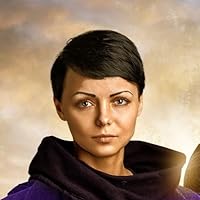
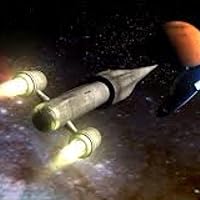
For the first time in his life, roboticist Casmir Dabrowski is headed to another star system as an advisor for the Kingdom space fleet. He’s being given a chance to prove himself to King Jager by helping find the ancient artifact he inadvertently lost. It’s best not to think about what might happen if he fails...
But with technologically advanced astroshamans after the artifact, not to mention the deadly mercenary captain Tenebris Rache, it’s not long before the mission collides with disaster.
Soon, Casmir and his friends are caught between warring factions, and he must choose between what the king would want and what he knows is right.
Disclaimer: although we’ve never actually met, I totally adore Lindsay Buroker. I’ve read everything else she’s written, in all their varied genres, and loved them all. That’s certainly true of the Star Kingdom series, and most definitely true of Crossfire (Book 4). Roboticist Casmir Dabrowski and friends may indeed be caught between warring factions, but never fear, they’ll figure something out - and it will be spectacular. But for the fact that I’m literally dictating this review to my husband from my hospital bed I could go on and on with praises. The book definitely deserves it. Since I can’t do that I will simply note that the book is most definitely one to read, and it is easy to highly recommend. I’m definitely looking forward to the next book in this series.
I read the whole series in one fell swoop; I was unable to pause since the unfolding of events kept me glued to the page. So since it is difficult to remember what happened exactly in each book, instead of writing a "traditional" review for each installment I decided to take a thematic/topical approach to some of the underlying questions Lindsay Buroker touches on in this series.
Since the nature of the relationship/connection between Casmir and Rache is revealed early on in a scene reminiscent of the iconic "I am your father" moment in The Empire Strikes Back, I would like to start with the nature vs nurture debate, and I feel that Buroker comes down strongly on the side of nurture.
Casmir (the, or one of the, main protagonists) and Rache (one of the main antagonists, though his role is rather ambiguous) are genetically identical, but whereas Casmir suffers from various ailments and is physically unimposing, Rache’s genes have been "cleaned up" and he has turned his body into a supreme fighting machine. Casmir grew up in a middle class family with his two academic adoptive parents who were always supportive of him, but also let him fight his own battles, and as a sickly and scrawny kid he learnt early on to rely on his wits and to defuse potentially violent situations with his self-depricating humor. At one point his being bullied is equated with "adversity" in his formative years and it is argued that this childhood experience is what makes him such a superior problem solver. While I wouldn’t argue that point, I would disagree with calling it "adversity". Aside from his health issues and the bullying he really had almost the best upbringing imaginable: two loving parents, a stable home and community, no economic worries and he was free to pursue whatever career path he wished. Rache, on the other hand, was the ward of an aristocratic family, about whom we don’t learn much, except that while not cruel, they were always distant. From the beginning there is enormous pressure on him to become a knight and to excel at every subject in order to be formed into the man (myth) that his genes seem to have him pre-ordained for. Not entirely unexpectedly he rebels at one point, but that rebellion is squashed in the most horrifying manner. But Rache is not subdued, and instead embarks on a path of vengeance that seems to have his self-destruction as the ultimate outcome. So, despite Rache’s priviledged background, his physcial advantages, his combat training and military instruction I would argue that as far as upbringing/the nurture side is concerned, Casmir actually has all (or at least most of) the advantage. When they first meet that is not readily apparent. Casmir is on the run, with practically no resources, only one friend, few allies and no clue what is really going on. The only thing he has are his skills and his affable nature. Rache, while plotting towards his ultimate goal, works as a mercenary, who is equally sought-after and feared. But when he first claps eyes on Casmir he is quick to grasp the ramifications of what it means that there is another being that is identical to him, so he lets him go. During the series Casmir and Rache cross paths many times, and despite the fact that the advantages in each encounter seem to be on Rache’s side, Casmir somehow not only manages to come out on top in their skirmishes, but Rache finds himself helping Casmir more often than not, even if events run counter to his own plans.
On a secondary level the nature vs nurture debate is also reflected in the divergent developments of the crushers. The crushers are nearly indestructible robots, designed by Casmir, first for the military and then adapted for his own protection, because of his lack of brawn. They are called Z-6000 (and from the design idea they are reminiscent of the Terminator T-1000 model), and although they all start out the same, over the course of the series (especially the latter books) they develop very different and distinct personalities, depending on their experiences, the input they receive, the people around them and how they are treated.
And in the end even Rache is changed by his "relationship" with Casmir and by his desire to find favor in the eyes of a complicated woman.
I would enjoy this series much more if the main characters were Kim and Rache. I know that the point exactly is that the geeky guy saves the day, but I just can't relate.
Not to mention the princess as the love interest is just so out there, and though nothing happened even in this book I can just see him getting her. There are more than one inside monologue that says that Casmir is not shallow, he wouldn't want someone just for how they look, but he likes the nurse because how she looks, and he is practically in love with the princess after two five-minute chats. Yeah, he is so not shallow.
Even though I love the Rache - Kim thread, there is just not enough of that for me to go on with this series and that just makes me sad. I wanted to find out how they would end up together. Because I'm guessing that's where the story is going.
Casmir and Kim on another flight in space. Almost all the usual people are there. Lindsay Buroker left us with a bit of a cliff hanger and that makes me a little frustrated.
I’ve thought, for a while, that I could like Rache and Ishii. This book with me closer to liking both of them. Asgar and Zee got ‘deeper’ with their personalities.
Overall, there’s a lot of moral complexity in this book and I really appreciated it.
I love this series and this novel didn't disappoint me at all! Inventive, fun, snarky and lots of adventure with unlikely heroes, and some reminders of unintended consequences. Looking forward to the next one.
Another will written space opera fantasy world 🌎 adventure thriller novel by Lindsay Buroker (Star 🌟 Kingdom book 4). A space opera with lots of twist, action, and violence as the team is involved in political events. There is lots of science stuff as the research goes on. I would recommend this series and author to 👍 readers of space Sci-Fi novels 👍🔰. Enjoy the adventure of reading or listening to books 📚. 2022 😤😯👒
As I’ve said before this series isn’t my typical preferred sub-genre but I got attached to the characters and it’s not toooo cheesy- great light, fun reading in between other stuff. Book five is on my Kindle and ready to go.
After finding this author I purchased her Dragon series. While enjoyable she has really grown as a story teller and this fourth book in this series did not disappoint. I’m hooked and can’t await the next book in September. I read this one in a day! Brilliant.
Good reading, great storytelling, author has a rye sense of humor and a gift for the appropriate quip. The characters are clearly drawn and have evolved throughout the series. Author has written “Steam-punk”, Fantasy and Sci-fi, all good. I like the space opera series’ the must, try them you’ll like them.
and working toward a "clash between the good and the bad". Good description of developing human relations and a nice touch of humor. No hard cliffhangers, although the books can definitely not be seen as standalone reads. And a certain captain cosying up to a certain roboticist . . nice turn of events . .
I always assume that each time I pick up one of Lindsay Buroker's books, it will be a very pleasurable read. This one is no exception. Totally enjoyable and touching all at the same time. I'm never disappointed and don't believe anyone else will be either. I recommend everyone needs to read them all!
Characters are interesting, their interactions are amusing and enthralling, politics is fun ( a critique of the pros and cons of a monarchy included) The cliffhanger finish always enjoyably annoying, lol. Who will end up running the system , I am tipping Casmir, with Rache/David as his peacekeeper
Action packed series with good character development!
Multiple storylines and great action holds your attention in this book. Casmir learns that naivity and good good intentions can have both good an bad results. Kim and Rache are growing closer. Bonita and Qui learn dealing with pirates can be dangerous. I look forward the next book.
I LOVE this series! Our intrepid roboticist rides again! Casmir, Kim, and Rache are wonderful characters. The plots are fun and interesting with lots of exciting action. I can hardly wait to see what happens next!
Throughout this series, the characters have driven the narrative, easing you into an affectionate familiarity with their quirky personalities and reasoning. Great storytelling at its best!
I find myself slowing my pace when reading cause I don't want to finish too quickly. Once again I am caught up with an empty feeling . Can't wait till September ,
Crossfire was just as exciting as the other books in this series! The plot was well thought out and kept me interested the whole time! So glad most of the major characters were included and are continually evolving! Looking forward to the next book!
This series is so full of people with issues to overcome and action packed events! It is fun to read about the characters and the story is great! Can not wait until the next book is out in September!!
I am really loving this series! It's well written and the MC's are interesting and complex. I could see it being a movie series, as long as it was done correctly. I look forward to the next story!
Casmir Dabrowski is sent to hunt down the spaceship he hid to prove his loyalty to the king. He knows he owes his loyalty to his kingdom, but as he sees how they're trying to gain more power across the galaxy, he can't help but feel he's on the wrong side. --------------------------------------------------- 3.5 stars rounded up to 4 stars
Overall, I enjoyed this book a lot, but I wasn't a big fan of how much time was spent on the romance buildup? It overtook the plot and felt a little unnecessary at times.
I really like Casmir's slow disillusionment with the kingdom's propaganda as he experiences more of the world. I just don't understand why he keeps repeating the same points over and over again. He goes "this is a little fucked but my family lives in the kingdom so there's nothing I can do but small acts of rebellion." It was fine the first couple of books but I don't get why Casmir isn't evolving.
The side characters weren't as well done? They didn't really grow and kept repeating the same plot points.
I wasn't a fan of the romances? Some of them just felt shoved in to pair off all the characters, like Casmir/Princess and Asgar/Qin. Those two pairings only had a handful of interactions and felt very superficial and tacked on. Tenebris Rache and Kim made more sense and felt natural to the narrative. That's the only romance I'm enjoying so far?
I love the interactions and dynamics between characters but the romances didn't work for me. I was annoyed when Casmir flirted with the princess/daydreamed and indifferent with Qin's and Asgar's random wondering about what the other was doing but not interacting with each other. Those romances just didn't make sense and weren't necessary.
I like how the overarching mystery developed even more but I wish there were more answers about the worldbuilding. It hasn't been fleshed out and it's a little wishy-washy.
I didn't like how Buroker soften Qin's history. I hate it when authors switch the language they use when describing sexual abuse. In the first couple of books, Buroker used the word rape frequently when describing the sexual abuse Qin went through from the age of 12 onwards but in this book Buroker changed it to sex and soften what happened a little bit. I get that the the word rape/sexual assault can make people uncomfortable in a campy scifi space opera like this one, but it was horrific what happened and Buroker made that apparent of the character's history. You can't retrospectively soften what happened.
Overall a fun addition to the series but I'm going to see how well I like the next one to see if I'll continue. This book left me feeling mixed.
I just listened to the audiobook yesterday (after awaiting it anxiously) and I have to say it is the first book that has made me literally LOL in a long time. It also made me cry and it also made me ridiculously happy.
I have noted in the past that Buroker's characters are pretty formulaic across all her books, and this opinion hasn't changed considerably, but the emotional depth and world building carried me past all that. Some might argue that there is not enough detail in the world building, but I would counter by saying that it's intelligent writing not to explain how things work all the time. Like our own world, things work because they work regardless of whether we know the reason. And there is nothing in the proposed scientific developments that would make me scoff. The caveat being that I am not any kind of scientist.
In fact, the only thing about the entire series that really makes me ponder is how Casmir's (apparently Jewish) religion handles any incongruency between Judaism as we know it and the advent of space colonisation. But that's not something I need to know, and there are worse tricks up an author's sleeve than to leave someone wondering about something so tangential to the main narrative.
Something I really like about this series is the rawness of it. The believability. The pirates are a-holes rather than loveable scamps. Slavery and human rights issues are frequently discussed. Politics and morality and other actually quite heavy topics are all covered within the weave of this tale, but you're not left feeling judged or lacking or even remotely bored. You're also not left feeling like the characters are paragons of virtue or superhuman abilities. They swear. They puke. They naively believe that their actions will not become regrettable. I LIKE that Casmir doesnt have a Starcrestian prescience.
As much as I relate to Kim Sato, I am quite sure that I could babble at a Casmirian level of enthusiasm for quite a bit longer, but I shall leave it at that.
I’m truly loving my journey in the Star Kingdom series. “Crossfire” truly helped to give more clarity to the plot and for future installments.
This time Captain Bonita has nanobot surgery to repair her aching knees. Then she and Qin embark on a mission to but Qin’s freedom. They run into an unsavory characters named Johnny twelve toes and he seems to think he is a debonair booty call for the Captain.
Meanwhile, the King has sent Casmir , Kim and Asgar back onto Captain Iishi ship to locate the missing pieces of the gate. They have located one of the robots from the ship, Tork and Casmir has rehabilitated him into helping locate the gate. See and Tork strike up an unlikely friendship. Casmir has also developed a keen interest in the princess. He attempts to assist her with a bee pollination project.
Of course Rache is one step ahead of the King’s fleet and has figured out where the gate has been taken. As everyone converges to the location they stumble into civil war on the planets surface. Dr. Yas is horrified because his parents are on the planet and Kim is equally distressed because one of her colleagues has been taken as a hostage.
Of Casmir, Kim, Aagar, Iishi are to survive and rescue their friends they will need to team up with an unlikely ally, Rache. However, the one thing they can truly agree upon is that they all are beginning to question the true motives of their King.
As usual, this read has a lot going on. I just love the way the robots are developing personalities of their own and ho Casmir champions their cause. Kim and Rache are developing more interests between them but distance keeps them apart. Qin and Bonita’s story leaves us with a cliffhanger and I can wait to see how it is resolved. Who knew such a quirky series could be so very entertaining!
This is the fourth book in the Star Kingdom series. I do not recommend it as a standalone, the series should be read in order. I enjoyed the humor in the story as well as the budding romance. I’m not sure how I felt about the Qin and Bonita cliffhanger. The author continues to develop the characters and gives them their own story lines. The characters are interesting. The author writes characters that are realistic. They have flaws and a good side whether they are the hero or the villain with a few exceptions. Lindsay Buroker is an auto-buy for me. The story is multi-faceted and raises several questions and opens several plot lines. Because it is part of a series, each book answers some of the questions raised until the finale. I enjoy the vocabulary used by the author. She uses interesting words in her writing. I also enjoy the richness of her stories. For example, if you look up the meaning of Tenebris Rache, it adds to the story.I have already purchased the next book in the series.