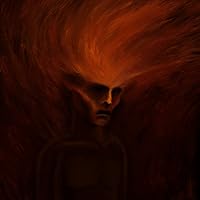
A missing tech mogul... a jaded reporter... a damaged AI returned from a horrifying reality... and something lurking in the woods.
When journalist Den Secord is tasked with locating enigmatic tech guru Gregor Makarios, he soon finds his understanding of reality under threat. At the edge of the world, surrounded by primeval forests, in the paradisical environs of Gregor's hi-tech hermitage, Den learns of the true nature of our Universe.
This is the way the world ends.
Heart of Darkness meets The Magus meets bleeding-edge psychedelic gnosticism in Stonefish, the debut novel from Scott R. Jones (When Stars Are Right, Shout Kill Revel Repeat).
The first book I read this year has electric sasquatch induced existential terror and goddamn frog bridges and extended poop metaphors and is, for the most part, an insane delight. Somehow, it's also a book without many surprises (okay, maybe one), and, in fact, it sort of tells you exactly what you're dealing with very early on, but that's not necessarily a negative because it's more about exactly how these moments are presented and how the situation (a near-future nested mirror of our world) is raged against that's so engaging (and sometimes genuinely alarming). And you're working with capital "D" dread here, meaning you know what's coming, and you know it's going to be bad, and if you dig that sort of thing (me! me!), then this book's got you covered. The structure is fascinating, too. Once the protagonist gets to the woods (sort of) to find the requisite eccentric recluse (sort of) and get his story (which itself is a flashback), the book fractures into a series of expository moments, framed as "interviews," but they're really more like extended conversations, something I very much enjoy, maybe to a fault. But this doesn't feel like a cheat because the story is bookended with the protag telling this story of a story of a story already. There are some noir tropes here, but also some heightened language and technology, contrasting the piles of theory with some more "lowbrow" funnies (some hilarious zingers throughout). So if it seems like it devolves into a highlight reel with the extended jawing at the end, this is likely exactly how a rattled-to-the-core secondhand narrative would probably unspool? Bonus points for the chapter laying out (much clearer than I've been able to) what a good Matrix sequel would have looked like (Joey Pants reference for the win). In a nutshell, this sort of Stalker meets Ex Machina freak-out that's more Ligotti (and "Dick," Phillip K's) than Lovecraft gifts us many wildly disturbing descriptions of hideous holographic manifestations and a perfect scatological rationale for our existence. "Do you give a shit?" it asks us, literally. Yes. Yes, I do. And by that I mean no. Wait.
For reasons I can’t really explain just yet I have been really distracted the last couple of weeks so I apologize in advance if this review is not as detailed as I normally like to be. That out of the way lets talk about Stonefish. The author Scott Jones was a guest on Dickheads when we broke down the PKD novel The Zap Gun. At the time my co-host Anthony Trevino declared Stonefish not only a Dick-like suggestion but one of his favorite reads of the year. He was so assured I would like it that he gave me a copy. So yeah Thank you, Anthony.
Stonefish is written by Scott R. Jones who is well known in Lovecraftian circles having written about Howie in both fiction and non-fiction. If you have to define Stonefish you might say bizarro, as it is super strange and surreal at times, it is very Science Fiction in gonzo 60s new wave that reminded me not just of PKD although he is clearly an influence. Fans of John Shirley and even a little Rudy Rucker will be pleased. At the same time Stonefish walks that thin line where the horror and Sci-fi novel gets blurred in a way that John Brunner was a master at.
Stonefish was published by Ross Lockheart’s indie press Word Horde. This company has set a very high watermark and the quality almost never fails. It is the type of book that the big houses in New York wouldn’t touch or understand. In the 60s it took really out there thinkers like your Don Wollheim and Malzbergs reading the slush piles to find homes for books like these.
Those were physically thin but also thin on characters and deep prose. Don’t get me wrong I love that stuff but for every Dune or Canticle for Lebowitz, there were 100 space pirate books. Jones has created a super weird and creative novel that is overflowing with ideas and plenty of laugh-out-loud moments intentional humor. Plenty of “what the fuck am I reading” moments that those of us who love the weird crave.
The story follows journalist Den Second as he investigates a tech guru Gregor Makarios who disappeared into a psychedelic spiritually-minded virtual realm. Where else would a high-tech hermit live? In this unreal realm, Gregor explores the nature of reality and the meaning of life. Jones weaves traditional and experimental structure to tell the story through a series of visions and Den’s extensive interviews with Gregor.
What is reality? What does it mean to be human? How are we affecting the fabric of life? What is technology doing to the human being? Stonefish is full of questions. Gregor’s psychology becomes Scott Jones's path to a psychological deep dive into our human nature and the crossroads with grand and scary cosmic questions. For an author known for his Lovecraftian interests, this novel is more spiritually lined up with the questions pondered in the work of Philip K Dick.
The book includes gnostic Coprophilic Sasquatch Archons, they are online cryptid avatars for Gregor. They are probably the single weirdest thing in the book, even this virtual online world has developed its myths legends, and weird corners.
Weirder than most cyberpunk Stonefish is full of leather trench coats and Mirrorshades. This novel doesn’t have a Cyberpunk outfit but it has the beating heart of that genre.
My favorite moments happened on pages 186 and 87...
“Shit gets real. Shit is the real. Shit is the soft skin of Stonefish, the convincing layer that tells yes, yes, you’re here and it’s all happening, and you are part of it an ain’t life grand?”
And a page later he is one of the most important passages. This is Gregor speaking directly to the audience:
“You’re trying to make sense of this. Don’t … I can’t make sense of it for you, either, so don’t ask. Stories, though! Stories I can tell.”
Is it dismissive to say this novel is about our relationship to reality? Such an important question why not ask it as many times as we can. Stonefish was a treat, a weird off-putting, and times hilarious trip. I am sold on Scott Jones as a writer so here is hoping for more. Read Stonefish for sure.
This is not a novel of the Lovecraft Mythos, though some of the literary DNA is evident. It is that baroque quality of transcendental weird fiction, written with the intensity of an initiation, science fiction with the bite not of grimy reality but of the promise to pull back the veil on how things really work...and maybe not everybody is ready for such a sight.
Readers familiar with Cody Goodfellow, Brian Keene, Warren Ellis, Paul di Filippo, Samuel R. Delaney, Cory Doctorow, and Robert Anton Wilson will find the tempo of this novel pretty quick; folks who are more used to generic science fiction, fantasy, and weird fiction might have a harder time finding the groove. The novel hits a sweet spot where the ideas are pitched at the reader quickly, but it never descends into complete flight from reality. For a subject that could go absolutely Alejandro Jodowrosky or David Cronenberg, Jones aims for a middle ground, not looking to score readers with easy titillation or false revelations, horror porn or pretentious mystical crap.
All of which touches on the feel of the book, but not necessarily the content. The plot in this one should remain a mystery. Go into it blind. Let yourself be surprised. It probably isn't going to change your life or your mind any more than any other book you've ever read, but if you haven't burnt out on questioning the nature of reality...if you've got any spark in your soul that can still look at something as mundane as a twig and imagine it having once been (and maybe still be) part of something greater...then do yourself a favor and pick up STONEFISH without the usual expectations that you know what's going to happen before it does. Let it lead you a little way.
Scott R. Jones has written a stand-alone novel, one with a meticulously crafted setting and flowing, seemingly-effortless dialogue that combine to create an immersive experience, once which drew me into the world of Den and Makarios, the skin of the Stonefish, and held me there—holds me there, still. It is rare, when I encounter a story that affects my thinking so profoundly that I find my thoughts wandering back to it days later, unable to move on to another book, to complete mundane daily tasks, without straying back to the deep psychological gutting, the wounds still leaking fresh trauma, and tracing that puckered flesh with fond remembrance.
The setting of Stonefish captured me immediately, with a level of detail and precision that I would expect from a naturalist. I live on the coast of northern California, surrounded by towering forests of redwood and sequoia, with the town of Willow Creek (known for its devotion to the local legend of Bigfoot) only an hour inland. I was transported in time to a very believable future, in which the planet’s decline has resulted in rising tides and thinning of the forests, with fungi heavily populating the dying trees and the more resilient, prehistoric ferns persisting, as the heat drives more fragile organisms to extinction. Jones’ imagery is breath-taking at times, futuristic architecture overgrown with mosses and lichen, manufactured totems posing as original historical objects, the mimicry of wood indetectable to someone like Den, whose previous exposure to the natural world is all but non-existent in a modern age of technological immersion. Jones’ attention to detail is crucial to contructing a world which is, in itself, a simulation, assembling the setting piece by piece so that, when the blindfold is finally removed, the effect of everything falling to pieces is that much more destabilizing.
The characters of “Stonefish” also possess a multi-layered depth, whether they are central or minor characters. Jones has a special talent for names that stick. Makarios? Excellent. The man is in his sixties, physically fit, and charismatic. The descriptions of his constant hand movements and air quotes bring the personality of Makarios to life, as does the repeated reference to objects, media, or sayings that “date” the man and emphasize the generation gap between Makarios and the much-younger Den, who is often left scratching his head in confusion. As a character, Makarios is intense, complex, intelligent, and broken. He possesses a sense of humor that frequently caught me by surprise, but this lapses with melancholy and exhaustion, the end result being an emotionally erratic man existing with a crushing knowledge of reality. Makarios is also a victim of torture at the hands of the Archons, a form of torture which I found both unexpected and uniquely heart-wrenching. He is courageous, beyond comprehension. And always, through the many enlightening moments that Gregor Makarios shares with the Den, the man is sorry. I would read this book again, if only to spend more time with Gregor Makarios.
Den is also a very well-written, developed character, occupying the dubious middle ground between disbelief and conviction. He serves as an excellent foil for Makarios’ character, and his constant questioning and responses to the truths unraveling around him guide the story’s progress. I was very impressed by how seamlessly Den’s narrative carried me through the gaps in time between present and past. His inserted commentary never felt forced, as though something needed to be explained. Rather, it contributed to the overall presentation of his character as a reporter, his ultimate goal to convey his experiences in a concise, understandable package to anyone who might read the fruit of his labors. I pitied Den. The process through which Jones uses Makarios and the Archons to enlighten Den is a painful one, and in the end, I wasn’t sure what fate I wished upon Den—what would be a more merciful outcome.
Li’l Dougie. If you had asked me a week ago if I’d ever form an attachment to a chronic masturbator, I’d have laughed you off. Now, I’d probably shed a tear. He will never stop jerking it. Bichael—the guy who always looks the same every time you see him, always on a bike, always going somewhere, never stopping. The Archons, with names like “Mandibole”, “Babayoko”, and “Ol’ Dirty Bastard”. Charlie Mack, with her intelligence and spunk, reclaiming lost languages and visiting with the ghosts of her ancestors. Each character, however briefly mentioned, leaves a lasting impression.
The horror. Jones allows it to creep steadily into the plot from the beginning, an unsettling paranoia that builds throughout the story. Black-eyed, sharp-toothed landotters, massive, elusive sasquatch, flesh-manipulating Archons—a parade of creatures walking the fine line between legend and reality, between reality and the “outside”. When the real horror begins, it is unrelenting. Jones writes gore with the twisted expertise of authors like Nick Cutter and Nathan Ballingrud. I could see it, feel it, sink my hands into the pulsing, pulpy mess and withdraw them, red and glistening. If a perfect blend of shit, blood, and adrenaline exists, Jones has tapped that source. On the heels of that gore comes a sensory deprivation that is equally terrifying. Everything is stripped away. Read this book. Try to walk away unchanged. It’s a powerful venom, and the sting is deep.
Any imperfections in this novel are more than offset by the abundant narrative energy and the raging flood of ideas. This won't be for everyone, but you read the synopsis and thought, "Hmm, sounds interesting," you'll probably love it. On the other hand, this isn't your mainstream, plot-driven narrative. I love to see a writer go for broke and empty their brain out onto every page, and Jones has done that here.
Ohh this book! We have been duscussing this book for the Otherland Speculative Fiction Book Club since yesterday and it's the only book we have been discussing for more than a day and there's no end in sight. Even though they're mostly babblings of a batshit insane person, every single sentence can and should be read carefully and taken apart to induce hours-long philosophizing. Why is Gregor batshit crazy, though? There are scenes in this book that will stay with me forever to attend my worst nightmares. Really, really effective writing, I shall read it again.
Well done, but kind of a downer. Weird, you’d think Gnostic world-hating cryptid horror would be a cheerier read, you know?
I think this coulda benefited from being a good bit longer, really. But he wanted to do his Heart of Darkness cryptid-hunt in post enviro-collapse PNW and that's all he wanted to do with it.
"The sky was a mobile slab of burnished slate, marbled with sunlight and shadow like a cut of old meat gone off."
This book wasn't what I expected at all. It was much darker and way weirder and I mean those in the best way possible. At no point was I able to predict where it was going. It was hard for me to get my head around how you'd even go about writing the story.
I read a lot and much of what I read kind of just goes by the wayside of my mind. I keep thinking about this one, though. Again, very much a compliment.
Safe to say, I enjoyed the hell out of Stonefish and if you like weird fiction (Lovecraft, Barron, etc) you should give it a read.
This book is amazing. Jones pens a landscape that pulls you into the hard skin of the Stonefish. A mix of cosmic horror, cyberpunk and lovecraftian events drops you into a void of pure madness, and clever dialogue and a smooth style. Highly Recommend!
There’s body horror, and then there’s THIS. So much more subtle, so much more unnverving. TFW when you in the noönet. 7.5/10.
Highlights: The incredibly convincing near-future that reflects today’s ideas and realities is such a contrast to the Blade Runners and Jetsons of the past. The story of Lil Dougie is incredibly unnerving, and in my opinion the best horror this book has to offer.
Passes the Bechdel Test?: Yes! Not with flying colors, but it also doesn’t get by on technicalities alone.
EDIT: After a while, I'm bumping this up another star to 8.5/10. This is STILL the most unique horror I've ever read, and so so relevant. I think about various facets of this book ALL the time. So it's definitely lasting.
This was a harder uphill climb to get into for me than I realized--the premise was intriguing to me and sounded like a lot on its own, but adding in a lot of near-future scifi faff that I personally find off-putting made it even more overstuffed. Once you get into it, all of that is explicitly stripped away except for a couple of somewhat cringe contemporary references, and you get what you came for. Unfortunately, the good stuff is done in overall by a fatal combination. There's not really a story here; instead, it's a loosely structured expository monologue. That monologue is often fun, though it's delivered with some occasionally irksome tics, but the content, and the degree to which the text supports that content, is incompatible with the kind of horror story this otherwise ought to be. The horror imagery and worldbuilding Jones has created is genuinely cool and exciting, but we never get to experience it as if it matters, on its own merits, because it's always presented as an illustration of some far more trite idea Gregor Makarios has already boxed it into. His gods feel less like an intrusion, an event of historical import, than actors in a play summoned to vindicate not just his religion but his personal attitudes toward it. That sense of self-indulgent, self-pitying anthropocentrism is always a pitfall in cosmic horror, but the way Jones structures this book faceplants right into it.
I have no idea what the author was trying to say. It may be that I’m just not smart enough to understand the point of this book. The effort I put into reading this was not rewarded
Jones summons forth abstruse theology in the language of dystopian thriller, creating the thinking person’s visceral cosmic dread.
Years ago, tech mogul and futurist guru Gregor Makarios disappeared completely from public record. However, Den Secord, a journalist for a minor virtual reality publication, finds a fragment that somehow escaped the purge. Following a hunch that Makarios has returned to his teenage obsession with cryptids, Den travels to the northern edge of civilisation. There he finds his instincts were both right and entirely wrong. He has his story, but can he face sharing it with the world?
Jones utilises the framing mechanic of Den writing his thoughts and experiences after his investigation is over, and cutting in short pieces he wrote after some of the events. Thus it is never in doubt that Den survives or finds something significant. However, Den does not immediately confirm what that something is. While both confirmation of survival and hinting at revelation can be irritating if mishandled, Jones uses them to create a dramatic irony in the reader’s mind that imbue events with a tension at odds with the mundane calm of contemporaneous descriptions rather than to assure or tease the reader. The format of baiting lede followed by building to conclusion also mirrors that of an article, supporting the characterisation of Den as a journalist.
The story is set in some near future when artificial intelligence and virtual reality have been created but civilisation has collapsed inward into online interaction and genteel decay rather than surging upwards into a bright technological future, a world where journalists use Ganzfeld tanks to imbue articles with sensory experience rather than writing them. This presents as two parts separation from our roots to one part satire of modern tech entrepreneurship.
Jones’ skilfully portrays the isolation of a society that has immersed itself in technology: pervasive virtual reality has made it easier to meet people or experience events online; and advances in materials technology have allowed decaying sites of significance to be replaced by self-repairing “ruins” that are identical to the senses. Thus, the reader unconsciously feels part of a world that isn’t real. This creates a powerful sense of dread yet denies the reader a specific problem to hang their dread upon; a sense that amplifies the natural human uncertainty of the wilderness outside civilisation where much of Den’s search occurs.
The allusions to current tech entrepreneurs are likely to divide readers. Thinly veiled references to famous eccentric businesspeople on the cutting edge do both provide a counterpoint to the growing horror that enhances by contrast, and add an archness to the narrative that fits the superficiality and fluidity of a world lived in simulated experiences. However, Jones appears to divide real-world character into more than one fictional analogy; thus, some readers might find their immersion broken by dissonance between their identification of a fictional character with a real person and that fictional character not being the one who performed a well-known part of the real person’s life story.
While this novel is centred on the psychological experience of reality not being as one thought, Jones does not shy away from the physical. Instead, the visceral is another feed of data, presented with the same hyperreality as simulation. This both grounds the more philosophical aspects firmly in reality and undercuts the unconscious certainty that our bodies are an anchor. However, it does also add a body horror element that might not be to every reader’s taste.
Jones’ evocation of vast and alien beings outside our own illusion of significance is superb, allowing the reader to experience rather than merely intellectually know the central truth of gnosticism. Whether this will also resonate with fans of cosmic horror is likely to depend on how strongly they crave incomprehensibility and indifference in their Outer Gods.
Den is a sympathetic narrator. Both his immersion in a society where uber-rich tech moguls can do amazing things easily and his curiosity as a journalist make it extremely plausible that he ignores his own growing uncertainty in favour of getting the story. In addition to allowing Jones to take the reader deeper into the inhuman, this slowly builds a sense of acceptance that verges seamlessly into complicity with the inhuman.
While a clear eidolon of Reclusive Futurist Guru, Makarios is also a nuanced character struggling with his connection to Other, and his conflicting drives to seek human company and spare others the same exposure he has.
Overall, I enjoyed this book greatly. I recommend it to readers seeking horror that avoids indescribability without losing mystery.
I received a free copy from the publisher with a request for a fair review.
This book stares into the face of cosmic horror. The cosmos blinks first.
(This is a repeat of my Amazon review!)
Reviewed in Canada on February 11, 2021
An investigative journalist who searches for what he thought was a scoop, and which quickly unfolds to become so much more than he bargained for.
When the journalist, Den, finds Gregor, the reclusive tech mogul everyone has been looking for, the book shifts gears and starts to really dig into the slow dread it's built up to this point The interaction between the two of them, as well as some other entities, is powerfully written and compelling.
I won't give too much away, but the progression of ideas Den and Gregor discuss, coupled with the unsettling implications of what those ideas could mean in reality... this is the kind of work that walks right up to what other cosmic horror stories might leave vague. And then it talks with what it finds on the other side. And builds things with them.
Jones deftly avoids being only an 'ideas' book, of characters just talking and philosophizing. He takes those conversations and extrapolates some truly terrifying realities. Often, this means that this book is excellent and compelling, but also difficult, as you let the ideas and implications roll around in your head. That said, the difficulty didn't reduce the momentum I brought to reading it, which only built up more to the intense conclusion of the story.
The book is also a challenge, because there were parts of me that wanted to join the chat with Den and Gregor, wanting to offer another idea or interpretation. I can't remember the last time I wanted to debate a book, or at least a book that I was also loving the whole way through.
Jones has written a novel that melds so many of it's inspirations into a wholly new thing. It is both a novel, literally, and it is a novel interpretation of the concepts. I'm glad I read it. You should read it too!
I read a lot of science fiction. It's rare for me to find a sci-fi book that I find to be genuinely disturbing, but this one was. There are large parts where nothing much is happening, which means when the author decides to reveal his ideas, it hits hard. Most people would probably take this as a recommendation, but I don't mean it that way.
This book is a modern day reinterpretation of Gnosticism. I'm not sure how seriously the author takes these ideas. I note he has another book that purports to be a more serious take on the subject(that I haven't read), which seems to indicate that he may think these ideas are a going concern. If that's the case this book is a modern anti-Brothers Karamazov. Brothers Karamazov is a powerful novel because it puts forward a certain world view particularly well. This book puts forward a world view almost completely 180 degrees from that. I don't think that world view is enjoyable to consider, and I also reject it, so I give this novel 2 stars. However, I admit that the author is a good writer, and gets his point across in an impactful way. Some people who don't take it too seriously might enjoy it, and some people who do take it seriously but agree with it will love it. I personally didn't enjoy and don't recommend.
To me, this is a great book. But like many great works of vision, it is imperfect. Like the result of a mind struggling to correlate all of its contents. Some of it doesn't seem to go anywhere, some strange unresolved hints will frustrate the reader, but still, I think this is cosmic, philosophical "horror" of the best kind, because it makes horror itself feel laughable, and doesn't rely on pure fantasy to convey its nihilism. Like, it is fantastic and imaginative, but also...scarily plausible. The Black Gnosis indeed.
And it's funny. Lots of poop and jerkin' it jokes. The fact that this manages to not feel juvenile with those elements, is impressive to me.
Stonefish is an intelligent, original horror/sci-fi blend featuring a mentally deficit AI, inter-dimensional Sasquatches, and a fair bit of pooping and masturbation. What is done to the bear is unforgettable, and the creation of the frog bridge is another extremely dark moment. Who is mad, who is sane, what is the nature of memory, what is reality, and who controls it all?
Disclaimer; I was given a copy of this book by the author in exchange for an unbiased review.
I'll have more of a review soon, but for now...holy crap is this book a mindf*ck! I mean this thing goes some places and is not afraid to make you question literally everything. There are a lot of concepts and ideas packed into this, some so wild that they actually make sense. Plus by the end of this you'll start to realize that we really don't want to see Bigfoot.
The book has some interesting ideas, and a few genuinely unsettling moments, but over all it never 100% meshed for me.
Like for example, the metaphor of the titular stonefish: The story starts introducing its Lovecraftian horrors that are lurking Out There. Inhabiting our world, but going unseen, and you think “Ah, I get it. They hide by blending in with reality the way a stonefish blends in with the ocean floor. Right in front of us, but unable to be perceived because our simple little fish brains lack the capacity to process them.” A nice, straightforward analogy.
But that’s not what the analogy is; and even after reading the whole book, I couldn’t say for sure what the actual analogy is intended to be. It’s something like EVERYTHING is the stonefish, and we live on its back? But also it’s gross and can sting you?
I don’t quite get it. And there’s a lot of little things like that in the book that keep me from getting completely on board with everything.
But like I said, there are plenty of individual scenes and ideas that work pretty well too, and for the most part are enough to keep the book interesting. If you like cosmetic horror, give it a shot.
Update 07/20/2023: Adding an extra star to my review because two years later I still think about this book regularly and if that isn't the sign of an interesting book I don't know what is.
This entire review has been hidden because of spoilers.
Scott R. Jones’ writing is assured, evocative, and compelling. Stonefish is a wild ride. It lures you in with Coprophilic Sasquatch Archons, and before you know it you’ve been swallowed, digested, and excreted, passed through a fine mesh strainer. Transformed and ready to spread the good news. Enlightenment ain’t pretty, and everybody hungry, so buy this book.
Kind of went off the trails for me a bit in the latter half, but overall a fun, neat book with some unusual ideas. Looking forward to checking more of his work!
I had this review brewing in me the whole time I read this book, but now I realize there’s nothing to say but...read it. One of the most original, page turning and thought provoking novels I have read during a lifetime of reading.
I got this a while back as part of Word Horde's horror bundle, and had been seeing some positive buzz online, so I decided to check it out. Overall I found it to be a very engaging read. There's plenty of weirdness here, with a great mix of thought-provoking philosophical sci-fi and humor in the form of bigfoot and poop jokes.
As much as I enjoyed it, there were a few issues that kept it from being a full 4 or 5 star read:
-A few moments of cultural insensitivity that didn't add to the overall story. These were few and far between, but when the odd unnecessary slur or moment of cultural appropriation came up out-of-nowhere, it was uncomfortable. Kind of a bummer to see in a book that was otherwise very enjoyable.
-A science fiction world that doesn't always serve the story or feel completely developed. It takes place around half a century in the future, but people still talk and meme in ways that feel so contemporary it strains credibility. The noönet concept itself feels like a natural extension of the pervasive hellishness of social media, but in the end I was confused about what it had to do with the overall story -- it seemed we were being set up for this technology to play a more pivotal role in the plot. The crèche the narrator lives in also seemed like it was supposed to be some kind of social commentary, but ultimately I couldn't tell what it was supposed to mean.
-A protagonist who serves mostly as a vessel witness to the weirdness. I wished I'd had just a little more information about his life and personality. Having a greater sense of empathy for him would have made this a much more impactful story.
-The overall structure and inconsistent chapter lengths/formats made it harder to read. I would have loved shorter, more focused chapters. The way they were organized made it especially hard to read on a Kindle.
All this being said, I really enjoyed this. I'd definitely recommend this if you enjoy weird sci-fi/horror and would absolutely read more from this author. FFO: bigfoot, cyberpunk, the films of Alex Garland
A very unique book that I'll be thinking about for a long time.
This is another book that I picked by the cover and the back jacket description.
It feels like it has all the elements of a book that I would like but it just didn't keep my attention or investment in the story.
Feels like the author wanted the shock and awe factor of Chuck Palahniuk and the style and themes of Vonnegut but just failed all together.
After reading it I can't even tell you what it is about??? SHIT?
At first it felt promising, but by the end I had to force myself through it. At the end I felt dumb for not 'getting it' but honestly I think that is just the book. Is there some big metaphor here that I missed?
Unfortunately, this didn’t live up to my expectations of Dread with a capital D, which I was really hoping for after seeing Stonefish compared to Negative Space so frequently.