Jump to ratings and reviews
Rate this book

Comme au cinéma

Rate this book
When war widow Irene Sandle goes to work in New Zealand’s tobacco fields in 1952, she hopes to start a new, independent life for herself and her daughter – but the tragic repercussions of her decision will resonate long after Irene has gone.

Each of Irene’s children carries the events of their childhood throughout their lives, played out against a backdrop of great change – new opportunities emerge for women, but social problems continue to hold many back. Headstrong Belinda becomes a successful filmmaker, but struggles to deal with her own family drama as her younger siblings are haunted by the past.

A sweeping saga covering half a century, this is a powerful exploration of family ties and heartbreaks, and of learning to live with the past

360 pages, Paperback

First published January 1, 2016

Loading...
Loading...

About the author

Fiona Kidman

47 books66 followers
Fiona Kidman is a leading contemporary novelist, short story writer and poet. Much of her fiction is focused on how outsiders navigate their way in narrowly conformist society. She has published a large and exciting range of fiction and poetry, and has worked as a librarian, producer and critic. Kidman has won numerous awards, and she has been the recipient of fellowships, grants and other significant honours, as well as being a consistent advocate for New Zealand writers and literature. She is the President of Honour for the New Zealand Book Council, and has been awarded an OBE and a Dame Companion of the New Zealand Order of Merit for her services to literature.

Ratings & Reviews

What do you think?
Rate this book

Friends & Following

Create a free account to discover what your friends think of this book!

Community Reviews

5 stars
76 (22%)
4 stars
145 (43%)
3 stars
93 (27%)
2 stars
17 (5%)
1 star
4 (1%)
Displaying 1 - 30 of 52 reviews
Profile Image for Lisa.
3,862 reviews497 followers
October 7, 2016
I love it when this happens: I started reading All Day at the Movies last night at about nine o’clock, fell asleep very late at night with the book over my nose, and didn’t get out of bed this morning till I finished the book at about eleven. It wasn’t that the novel is a page-turner; it was more that it was so utterly absorbing that I just didn’t want to put it aside.

Fiona Kidman DNZM OBE (b. 1940) is a prolific New Zealand novelist, poet, scriptwriter and short story author. She’s written more novels than are listed at her Wikipedia page, because (on the day I looked) the list doesn’t include The Infinite Air (2013, see my review) or this latest novel, All Day at the Movies (2016). With the possible exception of The Captive Wife (2005, which I loved but have not reviewed on this blog) I think it may be her best yet.

Beginning in the brutally conservative 1950s, the novel is constructed as a chain of interconnected stories, tracing the fortunes and secrets of a New Zealand family. Far from being the ‘golden age’ so often associated with the postwar period, this era was a difficult one for women. For Irene Sandle, widowed in the last year of the war, her only solace is the child born from Andrew’s last leave, but she lost a satisfying job at the library because in the 1950s there was no such thing as maternity leave.

When she went back to ask for her position after the birth, it had been filled. The land girls who had worked in the countryside came flocking after jobs in town. She did have a war widow’s pension after all, and a roof over her head, the head librarian explained. It wouldn’t be fair to take her back. That wasn’t exactly the point, because the roof was over her parents’ house. For a time that was all right, but it wasn’t any more. (p.18)

Chafing for freedom that she can’t have under her parents’ roof, Irene takes little Jessie with her to Motueka, where she finds work as a manual labourer on a tobacco farm.

To read the rest of my review please visit https://anzlitlovers.com/2016/10/07/a...
Profile Image for Kiwiflora.
920 reviews30 followers
February 12, 2017
Dame Fiona Kidman, what a national treasure this woman is. She writes fiction novels and short stories, poetry, memoirs – yes, more than one, film scripts. She has won numerous awards and fellowships for her writing, she has been involved in the publishing and advancement of all New Zealand writing and books. A true heroine of New Zealand publishing, but more importantly of telling the stories of women’s lives in this country. It seems to me that this latest book collectively takes all these past stories, including fragments from her own life story, seamlessly stitching them together into a moving, acutely observed chronicle of a family over a sixty year plus period.

There is history too in this novel, even if it is in the very recent past for many people in this country. Those of us around who remember, and may or may not have taken part in protests of the 1981 Springbok tour will recall it as a pretty traumatic, divisive time, even though it was only for 56 days. The tour has a prominent part to play in this book. Not so prominent but of equal import in the story and plot making are a variety of other events that were crucial to the times, if not necessarily so to the characters. For example, the 1951 Watersiders’ Strike, the death of Prime Minister Norman Kirk in 1974, the Ruth Richardson ‘Mother of All Budgets’ in 1991, United Women’s Convention of 1975, are just a few of the milestones that are peppered throughout this novel, and lend enormous authenticity to the characters, their actions and lives.

This novel is the story of a family, a family torn apart even before it had begun. A man dies during WWII leaving behind a pregnant wife, Irene. The story opens in 1952 with Irene and her now six year old daughter trying to start a new life with a tobacco picking job in Motueka. None of this goes to plan of course, and by the end of the first chapter, some thirty pages later, Irene has almost lost her daughter, found and lost a potential husband, been part of a horrible death, and in her shock, found herself an actual husband. And what a bad life choice that turned out to be. But what does one do – barely coping with one child, and a second child on the way. Irene was hardly unusual for her time, choosing to marry a man, Jock, making the best of what she saw as the best of a bad situation.

Tragedy strikes again some years later, with the death of Irene. Widowhood is indiscriminate in its choices. Little told are the stories of men widowed due to wives dying in childbirth or of illness, leaving them unable to cope with babies and young children. Enter the stepmother, who often started in the household as a housekeeper, or was a widowed friend, neighbour, or just a lonely woman who saw an opportunity to change her life. More often than not, totally ill-equipped to take on the care and upbringing of distraught grieving children not her own. Jock and his four children, Jessie, Belinda, Grant and Janice find themselves in this very situation. The new stepmother may be Charm by name, but certainly not by nature.

Life treats each of the four children differently in its unfolding of events over the years that follow, as the fallout of those early days takes hold, and never goes away. There is never any excuse for cruelty. Jock and Charm, really are the most awful pieces of work, making the lives of each of these children a total misery.

It is going to give too much of the plot away to say what happens to Jessie, Belinda, Grant and Janice. Suffice to say that collectively, there is teenage pregnancy, banishment, adoption, marriage, child sexual and physical abuse, racism and bigotry, what would probably be diagnosed now as dyslexia, depression and mental illness, domestic violence, drugs, imprisonment. Wow – you hooked now? You want to read this? A phenomenal amount of action packed into 318 pages! All against the backdrop of New Zealand’s ever changing social and political times.

It certainly is worth reading, if for nothing else than the documentation of change over the last sixty years or so in our society, and how attitudes have also changed. For example, to women working and having real careers, something that was almost unheard of in the 1970s; women having control over their reproduction, again only just getting underway in the 1970s; changes in attitude to unmarried mothers, teen mothers, adoption; to children with learning difficulties. Although I have my doubts if things would really have been any better for those children living with Jock and Charm under today’s Child, Youth and Family Service.

Admittedly the novel is a bit of a whirlwind. There are many potential plot lines that could be furthered explored and developed, many characters I would love to have known more about. But this is a minor criticism. The fact that I wanted to know more shows how engaged I was with the novel, with the characters, their lives, the decisions they make, what happens to them. Dame Fiona leaves no stone unturned in her telling, with a geographical reach as impressive as her social/historical reach – Hokianga, Auckland, Rotorua, Turangi, Wairarapa, Wellington, Motueka, South Canterbury, even as far out as the Campbell Islands. Her characters live in cities, farms, small towns. They are poor, middle class, protestant, catholic, successful career people, students, teachers, marginalized, academics, hairdressers. And this is the real beauty of this novel. She wants people to get on, to live and work together in harmony, empathy, understanding and kindness for each other. That despite our infinite variety in where we come from, how we live, we what do, we are essentially the same. It would be so easy for her to rail in anger and rage at the way women have had to fight for their equal place in our society, at the injustice served to those who don’t quite fit the traditional, conservative mould of much of New Zealand society in its short history. And yet she doesn’t. She quietly gets on with telling the stories of damaged people, always with an eye to things getting better, not reflecting or dwelling in the past, having those four children – Jessie, Belinda, Grant and Janice – constantly trying to make it right and do better for themselves. So, for two of them it doesn’t work out, which are the tragedies of this novel, as happens in many families, but in the last pages there is a reunion of sorts, realistically awkward, which does give hope for the future of this fractured family.

I truly hope you read this book, especially if you have lived through these times, have strong memories of what NZ society was once like, how things have changed for the better. Plus it is just such a great story. I loved it. Is this Dame Fiona's best book? I have no idea, but I certainly intend to read more of her so as to find out.
Profile Image for Marg.
377 reviews1 follower
December 10, 2016
A disappointing family saga. The characters are not particularly engaging and it weaves through NZ social history like it's ticking off boxes. I wanted to like it but in the end just didn't care.
Profile Image for Tripfiction.
2,112 reviews215 followers
March 8, 2018
Family saga set in NEW ZEALAND


The book opens with the story of Irene and her daughter, who move to the tobacco plantations in New Zealand in search of work. Subsequent chapters follow her descendants over three generations – their individual stories, relationships and where they end up in the world. The book starts in 1952 and comes to its conclusion in 2015.

Irene experiences a love affair but in the end sadly needs to take a more pragmatic decision about her future life. The unconscious family dynamics permeate the actions and desires of the next generations…. strength, fallibility, anger and disappointment.

The author has many accolades to her name and is a truly gifted writer. She explores the subtleties of human interaction and family with a deft and insightful hand. Family ties can be wonderful, they can also be broken, and life itself intervenes with its characteristic capricious perversity.

I was utterly drawn in by the writing style and the sketched characterisation. I felt tantalised by the people who populate the book and wanted to know more about them. And that is where the book didn’t quite work for me – the book felt like a compilation of short stories held together by the family structure and I wanted to get to know the characters more than I was offered. Perhaps I am just greedy for really well-explored characterisation, and oh, the potential for that really was there….
Profile Image for Lisa.
232 reviews8 followers
April 3, 2018
This is the first novel I have read by this NZ author. And clearly I am in the minority but I did not enjoy it. I found the characters very wooden and one dimensional and while the novel was attempting to deal with serious subjects it was done on such a superficial level. The only reason I continued to read it is because it is my reading for my online book club this month. I felt bored and disengaged and had to force myself to continue, but I put it down three times and started reading other books because I felt it was a complete waste of my time.
14 reviews4 followers
February 8, 2017
Story-telling redeems otherwise wasted lives

Postmodern novels tend to be about themselves, with little room left for the mimetic or what could pass for reflections of reality. Without eschewing the metatextual, alluded to through the filmic narratives of the character Belinda Pawson, All Day at the Movies is about life in New Zealand in the past six decades or so, about idealism gone wrong in adverse circumstances, while story-telling redeems otherwise wasted lives. Defying accusations of the banal, this latest novel by Fiona Kidman proposes that anyone can achieve self-realisation if perseverant, strong, and lucky enough to keep believing in themselves and be surrounded by good people. Without being exclusively about women, this narrative about the human condition in one of the smallest yet one of the most contradictory countries of the developed world tackles the vicissitudes that the dis-empowered - all too often children and women - have to face.

Not two of Kidman’s novels are the same. While there are writers who imitate their own style from a novel to the next, each of Kidman’s book is unique in both style and problematics: a singular take on historical events as in The Captive Wife or The Book of Secrets, distilling general human meanings from the individual destinies of everyone or that of an exceptional woman such as Jean Batten, in The House Within and The Infinite Air, or experimenting with interconnected stories and mystery fiction in The Trouble with Fire or All Day at the Movies.

All Day at the Movies experiments with short stories that could be read as both interconnected and distinct, self-contained, narratives. While prima facie fragmentary, the stories are connected through both the narrative thread that follows three generations of New Zealand women, and the depths of meanings and implications, that gesture towards profoundly ethical issues.

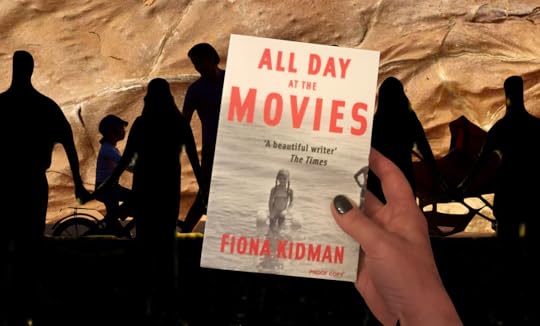
The cover of the book, designed by Kate Barraclough, is elegant and intriguing: it portrays someone who could be young Irene Sandler or perhaps her daughter Belinda Pawson, or it could have been me in the autumn before I stopped believing that acting on impulse meant freedom. The unobtrusive yet distinctive text design by Carla Sy contributes to the blurring of boundaries between reality and fiction, through a reading experience that slips seamlessly towards a life experience. The unusual text breaks – five buttons that lift from the text and become symbols in themselves – remind the reader that small things are sometimes the only mementos of great passions.

All Day at the Movies is the sort of narrative that entices its readers into its folds. Its weaving of stories rises from the stories of the land, from the history of NZ from the 1950s to 2015, from the time when the author herself would have become more aware of the world and of her own identity, to almost yesterday. The book is divided into fourteen chapters that vary in length from ten to thirty five pages in an incremental succession that seems natural, like the rise and fall of a wave, the rhythm of the sea breeze. The longest chapters, the first and the tenth, are perhaps some of the most complex, where the world of innocence (the city-girl naiveté of Irene) comes across the experience of thinly disguised lust and aggression, whereas an apparently doomed character, Irene’s youngest daughter Janice, tells her own story and is thus redeemed from a meaningless life to a meaningful narrative.

Any NZ reader would recognise the contours of the world evoked in the book – the wharf strikes, the Springbok tour, women’s emancipation, as well as distant echoes from Kidman’s earlier novels. Yet, through the deeply ethical question it raises, the world of All Day at the Movies speaks to an audience larger than a Kiwi readership. Its fictional universe is new and fresh and I never once had the impression of being overwhelmed or underwhelmed, tired or saturated with imagery or writerly devices and strategies. I didn’t have the feeling that I was reading a book, but rather living and breathing in its fictional universe, or holding my breath when characters faced tough existential choices that made me wonder: what would I do if I were in their shoes? give in? push back? leave? fight? And when a character’s life slipped away one quiet afternoon, I felt for the ones left, yet sighed a sigh of relief for the one freed from a life unnecessarily unkind yet sprinkled with small joys – the escape in a book, a memory or a story, a child’s gestures or words, a stranger’s kindness.

Other than the stories woven into the book, characters’ lives seem to contain other stories that linger just below the surface, or some others that are hidden deep, tucked away in the recesses of memory. There are a few very lovable characters: Brent Butcher, Maisie and Seth Anderson, Irene and her children Belinda, Janice, and Grant, about whose stories I would like to know more. Their motivations are just hinted at, enough to both illuminate and leave the reader wondering. However, the absence that is just intimated does not diminish the sense of completeness that the book imparts. The unstated is the space where the reader is invited in the story, and given licence to fill with their imagination, thoughts, and emotions that which hasn’t been said, that which perhaps, for various reasons, cannot be said.
There is something redemptive about the telling of stories in which the characters engage whenever given a chance: when making a new friend as Irene does in Motueka, when having friends over with Maureen and her middle-class callers, as part of a group therapy session with Janice, or at the end of one’s life.

Belinda’s stories make up a sizeable portion of the book, while she herself gets to tell her story through her art as a television producer. I wonder if the selectively omniscient voice of the novel is in fact Belinda Pawson’s. The episodes and the whole stories that linger beneath what is narrated in the novel, as a presence just guessed, add depth and complexity to the novel; their ripples move the narrative and crease its surface, while their absence articulates intriguing questions: Who is Belinda’s father? What happened to Grant? What is Bert’s backstory?

There are questions that rise from the book into the world: Is there any redemption for characters whose life has been an unbroken series of misery and misfortune? Can the telling of stories offer fulfilment or atonement? What can one do to prevent the tragedy next door?
Characters’ stories seem to be narrated from within their ranks, such that every story is significant, relevant, thought-provoking. Secondary characters’ stories are as vital to the novel and to the canvas of NZ society that it portrays as those of Belinda’s, the protagonist. These side stories could be the hubs of other stories, the foci around which other lives unfold, as in a scroll that extends beyond the borders of its rollers. An intriguing secondary character is Maureen, a failed writer, whose story might suggest that the appetite for avant garde experimentation might have run its course:
“a woman who had aspirations to write short stories but had abandoned the idea after several classes and as many rejection slips. ‘It’s all this avant garde nonsense,’ she said when she finally gave up. ‘Who reads it? Not me, I can tell you.’” (135)

However, there is a gesture, on the part of the author, towards “avant garde nonsense” and its fragmentary syncopated nature. The novel unfolds in kaleidoscopic episodes that complement one another and push the story along. Nonetheless, the overall impression is that of a coherent story, comparable in its psychological depth and social analysis with those of 19th century French, British, and Russian novelists. This tellable narrative experiments with the episodic nature of stories that seem to make up a narrative network, where tales talk to one another over time and space.

A novel in stories or an episodic novel might reflect the impatience of our times when few can afford to delve into a novel for long stretches of time. Particular to our metamodern times is also the ethical dominant of the fictional universe. A very contemporary type of ethics manifests in the blending of self-realisation and care for the other, visible in the proposition that creative endeavours can and do convey meaning, as do selfless acts of caring for others, like in Maisie’s response to Belinda’s situation.

Somebody on Twitter confessed having read the book in one sitting. I didn’t. I savoured it, willing it to last longer. For the hours it took me to complete reading the book, I was immersed in it with all my senses. When I finished reading it, I realised that its universe had altered my world, modifying my perception, enlarging my horizons as a reader and as a person. Through some cathartic alchemy, I felt that I had a broader, more tolerant, and happier personality. I thought that I could understand myself a bit better. I counted my blessings and I was overjoyed.

In the few hours it took me to read the book, I learned more about the social canvas of NZ than in ten years, two degrees, and numerous conversations. There are constants in Kidman’s writing: feminism, successful careers vs. women who die before their dreams start unfolding, men who seek an illusion as Grant does in the novel, children who grow and move on. Women’s liberation stories intersect in the novel with as many failed attempts at finding one’s feet in an ever changing world. There’s abuse, and the struggle to keep what matters in its central position in one’s life; there are temptations and failures, guilt and attempts at atonement. Kidman’s books fascinate through the ability to write as if she’s not writing, as if the world in the book is as real as reality. Fiction and reality weave seamlessly in and out of one another.

The characters of All Day at the Movies express their thoughts as they meditate on events and circumstances, but there’s nothing manufactured about their insights. Their views are the sort of things that any real-life perceptive person would express. There’s naked honesty about some of the characters that accounts for their verisimilitude; their openness and unassuming self-doubt make them endearing: “This is what she and Nick do – they get lost at night and want each other and talk about it, but that’s all. One day it may happen, but she can’t imagine that far ahead” (180).

The prose feels authentic, vibrant, and satisfying. It reminds me that everyone loves a good story. There are several stories that intertwine in All Day at the Movies, while also offering a chronological progression. Characters develop and expose aspects of their personalities with each new event. There are moments of joy and lyrical moments, as in this episode in Belinda’s and Nick’s story: “Another two days and it will officially be spring, but already the fragrance of new growth is around them in the dark, a magnolia blooming with its ghostly white cups in the shadows” (181).

Kidman’s fictional universe is deceiving in its simplicity, like a Zen story or a Sufi parable that is the end result of years of meditation, or the crystallisation of an epiphany. It’s deep, and wise and crystalline, as a crystal that reflects light; it mirrors reality and (re)constructs it; it captures some of the light of the world and enriches the world with its stories and meanings. The prose is clear and simple in the way that the ocean seems clear and fathomable.

Even though there is nothing bookish about this novel, books are a constant, testimony to the author’s affection for the written word. Attitudes to books evolve in time, with generations. “Reading books all the time was bad for a girl,” Irene’s mother believed and recalled a friend of hers who “has lost a daughter to books” (29). But it is also the idea of writing a book that traps Irene in the tobacco fields, thinking that to write a book “perhaps she needed to stay a bit longer, get to know the people better” (29).

All Day at the Movies is a meditation on human relationships that rises naturally from the narrative and that invites meditation. It raises questions but doesn’t provide ready answers. It is a deeply moral book that would satisfy anyone’s thirst for spice, a layered narrative that could be read at prima facie level (the icing of a compelling narrative) or at the level of any one of its multiple layers (such as that of a social or a feminist novel, a historical chronicle, a cross section of human comedy, with its folly and potential for transcendence).
The narratives of characters’ lives offer both pleasurable and traumatic experiences. I followed them so close, my eyes against the lens through which the narrator was watching the unfolding world of the novel, that the moments of brutality (such as incest or mindless violence) hit me in the face and scarred me for a while, tugging at my sense of morality: How can I live my relatively cushioned life when such things are done on Aotearoa’s shore? How can I witness lives lost because someone had made the wrong choices when trying to make all the brave and right ones? What can I do to ease another’s pain?

I found the book brave and inspired in the topics it tackles, in the non-indulgent exposure of some of the characters’ flaws, while the evil characters’ motivations are hinted at in ways that bring both a squeeze of the heart and a tear of compassion. It is also an inspiring book in the way it seeks the core of humanity in some of the most obnoxious characters. However, more importantly, it follows the flourishing of humanity within the humane protagonists. No lesson is preached, though many teachings are imparted through characters’ reactions and the questions that their actions raise: Can Belinda, who, in spite of her innocence or naiveté (“[you are] always the naïve!” one of the characters admonishes her), or precisely because of her innocence, can she see what other people can’t? Can we afford a god-like glimpse into the minds of people and see beyond the accumulating grime into a sort of original innocence?

A good book is one that makes you wish to meet its author and chat with them. I found Belinda endearing in a way that made me want to reach for the phone and chat with the author for hours, asking her all there is to know about this fascinating character. She’s not perfect; far from that. She’s a flawed human like you and I, but she’s a perfect character in the way she leads her life in the taut tension of indebtedness to Maisie, in a sort of kindness oblige, and a sense of responsibility for those who happen to wander into her life.

All Day at the Movies is not a novel that would right all the wrongs of the world, for no piece of fiction could, but it invites its readers to have a closer look at the world they live in, to notice its beauty and attend to its demands and duties, to extend a kind hand to the ones within reach. To exercise tolerance and patience in the small worlds that we inhabit.

I never spent more than half a day at the movies, but I did spend a few days reading full time, while the film of the novels that I was reading rolled in my imagination. I will certainly try it one day, to see what a day at the movies does to my sense of reality and the moving and permeable borders between fact and fiction. But before that I want to read Kidman’s book again. Now that I know the story I will pay more attention to the writing (to its écriture), and will savour it perhaps even more than the first time round. I don’t reread many books, but this is one that I feel I must.

And I hope it's made into a movie one day.

Alexandra E Dumitrescu
Profile Image for Jan.
427 reviews3 followers
August 13, 2019
Fiona Kidman is such a beautiful writer.
A carefully woven account of a family and its secrets.
Hard to put down.
Profile Image for Glynis Cooper.
50 reviews
October 25, 2025
An epic family tale that begins with Irene left a solo mother when her husband does not return to NZ from WW2. Beginning in the conservative 1950s, it follows the lives of Irene and her children, who are all struggling to survive and overcome the different situations that have affected who they have become.
I am keen to read more Fiona Kidman novels.
Profile Image for Anne.
422 reviews14 followers
May 2, 2020
Une superbe saga familiale tient le lecteur en haleine grâce à de multiples scènes de vie écrites comme des nouvelles : chaque chapitre relate une petite histoire, présentant un couple, une famille, un jeune homme ou une communauté, illustrant un pan de la Nouvelle-Zélande, tranche de destin lié pour un temps à celui de la descendance d’Irène! Ce livre offre des êtres touchants, en proie aux séquelles de la cruauté d’un homme, père ou beau-père ... morcelés entre résilience et souvenirs pour se construire ! C’est aussi un pays qui s’ébauche sous la plume vive de Fiona Kidman, tout aussi hétéroclite que peut l’être la famille d’Irène!
Une auteure peut connue en France, à découvrir !
Profile Image for Beth (bibliobeth).
1,945 reviews57 followers
March 8, 2018
8th March is International Woman's Day, commemorating the movement for women's rights, equality between the genders and celebrating all the achievements of women around the world. To celebrate this day, I'd like to showcase a very much new to me author (although incredibly prolific in her native New Zealand), Dame Fiona Kidman with her wonderful novel, All Day At The Movies which was brought to my attention by Gallic Press. A huge thank you to them for opening my eyes to a talented writer I have only now had the good fortune to come across and for the copy they kindly sent me in exchange for an honest review. I thoroughly enjoyed every sweeping moment of this narrative, packed full of drama, heart-ache, testing times and indeed, triumphs of one particular family. I loved how the author put so much heart into each character that she created and this only served to make me feel more connected and invested in each of them individually as a reader.

All Day At The Movies is an epic family tale spanning about sixty years focusing on a few members of a family down the generations. At first, we meet a determined mother, Irene Sandle who tragically, has become widowed with a young daughter, Jessie to support. She is forced to work in the tobacco fields of New Zealand in the early fifties which does not pay much and is back-breaking work but provides a roof over their heads and food in their bellies. However, in trying to provide a stable life for herself and her daughter, Irene becomes embroiled in a life that she hadn't planned and unfortunately, will have severe repercussions for the rest of her children down the line as their story continues once Irene is gone.

I cannot say anymore than this - to do so would be to give far too much away! Let me just say, we follow a few of Irene's children and how they deal with the struggles in their lives once their mother has gone and they are forced to navigate the world without her, without much support or strength from the other responsible adults in their lives. We hear very little about Jessie as she runs away entirely from the situation but it is obvious that the damage has already been done. We see a more prominent effect on the children left behind i.e. Belinda, Grant and the youngest girl, Janice who you could suggest goes through the most traumatic experiences. However, all children are affected in some way or another and even though Belinda does manage to make some success of her life after a rocky start, there are still demons that return to plague her, especially those connected with her siblings.

I absolutely adored the structure of this novel. It's almost like a series of short stories, beginning in 1952 with Irene's story, meandering right through the seventies and eighties and ending in 2015, where we begin to realise the full extent of how each of Irene's children have been affected by their past experiences. It's rare to find a perfect family of course, and relationships between certain members of our families can be tricky at times but Fiona Kidman illustrates these difficulties beautifully with a very sensitive analysis of the bonds that hold us together as a family and how tenuous these links can be, especially where there are issues of trust or neglect. I certainly wasn't expecting some of the themes that the author covered, including emotional and sexual abuse, death, racism, poverty, adoption, mental illness.... I could go on, I've just scratched the surface with the amount of issues addressed here!

Finally, I just want to touch on the fact that the author also uses events in New Zealand's history (which I know shamefully little about) to make an already action-packed narrative even more exciting. I was completely swept away, surprised and delighted by this fantastic novel which was a real joy to experience and I was quite sad to come to the realisation that we were in 2015 and there were no more generations of Irene's family to follow just yet! I could have read about them for much longer and there's certainly a few of the characters stories that will stick in my mind for a long while yet.

For my full review and many more, please visit my blog at http://www.bibliobeth.com
2,915 reviews82 followers
October 2, 2018

“I’m on the run because he always catches up with me. Running away, moving, my whole life I’ve been running. It’s like you’re in the dark, not knowing where you’re going to end up next. And then he’ll find me.”

Kidman has been plying her trade for around five decades now and it shows. The breadth and penetrating quality of her prose shows a mastery of her craft, yet it is measured with just enough restraint. She beautifully captures the mind sets of many different generations throughout many post war eras, comfortably inhabiting the shoes of abused children with the same ease she does of marijuana smoking septuagenarians, and all along we can identify and relate to them in some meaningful way.

From the tobacco fields of 1950s Motueka through to the city court rooms of the 21st century, Kidman grasps the essence and place with skill and authenticity. This is a book about families and the many complex, frayed, flawed and enduring threads that make them up. This book shows how politics affects day to day lives. We see who really pays the price for political change, it’s not those at the top concerned about tax increases, or favourable interest rates, but at the bottom. We see how the laws of the land work in a totally different way to those at the bottom of the rung. We meet the real victims of Rogernomics and Ruthanasia, the on-going casualties of New Zealand’s deeply misguided and damaging venture into free market neo-liberalism.

We see that NZ just like it’s bigger cousins in the northern hemisphere, has created a deeply flawed system that overly protects and rewards the wealthy and powerful whilst ruthlessly punishing the poor and disenfranchised, a system that ensures the rich stay rich and the poor remain poor and rarely the twain shall meet. We see the on-going legacy of these divisions and how they play out in wider society and how hard it is to break free from the limitations and legacy of them. We see how much of fate comes down to not what you know, but who you know.

There is a panoramic feel to this novel, in one sense it is on a fairly epic scale, yet in typical Kiwi fashion it manages to remain understated at the same time. Kidman retains a nice balance between the universal with the parochial, maintaining an accessible feel. This is a haunting and powerful piece of work with dark undercurrents restlessly pulling beneath its surface and it’s written by a woman at the top of her craft. This is a thoroughly enjoyable novel, which is incredibly hard to put down.
Profile Image for Jacob Heartstone.
Author 1 book1 follower
May 2, 2024
Might contain some LIGHT SPOILERS:

This is one of the rare cases I am glad that I didn't DNF this when I felt like it as soon as chapter two but kept ploughing on as it gets better the farther the story progresses. So that now, despite the very boring and not very engagingly written first couple of chapters, I am glad I stuck with it and saw it through until the end.

However, I still have a bunch of issues with this book: First of all, the writing remains rather bland and unimaginative throughout. The story, too, often meanders in weird directions without any reason or explanation, and the characters all remain sort of aloof and inapproachable even though the story lives from the fact that the reader can empathize with them.

Another thing that bothered me throughout (but that might just be a me thing) is that the book is often unnecessarily vulgar. Don't get me wrong, I don't mind that in general, for some characters, to contrast them with other characters. But here, all characters were described that way, and it didn't make any sense. Additionally, each and every character is constantly cheating on their partners which might be to some extent realistic but it's just not for me. I don't wanna read about it again and again and again.

Last but not least, I picked this up because it took place in New Zealand and I wanted to learn something about Kiwi history. And while it does cover some history, I feel like it does so rather arbitrarily. In any case, I as a non-Kiwi was completely lost most of the times, which makes me think I was not really the target audience...
Profile Image for Jessica Bronder.
2,015 reviews32 followers
December 6, 2017
Irene Sandle is a war widow that only has the baby her husband gave her before his death. She tries to return to work after the birth of her daughter. Not to be put out, Irene decides to move out of her parent’s house and work as a tobacco picker. She struggles to survive with her daughter and ends up marrying Jock. Sadly years later she dies in childbirth and leave Jock with four children he is not ready to raise. He in turn marries Charm who is not capable to raise the children either. What follows is neglect, abuse, teen pregnancy, and so much more.

This story revolves around Irene and her family over several years. Going against the norm for a woman, Irene is determined to create a life for her and her daughter. They both face trials but Irene does the best she can. So does Jock after Irene’s death. Sadly things don’t get better and all the children have to live with everything that they went through as kids and the choices they make as adults.

This is not an easy journey but I really enjoy how Fiona Kidman tells this story. These are real characters that do the best they can to survive and have real human flaws, unfortunately. It is touching and sad what the kids have gone through but it is also a reflection of real life. I think that many will enjoy this story.

I received All Day at the Movies from the publisher for free. This has in no way influenced my opinion of this book.
Profile Image for Lynda.
833 reviews9 followers
May 29, 2022
Sometimes I feel rewarded for my determination to finish any book I start reading. This is one of those books. Up to halfway I was sort of emmmmmm…. but by the end when I put it all into context I appreciated it. It is the story of generations of NZ (mostly) women from WW2 until the 21st century. It accurately reflects our social and political history and the way lives develop against that framework. It starts with war widow Irene who has a baby, Jessie so can no longer work at the library. She goes to Motueka to work on a tobacco farm and meets an honourable man who is unfortunately killed. Pregnant with Belinda she marries the Scottish overseer, Jock and has 2 more children with him. It is the children’s story more than it is Irene’s and their story is set against a dysfunctional, abusive family background which they endeavour to rise above. The youngest two, Jock’s children, Grant and Janice are the most emotionally and physically damaged. There are a number of good peripheral characters who have an impact as the family falls apart, moves apart, and comes together in alternating patterns. In many ways the novel reads like a series of short stories where characters return with new casts. I listened to this novel and was frustrated at times by the mispronunciation of New Zealand place names - Waiouru, Turangi, Hokianga and even Twizel are examples but there are more.
Profile Image for Granny Sebestyen.
497 reviews23 followers
October 26, 2019
"Comme au cinéma" de Fiona Kidman (360p)
Ed. Sabine Wespieser

Bonjour les fous de lectures ...

Ce roman nous embarque en Nouvelle-Zélande.
Fiona Kidman nous raconte, comme au cinéma, la vie d'une famille sur plus d'un demi siècle.

Ce sont les femmes qui dominent ce roman.
L'histoire commence avec Irène qui, avec sa fille de 6 ans, quitte Wellington pour les champs de tabac.
Irène la lettrée va lier son destin à Jock, un pourri jusqu'à la moelle.
De cette union naîtrons 3 enfants.
Pendant plus de 50 ans , nous allons suivre ces vies cabossées, découvrir des secrets bien enfouis.
Chaque enfant d'Irène se cherche , tâtonne, peine à trouver sa voie, vit plus ou moins bien sa vie.
S'en sortiront-ils et si oui, à quelle prix ?

Voici un livre sur les saccages de l'enfance, sur le pardon ( si il est possible), sur la survie.

Fiona Kidman en profite pour nous parler de l'histoire de son pays, des traditions, des problèmes de discriminations, de la place des femmes dans la société.

Je referme ce livre avec un sentiment mitigé ... il se laisse lire, j'ai appris pas mal de choses sur la Nouvelle-Zélande mais j'ai eu beaucoup de mal à me projeter dans les personnages et à ressentir de l'empathie pour les différents personnages .
18 reviews
Read
January 30, 2020
Irene finds herself in what feels like another country. It’s 1950’s New Zealand and she’s moved from Wellington to the tobacco fields of rural Motueka. Irene is obsessed with books, in fact she once worked as a librarian. Widowed after her beloved Andrew is killed in the war, she’s forced to try her hand at harvesting tobacco to provide a future for her and her daughter Jesse. Irene’s life turns to tragedy but her blood runs deep. Over the passage of time this novel follows the lives of Irene’s children in a uniquely New Zealand setting.

Fiona Kidman’s powerful characters are pivotal to the story. Their strengths and weaknesses are laid bare and key points in New Zealand history are told through their eyes. They live through key political moments in New Zealand history and their personal experiences tell the story of the evolution of our society. The book has a steady rhythm, sometimes heart-warming and at other times tragic. This powerful story leaves the reader immersed in the characters’ lives.

This was my first experience of reading a novel by Kidman, who is truly a New Zealand treasure. I’ll be sure to follow it up by reading more of her impressive catalogue.
Profile Image for Anna.
1,146 reviews13 followers
September 16, 2017
A really enjoyable novel about Irene's four children, Jessie, Belinda, Grant and Janice. Irene is smart and bookish but left as a pregnant widow at the end of WWII. She is unable to go back to her job after having Jessie so she moves to a tobacco plantation (I guess I forgot that we had those?). She falls in love with a Jewish man, gets pregnant and then the man is killed in a fire. Left pregnant, she marries Jock who seems to hate everyone - his wife and all his children. He treats his own biological children the worst of all. He's a reprehensible human being. So is Charm, the woman he marries after Irene dies. I loved so much about this novel - the moving through time from post-war Irene to almost the present day, and the setting around NZ, and the writing style. The Bolinda reader was terrific in terms of tone and mood but what a pity that she didn't research pronunciation of NZ place names and words. Would it kill Bolinda to get a NZ narrator?
This entire review has been hidden because of spoilers.
444 reviews6 followers
April 29, 2018
It is a poignant but tenderly written narrative, revealing the fragility of relationships but also the indestructible connection that ultimately binds us to our close family members. Taken separately, each individual chapter is an interesting look at life, especially for women, at a specific time period in modern history. The early chapters are particularly moving, highlighting barbaric attitudes towards unwed mothers being forced to give up their children and casual racism and sexism in society, but the novel as a whole shows how attitudes have changed, thankfully largely for the better.

full review on my blog : http://madhousefamilyreviews.blogspot...
Profile Image for Cait.
123 reviews3 followers
August 16, 2020
Fiona Kidman is a wonderful storyteller of the human condition - good and bad. All Day at the Movies is the story of a family - starting with Irene Sandle shortly after World War 2 on the South Island and weaves the varied stories of her descendants and their paths through modernising New Zealand. An interesting way for this ExPat to learn some history (especially from the view of women) and a rich story of the importance of family. There are some very troubling themes of abuse and incest, but I think the discomfort it causes betters the story and the reader.
677 reviews7 followers
December 2, 2021
The sadly realistic story of a NZ family through the generations. I found it sad because it is probably realistic for many families. I grew up in a completely different family and didn’t have to make the hard choices that each person had to make. It made me wonder what I would have chosen in similar circumstances - seeking for love, trying to stay safe, the risks of telling the truth, ways to make meaning …

I thought it well written. It captured the feelings of each character. The title wouldn’t have attracted me to read this book though I see the point now.
1,065 reviews
July 7, 2017
A beautifully flowing story set in New Zealand , of a family born of difficulty and the way each child managed to make his / her way in life. The novel deals with illicit relationships within the family circle and the far reaching ramifications. The author made the story feel so real. I listened to this as an audio book and loved how the narrator portrayed the New Zealand accent with the different characters. Highly recommended.
Profile Image for Tinanz.
221 reviews7 followers
October 21, 2019
Enjoyed this far more than I had expected to. I don’t usually like books that keep changing narrator, but this one kept me turning the pages and a day later it was finished. The story of a family starting in closed-minded, parochial 1950s New Zealand and finishing almost in the present day, we see how small differences in character and experience become vastly different lives.
Profile Image for Sandy.
877 reviews
February 3, 2026
As someone who has lived in NZ for many years but did not grow up here, I enjoyed the descriptions of life, politics, and customs during some key periods in New Zealand's recent history - all this as a backdrop to a fractured pseudo-family's struggles to find their places in the world, and each other.
Profile Image for Jo-Anne Barker.
Author 23 books15 followers
March 6, 2026
I wanted to enjoy this book because some of it is set near where I live in NZ, but it was difficult to enjoy. The historical setting was interesting, but the characters weren't so interesting. They didn't have me turning the pages in anticipation, wanting to know what happens next; instead, I left the book unfinished.
Profile Image for Jill.
1,129 reviews1 follower
June 18, 2017
A compelling family story beginning during the aftermath of WWII and continuing until the present. The author captures the changing political and social life of New Zealand through the eyes of one woman and her descendants.
Profile Image for Chris .
766 reviews13 followers
October 10, 2017
I can't really say that I enjoyed this book, it is more in the category challenging read than enjoyable read. However, it is very well written (as you would expect from Fiona Kidman) and I recommend it to anyone you sometimes like to be challenged by what they read and not just entertained by it.
Profile Image for Catherine.
74 reviews
April 8, 2018
I was a bit disappointed by this book. It felt like an old-fashioned kiwi novel from the 80s, just extended into the present day. And am also sick of getting absorbed in a novel before I realise it should come with a trigger warning. Good weaving of the different storylines though.
Profile Image for zespri.
604 reviews12 followers
January 19, 2019
Set in New Zealand in the post-war period, a war widow is left to find work and survive. The choices she makes follow her and her family, and a really interesting and absorbing social history of New Zealand is the result.
Profile Image for Bathsheba.
606 reviews3 followers
February 27, 2019
I feel like I'm missing something? What was everyone else reading? I enjoyed how well written it was but the story just didn't grab me like I'd hoped. I really wanted to like it as well because I'm starving for more stories set in New Zealand. That part of it was at least, very well done.
898 reviews7 followers
February 18, 2017
I was captivated by this book and couldn't put it down. An absolute must read.
Displaying 1 - 30 of 52 reviews