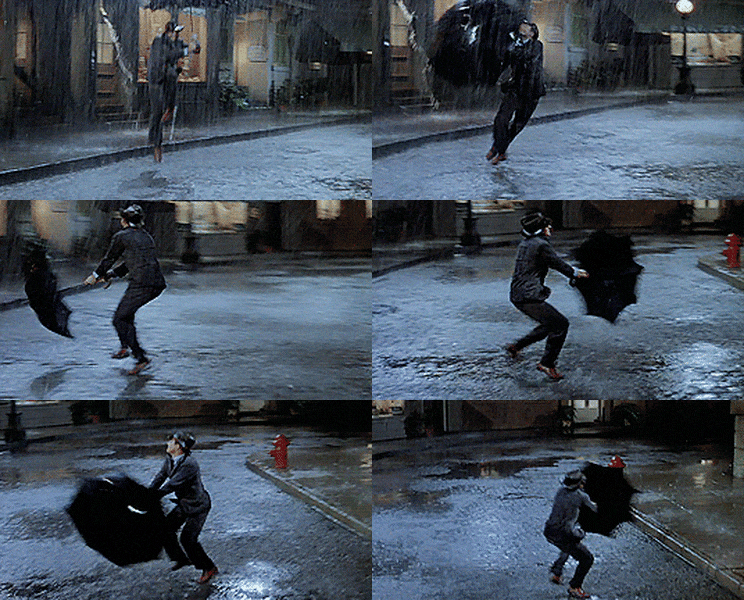
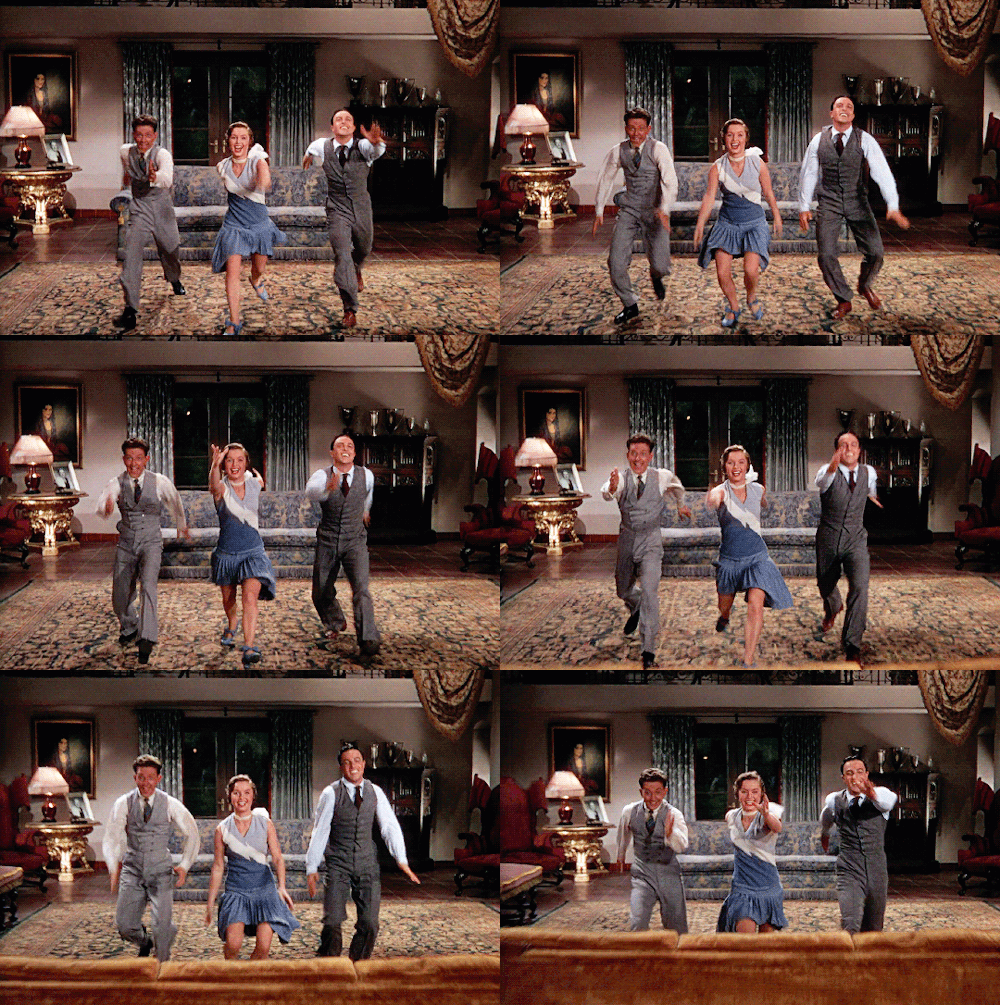
A biography that traces the long career of the innovative song-and-dance man whose routines in "Anchors Aweigh," "An American in Paris," and "Singin' in the Rain" made movie history
Published in 1984, the biography of the epitome of dancing and musicals in the 40s and 50s, Gene 'Singin' in the Rain' Kelly. The chapter on 'Singin' in the Rain' alone is worth reading this biography for… as, in my opinion, it's the greatest musical ever made, and as the book states, still now, not in the least bit dated. The book is very much slanted in the story of Gene as an 'artist' as opposed to as a private person and details a lot of his entertainment career, the dance teacher, the upcoming actor, through to superstar, and then to father and director. 6 out of 12 2010 read
This book reads like a press release from his PR guy. It was still interesting and fun. Finally found out why he didn't play Sky Masterson in Guys and Dolls, which was surely the part he was born to play. Louis Meyer strikes again. So hysterical that it passes barely with a mention that he and his long time partner Stanley Donan essentially traded wives. Gotta love Hollywood!
I am honestly ashamed it took me this long to read a biography on Gene Kelly. Singin' In The Rain is a movie I have been watching my entire life - I swear I watched as an infant! Kelly was a such a wholesome actor in his time, and who could resist watching his feet tap, tap, tap, away in each movie he made? I was especially surprised to learn Kelly wanted to be a lawyer and even attended law school before he recognized his true calling as a dancer and actor. Thank goodness! What would musicals in the 1940's and 1950's be without him?
It is such a tragedy that he never won an Oscar, but was given only a lifetime achievement award. Since Gene was recruited to Hollywood mainly because of his choreographing skills, which he honed on Broadway for the first thirty years of his life, it took quite a while to get to the Hollywood aspect I was dying to read about.
I liked that the book had direct quotes from Kelly. That helped me understand exactly what he was thinking and obviously made this book more authentic. However, I found the writing inconsistent. There were portions where the author described the entirety of a movie Kelly appeared in. In those parts, the author spent a lot of time describing everyone associated with the movie. I liked that information for movies that were my favorites like Singin' In The Rain, On The Town, and Summer Stock, but it was a little overkill for every single picture. Also, I felt that the essence of the biography suffered because the book became less about Kelly's experience on a movie and more about the overall picture.
There was a great emphasis on Kelly's creativity and his impact not just on dancing, but on how movies captured dance sequences. It turned out that Kelly was ingenious and created many styles and techniques that were absolutely groundbreaking. I also appreciated the inclusion of quotes by others in the industry who were lucky enough to work with him. Those quotes painted him as a kind and honorable man, who was down to earth and wanted only to put out good dancing and great movies. Kelly wasn't necessarily interested in being famous, just in being the best dancer he could be.
I enjoyed learning about Gene Kelly and found this book to be helpful in that regard.
Clear, concise writing about the career of Gene Kelly. A very straightforward read that will leave you with a better understanding of the actor as well as insight into the interconnectedness of the Hollywood studio system of the 1940s-60s. Mind you it was published in 1974 so we miss out on the last 20 years of Kelly's life. But if you are interested in knowing about how he got his start and his involvement in his most famous works, this is a great resource.
This biography of the great star of American Musical Motion Pictures from the mid-Twentieth century is a definitive biography of a man who shaped and perfected the art form while working at MGM in the 1940s and 1950s. Written with the cooperation of Gene Kelly and his family and friends and originally published in 1974 and updated in 1984, Clive Hirschhorn’s biography of Gene Kelly starts off with an account of Kelly’s childhood in Pennsylvania where he learned to dance and, with his family, established himself as a teacher of dance and operated a dancing school. From there he got into other aspects of performance like choreography before dropping out of law school and moving to New York City, where he became a prominent performer on Broadway. It was there that he attracted the attention of Hollywood and was soon living in the Hollywood Hills and under contract to the studios (Selznick International at first, then MGM, and others).
In Hollywood, Kelly lived a charmed life, working and socializing with the likes of Charlie Chaplin, Louis B. Mayer, Marilyn Monroe, Debbie Reynolds, Busby Berkeley, Barbra Streisand, Judy Garland, and many others. This biography walks through his career movie by movie and it is full of insider gossip and behind the scenes information about casting, scripts, location filming, and studio politics. Hirschhorn is light on analysis but he does chronicle Kelly’s development as a dancer, actor, director, and script writer. I did not realize how many different roles Kelly had in the many films that he made, and there are many fascinating stories about projects that might-have-been but didn’t pan out for one reason or another. (Kelly nearly had a cameo role in ‘Lawrence of Arabia’, Jean-Luc Godard wanted to make a film with him, and Kelly was sought out as a director for ‘Cabaret’.)
The highlight of this book is the highlight of Kelly’s career - the making of ‘Singin’ in the Rain’ - and it does not disappoint as far as behind-the-scenes making-of information. Hirschhorn interviewed many participants in that film, from Kelly to Reynolds to Donald O’Connor, and the story of the film's conception and making is almost as fascinating and wonderful as the film itself. While that film was the highpoint of the book and Kelly’s life, there were still many films to come, and while it is sad the way that the tremendous resources the studios made available for musicals dried up not long after that 1952 film, Kelly continued to work in films where he did less dancing and more acting and directing, including directing ‘Hello, Dolly!’ in 1969.
I wanted to read this book to learn more about Gene Kelly and the films he made, but I was surprised and impressed that it covered so much Hollywood history from the 1940s through the 1970s. It goes beyond Kelly and beyond musicals to give a rich account of the film industry beginning at a time when it held a prominent position in the entertainment industry, through the post-war years when the rise of television made competing for the entertainment dollar a life-or-death struggle for the movie studios. Kelly lived through it all and this biography puts his life into the context of the business changes that allowed him to reach his full potential and make a perfect film.
While this book certainly does seem to contain everything you ever wanted to know about Gene Kelly and were afraid to ask, I finished it thinking the author must have a life size statue of Gene Kelly in his front yard. The first part of the book about his family and how he became a dancer is fascinating. When it gets into his career and Hollywood, well showbiz, laws, and sausages have something in common, in that you don't always want to see how they're made. But one is given a good glimpse, enough to realize what a miracle it is that a lot of these wonderful films ever got made. Gene Kelly is one of my favorite dancers and truly unforgettable. While I'm glad to have had this glimpse into his life -- and how very amazing it was -- still, it's the films I'll remember the most.
[Notes made in 2004]. This is a standard "authorized" celebrity biography, based on interviews with the subject and his associates, and published before his death. I enjoyed the anecdotal nature of it, and it has a useful "filmography" at the end. It is less guarded than Astaire's autobiography: see the two accounts of the making of "The Babbitt and the Bromide", Astaire & Kelly's only real duet, for an interesting comparison. Kelly actively disliked the number, but deferred to Astaire as the "senior partner" - you'd never know this from Astaire's bald paragraph on the subject.
Come for Gene Kelly's continual insight into all aspects of his luminous career. Try to stay for Clive Hirschhorn's grossly overwritten, mostly overwrought analysis and criticism of Kelly's movies, but remember that Kelly's observations are always just around the next page, and it's almost worth it to suffer through that.
This is not an academic biography. The research behind it is thin, and it was written twenty-two years before Gene Kelly died. A main source is Gene Kelly himself, which has both advantages and disadvantages. Having said all of that, Hirschhorn interviewed lots of Gene Kelly's associates and provides some interesting background on his Broadway period and his important movies.
An easy read with no startling revelations,an old fashioned biography that was written when he was still alive.the only new thing I learnt was his time running a dance school with his family,and put the time in to learn his trade.worth a read.
I love Gene Kelly’s movies. I think he was a fine actor and singer as well as a phenomenal dancer. It’s very difficult to find out anything about the man behind the celluloid, however. After reading this book, I’m not surprised. He comes across as a decent, intensely private man and I now have a better understanding of why people often found him difficult to work with. I think Kelly’s years of working hard to support his family and pay his way through college, combined with his competitive spirit and perfectionism, meant that he threw himself 110% into everything and had little time for those who didn’t take their work as seriously. This book gives a good overview of his life (it only goes up until the early 1980’s, so nothing about his later years or third marriage) and I particularly enjoyed peeking behind the scenes at the movies I know well and love.
An excellent biography of an excellent entertainer. If you like Gene Kelly's movies (and if you don't - well, what's wrong with you?!), this book is well worth reading. It's written with obvious respect and warmth for Kelly, but Hirschhorn is also to be balanced and objective. Kelly and his family were interviewed for this book, and it is clear that Hirschhorn has researched his subject very well.
My only minor complaint about this book is that I would have liked to have read more about Gene Kelly's political affiliations. Oh, and the book ends in the mid-70s, when it was written (obviously), so 20 years of Gene's life is not recorded here. Nonetheless, it's an absorbing and entertaining read, with lots of information about his films and his work.
I've always loved Gene Kelly's dancing, but I never knew how many other aspects of the film business he undertook to learn. This book covers pretty much everything from his birth through 1983. A bit too detailed at times, but I appreciated the information about filming dance scenes. I had never really given much thought to the intricacies involved. Lots of photos. Sadly, they were all poor quality and the captions were badly placed and, therefore, confusing. I'd like to find out what happened after the 80's. I think I will search out a later bio.
I was smitten with Gene Kelly as a teen. Thanks to my best childhood friend Linda, I even knew his address... 725 North Rodeo Dr.
After reading this book, which was published in 1974, I think back and wish I had thanked him in a letter for sending me that autographed photo Linda asked that he send to me for my 16th birthday. Perhaps I would have struck up a pen pal relationship with him and gotten to dance with him as I dreamed i might, in the way only a starstruck young girl can dream.
I absolutely love Gene Kelly, and in turn I really enjoyed reading this book! There isn't very much literature on his life, so I was happy to find this. Such an exceptional man...
I do agree with others though about the book being a bit outdated. Unfortunately it's missing the final decades of his life.
Regardless, if you love Gene, as you should, this is a wonderful read!
A comprehensive, chronological account of Gene Kelly's life and career from childhood through the 1960s. Lots of interesting behind-the-scenes stories from his work in Hollywood, including his relationship with stars such as Frank Sinatra, Debbie Reynolds, Fred Astaire, Judy Garland and Jimmy Stewart.
Want to get further along in another book before I start this one....Really looking forward to it.
Finished it a couple weeks ago. Really enjoyed the book. Of course I've begun watching his movies now and sharing insights I learned as I watch them! :)
This would be another 3.5 stars. I loved reading about Gene I just wish there had been more detail on his personal life and a little less time spent on the specifics of making his movies.