Jump to ratings and reviews
Rate this book

The Universe

Rate this book

Let Lonely Planet take you further than ever before with the world's first and only travel guide to the Universe. Developed with the latest data from NASA, we take you from our home on Earth and out into the far reaches of the solar system, then into our neighbouring stars and planetary systems, and finally into the rest of our galaxy and the Universe.

This fascinating journey will help you explore space as you would the world with a Lonely Planet guide. Unique to these pages are wonderful comparisons of Earth with the other worlds of our solar system and even those exoplanets orbiting other stars.

You'll discover as much as we know about our celestial neighbourhood, and our place in it. In addition to planets and moons, get to know our Sun, explore the asteroid belt and the Kuiper Belt, and learn what lays beyond, in interstellar space. Outside our solar system, travel to some of the notable neighbouring stars, stellar systems and exoplanets we've discovered. You'll understand how we search for planets where life might exist and the stars they orbit.

Finally, discover the edge of the observable Universe. Get to know the structure of the Milky Way as well as an orientation to neighbouring galaxies like the Andromeda Galaxy which is visible from Earth. Then explore other galactic formations and learn about galactic clusters and superclusters. By the end of the book, you'll have a sense for the structure of the entire Universe as well as some of the big questions we still have as we ponder our place in it.

About Lonely Planet: Lonely Planet is a leading travel media company and the world's number one travel guidebook brand, providing both inspiring and trustworthy information for every kind of traveller since 1973. Over the past four decades, we've printed over 145 million guidebooks and grown a dedicated, passionate global community of travellers. You'll also find our content online, on mobile, video and in 14 languages, 12 international magazines, armchair and lifestyle books, ebooks, and more.

Important Notice: The digital edition of this book may not contain all of the images found in the physical edition.

608 pages, Kindle Edition

First published January 1, 2019

89 people are currently reading
376 people want to read

About the author

Lonely Planet

3,657 books882 followers
OUR STORY
A beat-up old car, a few dollars in the pocket and a sense of adventure. In 1972 that’s all Tony and Maureen Wheeler needed for the trip of a lifetime – across Europe and Asia overland to Australia. It took several months, and at the end – broke but inspired – they sat at their kitchen table writing and stapling together their first travel guide, Across Asia on the Cheap. Within a week they’d sold 1500 copies and Lonely Planet was born. One hundred million guidebooks later, Lonely Planet is the world’s leading travel guide publisher with content to almost every destination on the planet.

Ratings & Reviews

What do you think?
Rate this book

Friends & Following

Create a free account to discover what your friends think of this book!

Community Reviews

5 stars
77 (54%)
4 stars
50 (35%)
3 stars
12 (8%)
2 stars
2 (1%)
1 star
0 (0%)
Displaying 1 - 29 of 29 reviews
Profile Image for Montzalee Wittmann.
5,214 reviews2,340 followers
May 14, 2023
The Universe
By Lonely Planet
This is an amazing book that speaks "normal" speech most of the time as it describes and discusses just about everything you would want to know about the Universe. Geek speak is spoken when necessary😊.
The photos are awesome! They fill the book!
When you think the book is done going over the Universe, it starts again giving different information in different ways! If you don't get it the first time, (and how could you possibly absorb all of the universe info on the first go round?) the second time might help!
Great book if for nothing else than the pictures!
Profile Image for Anders.
64 reviews5 followers
December 12, 2023
Bit weak on the restaurant recommendations and not super helpful when it comes to getting around outside the solar system, but otherwise ok
Profile Image for Sandra Vel.
324 reviews
May 24, 2023
Una gran guía de astronomía. Da un repaso por los principales planetas de nuestro sistema solar, otros planetas, asteroides, cometas, misiones espaciales, galaxias...
De cada astro, explica sus características y curiosidades, historia de su descubrimiento, cultura popular, principales atractivos, etc...
Contiene mucha información y está explicado de una forma muy amena y comprensible, como si se tratara de una guía de viaje, incluyendo información como cuánto se tarda en llegar.
A mí me ha interesado todo el detalle del sistema solar, que ocupa más o menos la mitad del libro.
Como todas las guías, no es un libro para leer de tapa a tapa (aunque es tan interesante, que se puede hacer).
Es un libro "simpático" para regalar a los amantes de la astronomía, con un enfoque original gracias a Lonely Planet.
Aunque para mí, el mejor libro sobre el universo que he leído hasta ahora y que recomiendo al 100% es El universo en tu mano.
Profile Image for Rama Rao.
836 reviews144 followers
November 14, 2019
The Wild but Dazzling Universe

Even in the 21st century, there are places on the planet where few people tread. Lonely mountain tops, desert interiors, Arctic ice floes, or the vast ice sheets of Antarctica. The Kerguelen Islands of Indian Ocean and Spitsbergen of Norway are good examples. Earth is a very tiny place in our universe that is made of spacetime fabric with matter and energy. They come in various forms; planets, stars, galaxies, and black holes. The observable universe is estimated to be 93 billion light-years in diameter.

Solar system is a well-studied system and a good deal of information is available here. The Sun and eight planets with about 170 known moons and countless asteroids, some with their own satellites; comets and other icy bodies; and vast reaches of highly tenuous gas and dust known as Kuiper belt and Oort cloud. There is also other information; physical and chemical characteristics of exoplanets, galaxies, nebulas and galactic clusters. There are many colored pictures to admire the wonders of our universe.

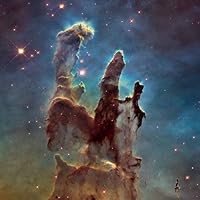
One of the surprises is that the Pillars of Creation taken by the Hubble Space Telescope of interstellar gas and dust in the Eagle Nebula is prominently displayed on the cover but not documented in the book. This is about 6,500–7,000 light years from Earth and it is also known by other names like Messier 16 or M16, NGC 6611, the Star Queen Nebula and The Spire.

This is a good reference book that prepares you for exploring the universe. It provides a comprehensive review of cosmic structures in the observable universe. Lonely Planet offers a good guide for readers interested in astronomy.
Profile Image for Nick.
Author 21 books141 followers
July 8, 2020
There's a genuine question about the role of reference books in the era of the Google. Especially for subjects that can change substantially a few times a year. Shouldn't we save the trees and just use the Internet?

This book is a wonderful reminder of why reference books still have a role to play. I started reading this book and learned more faster than I could possibly have on Google, simply because I didn't know what questions to ask. At the same time, I'm getting a sense of the dimensions of the field of astronomical knowledge that is, in some ways, even harder to get from the Internet.

Beyond that, Lonely Planet has created a book that's fun to peruse, easy to read, and a pleasure to hold in your hand. Get this book and immediately start learning about Epsilon Aurigae, Eta Carinae, and 1E 2259+586. And try to Google that!

Profile Image for Stephen Dedman.
Author 104 books51 followers
November 18, 2019
While it's not much use as a travel guide unless you're a billionaire and/or making plans well in advance of what's currently feasible, the format works beautifully for sparking or reviving interest in space exploration. Particularly useful for SF writers looking for a setting for a story.
Profile Image for Tim Robinson.
1,100 reviews56 followers
May 9, 2024
There are two ways to do a crossover between an astronomy book and a travel guide: straight, or for laughs. These guys have chosen to do it straight. But this route results in an overly long book that nevertheless feels very superficial. The worst of both genres. A better book could have been made with a third of the destinations and more detail on each. But then it wouldn't be a travel guide to the universe. This the kind of trap you fall into when you take a crossover too seriously.

This will never replace The Hitchhiker's Guide to the Galaxy.
Profile Image for alexander shay.
Author 1 book19 followers
April 2, 2021
I picked this book up originally because I was intrigued at the amount of information in it. Details on our solar system planets was only part of it; the rest was about things outside our solar system, outside the Milky Way even. The photos for the other galaxies in particular were stunning. Most of what I thought was interesting was still within our solar system, but tidbits like the confirmation that binary star systems exist and details about black holes and dark matter were neat as well.

That said, I don't think this is the type of book that is meant to be read front to back, which is what I did. It's very thick, and I found the layout and the weight a bit of a hindrance when trying to read. About 1/3 of the way through I returned the hardcover and took out an ebook version instead and things went much faster. The formatting was a bit off but the ease of reading was so much better I didn't mind.

Why I'm only giving this 3 stars is because once you get outside our solar system and begin to explore other systems and galaxies and stars, the information gets a bit repetitive and actually confusing. So many planets, stars, galaxies, etc, are referred to as "the closest to Earth" or "the brightest" or "the fastest rotation" only to have another object later in the text to be called the same thing. I don't know that the distinctions are made clear enough within the text, as obviously multiple planets cannot be the closest to Earth at the same time, unless their orbit changes or some planets were discovered later than others and beat the previous planets at their distance, etc. But it seemed like these details weren't really included, so I got a lot of mixed messages about which planets/systems/stars/etc are actually the best/fastest/brightest/etc.
Profile Image for AlenGarou.
1,739 reviews134 followers
June 3, 2020
3.5

Premessa: adoro le guide della Lonely Planet. Credo che siano le più ben fatte sul panorama dei viaggi.
Ed è proprio per questo che sono rimasta stupita da questa guida. Ok, l’ho presa praticamente a scatola chiusa visti i miei hobby, quindi un po’ me le cerco, ma…
È troppo ripetitiva!
Ragazzi, andiamo!
Il lavoro che c’è dietro è straordinario e non lo metto in dubbio, ma rileggere in continuazione le stesse frasi sparate nella top 10 a ogni capitolo non è stato esattamente il massimo. Suvvia, almeno per il Sistema Solare potevate ampliare un po’ il repertorio senza fare copia e incolla.
Bah.
Ripetitività a parte con relativa pesantezza, è veramente un’opera completa, consigliata soprattutto a chi se ne intende poco di astronomia ma ha la curiosità di approfondire. Vi sono molte pagine tecniche e le ultime novità soprattutto riguardanti i pianeti nani e gli esopianeti.
Profile Image for Emma England.
Author 1 book2 followers
May 28, 2020
Like all Lonely Planet books this is a reference guide and certainly not something you'd be likely to read cover to cover but it does make a gorgeous coffee table book. It's fun to dip in and out of for a few minutes here and there. A lot of the information is repetitive unfortunately, which suggests the editing was a bit of a botch job, but otherwise it is well worth it for anyone interested in space who wants to look at pretty pictures and learn the odd fact about various objects and matter in the universe we live in. Of course everything in it can be found on the internet, not least of all the NASA website, but sometimes it's just nice to flick through something rather than scroll.
Profile Image for Axel Flodin vacher.
32 reviews
May 16, 2020
Lonely Planet takes it one step further this time and gives us a guide to the entire universe. How cool isn't that! Much of the book is for good reasons spent on our solar system and the planets and moons therein. For some reason the initial introduction to the planets is given a lot of material that is then repeated in their main entries later on. This does in my opinion weigh down the overall feeling of the book, but not by much. This book does will in guiding us through most significant astral bodies and phenomenon. The one thing I wish it had though was an entry on the milky way itself.
Profile Image for atom_box Evan G.
247 reviews5 followers
June 30, 2021
Gorgeous looking book.

Pros:
Very portable: it's like a double thick LP travel guide, about as portable as Lonely Planet Russia.
It's broad: The planets, Messier objects, the known exo-planets. The comets chapter had photos of eight different comets; I could not have previously named and depicted eight comets. Look up Oumuamua comet in Google Images!
A nice atlas.
Really takes bathroom reading to another level.

Cons:
Shallow, intro level. High school freshman or below.

1,046 reviews46 followers
December 14, 2025
This is a bit different -- it's a tourism company doing an astronomy book. Really, it's just an astronomy overview, but trying to hit a different market with an unexpected publisher.

The book spends a little over half of the time on the main part of our solar system (sun, planets, their moons) then other parts of the sysetm (asteroids, comets, dwarf planets). Then we went to exoplanets, other stars, other galaxies, and then galaxy clusters.
Profile Image for Martin.
29 reviews
October 3, 2020
To be honest, I havent read the whole book. Its in my shelf and I pick it up sometimes and thumb though, read an entry and get lost in it.
Its fun to read and a clear recommendation for people who like physics, travelling and maybe Douglas Adams ;-)
Profile Image for Oliver.
13 reviews
October 17, 2021
BEAUTIFUL BOOK!

The hardcover version is printed on beautiful paper, and the page layouts are by far the best I have ever seen in an encyclopedia-type book. The book is worth it just for the book itself, the content inside is also amazing.

Recommended; 9/10
Profile Image for Kara Eshenaur.
10 reviews
February 6, 2025
I will never look at twinkling stars in the same way . . . this guide provided a thorough overview of astronomy basics. I am inspired to continue learning about some of the many topics discussed here.
Profile Image for Matt Heavner.
1,139 reviews15 followers
May 14, 2025
really fun - great tourist guide to the Universe! I enjoyed reading through al of it. I did want a few more (ok, just a few) references to the Hitch Hiker's Guide to the Galaxy in there, but there was lots of good science and good pop culture.
Profile Image for Narrelle.
Author 66 books120 followers
February 16, 2021
This guide to all the lonely planets in our solar system, as well as our sun and further flung celestial bodies, is a treat. Written in conjunction with NASA, it’s full of up-to-date information (at least, up-to-2018, which is when the info was compiled before the 2019 release).

While confident the science is all correct, I’m also delighted that the book is easy to read, the language accessible to those of us without PhDs in astrophysics. The combination of co-authors includes travel writers, space enthusiasts and Dr Mark A. Garlick (the one with said astronomy-related PhD experience). Several NASA scientists are also thanked, including its chief scientist, Dr James Green.

One of the fun things about this book is the humour. I get a little frisson of delight whenever I see the usual LP sidebar headings of ‘Getting There and Away’, ‘Top Tips’, ‘Five Facts’ and the Highlights, even for places like Neptune and Mars.

In keeping with current scientific thought, poor old Pluto isn’t a planet but still gets a write-up as Dwarf Planet.

Bill Nye’s lively introduction, which touches on global warming and the Earth’s (so far) unique role as the only planet supporting life is followed by other essays introducing the reader to current scientific thinking about our solar system and the universe at large, including naming conventions, some tips on how best to use the book, and the history of manned spaceflight.

This guide is ambitious beyond the solar system, mind you. The Sun and all its planets only take up the first 300 or so pages of the 608 in this book. It goes on to explore other non-planetary objects in the solar system, asteroids and the Kuiper belt, dwarf planets, comets, the Oort cloud, exoplanets, other stellar objects, and galaxies, including colliding galaxies and galaxy clusters.

Yes folks, this book has the universe as we thus far know it at your fingertips. And it’s all presented in easy to understand bites, with highlights, pull-out boxes, gorgeous images and clear explanations for the lay person, along with all the stats a numbers person could wish for.

The writers haven’t neglected pop culture either, with references to Arthur C Clarke and Isaac Asimov, HG Wells, Star Wars, Jules Verne and even Jupiter Ascending. Even Freddy Mercury scores a mention!

If anyone in your life is fascinated by our world and the stars beyond it, you can do worse than give them The Universe! Hell, give yourself the far heavens as well. Dip in and out of the book for the armchair travel among the stars, and be reminded that our planet is small and special in the vast universe and needs better care than we have given it, if we’re all to survive.
Profile Image for Aidan.
126 reviews10 followers
June 25, 2021
June 2021:

''Comprising some 25% of the mass of the Universe, dark matter is still fundamentally mysterious''.

''At least 80% of the Universe is thought to be composed of dark matter''.

These are both quotations from this book. Spaced only a page apart! Did this book even have an editor? It's incomprehensible how something as flawed as this has been green-lit for the printing press.


----
May 27, 2021.
It's passages as these, that make this book a joke:

''Passing on the chance for astronomy to be more oriented to pop culture, heavy metal subdwarfs are not named for their love of a specific music genre. Instead, this special class of subdwarfs is so named for their exceptionally high concentrations of heavy metals, including germanium, strontium, yttrium, zirconium and lead''.

This has actually been printed in this book, I am not kidding!

I understand that Lonely Planet didn't want this to be some hardcore science book, but a popularized version of it. That's fine. This isn't a popular science book, though... It's a book with a retarded writing style and laughable skills in the genre. In addition, there are numerous spelling mistakes and grammatical errors. Is this really the 21st century way to publish books?

---
May 2021:
the book is full of factual errors and spelling mistakes. At one point the author posits that the Earth is 10 AU away from the Sun !! The text is also truly juvenile and repetitive.


---
March 2021:
This book is a bit superficial. Not as bad as were my first impressions (the beginning of the book is quite juvenile), but it could still use some better quality.
Profile Image for andi.
9 reviews1 follower
May 18, 2022
This is a well organized guide to many objects in the universe. I find it helpful for looking up information about stars when using Stellarium, but I wish the right ascension and declination values were mentioned for each and every entry (only some entries have this information). I have to find this information by myself online or on Stellarium. Also, not everything is mentioned in this guide. You have to do some research on your own. For example, I was able to find some information on Perseids (meteor shower), but I couldn't find other meteor showers such as a-Capricornids. Nonetheless, I really appreciate the mythology and human history of many stars, planets, and galaxies. It shows how long humans have been interested in astronomy and all the connections they've made of celestial objects to themselves. I recommend this book if you're interested in general information about the universe. If you want more specific information about specific celestial objects, then another book would be better.
4 reviews
June 12, 2023
Amazing book. I have found a strange error in page 184. Under the point 3) Solar Power it is mentioned a paragraph about Earth radius calculation that was already shown in the chapter about Earth. Wondering what should have been explained there about Solar Power.
Profile Image for JohannaK.
69 reviews
January 11, 2021
The universe is so incredibly fascinating and vast. I loved to discover parts of it by reading this book cover to cover.
Displaying 1 - 29 of 29 reviews

Can't find what you're looking for?

Get help and learn more about the design.