

What do you think?
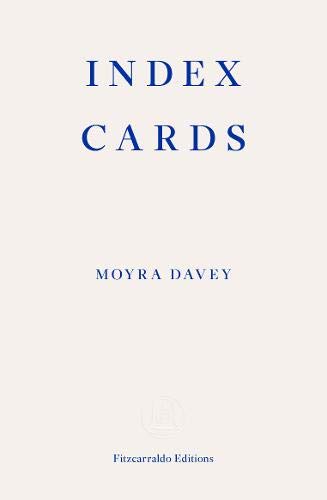
Index Cards
In these essays, the acclaimed artist, photographer, writer, and filmmaker Moyra Davey often begins with a daily encounter—with a photograph, a memory, or a passage from a book—and links that subject to others, drawing fascinating and unlikely connections, until you can almost feel the texture of her thinking. While thinking and writing, she weaves together disparate writers and artists—Mary Wollstonecraft, Jean Genet, Virginia Woolf, Janet Malcolm, Chantal Akerman, and Roland Barthes, among many others—in a way that is both elliptical and direct, clearheaded and personal, prismatic and self-examining, layering narratives to reveal the thorny but nourishing relationship between art and life.
232 pages, Paperback
First published May 26, 2020
About the author
Moyra Davey
22 books51 followersMoyra Davey was born in Toronto in 1958. She earned a BFA from Concordia University, Montreal, in 1982, and an MFA from the University of California San Diego in 1988. In 1989, she attended the Independent Study Program at the Whitney Museum of American Art, New York.
Davey’s work initially featured documentary photographs of her family and friends, and later came to focus on the quiet, overlooked details of daily life: coins, kitchen shelves, and clumps of dust gathered along the floor. Depicting outsize close-ups of the fronts of worn pennies, Davey’s Copperhead series (1990), emphasizes the circulation of banal, everyday objects individuated by the accumulation of human touch. In the mid-2000s, the moving image took on a renewed prominence in Davey’s work. Inspired by her deep interest in the process of reading and writing, the artist’s essayistic video practice layers personal narrative with detailed explorations of the texts and lives of authors and thinkers she admires, such as Walter Benjamin, Jean Genet, and Mary Wollstonecraft. Davey’s own writing is central to her videos. The transcript of Fifty Minutes (2006), in which the artist reflects on her years in psychoanalysis, was published as a personal essay in the artist book Long Life Cool White: Photographs and Essays by Moyra Davey (2008), and her text “The Wet and the Dry” formed the basis of the narration of Les Goddesses (2011).
Davey’s work initially featured documentary photographs of her family and friends, and later came to focus on the quiet, overlooked details of daily life: coins, kitchen shelves, and clumps of dust gathered along the floor. Depicting outsize close-ups of the fronts of worn pennies, Davey’s Copperhead series (1990), emphasizes the circulation of banal, everyday objects individuated by the accumulation of human touch. In the mid-2000s, the moving image took on a renewed prominence in Davey’s work. Inspired by her deep interest in the process of reading and writing, the artist’s essayistic video practice layers personal narrative with detailed explorations of the texts and lives of authors and thinkers she admires, such as Walter Benjamin, Jean Genet, and Mary Wollstonecraft. Davey’s own writing is central to her videos. The transcript of Fifty Minutes (2006), in which the artist reflects on her years in psychoanalysis, was published as a personal essay in the artist book Long Life Cool White: Photographs and Essays by Moyra Davey (2008), and her text “The Wet and the Dry” formed the basis of the narration of Les Goddesses (2011).
Ratings & Reviews
Friends & Following
Create a free account to discover what your friends think of this book!
Community Reviews
Displaying 1 - 30 of 81 reviews

June 4, 2022
A collection of essay-like pieces by New-York-based artist, photographer, and filmmaker, Moyra Davey. The entries are often elliptical, fragmented, many drawing on Davey’s earlier body of work; clear not just in her words but also in the way the text's juxtaposed with reproductions of her photographs or stills from her films. Included here are transcripts of videos, ideas for possible art projects, appearing alongside fragments of memoir and notes on episodes from her daily life. Davey has a fascination with “making”, and this extends to the processes not just of writing, but of reading, as creative acts. She muses over the writers and books she finds stimulating or hard to forget, chains of association form and spin out from one writer to another. Being diagnosed, then living with MS, as well as growing difficulties with her vision, sometimes make sleep hard to achieve, some nights are filled with reading through Robert Walser’s novels and stories, these in turn lead to reflections on Jean Genet – who like Walser often wrote on discarded scraps of paper. Davey’s an eclectic, enquiring, restless reader: thoughts about Mary Wollstonecraft and her children stir recollections of Davey’s youth and the lives of her own sisters; Virginia Woolf’s diaries vie with Susan Sontag’s and with Jane Bowles’s letters; Elizabeth Bowen unexpectedly mingles with Walter Benjamin, Natalia Ginzburg, and Roland Barthes. I’m not sure how far this works as an entirely standalone selection, or whether it’s better to have encountered - or at least have some knowledge of - Davey as an artist first, and I could see how some might find this collection scattered, overly random or frustrating, but for me it was fascinating and fertile: the way that Davey’s conjures thoughts around how ideas and episodes from what we read might feed into or shape our sense of self, or our existence over time; what reading is and what it might be; what we choose to read and why – all of which Davey’s addresses obliquely throughout and then directly in her penultimate entry “The Problem of Reading”.

March 9, 2021
I really enjoyed many of the references that Davey mentions. These essays seem a bit fragmented but I love her speaking of her process, her doubts, while she speaks of Mary Wollstonecraft, Walter Benjamin, James Baldwin, Susan Sontag. One of my favorite concepts is the "Low lying fruit" in photography. She is multidisciplined and her references come from photography, literature just as much as film. Wonderful book that came at a perfect time. Now I must see her visual work!

June 18, 2020
“The morning after the subway shot, I learn of Akerman’s death.” In “Hemlock Forest,” the eleventh of the fifteen essays that comprise INDEX CARDS, Moyra Davey reveals the curious happenstance of the great filmmaker, artist, writer, and teacher Chantal Akerman having taken her own life around the same time that Davey herself had been recreating a key difficult-to-achieve moment (the opposite of low-hanging fruit) from the Belgian master’s profoundly great 1977 experimental essay film NEWS FROM HOME. It is one of many uncanny correspondences that characterize this remarkable, sensitively attuned, and deeply personal book (and no doubt the life it indexes). I have my own experiences relating to Akerman’s suicide and the news of it having reached me, likewise a totally singular experience unintelligible independent of my own life’s journey. I have written a good deal about late 2015, the window in which this event occurred, and I have a good deal more still to explore. The weight of the news takes some time to register on Davey. That’s often how these things play. The sentence quoted at the outset of this consideration appears on page 150 of INDEX CARDS. Three pages later: “I am now officially derailed by Chantal Akerman.” Though born in Canada like myself (having spent her teen years in the city where I did my undergraduate and graduate degrees), Davey is just over twenty years my senior and has spent all or nearly all of the 21st century as a New Yorker and a major figure in the international art world, having exhibited through many prominent institutions. The circles she runs in being what they'd be, it's no surprise that the death of Akerman is going to produce substantial ripples within a more or less intimate peer group. Davey refers to a general tendency at the time to revisit Akerman’s films. “In the days and weeks after your death, we all stream and watch your films and interviews.” I recall doing just that. Back then. I read the essays, the obits, the tributes. But mine was a more isolated, more consummately private experience of grief. I lack intimate connections for whom this particular loss would have meant much of anything, any "we" from my standpoint fundamentally an abstraction. This is part of what the situation is going to be if you at some point in early adulthood return to the inauspicious mid-sized Western Canadian city in which you were born and kinda just surrender to the anonymity, the solitary pursuit or pursuits. I too have the benefit this month of a charming, you’d-almost-want-to-believe-fated correspondence. As I read “Hemlock Forest,” I do so having recently been able to watch two Akermans to which I had never previously had access—1989’s HISTOIRES D’AMÉRIQUE: FOOD, FAMILY AND PHILOSOPHY and 2006’s LÀ-BAS—on account of an eighteen film Akerman package having been recently made temporarily available to Criterion Channel subscribers. The essay “Hemlock Forest” is dated 2016. All the essays in INDEX CARDS conclude with the year of the essay’s composition appended. The essays tend to proceed chronologically, though this schematic is routinely disrupted in favour of striking counterpoints or salubrious interventions. This is the sequence of dates corresponding to the fifteen essays: 2006, 2014, 2008, 2010, 2013, 2011, 2014, 2013, 2012, 2014, 2016, 2017, 2017, 2003, 2019. The most striking chronometric discontinuity, notably, comes near the end of the book. Though concluding with the most recent piece, INDEX CARDS' penultimate essay is the earliest. We no doubt owe this in large part to Nicolas Linnert, editor of the collection in question, and I think it is an extremely shrewd move. While the development of her thinking does obey a certain linearity, Davey is always being pulled in multiple directions and the way elements of life and mind correspond to one another is wont to produce dynamic transversal bonds, modalities of self and self-identification that foment cross-associative syntheses. Chantal Akerman enters the picture before the event of her suicide interpolates itself as a veritable eruption, and we can be assured that she and her work will return again betimes. It is a law both of psychoanalytic theory (for which Davey routinely confesses a perhaps complicated partiality) and Zen Buddhism: the matter of what drive or desire or passion find themselves dealing with will not ever be satisfactorily resolved. There is no ‘having done with.’ In the opening essay, “Fifty Minutes,” Davey reflects upon reading Natalia Ginzburg’s VOICES IN THE EVENING on the subway, this in turn having excited the recollection of a piece by Vivian Gornick published shortly after 9/11 in which Gornick discusses Ginzburg, Elizabeth Bowen, and Anna Akhmatova. “As Gornick explains, all three authors have lived through terrible times: war, bombings, murder, ongoing persecution, and censure. Their writing, she notes, shares certain qualities of detachment, and a lack of sentimentality. It recounts events in a cool, matter-of-fact way. It does not emote.” Gornick had gone on to argue that it was not actually sentiment that was missing from the work of the three women, “it was nostalgia.” Davey stresses that her own experience of nostalgia has much to do with “unconsummated desire kept alive by private forays into the cultural spaces of memory.” These private forays are a kind of time travel, or a work that abides by its own temporal matrices, making dexterous leaps and forging mercurial connections. In considering Freud and Baudrillard, Davey alights upon the notion of the “lost and found game.” What is lost in time may be recovered in time, as when digging around in boxes of old contact sheets, but the clock and Gregorian calendar have precious little to do with it. In addressing nostalgia in its particularities and generalities, Davey had me returning to another filmmaker I cherish, the experimental cinema legend Hollis Frampton, whose 1971 piece [NOSTALGIA] is discussed in “Fifty Minutes” and happens to feature Frampton burning numerous photographs he once took on a hotplate while addressing the contexts that produced the photos, doing so asynchronously, such that we are always hearing about the next photo and looking at the one last abandoned to the proverbial void. Some void. Here I am in 2020, on whatever personal timeline, prompted by Moyra Davey, having another look at Frampton’s in-two-senses-rendered images. What is lost, the object or the work, is invariably going to have some commonality with those who are lost, the dead we loved or knew or merely knew of. Death was a motor of drive in Freud, perhaps the preeminent one. We reproduce for the precise reason that we are not long for this word, and from the basis of this mandate any number or personal hangups may happen to follow. Davey is aware that comportment with regard to living consciousness of death is of considerable importance. Herself diagnosed and living with the reality of multiple sclerosis, she is interested in death’s capacity to inspire more than in its tendency to arrest. She remarks upon the philosopher Gilles Deleuze’s assertion that to be ill without suffering is a very great privilege. She quotes legendary peripatetic asylum-resident Robert Walser in conversation with Carl Seelig: “I was very content in my sick person's room. To remain prone like a felled tree, without having to move one's little finger. All desires drift off to sleep, like children tired of playing. It's like being in a monastery, or in the anti-chamber [sic] of death.” In “Burn the Diaries,” the tenth essay (from 2014), Davey considers writers (many of them repeatedly-discussed favourites) like Jean Genet, Dennis Potter, Hervé Guibert, Christopher Hitchens, and David Rakoff, all of who saw terminal illness as above all a decisive and mobilizing factor in the life of their work. Dennis Potter, shortly to die of pancreatic cancer and taking carefully regulated dosages of morphine to manage the pain: “The fact is that if you see the present tense—boy do you see it! And, boy, can you celebrate it.... When I go flat out, I go flat out, and with a passion I've never felt. I feel I can write anything at the moment.” In the twelfth essay, “The Opposite of Low-Hanging Fruit,” Davey passingly refers to the “irritant-motor” of the aesthetic and ethical conundrums efforts to reconcile with which have continually informed her art-making practices and her dalliances with prosody. Death too might qualify as a substantial “irritant-motor,” the whole idea being that it can be put to the services of passion, exploration, experimentation. A big part of why I love the positioning of the 2003 essay “The Problem of Reading” next to last in INDEX CARDS is because of how fundamentally central the piece is, how its displacement within the schematic pays dividends in terms or reverberation but also insofar as concerns the new quality of luminosity it bestows upon the personal processes to the workings of which the reader is continually bearing witness. Fascinating here is how a letter from Davey’s longtime friend Alison Strayer—a peripheral presence in multiple essays—provides what we suddenly understand to be the germinal impetus for a future filiation experienced with Roland Barthes, grounded most especially in the latter’s assertion that the most valuable kind of reading is that which is already writing. That seed is planted in Davey by Alison Strayer, as testified to in the 2003, and comes to fruition in passing consideration of Barthes in the 2008 “Notes on Photography & Accident,” appearing third in this collection. Davey comes to apprehend in Barthes and, earlier, Walter Benjamin, a complementarity or correspondence as pertains both to writing and photography, especially should we be inclined to grant primacy to the snapshot. In 2008 Davey is excited by Barthes’ concept of the “punctum,” the burrowed inscription within the photograph that points to its contingency, its cosmic happenstance and the explosive life-force of its frozen reality. She notes how Susan Sontag, fan of both Benjamin and Barthes, points to Benjamin’s insistence on being a writer enmeshed in a similar snapshot-collecting process, hunting for “pearls” and “coral.” Early in “Notes on Photography & Accident” Davey herself interpolates the metaphor of seed planting. “And I have another motive as well: I want to make some photographs, but I want them to take seed in words.” (A number of the essays here, such as “Les Goddesses” from 2011 and the aforementioned “Hemlock Forest,” share their respective names with works she had or would go on to create on film.) “I decide to allow chance elements, the flânerie, as it were, of daily life, to find their way into this essay.” Later in the essay Davey comes around to her own sense of accident: “that accident is to be located outside the frame somehow, in the way we apprehend images. I shun the formal encounter via the institutions of galleries and museums, and gravitate to books and journals.” The is a moveable operative modality. It’s how you best gain access to impossibly rich ‘pearls’ and ‘coral.’ It is its own space-time. Much of the business of artistic-ethical quandary mobilized and continually remobilized in INDEX CARDS concerns matters that Davey refers to as “duty” and very often doesn’t call duty but could just as well do. “Caryatids and Promiscuity” is an essay in which the author—not for the first time here—considers her relationship with her four sisters (and photographs she took of them) through the lens of Mary Wollstonecraft and her daughters (plus auxiliary daughter, cousin Claire Clairmont), such that she finds herself grappling with the discursive context in which her practices were reared (and in which the beloved snapshot itself came to be routinely adjudged dubious or even outright invasive): “And now, thinking back over my recent transgressions, I don’t know that I can answer for what I’ve done. Obviously, there’s a question of degree, the lengths an artist might go to produce a potentially prurient, intrusive image, and then the use it gets put to, the circulation it receives. And then there is context: all of my still images in LES GODDESSES are accompanied by a fairly relentless voice-over, anchoring the nudes and the clandestine subway shots in a very pointed narrative.” Not necessarily able to set aside the quibbles her own methodologies may at times provoke even for her, Davey arrives at a provisional conclusion (within the same essay): “More important to me than fidelity and adherence to a medium is a kind of devotion to promiscuity (to lift that concept once again from the lexicon of Gregg Brodowitz), an embrace of materials, formats, histories and genres, and lastly but perhaps most importantly, an investment in language. I am a believer in heterogeneity as an enabler and enhancer of the story wanting to be told.” Far more than a mere triumph over the strictures of “fidelity and adherence to a medium,” this passage mobilizes an overcoming of internalized sense of duty, a force that is by some measure the arrester death never could be. Not simply a matter of the suspension of moral and/or ethical considerations, it confirms, to my mind, a tenuous fidelity to the three pillars of Gilles Deleuze’s ESSAYS CRITICAL AND CLINICAL (a book Davey does not discuss): creation, experimentation, demystification. Passion should set about hyping itself up. Unto who can know what. This is in large part where that early essay near the end of INDEX CARDS figures. “The Problem of Reading.” The essay brings us circuitously to the instantiation of a process, and this process is about reading that produces writing or at least more reading. Reading that intensifies, directs, or simply ‘leans in.’ 2003 Davey is very much taken with Virginia Woolf. It will serve her better than she can probably at this point comprehend. Randomness and chance are commonly allotted a key role in the generation of our personal syllabi. Davey takes a look at John Cage, Harold Bloom, Italo Calvino, et cetera. Woolf has something to offer. Especially for somebody like Davey. For any of us, really, who would rather be keen custodians of fruitful, energizing encounters as opposed to turgid, denuded databank beings. Davey looks at a number of Woolf’s essays, finding especial inspiration in “Hours in a Library,” a relatively early piece. “I think the truest method, as Woolf suggests, is to be open and sensitized, creative, always on the lookout for the thing that will nurture a known or intuited desire or inkling.” What is this declaration but the ratification of a way? Yes, a way. A thousand times more felicitous than that of the samurai. A discours de la méthode to put Descartes’ to shame.

July 8, 2020
Thanks to the wonderful Community Bookstore in Brooklyn for mailing me Index Cards--and for the great launch event featuring the author in conversation with Maggie Nelson (pub date May 26, 2020 from New Directions)--
Moyra Davey's Index Cards is a fantastic essay collection that contains works written over many years, yet the subject matter repeats and oscillates in fascinating ways--an anecdote about Walter Benjamin informs a conversation about the practice of psychoanalysis and different ideas on photography-making; the story of Mary Wollstonecraft and her daughters influences varying thoughts on everything from sibling relationships and parenthood to letter writing. In this way, Davey proceeds through the minutiae of daily life, by linking the processes of reading and writing with everyday occurrences.
These pieces seem quiet on the surface, but they explode with meaning, particularly in the face of a world that seems to equate importance with loudness. Instead, Davey focuses on the small connections that others might miss, like the similarly pared down existences of Robert Walser and Jean Genet at the end of their lives. Or the way that a casual reference to a writer, made by a friend, seems to give us permission to pick up different books and enjoy a more spontaneous reading experience. Index Cards, like its title, hones in on so-called plans for future creativity (notes, jottings, random quotations, journal entries, descriptions of people on the subway), and shows how these musings can constitute art in their own right.
Highly recommend, especially for artists who are feeling a bit lost. Davey does a lot to ground the difficulty of creative practices--and to emphasize the importance of meandering and wandering/wondering. It's okay to not always know what you're doing; in reality, that's the good stuff.
Moyra Davey's Index Cards is a fantastic essay collection that contains works written over many years, yet the subject matter repeats and oscillates in fascinating ways--an anecdote about Walter Benjamin informs a conversation about the practice of psychoanalysis and different ideas on photography-making; the story of Mary Wollstonecraft and her daughters influences varying thoughts on everything from sibling relationships and parenthood to letter writing. In this way, Davey proceeds through the minutiae of daily life, by linking the processes of reading and writing with everyday occurrences.
These pieces seem quiet on the surface, but they explode with meaning, particularly in the face of a world that seems to equate importance with loudness. Instead, Davey focuses on the small connections that others might miss, like the similarly pared down existences of Robert Walser and Jean Genet at the end of their lives. Or the way that a casual reference to a writer, made by a friend, seems to give us permission to pick up different books and enjoy a more spontaneous reading experience. Index Cards, like its title, hones in on so-called plans for future creativity (notes, jottings, random quotations, journal entries, descriptions of people on the subway), and shows how these musings can constitute art in their own right.
Highly recommend, especially for artists who are feeling a bit lost. Davey does a lot to ground the difficulty of creative practices--and to emphasize the importance of meandering and wandering/wondering. It's okay to not always know what you're doing; in reality, that's the good stuff.

February 10, 2021
Een verfrissende verzameling essays. Ik ben erg benieuwd wat Davey nog meer geschreven heeft.
*4,5
*4,5

July 31, 2020
"I realize that I write about being deformed and remade by the things I read. And I'm trying to write in the form of the things that I want to read: diaries, fragments, lists." (p.97)
29 JULY
Reading Davey at home. Cut the book in three parts. Halfway the second slice I realize how much the first part has changed. I think I should reread the first cut.
"Read. Read something else. Go back to the first thing and see how it is changed." (Mora Davey)
PUNCTUM
It is always hard to tell where MD stops her reading and starts her writing. More than once she had to be prompted to enlarge her writing, add something to her text and not stop at the point she felt she wrote all she wanted to tell. I enjoy that view on writing. MD takes photographs. Only you don't know when her photography is writing or when it's supposed to be reading. Any thought can be a click, the switch towards the counterpart. In her essays Davey constantly tries to connect the act of writing with photography, almost always ending up in reading. In writing on Benjamin, Barthes or Sontag she leaves us behind reading Woolf, Walser, Wollstonecraft or Genet.
MD is very fond of the literary connections in photography. "For Barthes the punctum could not be willed, and while [her] interjections are clearly not accidents, they have a strong unconscious quality. Her view of the world is profoundly and understatedly psychoanalytic. I love to read her because of this (...) [Her] perceptions thrill because they signal "truth" in the way that strange, eccentric details nearly always do."
BURN THE DIARIES
I don't think that's a good idea.
2020
29 JULY
Reading Davey at home. Cut the book in three parts. Halfway the second slice I realize how much the first part has changed. I think I should reread the first cut.
"Read. Read something else. Go back to the first thing and see how it is changed." (Mora Davey)
PUNCTUM
It is always hard to tell where MD stops her reading and starts her writing. More than once she had to be prompted to enlarge her writing, add something to her text and not stop at the point she felt she wrote all she wanted to tell. I enjoy that view on writing. MD takes photographs. Only you don't know when her photography is writing or when it's supposed to be reading. Any thought can be a click, the switch towards the counterpart. In her essays Davey constantly tries to connect the act of writing with photography, almost always ending up in reading. In writing on Benjamin, Barthes or Sontag she leaves us behind reading Woolf, Walser, Wollstonecraft or Genet.
MD is very fond of the literary connections in photography. "For Barthes the punctum could not be willed, and while [her] interjections are clearly not accidents, they have a strong unconscious quality. Her view of the world is profoundly and understatedly psychoanalytic. I love to read her because of this (...) [Her] perceptions thrill because they signal "truth" in the way that strange, eccentric details nearly always do."
BURN THE DIARIES
I don't think that's a good idea.
2020

July 1, 2021
I've been a subscriber of Fitzcarraldo Editions — a wonderful UK publishing house — for the past 2-3 years now and have greatly enjoyed a number of their titles. I was expecting to enjoy this as well, and when I came back from living out of state last year to find that I had three copies of "Index Cards" awaiting me, I immediately thought what a great thing that was — I could give the other two out to friends!
I love giving people books — what book fiend doesn't? But they have to be good books and that's unfortunately where "Index Cards" and I part ways. I can't give someone a bad book — better to give them no book at all! So now I've got three copies of "Index Cards" that I'm stuck with.
I'm going down to Orlando this weekend as well. I'd finally taken this one off the shelf because I was going to give my friend Shawn, who I'll be staying with, one of my copies. I would read it to ensure it was good, which I was sure it would be, and he would be thrilled to have received a book as a gift — similar book fiend that he is.
But instead I read this thing — an incredibly fragmented series of "essays," if you can call them that. "Index Cards" seems to be the result of a writing exercise in which Moyra Davey just wrote down whatever popped into her head in relation to a particular topic.
That'd be fine if these topics were at all interesting, but they're really not. Going in, I had no idea who Moyra Davey was, and perhaps this is part of the problem. If you pick this one up, perhaps you do so because you know who the author is and are eager to hear her thoughts on various things, mostly photography, which makes sense as she's apparently a photographer.
But gosh, is this a slog! You think wading through a marsh in the middle of a hurricane is a tough time — try reading more than 30 pages of this! It's not easy, I tell you.
So I skipped from essay to essay. One here, one there, bits everywhere else. Not. My. Thing. I appreciate the high-mindedness of the project, the ambition. But I need at least a little sugar in my pudding. At least a pinch of salt in my pasta.
This is as coarse and scattered as driftwood after a tsunami. As littered with tedium as a congressional hearing on C-Span.
To each their own. I will have to donate my three copies.
I love giving people books — what book fiend doesn't? But they have to be good books and that's unfortunately where "Index Cards" and I part ways. I can't give someone a bad book — better to give them no book at all! So now I've got three copies of "Index Cards" that I'm stuck with.
I'm going down to Orlando this weekend as well. I'd finally taken this one off the shelf because I was going to give my friend Shawn, who I'll be staying with, one of my copies. I would read it to ensure it was good, which I was sure it would be, and he would be thrilled to have received a book as a gift — similar book fiend that he is.
But instead I read this thing — an incredibly fragmented series of "essays," if you can call them that. "Index Cards" seems to be the result of a writing exercise in which Moyra Davey just wrote down whatever popped into her head in relation to a particular topic.
That'd be fine if these topics were at all interesting, but they're really not. Going in, I had no idea who Moyra Davey was, and perhaps this is part of the problem. If you pick this one up, perhaps you do so because you know who the author is and are eager to hear her thoughts on various things, mostly photography, which makes sense as she's apparently a photographer.
But gosh, is this a slog! You think wading through a marsh in the middle of a hurricane is a tough time — try reading more than 30 pages of this! It's not easy, I tell you.
So I skipped from essay to essay. One here, one there, bits everywhere else. Not. My. Thing. I appreciate the high-mindedness of the project, the ambition. But I need at least a little sugar in my pudding. At least a pinch of salt in my pasta.
This is as coarse and scattered as driftwood after a tsunami. As littered with tedium as a congressional hearing on C-Span.
To each their own. I will have to donate my three copies.

August 2, 2022
I agree with other reviewers that a lot of this book seems fragmented, but then I think that is what the author intended. If you think of little notes, fragments written on index cards, this fits.
I had an epiphany in my own work from this book after I looked up her photography. Her photo on Libraries and Coffeehouses stopped me in my tracks. So this book will always be special to me because of the rare occurrence that happened.
The one con: Too many references to bodily functions, which IMO were totally unnecessary.

Read
September 29, 2023Quotes:
"I spend most of my time trolling through a half a dozen or so books, all the while imagining there's another one out there I should be reading instead, if I could only just put my finger on it. Often I find the spark where I least expect it, in a book I may have been reading casually, lazily, wondering why I am even bothering to read it. Sometimes I persist with a book, even just through inertia, and it can happen that the writing will suddenly open itself up to me."
"In the dictionary there is a third definition of nostalgia, which is 'unsatisfied desire'. And that is what the word has always implied to me: unconsummated desire kept alive by private forays into the cultural spaces of memory."
"There is a flânerie of reading that can be linked to the flânerie of a certain kind of photographing. Both involve drift, but also purpose, when they become enterprises of absorption and collecting."
"How much easier to read [Walter] Benjamin on drugs."
"We tend to cannibalize experience and that we should consider spending more time just listening to music, for instance, for its own sake."
"When Mary Wollstonecraft visited Sweden and Norway in 1795, she drank the landscape. Its beauty was a tonic to her depression and sadness, and she bore witness in her letters to the restorative effects of the rugged coast-line, the giant trees, and the marvels of sunlight."
"I am now officially derailed by Chantal Akerman."
"After making Jeanne Dielman, Chantal told Delphine Seyrig, the star of her film, that she thought she no longer had the spark. You said that you thought you'd never again feel the euphoria of filmmaking. And Seyrig said to you: 'You have to make, make, make. You still have the passion. You're just not an adolescent anymore.'"
"It is not just a question of which book will absorb her, for there are plenty that will do that, but rather, which book, in a nearly cosmic sense, will choose her, redeem her.... She has the idea that if she can simply plug into the right book then all will be calm, still, and right with the world."
"I spend most of my time trolling through a half a dozen or so books, all the while imagining there's another one out there I should be reading instead, if I could only just put my finger on it. Often I find the spark where I least expect it, in a book I may have been reading casually, lazily, wondering why I am even bothering to read it. Sometimes I persist with a book, even just through inertia, and it can happen that the writing will suddenly open itself up to me."
"In the dictionary there is a third definition of nostalgia, which is 'unsatisfied desire'. And that is what the word has always implied to me: unconsummated desire kept alive by private forays into the cultural spaces of memory."
"There is a flânerie of reading that can be linked to the flânerie of a certain kind of photographing. Both involve drift, but also purpose, when they become enterprises of absorption and collecting."
"How much easier to read [Walter] Benjamin on drugs."
"We tend to cannibalize experience and that we should consider spending more time just listening to music, for instance, for its own sake."
"When Mary Wollstonecraft visited Sweden and Norway in 1795, she drank the landscape. Its beauty was a tonic to her depression and sadness, and she bore witness in her letters to the restorative effects of the rugged coast-line, the giant trees, and the marvels of sunlight."
"I am now officially derailed by Chantal Akerman."
"After making Jeanne Dielman, Chantal told Delphine Seyrig, the star of her film, that she thought she no longer had the spark. You said that you thought you'd never again feel the euphoria of filmmaking. And Seyrig said to you: 'You have to make, make, make. You still have the passion. You're just not an adolescent anymore.'"
"It is not just a question of which book will absorb her, for there are plenty that will do that, but rather, which book, in a nearly cosmic sense, will choose her, redeem her.... She has the idea that if she can simply plug into the right book then all will be calm, still, and right with the world."

August 22, 2021
elliptical and meditative essays on time, decay, craft, illness, the physicality of reading and writing, and the desire to prove and justify sensuality through making. My favorite book I have read this year.

March 29, 2022
It‘s difficult to properly connect with an essay collection that is based a lot around the works of the artist and author of said collection when you‘re not at all familiar with the works. Or the many people she writes about - if you‘ve never read Genet or Barthes or the likes, then that is another topic in here you might be bored by.
Some lovely paragraphs and sentiments and I did like the essay on reading; however I think this would have been way better if I‘d known Davey‘s works previous to this.
Some lovely paragraphs and sentiments and I did like the essay on reading; however I think this would have been way better if I‘d known Davey‘s works previous to this.

May 30, 2024
Thoroughly enjoyed the first half, & detested the pointlessness of the second. References start getting thrown about without any proper intellectual engagement with the material, there are too many instances of bodily secretion that are entirely extraneous to the stories, the writing begins to spiral down into near (yet pompous) nonsense, and then she also compliments Harold Bloom of all people on his 'relentless erudition'? What???

November 17, 2025
-enjoyed this interweaving tapestry of subjects, seeing where Davey slots them back into the narrative, where they crop up again and how they’re linked to the previous reflection
-feels like the reader can follow her train of thought in a natural sense, the form doesn’t feel forced or like a gimmick
-feels like the reader can follow her train of thought in a natural sense, the form doesn’t feel forced or like a gimmick

May 9, 2024
love to see the process of writing as a finished product, love when she repeats herself and lets things overlap. love to see the debris collected in the course of living
August 15, 2024
Moyra Davey writes with such a blunt spoken voice that is hard to put down. Having seen her video work I can faintly hear her speaking voice when reading, but I Think that is beside the point. Her style is hypnotic and the level of self reflexivity that she attains is so real to the experience of working through an idea(s). This collection of essays, their total culmination, is a total work of art in and of itself.

January 4, 2021
Reading this collection of essays started well. At some moments later it was difficult for me to push forward. I was very close to abandoning it, and I usually persevere and read books to the end. I'm happy that I stuck to this principle because the essay about reading "The problem of reading"(which is the one before the last in the collection) is a real jewel. Of course, there were other good essays too. Some of the essays were difficult to follow as they referred to artists that I don't know. I think professional artists will appreciate this collection more than me.
Not to mention that I didn't know who Moyra Davey is before reading the essays. It turned out she is an artist and photographer with a great passion for reading. She is revealing her personal and professional struggles extraordinarily. There is a lot of interesting thoughts on the topic of psychoanalysis too.
Moyra Davey is making some parallels through different writer's stories. There is a lot about Mary Wollstonecraft and her daughters (one of which is Mary Shelley) and also analysis and connections to other writers' works - Virginia Woolf, Ghoete, Susan Sontag, Jean Genet.
Some notable quotes:
"I would have told about how proprietary and controlling is my relation to the fridge, and about how the food it contains brings out my most anxious and miserly tendencies, as though by fixating on the process of consumption and replenishment I can control my destiny. "
"Read. Read something else. Go back to the first thing and see how it is changed."
Jean Genet is asked: "Is a reader changed by what he reads? Are there books that changed you?"
- "In the end no. . . . Every person takes his nourishment from everything. He isn't transformed by reading a book, looking at a painting, or hearing a piece of music; he is transformed gradually, and from all these things he makes something that suits him."
"What to read?" is a recurring dilemma in my life. The question always conjures up an image: a woman at home, half-dressed, moving restlessly from room to room, picking up a book, reading a page or two and no sooner feeling her mind drift, telling herself, "You should be reading something else, you should be doing something else."
This collection was a very good experience overall and was a bit random choice for me but I think I was in a mood for essays. I'm sure some of those are going to be re-read soonish.
Not to mention that I didn't know who Moyra Davey is before reading the essays. It turned out she is an artist and photographer with a great passion for reading. She is revealing her personal and professional struggles extraordinarily. There is a lot of interesting thoughts on the topic of psychoanalysis too.
Moyra Davey is making some parallels through different writer's stories. There is a lot about Mary Wollstonecraft and her daughters (one of which is Mary Shelley) and also analysis and connections to other writers' works - Virginia Woolf, Ghoete, Susan Sontag, Jean Genet.
Some notable quotes:
"I would have told about how proprietary and controlling is my relation to the fridge, and about how the food it contains brings out my most anxious and miserly tendencies, as though by fixating on the process of consumption and replenishment I can control my destiny. "
"Read. Read something else. Go back to the first thing and see how it is changed."
Jean Genet is asked: "Is a reader changed by what he reads? Are there books that changed you?"
- "In the end no. . . . Every person takes his nourishment from everything. He isn't transformed by reading a book, looking at a painting, or hearing a piece of music; he is transformed gradually, and from all these things he makes something that suits him."
"What to read?" is a recurring dilemma in my life. The question always conjures up an image: a woman at home, half-dressed, moving restlessly from room to room, picking up a book, reading a page or two and no sooner feeling her mind drift, telling herself, "You should be reading something else, you should be doing something else."
This collection was a very good experience overall and was a bit random choice for me but I think I was in a mood for essays. I'm sure some of those are going to be re-read soonish.

January 24, 2021
Was really excited for this book, but even though it is was a great success in my reading group - it was not for me.
There where good collection of quirestions and thought from other people, but I think it was very self indulgence and with the idea what the reader have read all the same things as the writer. There is too much of name throwing and that just made me skim through the book and get more and more frustrated. I think I needed some guidance how to read this piece of writing. It is very chaotic and has very little structure, or I just did not got it.
Maybe it is me who is the problem? But, would not recommend this book for a friend.
There where good collection of quirestions and thought from other people, but I think it was very self indulgence and with the idea what the reader have read all the same things as the writer. There is too much of name throwing and that just made me skim through the book and get more and more frustrated. I think I needed some guidance how to read this piece of writing. It is very chaotic and has very little structure, or I just did not got it.
Maybe it is me who is the problem? But, would not recommend this book for a friend.
January 24, 2021
the definition of a compulsive read! i picked it up on the lovely ms. zambreno's recommendation but it ended up being enormously relevant to my own research interests, so it was a double-gift! i love reading books about writing, about fragments and lists and the writing that writers do when they aren't, well. writing. this was such a fascinating look into that little, precious realm that exists on the margins of productivity.

May 20, 2025
the thing is only alive (and, by extension, i am only alive) while it is in process ……!

October 14, 2025
I first came into contact with Moyra’s work through an essay and conversation with Maggie Nelson in Maggie’s book Like Love: Essays and Conversations, where I really appreciated Moyra’s frank and honest dialogue with Maggie—especially around shame and how to navigate it when making art.
It’s a bit unfortunate, then, that this book wasn’t something I enjoyed. It contains many of the things I love—references to artists and thinkers I admire, fragmentary writing, and an emphasis on art as a life-sustaining force. Yet it began to devolve into list-making and accumulation, which became exhausting and taxing by the end.
There were some highlights, particularly Moyra’s tendency to return to earlier ideas and draw parallels between people and stories that, while not explicitly connected, circle similar questions and preoccupations. I found that highly generative and reparative. I especially loved her explorations of Jean Genet, and her essay on reading and writing—where she allowed herself to go deep and wide at once. But that kind of depth was missing from much of the rest, which too often felt like paper-thin references and passing thoughts.
Every now and then, Moyra discloses difficult aspects of her life—her upbringing, her loss of sexual appetite with age, her sense of not being a tender or good enough parent. Yet one can feel there’s a great deal being held back, which makes me wonder if it ties to the shame she so passionately discussed with Maggie in Like Love. Maggie, one of my favorites, dives into personal conundrums while layering deeply researched references that build something whole and resonant. In Moyra’s hands, that didn’t quite land for me.
Still, it’s a book brimming with ideas. If only there had been more intention to stay with them—to follow the threads as they emerged—it could have been much more compelling. I know she’s capable of that. Maybe in her next book, she’ll let those instincts fully shine through.
It’s a bit unfortunate, then, that this book wasn’t something I enjoyed. It contains many of the things I love—references to artists and thinkers I admire, fragmentary writing, and an emphasis on art as a life-sustaining force. Yet it began to devolve into list-making and accumulation, which became exhausting and taxing by the end.
There were some highlights, particularly Moyra’s tendency to return to earlier ideas and draw parallels between people and stories that, while not explicitly connected, circle similar questions and preoccupations. I found that highly generative and reparative. I especially loved her explorations of Jean Genet, and her essay on reading and writing—where she allowed herself to go deep and wide at once. But that kind of depth was missing from much of the rest, which too often felt like paper-thin references and passing thoughts.
Every now and then, Moyra discloses difficult aspects of her life—her upbringing, her loss of sexual appetite with age, her sense of not being a tender or good enough parent. Yet one can feel there’s a great deal being held back, which makes me wonder if it ties to the shame she so passionately discussed with Maggie in Like Love. Maggie, one of my favorites, dives into personal conundrums while layering deeply researched references that build something whole and resonant. In Moyra’s hands, that didn’t quite land for me.
Still, it’s a book brimming with ideas. If only there had been more intention to stay with them—to follow the threads as they emerged—it could have been much more compelling. I know she’s capable of that. Maybe in her next book, she’ll let those instincts fully shine through.

November 1, 2022
“Reflectieve nostalgia, on the other hand, has a “utopian dimension.” It is not about “rebuilding the mythical place called home (but about) perpetually deferring the homecoming itself”
‘Here is a personal example of reflective nostalgia: As I write and think about this abstraction, nostalgia, a particular landscape always presents itself. It involves a summer day, a park in Montreal, ‘60s-era architecture, my mother, and a scene from an Antonioni film. But I can’t say more than that. To do so would be to kill off the memory and all the generative power it holds in my imagination. I keep it perpetually in reserve, with the fantasy that someday I may land there, in what is by now a fictional mirage of time and place.’
‘Here is a personal example of reflective nostalgia: As I write and think about this abstraction, nostalgia, a particular landscape always presents itself. It involves a summer day, a park in Montreal, ‘60s-era architecture, my mother, and a scene from an Antonioni film. But I can’t say more than that. To do so would be to kill off the memory and all the generative power it holds in my imagination. I keep it perpetually in reserve, with the fantasy that someday I may land there, in what is by now a fictional mirage of time and place.’

February 10, 2021
Part autobiographical, part note-taking, really enjoyed the format of this. She writes very direct and unpretentious, but could also describe the most foul and shameful circumstances so eloquently. Her obsession w reading makes me more obsessed w reading :)

April 9, 2024
read this on the train to new york and in the subway there, I liked how meta these essays are - a lot of the grappling with how much she cites other things she has read in them as well as questioning the way she tends to read with the aim of using what she is consuming, rather than letting it pass over her. I underlined and make notes in the margins so i suppose i am the same.
June 7, 2020
Good to have these all in one place.
Read
August 28, 2020A fascinating collection of essays, masterfully weaving together a plethora of other texts and Davey's personal familial and professional struggles.


January 24, 2023
loved loved loved the essay "The Problem of Reading" in this!

Read
June 17, 2023Loved it

October 3, 2021
the only person who is allowed to love chantal akerman as much as i do

October 28, 2022
2,75; meh
Displaying 1 - 30 of 81 reviews