

What do you think?

Pasozyty w twoim mozgu
Pasjonujace sledztwo w poszukiwaniu niezliczonych sposobów, za pomoca których pasozyty kontroluja sposób myslenia, czucia i dzialania innych zwierzat - w tym ludzi.
Te male organizmy moga przezyc wylacznie w cialach innych stworzen i z punktu widzenia ewolucji maja wiele powodów, aby manipulowac zachowaniem swoich zywicieli, co ujawnia ksiazka Kathleen McAuliffe. Jak wladcy marionetek, manipuluja relacjami pomiedzy drapieznikami a ich ofiarami, i to duzo czesciej niz mogloby sie wydawac. Z nadzwyczajna precyzja naklaniaja szczury, aby zblizyly sie do kotów, pajaki, aby zmienialy wzory swoich sieci, a takze ryby, aby wystawialy sie na uczte ptakom.
My, ludzie, równiez nie opieramy sie glebokiemu wplywowi pasozytów. Organizmy, którymi zarazamy sie od wlasnych zwierzat domowych, najwyrazniej moga zmieniac cechy naszego charakteru i po czesci odpowiadaja za brawurowe i impulsywne zachowania - do samobójstw wlacznie. Mikroby obecne w naszych trzewiach maja wplyw na nasze emocje i zwoje mózgowe. Zarazki wywolujace przeziebienie i grype moga zmieniac nasze zachowanie nawet zanim pojawia sie pierwsze objawy choroby.
Te male organizmy moga przezyc wylacznie w cialach innych stworzen i z punktu widzenia ewolucji maja wiele powodów, aby manipulowac zachowaniem swoich zywicieli, co ujawnia ksiazka Kathleen McAuliffe. Jak wladcy marionetek, manipuluja relacjami pomiedzy drapieznikami a ich ofiarami, i to duzo czesciej niz mogloby sie wydawac. Z nadzwyczajna precyzja naklaniaja szczury, aby zblizyly sie do kotów, pajaki, aby zmienialy wzory swoich sieci, a takze ryby, aby wystawialy sie na uczte ptakom.
My, ludzie, równiez nie opieramy sie glebokiemu wplywowi pasozytów. Organizmy, którymi zarazamy sie od wlasnych zwierzat domowych, najwyrazniej moga zmieniac cechy naszego charakteru i po czesci odpowiadaja za brawurowe i impulsywne zachowania - do samobójstw wlacznie. Mikroby obecne w naszych trzewiach maja wplyw na nasze emocje i zwoje mózgowe. Zarazki wywolujace przeziebienie i grype moga zmieniac nasze zachowanie nawet zanim pojawia sie pierwsze objawy choroby.
344 pages, Paperback
First published June 7, 2016
About the author
Kathleen McAuliffe
5 books19 followersKathleen McAuliffe is the author most recently of the book This Is Your Brain On Parasites: How Tiny Creatures Manipulate Our Behavior and Shape Society (Houghton Mifflin), a bestseller in parasitology and microbiology that has been translated into six languages. Over the decades, she has written articles—many featured on covers—for over a dozen national magazines, including Discover, The New York Times (both the Sunday Magazine and newspaper), The Atlantic, US News & World Report, Smithsonian, and the Los Angeles Times. Earlier in her career, she was a health columnist for More Magazine, and a senior science editor at US News & World Report and Omni Magazine.
In addition to writing, McAuliffe is an adjunct professor at the University of Miami where she is currently teaching a course on the human microbiome.
McAuliffe was educated at Trinity College Dublin, Ireland, obtaining an M.A. in natural science after graduating with first-class honors (highest distinction). Her final year thesis on electroencephalography (EEG) recordings of the human brain was presented at the Eastern Psychology Association Conference in 1977.
McAuliffe resides in Miami, Florida with her husband, a physicist at the University of Miami.
In addition to writing, McAuliffe is an adjunct professor at the University of Miami where she is currently teaching a course on the human microbiome.
McAuliffe was educated at Trinity College Dublin, Ireland, obtaining an M.A. in natural science after graduating with first-class honors (highest distinction). Her final year thesis on electroencephalography (EEG) recordings of the human brain was presented at the Eastern Psychology Association Conference in 1977.
McAuliffe resides in Miami, Florida with her husband, a physicist at the University of Miami.
Ratings & Reviews
Friends & Following
Create a free account to discover what your friends think of this book!
Community Reviews
Displaying 1 - 30 of 354 reviews

April 11, 2018
The mechanisms in animals and humans are known so far. Only who says that we know all of them?
There are cases of parasitism that are apparent like when prions capture the brain of cattle in the form of BSE and no one trusts the steak anymore, especially when it is cooked blue rare to medium-rare. Or when the notorious mushroom Ophiocordyceps unilateralis captures ants and lets cute, fashionable but deadly hats sprout out of their heads.
Not to forget the apparent, unappetizing parasites such as various worms. But even these, through changes in the digestive tract, can indirectly manipulate the behavior of the host as a side effect of the altered microfauna.
The ultimate goal of a parasite is to live unrecognized as long as possible in the host and multiply. If the host dies too soon, the parasite, like a very deadly virus, has been too greedy and poorly adapted. It would be ideal for it to be able to live for the entire lifespan of a host unrecognized in it without causing any suspicious symptoms and to infect as many as possible during this time. The most cuddly would be a place around which the victim's immune system is vigilant and no other competitor has access, perhaps in the central nervous system, such as herpes and other viruses. Or a monopoly in the brain as the ultra jackpot.
Science knows a few of the processes that parasites are taking advantage of to turn their victims into hosts. In the most astonishing ways, they can take direct control of their minds. This fatal relationship concept seems to be reserved for insects and fungi. Still. It's not subtle, either, because ants recognize the warning signs and haul sufferers to the ant equivalent of plague and leper colonies.
In less extreme cases, just the meat and body of the host serves as a transport medium to be carried back to the optimal breeding areas. A complex interaction between the breeding site, the intermediate hosts and the end hosts is necessary. The tormentors manage to orchestrate every step of the logistics chain perfectly with their different development stages and all their dolls dance in perfect synchrony.
Looking at human evolution from a microbiological point of view and traveling back a few million years, one question arises. Have the small rodents, monkeys and high civilizations acted and developed only on own their initiative? As a hypothesis, one could assume that the climatic favored parasites significantly influenced the evolution of higher life forms. Not the god-king formed the face of the earth, but the dwarfs in his holy body.
A philosophical consideration: if the earth is a life form, man is an incredibly clumsy, destructive and stupid parasite. It has not internalized to let one's host live as long as possible. One could also target the analogy to a virus, as in the movie Matrix. It's a little bit of both.
A better and longer evolved fungus or prion could have specialized since the first small mammals to become a lifelong unnoticed companion. In order not to be recognized by the white blood cells and the memory cells, he had to camouflage or mislead better and better. To overcome the blood-brain barrier, he had to miniaturize himself.
Since the brain does not feel pain, a brain parasite mutated with a focus on destructiveness and resulting madness could begin to cause damage and infection. Only at elevated infection levels or because of signs of brain damage, one would notice his presence. But before that, it could switch and act and play. For example, the always top-rated and far too serious game called human ego, personality and consciousness.
Or if it needs the hosts' death for reproduction, it lets them become depressed, so they commit suicide. Or it makes them aggressive and careless, so they would rather die in an accident or fight.
If a person infected with an influenza virus feels the increased need for social contacts and AIDS patients develop some strong sexual instincts shortly before they die, the small manipulators can certainly do even more in the long term.
This is much more subtle than when the forehead begins to bulge and the fruiting bodies of a mushroom burst out between the eyes in the subway or at a family party and crush both the skull and the celebration.
A wiki walk can be as refreshing to the mind as a walk through nature in this completely overrated real-life outside books:
https://en.wikipedia.org/wiki/Parasitism
https://en.wikipedia.org/wiki/List_of...
There are cases of parasitism that are apparent like when prions capture the brain of cattle in the form of BSE and no one trusts the steak anymore, especially when it is cooked blue rare to medium-rare. Or when the notorious mushroom Ophiocordyceps unilateralis captures ants and lets cute, fashionable but deadly hats sprout out of their heads.
Not to forget the apparent, unappetizing parasites such as various worms. But even these, through changes in the digestive tract, can indirectly manipulate the behavior of the host as a side effect of the altered microfauna.
The ultimate goal of a parasite is to live unrecognized as long as possible in the host and multiply. If the host dies too soon, the parasite, like a very deadly virus, has been too greedy and poorly adapted. It would be ideal for it to be able to live for the entire lifespan of a host unrecognized in it without causing any suspicious symptoms and to infect as many as possible during this time. The most cuddly would be a place around which the victim's immune system is vigilant and no other competitor has access, perhaps in the central nervous system, such as herpes and other viruses. Or a monopoly in the brain as the ultra jackpot.
Science knows a few of the processes that parasites are taking advantage of to turn their victims into hosts. In the most astonishing ways, they can take direct control of their minds. This fatal relationship concept seems to be reserved for insects and fungi. Still. It's not subtle, either, because ants recognize the warning signs and haul sufferers to the ant equivalent of plague and leper colonies.
In less extreme cases, just the meat and body of the host serves as a transport medium to be carried back to the optimal breeding areas. A complex interaction between the breeding site, the intermediate hosts and the end hosts is necessary. The tormentors manage to orchestrate every step of the logistics chain perfectly with their different development stages and all their dolls dance in perfect synchrony.
Looking at human evolution from a microbiological point of view and traveling back a few million years, one question arises. Have the small rodents, monkeys and high civilizations acted and developed only on own their initiative? As a hypothesis, one could assume that the climatic favored parasites significantly influenced the evolution of higher life forms. Not the god-king formed the face of the earth, but the dwarfs in his holy body.
A philosophical consideration: if the earth is a life form, man is an incredibly clumsy, destructive and stupid parasite. It has not internalized to let one's host live as long as possible. One could also target the analogy to a virus, as in the movie Matrix. It's a little bit of both.
A better and longer evolved fungus or prion could have specialized since the first small mammals to become a lifelong unnoticed companion. In order not to be recognized by the white blood cells and the memory cells, he had to camouflage or mislead better and better. To overcome the blood-brain barrier, he had to miniaturize himself.
Since the brain does not feel pain, a brain parasite mutated with a focus on destructiveness and resulting madness could begin to cause damage and infection. Only at elevated infection levels or because of signs of brain damage, one would notice his presence. But before that, it could switch and act and play. For example, the always top-rated and far too serious game called human ego, personality and consciousness.
Or if it needs the hosts' death for reproduction, it lets them become depressed, so they commit suicide. Or it makes them aggressive and careless, so they would rather die in an accident or fight.
If a person infected with an influenza virus feels the increased need for social contacts and AIDS patients develop some strong sexual instincts shortly before they die, the small manipulators can certainly do even more in the long term.
This is much more subtle than when the forehead begins to bulge and the fruiting bodies of a mushroom burst out between the eyes in the subway or at a family party and crush both the skull and the celebration.
A wiki walk can be as refreshing to the mind as a walk through nature in this completely overrated real-life outside books:
https://en.wikipedia.org/wiki/Parasitism
https://en.wikipedia.org/wiki/List_of...

Read
May 21, 2016Imagine a disease causing organism - like a parasite - that needs to pass from one host to another to survive and reproduce? How does it make sure it gets where it wants to go? Well one way is to manipulate the behavior of its host. Certain parasitic liver flukes (flatworms) for example - which reproduce in cows - must pass from cows, to snails, to ants, and back to cows to complete their entire complicated life cycle.

These clever flukes have found a way to induce infected ants to forego retiring to their comfy nests come evening and instead climb up stalks of grass - where they're easily eaten by grazing cows.

Then snails eat the cow poop, ants munch on the snail slime, and the cycle goes on.
Or what about the hairworm - which reproduces in fresh water - but has to pass from a mosquito (paratenic host) to a cricket and then back to water to make more of its kind. These cunning operators force infested land-dwelling crickets to (uncharacteristically) jump into a lake or pond.

The worms then escape, reproduce, latch onto mosquito larvae, and get back to land in airborne mosquito adults - which make a nice meal for hungry crickets...and so forth.

Hairworm escaping from cricket
In the early chapters of her book, Kathleen McAuliffe presents many examples of infectious organisms manipulating their hosts in this fashion - from impelling fish to wiggle their bellies to attract peckish birds;

To forcing spiders to spin 'nursery webs' for wasp larvae;

To making crabs sprout brood pouches for baby barnacles; and so on. The manipulator's methods may involve forming cysts in the brains/nervous systems of their victims, producing chemicals, activating/inactivating hormones, making proteins, altering DNA, etc. Whatever works for them.
You might think....well....those are 'lowly' invertebrates. Advanced animals, like mammals wouldn't succumb to this kind of tampering. But you'd be wrong. For instance, Toxoplasma gondii ('toxo') is a protozoan parasite that lives and reproduces in cats, forming cysts that are shed in cat feces. When a rat consumes the cat turds the parasite induces the rodent to engage in risky behavior - like purposely cavorting in the path of a hungry feline - so the toxo can get into another cat and continue to propagate its kind.

As it happens toxo can also infect humans, who contract them from litter boxes, unwashed produce, or contaminated water. The protozoans then make themselves at home in the victim's brain where (as in rats) they induce 'risky' behavior.

In people this might be dangerous driving, antagonizing enemies, reacting slowly to hazardous situations, perhaps even attempting suicide. Moreover, scientists have found that the parasites may hasten the development of schizophrenia in susceptible persons.

Parasites aren't the only organisms that alter human behavior. Pathogens (disease causing microbes) - which have probably been around since life evolved - also manipulate their hosts. Anecdotal reports, for example, suggest that terminal aids patients develop fierce cravings for sex - presumably to help the HIV virus find new hosts. And people recently infected with a flu virus may get the urge to go out and socialize - inevitably spreading germs - before aching muscles and a runny nose sends them to bed.

Even organisms that are essential parts of the human body, like gut microbes that help us digest food, can adversely influence our behavior. For instance, patients with gastrointestinal disorders - possibly caused by too many 'bad bacteria' - are more likely to suffer from bipolar disorder, anxiety, and depression.

Researchers have shown that probiotic remedies (similar to the ingredients in some kinds of yogurt) can boost the gut's 'good bacteria' population and help alleviate these symptoms.
Of course host organisms aren't going to let parasites and pathogens have it all their own way. They're going to fight back! Thus, animals have evolved a variety of self-protective behaviors. For instance, many species - including primates - perform grooming behavior that removes parasites from the skin;

Herds isolate or shun sick individuals;

Animals eat or use medicinal plants;

Organisms avoid vomit and poop (don't shit where they eat);

And most creatures strive to find healthy partners for sex. This explains the appeal of attractive partners with an appealing aroma, who are less likely to have health issues that affect their appearance and smell.

With regard to human avoidance of parasites and pathogens, McAuliffe describes our "behavioral immune system." To put it simply, this is a repertoire of behaviors that helps us avoid 'disgusting' things that (we instinctively feel) may make us ill. This growing field of study is called disgustology and its proponents are dubbed disgustologists. (ha ha ha). Scientific studies (and everyday observations) demonstrate that people are often repulsed by:
Cockroaches;

Rats;

Spiders;

Worms;

People with bad hygiene;

Individuals with skin rashes;

Things that smell bad;

Revolting foods (which vary with culture);

And - oddly enough - clusters of little holes...which apparently remind us of insect eggs.

In fact people's avoidance of pathogens and parasites may have led to the development of culture, religion, racial prejudice, dislike of foreigners, liberal or conservative leanings, and so on. These latter speculations are interesting and provide a unique perspective on human history.
I enjoyed the book, which I found very enlightening. My major criticism would be that the topics range all over the place, with some explanations being better than others. Still, I'd highly recommend the book. If nothing else, it will give you a little insight into what people feel and do....and provide some excellent conversation starters for social gatherings.

Thanks to Netgalley, the author, and the publisher for a copy of this book.
You can read my book reviews at:
http://reviewsbybarbsaffer.blogspot.com/

June 30, 2016
My thanks to NetGalley and Houghton Mifflin Harcourt for an eARC copy of this book to read and review.
I just don't know if I can trust any of the information in this book or not. First of all, parasites play a part in about the first half of the book, then the author goes into the gut biome and how society might have been shaped due to communicable disease, which while interesting, takes the focus off of parasites, which due to the title, this reader assumed would be the star of the show. Not exactly as advertised. Not horrible, but not what I was expecting.
Politics also get delved into, pitting liberal versus conservative, which I didn't fancy too much and didn't see much of a connection to re; parasites.
And what made this only two stars for me, the information that I already came into the book knowing, highlighted where the author was either wrong, misinformed, or withholding full information about certain topics. That made me question the information presented that I didn't already know. What was I missing? What was the author leaving out? What was the author misdirecting, either purposefully or by misunderstanding, the reader about?
Two stars because it was an interesting book, but the lack of adhering to the topic at hand, as presented by the title and subtitle of the book (yes, I know author's don't always have control of that, but boo to the person who had the final decision on that) and the lack of information with certain topics causing the veracity of the whole to come into question, makes this two stars.
If you know a lot about the topics of parasites, gut biome and society re: diseases and how they react to them, you might get something out of this book. If you are a newbie, you might also get something out of it, but there are better books out there on these topics, many of which the author used in the creation of this book. I recommend going to the sources, rather than this distillation of them.
Recommended: Parasite Rex by Carl Zimmer, Guns, Germs and Steel and Collapse: How Societies Choose to Fail or Succeed both by Jared Diamond and anything on Paleo by John Durant, Robb Wolf or Loren Cordain.
If you've read all of those and you are looking for something new, published more recently, so it has more recent studies in them, then you may get something out of this.
I just don't know if I can trust any of the information in this book or not. First of all, parasites play a part in about the first half of the book, then the author goes into the gut biome and how society might have been shaped due to communicable disease, which while interesting, takes the focus off of parasites, which due to the title, this reader assumed would be the star of the show. Not exactly as advertised. Not horrible, but not what I was expecting.
Politics also get delved into, pitting liberal versus conservative, which I didn't fancy too much and didn't see much of a connection to re; parasites.
And what made this only two stars for me, the information that I already came into the book knowing, highlighted where the author was either wrong, misinformed, or withholding full information about certain topics. That made me question the information presented that I didn't already know. What was I missing? What was the author leaving out? What was the author misdirecting, either purposefully or by misunderstanding, the reader about?
Two stars because it was an interesting book, but the lack of adhering to the topic at hand, as presented by the title and subtitle of the book (yes, I know author's don't always have control of that, but boo to the person who had the final decision on that) and the lack of information with certain topics causing the veracity of the whole to come into question, makes this two stars.
If you know a lot about the topics of parasites, gut biome and society re: diseases and how they react to them, you might get something out of this book. If you are a newbie, you might also get something out of it, but there are better books out there on these topics, many of which the author used in the creation of this book. I recommend going to the sources, rather than this distillation of them.
Recommended: Parasite Rex by Carl Zimmer, Guns, Germs and Steel and Collapse: How Societies Choose to Fail or Succeed both by Jared Diamond and anything on Paleo by John Durant, Robb Wolf or Loren Cordain.
If you've read all of those and you are looking for something new, published more recently, so it has more recent studies in them, then you may get something out of this.

December 11, 2020
This fascinating book describes how parasites may change our reasoning, behavioral patterns, social behaviors, and even our politics. These parsites range from single-celled organisms to larger ones like worms. The book shows a multitude of ways that harmful microbes can change insect behavior, sometimes resulting in infecting humans and causing severe illness.
There is an amazing anecdote about a French biologist who tried desperately to get enough grant money to travel, at great expense, to New Zealand. He went there to find a parasite work that drives crickets to jump into water (they can't swim). He went there and came up almost empty handed. Then he found out that about 80 miles from where he lived, hundreds of crickets every night were driven into a swimming pool by that same parasite!
It is amazing how a certain wasp injects venom into a roach and pacifies it. Then the wasp walks the roach to its burrow, like a dog! The roach is much bigger than the wasp, and the wasp doesn't have to waste energy dragging it.
A cat parasite named T. gondii can also infect people. People can catch it by contact with cats, cat litter, unwashed vegetables, gardening, and undercooked meat. It infects the brain, and can cause subtle behavioral changes. It may even trigger schizophrenia in some genetically-sensitive people. Infected people are more prone to traffic and industrial accidents. In rats, the microbe induces "fatal feline attraction." Anti-psychotic medication given to rats can prevent this condition!
People given flu vaccinations may become more social. This may be true for other virus infections, as well. This does not bode well for Covid-19 infections, for which, before symptoms arise, may draw people to become more social and spread the virus further.
Experiments with young mice in a sterile environment suggest that microbiota in the gut shape the wiring of the brain, and strongly suggest an influence on personality. Bacteria in the gut seem to do this by stimulating the vagus nerve, which connects the digestive system and the brain. There is evidence that probiotics--fermented foods--can be helpful in many ways.
In a chapter called "The Forgotten Emotion", there is a fascinating discussion about disgust. It is so interesting to learn the reasons why we are disgusted by certain things. Why are earthworms, rats, cockroaches, acne, and even seaweed are considered disgusting. Why is vomiting contagious? Many of these disgusts are influenced by evolution. Our aversions to parasites and disgusting things translate into everyday behaviors, including bigotry and political views.
Ancient Mosaic Law "correctly identifies the main sources of infection as vermin, insects, corpses, bodily fluids, food (especially meat), sexual behaviors, sick people, and other contaminated people or things. It implies that the underlying source of infection is usually invisible and can be spread by the slightest physical contact. And it prescribes effective methods of disinfection, such as hand washing, bathing, sterilization by fire, boiling soap, and quarantining."
In the book's last chapter, there is an interesting hypothesis that explains a correlation between collectivism with levels of infectious diseases and parasites. This correlation exists on an international level, and also within the US on a regional level. This hypothesis explains regional levels of religiosity, intermarriage, political persuasions, and certain personality traits.
Obviously, the book's title is taken from the once-famous commercial against drug use. A man holds up an egg and says "This is your brain". Then he points to a frying pan and says "This is drugs." He cracks the egg into the hot frying pan and says "This is your brain on drugs. Any questions?"
This is a short book that shows a multitude of ways in which parasites can alter our thinking and our behavior. Some of these behaviors are actually helpful, while many are harmful. I enjoyed reading the book, as it gives a lot of insight into the reasons for some types of behaviors--and how to avoid the harmful behaviors.
There is an amazing anecdote about a French biologist who tried desperately to get enough grant money to travel, at great expense, to New Zealand. He went there to find a parasite work that drives crickets to jump into water (they can't swim). He went there and came up almost empty handed. Then he found out that about 80 miles from where he lived, hundreds of crickets every night were driven into a swimming pool by that same parasite!
It is amazing how a certain wasp injects venom into a roach and pacifies it. Then the wasp walks the roach to its burrow, like a dog! The roach is much bigger than the wasp, and the wasp doesn't have to waste energy dragging it.
A cat parasite named T. gondii can also infect people. People can catch it by contact with cats, cat litter, unwashed vegetables, gardening, and undercooked meat. It infects the brain, and can cause subtle behavioral changes. It may even trigger schizophrenia in some genetically-sensitive people. Infected people are more prone to traffic and industrial accidents. In rats, the microbe induces "fatal feline attraction." Anti-psychotic medication given to rats can prevent this condition!
People given flu vaccinations may become more social. This may be true for other virus infections, as well. This does not bode well for Covid-19 infections, for which, before symptoms arise, may draw people to become more social and spread the virus further.
Experiments with young mice in a sterile environment suggest that microbiota in the gut shape the wiring of the brain, and strongly suggest an influence on personality. Bacteria in the gut seem to do this by stimulating the vagus nerve, which connects the digestive system and the brain. There is evidence that probiotics--fermented foods--can be helpful in many ways.
In a chapter called "The Forgotten Emotion", there is a fascinating discussion about disgust. It is so interesting to learn the reasons why we are disgusted by certain things. Why are earthworms, rats, cockroaches, acne, and even seaweed are considered disgusting. Why is vomiting contagious? Many of these disgusts are influenced by evolution. Our aversions to parasites and disgusting things translate into everyday behaviors, including bigotry and political views.
Ancient Mosaic Law "correctly identifies the main sources of infection as vermin, insects, corpses, bodily fluids, food (especially meat), sexual behaviors, sick people, and other contaminated people or things. It implies that the underlying source of infection is usually invisible and can be spread by the slightest physical contact. And it prescribes effective methods of disinfection, such as hand washing, bathing, sterilization by fire, boiling soap, and quarantining."
In the book's last chapter, there is an interesting hypothesis that explains a correlation between collectivism with levels of infectious diseases and parasites. This correlation exists on an international level, and also within the US on a regional level. This hypothesis explains regional levels of religiosity, intermarriage, political persuasions, and certain personality traits.
Obviously, the book's title is taken from the once-famous commercial against drug use. A man holds up an egg and says "This is your brain". Then he points to a frying pan and says "This is drugs." He cracks the egg into the hot frying pan and says "This is your brain on drugs. Any questions?"
This is a short book that shows a multitude of ways in which parasites can alter our thinking and our behavior. Some of these behaviors are actually helpful, while many are harmful. I enjoyed reading the book, as it gives a lot of insight into the reasons for some types of behaviors--and how to avoid the harmful behaviors.

July 10, 2018
This started out pretty interesting, focusing on Toxoplasma gondii and rabies and other microorganisms that affect human behavior in completely bizarre ways. But much of the second half was devoted to sociology about parasites - surmising, for instance, that some forms of bigotry can be traced to a fear of contagion. That's interesting, I guess, but pretty simplistic and speculative. And there were bizarre detours into the psychology of disgust and such random topics as trypophobia (fear of clusters of small holes) that made me wonder if I was even reading the same book.
Then at the end, the author descended into some hallucinogenic navel-gazing about whether all of us might just be parasites in some massive being we can't possibly understand, maaaaaaan, and I said "What?"
Then at the end, the author descended into some hallucinogenic navel-gazing about whether all of us might just be parasites in some massive being we can't possibly understand, maaaaaaan, and I said "What?"

September 2, 2018
So this was really interesting and pretty much a fast read. It started with parasites and ended with, uh, social parasitology? I hope I can call it this way?
The main idea of the book is as suggested by author - parasites, big and small with their beyond understanding biochemical genetic mechanisms of adaptation/manipulation can force us into things we don't really want to do, but that are convenient/life saving for them. And it's not just toxoplasmosis that makes us fall for cats (that's a blasphemy IMHO, cats were cool long before toxoplasmosis!.. or idk anymore), but also all kinds of tapeworms, virus diseases, etc etc. Yes, she also talks about ebola and AIDS and I'm not sure if we're still talking about parasites, but I guess I get her point? Many interesting researches are presented by author, some of them quite shocking, and their results sound too sci-fi to be true.
This whole parasite thing was just plain and simple scary at times. Was it all really true? Only researchers can answer, because journalists tend to over react sometimes, it seems.
I really liked this book, especially when it was more into science and less into magazine journalism.
The main idea of the book is as suggested by author - parasites, big and small with their beyond understanding biochemical genetic mechanisms of adaptation/manipulation can force us into things we don't really want to do, but that are convenient/life saving for them. And it's not just toxoplasmosis that makes us fall for cats (that's a blasphemy IMHO, cats were cool long before toxoplasmosis!.. or idk anymore), but also all kinds of tapeworms, virus diseases, etc etc. Yes, she also talks about ebola and AIDS and I'm not sure if we're still talking about parasites, but I guess I get her point? Many interesting researches are presented by author, some of them quite shocking, and their results sound too sci-fi to be true.
This whole parasite thing was just plain and simple scary at times. Was it all really true? Only researchers can answer, because journalists tend to over react sometimes, it seems.
I really liked this book, especially when it was more into science and less into magazine journalism.

July 24, 2016
So, midway through the first chapter of this book, I realized that it was probably going to creep me out. Moreover, I resolved to only read it during the daytime, as it was definitely not good preparation for a trip to dreamland. Forget about cinematic zombies and vampires, this book has the real thing, across multiple species, and raises some awkward questions about humans and free will. Not good topics for late night thinking.
The author began with an article on toxoplasmosis gondii, a parasite that has a complex life cycle. It goes from rats, to cats, to cat feces, and then back to rats. Two of these steps are pretty easy, but one of them is harder because rats have a natural instinct to avoid cats. Of course, perhaps a cat will eventually catch it anyway, but perhaps not, and that's a chance that toxoplasmosis gondii is not going to take.
Instead, it alters the behavior of the host rat. Instead of avoiding the smell of cat urine, it begins to seek it out. Obviously, a rat which seeks out the smell of cat urine is a lot more likely to end up eaten by a cat, than one which avoids it. It all makes sense, from the point of view of toxoplasmosis gondii. It doesn't make so much sense from the point of view of the rat, but it appears that toxoplasmosis gondii gets into the brains of their hosts, and alters their neurons in a way to make them act against their own interests.
This is creepy enough, but it turns out that toxoplasmosis gondii are able to live in humans as well. We don't end up eaten by cats all that often (nowadays), but it appears that at least sometimes we end up changing our behavior as well. In addition to impacting our ability to smell cat urine (which is an oddly gender-dependent effect), it alters our willingness to take risks. People with toxoplasmos gondii infections do not normally end up showing obvious signs, but it has been linked to increased levels of depression, suicide, schizophrenia, and even traffic accidents.
From there, we go on to learn about numerous other parasites that have the ability to manipulate their host's behavior. For example, fungus that makes ants climb up a plant, hang from the bottom side, and then die there with their jaws locked on so that the fungus which sprouts from their body will rain spores down on other ants. Or the wasp that performs brain surgery on a cockroach (admittedly, not a large brain), and then has a compliant zombie which will allow its antennae to be yanked off and will go wherever the wasp steers it to, and stay there. Like, say, in a chamber waiting for the wasp's egg to hatch so the next generation wasp can eat it. It's hard to feel sorry for a cockroach, but that's pretty horrifying.
It gets worse: they are starting to find evidence of more parasites that live in humans, and alter our behavior (hopefully not resulting in any of our limbs being yanked off, though). It gets even worse: with the rapid drop in the price of DNA sequencing, we are able to find out about non-human DNA inside us at an ever-accelerating rate. We may find out about a lot of parasites inside us, that we never knew were there, in the near future. They may live in our gut and make us crave the foods they want, instead of what we should eat. They may do things we haven't even guessed at yet.
Just when you think the book is headed down into a nightmarish melange of uncomfortable science that leaves our concept of free will a bloody pulp, McAuliffe takes a sharp turn, and we start talking about non-parasites. Not everything that lives on us and in us is a parasite, not even if we're just talking about the ones that influence our behavior. Lab mice who are purged of absolutely all microbes, turn out not to be healthier or smarter. Instead, they turn out to be listless, reckless, unable to learn as well, unable to avoid predators. Most of those microbes living inside us do NOT want us to get eaten by a cat, because their lifecycle involves getting passed on to a baby human (or lab mouse, as the case may be), and they need us alive and well to do that.
Then, we go into even stranger ground, and here McAuliffe (by her own admission) is getting a little ahead of the evidence (but not much). There are starting to be more and more researchers looking at whether or not the presence of more or fewer dangerous microbes, has impacted how human cultures evolved. What is the best attitude towards a stranger who shows up? Should marriage outside of the culture you're in be allowed? Is it ok to eat new foods? How should we regard people who travel a lot, and adopt strange practices from other places? McAuliffe thinks it may have something to do with whether there's more or less risk of a new plague showing up with that stranger, or that xenophile from your own tribe who travels abroad and then comes back. The greater the risk of a culture-obliterating parasite), the less the potential payback of new ideas and new friends is worth it. If you don't think it can happen, read up on the fate of the Native American city-based civilizations. Had they been more culturally xenophobic, they might still be here.
Well, maybe. It's certainly an intriguing idea, but lots of intriguing ideas turn out not to be true. On the other hand, the idea that toxoplasmosis gondii can alter human behavior seemed pretty wacky twenty years ago, and it's now been supported by multiple studies in different countries by different researchers. When McAuliffe points out that we are apt to underestimate the impact of microbes simply because they are not seen, I am reminded that much of the history of the clash between Native Americans and Europeans is pretty much beside the point. If every European settler had been peaceful, and every Native American friendly, the end result would have been much the same, because smallpox, measles, cholera, and a host of other diseases didn't want to play nice. It was really the microbes that dictated how the West was won, and the humans involved were mostly just vessels, and all the wars fought between them were sideshows that had little impact on the end result.
So McAuliffe's book may or may not be getting the details right, but the underlying message is surely on target. We may not be paying attention to parasites, but they are paying attention to us, and they have been for a long, long time. It's very likely that we are underestimating their impact.
The author began with an article on toxoplasmosis gondii, a parasite that has a complex life cycle. It goes from rats, to cats, to cat feces, and then back to rats. Two of these steps are pretty easy, but one of them is harder because rats have a natural instinct to avoid cats. Of course, perhaps a cat will eventually catch it anyway, but perhaps not, and that's a chance that toxoplasmosis gondii is not going to take.
Instead, it alters the behavior of the host rat. Instead of avoiding the smell of cat urine, it begins to seek it out. Obviously, a rat which seeks out the smell of cat urine is a lot more likely to end up eaten by a cat, than one which avoids it. It all makes sense, from the point of view of toxoplasmosis gondii. It doesn't make so much sense from the point of view of the rat, but it appears that toxoplasmosis gondii gets into the brains of their hosts, and alters their neurons in a way to make them act against their own interests.
This is creepy enough, but it turns out that toxoplasmosis gondii are able to live in humans as well. We don't end up eaten by cats all that often (nowadays), but it appears that at least sometimes we end up changing our behavior as well. In addition to impacting our ability to smell cat urine (which is an oddly gender-dependent effect), it alters our willingness to take risks. People with toxoplasmos gondii infections do not normally end up showing obvious signs, but it has been linked to increased levels of depression, suicide, schizophrenia, and even traffic accidents.
From there, we go on to learn about numerous other parasites that have the ability to manipulate their host's behavior. For example, fungus that makes ants climb up a plant, hang from the bottom side, and then die there with their jaws locked on so that the fungus which sprouts from their body will rain spores down on other ants. Or the wasp that performs brain surgery on a cockroach (admittedly, not a large brain), and then has a compliant zombie which will allow its antennae to be yanked off and will go wherever the wasp steers it to, and stay there. Like, say, in a chamber waiting for the wasp's egg to hatch so the next generation wasp can eat it. It's hard to feel sorry for a cockroach, but that's pretty horrifying.
It gets worse: they are starting to find evidence of more parasites that live in humans, and alter our behavior (hopefully not resulting in any of our limbs being yanked off, though). It gets even worse: with the rapid drop in the price of DNA sequencing, we are able to find out about non-human DNA inside us at an ever-accelerating rate. We may find out about a lot of parasites inside us, that we never knew were there, in the near future. They may live in our gut and make us crave the foods they want, instead of what we should eat. They may do things we haven't even guessed at yet.
Just when you think the book is headed down into a nightmarish melange of uncomfortable science that leaves our concept of free will a bloody pulp, McAuliffe takes a sharp turn, and we start talking about non-parasites. Not everything that lives on us and in us is a parasite, not even if we're just talking about the ones that influence our behavior. Lab mice who are purged of absolutely all microbes, turn out not to be healthier or smarter. Instead, they turn out to be listless, reckless, unable to learn as well, unable to avoid predators. Most of those microbes living inside us do NOT want us to get eaten by a cat, because their lifecycle involves getting passed on to a baby human (or lab mouse, as the case may be), and they need us alive and well to do that.
Then, we go into even stranger ground, and here McAuliffe (by her own admission) is getting a little ahead of the evidence (but not much). There are starting to be more and more researchers looking at whether or not the presence of more or fewer dangerous microbes, has impacted how human cultures evolved. What is the best attitude towards a stranger who shows up? Should marriage outside of the culture you're in be allowed? Is it ok to eat new foods? How should we regard people who travel a lot, and adopt strange practices from other places? McAuliffe thinks it may have something to do with whether there's more or less risk of a new plague showing up with that stranger, or that xenophile from your own tribe who travels abroad and then comes back. The greater the risk of a culture-obliterating parasite), the less the potential payback of new ideas and new friends is worth it. If you don't think it can happen, read up on the fate of the Native American city-based civilizations. Had they been more culturally xenophobic, they might still be here.
Well, maybe. It's certainly an intriguing idea, but lots of intriguing ideas turn out not to be true. On the other hand, the idea that toxoplasmosis gondii can alter human behavior seemed pretty wacky twenty years ago, and it's now been supported by multiple studies in different countries by different researchers. When McAuliffe points out that we are apt to underestimate the impact of microbes simply because they are not seen, I am reminded that much of the history of the clash between Native Americans and Europeans is pretty much beside the point. If every European settler had been peaceful, and every Native American friendly, the end result would have been much the same, because smallpox, measles, cholera, and a host of other diseases didn't want to play nice. It was really the microbes that dictated how the West was won, and the humans involved were mostly just vessels, and all the wars fought between them were sideshows that had little impact on the end result.
So McAuliffe's book may or may not be getting the details right, but the underlying message is surely on target. We may not be paying attention to parasites, but they are paying attention to us, and they have been for a long, long time. It's very likely that we are underestimating their impact.

June 12, 2016
This book is an excellent example of why journalists shouldn't write about parasites. She lost me in chapter 2 when she repeatedly called Guinea Worm a tapeworm! (It's a nematode just to set the record straight.)

March 4, 2018
Saudades desses livros de bio integrativa interessantes. Kathleen McAuliffe faz um passeio por várias doenças famosas por manipularem o cérebro dos hospedeiros (como Cordyceps e toxoplasmose). Mas trazendo uma série de descobertas novas, a bioquímica que foi descoberta por trás dessas interações e consequências enormes, de sociais a evolutivas da nossa convivências com essas doenças.
Fácil, fácil entre os livros biológicos que mais gostei de ler, pelas curiosidades, coisas nojentas e pela abrangência do que é coberto. Adorei a discussão sobre como organismos lidam com as doenças, incluindo nossa sensação de nojo e o apreço por temperos.
Fácil, fácil entre os livros biológicos que mais gostei de ler, pelas curiosidades, coisas nojentas e pela abrangência do que é coberto. Adorei a discussão sobre como organismos lidam com as doenças, incluindo nossa sensação de nojo e o apreço por temperos.

December 10, 2019
Parasites are like that invisible passenger. Adept at outwitting our immune systems, they sneak aboard our bodies and then the devilry begins. They cause rashes, lesions, aches, and pain. They eat us from the inside out; use us to incubate their young; sap our energy; blind, poison, maim, and sometimes kill us. But that’s not the full extent of their clout. Some parasites have another trick up their sleeves—an awesome hidden power that astounds and confounds even scientists who study them for a living. Simply stated, these parasites are masters of mind control. Whether as tiny as a virus or as big as a six-foot-long tapeworm, they have found all kinds of devious methods to manipulate the behavior of their hosts, and that includes, many researchers now strongly suspect, humans.
This was a fascinating exploration into the many ways parasites infiltrate the brain and change the way humans and other animals think, feel and act. Even though these organisms can be microscopic (not including long tapeworms!), their effects can change our personality and at time become deadly. The author poses an interesting question - how much of our personality and actions are a direct result of these parasites?
My favourite parts of the book deal with how parasites control animals and make living slaves out of them. For example, there is a trematode that starts out infecting ants but its long term goal is to reach a sheep's mouth. To make this giant leap, it invades the region of the ant's brain that controls movements. Each night, the ant is forced to walk away from its colony and made to climb to the top of a blade of grass. Here, the ant holds on until a sheep happens to be walking by and eats that specific piece of grass. The trematode makes the ants do this night after night until it finally ends up in the sheep's belly. Talk about playing the long game!
There is an interesting discussion about the effect that gut bacteria has on our propensity to gain or lose weight.
Behold two mice. One is pleasantly plump, the other skin and bones. Yet the thin mouse is by far the bigger eater of the two. It weighs less because, unlike its chubby counterpart, it has no microbes in its gut. Without these helpers to break down its food, most of it passes through its intestine undigested. Though the animal consumes 30 percent more food than the bigger mouse, it has 60 percent less fat.
In 2006, Gordon’s team made an important discovery: fat mice had a far larger proportion of one major division of gut bacteria and less of another, while thin animals displayed the reverse profile. Obese and thin humans, to Gordon’s fascination, showed the same pattern. Did that mean certain bacteria were making people fat? Or could it be that the excess calories consumed by fat people favored the growth of those strains?
To counteract the lack of gut bacteria in humans, there is a procedure involving fecal transport. Something to look forward to in the future are feces pills we can take to repopulate the good bacteria in our stomach (hilariously called "crapsules" in the book).
All in all, I thought this was a very interesting book that is jam-packed with information. It will definitely make you think twice about whether you have complete autonomy over your life!
This was a fascinating exploration into the many ways parasites infiltrate the brain and change the way humans and other animals think, feel and act. Even though these organisms can be microscopic (not including long tapeworms!), their effects can change our personality and at time become deadly. The author poses an interesting question - how much of our personality and actions are a direct result of these parasites?
My favourite parts of the book deal with how parasites control animals and make living slaves out of them. For example, there is a trematode that starts out infecting ants but its long term goal is to reach a sheep's mouth. To make this giant leap, it invades the region of the ant's brain that controls movements. Each night, the ant is forced to walk away from its colony and made to climb to the top of a blade of grass. Here, the ant holds on until a sheep happens to be walking by and eats that specific piece of grass. The trematode makes the ants do this night after night until it finally ends up in the sheep's belly. Talk about playing the long game!
There is an interesting discussion about the effect that gut bacteria has on our propensity to gain or lose weight.
Behold two mice. One is pleasantly plump, the other skin and bones. Yet the thin mouse is by far the bigger eater of the two. It weighs less because, unlike its chubby counterpart, it has no microbes in its gut. Without these helpers to break down its food, most of it passes through its intestine undigested. Though the animal consumes 30 percent more food than the bigger mouse, it has 60 percent less fat.
In 2006, Gordon’s team made an important discovery: fat mice had a far larger proportion of one major division of gut bacteria and less of another, while thin animals displayed the reverse profile. Obese and thin humans, to Gordon’s fascination, showed the same pattern. Did that mean certain bacteria were making people fat? Or could it be that the excess calories consumed by fat people favored the growth of those strains?
To counteract the lack of gut bacteria in humans, there is a procedure involving fecal transport. Something to look forward to in the future are feces pills we can take to repopulate the good bacteria in our stomach (hilariously called "crapsules" in the book).
All in all, I thought this was a very interesting book that is jam-packed with information. It will definitely make you think twice about whether you have complete autonomy over your life!

April 3, 2020
As a lover of parasitology, this is a book for me! The name dragged me in to what is a very interesting area of science and something that has always intrigued me. It Introduced me to a field I hadn’t even known existed - neuroparasitology.
I loved the subject of parasites and parasitology whilst at university which first sparked my interest and endeavoured to make it a future area of study along with microbiology which I have a huge interest in. I learnt a lot in reading this book and was constantly mind blown at the cleverness of the parasites discussed and explained, as well as brining some things to light which I hadn’t even considered or thought about, such as parasites and prejudice.
There’s few other areas of science than parasitology where you can be so utterly repulsed and disgusted whilst simultaneously being amazed, astounded and astonished all at once. Not for the faint hearted to delve into the gruesome nature of parasites but a great read for all those interested in the field!
I loved the subject of parasites and parasitology whilst at university which first sparked my interest and endeavoured to make it a future area of study along with microbiology which I have a huge interest in. I learnt a lot in reading this book and was constantly mind blown at the cleverness of the parasites discussed and explained, as well as brining some things to light which I hadn’t even considered or thought about, such as parasites and prejudice.
There’s few other areas of science than parasitology where you can be so utterly repulsed and disgusted whilst simultaneously being amazed, astounded and astonished all at once. Not for the faint hearted to delve into the gruesome nature of parasites but a great read for all those interested in the field!

August 7, 2016
As I'm finding with most non-fiction books of late, the author entirely loses their theseis somewhere around halfway through the book.
Here we go through the interesting readings of stomach bacteria and toxoplasmosis...then things radically shift to the subject of "disgust". While still somewhat interesting (the birth of religion as seeing these things as punishment, etc)...it is comepletely off topic.
What is it "editors" do again?
Here we go through the interesting readings of stomach bacteria and toxoplasmosis...then things radically shift to the subject of "disgust". While still somewhat interesting (the birth of religion as seeing these things as punishment, etc)...it is comepletely off topic.
What is it "editors" do again?

February 25, 2017
Starts off well - some very interesting observations - but the author's blanket statements about humans vs animals (as if we're not animals) are annoying. Animals do, humans might; animals can't, humans can. Animals don't know they are going to die? Animals don't have imaginations? Seriously?! The title is misleading too, since the overall premise seems to be that animals brains are affected by parasites - but our oh-so-special human brains only might be.

July 8, 2018
Parazitai gyveno su žmonėmis VISĄ LAIKĄ ir gali labai stipriai paveikti žmones tiek individualiai, tiek ištisų visuomenių lygiu. Parazitai man labai įdomu, o žmonės ir visuomenės - nelabai, todėl galėčiau sakyti, kad labai patiko tik dalis šios knygos.
Kaip pop-science knyga ji yra tikrai gerai parašyta (ir tų aprašymų apie mokslininko gyvą žvilgsnį ar plaukų spalvą kuo toliau, tuo mažiau buvo) ir, manau, turėtų patikti žmonėms, kurie mėgsta labai bendras, "daug ką paaiškinančias" mokslo populiarinimo knygas (kaip pvz Harari "Homo Deus"). Daug šioje knygoje aprašytų tyrimų rezultatų nėra iškalti akmenyje - ir kai kuriuos sunku daryti, dėl to, kad negali surinkti grupės žmonių, dalies jų apkrėsti parazitais, ir stebėti, kaip kinta jų elgesys lyginant su kontroline grupe. Bet autorė aiškiai pasako, kuris tyrimas replikavosi, kuris ne, kur trūksta įrodymų, kur gal šiaip koreliacija etc.
Tai čia gerai, bet šiaip aš mėgstu konkretesnes knygas, kur eina giliau į temą, o ne plačiau į "visuomenę". Knygoje apie parazitus tikėčiausi atrasti daugiau parazitų klasifikacijos, įdomių atvejų analizės, skirtingų parazitų evoliucijos bruožų etc.
Buvo, tiesa, labai fainų paminėta, bet daugiau kaip iliustracijos vieno ar kito principo, pvz:
tarakonai nėra visai durni, t.y. jie ne tik reaguoja į stimulą, bet ir kažkaip jį apdoroja, t.y. priima sprendimus, todėl juos taip sunku pagauti. Bet štai yra parazitinė vapsva (šiaip yra žiauriai daug nuostabių parazitinių vapsvų, galėčiau vien apie jas knygą skaityti), kuri tarakoną gaudo gaudo ir pagauna, o kai pagauna, įkiša geluonį jam į galvą ir labai atsargiai suleidžia nuodų į būtent tą smegenų dalį, kuri "priima sprendimus". Tada tarakonas pasidaro žiauriai ramus ir tiesiog eina paskui vapsvą, kai ta paėmusi už antenos nuveda jį į kokį plyšį ir ten palieka jį gyvą, dar sudėjus kiaušinius, kad vapsvyčiams būtų ką valgyti.
Dar labai faina paskaityti apie toxoplasma gondii. Tai parazitas, kurį šiaip turi daug žmonių, nespoilinsiu, bet verta paskaityti, o tada prisikabinti prie kokio žmogaus bare ir pasakoti jam apie toxoplasma gondii, kol tas žmogus visai užsikonfūzins dėl savo tapatybės.
Jau buvau skaičiusi kažkiek straipsnių apie tai, kaip žarnyno mikrobiomas veikia mūsų nuotaikas (+daug daug kitų dalykų), ir apie fecal transplants, kas yra būtent tai, kaip ir skamba - transplantuojamas kito - sveiko - žmogaus šūdas. Apie fekalinį transplantą man labiausiai patiko sakinys "Not just anal but also oral delivery systems might be possible - for example, pills that you swallow ("crapsules", as scientists are fond of calling them)".
Paskui, kaip jau minėjau, yra daug apie infekcijas ir psochologiją, kodėl vienos kultūros taip mėgsta viską prieskoninti, o kitos - ne, apie pasišlykštėjimo emocijos svarbą ir kaip ji susijusi su organizuotų visuomenių ir religijų susikūrimu, bet kuo trukdo šiuolaikiniame pasaulyje ir daug kitų labai bendrų dalykų.
Žodžiu, knyga nėra bloga, bet, mano galva, per daug "visko paaiškina" ir per mažai pasakoja apie parazitus - nors, kita vertus, paantraštė kaip ir pasako, apie ką bus ši knyga, tai nelabai turiu kuo skųstis.
Kaip pop-science knyga ji yra tikrai gerai parašyta (ir tų aprašymų apie mokslininko gyvą žvilgsnį ar plaukų spalvą kuo toliau, tuo mažiau buvo) ir, manau, turėtų patikti žmonėms, kurie mėgsta labai bendras, "daug ką paaiškinančias" mokslo populiarinimo knygas (kaip pvz Harari "Homo Deus"). Daug šioje knygoje aprašytų tyrimų rezultatų nėra iškalti akmenyje - ir kai kuriuos sunku daryti, dėl to, kad negali surinkti grupės žmonių, dalies jų apkrėsti parazitais, ir stebėti, kaip kinta jų elgesys lyginant su kontroline grupe. Bet autorė aiškiai pasako, kuris tyrimas replikavosi, kuris ne, kur trūksta įrodymų, kur gal šiaip koreliacija etc.
Tai čia gerai, bet šiaip aš mėgstu konkretesnes knygas, kur eina giliau į temą, o ne plačiau į "visuomenę". Knygoje apie parazitus tikėčiausi atrasti daugiau parazitų klasifikacijos, įdomių atvejų analizės, skirtingų parazitų evoliucijos bruožų etc.
Buvo, tiesa, labai fainų paminėta, bet daugiau kaip iliustracijos vieno ar kito principo, pvz:
tarakonai nėra visai durni, t.y. jie ne tik reaguoja į stimulą, bet ir kažkaip jį apdoroja, t.y. priima sprendimus, todėl juos taip sunku pagauti. Bet štai yra parazitinė vapsva (šiaip yra žiauriai daug nuostabių parazitinių vapsvų, galėčiau vien apie jas knygą skaityti), kuri tarakoną gaudo gaudo ir pagauna, o kai pagauna, įkiša geluonį jam į galvą ir labai atsargiai suleidžia nuodų į būtent tą smegenų dalį, kuri "priima sprendimus". Tada tarakonas pasidaro žiauriai ramus ir tiesiog eina paskui vapsvą, kai ta paėmusi už antenos nuveda jį į kokį plyšį ir ten palieka jį gyvą, dar sudėjus kiaušinius, kad vapsvyčiams būtų ką valgyti.
Dar labai faina paskaityti apie toxoplasma gondii. Tai parazitas, kurį šiaip turi daug žmonių, nespoilinsiu, bet verta paskaityti, o tada prisikabinti prie kokio žmogaus bare ir pasakoti jam apie toxoplasma gondii, kol tas žmogus visai užsikonfūzins dėl savo tapatybės.
Jau buvau skaičiusi kažkiek straipsnių apie tai, kaip žarnyno mikrobiomas veikia mūsų nuotaikas (+daug daug kitų dalykų), ir apie fecal transplants, kas yra būtent tai, kaip ir skamba - transplantuojamas kito - sveiko - žmogaus šūdas. Apie fekalinį transplantą man labiausiai patiko sakinys "Not just anal but also oral delivery systems might be possible - for example, pills that you swallow ("crapsules", as scientists are fond of calling them)".
Paskui, kaip jau minėjau, yra daug apie infekcijas ir psochologiją, kodėl vienos kultūros taip mėgsta viską prieskoninti, o kitos - ne, apie pasišlykštėjimo emocijos svarbą ir kaip ji susijusi su organizuotų visuomenių ir religijų susikūrimu, bet kuo trukdo šiuolaikiniame pasaulyje ir daug kitų labai bendrų dalykų.
Žodžiu, knyga nėra bloga, bet, mano galva, per daug "visko paaiškina" ir per mažai pasakoja apie parazitus - nors, kita vertus, paantraštė kaip ir pasako, apie ką bus ši knyga, tai nelabai turiu kuo skųstis.

June 6, 2024
I was fascinated by the first half of this book which examined parasite life cycles and behavior manipulation of their target organisms. Having had to study and memorize so many of these for various exams over the years, I really appreciate McAuliffe's engaging writing and photos included in the Ebook. I felt the second half of the book veered away from science and more into sociology, as McAuliffe drew heavily from researchers who've explored the links between levels of disgust in various human societies, parasitic burden, religiosity, and government style. It makes sense now, reading that this book was originally based off of an article (How Your Cat Is Making You Crazy from the Atlantic, March 2012. This is definitely interesting content, but I would have preferred either a longer book just on the biology of parasites told in McAuliffe's compelling style.
My stats:
Book 111 for 2024
Book 1714 cumulatively
My stats:
Book 111 for 2024
Book 1714 cumulatively

August 31, 2017
Fascinating book! Tons of interesting information that made me very eager to see where the study of parasites will lead us in the future. Admittedly, a lot of extrapolations and assumptions were made in the book but I think that was part of what made it interesting. As parasitology is still a relatively new study, there exists a wide variety of possibilities for the field to take us and I think the book does a great job in showing how important parasitology can be for us. The author herself admits fully that the book is biased to see the world in terms of parasites but, again, I liked that about it. It's a new perspective on society that is very much worth considering.

June 26, 2017
A great book near the beginning. As it approaches the end, about humans and human society, it gets more speculative -- and more parochial. Maybe Americans would never buy a dark toothpaste, but what about Indians who brush with charcoal? And when it comes to food, beetroot and chocolate are pretty dark! The later chapters reveal more about the current preoccupations of non-Trump America than anything deep or lasting about our brains.

June 16, 2016
Extremely broad approach to parasites.
This author examines viruses and genes as parasites, as well as tiny creatures we easily identify as parasites. She looks at how all types of parasites might have contributed to building animal bodies and even the cultures in which we live. McAuliffe also provides some of the most up to date information on gut microbes and disgust research.
This author examines viruses and genes as parasites, as well as tiny creatures we easily identify as parasites. She looks at how all types of parasites might have contributed to building animal bodies and even the cultures in which we live. McAuliffe also provides some of the most up to date information on gut microbes and disgust research.

August 8, 2016
Totally fascinating book. This really is the current cutting edge of biological and evolutionary sciences. I feel so lucky to live in a time where we have wonderful minds figuring this stuff out and then sharing with us.
I wish daily we put more of our world's wealth into pure scientific inquiry.
I wish daily we put more of our world's wealth into pure scientific inquiry.

September 14, 2018
The human body contains about 100 trillion cells, but roughly 90% of those are from bacteria, viruses and other microorganisms. This book surveys how parasites, pathogens and viruses affect their hosts and those that move between species - like rats who love cats and zombie ants.
The first third of the book focuses on those species hopping parasites, including those like Toxoplasma gondii which can end up in humans. The text then moves into other pathogens, viruses, and our gut biome. Each problem has a way to avoid it, an immune response - many generated by the body itself. Perhaps the most interesting part is the last, which focuses on the Behavioral Immune System, a concept created by Mark Schaller to describe how individuals within society avoid infection.
That last conscious (and unconscious) method is also the most controversial. Studies are described connecting this avoidance to fear of immigrants, people who are unclean and even those with dark skin. Other connections made include collectivist vs individualism and even conservative vs liberal. A few studies do not make a truth, and correlation does not imply causation, but these sections do lead one to think.
The book jacket states it was extended from a successful article, and at times it feels like it. Descriptions fall a bit closer to pop science than clinical precision. Speculation is frequent, and the author focuses a little too much on disgust as a motivation. At various times, the author speculates on who exactly is in control, the parasite or "you".
Overall interesting, and a fairly quick read.
The first third of the book focuses on those species hopping parasites, including those like Toxoplasma gondii which can end up in humans. The text then moves into other pathogens, viruses, and our gut biome. Each problem has a way to avoid it, an immune response - many generated by the body itself. Perhaps the most interesting part is the last, which focuses on the Behavioral Immune System, a concept created by Mark Schaller to describe how individuals within society avoid infection.
That last conscious (and unconscious) method is also the most controversial. Studies are described connecting this avoidance to fear of immigrants, people who are unclean and even those with dark skin. Other connections made include collectivist vs individualism and even conservative vs liberal. A few studies do not make a truth, and correlation does not imply causation, but these sections do lead one to think.
The book jacket states it was extended from a successful article, and at times it feels like it. Descriptions fall a bit closer to pop science than clinical precision. Speculation is frequent, and the author focuses a little too much on disgust as a motivation. At various times, the author speculates on who exactly is in control, the parasite or "you".
Overall interesting, and a fairly quick read.

February 4, 2016
Are you interested in learning about zombified cockroaches? How about suicidal ants? Or maybe cat-loving mice? Round worms in human, anyone? If you answered yes any of these question or you just want to find out what is going on inside your body, read This Is Your Brain On Parasites. You will be informed, maybe entertained, and likely creeped out.
McAuliffe opens the book with an Introduction on how she stumbled on this topic. It was an Internet post about a single-celled parasite that targets rat brains and reverses their innate fear of cats into an attraction to cats. The first five chapters concentrate on the negative affects parasites can have on their hosts. These are the chapters that deal with zombified cockroaches, suicidal ants, cat-loving rats, and possible effect on humans. Chapters 6, 7, and 8 examine gut bacteria and its effect on weight and emotions. The final four chapters delve into more esoteric concerns such as disgust, prejudice, piety, and free will.
This Is Your Brain On Parasites is an interesting grab-bag of parasitical science research. McAuliffe provides a readable discussion not just on the negative effects of parasites, but also how they benefit their hosts and maybe have shaped human society. If you are intrigued or freaked out by this research, read and become informed.
McAuliffe opens the book with an Introduction on how she stumbled on this topic. It was an Internet post about a single-celled parasite that targets rat brains and reverses their innate fear of cats into an attraction to cats. The first five chapters concentrate on the negative affects parasites can have on their hosts. These are the chapters that deal with zombified cockroaches, suicidal ants, cat-loving rats, and possible effect on humans. Chapters 6, 7, and 8 examine gut bacteria and its effect on weight and emotions. The final four chapters delve into more esoteric concerns such as disgust, prejudice, piety, and free will.
This Is Your Brain On Parasites is an interesting grab-bag of parasitical science research. McAuliffe provides a readable discussion not just on the negative effects of parasites, but also how they benefit their hosts and maybe have shaped human society. If you are intrigued or freaked out by this research, read and become informed.

January 15, 2019
I have been studying parasites and their effects on the human body for years. I guess you could say I’m a parasitologist. This book was very interesting and went to many areas I hadn’t thought of. I appreciated the scientific findings as well. The author definitely used a lot of speculation, and towards the end, I felt she discredited herself a bit with her saying that we are more molecules than human. I also didn’t agree with many things she posited. Morality can be affected by parasites, but what about the opposite? Immorality leads to giving away one’s freedom and subjecting oneself to the natural consequence of being victimized? This (parasites) is another example of how there is opposition in all things. One more thought. I loved the section on how Jewish law equates to keeping oneself clean on all levels and how it has helped prevent disease and parasites. In the end, I will be pondering a lot on what this book offered. I’m so glad I read it and that the author took a leap to write and share it.
September 4, 2016
This book is very controversial and hard to believe! Parasites are having a much bigger effect on society than we ever imagined. I am still not sure I believe all this. For instance we are more religious in the south because we have more parasites! Atheists don't have very many!
This entire review has been hidden because of spoilers.

December 23, 2018
Fascinating read!
How parasites can influence your personality and behavior and that of groups and nations.
Would have liked a little more science details.
How parasites can influence your personality and behavior and that of groups and nations.
Would have liked a little more science details.

May 18, 2017
This is a book full of disclaimers. The disciplines it introduces here are the new kids on the block. That is because parasitology's forays into behaviour science, psychology, sociology or neuroscience almost always try to create theories that explain things which other theories have already explained with a relative measure of success anyway.
Disclaimers aside, science and health journalist Kathleen McAuliffe's book is an up to date overview of the past and current research done in fields which deal with the influence parasites or symbionts (the good parasites) have on their hosts, be they higher animals or humans. I was hoping it would go into depth about our gut bacteria and how it connects to our neurons in that area and influences the brain, but apparently the research does not have any concrete results yet. The book skims the surface of these efforts, with a few scientific details added, but, more importantly, allows space for the way we can understand macro psychological and socio-economic phenomena from the point of view of parasite research. This is where all the disclaimers come in, though.
So, beginning with Toxoplasma Gondii's direct manipulation of the rat's brain, which makes it more attracted to cats, and then switching to gut bacteria and probiotics, then to the indirect influence parasites have on culture and political regimes, the book is a great introduction for lay readers into the world of small creatures we all carry within us and how we live with them.
Disclaimers aside, science and health journalist Kathleen McAuliffe's book is an up to date overview of the past and current research done in fields which deal with the influence parasites or symbionts (the good parasites) have on their hosts, be they higher animals or humans. I was hoping it would go into depth about our gut bacteria and how it connects to our neurons in that area and influences the brain, but apparently the research does not have any concrete results yet. The book skims the surface of these efforts, with a few scientific details added, but, more importantly, allows space for the way we can understand macro psychological and socio-economic phenomena from the point of view of parasite research. This is where all the disclaimers come in, though.
So, beginning with Toxoplasma Gondii's direct manipulation of the rat's brain, which makes it more attracted to cats, and then switching to gut bacteria and probiotics, then to the indirect influence parasites have on culture and political regimes, the book is a great introduction for lay readers into the world of small creatures we all carry within us and how we live with them.

May 2, 2017
Parasites are in your brain, guts, feet, eyes, your pets, and pretty much everywhere.
If you're a germaphobe don't read this. Seriously, put the book down and get back to some important hand washing because this book will scare you straight.
Did you know that some parasites for example infect ants brains and makes them climb up a blade of grass, latch on, and wait for something to eat them? If something doesn't it goes home and repeats the pattern the next night until it's eaten.
Or that the toxoplasmosis parasite infects rats and makes them actually attracted to cats? Yeah, these poor zombie rats actual put themselves out there to be eaten.
What I found most fascinating is this research into what parasites do to us humans. There is apparently a correlation between parasites in the human brain and a reduced fear of danger that at cause traffic accidents.
In the last chapter there is some fascinating theory about countries with high rates of disease whose populations tends to be more collective, significantly more religious, and willing to give up individual rights and/or tolerate dictatorships.
I didn't agree with all of theories presented here but it definitely gave me some food for thought, which I will scrub, thoroughly cook, and wash my hands before eating.
If you're a germaphobe don't read this. Seriously, put the book down and get back to some important hand washing because this book will scare you straight.
Did you know that some parasites for example infect ants brains and makes them climb up a blade of grass, latch on, and wait for something to eat them? If something doesn't it goes home and repeats the pattern the next night until it's eaten.
Or that the toxoplasmosis parasite infects rats and makes them actually attracted to cats? Yeah, these poor zombie rats actual put themselves out there to be eaten.
What I found most fascinating is this research into what parasites do to us humans. There is apparently a correlation between parasites in the human brain and a reduced fear of danger that at cause traffic accidents.
In the last chapter there is some fascinating theory about countries with high rates of disease whose populations tends to be more collective, significantly more religious, and willing to give up individual rights and/or tolerate dictatorships.
I didn't agree with all of theories presented here but it definitely gave me some food for thought, which I will scrub, thoroughly cook, and wash my hands before eating.

April 24, 2020
I enjoyed this one. It had a ton of super-interesting information.
The book covers many things "parasite" - from parasitic diseases like malaria, to parasitic creatures and their hosts: the parasitic wasp, zombie ants, and many others.
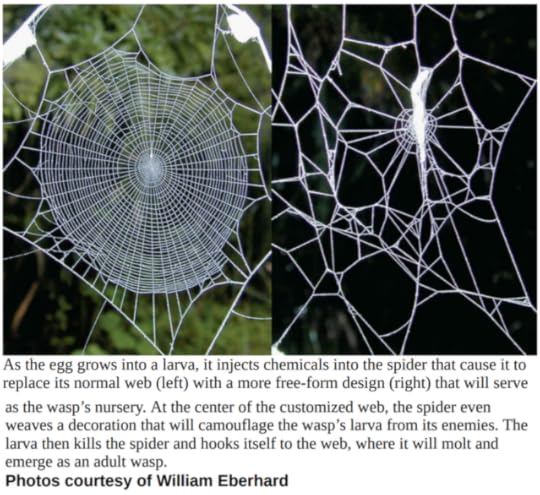
Author Kathleen McAuliffe also talks about viral parasites; rabies, and toxoplasma gondii (T. gondii). She includes the fascinating research of Czech biologist Jaroslav Flegr, who believes T. gondii can alter humans’ personalities and prompt us to act recklessly.
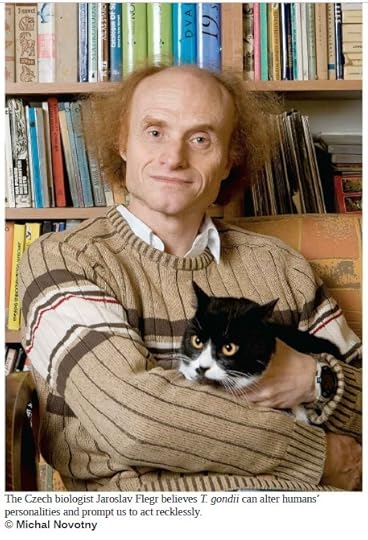
"This Is Your Brain on Parasites" also has quite a large section near the end that talks at great length about the evolutionary mechanism of disgust, and many of its related social manifestations and ramifications. She links disgust to social cooperation, mate selection, and the behavioral immune system. Some very interesting writing!
I would definitely recommend this book to anyone interested. It was well-written, researched, and delivered.
4.5 stars.
The book covers many things "parasite" - from parasitic diseases like malaria, to parasitic creatures and their hosts: the parasitic wasp, zombie ants, and many others.
Author Kathleen McAuliffe also talks about viral parasites; rabies, and toxoplasma gondii (T. gondii). She includes the fascinating research of Czech biologist Jaroslav Flegr, who believes T. gondii can alter humans’ personalities and prompt us to act recklessly.
"This Is Your Brain on Parasites" also has quite a large section near the end that talks at great length about the evolutionary mechanism of disgust, and many of its related social manifestations and ramifications. She links disgust to social cooperation, mate selection, and the behavioral immune system. Some very interesting writing!
I would definitely recommend this book to anyone interested. It was well-written, researched, and delivered.
4.5 stars.

November 5, 2018
A broad (very broad) overview of how parasites may be affecting life on earth, including areas of human cognition that we normally think of as being independent from biological influences.
I felt like I wanted a book that was written about fifty years in the future, after a lot more research had been done, verified, etc. I can't speak to whether any of what was here was accurate, but it did feel like there was too much emphasis on the possibilities of humans being influenced by parasites versus what we do actually know about loads of different parasites throughout nature. I was here for the icky details--not necessarily the hypothetical influence on psychology. Interesting, but it should have been maybe a single speculative chapter, not like a third of the book. I get that's kind of the premise of the book, but the info provided was soooo thin that maybe it shouldn't have been.
The style was fun and engaging.
I felt like I wanted a book that was written about fifty years in the future, after a lot more research had been done, verified, etc. I can't speak to whether any of what was here was accurate, but it did feel like there was too much emphasis on the possibilities of humans being influenced by parasites versus what we do actually know about loads of different parasites throughout nature. I was here for the icky details--not necessarily the hypothetical influence on psychology. Interesting, but it should have been maybe a single speculative chapter, not like a third of the book. I get that's kind of the premise of the book, but the info provided was soooo thin that maybe it shouldn't have been.
The style was fun and engaging.

October 24, 2016
The book was "ok". Some interesting bits interspersed with somewhat long-winded and boring bits. Only the first third of the book was about parasites. Another third covered microbes and the last third was a wishy-washy diatribe about disgust mixed with germs and politics. There were also some errors which makes me wonder what else the author got wrong. This book also has what appears to be the new method of referencing reference material. It is an absolute pain in the rear-end to figure out which bits of text match up with the relevant reference. This is a book I recommend readers get from the library or borrow from somewhere else if you are curious, not purchasing material.
Parasite Rex by Carl Zimmer is a better book on parasites - it actually has loads more information of a vast variety of parasties. Any other book on microbes would be better.
Parasite Rex by Carl Zimmer is a better book on parasites - it actually has loads more information of a vast variety of parasties. Any other book on microbes would be better.

June 27, 2016
Really entertaining and informative book about how parasites and other microorganisms (especially gut microbiota) can affect human/animal behavior. I remember reading the author's article in The Atlantic years ago about Toxoplasmosis and risk-tasking behavior, and am super-glad she decided to expand it into a full-fledged book.
The last couple of chapters jumped the shark a little with some ideas about how some religious practices and racism may have evolved from parasite-avoiding behaviors (Maybe, but definitely more tenuous link and fanciful conclusions than the other solid science writing underpinning the rest of the book.)
The last couple of chapters jumped the shark a little with some ideas about how some religious practices and racism may have evolved from parasite-avoiding behaviors (Maybe, but definitely more tenuous link and fanciful conclusions than the other solid science writing underpinning the rest of the book.)
Displaying 1 - 30 of 354 reviews