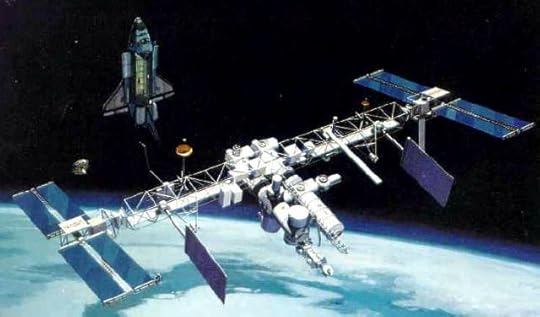
The story of 'Islands in the Sky' centers around a young man, who, after brilliantly winning a space-related competition, requests a vacation on a space station as his prize. It is written with Arthur C. Clarke's obvious knowledge of science, but moves at a page turning rate througout the entire narrative. The short novel gives a realistic possiblilty of work and play in future space, hightened with constant excitment and action.
Stories, works of noted British writer, scientist, and underwater explorer Sir Arthur Charles Clarke, include 2001: A Space Odyssey (1968).
This most important and influential figure in 20th century fiction spent the first half of his life in England and served in World War II as a radar operator before migrating to Ceylon in 1956. He co-created his best known novel and movie with the assistance of Stanley Kubrick.
Clarke, a graduate of King's College, London, obtained first class honours in physics and mathematics. He served as past chairman of the interplanetary society and as a member of the academy of astronautics, the royal astronomical society, and many other organizations.
He authored more than fifty books and won his numerous awards: the Kalinga prize of 1961, the American association for the advancement Westinghouse prize, the Bradford Washburn award, and the John W. Campbell award for his novel Rendezvous with Rama. Clarke also won the nebula award of the fiction of America in 1972, 1974 and 1979, the Hugo award of the world fiction convention in 1974 and 1980. In 1986, he stood as grand master of the fiction of America. The queen knighted him as the commander of the British Empire in 1989.
An interesting story about a boy who wins a contest and uses a loophole to visit space and has a few adventures. Nothing too over the top, however.
The story was okay...but there were a few little gems that I found most interesting (and were no doubt due to its origin in the 1950s). There are spider-creatures on Mercury. There is life on Venus. And there is possibly intelligent life on Mars...and Humans are interacting with all of it. This seems to be set sometime in the 2080s as there's a reference to a ship which had orbited Venus in 1985 having had "nearly a century since it's last trip."
I also find it interesting that Humanity is actively terraforming Mars in this book, adding considerable amounts of oxygen to the planet's atmosphere (so much so that some people are able to tolerate it for a few minutes without a breathing mask) and yet they are walking around and interacting with the native Martians who, as the book states, may or may not be the remnants of an ancient civilization. So, um, is not terraforming Mars then going to kill them?? Or, since this was the 1950s, was that not a thought?
I've been reading Arthur C Clarke for more than 50 years yet I never got around to this classic until now, just out of happenstance. It's oriented towards Young Adult readers (what we called "juvenile" books, back in the day) and while he's not as well known for this genre as Robert Heinlein was, he's every bit as good. Interestingly, this book opens with our young hero winning a national contest to begin his adventures in space, just as Heinlein's much later "Have Spacesuit Will Travel" did. Most of the similarity ends there although both authors emphasize realistic science.
In Clarke's book the protagonist wins a trip to a near earth orbit space station and joins its crew for two weeks. Written in 1952, his idea of space tourism seemed to me to resemble the Russian practice of paying guests on Mir and the ISS. The description of a different 'space hotel' with long curving corridors hints at Station 5 in "2001-A Space Odyssey." Some of his ideas seem quaint by modern standards, such as having young "apprentices" on space stations and of native Martians or even Mercurians. But who knows? Maybe it just hasn't happened yet. The book still remains remarkably fresh and entertaining, imho, considering it's pushing 70.
Great example of classic "hard" SF, with lots of technical terminology, discussions of thrust and orbits and rockets and navigation, and near-misses with hull punctures, medical emergencies, and mishaps. Includes a very early jab at the idiocy of treating space as a garbage dump and launching nuclear waste and other trash into it. By today's SF standards it's pretty thin (ok, emaciated) in terms of plot, but given the time and context in which it was written it was probably considered jam-packed with cool stuff and sent techno-nerds everywhere into spasms of joy, so I give it props for that :)
My absolute all time favourite sci-fi book when I was a wee bairn.
It was the first book I bought with my own money from the school book club and I read it a number of times - easily into double figures - when I was 12-13 years old.
It was a BRILLIANT book for a kid who was into science-based hard sci-fi and so when I joined GR and looked back through the rose-tinted prism of time I unhesitatingly gave it a 5* from my happy memories of reading it all those many years ago.
A while back I decided my daughter was finally old enough to appreciate it and began to read it to her at bedtime.
She was actually a year or so younger than when I first read it, but she is far brighter than I was.
Personally I LOVED reading it again, but pretty soon I realised how problematic it was for a kid of the 21st century to enjoy what I assumed would have become a timeless classic.
Not only did I have to take time out to explain the science involved - but then had to then explain why that science was now considered incorrect.
Then there were the questions she asked:-
"Why didn't they just use a mobile phone?"
"Why not use a computer to find out the answer?"
"Why did they let a 15 year old go into space without his mum or dad?"
"Why are there no girls in the space station?" (I think there are no female characters AT ALL.)
All very good questions which I had to stumble through before continuing with the reading.
It became apparent we weren't gonna make it through the book, so it was 'shelved'.
I still maintain it's a wonderful and exciting 'boys-own' adventure and some kids will get a lot out of reading it.
But, I suppose, even labelling it with that phrase by definition will preclude at least 50% of children from being its target audience.
It is really a 3* in all honesty, but the pre-teenage me would never forgive me now for giving it such a low score - so I will meet young me in the middle and give it a 4*
Clarke's books seem to be focused more on concepts than on plot or characters, that's why I'm quite surprised how much I enjoy his work so far. This includes a lot of interesting ideas and thoughts about space travel, life on a space station and colonies, told from the perspective of an interested and ambitious young man. It reminded me of "The long way to a small angry planet" in a way, even if it's noticeably much older and has less developed characters. Still, for such a short book, some minor characters, like Commander Doyle, had more depth than one would expect. It has few plot, it's more like a collection of things happening and ideas explored and that was actually nice for once.
Meikäläinen tunnistaa Robert A. Heinleinin "nuortenkirjat" melkeinpä ainoastaan siitä, että päähenkilö on nuori. Toisella scifin suurmestarilla ja Heinleinia vielä huomattavasti korkeammalle arvostamallani Arthur C. Clarkella tilanne on toinen: Ilmojen saaret on juoneltaan, jos sellaisesta voi edes puhua, hyvinkin heppoinen ja höhlä, teemat hyvin yksinkertaisia ja pintapuolisesti käsiteltyjä, ja kaikesta paistaa se, että jutun ei tarvitse olla kovin kummoinen, koska se on suunnattu teineille. Onneksi Clarke ei monta nuortenkirjaa tehnyt – Dolphin Island taitaa olla ainoa muu varsinaisesti nuorille suunnattu kirja. Sitä en ole lukenut, eikä se Ilmojen saarten perusteella nouse kovin korkealle pikapuoliin luettavien kirjojen listallani.
On tietysti niinkin, että Ilmojen saaria ei välttämättä edes pitäisi lukea romaanina, vaan lähinnä kyse on opetuskertomuksesta. Clarke halusi selittää nuorisolle, miten raketit toimivat, mitä kaikkea jännää painottomuus (tai mikrogravitaatio, kuten nykyisin halutaan sanoa) aiheuttaa, ja mitä hyötyä satelliiteista on. Nämä ovat ehdottomasti kunnioitettavia päämääriä, ja Clarken panos tässä työssä oli äärimmäisen merkittävä. Siitä ei vain valitettavasti synny kovin hääppöistä kirjaa.
Minulle ehdottomasti mielenkiintoisinta antia Ilmojen saarissa olivat lyhyet kuvaukset Merkuriuksesta, Kuusta ja Marsista. 1950-luvun alussa kun ollaan, niin Merkurius vielä käänsi aina saman puolen Aurinkoa kohti, ja Kuun etäpuoli oli samanlainen kuin lähipuoli. Toki Marsissa ja Merkuriuksessakin oli vielä elämää. Tästä tykkäsin, mutta muuten Ilmojen saaret oli selvästi Clarken laajan tuotannon vaatimattominta antia.
Lähinnä siis suosittelen Ilmojen saaria vain kovimmille Clarke-faneille, joiden pitää lukea kaikki, tai sitten niille, joita vaan sattuu kiinnostamaan 1950-luvun alun avaruushehkutus (luen itseni osin molempiin ryhmiin, vaikkakaan en varsinaisesti mikään täysverinen kompletisti olekaan). Tasa-arvovalistajille kirja taas toimii varoittavana esimerkkinä, sillä kuten Clarkelle oli tyypillistä, naiset eivät ole oikeastaan edes sivuosissa. Päähenkilön äiti mainitaan jokusen kerran, ja ainoa toinen naishahmo taisi olla avaruusasemalla piipahtava naisnäyttelijä.
Kirjan kuvitus on enimmäkseen ihan tyylikästä, harmi vain ettei tekijästä ole tietoa. Hugo L. Mäkisen suomennos taas oli huonolla tavalla vanhahtava ja osin vain kökkö ja kankea. Mäkisen toistuvasti käyttämä ilmaus "keski-ilmassa" (Clarkella epäilemättä "mid-air") ärsytti järjettömyydessään. Onneksi luettavaa ei ollut kuin vajaat 160 sivua.
The sort of juvie SF that gives juvie SF a bad name. There is no overarching plot, just a series of episodes, each one of which would be too weak to stand on its own as a short story. Every situation just an excuse to lecture about some gizmo or natural phenomenon. Not that I don't appreciate the lectures, but... I'm pretty sure I read this when I was 10 or 11, and I imagine it enchanted me, but rereading it as an adult, I'm less than charmed.
The unlikeable main character is a quiet kid who is constantly making smart-alec remarks to himself (never aloud!) and thinks nothing of bending the rules to get what he wants, regardless of the trouble it's going to make for other people. Luckily he's mostly a mute and passive narrator, since any time he opened his mouth or gave an opinion I kind of wanted to smack him.
Sadly, he goes through a life-changing experience—traveling into space for the first time and having numerous adventures—and returns to Earth without having noticeably grown or changed. No, check that—he meets a family from Mars in the last couple of chapters, and their pretty photographs convince him that he wants to go to Mars, so I suppose has grown beyond his earlier ambition to just live in a space station.
Clarke's science is pretty good, aside from his lifelong inclination to cram life under every moonrock. And, while I'll forgive him for giving Mercury a magnetic field, I'm baffled as to why he gave it an aurora when he specified that it was an airless body. It's refreshing, though, to read an author who knows a orbital eccentricity from their elbow, and for me all the celestial mechanics is quite a treat. But it is Clarke's gift for forecasting future technology that is truly exquisite. Change a few incidental details and the landing of the "Earth ferry" would do for the Space Shuttle—and remember that this novel was first published in 1952.
Yet, other SF authors are able to write novels with young protagonists encountering intruiging technical and scientific ideas, also meeting interesting and 3-dimensional characters, with some semblance of a plot arc. As juvie SF, this is pretty lackluster, and it's interesting mostly as an exhibit of paleofuturism.
This is one of the books that drew me into science fiction. That was about thirty years ago and it's been almost as long since I last read this book. Now there's always a danger when reading something pivotal in your childhood years that it no longer stacks up when you re-read it with adult eyes. Thankfully this didn't prove to be the case and I think I enjoyed more now that I have a more analytical mind - and it's still a cracking story to boot!
What attracted me then and still does is the solid engineering basis for the technology and the experience of living in space. In many ways it acts as an easy introduction into the key elements of hums surviving in orbits. There are some key differences though which reflect the time from which it is written. Most notably is the romantisism of mankind's expansion into orbit. We unfortunately haven't come close to this vision.
Following that point is that it's interesting to see what isn't there and that's a reflection of what we have learned since then. A good example is the issue of health, the problems suffered by stronauts on extended missions in orbits aren't mentioned. Another notable inaccuracy is the planetary science, there's life where we know that there isn't.
But these issues don't really matter because the story reflects the dream of anyone who has wished to go into space. It delves into concepts that are core to understanding that dream and fascinates with the imagination of the author's vision. It's a short, fast paced book that packs a lot in and reminds me just why I enjoy science-fiction so much.
This book is like sitting through a word-for-word description of a complete stranger's vacation. You're at a party, and as you are listening to him describe every little occurrence he came across on his journey, trip, and return home you find yourself wondering, "why not skip to the notable highlights?". By the end of his tale you realize it's because there aren't any. There's nothing necessarily unlikable about him, but also nothing overly likable about him either, and as you sit and nod your head along to his story you begin to wonder how you can get through this quickly, grab your drink and get the hell away from him without being rude as his story is not poorly told, just drawn out and ultimately dry.
It's unfortunate that this story couldn't come together - which becomes pretty clear about 100 pages in. My hopes grew at the end of most chapters from about #3 onward as they had begun to close with some type of suspense - or FINALLY some sort of conflict or tension to bring about the "extraordinary adventure" the front and back covers promise, only to be let down in the first couple of sentences of the following chapter when it turns out to be a misunderstanding or have a logical, and yet again boring, explanation for the excitement the preceding chapter had set up.
Arthur C. Clarke is generally a very entertaining writer, with a good blend of technical details and engaging story lines. This one just didn't make for an enjoyable read - but at least it was short.
My reason told me that I was perfectly safe, but all my instincts shouted, “You’ve a five-hundred-mile fall straight down beneath you!”
A pleasant if improbably bright teen “wins” a two-week vacation in space. What could possibly go wrong? (Quite a willing suspension of disbelief is required.) Light-hearted young adult adventure which, aside from the alien references, hews close to 1952 reality.
"This was the moment when I really knew that I had reached space at last, and that nothing else could ever be the same again."
Written only five years after the invention of the transistor, Clark’s errors in electronic technology are understandable. On the other hand, he gets more science right than many modern author apparently raised on Star Trek pseudo-science. He correctly forecasts geosynchronous communication satellite, for example.
"All, that is, except the Morning Star. As everyone knows, she made the first circumnavigation of Venus, back in 1985."
Not nearly the storytelling expected of Clark, but a fun romp through a teen’s wish fulfillment in space minus the bleak themes which dominate modern science fiction.
"I want to make one thing quite clear. Although the word “stowaway” has been used, I don’t consider it at all accurate. No one had actually told me to leave the ship, and I wasn’t hiding. … But nobody did, so whose fault was that?"
This is very much a science fiction novel for beginners and was originally published in 1952. A little bit of research confirmed this as it was part of a line of juvenile science fiction books under the Winston Science Fiction line. So it’s basically a young adult novel for it’s time. That made perfect sense to me after reading it.
The story is told from the perspective of Roy, a teenager who earns a trip to a space station by winning a quiz show. This novel is set around the year 2080, and space travel including planet-hopping the solar system is relatively common for people in 2080.
Clarke weaves plenty of real science and other speculations about what life in space might be like, backed up by the most cutting-edge theories at the time. He explains weightlessness, how satellites work, geosynchronous orbits, spacewalks, spaceship docking procedures, and much more, some of these ideas found their way into the 2001 movie, especially the space station itself of which an identical model was used in the 2001 film. Clarke says a person’s legs would ideally be bound into a cylinder during spacewalk as they tend to be cumbersome in a weightless environment, for instance.
The book follows Roy as he is made familiar with the station, it’s crew, and their various jobs. It’s a wonderworld for a kid in the 50s for all of this would be fresh and new. Most people reading this review are long familiar with space-based tropes, but imagine how exciting this story would be back then.
Regarding the young adult angle, this book doesn’t talk down to the reader. Although it’s simplified and straightforward, it’s still fun for an old man of 49. I wish I had been directed to something like this when I was 12.
The science holds up in these pages and it’s never silly or wrongheaded. Clarke has always had a knack for keeping the action grounded and realistic, even 70 years after first publication.
It’s a solid book and a solid 3 stars, although there are a dozen (or more) Clarke books better than this one. If you’re looking to find a great introduction to spacey concepts for a younger reader (or any n00b) this is a strong recommend.
Ein Junge schafft es mit einem Trick, bei einem Wettbewerb eine Reise zur erdnahen Raumstation zu ergattern. Dort darf er ein paar Wochen bleiben, sich an die Schwerelosigkeit gewöhnen, das Alltagsleben mitmachen, an den Lektionen den Auszubildenden teilnehmen. Da er sich immer dezent nach vorn drängelt, kann er noch ein paar Ausflüge machen und erlebt so noch mehr von der erdnahen Weltrauminfrastruktur. Der Autor verzichtet auf spektakuläre Geschehnisse, es gibt nur eine einzige gefährliche Situation und auch die wird bald bewältigt.
Man kann den Roman wohl als Jugendliteratur bezeichnen. Er reiht sich in die Werke ein, wo Clarke die Entwicklung der Raumfahrt als logische Fortsetzung der technologischen Gesellschaft des 20. Jhdts voraussagt (und propagiert). All das hört sich jetzt etwas verstaubt an, eher die Art von Roman, die mich ernstlich langweilen könnte. Aber stattdessen habe ich den Roman flott durchgelesen und durchaus genossen.
Er wurde 5 Jahre vor Sputnik geschrieben, enthält also jede Menge Mutmaßungen über die Weltraumtechnik der Zukunft. Hierbei bemühte Clarke sich um Realismus und wissenschaftliche Genauigkeit. Nur was das Leben auf anderen Planeten unseres Sonnensystems anbetrifft, ließ er seinen Phantasie recht ins Kraut schießen (und lag damit natürlich komplett daneben). Es ist ganz amüsant die Voraussagen mit der Wirklichkeit zu vergleichen. Der Roman bestätigt mal wieder, dass Arthur C. Clarke zu den Altmeistern der SF gehört, die mir am besten gefallen. Noch eine Kuriosität am Ende: auch in diesem Roman kommen praktisch keine Frauen vor.
This is a story about the setting, the world that the main character lives in. As many people have commented nothing happens in this book. This is not an action book. However, I still really enjoyed it!
Clarke writes about a world where humans already have many space stations, colonies on the moon, and mars, and even exploration missions to mercury. Clarke clearly understands the way things work in space even though this was published in the 50's. Clarke describes the life of an average boy as he takes a couple weeks of vacation on a space station, not a vacation station though, but a working station.
I started reading this novel in Kadikoy library, but could not finish it in one sitting. When I returned to finish it, someone else had borrowed it, so I couldn't. I doubt I'll find it again because it's a vintage publication, but I really enjoyed what I read so far
This snapshot of life in space still holds up today
WINSTON SCIENCE FICTION # 4: "Islands in the Sky", by Arthur C. Clarke
I don’t recall where I initially learned that Arthur C. Clarke was the first science fiction author to describe geostationary telecommunications satellites in fiction, but apparently it never occurred to me to actually look up where he did this. The concept appears here, in “Islands in the Sky”, Clarke’s contribution to the Winston Science Fiction series.
Clarke’s story is, unsurprisingly, a high-water mark in the early books of the Winston series. It follows the experiences of sixteen-year-old Roy Malcolm, who participates in a radio quiz show and wins a trip “anywhere on Earth.” Knowing Roy is obsessed with space travel, the boy’s lawyer uncle has coached him in how to finagle this prize into a trip to the “inner station”, an orbital facility close enough to Earth that it legally qualifies as part of the planet. Soon, Roy is on his way to space.
The rest of the book is vintage Clarke. Hard scientific descriptions of what life in space might be like, as seen from the perspective of the early 50’s.
The short novel’s main weakness is also it’s strength—Clarke spends so much time describing how humans live and work in space, there isn’t much time for character or plot development. At the same time, the author’s dedication to scientific accuracy makes his descriptions seem authentic nearly 70 years later, which is more than can be said of many other sf novels from the same period.
Certainly, there are times when Clarke’s assumptions show their age. Perhaps the most striking example of this is his pre-space age perspective, not uncommon in sf of the period, that microgravity would be a boon to human health. Today we know differently—NASA’s year-long experiment with the Kelly twins established that the human body works best in the gravity field where it evolved.
In many ways, “Islands in the Sky” is more reference book than novel—a resource beginning sf authors could use to make stories set in space more true-to-life. Even where it’s speculations miss the mark, it just highlights how on-the-mark everything else seems, by contrast. An updated, “spiritual successor” to the book, which revises its few obsolete assumptions, would do a great service for the sf community.
Recommended for the engineering-minded reader interested in the nuts-and-bolts off life-in-space.
I'm not really a fan of hard sci-fi or the early juvenile novels my DH enjoyed as a boy. But I found Islands in the Sky to be an interesting, quick read. At 45% there was still basically no plot, but I didn't really mind, as the MC is likable enough and the style easy to read. There was a lot of description of life in space, and I can see that young fans of space travel would have liked this book. For me it was fine. 2.5 stars
Un classique de la SF qui m'a réellement chamboulé à certains moments autant qu'il m'a rempli d'ennui à d'autres.
Le style d'écriture est assez plat vu le ton employé puisque le narrateur raconte l'histoire de son séjour dans l'espace comme s'il écrivait un journal de bord, bien un journal intime, un mémoire ou une lettre (j'espère que vous voyez ce que je veux dire :P ).
Il ne se passe pas grand chose d'intéressant mais la force de ce roman est, à mon avis, dans les descriptions faites par Arthur C. Clarke. Celles-ci sont tellement "réalistes" qu'elles arrivent pendant quelques millièmes de secondes à te faire croire que le monde futuriste décrit par l'auteur est bel et bien le présent que nous vivons. S'en est même perturbant !!
Bref, dans l'ensemble, j'ai aimé ce voyage mais ce n'est certainement pas un page turner. C'est un roman qui se lit doucement et qui se déguste.
I could get behind the idea of the story having no tension. It could be like a hypothetical documentary, where under the pretext of a kid going on a vacation in space, we get lots of explanations regarding how travel works or how people live on other planets.
What I can’t forget is the constant fake scares found on almost every chapter. There is some sort of crisis going on that can endanger their lives that is proven to be a misunderstanding or a lie every single time. It’s like the author knew the plot was boring and was trying to keep the reader engaged by baiting him with seemingly dangers that could kill him. Doing it once could be excused as a joke. Doing it a dozen times in a short book that has nothing much in terms of plot or characters, makes you feel like you are being treated like an idiot.
There is nothing interesting about the cast and the plot is just an excuse to shovel in fundamental ways of how technology would probably work in the future. The jump scares are what stick out the most and since they are all proven to be fake, makes you hate the book despite its educational and/or inspirational intentions.
Διαβάζοντας το με έπιασε μια νοσταλγία. Αρχικά γιατί πρόκειται για έργο της λεγόμενης εφηβικής λογοτεχνίας, και έπειτα γιατί είναι εκδόσεις Κάκτος. Αυτό συνεπάγεται τα απαραίτητα τυπογραφικά λάθη, την απρόσεχτη μετάφραση αλλά και όλη αυτή τη νοσταλγική ατμόσφαιρα της Ε.Φ. στα ελληνικά τέλος '70 αρχές '80. Στην υπόθεση του η νουβέλα αυτή είναι το όνειρο κάθε έφηβου, δηλαδή να γίνει αστροναύτης και να ταξιδέψει στο διάστημα...
Δεν είναι αυτό που ήλπιζα, αλλά δεν μπορώ να πω ότι απογοητεύτηκα κιόλας. Περιγράφει σε εξαιρετικό βαθμό τη ζωή στο Διάστημα και συγκεκριμένα στους Διαστημικούς Σταθμούς και οι μοναδικές φορές που ξεφεύγει λίγο από τα στενά επιστημονικά όρια είναι όταν αναφέρει την ύπαρξη ζωής στους άλλους πλανήτες του ηλιακού μας συστήματος. Λέξη κλειδί: Βαρύτητα.
Islands in the Sky was originally published in 1952 and was one of the Winston Science Fiction juvenile series published in the 1950s. I remember reading this when I was in the 5th or 6th grade back in the early 60s along with others in the Winston series. I currently have a collection of most of the series and may reread some more of these soon.
This novel takes place in the last part of the 21st Century and the protagonist is sixteen-year-old Roy Malcolm who wins a science quiz program. His prize is a trip to anywhere on earth but he convinces the judges that the Inner Space Station in orbit around earth is actually considered part of earth so he is awarded his wish to go there. While there, he experiences several adventures including an emergency trip to a space hospital several thousand miles outside of the inner space station's orbit. On the way back from the hospital, the ship accidentally goes off course and must rendezvous in the Moon's orbit to refuel. While on this trip, the Captain relates his participation in the first voyage to Mercury and how he ended up losing both his legs (which is no encumbrance on the gravity-less space station). He also witnesses the filming of a current space adventure on the station. Since this book was written in 1952, science-fiction pulps were quite prevalent and the space adventures of the novel were based on these rather than real science.
In some ways this book was rather dated (i.e. space adventures), but Clarke, as usual, was able to bring in his vast knowledge and much of the science was quite remarkable considering this was written in 1952. For example, the ship that shuttles Mars colonists and workers on the space station back to earth could have been a blueprint for the Space Shuttle program. And of course, the space stations described in the book were a prediction of the space stations of today. The science discussed relating to gravity on the station and how workers there coped with no gravity was also very realistic. Overall, I probably enjoyed this most for the nostalgia in reading something I had originally enjoyed in grade school, but I would still recommend it. I also want to reread some of Heinlein's juvenile novels to see how they compare.
No doubt this story was amazing when it was originally published in 1952. Frankly, geosynchronous orbital satellites can be traced back to the ideas proposed by the author. But today most of the things that the author describes in this story have been duplicated in so many movies that it has become expected rather than innovative.
The story: a young man wins a contest to go into space to the Near-Earth-Orbit space station. He hits it off with the crew and ends up becoming involved with the running of the station including helping with an emergency medical flight to a space hospital. He even gets to go to Mercury.
Any problems with the story? The crew was too undisciplined for space. They seemed like nice guys and all, but a lot can go wrong in space if one is not careful all the time and they were not as careful as I would have expected. Even the young man in the story was surprised that they were allowing him to do so much.
Any modesty problems? No.
The ending continued the learning experience, keeping to real science rather than glossing over the problems with landing a space vehicle. The author understood the details back in 1952. It was almost a blueprint for the future space program.
Bir çeviri rezaletiyle karşı karşıyayız. Türkçe'nin kötü kullanımının yanısıra, bazı cümleler tamamen es geçilmiş ya da sırası karışmış gibi gözüküyor.
Clarke romanı genç yetişkin okura yönelik yazmış, bir olay örgüsünden ziyade, uzay istasyonundaki yaşamı tarif etmiş; yer yer teknik detaylara inmiş. Bir şekilde uyanıklık edip bedava bir uzay istasyonu gezisine hak kazanan genç anlatıcı, kendi tecrübelerini bizle paylaşıyor; konu bundan ibaret.
Biraz daha keyifli olabilirdi, ama dediğim gibi, çeviri çok feci.
This is a simplistic tale of a not very bright boy visiting a space station for the first time. In a world where space travel is quite ordinary, and has been for long enough that there are Human colonies on both Mars and Venus, with people born there who are old enough to be going to college, he is remarkably ignorant of basic details that should be in every textbook and news program. And Clark didn't seem to realize that Earth cities would be visible from space. Still, if you ignore all that, it's a reasonably fun romp.
I may have read this back in my youth, but if I did it was so long ago that I had forgotten all of this vintage tale of space by Arthur C. Clarke. It is important to note that it was written in 1952, almost a decade before the first human traveled into space, yet Clarke had a keen understanding of the physics of orbits, landing, etc. and turns the details into a nice tale of a teenager who wins a trip into space that's not horribly dated. 3.5 stars.
Yet another classic science fiction author who could imagine all sorts of adventures in space, but couldn't conjure the idea of women having any part of it.
When George Lucas was filming the first Star Wars film, and the government authorities had to take a look at the plans for the X-Wing fighter to determine whether government secrets had been leaked out, they missed the boat by about 30 years. Science fiction writers had been guessing the state of things for ages, and it's truly a remarkable experience to see just how right they were. I just read the late Arthur C. Clarke's Islands in the Sky, and was fascinated with the intricate descriptions of the Space Shuttle, weather satellites, communication devices, ideas of orbiting solar energy panels, space stations..etc... all written in 1952! Simply amazing. How one man could think of the entire world so far ahead, and then live long enough to see it come to fruition. And we did go to Venus (although not a manned outfit) by 1985, but found it incredibly hot and uninviting. So the time frame was off a little, but the ideas were sound.
Another aspect was how similar this book is to Orson Scott Card's Ender's Game. I know this comparison has been made before, some even suggesting that OSC copied it from Clarke (which is not true at all, but instead points to how amazingly accurate Clarke was when developing the science behind the novel). It is a homage to Clarke for Card to be so directly compared with him. The orbiting space "hotel", with it's rotating gravity wells, is almost identical to the military training station in Ender's Game. Also the ideas about where "down" was in space. There is room enough in this world for both novels.
One day, when the fascination for things of fantasy fade, when dragons are asleep on their hoards, and vampires are safely stored in their coffins, and wizards study the stars rather than alchemy, the jewels of science fiction will come back to enchant children once again. Islands in the Sky is currently out of print, and I only hope that one day that return to join the classics of the age, never to go out of print again. In fact, there are quite a few novels now that teenagers and kids can read from the masters of science fiction. They are valuable resources for teachers who want to incorporate science and math into reading. I'm gonna list some of them here, and will work on it more as a resource for teachers that come to Borders.
Have Space Suit, Will Travel by Robert A. Heinlein
Red Planet also by Heinlein
Dolphin Island by Clarke
And every student should be exposed to the short story "Cold Equations," by Tom Godwin. Not to mention stories by Ray Bradbury and Isaac Asimov.
Me gustó bastante esta novela, tiene un poco de accion pero mucho de aventura e incidentes que finalmente terminan bien. Es, al menos a mi parecer, una novela de ciencia ficcion que podria agradar a chicos y grandes por igual.
No puedo dejar de hacer notar que la novela esta llena de detalles tecnicos y minucias sobre el dia a dia dentro de una estacion espacial, detalles como el alimento, el baño, beber liquidos y otras cosas que se complican demasiado estando en gravedad cero... pero lo impresionante es que esas cosas aun no pasaban!!!
Mucho de lo que se habla en la novela es sencillo de imaginar en estos tiempos ya que lo hemos visto tanto en películas como en caricaturas y hasta en videojuegos, pero en el 57, que fue cuando se publicó esta novela, nada eso existía, todo era solo conjeturas.
A mi modo de ver las cosas el gran logro de esta novela consiste en que habla de la forma mas natural y como si no fuera nada extraordinario sobre cosas que en ese entonces no se sabia.
Un detalle que me llamo la atencion fue la descripcion de los vehículos espaciales, que en lugar de ser naves altamente estilizadas, a medio camino entre una flecha y un auto deportivo, eran toscas naves que no tenian nada de aerodinámico, obviamente no se requiere esta cualidad en un lugar donde no existe la resistencia del aire, y hasta hace comentarios burlones a como la gente de aquellos años imaginaba las naves espaciales.