Francis Bacon created an indelible image of mankind in modern times, and played an outsized role in both twentieth century art and life--from his public emergence with his legendary Triptych 1944 (its images so unrelievedly awful that people fled the gallery), to his death in Madrid in 1992.
Bacon was a witty free spirit and unabashed homosexual at a time when many others remained closeted, and his exploits were as unforgettable as his images. He moved among the worlds of London's Soho and East End, the literary salons of London and Paris, and the homosexual life of Tangier. Through hundreds of interviews, and extensive new research, the authors probe Bacon's childhood in Ireland (he earned his father's lasting disdain because his asthma prevented him from hunting); his increasingly open homosexuality; his early design career--never before explored in detail; the formation of his vision; his early failure as an artist; his uneasy relationship with American abstract art; and his improbable late emergence onto the international stage as one of the great visionaries of the twentieth century. In all, Francis Bacon: Revelations gives us a more complete and nuanced--and more international--portrait than ever before of this singularly private, darkly funny, eruptive man and his equally eruptive, extraordinary art. Bacon was not just an influential artist, he helped remake the twentieth-century figure.
I've not read any other biographies of Francis Bacon so can't compare this to them but I think this is superb. The authors cover Bacon's long and fascinating life as well as providing insights into his art. There are colour reproductions of many of his most celebrated paintings (although some of the triptychs are rather small) plus numerous black and white photographs scattered throughout the text. I was lead into this via Iain Sinclair's semi-fictional biography of the photographer Roger Deakin Pariah Genius and this book is itself pointing me towards the 2 volume biography of Lucian Freud by William Feaver since the 2 artists were close friends for several decades before a falling out happened late in life.
Phenomenal read about an infinitely interesting person, but naturally drags in many areas over its 800+ page span; however i doubt there will ever be a Bacon biography this engaging and comprehensive again
Revelations is the incredibly comprehensive biography of Francis Bacon, the celebrated artist whose life began in the first and ended in the last decade of the 20th century. It is a long and sometimes laborious work, but well worth the effort if you are looking for an in-depth picture of the painter’s life. Mark Stevens and Annalyn Swan used an impressive array of sources to understand how Bacon was able to develop from a shy, asthmatic English boy in Ireland to an international superstar who felt as much at home in Paris as in London.
Growing up gay at a time when homosexuality was taboo and without any formal education, Bacon managed to carve out a career, starting as a designer in Paris. His life was anything but stable: always on the move and in need of money to gamble, he went from lover to lover and never stayed anywhere for long. Bacon has been described as charming and intelligent (he was a ferocious reader), but he was also known for his small-minded outbursts, especially when drunk (which was often). Above all, Bacon was a dandy when no one used that word anymore.
Although Stevens and Swan do take up Bacon’s artistic choices, they are mostly concerned with his personal and social life. Their account contains so much detail, that it affects the narrative. The authors also provide a large amount of background information for context. For instance, when Bacon follows his lover Peter Lacy to Tangier (Morocco), they describe the city and its liberal politics in detail. This makes the book very informative, but also overwhelming. The art comes second. While it becomes clear why Bacon was a figurative painter ‘in isolation’, abhorring abstraction and making art for art’s sake, I still don’t feel I fully understand his work now.
I consecutively picked up Maurice by E.M. Forster to learn more about the era in which Bacon was born.
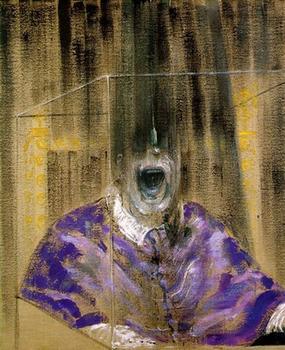
Francis Bacon - Head VI (1949) (source: Wikimedia)
This is a very long book, and I must admit I was ready to be done with it before it ended. The authors kept asserting that Bacon was a wonderfully likeable person, but I can't say I felt his charm. I dislike enormously being around people who are drunk or otherwise intoxicated--they are usually dull and less amusing than they think they are, even when they aren't being belligerent-- and Bacon seems to have been a pretty obnoxious drunk. A lot of the way he moved through the world was conditioned by his childhood among wealthy, socially privileged people--though those aspects of his upbringing were certainly countered by his sexuality and his general unwillingness to abide by the rigid gender norms of his family and social environment. But his attitude to money, which the authors call "eccentric,” was utterly conditioned by his background; he could be incredibly reckless with money because he always expected to be rescued--and he always was--and he didn't seem to notice or care that other people were living under constraints that didn't seem to apply to him. Part of my motivation for reading it is that I was hoping that I would develop a better understanding and appreciation of Bacon's art, and I guess I did, but I still don't like it all that much. But I know it only from reproductions; I hope I get a chance to see his actual work hung on actual walls so I can better assess just how I feel about it. If you're interested in Bacon or in twentieth-century art, especially British art, then I recommend this book; it's comprehensive and readable, and it’s hard to imagine a better biography of the man being written.
I have devoured with joy Bacon biographies in the past and also been delighted by Love is the Devil with the sublime Derek Jacobi as Bacon. I found this book slavishly research but ultimately satisfying primarily because their should be more contemporary discussion of Bacon and his work.
At almost 900 pages of text, this wasn't an easy book for me to pick up. My interest in art has always been fairly superficial and this would be the first one of these tomes on a single artist. I did anyway, and a week later I'm happy I did. This was a great book on an important painter who had an amazing, complex life. It was thoroughly informative and hugely enjoyable.
I think the first Bacon painting I saw (and remembered anyway) was an early triptych exhibited at Tate Britain. On a shock orange background, the three pictures depict some pretty disturbing caricatures of a human, as if a living person has been moulded into clumps of flesh, with the sightless victims screaming out silently, begging for death. It touched a nerve. It was also pretty horrible. Perhaps even more so, because the painting looked so out of place in the same space Gainsborough and Turner. But then again, Bacon's early nightmarish paintings would seem out of place pretty much anywhere.
The lack of context, this rejection to be a member of some historic movement was a consistent thread in Bacon's art that spanned more than half a century. Born an asthmatic Anglo-Irish in a well-to-do military family, he seems to have stumbled upon painting whilst working as a furniture and interior designer. His paintings began to be noticed only in his late thirties, and even then it wasn't a straightforward propulsion to stardom. Neither impressionistic nor abstract, his works were difficult to place in either the Paris or New York art 'scenes', and the agonising, violent images in huge dimensions did not readily find a willing market amongst collectors either. No matter; Bacon continued to pursue his own artistic tradition with Nietzschean fervour, until, eventually, he became one of the most celebrated artists of the last century.
Whilst chronicling his professional trajectory, the book also faithfully follows his personal life. And what a life it was. He was a gay man born from parents who regarded homosexual acts 'as an abomination', and lived in societies that grudgingly accepted his existence at best. He nonetheless cultivated some deep relationships, both lovers and friends, who in turn shaped his life. It wasn't all happy days - his relationship with Peter Lacy, who the author speculates was the love of his life, was particularly frought. Once an aspiring musician, Lacy gradually degenerated into an alcoholic, abusive partner. It wasn't a choreographed S&M session with safe words; Lacy beat him furiously in their many rows, in one instance hurling Bacon out of a window, letting him fall 10-15 feet below. Yet they stayed together for a long time.
Thankfully, not all of Bacon's relationships were as emotionally charged and ruinous. He was usually gregarious, charming and 'dandy' wherever he went. He loved parties, drinking, and gambling -- he loved to win, and he also loved to lose, especially everything. He kept many a lifelong friends, and remained loyal to his family and adopted families, yet he delighted in meeting new people. Even in his eighties, he said 'often when I go out in the evenings I flirt as if I was 50.' And as his asthmatic body started to fail him, he 'resolutely refused to give up champagne.' That made me happy.
I found this a profoundly extensive but also excessive biography, which could have been so much better if it were cut down to about 3-400 pages... There is just swathes of pages dedicated to history that seems pretty bland and uninteresting and only loosely important (footnotes turned into chapters?)... These are words which I never thought I'd use when describing a bio of Francis Bacon's life.. There also seems a lot of doubt about Bacon's own retelling of events in his life... He's almost sold as a compulsive liar... Which seems odd - for a biography to be so incessantly dubious.
Saw some Bacon at the Seattle Art Museum when visiting and realized I might be mature enough to appreciate upsetting paintings by an insane gay guy now; listened to the Bad Gays podcast about him from Ben Miller and Huw Lemmy, and then found this book at the library to continue learning about him.
I had a Bright Young People phase in high school (cringe), and the thing about Bacon that's sort of nice is he was a Bright Young Person, in that he partied in Berlin and Paris in the 20s as a teenager, who then had this masochistic, horrible drive to produce art and do things, and then actually did something with his life and his aesthetic affect. His Wildean wit is definitely a point in his favor, as is his disinterest in being part of the Anglo-Irish aristocracy. What else is an abused athsmatic son of a failed horse trainer to do? I like his drive, and the passion for image and breaking the image that he brought from an early career as a decorator (at age 20, with all sales bolstered by lesbians he met in Paris) to his career as a figurative painter. He's a great character, and I feel both some sympathy with his impossible-to-conceal homosexuality and his desire to make beautiful paintings of the ugliest things. I don't really get the pope thing and I think that's maybe the work of his I like least, but I like how he paints screams, discomfort, and flayed flesh, and I like the luminosity of murdered forms in his work, splayed against 2D flat backgrounds or sometimes dissolving into them. You can see he is a storyteller from his figurative work, and I appreciate that he didn't let figurative painting become a relic and tried to engage the developments in painting of the last two decades to continue pressing painting up against The Horrors.
My take on this biography is that it's exhaustive, and great for people who (like me) enjoy stories of born-rich homosexuals rejecting their birthright wealth, being crazy and chaotic, and being sort of difficult people and also exceptional, impossible-to-ignore artists. There could be any number of books or plays with this guy as their subject-- from booing Princess Margaret's singing to bringing his Teddy Boy boyfriend to ritzy parties to engaging in masochistic brawls with his lover, there's no shortage of stories. It might stretch a little long, but Stevens' analysis of each new painting is worthwhile reading and helps contextualize slow developments over a long career. There is a whole section of Bacon's life where the role of his friends seems to have been to continuously extend him credit and rescue him from various problems he'd made for himself. The author is definitely extremely sympathetic to Bacon--who from all descriptions would have been a NIGHTMARE to be intimate with in either friendship or romance-- and also performs the role of apologist for Peter Lacy's violent beatings of Bacon. I think there's also some decided lack of political perspective on Bacon's life as an English man (born in Ireland or no) who lived in mansions through Irish independence and then basked with Burroughs and other gay guys in Tangiers as Moroccan independence was getting under way. The way that the crackdown on gay life is described sort of sidesteps the fact that exploitative sex trafficking by Europeans of Arab boys was definitely happening alongside consensual gay encounters in a lot of the North African world that European gay guys flocked to. I was grateful to learn about Ahmed Yacoubi, a onetime student of Bacon's from Morocco who was persecuted by his government on morals charges while white guys got off scott-free for the same "offenses"-- he was abandoned by his European friends, and the narrative leaves him in jail, but after looking him up I was delighted by his paintings, which show decided Bacon influence but which are also doing their own lively, collage-y thing that clearly stems from other sources too.
me había planteado esta lectura como un proyecto prácticamente vital y obviamente todo lo que se mida contra esas expectativas va a salir perdiendo por lo que me parece importante empezar diciendo que como lectura es deliciosa: bien escrito, bien documentado y (casi siempre) muy entretenido.
los peros surgen cuando se tienen en cuenta las intenciones y los sesgos de los autores que (como en casi todas las biografías) dibujan la figura de francis bacon según la gente que lo rodeaba y no tanto por como él se definía. supongo que esto es lo más objetivo pero no podía dejar de pensar que también somos lo que queremos ser y no solo lo que los demás ven a través de estas pretensiones.
también me escama lo poco que se quiere hilar la homosexualidad de bacon con su vida, se menciona como algo vital pero separado de todo lo demás (como algo que se practica, no que se es) y en los momentos en los que colisiona con el arte apenas se busca ir más allá cuando todo está en los cuadros.
acabo el libro pensando en la frase de belen gopegui de que la vida es corta pero es ancha y que aquí se habla mucho de la longitud y no tanto de la amplitud.
Francis Bacon zijn kunst is grenzeloos interessant, maar zijn leven hoeft niet zó gedetailleerd voor mij. Soms daardoor iets te hoog roddelgehalte... ik ben toch tot in de helft geraakt uiteindelijk.
Mark Stevens and Annalyn Swan certainly know how to write a biography of an immense, long-lived and profoundly complicated painter! I loved their biography of Willem de Kooning. If possible, "Francis Bacon: Revelations" is even better.
The book was a gift for last Christmas or my birthday on January 5--yes it took a while to get to it and through it--and was a counterpart to the two volume biography of Lucien Freud by William Feaver. See my review of volume 1 here: https://www.goodreads.com/review/show... These two painters dominated English painting from about the 1940s through the end of the twentieth century, Bacon dying in 1991 and Freud in 2011. The artists were themselves for a time the closest of friends but at the end living in separate worlds, not just because Bacon was homosexual and Freud was bedding every woman he encountered (and they were bearing his children). As far as their art goes I am more drawn to later Freud and 1950s-60s Bacon, but that is just me.
My point is--sorry for the digression--that the biographies (assuming volume two of Freud is consistent with volume one) are not only different perspectives on the artists but utterly dissimilar approaches to biography itself. Feaver inserts himself into the narrative at every opportunity--and his chatty, faux-chummy style larded with obscure British slang reads like the confusing fits and starts of some Englishman who has reached the port stage of dinner, having worked through cocktails, champagne and wines chosen for each course, and is moving back and forth between cloudy memories and the significance of the here and now. One the one hand it is great to have been invited to the party and sipped some of the wines, but on the other hand it is discomfitting to be so unsure of who all the other guests are, how they are connected and why they were arranged around the table.
As is their wont, Stevens and Swan start and the beginning and secure the artist in the full backstory of family. In the case of Bacon, that is immensely helpful--in fact, essential. I had never fully understood how he was raised and where his education was provided. Now I realize that except for the attentions Nanny Lightfoot, he seems to have been a feral child and an artistic autodidact who mainly learned by looking and and doing. If I have a complaint it is their failure to explain how Bacon turned from a painter who destroyed nearly everything he started and couldn't assemble enough new work for shows at the smallest of galleries to an artist who seemed able by the 1970s to produce numbers of portraits and expansive bodies of work. I accept the change--I just wish the authors had helped me recognize the transition.
The great subtexts that weave together are the love stories and they way they shaped different ages in Bacon's life and made sense in a larger way of who Bacon was a person. The craziness of George Dyer, following the tragedy of Peter Lacy, dominates the traditional Bacon story the way that Marie-Therese Walter and Dora Maar seem to overwhelm Picasso's story. These stories are indeed cinematic--and have found their way on to the big screen. As lenses, however, they are distorted. Having finished this biography, I feel like my old, smudgy, specs with the incorrect prescription have been exchanged for a sparkling new pair through which I can see everything.
What a book to start another tough year! Many thanx to the great authors to paint such a colorful picture of the complex artist and man! This biography managed to through exam the real man behind the painting. Bacon cultivated the myth about himself, his persona as an artist and as an important man. The biographers managed to reveal some of the true man hiding behind the facade. As many talented and great people, Francis Bacon was very complex human being, with many contradictory and opposing characteristics. He defied some conventions yet stayed true to many thing he considered proper. He wanted to flaunt his carelessness about money, class and status yet worked hard to stay on top echelon. He despised making money yet never truly suffered the lack of it, even during hard hit times he always had a home and a following of rich friends to fall on. The wonderful work of the authors allowed us to see the objective ( as any book can be) view of the tough life of this amazing artist. For the days I read this book Bacon became very close acquaintance or even friend to me. It helped that I knew and admired not only his work, but also many people shaping it. Through this story I could feel the times he lived and the cultural icons who defined it. I loved how the personal story behind every painting corresponds to the events in the life and how it changes the perception of the work. I also feel the struggle of the demonic forces inside that illustrate how it can be resolved on the canvas. Many people suffer through the hardships of toxic parents, violent love relationships and tumultuous friendships. Yet only the talented few can sublimate these destroying powers into the truly divine works.
I can’t think of any way this biography can be topped. I appreciated all the details and enjoyed every minute of reading this epically researched tome on one of the 20th Century’s greatest artists.
This is a really comprehensive, balanced and fair-minded review of Francis Bacon's life and work which brings the painter and his work to life but maintains a respectful distance and degree of objectivity / tries to avoid judging his work or behaviour - though it does frequently question FB's own tendency towards myth-making, based on extensive research. This could be enjoyed by someone who knows very little about FB as well as a reader who is familiar with quite a bit of the painter's life and work already. It is long but worth the effort. The nature of the subject is that it would be hard for a biographer to write a dull book about FB. He is probably one of the most fascinating people of any genre of the arts. So the task here was not to spice anything up but to present a detailed, thoughtful and balanced account - and, in so doing, this extraordinary life shines through. However, there is a lot of detailed information here too. It is a semi-official biography, endorsed by the FB estate but doesn't shy away from some of his poorer behaviour / failings - as well as quite a bit of detail about some of his more messy personal relationships. However, FB's better nature - including extravagant generosity towards some people in his life - is also presented. Ultimately, there are elements of FB's behaviour and practice which defy rational explanation but the authors attempt to present a balanced, thoughtful and well-researched account to at least make the artist more understandable. I think they largely succeed.
This is a fascinating look at the life of Francis Bacon, and the lives of those around him. It goes into extraordinary detail about most aspects of his life and the heady times he lived in. I'd love to have experienced the London nightlife (at The Colony bar) when he was around!
I knew he had an abrasive side but I didn't realize just how much of a bitch he could be. Laughing out loud at his best friend's solo exhibit? Wow! That's brutal! It's no wonder that he alienated most of his friends in his later years.
One of the best things about the book is that there are photos of Francis and his friends and lovers, the homes he lived in and the places he visited.
Although there are many reproductions of his paintings I found it frustrating to read about a piece of artwork then have to search the two color sections to see if there was a photo included. It would have been nice if there were a notation telling what page it was on IF one existed.
But all in all it's a very good read. I've got several books about Bacon, and this is by far the best in terms of his life story. The others in my library are better references if you want big glossy full color images.
An absorbing study of an extraordinary individual. This is quite a piece of work, charting all the fine details of a long, full life - it’s quite a tome and requires quite a commitment to get through it!
Bacon lived a precarious existence, almost constantly broke, but ever the thrill-seeker, gambling away any money he came by. He didn’t stay put for long too and travelled extensively, settling here and on a whim moving on again.
We get an idea of a creative individual, a true and in the main, very honest artist, passionate, life affirming, but also destructive, jealous and bitter, and it appears that although many were charmed by him, many, especially his 'great-loves', left in his wake, were destroyed, emasculated, effectively ruined.
I read this following a visit to the Man and Beast exhibition at the Royal Academy in London and it was useful to try and grasp the artist at work as the paintings are very immediate and pack quite a punch.
We gain some ideas of his influences how was the artist was formed - Aeschylus, Picasso and Nietzche amongst others, had an effect on him. We have to be careful though as Bacon carefully tended his own image, tailoring his biography to fit the audience.
He relished his senses and was certainly influenced by the tumultuous years - the war working in the service:
Life in London became both deadly and, paradoxically, intensely alive. For certain artists and writers the Blitz produced—as the monstrous sometimes will—a surprising joy: a feeling of never before having experienced something so immediate and powerful.
We get some descriptions and explanations of his work and the possible ideas behind them:
The currish dog appeared trapped—except for a bit of trailing leg—within a green circle inspired by a photograph of the 1936 Nuremberg Rally. He appeared to be circling, tongue dripping, as dogs do when they try to lie down. He could not find peace. Bacon’s youth was filled with dogs that his parents—and the society around him—loved with the physical easiness they rarely displayed around their children. Bacon found something deeply human in doggish despair, whatever the growls.
Bacon had an amazing life, the 'desperate optimist' living in 'exhilarated depair'. I’d recommend this read, set yourself a good bit of time to get through it though.
Readable and engaging tale of the man and his predilections. The accounts of his romantic relationships are especially well documented. As can usually be expected from a biography like this, there is fairly little in the way of insightful analysis into the works themselves but rather the providing of context which nevertheless helps greatly in understanding the work. When discussing paintings the authors tend to merely describe what we can already see. (I also found this to be the case with their De Kooning bio). At the other end of the scale, if you’re interested in a more creative and penetrating non-biographical approach I highly recommend Deleuze’s study ‘The Logic of Sensation’. That Deleuze’s text only receives a brief mention in this book shows to some extent the authors’ inability or unwillingness to engage in the deeper theoretical aspects of Bacon’s work. But, y’know, it’s a biography and it does all of the life story and gossip pretty well.
A detailed repository of every piece of information anyone needs to know about this key twentieth century artist. The authors balance anecdotes about eccentric and extreme behaviour with a sympathetic, frank exploration of Francis Bacon's character and influences. But most importantly, the paintings are discussed with accounts of chronology, formal development, evolution of themes and vision, as well as money, galleries, marketing.
It's a daunting tome but it shrank as the biographers pulled me in past sensationalism. So good that I reread many paragraphs and paused frequently to let paintings speak. (My one disappointment was the number of paintings illustrated but I kept a book of reproductions handy and referred to the internet.)
Thank you Mark Stevens and Annalyn Swan. Thank you Francis.
When you finish a very long book and feel like you are seeing off a good friend, it has to be a five star rating. The true test of a great biography is when the subject is a complete stranger to the reader, and that stranger becomes completely interesting and captivating. Anyone interested in the genre of biography will appreciate not only the lucidity of the writing but the clearly evidenced research. This is my third book about Bacon but this is the only one that really places him in the world that informed both he as a person, and thus his art. It is also mostly without judgement, letting the reader decide what sort of person, good or bad, Bacon was. This may not change your mind about Bacon's art, which like Bacon is difficult and confronting, but it will add clarity to both. Highly recommended.
What a fabulous surprise. I am not really a big fan of Bacon's paintings (having become familiar with it at the 1985 Tate retrospective when Bacon was still alive) although I do find the "screaming Popes" fascinating. Nor would I usually find Bacon's personality to be particularly appealing. But Stevens and Swan have written an extraordinary biography that I thorougly enjoyed. They made both Bacon the man and his paintings absolutely engaging. Bacon traveled in a circle of amazing people who really make this book and the criticism of the paintings, which I never really understood before, have taught me much. I recommend this highly to anyone interested in 20th century art even if Bacon's was certainly an outlier.
I listened to this on audio and LOVED it. I have always loved Francis Bacon’s work, but thought of him as a genius outside of time and space and had no idea he was born in 1909 and died in 1992 and lived through so much. This bio was really well put together and gave a balanced focus on the artists life and friends or relationships and his influences and art works.
I rarely read biographies, it is interesting but also quite weird how much significance is attributed to small elements like how someone signed off a letter! Especially great to hear about his very early work and his very late work, as those were less familiar to me. I only wish there were MORE pictures, but that is always the way with art books.
After reading biographies about Van Gogh, Monet, and Caravaggio, I was worried this one would fade at the end. Those other three have such dramatically painterly endings to their life. Bacon is a bit conservative, 80s pop star towards the end. However, this book held up and gave me to info to have compassion for his later stage. Books like these completely enrich the art viewing experience for the rest of one's life, and especially for someone like Bacon who painted so many portraits of people in his life. I loved reading this book.
huge, perhaps a little bloated by the attention paid to the huge surrounding cast, but unimpeachable in its own avenue. bacon sounds equal parts brilliant and unbearable in person, and caused a lot of his own problems. but the old man is dead so all we have are the paintings, i recently saw three studies at the tate again and was thrilled as usual.
Thought it was going to be more intertwined with his art but it was less about the art more about the character. Still, a great book with such in depth detail.
“Bacon was briefly admitted to the London clinic. Barry joule picked him up, and the newly discharged bacon declared that he must then and there eat a croissant”.
This entire review has been hidden because of spoilers.
Very expansive account of Bacon's life and those surrounding him. Felt a bit too thorough into other people's lives at times and I struggled to get through it as quick as I usually do with books. Definitely worthy as a source to learn lots about the artist and his life if you didn't know much on the personal side in the first place.
Wow!! This book is unbelievable!! I’m a huge massive Frances bacon fan so was obviously interested in this book. I have read nearly every book about him but this was outstanding! How the authors have compiled this is amazing. The sheer work and research involved is a whole new level.
The narrator chosen in the bookbeat audio book is probably the best I have ever listened to also!
This has to be one of the most meticulously researched books I've ever read. I felt like I knew Bacon by the end of it! Nice writing style also....even when the breath and depth of context was wide and deep it never felt turgid or dry. A must read for Bacon aficionados.
This is definitely a biography and not an in-depth analysis of Bacon’s art. The paintings become prop-objects in his often dramatic life, and that might be appropriate as you get the impression the authors found it hard to get beneath the public mask that he presented to the world.