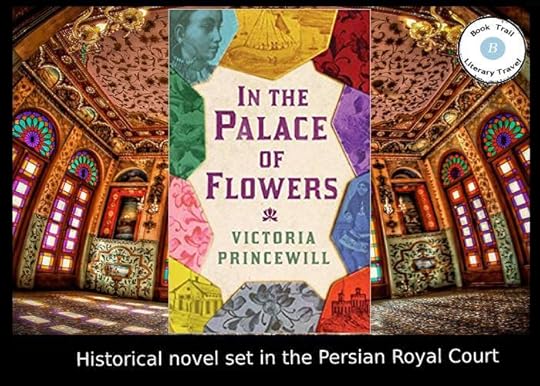
In the Persian royal court, even death is a privilege. At the funeral of a nobleman, Jamila watches the mourning rites and realises what she has always her own death will pass unremarked, her life unacknowledged. An Abyssinian slave in the royal court of Iran's Qajar dynasty, Jamila has learned to survive. But survival is not enough. Determined not to be forgotten, she and Abimelech, a fellow Abyssinian slave and eunuch, navigate the deadly politics of the palace, from the intrigues of the harem to the radicals gathering beyond its walls. Atmospheric, richly imagined and deeply moving, In the Palace of Flowers is a sweeping historical novel about identity, resilience and the universal desire to be seen, remembered and valued.
This novel takes a snippet of recorded history and explores it in depth, through the realm of fiction. Jamila Habashi was an Abyssinian slave in Iran and wrote the only known first person account of someone in her position; In the Palace of Flowers imagines what the life of such a slave would have been like. In the novel, Jamila is a slave of one of the Shah’s wives and the concubine of one of his sons. Abimelech, another Abyssinian slave, is a eunuch of the court. He and Jamila have a bond yet very differing views and ambitions for their life at the royal court. Jamila longs for autonomy, for some kind of change or revolution but she struggles to ascertain exactly what she wants for herself and she must decide who to trust. Abimelech, on the other hand, aspires to gain power within the court; as much as someone of his position can.
Through their respective arcs we see the volatile political rivalries within the court; the rivalries of a more intimate nature; the lengths that everyone is willing to go to, and also the precariousness of anyone’s position. The historical backdrop was steeped in detail, brilliantly researched and captured through this story. Not only was the political atmosphere of the court demonstrated, but also the pressures coming from outside, of the Iranian people’s unrest and the interest of foreign agencies.
At times the content was graphic and harrowing in its depiction of Jamila and Abimelech’s lives and I think if it wasn’t, then it would have been airbrushing the realities of this history. But so much more important than what was done to them, is what they did themselves; the decisions they took and why.
A unique and extremely valuable work of historical fiction that brings to the forefront those who were least valued in their lifetime.
Transports the reader to the dangerous yet fascinating Persian Royal Court
Victoria Princewill has done some very clever research here. She weaves this into the novel, her story with such a light touch though, you don’t realise the exquisite detail and history you’re learning at the same time. Victoria’s surname is particularly apt given that this novel is set in a royal setting, the Persian court. I imagine she was one of the characters! Very vividly brought to life. This is a rich tapestry indeed!
I actually found the novel similar to a Shakespeare play with its tragedies and shadowy figures just off stage. The story, just like the cover, is a jewel in the literary landscape. What lies behind the bejewelled facade though? Shadows and darkness, pain and intrigue. If you thought the court of Henry VIII was cruel, then this is something else. There are power struggles, painful realisations, emotional discoveries and a level of oppression that will have your crying.
Jamīla and Abimelech are two Abyssinian slaves navigating the complexities of the Shah’s royal court. That is the main story and from this, the author has woven a complex tale that takes you from one emotion to another. It’s visually stunning and I was fascinated to be in Iran at this time as I really feel I have been there at a very key moment in history.
I don’t want to spoil it, so there’s nothing more I want to say. Please read this. It’s special and unique and a very interesting time and place for an author to bring back to life, explore and evoke with panache for a lucky readership. Maybe one day a film audience!
In the fag end of the 19th century, women from Abyssinia, Ethiopia, Zanzibar and other places used to serve as slaves in Qajar-ruled Iran. They were a prominent presence in the upper echelons of society, and they worked in varied roles like house servants, guards, eunuchs who were protectors of the king’s harem, etc.
In The Palace of Flowers, Victoria Princewill takes a fragment of a real-life account by Abyssinian slave Jamila Habashi who served in the royal palace and imagines her life. The story is not just about Jamila, though. It also includes a peek into the lives of the women in the harem, the eunuchs as well as the princes, all ruled by a despotic Shah. Rebellion, inside and outside, is not too far away, and we’re soon caught up in the complex maze of palace intrigue and the increasingly strong winds of revolution.
Revolving primarily around Jamila and Abimelech, an Abyssinian eunuch and slave, we get an excellent idea of class divisions and societal differences among the servants through them. Jamila is unhappy with her life, but she is unclear about what exactly would make her happy. Sanaa, one of the Shah’s favourites in the harem and with whom Jamila has a friendly relationship, too is unable to understand.
“Tell me, what precisely do you seek? Abimelech implied you were restless, hungry, in search of something more…When I ask what you seek, you say you wish to work in the harem theatre. I am… confused.”
The story doesn’t detail just Sanaa’s restlessness. There’s political change afoot too with the general population’s increasing dissatisfaction with the Shah’s rule.
To me, The Palace of Flowers is all about seeking freedom within and without. And it was not just the slaves or the eunuchs but even the princes and the women in the harem who sought it.
I felt the pace lag in many places, and I feel the book could have been shorter, crisper. However, this is an important book. Do read it if you are prepared for the heaviness of it all.
Thanks to NetGalley and Cassava Republic for the ARC.
'I do not simply want out. I want...more. Our minds are not mere basins for our memories.' -Jamila
The prose is rich, the setting sumptuous, decadent with an underlying desire for more on the part of our main characters.
Princewill aptly captures the spaces that slaves occupy, whether it be for pleasure, company, or entertainment; they are expected to compress their very being so as not to offend their masters, who have no desire to even think about the personhood, dreams, and desires of those that serve them.
Jamila and Abimelech give the reader a clear picture of the hierarchy and power dynamics that exist within the palace, not just among the slaves but also within the harem and among the wives; all pursuing greater prominence and the favour of the Shah.
Through their eyes we experience the yearning to secure position and favour, to adapt to one's situation, and to seek the knowledge that would allow a change in station and rank. Jamila's desire to be more than just a pleasure slave is apparent and she does not hesitate in seeking out the way in which she might be able to elevate her status.
However she can be less than discerning in her approach and as such fails to play the long game, which sees her making a compromise that endangers others to secure her well-being.
There are instances when the royals display a certain casual violence or violation of Jamila, harbour ill thoughts towards their instructor for failing, on their part, to grasp what is/was being taught, that speaks directly to the fragility of the ego of those who rule and how they yearn to be stroked and elevated, regardless of skill or knowledge.
The intrigue and political machinations that hang heavy over the palace is another aspect that engages the reader: the jostling of advisers to keep their position or see it raised/secured by betting on the right heir, playing on or to egos, the shifting of allegiances, evaluation of alliances and the unrest that sweeps through the streets all play into the storied history that Princewill has weaved.
In the Palace of Flowers follows the story of two Abyssinian slaves, Jamīla and Abimelech, serving in the royal courts of the Qajars in 19th century Iran. It’s about friendship and betrayal, ambition in the most desperate of circumstances, and the fear of being forgotten. It’s violent and it’s horrifying at parts. And it’s inspired by the only existing first-person narrative of an Abyssinian slave in Iran, Jamīla Habashī.
This is such a beautifully observed book. All the little bits describing conflicting or indescribable emotions are so visceral, and get you feeling that uncomfortable ‘knowing feeling’ in the pit of your stomach.
It’s a fast-paced story; I felt like I’d been scooped up on the shoulders of the pages and was being marched through the harem, the palace corridors, the bazar.
I still can’t decide which of the characters I liked and at what points - I’m still thinking about what I think about their decisions, their reactions, their wants. These are complex characters, which of course makes them all the more real. . This is an adventure story, a power story, a betrayal story, a political story, a conflicted story - before anything else, it’s a novel with a beating heart that you’ll not want to put down.
But the ‘realness’ is really what makes this book such an incredible experience. I knew nothing of nineteenth century Iran, and so I certainly knew nothing about the Abyssinians sold into slavery there. I had to look up many of the words and historical events referenced throughout (not because it’s nonsensical, but because I couldn’t not know more) - and it brought even more fire and light to the story.
That realness is, of course, the entire point. The real-world Jamīla, who wrote down her story in a 1905 letter, wanted to be remembered, and remembered she is - as well as the many different kinds of people this story draws its humanity from.
It's a stunning debut, it’s out February 16th - pre-order yourself a copy people!
Yes, the book is well written. The language is rich and beautiful. The story is gripping. The characters are complex. The pace ebbs and flows. Its pages contain memorable phrases.
But none of that matters, compared to why the book is important.
"In the Palace of Flowers" is important because it gives a voice to a forgotten people.
An Abyssinian slave called Jamila lived in Persia at the end of the 19th century. She left one single note, a list of people who bought her. Starting from that note, Victoria Princewill creates a whole flamboyant fictional universe.
The phrase "We shall be forgotten" opens the story. It is utterly false. Thanks to the author's work, Jamila, and by extension her people, shall never be forgotten.
Profound! I don’t even know how to start digesting this book. Can we talk about the dialogues the characters have?!! I really need a minute fam because I need to coherently collect my thoughts 😩
" The peace you seek does not exist outside. Nor solely at dawn. You must be able to find it at all times, in the dark, within yourself. "
This story is a dual narrative, told from the perspective of two Abyssinian slaves at the Qajar court in 19 th century Persia ( Iran ) : Jāmila, a slave to one of the Shah's least favourite wives among 80, besides being a playmate of the Shah's youngest son, Nosrat Mirza; and Abimelech, eunuch to Nosrat Mirza, who also managed to become a trusted advisor of the Shah.
The story opens with Jāmila standing in the crowd present at a Nobleman's funeral and realising that as a slave she would never have one. Her kind were not considered human enough to be granted a funeral. Their bodies were just tossed aside into an unmarked spot, to be obliviated from history. This thought runs through the fabric of the entire story. Slaves were to serve the noblemen and make themselves invisible at other times. Even the revolutionaries who wanted to dismantle the Qajar court, to give Iran back to the Iranians, devoid of British and Russian influence, did not consider the African slaves as part of their community. They were not " people ".
Yet the real Jāmila Habashī, from the Omrānīah tribe did leave behind a letter, dated 1905, which is the only existing first-person account of an African slave in Iran, written in their own hand.
The story contains explores themes of search for ones identify, court politics, the importance of women in society at the time, and the inned workings of the Shah's harem as well as his court.
Victoria Princewill does an excellent job of simulating Jamilā and Abilemech's story and that of their peers during that time in this historical fiction.
I would like to thank Netgalley and the publisher for this e-copy of the book.
I so enjoyed this historical fiction novel set in 1890s Iran! In the Palace of Flowers tells the story of two slaves in the court of Naser al-Din Shah Qajar. Jamila is the slave of one of the Shah's wives, and concubine to the Shah's fourth son. Abimelech is a beloved eunuch in the harem, although he is charged with tutoring the Shah's fourth son he longs for political power. Jamila and Abimelech are both Abyssinian (Northern Ethiopian), and rank high in the slave hierarchy of Iran. They met while they were captured by slave traders, and hold a special relationship in the court. In different ways, they both seek relevance and lasting prominence.
Through their eyes we get to know a tumultuous court full of intrigue, where power is increasingly unstable. There are secret meetings, multiple groups planning insurrections, and hierarchical struggles. There were some truly Game-of-Thrones level moments that kept things so exciting. Although it took me a while to get situated with the timeframe, characters, and rules of the palace, once I did things moved quickly.
Victoria Princewell did a fantastic job at highlighting the beauty of the court without masking its cruelty. I knew very little about the fate of African slaves in Persia, and this book was enlightening. Reading a historical fiction novel set outside of the West was refreshing!
DISCLOSURE **I received a free copy of the book from the publisher*"
I was so very intrigued by this book, I love stories that tell history through the eyes of those who were considered weakest at their time, whose names, lives and opinions seem to fly away with the wind while the stories of powerful men are engraved into history.
That, in its own way, overthrows those in power, by putting them in the background and their victims, who are so much more than just victims, in the spotlight.
I also loved that one of the main themes is how those who are oppressed can be blind to their own oppressive behaviours.
This becomes very real in the book as we see how revolutionary Iranians who fight the Qajars for a better reality, have their blatant racism on display. Then we see the same among other communities. A famous Arab thinker wrote that if those who are oppressed do not break those chains and get dignity, the negativity of oppression stays inside them only to be released on who ever is weaker than they are.
My main problem with the book was that I assumed the author was white and therefore was overly careful in reading it, and a little uncomfortable.. also greatly surprised at how it did not portray us in the usual way white authors do, and happily noticing the anti-colonial aspects.
Today, I found out the author is a black woman, and I can't explain how happy that made me, so happy that I want to re-read it with the ease which that fact gives me.
Also, I just love seeing books by strong colored women about strong colored women ❤
It’s hard for me to formulate my thoughts on this searing historical fiction because it’s based on true events that may have occurred to an African enslaved person in Iran in the early 1900s. I hesitate with my lower rating because I don’t what that to detract from the importance of the subject matter presented.
However, having said that, my star rating really only reflects the slower pace of the novel and my difficulty in finding the wording engaging only because I felt it was so convoluted.
The fates of both Abimelech and Jamila were written on the wall from the beginning and their character arcs became quite tragic. This attests to the time period and conditions in which they lived and that, to me, is unfathomable. The theme was learning to find freedom in oneself and a higher entity because freedom elsewhere is never true freedom.
Be forewarned, there is much graphic and sexual content not unlike that of Game Of Thrones.
I was tempted by the bright cover of this book. Full of intrigue and politics. I did not know much about this period of Persian history, I enjoyed descriptions of living quarters of wives, concubine and slaves. The political scheming of the Shah's household was complicated and confusing. I only got half way through this book. I had just finished Hilary Mantel's masterpiece bring up the bodies, so probably not a good time to try Palace of flowers
In The Palace of Flowers imagines the story of two Abyssinian slaves at the court of Nasser al-Din Shah Qajar in the 1890s. With eighty wives and countless concubines all scheming for influence from inside the harem, and armies of princes, diplomats and advisors playing political games in the palace, even surviving a full week at court is incredibly complex.
When we meet Jamīla, she is the personal slave of one of the Shah’s least important wives and the unofficial lover of Prince Nosrat, one of the Shah’s least important sons. Jamīla desires more from life than that. She wants an education. Her persuit of knowledge and freedom fundamentally changes her life at court and leads her towards the first stirrings of the Iranian Constitutional Revolution.
In a parallel story, the eunuch Abimelech is bored by his position as Prince Nosrat’s personal tutor, a job which carries so few duties he finds himself offering to assist other slaves with theirs. His proximity to the royal family gives him a taste of power, however, and Abimelech soon realises that he could, if he pursued it, perhaps even influence the actions of the Shah himself...
There is a level at which this novel is an exciting courtly intrigue story depicting the passions and power struggles of the Iranian elite, but this is really a cover story for what is a profoundly serious exploration of what it meant to be a slave in this very specific time and place. This is not an Arabian Nights fantasy: it’s a historical novel based on real events, and as the book goes on Princewill increasingly reminds us of the psychological, physical and sexual violence that shape the reality of her slave protagonists.
The book is concerned with remembrance. Who will be remembered, and what will be remembered about them? In the story, the idea that Jamīla will be remembered is futile, laughable. But in real life, the historical Jamīla did write a short account of herself, and with Princewill’s help, a version of her speaks to us today through this novel. This novel is a powerful act of imagination and a moving tribute to all the slaves whose voices were lost.
In the Palace of flowers, tells the story of two enslaved Abyssinians; Jamila and Abimelech; and their lives within the Persian Royal Court in the late 19th century. The opening question posed by this book is; how will we be remembered when we die? Jamila in particular is plagued by this existential question and refuses to accept that her life has been predestined to be one that will be forgotten. She seeks out books and education and as a means of securing an autonomous future and identity for herself. Abimelech, a Eunuch in the court, grapples with past trauma and a desire to ensure that his intelligence is respected and his status ensured. Faced with the immutable fact that they are owned people the two make an attempt to be the masters of their own lives, with varying consequences.
The novel explores the various established hierarchies within the court as well as efforts to disrupt this. In particular I enjoyed the exploration of how politics permeated various parts of the royal court and was not limited to the Shah and his advisors. For example the status of the slaves were not equal, with some being advisors, tutors, concubines, cleaners and this in itself was largely dependent on where they had originated from. Similarly the many wives of the Shah who lived within the Harem, had to vie for his attention and affection, in a way that was somewhat comical at times, but nevertheless demonstrated their politicking. Overall it was interesting to see these dynamics at play and the lengths that individuals would take to ensure their place in the status quo.
This unique historical perspective was inspired by a single surviving letter written in 1905 by an enslaved African Women living in Iran. The strength of the narrative is in on sense largely due to the sense of dignity and strength of will given to both characters but also the rich descriptions of life in the court. The ability of the author to bring to life a relatively obscure part of history and the trans - sharan slave trade really marks this book as an exemplary example of historical fiction and one that will stay with me for a long time.
Thank you @NetGalley and @Cassavarepublicpress for providing me an ARC of this book.
Jamila is a young Abyssinian slave in the Qajar royal courts in the late 1800s Iran. Restless about life as a slave and anxious about her future, her primary ally is Abimelech, an ambitious eunuch in the service of an indulgent royal prince. Jamila is fiercely independent and Abimelech is clever, skills and personalities which are admirable but also dangerous for owned people.
It is a story about survival and the very human need for freedom and legacy and begins with Jamila's understanding that life under slavery is transient and worthless.
Victoria Princewill has crafted a brilliant novel, inspired by a letter, the only existing first-person account of Jamila Habashi, an African slave in Iran in 1905.
Stunningly vivid, detailed and well researched; it is a fresh, unpredictable and atypical slave narrative. The author weaves a complex, thought-provoking and immersive tale; one of political intrigue, drama, sexual fluidity, power, patriarchy and abuse. The characters are nuanced, and there are a depth and a sense that they are fighting for something worthy, amidst what could easily become a tale about palace drama. This is not a book you devour in one sitting, the sentences demand you linger.
Though moving, and there are violence and trauma, as expected, it is not one that focuses on brutality choosing defiance instead. There is also beauty, tenderness and poignancy. I was invested in both characters journeys, be it their naivete, triumphs or failings.
The author has crafted a lush and memorable tale, befitting of the history it seeks to resurrect.
Full of intrigue and suspense this tale follows the lives of two slaves of the Shah's palace. Jamila and Abimelech were both taken from Abyssinia and sold to the royal palace. Both lead lives of mistreatment and anxiousness, walking a thin line between what they think is expected of them and what might upset their masters. Jamila holds out hope of a better future while Abimelech is more pragmatic. The plot gets pretty intense at times and some of the scenarios bordered on the ribald. At the risk of sounding like a nitpicker, this book could have benefitted from a glossary for some of the Persian words. Though the definition of some words could be implied I still found myself looking up quite a few words and for one word I never did find a satisfactory definition.
A compelling and imaginative exploration of the historical setting. The book really reminded me of great Chinese Imperial Court dramas but uncensored which brought every aspect of the setting to life.
I am generally ignorant of the time period but I felt the author expertly introduced elements of the era throughout the book so I was immersed in the story and not needing to look up a wiki every other page.
My favourite aspect of the book is the cast of characters and their interactions with each other. Each one is vividly painted, has their own story to tell and as soon as you think they’re all good, they reveal a flaw that brings your opinion crashing down to Earth.
3.5 🌟 A well-written, atmospheric novel for readers who love history and politics. Reading this book was quite a unique experience. The setting and the characters were unlike many, giving the novel a distinctive flavor.
In the Palace of Flowers is a #HistoricalFiction novel “inspired by the only existing first-person narrative of an Abyssinian slave in Iran, Jamila Habashi.” It follows the lives of Jamila, a slave and concubine, and Abimelech, a palace eunuch. Both were brought to Iran from Abyssinia (present day Ethiopia). The book reveals their search for meaning and identity as they tackle politics in the royal court and their dealings with the radicals who sought to usurp the Qajar rule in Persia.
This is such an important book. It’s one of those books that you read and proceed to find out more for yourself. Before now, I’ve never really read anything on the lives of slaves bought from Africa to Iran.
It is obvious that the author put in so much work and research to convey the tone of the people and to transport readers to Qajar-ruled Iran. The details are there to see and imagine while you read; from the events in the royal court and harem, to the vivid description of the architecture.
While I was indifferent about starting this book, reading this reminded me of the reasons why I love historical fiction.
In The Palace of Flowers by Victoria Princewill is simply stunning and unlike anything else I’ve read. Though at the heart of this book stand two Abyssinians enslaved and working in the royal palace of the Qajars at the cusp of the 20th century, it is unlike any slave narrative I have ever read because it doesn’t focus on the transatlantic slave story, but one in the Qajar dynasty of Iran. I confess, this was not just a riveting story but an education too on history, religion, culture and politics.
When I was writing my PhD, I came upon the works of Saidiya Hartman and I was enthralled by the way in which she wrote about history and the creativity with which she interrogates its silences. She wrote in Wayward Lives, Beautiful Experiments, “Waywardness is an ongoing exploration of what might be; it is an improvisation with the terms of social existence, when the terms have already been dictated, when there is little room to breathe...It is the untiring practice of trying to live when you were never meant to survive.” So often as I read this book, I thought to Saidiyah Hartman’s work too. Especially as at the centre of The Palace of Flowers are Jamila and Abimelech and their desire to be seen and to be remembered when they are gone. It is the story of their untiring practice of trying to live when they were never meant to survive. And that Jamila’s storyline is inspired by the sole existing first person narrative of an Abyssinian slave named Jamila from that historical period in the form of a brief letter which she penned also harkened in my mind the works of Hartman which is no small compliment for this book and its author!
The story is beautifully written and so sensory as Princewill steeps the reader in the colours, sounds and aromas that fill the bazaars, the palace and courts of 19th century Iran. But with the backdrop of political intrigue, subterfuge and unrest, this book was at times brutal to read. I was often reviled by what I read and at other times completely heartbroken, but that Princewill could toss my heart around with her words speaks to the skill of her writing.
I loved how in following Jamila and Abimelech and their sometimes divergent paths in living a life to claim as their own, we are taken on a journey and granted a view that pierces through the opulent veneer of the harems to reveal another struggle for freedom, and then into the bazaars and streets of Tehran into the hub of the resistance against the Qajars and find another fight for freedom but that has injustices of its own within its ranks, and then of course the courts and the struggle for political survival with foreign presences circling like hungry wolves. Whilst it’s very much a historical fiction, there were many lesson to be gleaned for the present.
Thank you @NetGalley and @Cassavarepublicpress for giving me this ARC in return for an honest review.
This evocatively written #historicalfiction is about the desire to be remembered, to mean something, to be of consequence but there is so much more weaved into the pages. The realisation that it was inspired by the only existing first-person account of an African slave, Jamila Habashi in 1905, makes the novel all the more haunting and poignant. There is history to be learnt from this book and so many pearls of wisdom if you choose to see them.
We follow Jamila and Abimelech, through the politics and ideologies of late 19th century Iran and bear witness to the jealousy, pettiness, bitterness, abuse, betrayal and scheming of the harem. Even amongst the slaves, cultural status and skin colour determines position and fate. No matter where they are in the hierarchy, be they nobility or slave, no one is truly happy with what they have. Underneath the rich exterior we see loneliness and longing and the constant struggle for freedom, power and recognition. But we also see a glimmer of hope, of love and friendships formed in the most dire of circumstances.
Jamila is given the luxury of books which consequently evokes numerous questions in her mind about “essentialism and existentialism” and shows the power of education in the fight for independence and self worth. The guidance she has from her friend Abimelech who is intelligent and loved by many, is overridden by his desire to rise up in ranks and to be recognised in court, and their friendship and loyalty is tested numerous times.
Some of the content is quite explicit and there is mention of abuse, suicide and violence. I was taken on a roller coaster of emotions, frustration, anger, horror and hope. I often felt deeply saddened by the lives of the African slaves. The intricacy of the writing made me sense the pain, despair and desperation of each of the characters and I become invested in their well-being as they faced trials and tribulations and were forced to serve people who used them and abused them for their own means of sadistic gratification.
This is a story that will stay with me for a while. Victoria Princewill has succeeded in ensuring we don’t forget
When I started this book, I was dropped right into an opulent world where the darker emotions are more prevalent than happier ones. Every relationship is fraught with undercurrents. This is the Shah's harem in Persia. At the end of the book, the author actually provided a poem by the real slave that the story is based on, and this adds an additional aura to the narration. That said, I did not enjoy it. There were many political intrigues, and I learnt a lot about certain practices of the time that I would have otherwise no knowledge of. Despite all of that, the individual characters in this particular glimpse of the court did not seem to play out in any particular way. There are a lot of sections, one to do with the workings of the Harem/queens/concubines, another with the preferences of the people in the court and finally slaves and what life meant for all of them. Each section seemed historically significant but, as a story, did not come together. I am in the minority with regards to my reactions to the book, given the glowing reviews. It is just that to bolster my mood after reading the harrowing realities of the time, I wanted a plotline to go with it, and I did not think I got that from this book. The author has put significant time and effort into bringing to life the history of the palace and the country's politics, and it shows up well. It was just not the right book for me. I would recommend it to historical fiction readers looking for a new country/time to try as long as they are comfortable with darker overtones. I received an ARC thanks to NetGalley and the publishers, but the review is entirely based on my own reading experience.
One of the most useful questions I learned as a young English major was, “Who is rewarded in the end?” The literary version of cui bono has helped me understand what I’m supposed to take from a book more than once. It certainly helped when I read In the Palace of Flowers, by Victoria Princewell and was stunned by a surprise ending that I didn’t expect at all. This novel follows the fortunes of two enslaved Abyssinians (Ethiopians) in the court of Naser al-Din Shah Qajar at the end of his reign in the mid-1890s. Abimelech, a eunuch in service to one of the many princes, has faith that he will be rewarded for his hard work and loyalty. Jamila, who serves one of the even more numerous royal wives, is much less trusting. This absorbing novel takes us deep into the harem at Golestan Palace, in Tehran, and the maelstrom of politics, betrayal, sex, and endless plotting...
Read the rest of my review at A Bookish Type. I received a free copy of this book from the publisher via Edelweiss, for review consideration.
Too many characters. I wanted to like Jamila and Abemelech but I couldn't get to know them well enough. Lots of time spent on the political machinations with not enough time spent on contextualizing for those of us who are not familiar with Iranian history. I wanted to like this but the short and choppy chapters made this feel disjointed. Also the sex scenes were just there...did not feel like they propelled the story forward.
This entire review has been hidden because of spoilers.
I struggled with this book. It seemed characters were jumping between completely opposing views and motivations for no reason other than to make the plot jumpier, and it ultimately didn't lead anywhere. I was also very uncomfortable with the casual, it-is-what-it-is-ness of (sexual and not only) violence, but I can understand that as a stylistic choice / nod to the source of inspiration. Dunno, it didn't work for me.
This book in 3 words: sensory, intrigue, historical Reminded me of: actually reminded me a lot of another ARC I’ve read this year, She Who Became the Sun – strong protagonists forging their path in a world that is not theirs to control.
An Abyssinian by birth, a slave to the Persian court by events outside of her control, as Jamila watches the funeral of a Persian nobleman in the opening pages of the novel she reflects how marvellous a thing it is to be remembered. Of course, as a slave, she will not be, nor will Abimelech, a eunuch and a fellow slave. This realisation starts Jamila and Abimelech out on a journey to find an identity, a purpose, in love, in radical thought and in loss and letting go.
Inspired by a letter, the only one written in the hand of an African Slave in Iran, Jamila Habashi, this novel is steeped in a sense of history and of identity.
I really struggled to rate this one at first. As I finished the novel, I really felt I had wanted more for the characters, something happier, something more fulfilled as an ending. But a couple of days to mull it over and I realised, of course, this was never a story that was going to be about happily ever afters for all the characters. This is a story of people bound in a lifetime of enforced ownership over their lives, and no story of slavery can be without loss, no matter how happy the end.
Having realised that, I truly enjoyed reading this book. It is rich in both the language of the Persian court and sensory description, meaning I felt like I was being transported in a way I could feel and hear. Princewell was artful in her explanation of some of the unfamiliar names and titles, weaving translations into the text in a way that meant I understood without needing to be explicitly told.
The dialogue is also a real strength. It is compelling and real, at times devastating and others clipped and uncomfortable. The way relationships played out, sometimes over only one or two meetings of the characters was artful, and even though there was a large cast of characters, none of them felt extraneous. Each one added to the woven threads of Jamila and Abimelech’s story, and each added a layer to the narrative in a way that left me at the end feeling like I’d read many stories, not just one.
This is one I want to come back to and read again, to savour, rather than my usual full pelt reading pace. I’d encourage you to get a copy, and savour it too.
Thank you @NetGalley and @Cassavarepublicpress for giving me this ARC in return for an honest review.
This evocatively written #historicalfiction is about the desire to be remembered, to mean something, to be of consequence but there is so much more weaved into the pages. The realisation that it was inspired by the only existing first-person account of an African slave, Jamila Habashi in 1905, makes the novel all the more haunting and poignant. There is history to be learnt from this book and so many pearls of wisdom if you choose to see them.
We follow Jamila and Abimelech, through the politics and ideologies of late 19th century Iran and bear witness to the jealousy, pettiness, bitterness, abuse, betrayal and scheming of the harem. Even amongst the slaves, cultural status and skin colour determines position and fate. No matter where they are in the hierarchy, be they nobility or slave, no one is truly happy with what they have. Underneath the rich exterior we see loneliness and longing and the constant struggle for freedom, power and recognition. But we also see a glimmer of hope, of love and friendships formed in the most dire of circumstances.
Jamila is given the luxury of books which consequently evokes numerous questions in her mind about “essentialism and existentialism” and shows the power of education in the fight for independence and self worth. The guidance she has from her friend Abimelech who is intelligent and loved by many, is overridden by his desire to rise up in ranks and to be recognised in court, and their friendship and loyalty is tested numerous times.
Some of the content is quite explicit and there is mention of abuse, suicide and violence. I was taken on a roller coaster of emotions, frustration, anger, horror and hope. I often felt deeply saddened by the lives of the African slaves. The intricacy of the writing made me sense the pain, despair and desperation of each of the characters and I become invested in their well-being as they faced trials and tribulations and were forced to serve people who used them and abused them for their own means of sadistic gratification.
This is an unforgettable story that will stay with me