Jump to ratings and reviews
Rate this book

Rockhopper Copper

Rate this book
.

176 pages, Paperback

First published January 10, 2011

21 people are currently reading
181 people want to read

About the author

Conrad Glass

2 books

Ratings & Reviews

What do you think?
Rate this book

Friends & Following

Create a free account to discover what your friends think of this book!

Community Reviews

5 stars
11 (16%)
4 stars
17 (25%)
3 stars
28 (41%)
2 stars
10 (14%)
1 star
1 (1%)
Displaying 1 - 10 of 10 reviews
Profile Image for Kim Symes.
138 reviews4 followers
May 15, 2020
I bought this book online after randomly travelling the world via Google maps, and landing on Tristan da Cunha.

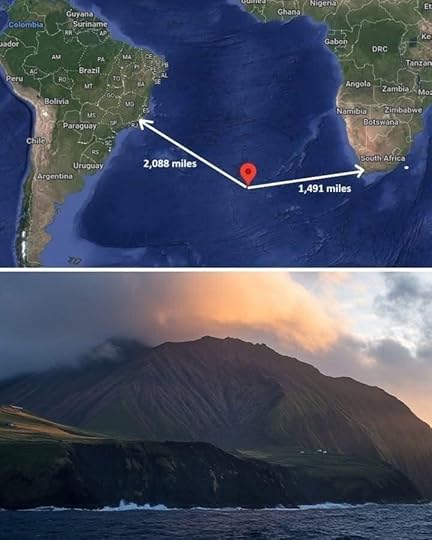
I was intrigued to see that Tristan is the most remote inhabited island on the planet, and is home to just 250 individuals from 7 families. They have no airstrip, and it takes 6 days by boat to reach the nearest mainland, which is Capetown, S.Africa.

The anthropologist in me was curious to know how people would organise themselves under these circumstances, and of course, how they survive.

The author, Conrad Glass, is one of the islanders, and a direct descendent of the Scottish pioneer who settled the island in the early 1800s. He is not a professional author - in fact he is the Island's policeman. As a result, the book doesn't follow the kind of structure you might expect from an account of a people and a way of life. You might expect a rather extensive introduction to the geography and geology of the island, followed by a history from first settlement, together with short biographies of the main characters, and the origins of the islanders. You might expect to get an overview of how their tiny economy works, and of their links to Britain, - and you might want to hear about how on earth such a small, isolated community manage to get along together!
But all of that would be the kind of thing an outsider would write.
This is an account by an insider - someone who is living the experience day to day. So, while we do get little snippets of the above topics, the sequence is unusual. We get a detailed account of wildlife surveys - including the numbers of each species spotted on a particular day. There is a whole chapter on digging up potatoes. For me, the greatest interest was in the unsaid assumptions - the women make the sandwiches for the men, the men go fishing; 'immigration' refers to people disembarking from a cruiser for a few hours (something which happens about 8 times a year).
This is a community that live by a mix of agriculture (potatoes, sheep), hunter-gathering (fishing, catching seabirds) and industry (a small crayfish processing factory), and who have to be resourceful enough to flip between these different modes from day to day as conditions allow. Of course, what any reader might be most curious about his how a community comprised of just 250 people with 7 surnames get along together, with all that shared history and skeletons in closets. Well, if Conrad has stories to tell on that side of things, he hasn't written them down in this book. Understandably so - I would imagine one of the most valuable traits in such a community is tact and diplomacy, and he is wise not to divulge any of his neighbours' or family's secrets.
Profile Image for Jennifer.
1,919 reviews63 followers
March 27, 2013
This is a very odd little book about an odd place - the remote island of Tristan da Cunha, written by an islander. The structure is most peculiar and in many ways seems to be a collection of notes. It seems a book written as much for internal as external consumption, with echoes of stereotypical policeman's notebook style - he does almost proceed in a northerly direction rather than walking and lists of names that are just slightly too long (made worse by the fact that there are only a handful of different surnames in use) So it wasn't an easy or particularly fun read.

That said, it did give some insight into a very different way of life. I could understand him bristling at some attitudes towards islanders, his riposte to a cruise visitor who was surprised by the way they look "What were you expecting, the missing link?" was heartfelt. It is clear that islanders have to work very hard - looking after their potato fields, their sheep and cows, in addition to working in the fishing factory or at other jobs, and dropping everything to rescue those in peril on the sea. Conrad Glass himself is the main police officer and also has conservation responsibilities, hence his trips to count penguin chicks.

Reading between the lines the islanders are forced into a somewhat itinerant life. The difficulties of access (nothing by air and limited by sea) mean that trips away from the island for further study or training or medical treatment are apt to last a long time. I felt rather frustrated at the lack of information about the impact this has on social relationships, and on aspects of daily life. He talks of Tristanian traditional food but doesn't really expand on that. I would also have liked to know how medical situations are managed.

But I learned enough to have tremendous respect for the islanders, whilst wondering, like the author, whether life on the island is going to be sustainable long term.
Profile Image for William F..
62 reviews3 followers
January 4, 2023
Absolutely sparked an interest in the remote Atlantic isles, charming, but 3 stars because many of the hour-by-hour accounts of fishing trips can be a bit mundane, seeming to be written more for someone with extensive knowledge of boating than a land person like me.
Profile Image for Jon.
447 reviews5 followers
December 12, 2015
Uneven. While it contains some genuinely fascinating information, it is also very boring in places. (way too much detail about penguin censuses, for example). On top of it, the book is pretty short.
Profile Image for Silvia Traverso.
193 reviews2 followers
February 22, 2023
Ci sono descrizioni di Tristan da Cunha molto interessanti e curiosi aneddoti di vita degli abitanti ma in molte parti il libro scende in dettagli poco interessanti .
Profile Image for Quo.
347 reviews
February 18, 2025
Rockhopper Copper represents a travel souvenir from the world's most remote, inhabited destination, Tristan da Cunha, first sighted by Portuguese in 1506, a volcanic remnant of the once vast British Empire, an outpost in the Southern Ocean with only 240 folks, still flying the Union Jack.


The book's author is the windswept island's official police inspector & conservation officer, Conrad Glass, a descendant of the island's first English settler, Wm. Glass (in 1816), with many on Tristan da Cunha sharing his surname. Mr. Glass meets the few ships each year whose passengers are fortunate enough to encounter calm seas and to come ashore, leading tours of the island while extolling its history.

And because of the island's pursuit of conservation, it is self-sufficient, in part due to its management of clawless lobsters & other fish, sold to South Africa, five long days distant by ship & to other places around the globe, including Europe, Japan & the U.S.

Rockhopper Copper takes its name from a breed of resident penguins & relates the early history of Tristan da Cunha, its initial settlers, including Irish & American and the 1961 volcanic eruption that forced all residents to flee the island to the U.K. by way of South Africa. Two years later, almost every "Tristanian" chose to return to their tiny island, at Britain's expense.


There is also a wealth of information, including some heavy nautical terminology, related to fishing in & around the island, with occasional loss of life due to occasional freak waves & rather common storms at sea. In 1885, 15 of 18 able bodied men on Tristan da Cunha were lost at sea.

There have also been numerous shipwrecks on the rocks near the shore of the island. There is also the tale of buried treasure via a former privateer, long searched for but now most likely buried well beneath the hardened lava from the 1961 eruption.

Walking about Tristan da Cunha, one has a sense of having entered a timeless diorama, a place somehow lost in time. In his 1985 book Outposts: Journeys to the Surviving Relics of the British Empire, Simon Winchester describes the island's people:
The islanders were tall & tough-looking, with long-jawed faces & olive skins, faces that had an oddly similar look, as though they might be close cousins. Their similarity-of dress, face & mannerism, broad smiles & courtly politeness seemed at once proud & deferential but also vaguely frightening, as though these were aliens from another planet.

All these islanders seemed to step to a subtly different drum--they spoke a pure, oddly inflected English, they flew the colonial flag and they carried pictures of the Queen & her children. But there was a difference about them, as though they were detached by more than mere distance & stormy seas from the mainstream of human society. They were British in name only: before all else they were, without a doubt, Tristanian.
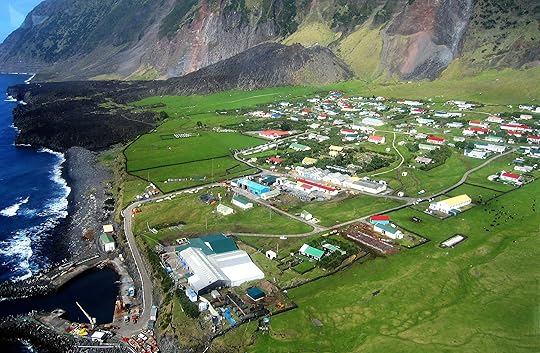

Tristan da Cunha is the sort of place that few manage to set foot on. I was fortunate to come ashore as part of a long voyage from Ushuaia (Patagonia), at the tip of South America to the Falkland Islands, South Georgia (Antarctica) & then on to St. Helena & Cape Verde, off the coast of West Africa via a small but lovely ship, the Seaventure, carrying only 64 passengers & 8 mostly British naturalists, a most memorable journey.

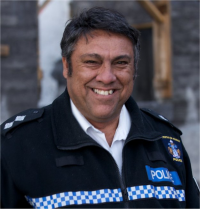
*Within my review are the images of author Conrad Glass, the island's exterior formation & position between S. America & Africa + a view of its only town, at the base of a now dormant volcano.
Profile Image for K.H..
10 reviews1 follower
August 28, 2014
There are a number of books written about Tristan da Cunha, however many are written by people who only briefly stopped (or have never been) on the island. This book is different as it is written by someone from the island with a great deal of knowledge about its people and inner workings. If you have an interest in Tristan than this book will fill in a lot of blanks about the daily goings on there. The style is not that of a linear history but rather a number of chapters that try and cover different aspects of life on Tristan. Things like the famous postage stamps, potato growing, how Tristan is confronting the future and its links to the wide world, as well as much about the environmental and conservation efforts that are currently being pursued. There are also a few chapters dedicated to tales about the island's past and the type of work Mr. Glass (the author) is involved with as the only policeman on the island. (It's a lot more work than you'd think.) Highly recommended for the curious who will probably never get a chance to visit this fascinating place.
Profile Image for Kevin.
40 reviews2 followers
Want to read
November 5, 2014
Started this book but did not get too far. I just could not really connect with it.
Profile Image for Val.
2,425 reviews87 followers
October 21, 2015
This is my World Tour book for Saint Helena, Ascension and Tristan da Cunha (territory). It is a memoir by Conrad Glass who was the police inspector for Tristan da Cunha.
Profile Image for Prcík Tomeš.
24 reviews
May 12, 2018
Great, great and unique insights into the life of a unique community at the end of the world. Captivating.
Displaying 1 - 10 of 10 reviews

Can't find what you're looking for?

Get help and learn more about the design.