

What do you think?
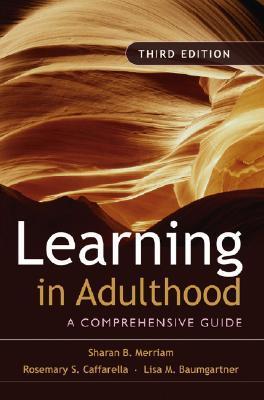
Learning in Adulthood: A Comprehensive Guide
In this updated landmark book, the authors have gathered the seminal work and most current thinking on adult learning into one volume. Learning in Adulthood addresses a wide range of topics Who are adult learners? How do adults learn? Why are adults involved in learning activities? How does the social context shape the learning that adults are engaged in? How does aging affect learning ability?
533 pages, Hardcover
First published April 30, 1991
Ratings & Reviews
Friends & Following
Create a free account to discover what your friends think of this book!
Community Reviews
Displaying 1 - 30 of 31 reviews

Read
November 6, 2020This is not what I expected, which is not the author's fault. This is primarily a summary of scholarly theory about how adults learn. It's more concerned with condensing academic articles about how the brain retains information, than in providing educators with practical help in actually teaching.
As a summary of academic research, it covers an admirable amount of territory.
As a summary of academic research, it covers an admirable amount of territory.

March 1, 2008
Required reading for a graduate course I took on foundations of adult education. Good introduction for someone new to the field.
March 16, 2008
Read this twice, the first edition in Jan. 1998 and the second edition on July 17, 2000. It's very comprehensive.
May 30, 2010
It was a textbook for one of my summer courses, so what can I say? It is a very good book for the course. I learned a great deal, but was it fun? Not exactly!!!!

Read
August 8, 2013I can't believe I read the whole thing!

May 6, 2024
The sheer NUMBER of times I have typed "Merriam et al. (2007)" this semester. Holy smokes. Also, Merriam et al. say academia's allll screwed up; go touch grass and tear down the patriarchy. Who am I to ignore them?
Pros
Truly comprehensive overview. I am here, standing and clapping my hands together for the authors. Really, truly, genuinely, this book is a fantastic example of what it means to compile resources of a discipline together into a comprehensive text. Did it favor some theories over others on author preference alon? Sure, but I'm not faulting the authors for that. They provided sufficient defense for why some theories got more attention than others. Just truly amazing work, awesome reference list. Round of applause for these authors and the work they put into this.
PERSONAL COMMUNICATIONS WITH BO CHANG (p. 50) AND JARVIS (p. 93). SHUT UPPPP THAT'S SO FRICKIN CUTE. ACADEMIA BUDDIES. I'd never seen this before!!!!! I AM IN L O V E WITH THE IDEA OF CREDIBLE AUTHORS IN THE FIELD EMAILING IDEAS BACK AND FORTH. THIS IS SO SO CUTE I CAN'T GET OVER IT. Do they sign off with hearts?? Do they have nicknames for each other?? Do they have inside jokes that we'll never get to see but that mean so much to them as individual humans, existing outside of their work???? I HAVE BEEN YELLING ABOUT THIS FOR M O N T H S NOW.
T H E O R I E S AND HOW! My GODS does this book cover a lot of ground. I learned so much. SO much. This may well be the most informative textbook I've ever had the privilege of reading. Truly demonstrates the defining taxonomic theories and groups of theories in andragogy and adult learning. There's so MUCH information!!!!!!
"F*ck capitalism and academia," say Merriam, Caffarella, and Baumgartner in 2007. I'm paraphrasing (unfortunately), but I bet if their editor had allowed them to say that, they would've. Anti-capitalism in academia 101 text. This was CRAZYYYYY. I've never read a text that was so carefully transparent. It was "f*ck academia" but written so as to be acceptable to [clearing throat and straightening bowtie] The Academy. FRIENDS, I AM R E A D I N G THIS FOR ACADEMIA. THE AUTHORS LIKELY K N E W THAT WAS THE CONTEXT IN WHICH THEIR BOOK WOULD BE READ. WHAT AN EXPERIENCE THIS BOOK WAS.
Cons
I think I will always and forever be haunted by pages 9 and 15-16. Actual nightmares from those stats and their implications.
GIVE ME! MORE! DIAGRAMS! MOOOOREEEEE VISUALS!!! More visual breaks too!!! I'm wondering if the later editions included more visual breaks? Hopefully??? It was a bit overwhelming to try to convince myself to read allllllll those words and theories when there were no Visual Anchor Points other than the occasional subheading. Don't get me wrong, the subheadings were great, but the text would greatly benefit from More visual content.
Pros
Truly comprehensive overview. I am here, standing and clapping my hands together for the authors. Really, truly, genuinely, this book is a fantastic example of what it means to compile resources of a discipline together into a comprehensive text. Did it favor some theories over others on author preference alon? Sure, but I'm not faulting the authors for that. They provided sufficient defense for why some theories got more attention than others. Just truly amazing work, awesome reference list. Round of applause for these authors and the work they put into this.
PERSONAL COMMUNICATIONS WITH BO CHANG (p. 50) AND JARVIS (p. 93). SHUT UPPPP THAT'S SO FRICKIN CUTE. ACADEMIA BUDDIES. I'd never seen this before!!!!! I AM IN L O V E WITH THE IDEA OF CREDIBLE AUTHORS IN THE FIELD EMAILING IDEAS BACK AND FORTH. THIS IS SO SO CUTE I CAN'T GET OVER IT. Do they sign off with hearts?? Do they have nicknames for each other?? Do they have inside jokes that we'll never get to see but that mean so much to them as individual humans, existing outside of their work???? I HAVE BEEN YELLING ABOUT THIS FOR M O N T H S NOW.
T H E O R I E S AND HOW! My GODS does this book cover a lot of ground. I learned so much. SO much. This may well be the most informative textbook I've ever had the privilege of reading. Truly demonstrates the defining taxonomic theories and groups of theories in andragogy and adult learning. There's so MUCH information!!!!!!
"F*ck capitalism and academia," say Merriam, Caffarella, and Baumgartner in 2007. I'm paraphrasing (unfortunately), but I bet if their editor had allowed them to say that, they would've. Anti-capitalism in academia 101 text. This was CRAZYYYYY. I've never read a text that was so carefully transparent. It was "f*ck academia" but written so as to be acceptable to [clearing throat and straightening bowtie] The Academy. FRIENDS, I AM R E A D I N G THIS FOR ACADEMIA. THE AUTHORS LIKELY K N E W THAT WAS THE CONTEXT IN WHICH THEIR BOOK WOULD BE READ. WHAT AN EXPERIENCE THIS BOOK WAS.
Cons
I think I will always and forever be haunted by pages 9 and 15-16. Actual nightmares from those stats and their implications.
GIVE ME! MORE! DIAGRAMS! MOOOOREEEEE VISUALS!!! More visual breaks too!!! I'm wondering if the later editions included more visual breaks? Hopefully??? It was a bit overwhelming to try to convince myself to read allllllll those words and theories when there were no Visual Anchor Points other than the occasional subheading. Don't get me wrong, the subheadings were great, but the text would greatly benefit from More visual content.

January 2, 2026
When the book mentioned that it was a comprehensive guide to learning in adulthood, I did not expect it to take the turn it did. Rather than being helpful and providing techniques for adulthood learning, the book takes a crack at explaining the social norms that perpetuate the patriarchy.
Perhaps I am being slightly unfair. Although the book does mention Critical Social Theory, which is an idea I had to look up, maybe it does have some use beyond a text in someone's echo chamber.
I didn't finish the book. The writing is too dry and academic for me. The book opens by lambasting people and states that we have to understand the underlying social norms that allow adult learning to happen. I can understand their point in that sense. I am a single white male. I obviously have more time to achieve my goals than a single mother of three children, but I feel that isn't the point someone should have to make. I gave it to Chapter 4.
I loathed the book. Thanks for reading my review, and see you next time.
Perhaps I am being slightly unfair. Although the book does mention Critical Social Theory, which is an idea I had to look up, maybe it does have some use beyond a text in someone's echo chamber.
I didn't finish the book. The writing is too dry and academic for me. The book opens by lambasting people and states that we have to understand the underlying social norms that allow adult learning to happen. I can understand their point in that sense. I am a single white male. I obviously have more time to achieve my goals than a single mother of three children, but I feel that isn't the point someone should have to make. I gave it to Chapter 4.
I loathed the book. Thanks for reading my review, and see you next time.

Read
February 9, 2023For a long time, I’ve thought about the ability to learn as a master skill – the one that unlocks all the other possible skills. Learning in Adulthood: A Comprehensive Guide echoes that same sentiment. It acknowledges that, today, the world we live in requires greater degrees of learning than ever before and recognizes that much of the way we try to support and encourage learning isn’t best practice and doesn’t work.
Read more
Read more

February 26, 2022
Read this for my adult learning through the lifespan class in grad school.
The most insightful chapters were ones discussing adult learning theories, where adults learn, and and the impacts of tech changes and globalization on adult learning and education. Theories that resonated with me were McClusky’s Theory of Margin as well as Jarvis’ Learning Process
This will be a reference book for me to come back to.
The most insightful chapters were ones discussing adult learning theories, where adults learn, and and the impacts of tech changes and globalization on adult learning and education. Theories that resonated with me were McClusky’s Theory of Margin as well as Jarvis’ Learning Process
This will be a reference book for me to come back to.

December 1, 2023
This book does a great job summarizing a broad range of thoughts and theories of adult education. There is quite a bit of jargon that’s forced in to reflect the sentiment of the times, but if you can filter out some of that this is well worth your time to read. There’s a lot of different rabbit holes this will lead you down (in a good way)

May 10, 2026
This was the textbook for my Learning Principle course--we actually read it cover to cover! It was a well-written textbook that was understandable and research heavy. It covered a huge range of topics that were not at all what I expected when I started the class.

November 10, 2018
One of the better text books I've read in a long time. Gives a good overview of required knowledge of adult education.

December 1, 2020
had to read the entire thing for class

Read
November 1, 2023Read for EDU647 - Foundations of Adult Education

September 9, 2024
Read for graduate program for teacher leadership M.ed. Very dense at times but will refer to reading notes possibly.

July 7, 2014
mmmmmzzzmmmmmmmmmmmme_emmmmmmmmmmmmmmmmmm(^_^)mmmmmmmmmmmmmmmmmmmmmmmmmmmmmmmmmmmmme_emmmmmmmmmmmmmmmmmmmmmmmmmmmmmmmmmmmmmmmmmmmmmmmmmmmmmmmmmmmmmmmmmmmmmmmmmmmmmmmm(~_~;)mmmmmmmmmmmmmmmmmzzzmmmmmmmmmmmmmmmmmmmmmmmmmmmmmmmmmmmmmmmmmmmmmmmmmmmmmmmmmmmmmmmmmmmmmmmmmmmmmmme_emmmmmmmmmmmmmmmmmmmmmmmmmmmmmキタ━━━(゜∀゜)━━━!!!!! done with this class this Friday, I sort of abandoned this book
update: I did not totally abandon this book.
update: I did not totally abandon this book.

July 10, 2011
This book is a great example of how modernism is ruining education. Every chapter is colored by a modernistic bias, and the end result is the attitude, "Why bother with adult education at all?" I gave it two stars just because of the descriptions of the various theories, though most of the theories are dismissed as not "modernist" enough by the authors.

July 28, 2014
It's a dense read and nonfiction is a slower pace for me. Lots of information on theories in adult education with relevancy to modern society and culture. I appreciated it more when I was able to apply it to the interviews and essays that I wrote for my graduate class at ECU.
September 9, 2010
It was okay, I found some chapters really interesting with really relatable knowledge and other chapters a little too crammed with information that it became too much. I had to read this for a class.

May 29, 2011
a ok-ok book, for my EDU courses.

October 23, 2011
For a grad school textbook, it did not suck. I'm sure I wouldn't have read it of I didn't have to for class. I enjoyed it.

July 6, 2012
I'm reading this book as part of "the foundation of adult education" course I'm taking
October 20, 2012
This was the textbook in a graduate level class. I found it hard to read and boring. It is filled with names of scholars and their contributions to adult learning theories.

January 6, 2013
Dense and rough going at times but excellent information and interpretation of the literature on adult learning.
January 20, 2013
A good reference book. A little dry to read page by page.

July 2, 2013
Selling some of my graduate school books so I'll keep a list here...

September 2, 2013
I keep this book on my desk and refer it frequently. I like the summaries of the different learning theories and the critique of each theory.

October 3, 2013
Perhaps the "bible" for adult educators. I have returned to it numerous time and will continue to use it as timeless information necessary to understand and educate adult learners.

August 23, 2014
Easy to read textbook. It provides a decent overview of the topic.

February 16, 2015
An important work for understanding how adults learn.
Displaying 1 - 30 of 31 reviews