"Крутилы" Фарелла Далримпла - бестселлер New York Times, поцелованный Майком Миньолой. Создатель "Хеллбоя" похвалил работу Далримпла, отметив красоту рисунка и интересных персонажей, сказав, что "таким и должен быть комикс". В центре сюжета - группа подростков, сражающаяся с монстрами, хлынувшими в наш мир из тёмной реальности. А впустили их самые главные герои - Шервуд и Орсон, сунувшись в пещеру, в которую было строжайше запрещено входить. И теперь только юные бойцы, называющие себя Крутилами, могут дать отпор наступающим Мрачникам.
Farel Dal lives in Portland, Oregon and is currently working on a comic book called ROBot TOD. He is the creator of: 20202020 (2022 floating World comics), THE OFTEN WRONG(Image comics 2019), Proxima Centauri (Image comics 2019), IT WILL ALL HURT (Image Comics 2018), Pop Gun War: Chain Letter (Image Comics 2017) and POP GUN WAR: GIFT (2016 Image Comics, 2001 Dark Horse), The Wrenchies (First Second Books 2014), and Delusional (Adhouse 2013). Farel was a co-founder and contributor to the comic anthology, Meathaus, and the artist on Palefire (Secret Acres 2015) written by Mk Reed, Prophet (Image Comics 2012) by Brandon Graham, Omega the Unknown (Marvel Comics 2010) by Jonathan Lethem, Jenny Finn (Dark Horse 2018) by Troy Nixey and Mike Mignola, and Caper (DC Comics 2003) by Judd Winick. Farel Dalrymple and Soph Franz just debuted MONSTER_US!!! a 64-page monster art zine which you can get on their store https://store.fareldal.com/
I thought I'd be able to write something, but I can't. It's gonna need another reread, and a long think.
Suffice it to say you need to pick this up, and you absolutely have no idea what you're getting yourself into when you do. -- I don't know how to comment on the book any further unless I take notes while I go, which is pretty much how I use Goodreads half the time anyway. I feel a little bad about it this time around because Wrenchies is so new, so as much as it feels kind've silly I'll bracket off my notes as spoilers. Lame.
(Followup: by the time I finished my notes, they became an article unto themselves. Don't bother clicking the link unless you really, really want a really, really detailed play-by-play of the entire book.)
My real review follows.
--
If you’ve ever taken a peek at Grant Morrison’s The Invisibles (and there’s no reason you need to, except if you want to know what’s up when someone asks you if you’ve read The Invisibles, and anyone who asks you that is a blowhard, so fuck it), you may know that his intent with that project was to enact a magic rite that would echo across both his own works and others, “a hypersigil to jump-start the culture in a more positive direction.” (wikipedia, natch)
And this is a terrible and patronizing idea, and Invisibles is a terrible and patronizing book, not least of all because its painful illusions of grandeur.
But that doesn’t mean there’s not something interesting about the concept behind it, both in being aware of a one’s own cultural impact, and of the strange energies that come out of cross-textual worldbuilding. I would posit that if you’ve ever used terms like "Buffyverse" to describe Joss Whedon’s body of work, or "Diniverse" to talk about superhero cartoons, or even been aware of the intentions behind Stephen King’s Dark Tower series, there’s something about hypersigilism that’s being invoked.
Shared story universes are the bread and butter of comics, of course -- a meta-detail that is assuredly part of the equation for The Wrenchies, as its own narrative leaps across worlds, realms, and dimensions of time and space -- and includes characters from throughout Dalrymple's past comics. As in superhero stories, there are notes of religious concern at play here as well, wrapped up in the question of God-as-Author.
But rather than lose itself in Morrison’s auteurish pompousity, Dalrymple’s thought process works more honestly as a somewhat desperate search for self. Instead of basking in the aggrandizement of storybuilding, there is an attention here to the real human-being-people who make stories -- who do so in an attempt to find self-worth, to find community, to find inner peace. In The Wrenchies, one person might be a superhero, a secret agent, a paper pusher, and a comics artist all in a single lifetime -- but there is certain fragmentation, a trauma in all that calamity. And while there is a very real awareness of the Big Bad World outside fiction's walls, the focus of The Wrenchies lies in what happens when a person becomes too lost and broken to be able to even access that world, much less find their place in it.
Such a tragic figure exists at the literal heart of The Wrenchies, and also echoes throughout its supporting cast -- the post-apocalyptic child-warriors that are the book’s namesake, the rudderless kid in a nameless modern city who hopes to join them, the isolated adults cast into a land of magic without a true understanding of their own agency. The questions of existential meaning that surround these characters feed the meditative concerns at the center of the book, and their mounting paranoia about the hopelessness of their futures looms as large as the fantastic monsters that pursue them across the strange landscapes in which they find themselves.
I’m not saying The Wrenchies is a perfect work (although I might be), and I’ll concede that it demands no small amount of patience and a certain suspension of disbelief to be enjoyed in the first place. But I do believe it’s an incredible testament to what can be done by one person in the field of comics -- and it’s made my bookshelf a hell of an exciting place to be in 2014.
A gorgeously-drawn graphic novel that suffers from a bonkers plot and scrambled timeline.
I'll try to give a brief summary here, but understand that this is gleaned from every part of the book — beginning, middle, end. Farel Dalrymple doesn't present the story in a linear fashion, which is incredibly frustrating.
A boy and his brother enter a cave and are attacked by a demon-like creature called a shadowman. During the course of the attack, the demon messes with the first boy's eyes and something radically shifts in his brain/destiny. After his brother saves him, the boy's eyes are drawn to a medallion in the demon's cave through which he sees/astral travels into a different dimension where he can view aspects of the future.
This future is an apocalyptic world filled with these shadowmen and children who fight against them. All grownups in the world have become shadowmen. When a child reaches a certain age, they are "harvested" by the demons and become part of the problem. Something powerful and magical is fueling these shadowmen, but discovering and disabling that artifact is the large story arc so I won't spoil it for you here.
Meanwhile, the boy-with-the-demon-altered-eyes is (I kid you not) kidnapped by aliens while his brother goes on to fight the shadowmen in the real world. Then there's some character development about the children/warriors in the apocalyptic world, the involvement of a child from our time, a blind child who uses technology in a way that borders on magic, another child who actually uses magic... And, at one point, I think the author tries to add the difficulty he had writing the comic into the comic itself.
I think that's enough of a summary. Don't you?
This isn't a fairy tale story for teens though it seems to reach for a coming-of-age feel. The children use drugs to protect themselves from the mind-altering powers of the shadowmen and are constantly fighting bugs that pop out of the shadowmens' heads after they kill them. It is a paranoid schizophrenic's nightmare.
The Wrenches is violent and disturbing, rather like Peter Pan on acid with demons instead of pirates. And not in a good way.
I suppose if you just looked at the artwork and didn't read it, you might enjoy this graphic novel. Honestly, the panels are stunning. Shame about the story tho.
Dalrymple draws and paints and means well. As a story, though, I found this almost unreadable. Lifeless characters, random plot developments, heavy-handed self-reflexivity - a mess!
Magical? Mind-expanding? Evocative. All that just from chapter one.
Or maybe it's just distracted. Tangential. Unfocused.
I keep hearing Keith's review (https://www.goodreads.com/review/show...) in my head, and it keeps haunting me with the promise of some mind-bending insanity. But the more I read, the faster I skim, as I get more and more impatient for something to surprise and delight (or at least unsettle) me.
These loosely-connected tales of these kids don't entirely like up in time - is this a post-apocalyptic world, or just a bunch of kids with more imagination and less interesting lives?
Have you ever heard Louis CK's bit on the tomato story? (Here is 12 minutes of pure joy for you - you're welcome: http://m.youtube.com/watch?v=X0IV_ZB9CDs) This feels like the meandering storytelling approach - and I don't have the patience to wait for Dalyrumple to come back around to the point.
I've got a lot of other comics to read - books I'm looking forward to a lot more than this. Sorry Keith, I swear I'll try another someday.
I am a Shallow Comics Reader. Hear my attention span pop.
This book was painful to read. It was boring, confusing, and I couldn’t have cared less about any of these characters. I’m almost two thirds of the way through this and I still haven’t quite figured out what exactly this is about It has been such an exasperating read, to say the least.
Plot: Confusing, messy, unclear. Set in some kind of apocalyptic world, I was never able to figure out what the goal of the story was.
Characters: Could never really figure out who the main character was. There were way too many characters and I could never be brought to care for any of them.
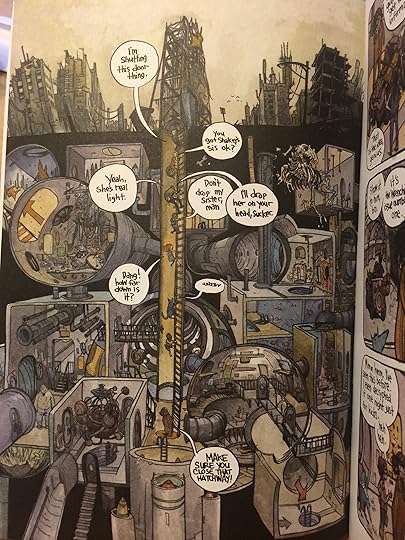
Artwork: At times, very good artwork. Great use of color. But on the bad side, there were panels where there was just too much going on and because of it, it looked as if the artist got lazy trying to fill in as much as he could into one panel.
Dialogue: Confusing. Random. Overcluttered. Hard to read at times. So many characters were speaking at the same time that it was hard to make sense of it all and it was hard to tell the sequence of conversation. Some was conversation in crowds that didn’t seem to have a place within the story.
Would I recommend this to anyone? Nope. Had to DNF this at page 190/303, ch. 5., The Quest.
I was really into this at first, loved the art and was enjoying the plot and action. But less than a third of the way in it got WAY too vague and lost all its momentum. I'm willing to 'go with it' through a lot of vague and weird things, but it has to be interesting and at least vaguely follow-able. It also fell into characters just explaining the story for really long periods, rather than anything actually happening.
The premise of this story is really good and quite intriguing but I found the execution a little confusing and overly complicated, I was rather lost by the time I was halfway through and found myself having to go back to check that I hadn't missed anything vital. There are moments where this is really engrossing and whisks you along at speed, but then there are bits that just don't seem to fit and seem to come out of nowhere. Because of this I found I couldn't really get to grips with the characters and found them lacking a bit of depth. This could just be me missing something really obvious or not getting the point but it really did spoil it for me. The artwork however was superb, embracing the gritty dystopian world the Dalrymple has created and taking the reader right into the heart of it. Worth a try but may need a few re-reads before the full potential is realised.
One of the most interesting parts of Farel Dalrymple's THE WRENCHIES, for me, is how it deals with the violence of the post-apocalypse.
This book is full of characters who are children and teenagers, and they're dealing with the end of the world and magic!zombies wandering around everywhere who are trying to eat them. Because THE WRENCHIES is a graphic novel, it's difficult for the end of the world not to be in your face at every minute you're reading -- you can never forget while the characters have a quiet emotional moment, because their surroundings continually pervade.
Farel's art in this is fantastic, and I think that the way that he the setting becomes part of this story really makes it something extraordinary.
So, the drawing and painting of this one is terrific. It's dark, in almost every sense, but I think it is still almost (not quite?) an all ages book, since, though it is pretty violent in places, it is not that violent, in my opinion. The art I love, actually, but everything is dark, visually and thematically, because it is a post apocalyptic or dystopian tale, where gangs of kids roam the blasted out world defending themselves against Shadowpeople, or Creepers, that all seem very much like Zombies, of course, though these Creepers wear suits. This gang is called--and all gangs apparently have to have a name--The Wrenchies, which to a seventies guy like me calls to memory the environmental "activist" group, The Monkeywrench Gang by Edward Abbey, a group that throws a "wrench" into the capitalist machine, but this group of kids doesn't seem to have such elevated political goals, though I have only read it once, so maybe it does. Much of what happens isn't completely clear to me on the fist read, but this didn't bug me as much as the world making and character relations seemed more central than plot.
One of the kids got the idea for the gang from a comic book called The Wrenchies, a copy of which surfaces in the trash for some reason and gets passed around, so the uses of comics is a theme that gets thrown in here too. The group of kids is interesting, with unique and though all quite similar in some ways, they all that seem to talk realistically together. I confess I am still a bit confused what the plot leads to, what it is about, as I said, but the art work and characters I liked a lot… maybe if I reread it I will think less of it--maybe it really doest make much sense, which seems possible; there's other creatures than the Creepers, and both good and bad magic and ghosts are also thrown in--but the central images in it were appealing to me and I suspect, would also appeal to teens.
I honestly can not figure out what the plot line was. This book was just surreal. And not in a good way. Perhaps if I was under the the influence of some hallucinogens, I might be able to make sense of it. But I'm not, nor will I be. So it shall remain one of the graphic novels that I just shelve.
And now that I have let my mind rest an entire night's sleep on this novel, I am still completely baffled by what I just read. There are so many interweaving story lines, with tertiary characters that aren't developed, and bizarre bird walks that only kind of reach resolution in the four epilogues, and rampant drug use that simply exists that I am completely flabbergasted. This is one graphic novel that I wouldn't bring to the table for consideration for anything. It's like one bizarre stream of consciousness emitted by a psychiatric patient who is suffering dementia. The constant switches between time periods and realities are completely disruptive of any real plots that could have been developed or fleshed out.
Don't spend your money on this one. It's not worth it, unless you want to try to decipher a hallucinogenic rambling that doesn't even give a good background.
This little gem gets me on so many levels. First and foremost, the artwork is amazing. Every page begs for your attention with colorful detail that arrests your eyes from moving on in the story. Oh but you will move on, because the story won't let you stop for long. The narrative will exercise your understanding of reality, it will test your need for the clear and obvious. You will be wondering how to connect it all, in fact a good part of the story will play out in your own mind as you fight for cohesion. This is what I love, something that works out my imagination, that won't let me slip by comfortably. A story that implants itself in your subconscious as you try to work it all out for days after you thought you finished it.
This is one of those books that really doesn't lend itself well to summarizing, but I'll do my best. There are several groups of characters that exist in several different dimensions (realities?). We have our world, with two of the main characters. Then there's the world of the Wrenchies, a post-apocalyptic wasteland where only the children are technically "safe" from the Shadowsmen, a terrifying entity that attacks anyone "of age" with the purpose of turning their victims into more Shadowsmen. Then there's yet another dimension with super-heroic adult versions of the Wrenchies as portrayed in the Wrenchies comic book that appears in each of the first two dimensions (our world and the Wrenchies'). The story began a few decades ago when a pair of brothers enter a cave and encounter one of the Shadowsmen. The story picks up later when one of the brothers is an adult living next door to an adolescent boy named Hollis. Hollis doesn't fit in well with his peers. He wears a superhero outfit everywhere he goes and would prefer to be in his fictional worlds rather than the real one. He finds a totem hovering in the air outside his window and jumps to grab it. He's then pulled into the world of the Wrenchies, who regard him with a sense of wonder and include him in their group without question. As things get weirder, a character known as "The Scientist" pulls the heroes in through a portal similar to the one Hollis came through. Now they all need to work together to defeat the scourge of Shadowsmen who are also taking advantage of the rifts between dimensions. There's a lot of unusual stuff going on in this graphic novel and it's occasionally hard to explain exactly what's happening, which means it's not for everyone. It's very gritty and violent, which one might expect from roving bands of armed children wandering around a post-apocalyptic world. The treatment of the kids is simultaneously disturbing and heart-warming. In spite of the extreme violence that comprises daily life in the world of the Wrenchies, the bonds they create amongst each other are strong and true. Add in some interesting philosophical dilemmas and you have a thoroughly fascinating, if somewhat disorienting, story. The artwork is lavishly detailed and full-color, making this a graphic novel you can really sink your teeth into. In fact, repeated reads may be required to fully appreciate the experience. I have a feeling one would notice something new upon each read.
This book is extremely incoherent in the worst way possible. I tried to write a review but apparently this book is so bad and confusing and stupid that it's infected my ability to write a coherent thought. I want to say something along the lines of, "It's like somebody forced me to watch a four year old on PCP act out their favorite David Lynch movie," but even that is giving it too much credit.
Visualization. Wrenchies has this distinct drawing style, that you will either love or hate, added with the underlying grotesque layer. It is not a pretty world (growing up never is) and the ambiguous themes that are presented throughout the book matches the drawing style.
Themes. There’s a lot going on in the world of the Wrenchies. There always is on the edge of adulthood and adolescence, especially knowing that you will go crazy if you grow up would not sit well with anyone. There’s also the issues of fitting in, expressing yourself, and ultimately, how some people never find that element of “i was meant for something more intangible” and can become self-destructive, setting off a chain of events that could potentially effect people outside of just “I.” There are friendships, relationships, other-worldly beings that could represent a myriad of psychological or philosophical discussions. This graphic novel had the potential to read a wide audience. The result:
Let’s delve into why it did not work:
The book was a labyrinth.
No. I didn’t! Reading this book was FRUSTRATING. I do not mind flashbacks, I do not mind sitting through a book going 'i'm so lost' a bazillion times, to be mind blown when it comes together. I appreciate an author who throws in a ‘plot twist’ or has us in suspense and reveals a storyline out of our wildest imagination. This book’s set up----was misleading, and frankly a chore----because it was a mish-mash of a premise, world-building, character-building, that somehow “sorts itself out” through Hollis’s final choice.
I do not mind beginning flashbacks, set-ups, etc. Yet, I do mind when there seemed to be no organized link to when this ‘all happened’ or a murky explanation about how this world exists and why it is spilling out ‘into reality.’ It was a mind-bend but definitely not in a good way. I don’t mind working for a book, I do not mind furiously searching to see, if I’m the odd duck, and I’m just not getting it. I'm just telling myself:
I liked the art style but the story was messy and bland. I enjoyed the first bit of this graphic novel but than it just went really down hill for me. I did not care for the characters and the plot was super random.
It begins with a single demon in a cave. Soon, the world is overtaken by violent creatures which prey on teenagers, turning them into monsters themselves. This graphic novel combines an apocalyptic world, superhero and comic book lore, and a gang of warrior children. Dalrymple’s aesthetic is raw, saturated – beautiful and terrible all at once. There’s an exactness to his scrawl. The reader will find themselves dwelling on his scenes, looking for the winking details and small moments of truth. There is a dreamlike quality here – the story goes beyond nonlinear to become almost nonsensical, and perseverance sometimes requires patience and/or hypnosis. This is a work which will primarily appeal to adults, or to idealistic, metaphor-seeking deep thinkers. The illustrations are stunning, the ideas grand – and graphic novel aficionados and free-associating minds will enjoy it the most. Recommended for upper high school and adults due to graphic violence, language, and mature themes. //Review I posted in the WashRAG
~~~
All of that is true. However, while I admire it as a work, I still haven't quite settled on whether I think it's weaker for the hard-to-follow plotline. Whether it's a failing of GN storytelling technique. The illustrations, though beautiful, are pretty inconsistent at times. I really do love his use of bleeds and the page as a whole. His layouts are stunning. So, the storytelling weakness isn't a failing there. It's easy to figure out where to go on the page, but pieces feel left out. Also his characters are fairly impenetrable. You really don't get a sense of who these people are at their cores, or even who the good guys/bad babes are. If your appeal factor is character or plot, this is probably not the book for you. Go here if you like world-building or language. Or, ya know, gorgeous visuals that are occasionally horrifying.
I always get burned by impulse purchase books, but every year or two I see a shiny pretty cover, I'm stricken by sudden-onset selective amnesia, and I get burned once again. This was my 2015 when-will-I-learn moment.
The storyline is a confused mashup of standard fantasy quest plot points, told in the clumsiest way imaginable. Something about a ruined world populated by children who fight zombies and demon-bugs. There's a magic amulet with useless heroes inside it who mostly just die. There's a wizard in a coma who's sort of responsible and he must be rescued. Or killed. Whatever. There's a fat nerd from Earth who wears a superhero costume; he's important, though it's not clear why.
Worst dialogue I've ever read. I suspect Farel Dalrymple is an ambitious ten year old; maybe he'll do good things one day. This is not that day.
I do like the simple art and the muted color scheme. But that didn't stop me from praying for the book to end so that I could just...be...done already.
What if the Gnostic Archons had created SCOOBY DOO?
If you like Grant Morrison's THE INVISIBLES and THE FILTH, then you may well dig this beautifully illustrated scifi-magick-timetravel extraveganza.
Warning: this book does not reinforce mainstream spoonfed consensus reality, even on a storytelling scale. Does the plot add up? NO! It is not intended to, but thematically, it all ties together wonderfully, especially upon a second read.
My only caveat is, as with some gnostic themed work of fiction, THE WRENCHIES can be a bit dark, a potential hurdle for the publishers to overcome RE hitting the YA audience. But the glimmer of light in that darkness is quirky, charming, innocent, wise and oddball funny.
This book is already an instant lost gnostic classic.
2.5 Stars. Artwork was dark, painterly, and simply great. The story left me with no flow, minimal character development, and really wanting it to be better than it was. It was worth it to admire the artwork and some of the highlights of the messy text. A fun dystopian idea but not enough development for me to work. It felt like Dalrymple was torn between wanting to create a story with all the parts to make sense (or at least a reasonable amount) and wanting to have it be more of a stream of consciousness tied around a central world and its hodgepodge of characters.
So, the art was super epic and I loved it. Everything else was all over the place and was just terribly done. Nothing was clear and so many things were happening at once. The characters weren't bad but besides that and the art, this just wasn't for me, at all.
I got a copy of this book through the Amazon Vine program to review. It was an interesting read. I thought the plot was way too convoluted and at times way too wordy. While I enjoyed some of the irony in the story in the end I don’t think it is something many people will enjoy.
These two kids wander into a cave and one of them, Sherman, gets an eyeful of evil and acquires an evil amulet. Then we are transported to a story in the future where the world has ended and a gang of kids dubbed The Wrenchies is struggling to survive and outrun the Shadowmen. They stumble upon an old copy of the original Wrenchies comic and embark on a quest to decipher the message hidden within this comic and save the world.
Okay the above is a decent synopsis but the plot is much much much more complicated than that. I got it but I am not going to go in to everything because, you know, spoilers. And I don’t want to deprive anyone of the pleasure of struggling through this mess of plot to discover the story on their own (I am being sarcastic here, it really was a mess). Let’s just say it involves time travel, multiple realities, and the whole “whatever you think can become real” (if you have an evil amulet) school of thought.
So, I am being pretty nice in the above statement...my initial reaction was “Holy crap the plot is a f***ing mess”. Seriously, it’s all over the place and confusing as hell. I think I ended up understanding what was going on but who the hell really knows what was going on here. There are a ton of characters and it is hard to keep track of them all. To be fair the author does provide a key with their illustrations and names at the front of the book. I didn’t really enjoy any of the characters, you don’t really get to know them because there are so many of them.
I wasn’t a fan of the illustration style. It is definitely a unique style and it depicts the dark and depressing story well. But honestly I think you will either love it or hate it. I feel like Dalrymple went out of this way to make characters and surroundings super ugly and disgusting. Things are meant to look awful and disturbing throughout and the illustration style does convey this well.
Then there is the whole drug use thing...all of these kids are always hopped up on a million drugs. Apparently the premise is that the Earth is so polluted that the extra pollution from the drugs helps them to survive...but whatever. I thought it was kind of unnecessary and didn’t really enjoy reading about it.
My last complaint is that the whole story also digresses waaaayy tooo much and is seriously over wordy at times. There were portions where I was absolutely losing it and falling asleep. Especially once The Scientist enters the story, that man can pontificate like no one’s business.
All the above negative being said I do think there is an interesting story at the core of this graphic novel, I just wish it had been told in a way that wasn’t so schizophrenic...but maybe that’s a sort of charm that will appeal to some readers?
Overall okay, but convoluted and hard to get through. I definitely recommend taking a look at the illustration style before buying to see if the grotesqueness appeals to you. There is a clever and intriguing story here, but it takes some work to read through this book and understand what is actually going on. So if you like a very convoluted story that twists on itself a millions times and has tons of characters to keep track of, you might enjoy it. I thought the story was overly complex and could have been told in a much better way as to not be so confusing. I also thought it got very wordy. My initial gut reaction was to give this 2 stars, but after I thought about it a bit there is some interesting material in here, so it gets three stars...just barely.
There are two brothers who kill a shadow and find an amulet. One of those brothers grows up to write a comic called The Wrenchies. There's a world where shadowmen have killed almost everyone, and the best fighters who oppose them are a group of young'uns called The Wrenchies who read a comic called The Wrenchies. Then there's young Hollis, who reads a comic called The Wrenchies and then falls into the world of The Wrenchies. Confused? Welcome to THE WRENCHIES.
Honestly, I feel like I should read THE WRENCHIES again to better sort how things fall into place as the novel progresses. At the same time, I haven't, because I don't really desire to read it again.
Farel Dalrymple's art is well suited to the world of THE WRENCHIES, fading and decaying and under siege. I do wish there was some variation in style to help keep separate worlds apart visually. At the same time, that works for how the layers and locations of the story blend together. But really, I just found that I didn't like the art much. There was something off-putting about it to me, although it was so close to what I usually like. There is a deliberate ugliness, but not one that worked for me. Plus, I found all the red noses distracting.
As for the story itself, it will appeal to fans of post-apocalyptic literature. There are a lot of characters to keep straight, and it can be hard to remember who has died. I definitely felt like I never had a great grasp on Hollis's age. His looks told me one thing, but his behavior and voice made me peg him as younger. (I definitely liked him better when I decided he was younger than I first thought, although I felt weird about him being the questing hero in a gory story that in some ways boils down to drug addicts vs. zombies.) I feel like the book could've spent more time developing Sherwood as well, since Sherwood drives most of the plot, even if he isn't the one of a heroic quest.
THE WRENCHIES just never grabbed me, although it was full of ideas I found intriguing. It's wonderfully layered and complex, but not interesting enough for me to really try to unpack what lies beyond the surface. I'm just not the right audience for this graphic novel.
A gang of children battle against a horde of evil zombies, vampires, and demons to save the world. And that's just the beginning!
I have really been looking forward to this guy's next big book ever since reading Popgun War. If Popgun War was a surreal and haunting dream, The Wrenchies feels deeper like a recurring, heart-pounding nightmare. One that is all the more visceral because the drama is laden with meaning. It is also by turns funny, sweet, beautiful and heart breaking.
I expect that some readers will be uncomfortable with the weirdness, and will complain that they want a more straight-forward plot where simply A then B then C happens, the end. Get with it you Squares! The Wrenchies is happening on like, multiple dimensions, and often plays with that maddening uncertainty— how can we the reader be sure of exactly what is going on when the characters themselves may only be figments in the feverish dreams of a mad magician? Really it is all there: The comic itself is a magical meta-incantation. One that the creator: the jaded artist, needs the lost innocence of childhood to complete. To heal, to absolve. This isn't a comic, this is a spell! And in this way I think it has a lot in common with two other "comics as spells", both equally excellent and challenging: Alan Moore's From Hell. And Grant Morrison's The Invisibles. Both of these (awesome and very meta) graphic novels are about the idea of a work of art being a sort of spell that is completed by the reader.
While a lot of this is very awesomely trippy, some of the finest pleasures of The Wrenchies are understated like Dalrymple's terrific use of color palette, and his incredibly spot-on depiction of childhood characters.
It's an apocalyptic Alice in Wonderland on mushrooms for adults who remember the magic being children. It is a dark-dream laced with nostalgia. It's a trip. It's a journey. It's a fully loaded nightmare that like the work of Moore and Morrison is worth revisiting again and again.
The Wrenchies was a beautiful read, if not a bit confusing. I loved the artwork, I loved the settings and the colors used to portray a post-apocalyptic world where only children survive. Once you close in on adulthood, the Shadowmen come for you. These kids form gangs and this one follows the Wrenchies, a group that is filled with interesting characters. Unfortunately, after killing some Shadowmen, they find their name written on a paper and know that they are after their gang, who seem too good at killing off the wretched, freaky creatures that look like warped men in suits.
Then it gets even trippier as multiple dimensions are introduced. The basic premise being that the creator of this world and the Shadowmen is a comic book artist, who has been captured and needs to be rescued. The scientist, a large towering man that is somewhat of a legend is supposed to guide them and brings in characters from other worlds – include a set of grown Wrenchies from the comic series and a boy named Hollis, a chubby boy who wears a superhero costume everywhere.
As much as the plot got a bit messy and at times, I reread and went back to see if I had missed something, I realized I would just push past and enjoy the ride. I loved the illustrations, the characters that were built. It’s a bit gory at times, and the Shadowmen shove their fingers in the eyes of their victims which is quite an appalling way to meet your end. I like the length, giving enough space for the plot to push around into some strange events.
Verdict:
A messed- up graphic novel, in both good ways and bad. Not a book for everyone, but one I enjoyed and may even reread.
I have no idea what I just read, but I already want to read it again!
Love love LOVE this book. Its an experience for sure. It took me quite some time to read but only because of how layered it is. It is in chapters which helps, but there's just a lot to cover and I found myself having to put it down from info overload. However, the way everything is finally pulled together is so beautiful and worth the time! Worlds inside of other worlds! Kids in a post apocalyptic world fighting off the evil shadow men find this kid from our world who just wants to be a superhero. All of them are out looking for a god like being that's holding the world as it is. And then the last chapter happens and everything I thought I knew changes (for the better). The art is gorgeous. SURREAL YET SO REAL!! and I kind of want a smiley tattoo, thats how much of a mark it left on me. Some of the city-scapes remind me of Moebius, but really I haven't seen any other comic do some of the things this book does. READING PROXIMA CENTRURI FIRST HELPED A LOT! It's a great introduction to Sherwood and some of the other gang members. Its also has less info and is shorter, you wont feel as overwhelmed by it like you might with the Wrenchies. Not sure if there will be more of this story from Farel Dalrymple, but I sure hope so!
This rating/review is based on an ARC from netgalley.
3.5 stars.
Probably the weirdest comic I've ever read (well, this one and Ed the Happy Clown). It reminded me a lot of the movies Primer and Upstream Color: really complicated with not a lot of explanation. I like that though. I think it would have benefited from perhaps a little less text, but overall it was an enjoyable read. That being said it is definitely NOT for everyone. I can see people being frustrated by the length and lack of clear plot.
One of the greatest parts of this book is the art. The characters are beautifully created and the world is incredibly strange. The style is semi-life like, but with some really interesting, more cartoony elements. And the colors! I loved the red noses! It is certainly a very visually engaging comic book.
The Wrenchies opens with green gore and violence. Two young boys find a cave and destroy the creature that lives there, setting in motion events that will lead to a surrealistic future full of magic and darkness. Or do they? I was unprepared for the Wrenchies. Based on the reviews and the Amazon customer comments, I was expecting post-apocalyptic story about monsters--maybe something akin to Paul Pope's "Battling Boy." It was that, partly. But mostly it was something completely different. I'm not even sure what. It deserves close reading and multiple readings. It deserves discussion. Like so much (post-)post-modern fiction, "The Wrenchies" can't stop commenting on itself and on the nature of art. What starts as a sci-fi/fantasy/horror comic ends up as a philosophical treatise about guilt, aging, and creative power. Farel Dalrymple and First Second have put out a truly strange, truly beautiful book. It is certainly one of the most disturbing and thought-provoking graphic novels I have read this year.
Wow, this was.. strange. Post-apocalyptic tale turning into sort of metaphysical meditation on one's fate and choices.. or maybe different sides of your spirit and persona.. or not. I might sound a bit idiotic saying I didn't wholly grasp all the ideas etc presented here but I still liked this a lot. That being said, I was sort of interpreting this all the time I went on and looked at it from many different views. I felt the story really encourages you to do it, not really emphasizing any specific or obvious interpretation. All the characters were really interesting, even the annoying ones (such as a scientist in a robot body) and the art was to die for. All in all what came to mind was that this really had the feel of a superartsy science fiction film. And I mean that in a good way.
Maybe I'll rate this lower after a second read but right now I feel this really made an impact.