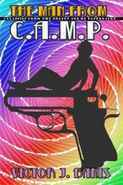
Resourceful as James Bond, flamboyant as Austin Powers, and gay as a Christmas goose, there's never been a secret agent quite like Jackie Holmes, the Man from C.A.M.P. These fast-paced stories, written and set in the swinging sixties introduce a new generation of readers to the fabulous adventures of gay superspy Jackie Holmes, the Man from C.A.M.P. Armed with a cache of secret weapons, a body that just won't quit, and a white poodle called Sophie who's trained to kill with her razor-sharp teeth, the blonde bombshell with a license to thrill known as Jackie Holmes will blow you away!
Victor Jerome Banis was an American author, often associated with the first wave of west coast gay writing. For his contributions he has been called "the godfather of modern popular gay fiction.
Banis wrote under a number of pseudonyms for Greenleaf, Brandon House, and Sherbourne Press. They include Victor Jay, J. X. Williams, Jay Vickery, and others for his gay pulp fiction works. However, upon the success of The Gay Haunt (1970), published by Maurice Girodias in his Traveller's Companion series, Banis moved away from the gay genre. He began writing heterosexual Gothic romances, again under a variety of pseudonyms, Jan Alexander and Lynn Benedict being two of the most popular names used.
this is silly retrospective fun. sure it's full of stereotypes, riffs on Bond, and is POORLY edited (if at all), but it's a cheeky poolside or beachfront diversion and a historical glimpse at the times. read the foreward!
The Man From C.A.M.P. By Victor J. Banis MLR Press reissue, 2008 Five stars
I am not giving this bundle of three novellas re-published in 2008 as “The Man From C.A.M.P.” five stars because it is great writing or good literature. I’m doing it because these are important, and highly amusing, documents of one of the earliest subversive gay writers in America.
When I grew up in the 1960s, James Bond was a big thing. His serious imitators on television were “The Man From U.N.C.L.E., Mission: Impossible, and The Avengers. His spoofing imitators on television were Get Smart and Batman. I watched all of them. Victor Banis invented the Man From C.A.M.P. at the same time, and published them as a wily subversion of the nasty anti-gay atmosphere in the years before Stonewall.
In these three hastily-written novellas, we have Jackie Holmes as the man from C.A.M.P., a top-secret global agency dedicated to helping the cause of what we now call GLBT folks everywhere. Jackie himself is vastly rich, an expert in gemstones, and a connoisseur of rare high-performance vintage automobiles. Jackie is slender, short, blond, pretty and extremely nelly. But underneath that calculated self-presentation, he is smart, tough, and resourceful; and can take down a thug with a gun in the blink of an eye.
Another thing Jackie does is to seduce the reluctant, and often homophobic straight operatives from other agencies who are assigned to work with him by Lou Upton, the middle-aged Interpol officer who knows just how good Jackie is. In spite of the pining of Jackie’s associate, Rich, a huge bruiser with a tender heart and a massive thing, Jackie is steadfast in his promiscuity and insatiability.
In all honesty, I would have no patience with these if written today by a young gay writer. They are creations of their time and place, and their subversive, revolutionary quality is owed entirely to the daring of the author who brought them to life over half a century ago.
I thoroughly enjoyed this. Much better than the gay pulp novel I was expecting. Good plot, good characters, and a lovely, positive portrayal of gay culture for its time. I was hoping for a few more sex scenes (apparently the author didn't like writing them), but the few it had were very good. Looking forward to reading the rest of the series.
When the Victor J. Banis Foundation reached out to me about doing an article on The Man from C.A.M.P. I couldn’t say “Yes!” fast enough.
Collectively, gay pulp fiction gave community, hope and entertainment to queer readers throughout the 1960s and 70s. Individually, however, only a few titles were true landmarks of undeniable literary influence. These included Richard Amory’s Song of the Loon trilogy (1966-1968), Victor Banis’s The Why Not (1966) and, yes, his nine-book Man from C.A.M.P. saga (1966-1968) (written under the publisher's house pseudonym Don Holliday.)
My essay on Victor's historically significant novels and their role in starting a literary revolution was originally published by the Victor J. Banis Foundation’s website. They have graciously allowed me to reprint it here on Goodreads:
The Man from C.A.M.P. 60th Anniversary
The story of queer liberation is often told as beginning in the streets. Near Christopher Street and Waverly Place, to be exact, where the police raid of a New York City gay bar set into motion a literal and symbolic fight for freedom.
The Stonewall Uprising of June, 1969, wasn’t just about defending a favorite weekend haunt. It marked a dramatic shift in handling oppression, from passive acceptance to active resistance. As Stonewall participant Mark Segal explained: “We’re going to take back our identity. We’re no longer going to allow society to label us. We’ll be out, loud, and proud – and in your face.”
An appetite for revolution brewed thick that night. To understand why, we must zoom out to three years earlier when a different kind of riot took root. Not in the streets, but at newsstands, bus terminals and drug store paperback spinners. This was an uprising in book form. A literary Stonewall, if you will. And Victor J. Banis threw the first tome—or at least the first that struck.
In the mid-1960s, publishing queer fiction remained risky. For one, you could be charged with violating “obscenity” laws. This meant expensive legal defense fees that could extend all the way up to the Supreme Court. Consequently, most publishers either avoided gay characters entirely or presented them as suicidal, predatory deviants, capable of redemption only by forsaking their sexuality. The “Morality Squad” welcomed these negative portrayals which reinforced their belief that being gay was a sickness.
Legal liabilities aside, publishers doubted enough readers would purchase celebratory, sex-positive queer novels to make them profitable. Paperback writer Victor J. Banis felt certain they would and convinced Greenleaf Classics to take a chance.
At the time, Greenleaf was a rising publisher of taboo fiction, a free speech advocate, and never one to turn their back on a buck. Later—shortly after signing with Banis, coincidentally—they exploded in popularity and ranked among America’s most successful so-called porno publishers.
As a “trial run,” Greenleaf purchased two of Banis’s queer manuscripts. Both became landmarks of the era and paved the way for an entire Golden Age of audacious, unrepentant gay pulp fiction.
The first manuscript, The Why Not, is a novel written in vignettes. Each chapter highlights a different character preparing for an evening at the same gay bar. Some seek escape from personal troubles, others are just excited for the weekend. The novel’s revolutionary aspect was its simplicity. These queer characters weren’t diabolical or unstable—at least not unusually so. They were fully realized, everyday people in need of a night out.
“Read this book,” urged the gay-centric periodical Tangents shortly after publication. “You may meet yourself in it.”
This review is as relevant today as it was then. While the blackmail plots and social angst of that era have diminished, gay bars remain irreplaceable sources of support for the queer community. The Why Not, better than any historical document I've seen, provides context for why someone would risk everything to defend a small, Mafia-run bar like the Stonewall Inn.
Proving Victor's point, The Why Not surpassed commercial and critical expectations. But it was his second manuscript which captured lightning in a bottle. This was the book which cemented Banis’s place in queer history.
A spoof of James Bond and The Man from U.N.C.L.E., Banis’s The Man from C.A.M.P. follows gay secret agent Jackie Holmes as he thwarts plots against the gay community. A man-eating pet poodle and high-tech gadgetry—false asscheeks hiding a dagger, for example—give Jackie an edge against assassins. True to its source material, a sidekick love interest tags along. This time it’s a hunky straight guy who grows increasingly bi-curious with each near-death experience.
Hilarious and relentlessly entertaining, C.A.M.P. remains a raucous good time for readers who appreciate the camp aesthetic its title invokes. It also remains liberating all these years later. Jackie Holmes is both proudly fey and a counter argument to queer stereotypes. His physical strength and mechanical adeptness continually puzzle friends and enemies who expect otherwise. Through the sidekick’s perspective, readers witness the emotional struggle of a heterosexual outperformed by a gay man and chuckle at his confusion when accidentally aroused by Jackie in drag.
Far from a one-hit-wonder, The Man from C.A.M.P. quickly spawned numerous sequels and spin-offs—even a tie-in cookbook. Each new adventure expanded this compelling world of espionage, where gay bars hid secret agent headquarters and queer heroes put an end to homophobic groups like B.U.T.C.H. (“Brothers United To Crush Homosexuality”).
The C.A.M.P. books were and are decidedly political novels masquerading as comedy. They dared to present gay sex as positive and pleasurable while empowering readers to recognize how opposing forces impacted their livelihoods. Gay secret agencies might be fictional, but real political groups actively sought to dismantle their civil rights. Victor J. Banis, subtly and overtly, called on readers to embrace their inner Jackie Holmes and join the fight.
It’s a fight that marches on today. Sixty years later, we still need heroes like Jackie to inspire us to claim the equality we deserve.
Has any company in the history of eBook publishing ever proof-read their book before putting it on sale? I'm beginning to think not. I found about 100 mistakes in this book, from simple things like periods instead of commas, or missing punctuation, to big obvious things like the eight times the word "but" got changed to "hut", or the strange sound at the end of the hail instead of the end of the hall, or music to my cars instead of music to my ears. Music to my cars??? Really no one picked that up?
The book itself was fun, a quick, light read. I enjoyed it well enough. While I was reading it, I pictured it as a sixties TV show playing in my mind. The story was cute, I would have liked more camp from C.A.M.P., but I enjoyed it.
this is not high literature. it is not even well-written. it is, however, an incredibly iconic piece of gay pulp, featuring the first-ever positive portrayal of a gay secret agent/superspy protagonist, and it continues to be a very entertaining read 60 years on, gleefully cheeky and unserious.
it's very fun seeing the classic spy fiction staples parodied and filtered through gay camp - a secret base entered through the bathroom stall of a gay bar; undercover missions carried out in drag; a hidden weapon compartment in the superspy's fake buttcheeks. still, it's very much of its time, sometimes in endearing ways, and sometimes... less so. it is, for example, quite jarring how nonchalantly and frequently the book throws around the threat of sexual violence in what is otherwise a rather light and silly story.
(also, while i do understand the intention of republishing the book unchanged, "dated ideas, typos, warts and all," as the note from the Victor J. Banis Family Foundation states, i wish it had gone through a round of two of editing, even if solely to fix the typos. i'm not generally bothered by the occasional typo, but my god is the amount of them in this book distracting.)
its flaws notwithstanding, this is a piece of gay history; i'm glad it got to be republished to be experienced by a new generation of queer readers (and it is an experience!) and that i got to be one of those readers.
A top contender for the silliest book I've ever read. Absolutely fabulous. I love these old gay pulps. There's nothing like them in the world. Victor J. Banis gets it.
3 for the book itself, 5 for the historical importance so...
I read and enjoy quite a lot of gay and M/M stuff and had seen a lot of references to The Man from C.A.M.P as a seminal (boom tish) work so I thought I should give it a go. It's not great literature, nor does it pretend to be. It's gleefully, unashamedly pulpy as Jackie Holmes, twink superagent (self-described as "gay as a Christmas goose", rights wrongs done to homosexuals and changes the minds of hunky homophobes one seduction at a time.
The formatting and typos in the kindle edition are infuriating, but the introduction, by Fabio Cleto, and the interview with Banis at the end, provide such an interesting background and context for the books that it's worthwhile. It's hard to believe it was such recent history when we have come so far.
Loved it! Great quick read. This was the first gay pulp I wanted to read after all the literary histories I've read about the genre. This is one of three re-published with a foreword by the author who said each one was written in about five DAYS, with no revisions or editing whatsoever. I'm really impressed.