

What do you think?

The Philosophy of Cognitive-Behavioural Therapy (CBT): Stoic Philosophy as Rational and Cognitive Psychotherapy
This exciting new edition of The Philosophy of Cognitive-Behavioural Therapy (CBT) demonstrates how techniques and concepts from Socratic philosophy, especially Stoicism, can be integrated into the practise of CBT and other forms of psychotherapy. What can we learn about psychological therapy from ancient philosophers? Psychotherapy and philosophy were not always separate disciplines. Here, Donald Robertson explores the relationship between ancient Greek philosophy and modern cognitive-behavioural psychotherapy.
The founders of CBT described Stoicism as providing the "philosophical origins" of their approach and many parallels can be found between Stoicism and CBT, in terms of both theory and practise. Starting with hypnotism and early twentieth century rational psychotherapy and continuing through early behaviour therapy, rational-emotive behaviour therapy (REBT), and cognitive-behavioural therapy (CBT), the links between Stoic philosophy and modern psychotherapy are identified and explained. This book is the first detailed account of the influence of Stoic philosophy upon modern psychotherapy. It provides a fascinating insight into the revival of interest in ancient Western philosophy as a guide to modern living. It includes many concepts and techniques, which can be readily applied in modern psychotherapy or self-help.
This new edition, covering the growth in third-wave CBT, including mindfulness and acceptance-based therapies, will appeal to any mental health practitioner working in this area, as well as students and scholars of these fields.
The founders of CBT described Stoicism as providing the "philosophical origins" of their approach and many parallels can be found between Stoicism and CBT, in terms of both theory and practise. Starting with hypnotism and early twentieth century rational psychotherapy and continuing through early behaviour therapy, rational-emotive behaviour therapy (REBT), and cognitive-behavioural therapy (CBT), the links between Stoic philosophy and modern psychotherapy are identified and explained. This book is the first detailed account of the influence of Stoic philosophy upon modern psychotherapy. It provides a fascinating insight into the revival of interest in ancient Western philosophy as a guide to modern living. It includes many concepts and techniques, which can be readily applied in modern psychotherapy or self-help.
This new edition, covering the growth in third-wave CBT, including mindfulness and acceptance-based therapies, will appeal to any mental health practitioner working in this area, as well as students and scholars of these fields.
262 pages, Paperback
First published January 1, 2010
About the author
Donald J. Robertson
15 books1,227 followersDonald J. Robertson is the author of seven books including "How to Think Like a Roman Emperor"; the graphic novel "Verissimus", about the life and philosophy of Marcus Aurelius; a philosophical biography, "Marcus Aurelius: The Stoic Emperor"; and "How to Think Like Socrates", a guide to applying Socratic wisdom to modern life, based on the story of his life.
Donald is a cognitive-behavioural psychotherapist, writer, and trainer, specializing in the relationship between ancient philosophy and modern self-improvement psychology. Donald is known for his work on Stoicism and evidence-based psychotherapy. He was born in Ayr, Scotland, but now lives in Quebec and Greece.
Donald is a cognitive-behavioural psychotherapist, writer, and trainer, specializing in the relationship between ancient philosophy and modern self-improvement psychology. Donald is known for his work on Stoicism and evidence-based psychotherapy. He was born in Ayr, Scotland, but now lives in Quebec and Greece.
Ratings & Reviews
Friends & Following
Create a free account to discover what your friends think of this book!
Community Reviews
Displaying 1 - 30 of 30 reviews

July 16, 2018
I read this book accidentally, after an embarrassing lapse of drunk Inter-Library Loan requesting. I was quite astonished when my library told me they’d summoned a copy from a few hundred miles away, and then vaguely recalled stumbling over the title somewhere and — did I request it? Oh, I guess I did.
I felt bad: I already had too many books that I was putatively “currently reading”, and while this one still looked interesting, it probably wouldn’t have normally climbed to the top of the heap. But the shame of sending it back home unread was too much. So read it — and finish it — I did, wrapping up literally in the wee small hours the day it had to be returned.
This is probably a great book for the philosophically-minded psychologist, especially one who specializes in Cognitive Behavioral Therapy, or perhaps Rational-Emotive Behavioral Therapy, which is apparently closely related. Or a philosophically-minded patient under the guidance of such a therapist.
It’s also going to be a great book for a philosophical type who is intrigued by how the ancient teachings of Socrates and his ilk still reverberates strongly — and in psychotherapy! How cool is that?
Those are pretty obvious. But I’m neither (although if you think I should be under the guidance of a psychologist, I wouldn’t argue with you), and I still found it quite interesting.
About that: really, this is just part of the zeitgeist.
You see mindfulness everywhere these days, for example. Well, we tend to look towards Buddhism for the roots of that, but it can also be traced back to the Stoics (and several other branches descending from Socrates’ teachings). In fact, the parallels between Stoicism and some aspects of Buddhism are actually quite stunning.
Which I liked, because there’s nary a hint of spiritualism or other annoying forms of woo here, and that kind of thing can make me throw a book across the room in frustration.
But this touches on that zeitgeist thing in another way. I think I’ve typed this two or three times in the past few days: our cognition was adequately adaptive during the Paleolithic, but is performing dismally in our modern civilization. We just didn’t evolve to think rationally, but it never really got in the way until recently.
And Stoicism (as well as Cognitive Behavioral Therapy, and Rational -Emotive Behavioral Therapy) is all about training ourselves to pause and consider our responses. If you’ve been paying attention, that should make you think of Daniel Kahneman’s Thinking, Fast and Slow. Thinking “fast” (what Kahneman also calls “System 1” thinking*) is what our evolution handed us, and thinking “slow” (“System 2”) is what we can do when we deliberate on those fast results, and probably amend them.
Here’s a little chart the author provided to show that Seneca, one of the more famous Stoic philosophers, saw that same process.
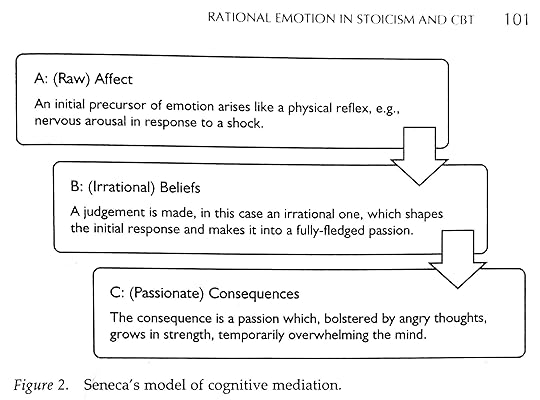
Well, here it is about a person’s emotional responses, which is the connection to therapy.
But that’s actually beside the point. Because it is precisely when we have a strong identity attachment to a conclusion that we’re likely to be misled by our instinctive “fast” thinking. When we’re detached from something emotionally, it’s pretty easy to pause and reconsider. And, yeah, that’s the same “detachment” that Buddhists and Stoics are renowned for.
Which gets to something I’ve been thinking about in recent years. The more we care about something, the less we should trust ourselves that our opinions are valid. And it is precisely when someone we’re talking to is enthusiastic and passionate about a topic that we should be wary, and seek opinions from others. That’s counter to much of what we tend to do; we’re attracted to those who feel strongly and speak movingly. But I think the evidence is growing pretty strong that their thinking (unless they’re highly trained Stoics, perhaps?) is probably flawed.
* The terms “System 1” and “System 2” didn’t originate with Kahneman. Earlier, the psychology professors Keith Stanovich and Richard West coined the terms, but when a fellow psychologist wins the Nobel Prize and then writes a best-selling book that uses your terms, it’s probably understandable the reading public will associate them with him.
I felt bad: I already had too many books that I was putatively “currently reading”, and while this one still looked interesting, it probably wouldn’t have normally climbed to the top of the heap. But the shame of sending it back home unread was too much. So read it — and finish it — I did, wrapping up literally in the wee small hours the day it had to be returned.
This is probably a great book for the philosophically-minded psychologist, especially one who specializes in Cognitive Behavioral Therapy, or perhaps Rational-Emotive Behavioral Therapy, which is apparently closely related. Or a philosophically-minded patient under the guidance of such a therapist.
It’s also going to be a great book for a philosophical type who is intrigued by how the ancient teachings of Socrates and his ilk still reverberates strongly — and in psychotherapy! How cool is that?
Those are pretty obvious. But I’m neither (although if you think I should be under the guidance of a psychologist, I wouldn’t argue with you), and I still found it quite interesting.
About that: really, this is just part of the zeitgeist.
You see mindfulness everywhere these days, for example. Well, we tend to look towards Buddhism for the roots of that, but it can also be traced back to the Stoics (and several other branches descending from Socrates’ teachings). In fact, the parallels between Stoicism and some aspects of Buddhism are actually quite stunning.
Which I liked, because there’s nary a hint of spiritualism or other annoying forms of woo here, and that kind of thing can make me throw a book across the room in frustration.
But this touches on that zeitgeist thing in another way. I think I’ve typed this two or three times in the past few days: our cognition was adequately adaptive during the Paleolithic, but is performing dismally in our modern civilization. We just didn’t evolve to think rationally, but it never really got in the way until recently.
And Stoicism (as well as Cognitive Behavioral Therapy, and Rational -Emotive Behavioral Therapy) is all about training ourselves to pause and consider our responses. If you’ve been paying attention, that should make you think of Daniel Kahneman’s Thinking, Fast and Slow. Thinking “fast” (what Kahneman also calls “System 1” thinking*) is what our evolution handed us, and thinking “slow” (“System 2”) is what we can do when we deliberate on those fast results, and probably amend them.
Here’s a little chart the author provided to show that Seneca, one of the more famous Stoic philosophers, saw that same process.
Well, here it is about a person’s emotional responses, which is the connection to therapy.
But that’s actually beside the point. Because it is precisely when we have a strong identity attachment to a conclusion that we’re likely to be misled by our instinctive “fast” thinking. When we’re detached from something emotionally, it’s pretty easy to pause and reconsider. And, yeah, that’s the same “detachment” that Buddhists and Stoics are renowned for.
Which gets to something I’ve been thinking about in recent years. The more we care about something, the less we should trust ourselves that our opinions are valid. And it is precisely when someone we’re talking to is enthusiastic and passionate about a topic that we should be wary, and seek opinions from others. That’s counter to much of what we tend to do; we’re attracted to those who feel strongly and speak movingly. But I think the evidence is growing pretty strong that their thinking (unless they’re highly trained Stoics, perhaps?) is probably flawed.
* The terms “System 1” and “System 2” didn’t originate with Kahneman. Earlier, the psychology professors Keith Stanovich and Richard West coined the terms, but when a fellow psychologist wins the Nobel Prize and then writes a best-selling book that uses your terms, it’s probably understandable the reading public will associate them with him.

May 29, 2013
Cognitive-Behavioral Therapy (CBT) is a form of psychological counseling in which the therapist eschews the traditional seeking of root causes for a more objective and forward-seeking approach. Rather than help the patient seek reasons for their problems, the CBT therapist trains the patient in the use of psychological tools and rationalizations to help the patient manage and overcome their disorder. Through the building of habits, repetition, and framing, the patient is expected to develop a behavior pattern that, through dissonance, drags their emotional state into compliance with their daily activities. This approach has demonstrated surprising efficacy in double-blind studies.
The Philosophy of Cognitive-Behavioral Therapy , by Don Robertson, is a sadly long-winded treatise that attempts, and mostly succeeds, to show that the roots of CBT can be found in ancient traditions, mostly Stoicism but also Epicureanism, Skepticism, and even Buddhism. But it's too long, too wordy, too desperate to make its case.
Robertson starts by showing that modern psychotherapy, the sort where the patient must do something to overcome his problems, is trying to be exactly what philosophy was two millennia ago: a practice, a daily routine, a way of living that was harmonious with both human nature and the inevitability of life and life's challenges. Each of these, be it Buddhism or Stoicism or whatever, taught people both a fundamental set of truths about the human condition, and a daily practice for how to manage the frustrations and even despair that comes from those truths.
Robertson then goes through the various standard practices of CBT and its modern precursors, and shows how the Stoics were already doing all of those things 2,000 years ago: mental rehearsal for tragedy or disaster, daily planning to do "the work the world has brought you," always with the tagline, "fate willing," nightly journaling of your day to ensure your actions were in line with your planning, actively imagining a present counsellor over your shoulder to see your own actions as others would see them; imagining your frustrations as others might see them to assess their true weight; and embracing a long-term sense of love, happiness, and joy that has nothing to do with immediate pleasures, but instead is ultimately about ensuring your own long-term mental health, by embracing trust, autonomy, initiative, competence, identity, intimacy, productivity, and the ultimate condition: integrity.
This book, however, could have been half as long and accomplished twice as much. Robertson tries too hard, and co-opts too many different traditions, in his attempt to make his point. At several points Robertson quotes Spinoza, Montaigne, Descartes, and other philosophers, and this comes across much less as a connection between the two traditions and more as an argument from authority: "All these smart guys embraced Stoicism, so you should as well." At one point, Robertson makes a tenuous connection between the teachings of Jesus and his premise, but the material there is weak and desperate; it comes out as an attempt to reassure his audience that there's nothing un-Christian about either practice, and it's one that fails.
This is a thick book of small but valuable nuggets of knowledge and wisdom. It is most definitely not a self-help book, nor is it really a solid introduction to either Stoicism or CBT. Robertson jumps around too many different issues to do more than make his central case: everything in CBT has been done before, successfully, and CBT practitioners should both understand that and be proud of it.
The Philosophy of Cognitive-Behavioral Therapy , by Don Robertson, is a sadly long-winded treatise that attempts, and mostly succeeds, to show that the roots of CBT can be found in ancient traditions, mostly Stoicism but also Epicureanism, Skepticism, and even Buddhism. But it's too long, too wordy, too desperate to make its case.
Robertson starts by showing that modern psychotherapy, the sort where the patient must do something to overcome his problems, is trying to be exactly what philosophy was two millennia ago: a practice, a daily routine, a way of living that was harmonious with both human nature and the inevitability of life and life's challenges. Each of these, be it Buddhism or Stoicism or whatever, taught people both a fundamental set of truths about the human condition, and a daily practice for how to manage the frustrations and even despair that comes from those truths.
Robertson then goes through the various standard practices of CBT and its modern precursors, and shows how the Stoics were already doing all of those things 2,000 years ago: mental rehearsal for tragedy or disaster, daily planning to do "the work the world has brought you," always with the tagline, "fate willing," nightly journaling of your day to ensure your actions were in line with your planning, actively imagining a present counsellor over your shoulder to see your own actions as others would see them; imagining your frustrations as others might see them to assess their true weight; and embracing a long-term sense of love, happiness, and joy that has nothing to do with immediate pleasures, but instead is ultimately about ensuring your own long-term mental health, by embracing trust, autonomy, initiative, competence, identity, intimacy, productivity, and the ultimate condition: integrity.
This book, however, could have been half as long and accomplished twice as much. Robertson tries too hard, and co-opts too many different traditions, in his attempt to make his point. At several points Robertson quotes Spinoza, Montaigne, Descartes, and other philosophers, and this comes across much less as a connection between the two traditions and more as an argument from authority: "All these smart guys embraced Stoicism, so you should as well." At one point, Robertson makes a tenuous connection between the teachings of Jesus and his premise, but the material there is weak and desperate; it comes out as an attempt to reassure his audience that there's nothing un-Christian about either practice, and it's one that fails.
This is a thick book of small but valuable nuggets of knowledge and wisdom. It is most definitely not a self-help book, nor is it really a solid introduction to either Stoicism or CBT. Robertson jumps around too many different issues to do more than make his central case: everything in CBT has been done before, successfully, and CBT practitioners should both understand that and be proud of it.
September 19, 2019
I started perusing this 5 years ago on my planning periods at school--very insightful look at how the ancient's prose model many of today's therapeutic methods, Mr. Robertson intersperses theory, quotes, and in-depth background information into his explanations. I like how he refers to Paul Dubois, Pierre Charcot, and the auto-suggestion methods of Emile Coue. This book is very comprehensive, useful, and historical
The "View from above" is extremely therapeutic--Marcus Aurelius exhorts you to view all time and all eternity as a corkscrew in comparison.
"Frequently picture yourself moving with the clouds, visions of this kind purge the mind of earthbound dross" Marcus Aurelius
The "View from above" is extremely therapeutic--Marcus Aurelius exhorts you to view all time and all eternity as a corkscrew in comparison.
"Frequently picture yourself moving with the clouds, visions of this kind purge the mind of earthbound dross" Marcus Aurelius

April 12, 2014
It took me four months to read this book as I purposely took my time to reflect on the chapters, and follow up on the references. Robertson has provided an exhaustive account of stoicism and its relation to CBT from the early history of psychotherapy to contemporary practice, and shows how each stage of CBT's evolution can be explicitly linked to a parallel practice in stoicism.
The book is authoritative and extremely well-written.
The only criticism I have is not to do with the content but how the publisher put this together: there are plenty of typos and errors throughout which sometimes distract. This does reflect poorly on Karnac books, if not the author.
The book is authoritative and extremely well-written.
The only criticism I have is not to do with the content but how the publisher put this together: there are plenty of typos and errors throughout which sometimes distract. This does reflect poorly on Karnac books, if not the author.

August 19, 2011
Ack! So many thoughts! So hard to get them down in a logical sensical way for book club. It has been a long time since a book has rocked me page-by-page with such intense ambivalence.
am·biv·a·lence [am-biv-uh-luhns]
noun
1. uncertainty or fluctuation, especially when caused by inability to make a choice or by a simultaneous desire to say or do two opposite or conflicting things.
2. Psychology- the coexistence within an individual of positive and negative feelings toward the same person, object, or action, simultaneously drawing him or her in opposite directions.
The whole stoic suck-it-up/CBT workbooky brain re-training thing and the uber-masculine and/or scientific language of doing "war" to master and dominate your own thoughts and forcing yourself to say that you are in complete "control" your feeling is so repellent and literally gives me panic attacks just reading it. On the other hand the notion of being aware of what you can and can't control, and making peace with how little you can control (it does seem wise to admit that really the single thing we seem to be able to affect in some way is our own response to events and circumstances), is incredible, and the two ideas are totally intertwined throughout this book. Maybe if he the author was a little less dismissive of "exotic' (feminine?) eastern thought" I could integrate the paradoxes and challenges of those two linked notions better, because a lot of the CBT and Stoic ideas are very similar to Buddhist ideas, but the Buddhist ideas are somehow expressed in kinder and funnier and more relational language in significant, but subtle ways. Arg. Inarticulate watery girl-mind is arising.
am·biv·a·lence [am-biv-uh-luhns]
noun
1. uncertainty or fluctuation, especially when caused by inability to make a choice or by a simultaneous desire to say or do two opposite or conflicting things.
2. Psychology- the coexistence within an individual of positive and negative feelings toward the same person, object, or action, simultaneously drawing him or her in opposite directions.
The whole stoic suck-it-up/CBT workbooky brain re-training thing and the uber-masculine and/or scientific language of doing "war" to master and dominate your own thoughts and forcing yourself to say that you are in complete "control" your feeling is so repellent and literally gives me panic attacks just reading it. On the other hand the notion of being aware of what you can and can't control, and making peace with how little you can control (it does seem wise to admit that really the single thing we seem to be able to affect in some way is our own response to events and circumstances), is incredible, and the two ideas are totally intertwined throughout this book. Maybe if he the author was a little less dismissive of "exotic' (feminine?) eastern thought" I could integrate the paradoxes and challenges of those two linked notions better, because a lot of the CBT and Stoic ideas are very similar to Buddhist ideas, but the Buddhist ideas are somehow expressed in kinder and funnier and more relational language in significant, but subtle ways. Arg. Inarticulate watery girl-mind is arising.

September 27, 2023
A fascinating look at the philosophical roots of modern psychotherapy.
“However, there is an important sense in which psychotherapy, even as we know it today, can trace its roots much further back, perhaps all the way back into prehistory, before such ideas were committed to writing. Modern psychotherapy, especially in the form of cognitive-behavioral therapy (CBT), the most ‘modern’ of our contemporary schools, can also be viewed as part of an ancient therapeutic tradition derived from the informal philosophical circle surrounding Socrates (470-399 bc), and, therefore, stretching back to Athens in the fifth century bc. Of the various schools of Socratic philosophy, the one that bears the strongest therapeutic orientation is undoubtedly Stoicism, especially that of the later Roman schools. According to Galen, physician to the Stoic Emperor Marcus Aurelius, Chrysippus, one of the founders of Stoicism, emphasized the role of philosophers as that of ‘physician of the soul,’ someone whom we would now refer to as psychotherapist.”
~ Donald Robertson from The Philosophy of Cognitive Behavioural Therapy
Got problems with your soul?
These days, you’d see a psychotherapist.
But, back in the day, it was the philosopher who’d help you optimize–they were the preferred physician of the soul.
This book is about the philosophical roots of modern psychotherapy. Specifically, it outlines the connection between cognitive behavioral therapy (CBT) and Stoicism.
Ryan Holiday recommended it in his great book The Daily Stoic .
As a lover of both ancient wisdom and modern science, I really enjoyed it. It’s not your typical self-help book but if you, like me, are deeply interested in the intersection of ancient (Stoic) philosophy + modern psychotherapy, I think you’ll dig it. (Get a copy here.)
Some of my favorite big ideas from this book include:
1. Warrior vs. Librarian - Which are you?
2. CBT - Has its roots in Stoicism
3. Highest Human Purpose - High five your highest self.
4. The Reserve Clause - Deo Volente.
5. The Ideal Sage - Your ultimate guide.
I’ve summarized those Big Ideas in a video review that you can watch here: https://youtu.be/DKN9KrqKDfQ?feature=...
I’ve also added The Philosophy of Cognitive Behavioural Therapy by Donald Robertson to my collection of Philosopher’s Notes--distilling the Big Ideas into 6-page PDF and 20-minute MP3s on 600+ of the BEST self-development books ever. You can get access to all of those plus a TON more over at https://heroic.us.
“However, there is an important sense in which psychotherapy, even as we know it today, can trace its roots much further back, perhaps all the way back into prehistory, before such ideas were committed to writing. Modern psychotherapy, especially in the form of cognitive-behavioral therapy (CBT), the most ‘modern’ of our contemporary schools, can also be viewed as part of an ancient therapeutic tradition derived from the informal philosophical circle surrounding Socrates (470-399 bc), and, therefore, stretching back to Athens in the fifth century bc. Of the various schools of Socratic philosophy, the one that bears the strongest therapeutic orientation is undoubtedly Stoicism, especially that of the later Roman schools. According to Galen, physician to the Stoic Emperor Marcus Aurelius, Chrysippus, one of the founders of Stoicism, emphasized the role of philosophers as that of ‘physician of the soul,’ someone whom we would now refer to as psychotherapist.”
~ Donald Robertson from The Philosophy of Cognitive Behavioural Therapy
Got problems with your soul?
These days, you’d see a psychotherapist.
But, back in the day, it was the philosopher who’d help you optimize–they were the preferred physician of the soul.
This book is about the philosophical roots of modern psychotherapy. Specifically, it outlines the connection between cognitive behavioral therapy (CBT) and Stoicism.
Ryan Holiday recommended it in his great book The Daily Stoic .
As a lover of both ancient wisdom and modern science, I really enjoyed it. It’s not your typical self-help book but if you, like me, are deeply interested in the intersection of ancient (Stoic) philosophy + modern psychotherapy, I think you’ll dig it. (Get a copy here.)
Some of my favorite big ideas from this book include:
1. Warrior vs. Librarian - Which are you?
2. CBT - Has its roots in Stoicism
3. Highest Human Purpose - High five your highest self.
4. The Reserve Clause - Deo Volente.
5. The Ideal Sage - Your ultimate guide.
I’ve summarized those Big Ideas in a video review that you can watch here: https://youtu.be/DKN9KrqKDfQ?feature=...
I’ve also added The Philosophy of Cognitive Behavioural Therapy by Donald Robertson to my collection of Philosopher’s Notes--distilling the Big Ideas into 6-page PDF and 20-minute MP3s on 600+ of the BEST self-development books ever. You can get access to all of those plus a TON more over at https://heroic.us.
September 11, 2012
Well-written discussion of the links between Stoic Philosophy and Cognitive Behavior Therapy. For those who may feel a bit embarrassed about seeing a therapist or doing CBT self-help exercises, this book provides some useful historical context. I had little knowledge of stoic philosophy prior to reading this book; it was very eye-opening for me. I had never realized that any western philosophy was so practical or so focused on how to be happy.
The only criticism I have of the book is that while reading it, I got the sense the the author was continually relying on the same 6 or 7 sources.
The only criticism I have of the book is that while reading it, I got the sense the the author was continually relying on the same 6 or 7 sources.

April 9, 2020
The butler did it.
Donald Robertson demonstrates the fruitfulness of connecting Stoic thought to Cognitive-Behavioral Therapy in this detailed and careful book. I think it suffers two main flaws. First is that it downs' quite settle one way or another on whether it is a scholarly work or a work showing a clinical approach to therapy, or even an attempt to reach a popular audience (which seems less the case than the other two). It may fail to reach either audience as a result, which is unfortunate, because as a philosopher and someone who has benefited from CBT, I see great potential for introducing Stoic themes into psychotherapy -- as I had already been doing before I discovered Robertson's work.
The other flaw, as I see it, is that Robertson draws so much from Marcus Aurelius' Meditations, and so little from Epictetus' Handbook (even favoring the Discourses ascribed to Epictetus). That certainly gives a particular slant to his interpretation of Stoicism. I'm not an expert, but an avid reader and a fan of Epictetus, and find the Handbook to have a more austere and in some ways more demanding prescription for life, which makes the adoption/adaption of a Stoic way of life in the contemporary world more challenging.
I've asked Robertson himself about the possibility of this approach with PTSD--which is at the heart of much addiction, I'm convinced--and he has not himself studied the matter. I believe there are potential dangers, because of the lack of a core and centered self that traumatized persons subjectively feel, and the way reason becomes a functional method of coping, not an autonomous form of nous, logos, etc. for people with trauma history. Someone with dissociation, with disconnection with emotion (in contrast to trouble regulating emotion), and who experiences subjective consciousness as series of coping systems lacking a singular core self, could possibly be endangered picking up a Stoic treatise and attempting to follow reason. The question becomes: which reason? Reason as recruited into what coping system? I don't know that a Stoic approach is ruled out, but further study of it would be worthwhile--as further study of trauma as underlying many behavioral health problems always is.
Donald Robertson demonstrates the fruitfulness of connecting Stoic thought to Cognitive-Behavioral Therapy in this detailed and careful book. I think it suffers two main flaws. First is that it downs' quite settle one way or another on whether it is a scholarly work or a work showing a clinical approach to therapy, or even an attempt to reach a popular audience (which seems less the case than the other two). It may fail to reach either audience as a result, which is unfortunate, because as a philosopher and someone who has benefited from CBT, I see great potential for introducing Stoic themes into psychotherapy -- as I had already been doing before I discovered Robertson's work.
The other flaw, as I see it, is that Robertson draws so much from Marcus Aurelius' Meditations, and so little from Epictetus' Handbook (even favoring the Discourses ascribed to Epictetus). That certainly gives a particular slant to his interpretation of Stoicism. I'm not an expert, but an avid reader and a fan of Epictetus, and find the Handbook to have a more austere and in some ways more demanding prescription for life, which makes the adoption/adaption of a Stoic way of life in the contemporary world more challenging.
I've asked Robertson himself about the possibility of this approach with PTSD--which is at the heart of much addiction, I'm convinced--and he has not himself studied the matter. I believe there are potential dangers, because of the lack of a core and centered self that traumatized persons subjectively feel, and the way reason becomes a functional method of coping, not an autonomous form of nous, logos, etc. for people with trauma history. Someone with dissociation, with disconnection with emotion (in contrast to trouble regulating emotion), and who experiences subjective consciousness as series of coping systems lacking a singular core self, could possibly be endangered picking up a Stoic treatise and attempting to follow reason. The question becomes: which reason? Reason as recruited into what coping system? I don't know that a Stoic approach is ruled out, but further study of it would be worthwhile--as further study of trauma as underlying many behavioral health problems always is.

July 3, 2024
In this book Robertson offers information on the history of cognitive behavioral therapy and rational emotive behavior therapy and their linkages to Stoic philosophy. Having the context for these theories and their interventions felt informative and useful. I very much appreciated the parallels between Stoic and Buddhist philosophy and how this book provides an entry point to CBT and REBT for those who do not resonate with Buddhist ideas.
However, some of the attempts at linkages felt like a stretch. For instance, the intentional seeking out (both using imaginal strategies and in reality) of deep hardship as a way of hardening one to stress is taken to such an extreme in Stoic exercises that, while CBT owes a debt to it, the actual reality of the CBT strategies feels distinct. Similarly, the idea of acceptance of Zeus's will, which Robertson translates as nature's will, also feels like it would not have a real parallel in modern thinking but is rather a distant cousin to the idea of acceptance of the things we cannot change.
The final chapter on third wave therapies (really just ACT) felt like more of a stretch. ACT explicitly owes a debt to Buddhist teachings, per Hayes, and any similarity to Stoic philosophy is simply due to the overlap between this and Buddhism. Particularly given the Stoic emphasis of controlling one's mind, ACT feels very different. I also didn't buy that the defusion strategies within ACT are similar enough to dissociation to warrant Robertson's comparisons here.
Robertson spends a lot of time outlining Stoic exercises that are very similar to CBT exercises. I was unsure whether this was simply to point out the similarities or if it was because Robertson is a proponent of bringing Stoic exercises back in their original forms. The former feels helpful again to lend context, but the latter seems like taking a step back given the strong research foundation for CBT and dearth of research on the utility of the more pure Stoic versions.
All in all, a nice option for presentation of CBT/REBT principles if a patient already approaches the world from this viewpoint, but not something I see myself incorporating into day-to-day practice.
However, some of the attempts at linkages felt like a stretch. For instance, the intentional seeking out (both using imaginal strategies and in reality) of deep hardship as a way of hardening one to stress is taken to such an extreme in Stoic exercises that, while CBT owes a debt to it, the actual reality of the CBT strategies feels distinct. Similarly, the idea of acceptance of Zeus's will, which Robertson translates as nature's will, also feels like it would not have a real parallel in modern thinking but is rather a distant cousin to the idea of acceptance of the things we cannot change.
The final chapter on third wave therapies (really just ACT) felt like more of a stretch. ACT explicitly owes a debt to Buddhist teachings, per Hayes, and any similarity to Stoic philosophy is simply due to the overlap between this and Buddhism. Particularly given the Stoic emphasis of controlling one's mind, ACT feels very different. I also didn't buy that the defusion strategies within ACT are similar enough to dissociation to warrant Robertson's comparisons here.
Robertson spends a lot of time outlining Stoic exercises that are very similar to CBT exercises. I was unsure whether this was simply to point out the similarities or if it was because Robertson is a proponent of bringing Stoic exercises back in their original forms. The former feels helpful again to lend context, but the latter seems like taking a step back given the strong research foundation for CBT and dearth of research on the utility of the more pure Stoic versions.
All in all, a nice option for presentation of CBT/REBT principles if a patient already approaches the world from this viewpoint, but not something I see myself incorporating into day-to-day practice.

December 28, 2018
I wish there was a category on Goodreads for "started to read but didn't finish." Because that was my experience with this book. So, my rating is for what I read of the introduction and part of chapter 1. Talk about some mind=boggling material! This is definitely a book for the philosophical mind. I thought I'd dip my toes in some stoic philosophy but found unable to understand and be excited about reading the material. Being that I am not in school, I want to read for a pleasurable past time, and despite my interest in psychology and stoic principles, this book was difficult to read and comprehend.

Read
May 4, 2022A comprehensive and detailed explanation of the various aspects of Stoicism and its historical significance in the formation of modern psycho-social intervention such as cognitive behavioral therapy.
Robertson appears to suggest the Stoic philosophy is a missing ingredient needed to make make the CBT practitioner whole: “It is not a trivial matter to observe that, unlike Stoicism and most classical philosophies, CBT lacks any clear account of the ideal toward which it aims. If asked to point to a specific human being who embodies the principles of CBT in their life, most therapists would probably be at a loss for words”.
Robertson appears to suggest the Stoic philosophy is a missing ingredient needed to make make the CBT practitioner whole: “It is not a trivial matter to observe that, unlike Stoicism and most classical philosophies, CBT lacks any clear account of the ideal toward which it aims. If asked to point to a specific human being who embodies the principles of CBT in their life, most therapists would probably be at a loss for words”.

February 19, 2025
The author explores how Stoic philosophy can be applied to modern therapy, especially Cognitive Behavioral Therapy (CBT). He makes a compelling case that philosophy and psychotherapy aren't as separate as they seem. In fact, ancient Stoic teachings have a lot in common with the techniques used in CBT today. Robertson shows how rethinking the history of both fields can teach us valuable lessons for personal growth and mental well-being. It's an insightful read for anyone interested in psychology, philosophy, or self-improvement. Definitely worth checking out!
January 14, 2023
The book itself spends for to long repeating concepts established in the beginning. What I came to look for is Stoicsm and it's use in CBT, not a tirade about why stoicism itself is similar (and better). This book linked stoicism and CBT but at no point encouraged integration. A better title would have been "Stoicism, the Philosophy Behind CBT". This would make a great article but made an unnecessary book.
October 14, 2017
A practical and philosophical gold mine
Having been interested in both Stoicism and REBT for decades, this book does a laudable job of explaining and discussing the impact of Stoicism on modern psychotherapy. It also gives countless pearls - both ancient and modern - for using these principles in everyday life. An excellent read.
Having been interested in both Stoicism and REBT for decades, this book does a laudable job of explaining and discussing the impact of Stoicism on modern psychotherapy. It also gives countless pearls - both ancient and modern - for using these principles in everyday life. An excellent read.

March 10, 2020
Someone's graduate thesis on the similarities between stoic philosophy and REBT (and, to a lesser extent, CBT). Stoics practiced mindfulness, did extensive self-talk, played it through to the end, and journaled relentlessly. The same therapeutic processes that kept that perpetual sadsack Marcus Aurelius from falling on his sword remain the foundation of modern depression treatment.

May 21, 2021
To raise our level of awareness to one that stimulates intuition and helps us see reality more clearly, we need to dedicate time daily to our personal growth. Every moment of our life must be seen as a moment of experience and growth.
Inspiring book!
Inspiring book!

May 10, 2024
Great read — very interesting intersection of philosophy and psychology. Discusses how modern psychotherapy is influenced by ancient Stoicism, and I agree with the author’s thesis of the importance of having a broader philosophy of life in addition to the techniques of CBT.

February 11, 2017
Practical book on stoicism
One of the best and most practical books on stoicism. Robertson shows how one can easily enact stoics principles and habits in your life.
One of the best and most practical books on stoicism. Robertson shows how one can easily enact stoics principles and habits in your life.

September 4, 2017
Really enjoyed this book - thought it was a good intro to stoicism and the comparison to modern psychology

July 10, 2019
Helpful and clever crossing of the streams between OG philosophy and modern therapy.
January 8, 2022
Useful but not an easy read.

April 10, 2024
A great book that clearly outlines how philosophy and psychotherapy are historically connected and not that different.

July 23, 2011
I give this book 3 out 5 Stars because, although this book was written with a focus on Stoicism and its relations to Psychotherapy, the author makes references to Christianity and when he does the references are more so ignoramus and implied biased (e.g. Biblical God as Myth, The Laws seen as Arbitrary, Catholicism seen as Oppressive, etc...) one gets a sense of being spiteful toward Christianity, which is a shame considering the High Quality Intellectual work that went into the book.
The Author does a wonderful job, Explaining the History, Practices, and Principles of Stoicism as well as the History, Practices, and Principles of REBT and CBT leading to the bridge-building and elucidating of the relations between Stoicism and Modern Psychotherapy practices in REBT and CBT [even to a certain extent Modern Philosophy and Self-Improvement Movement] which I much enjoyed seeing these connections made.
If asked whether or not I would recommend this book to others, I would, but I would have to qualify that recommendation with the pre-caution that the peppered biases and misconceptions the author makes toward Christianity throughout the book.
The Author does a wonderful job, Explaining the History, Practices, and Principles of Stoicism as well as the History, Practices, and Principles of REBT and CBT leading to the bridge-building and elucidating of the relations between Stoicism and Modern Psychotherapy practices in REBT and CBT [even to a certain extent Modern Philosophy and Self-Improvement Movement] which I much enjoyed seeing these connections made.
If asked whether or not I would recommend this book to others, I would, but I would have to qualify that recommendation with the pre-caution that the peppered biases and misconceptions the author makes toward Christianity throughout the book.
July 17, 2015
This book is by far the best of several that I've read about Stoicism. Other books rely too heavily on large quotes of Roman or Greek authors, quotes that themselves are written as rather archaic translations, difficult to understand in a modern context.Robertson, instead, explains concepts in modern English, drawing upon concepts from modern cognitive therapy, then provides relevant quotes from the ancient authors. Even without the quotes, this book could stand alone as a good explanation of Stoicism and a successful philosophy in how to live one's life.

February 3, 2013
An excellent review of ancient Stoic philosophy and how it formed the basis of a number of therapeutic techniques in modern psychology, especially Cognitive-Behavioral Therapy. There is a lot of practical "how-to" advice that applies equally to self-therapy and Stoic philosophy . . .

July 13, 2014
A pretty good book for introduction to some of the therapeutic techniques employed by stoics.

January 23, 2016
A very good book, I think, best read in small doses. If you are in one of the helping professions....or just interested in the ancient philosophers - or both; this book is worth reading.
May 22, 2020
Very helpful!
I have found Stoicism incredibly helpful. It is nice to know these techniques actually have basis in science. Great read!
I have found Stoicism incredibly helpful. It is nice to know these techniques actually have basis in science. Great read!
January 13, 2021
Brilliant as always

June 12, 2022
Excellent. Except for the later chapters, where the author began to discuss ideas of other authors and engage in a sort of "they said" idea.
Otherwise, quite good.
Otherwise, quite good.
Displaying 1 - 30 of 30 reviews