Jump to ratings and reviews
Rate this book

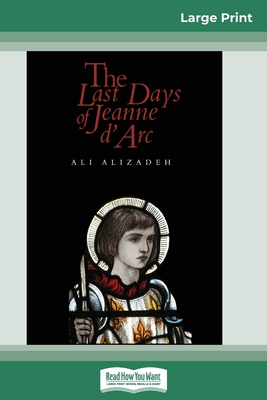
The Last Days of Jeanne d'Arc

Rate this book
Jeanne is a young woman from rural France. She's a knight who wears men's clothing. The English call her Joan of Arc. Jeanne has led France to victory in epic battles. She hears ghostly voices and has unspeakable desires. The English want to burn her. Her king has abandoned her. Her heart has been broken. Her heart cannot be burnt. This is her story, and the story of her beloved. Ali Alizadeh's novel The Last Days of Jeanne d'Arc is a provocative new portrait of the life of one of history's most fascinating figures. Countless books have been written about the young Frenchwoman who claimed to hear the voices of saints, led the armies of France in the war against England in the Middle Ages, and was captured and burnt for heresy by her enemies. Based on a rigorous study of the historical material, The Last Days of Jeanne d'Arc provides the first serious dramatisation of Jeanne's sexuality. Alizadeh uses an innovative storytelling technique that weaves together multiple narrative perspectives to tell the story of a courageous young woman who, driven by a passion for justice and forbidden desire, changes the course of Western history.

412 pages, Paperback

First published September 1, 2017

2 people are currently reading
130 people want to read

About the author

Ali Alizadeh

27 books6 followers

Ratings & Reviews

What do you think?
Rate this book

Friends & Following

Create a free account to discover what your friends think of this book!

Community Reviews

5 stars
16 (28%)
4 stars
25 (44%)
3 stars
12 (21%)
2 stars
3 (5%)
1 star
0 (0%)
Displaying 1 - 18 of 18 reviews
Profile Image for Kris.
175 reviews1,621 followers
February 13, 2018
3.5 stars -- when work settles down, I'll try to write a review. Briefly, I found the love story historically unconvincing, but I'm also a tough audience -- one reason why I usually steer clear of historical fiction set during the Middle Ages.
Profile Image for Joseph Schreiber.
584 reviews180 followers
January 13, 2018
Jeanne d’Arc has been the subject of countless historical, literary and dramatic accounts, but none as intimate, poetic and sensitive as this wholly unique, experimental approach, not simply to a well-known heroine, but to historical fiction. Full review can be found here: https://roughghosts.com/2018/01/12/a-...
Profile Image for Lisa.
3,776 reviews490 followers
September 23, 2017
I loved every word of this spellbinding book, which kept me captivated to the last page even though I thought I knew what the ending must be.

(I had a conversation with The Spouse this morning about how we came to know the story of Joan of Arc: did we read it in The Victorian Reader, Fifth or Sixth Book? Or The School Magazine that came once a month? Was it one of those Annuals that we used to get each year at Christmas?)

[Edited a bit by me to reduce its length and the number of links & footnotes] Wikipedia summarises her life like this:

Joan of Arc (French: Jeanne d’Arc), 1412-1431), nicknamed “The Maid of Orléans” (French: La Pucelle d’Orléans), is considered a heroine of France for her role during the Lancastrian phase of the Hundred Years’ War and was canonized as a Roman Catholic saint. Joan of Arc was born to Jacques d’Arc and Isabelle Romée, a peasant family, at Domrémy in north-east France. Joan said she received visions of the Archangel Michael, Saint Margaret, and Saint Catherine of Alexandria instructing her to support Charles VII and recover France from English domination late in the Hundred Years’ War. The uncrowned King Charles VII sent Joan to the siege of Orléans as part of a relief mission. She gained prominence after the siege was lifted only nine days later. Several additional swift victories led to Charles VII’s coronation at Reims. This long-awaited event boosted French morale and paved the way for the final French victory.

On 23 May 1430, she was captured at Compiègne by the Burgundian faction, which was allied with the English. She was later handed over to the English and put on trial by the pro-English Bishop of Beauvais Pierre Cauchon on a variety of charges. After Cauchon declared her guilty she was burned at the stake on 30 May 1431, dying at about nineteen years of age.


This trial was later debunked and Jeanne was declared a martyr, and she was canonised as a saint in 1920. (The Catholic Church doesn’t rush into things, it seems).

Ali Alizadeh’s Jeanne d’Arc, however, is not quite the saintly Joan of my childhood memory. She is much more interesting, provocatively so. And although The Last Days of Jeanne d’Arc is fiction, it is, according to the blurb, based on rigorous study of the historical material.

When the story opens Jeanne is a vulnerable captive, escorted into a dank cell by men waiting only for nightfall to violate her famed virginity.

Two more men enter, tense and compact. Steel helmets and poleaxes. In between them, another person. Being escorted by the guards. Being held by her wrists. She’s shorter than the room’s other occupants. A young woman. Filthy face. Her dark hair, a shoulder-length mess. Barefooted. Brought into the space unwillingly.

The guards take her to the centre of the cell. The captain with the key orders something in a foreign language. The other men avoid looking at the woman, continue to grip her wrists. She’s dressed like a man, in black tunic and black leggings.

The captain exits. The soldier with the spear glances at her. Her eyes are closed. The soldier’s fists tighten around his weapon. He grunts a phrase, puerile, forceful. Her lips tremble. One of the prison guards grins, stops grinning when the captain marches back in. (p.3-4)


As a condition of perpetual imprisonment rather than burning at the stake, she is forced out of the tunic and leggings which to some extent had protected her against sexual assault. She is shackled by the ankles and left alone to cry.

To read the rest of my review please visit https://anzlitlovers.com/2017/09/23/t...
Profile Image for Sabrina.
474 reviews37 followers
March 12, 2018
3.5 Stars.

I picked up this book expecting to read a fictionalised version of Joan of Arc, but I was extremely surprised when this turned not just into historical fiction but historical romance, focusing on Joan's romantic relationship between another woman, Pieronne, and the struggle to accept hersef for loving women (it's always exciting when something you didn't expect to. The interplay between Joan struggling with her feelings for women against her faith (which is one of the defining elements of the Joan of Arc narrative as we know it) felt like it had more potential - something about the way Joan's character was portrayed felt sloppy; the narrator tended to mythologise Joan rather than humanise her more often than not, and the fact of her loving women seemed as though it was added in as an attempt to build her as a tragic hero, which made me very, very uncomfortable.

The writing was the strongest part of the novel - the narrator tried to fit the fictionalised parts with the historical as much as possible, and constantly interwove facts and historical records amongst the story as a whole.

I have mixed feelings about this book, it was a very strange, but very well written novel that felt like it had more potential than it did, especially when it came to the character arc of Joan herself.
Profile Image for J.
178 reviews
January 16, 2018
8 September
I led the first wave of the assault myself. My page Raymond was carrying my standard. The French army’s decision to not only break the truce but to attack Paris on the Feast of Nativity provides the Burgundians and the English with further proof of the horrible woman’s hatred of decency and Christianity. The scholars of the University of Paris denounce her actions. I clenched my teeth, ran on the bundles of wood we had thrown into the moat. I climbed a small hill. With her company the Maid attacks the Gate of Saint-Honoré. She’s heard to be screaming at the city – like a bawdy whore and a diabolical creature in the shape of a woman, in the words of one Burgundian chronicler.
Surrender to the king of France!
Sprays of crossbow bolts and molten metal and heated bullets. Nothing will stop her soldiers. Under a cover of shields and their own archers’ arrows, they rush forth with scaling ladders. The walls of Paris are to be climbed and breached. The English flags, the crosses of Saint George are to be toppled and replaced with the lilies of France. The Hundred Years’ War is to be ended. Today. And I could not stop to feel pity for my falling men. The great shattering of the facade of the enemy’s position by our cannons. She begins to descend from the hill to join the French soldiers struggling to raise the ladders against the towering walls.
The city is ours! It belongs to God. Paris belongs to France. By Saint Denis –
Die, you fucking minx!

*
Profile Image for Magdalena.
Author 45 books148 followers
Read
October 2, 2017
Much has been written about Joan of Arc or Jeanne d’Arc, but Ali Alizadeh approaches his subject with such a deep sense of Jeanne's humanity and in such a rich, multifaceted way, that she seems an entirely new character. This Jeanne is both simple and deeply complex. The simplicity is because, at heart, Jeanne is just a frightened young girl whose voices have led her to a bloody battle followed by incarceration and vulnerability at the hands of her cruel English captors. The complexity comes from the out of sync time sequences and shifting points of view. Jeanne is her own narrator, moving between first and third person as she dictates her story to no one in her solitary confinement. Her voices move in and out of her head, and the story is developed through a series of narratives that don’t merge but instead give us a Jeanne that is both object and subject. The result is a tale that is humanising and deeply powerful, without losing any of the mystique associated with the historical character.

The voices may or may not be aspects of Jeanne’s own mind and Alizadeh allows the ambiguity. At times the writing is spare and immediate, personal pronoun stripped:
Keys clink and turn. The iron grill moves on squeaky hinges. Obtrusive orange glow, a flame. (17)

Other times the narrative slides into third person in what feels almost like a straight historical narrative:
Philip VI of France calls Edward III of England contumacious and annexes the duchy of Aquitaine. Edward responds by declaring Philip an illegitimate ruler. Edward announces that the entire kingdom of France belongs to the English crown. (25)

The variety of voices and viewpoints allows the reader to participate in Jeanne’s mental processes, tracing a line between myopic fear and a fearless commitment to the righteousness of her voices.  The multiplicity  also allows the narrative to move smoothly forward and backwards in time. The story opens in the prison, “A place of grey stone”, where Jeanne is forced, by virtue of her signed abjuration, to remove her black tunic and leggings and put on a white feminine gown. Jeanne’s extreme discomfort at her own nakedness immediately places the reader into an uncomfortable position witness to her humiliation. The two opening chapters are intimate and poetic, with short sentences and rich visual descriptions that places us in the cell with her:
Her back coils over her knees on the floor. Clasped hands are now knotted fists. (6)

The story then moves seamlessly into scholarship. In dated, diary-style, the story begins again at the point of capture, working through Jeanne’s interrogation and the steps to her abjuration. This backwards progression continues to 1932 and the beginnings of the hundred years war where Alizadeh gives us a very clear picture of the political manoeuvrings that led to the war, and then slides forward again to the point where Jeanne enters the war. These shifts in time might be disturbing in the hands of a lesser writer, but Alizadeh handles them like a poet, shifting easily between epistolary, third person narrative, and a first person confession that goes right back to Jeanne’s youth in Domremy at the point where a shy, bullied girl starts to hear voices.  These voices coincide with Jeanne’s sexual awakening and a growing sense of being different, and the co-mingling of sexual desire, religious fervour, and a desire to make history by ending a brutal war that is destroying France all come together perfectly. Jeanne’s first person narrative has several voices, one of which is parenthetic, as if Jeanne were talking from the present tense to her younger self: “(And I knew you too were bullied, my love….)" (89). Other voices that enter the story include the Saint Catherine, whose particular voice is set off in a concrete poetry style, heavily spaced and structured. From this point the story progresses through to the present, but the voices continue to intrude and mingle, taking different storyteller roles, as the many representations of Jeanne form a mosaic, collectively true. The slip between first and third person happens so frequently at times it becomes a single fractured voice:
I knelt, ate, crossed myself and rose to my feet. She feels tipsy, giddy and a little disoriented. She nearly trips over a pew and falls against the chapel’s arched entrance. She pushes disorderly locks of hair off her face. My hair was getting too long. It almost reaches her shoulders. (223)

Alizadeh’s scholarship is obvious as he traces the trajectory of the war and the political underpinnings as the English and French kings jockey for power at the expense of the common people who starve and suffer. The war progresses and Jeanne’s prowess and luck change history, even as she begins to question the brutality of the battlefield and the certainty of her destiny as she move towards inevitable death. The facts are engaging enough as a history, but Alizadeh’s portrait of a young women in love, coupled with his exploration of the patriarchal, uncertain nature of both historical account and memory (“Or does she?”) takes this story to a new level.  Alizadeh’s Jeanne allows for the contradictions in the varied voices that are both inside and outside of his subject and also calls attention to the fact that narrative is something that is constructed rather than something inherent. Jeanne becomes a sympathetic and rich character that defies her many labels - heroine, villain, warrior, outcast, witch. Alizadeh invites the reader to take her side, not in spite of her frailties, but because of them.
12 reviews2 followers
October 30, 2017
Provocative yet plausible. When reading history one must tread with caution as history is written from the point of view of the victors. The vanquished not only lose their lives but also their voices from the annuls of history. Credit to Ali Alizadeh for giving a new voice to Jeanne d'Arc.
Profile Image for Champagnesnob.
56 reviews1 follower
November 28, 2017
I wasn't going to rate this high, but given that I couldn't put it down it gets 4. The style was very conscious - skipping from first to third person within sentences sometimes and I'm not sure this was effective. I also remain unconvinced by the historical interpretation, but overall this is a very compelling read.
Profile Image for Gretchen.
238 reviews2 followers
April 9, 2018
I found out about this book through another friend, and she was very enthusiastic about it. Considering how many times the story of Joan of Arc has been told, this one went out on a limb style and with the idea. The author has written poetry previously, and the style reflected that - short sharp, incomplete sentences, shifting point of view - from a omnipotent narrator, to first person from Joan, and addressing the reader directly. And the sheer idea of looking at Joan's story and imagining that she was a woman loving woman who had been promised that suffering through the war would lead her to the woman that God wanted her to love. As a queer woman who struggles with my faith and sexuality, this story was so very important. I was moved towards tears more than once, as Joan's story ended the same way, but with the promise that she would meet God, her Voices and her love in heaven. The style may not be for everyone, but once you adjust to it, it is beautiful.
1,916 reviews21 followers
February 23, 2018
I so wanted to like this. Mr Alizadeh's short stories, Transitions, were cruelly magical and in some ways this book also has some magic - but not enough for me. The magic is the writing - a combination of styles: history, poetry, romance, law - but while some reviews have loved this, I found that it more often that not pushed me away. There was a line in one review which said it was like watching a caged tiger and that made sense of my value to connect to this Joan. It wasn't the 21st century reflections that irritated me - some of that was rather wonderful. Perhaps it was the lesbian story - but then again, why shouldn't this be a possible part of the tale. Perhaps, the writing was just too clever.
Profile Image for Eva.
131 reviews13 followers
March 5, 2020
Very interesting take on the life of Jeanne d'Arc. Although much of the storyline can be deemed improbable from most perspectives, the conspiracies and ideas are very interesting and force the audience to think about the story rather than just read.
Personally, I find the way it's written extremely intriguing and like the very distinctive perspective it provides, it also draws the audience in and makes it difficult for the audience to get truly confused as there is no real complex dialogue.
All in all a very interesting take on the life and time in which Jeanne d'Arc (or Joan of Arc as many know her) lived, the historical evidence and use of history creates authenticity and makes the story much nicer to read.

Profile Image for Tasha.
200 reviews5 followers
March 22, 2018
Really well researched story, a creative non-fiction account of Jeanne D'Arc's life. I loved the bits about her voices and battles and the whole historical shebang, but then the story mostly centres around this account of her being in a secret lesbian relationship... which, I guess was fine? The author wrote an epic poem about her as his PhD so I'm assuming this might be an offshoot of that. It loses a star because it switches between first and third person from sentence to sentence.
Profile Image for Jodie.
180 reviews
May 15, 2025
I struggled to get in to the story. Found the background disjointed. Lost me with a point of view shift in the middle of a sentence. Read that bit 10 times and couldn’t work out how it had gone from her to I. Last four chapters were well done.
40 reviews1 follower
April 10, 2021
This is one well researched book.
Profile Image for Hannah G.
158 reviews3 followers
Read
May 12, 2022
DNF. This sounded intriguing but it’s beyond me at the moment because of the writing style and cos I am unfamiliar with and I guess not that interested in that period of history. I may try again.
Displaying 1 - 18 of 18 reviews

Can't find what you're looking for?

Get help and learn more about the design.