

What do you think?

The Wrack
Plague has come to the continent of Teringia.
As the Wrack makes its slow, relentless march southwards, it will humble kings and healers, seers and merchants, priests and warriors. Behind, it leaves only screams and suffering, and before it, spreads only fear.
Lothain, the birthplace of the Wrack, desperately tries to hold itself together as the plague burns across it and its neighbors circle like vultures. The Moonsworn healers would fight the Wrack, but must navigate distrust and violence from the peoples of Teringia. Proud Galicanta readies itself for war, as the Sunsworn Empire watches and waits for the Wrack to bring its rival low.
And the Wrack advances, utterly unconcerned with the plans of men.
As the Wrack makes its slow, relentless march southwards, it will humble kings and healers, seers and merchants, priests and warriors. Behind, it leaves only screams and suffering, and before it, spreads only fear.
Lothain, the birthplace of the Wrack, desperately tries to hold itself together as the plague burns across it and its neighbors circle like vultures. The Moonsworn healers would fight the Wrack, but must navigate distrust and violence from the peoples of Teringia. Proud Galicanta readies itself for war, as the Sunsworn Empire watches and waits for the Wrack to bring its rival low.
And the Wrack advances, utterly unconcerned with the plans of men.
Unknown Binding
First published April 23, 2020
About the author
John Bierce
12 books1,260 followersJohn Bierce is a fantasy novelist, history and science buff, SFF fan, and general all-around dork. He currently lives in Lisbon, Portugal.
https://johnbierce.com/
https://johnbierce.com/
Ratings & Reviews
Friends & Following
Create a free account to discover what your friends think of this book!
Community Reviews
Displaying 1 - 30 of 83 reviews

August 18, 2020
My rating 4.6
The fantasy book “The Wrack” by John Bierce surprised me with a story because there is no single protagonist; the main antihero is the Wrack disease, which is slowly destroying the world in which the plot of the book is set. But I read the book with enthusiasm, and I liked the story.
The point of the whole plot is that the whole world can be destroyed regardless of beliefs and differences among empires, and that small people can do great things. When one empire falls, other empires in the region want to take advantage of the situation, but if that empire falls because of the plague of disease, what price of greed should be paid by those who want to seize its wealth? An interesting idea runs through the story, which would happen after a terrible disease that destroys everything in its path. What would the survivors do and how would they behave, the rulers in power? The whole world will have to change if it wants to survive a cataclysm of enormous proportions in which no one is safe, whether rich or poor. One thing is for sure: no empire will remain intact when The Wrack arrives.
I honestly enjoyed the story and would recommend the book to Fantasy fans.
The fantasy book “The Wrack” by John Bierce surprised me with a story because there is no single protagonist; the main antihero is the Wrack disease, which is slowly destroying the world in which the plot of the book is set. But I read the book with enthusiasm, and I liked the story.
The point of the whole plot is that the whole world can be destroyed regardless of beliefs and differences among empires, and that small people can do great things. When one empire falls, other empires in the region want to take advantage of the situation, but if that empire falls because of the plague of disease, what price of greed should be paid by those who want to seize its wealth? An interesting idea runs through the story, which would happen after a terrible disease that destroys everything in its path. What would the survivors do and how would they behave, the rulers in power? The whole world will have to change if it wants to survive a cataclysm of enormous proportions in which no one is safe, whether rich or poor. One thing is for sure: no empire will remain intact when The Wrack arrives.
I honestly enjoyed the story and would recommend the book to Fantasy fans.

August 5, 2020
First of all, let's get to the elephant in the room shall we? This book is about a plague that ravages a city, an empire, and the land that surrounds it. Interesting timing to say the least, but one that we cannot fault the author for. He himself even comments on the awkward coincidence of releasing his book during these awful and uncertain times. Be that as it may, it has no bearing on the story itself once you immerse yourself in the fantasy world that John Bierce has created. Honestly, as I got deeper and deeper into the book, I found myself not even making the connection anymore and was able to just settle in and focus on this solidly crafted tale.
This book is obviously brutal when it comes to the subject matter. A story about a plague isn't really going to be a barrel of laughs. As we follow the plague known as the Wrack and its devastating effects on the populace, I was a little detached at times just because we never really get to become too invested in any particular character before we move on to the next grisly death. This is where I wished the book would have been a little longer as I feel like the short length really made it difficult to flesh the characters out and I would have liked more depth. However, I thought that the writing was excellent and the descriptions of every pain and convulsion that the Wrack brought down upon its victims was vividly detailed. So the prose was a definite plus for me.
Another of the major strengths was the world-building in my opinion. The setting of Lothain and its surrounding environs was exceptionally conceived and a suitably dark background for the high body count tale that plays out on its stage. The magic was also quite good, especially how the communication network between cities was handled through the use of semaphores. These are not the traditional semaphores that you are familiar with, I can guarantee that. And the method of conveying these messages was something that was very original and added a mystical element that strengthened the overall story.
Ultimately, I very much enjoyed THE WRACK despite a couple of minor issues that I had. It delivered a satisfying story that kept me turning the pages. Yes it is a dark book and not for the faint of heart, but there are also some touching and very human moments that make this more than just a one-trick pony. I look forward to revisiting this world in future books (should there be more) and also checking out some of John's other works.
This book is obviously brutal when it comes to the subject matter. A story about a plague isn't really going to be a barrel of laughs. As we follow the plague known as the Wrack and its devastating effects on the populace, I was a little detached at times just because we never really get to become too invested in any particular character before we move on to the next grisly death. This is where I wished the book would have been a little longer as I feel like the short length really made it difficult to flesh the characters out and I would have liked more depth. However, I thought that the writing was excellent and the descriptions of every pain and convulsion that the Wrack brought down upon its victims was vividly detailed. So the prose was a definite plus for me.
Another of the major strengths was the world-building in my opinion. The setting of Lothain and its surrounding environs was exceptionally conceived and a suitably dark background for the high body count tale that plays out on its stage. The magic was also quite good, especially how the communication network between cities was handled through the use of semaphores. These are not the traditional semaphores that you are familiar with, I can guarantee that. And the method of conveying these messages was something that was very original and added a mystical element that strengthened the overall story.
Ultimately, I very much enjoyed THE WRACK despite a couple of minor issues that I had. It delivered a satisfying story that kept me turning the pages. Yes it is a dark book and not for the faint of heart, but there are also some touching and very human moments that make this more than just a one-trick pony. I look forward to revisiting this world in future books (should there be more) and also checking out some of John's other works.

August 7, 2020
John Bierce's The Wrack is an exciting and unique take on a fantasy novel. You don't read many fantasy novels that take on the plague as a plot point. Science Fiction, sure. Urban fantasy, occasionally. But not a pure fantasy novel. That is why this novel was such a treat to read for me. When I started reading it for the tour, I almost had to put it down. I have avoided apocalyptic/disease type novels, if you will forgive me, like the plague. They are usually too much with the state of the world. We live in a time with an actual epidemic, and sometimes I don't need the fantasy I read to reflect on real life.
I am glad I kept reading, though, because The Wrack is a fantastic fantasy book that might be one of my favorites thus far this year.
The plot is the spread of a mysterious illness, called The Wrack, a plague that lays waste to the people and kingdoms. It spares few, and leaves screams and wailing in its wake. It is a terrifying concept, to look in the face of the plague, and flail and grasp for answers while it decimates poets and paupers alike. That feeling of abject desperation was almost anxiety-inducing.
It is brilliant writing on the part of John Bierce.
Stylistically The Wrack reminds me of World War Z, written by Max Brooks. World War Z was a collection of vignettes of different societies and cultures, and that dealt with zombies. The Wrack has a similar feel, with Bierce touching on many different areas of the kingdom, rich and poor alike, and showing how they react. Maybe it is because of the short length of the story, or the shortness of individual chapters, but I did not connect much with the characters. It all became awash in the multitudes of suffering people. Even in that, the actual characters are a supporting cast. The real star of the story is the plague, The Wrack.
The world-building was also one of the main stars of the story. As you can tell, this isn't character building or character-heavy. If The Wrack is the star of the story, I think the main supporting character is the cities and kingdoms that Bierce describes. He created an extraordinarily rich landscape full of very different cultures. All of which play a pivotal role in how groups or individuals react to something like a plague. The magic system is also unique. Seers, magic users, use different polished stones, set in their eye sockets to see and read another plane of energy. When seers look at people about to suffer The Wrack, they get a buildup of wavy lines in their liver. It seems very esoteric to describe, but Bierce did this well. It was a unique magic system, one I would love to read much more about it.
I want to talk a bit about the timing of a book like this. I know with everything going on, it has got to be hard working on a story for years and releasing it only to have the world as a whole take a terrifying dive. I almost had to put it down initially because the feelings I felt, terror, despair, and the overwhelming urge to hide are what these characters are feeling in similar circumstances. It was a hard thing to read. So this book might not be one for all readers, right now. If you can't take reading something dark with a plague angle to it right now, that is very understandable. But put this book on your TBR for better times, because this is a great story that is well done, even if it had some tiny issues. It is engaging, thought-provoking, and imaginative. I hope that in better times, this book gets all the love it should.
I am looking forward to checking out more of Bierce's work.
I am glad I kept reading, though, because The Wrack is a fantastic fantasy book that might be one of my favorites thus far this year.
The plot is the spread of a mysterious illness, called The Wrack, a plague that lays waste to the people and kingdoms. It spares few, and leaves screams and wailing in its wake. It is a terrifying concept, to look in the face of the plague, and flail and grasp for answers while it decimates poets and paupers alike. That feeling of abject desperation was almost anxiety-inducing.
It is brilliant writing on the part of John Bierce.
Stylistically The Wrack reminds me of World War Z, written by Max Brooks. World War Z was a collection of vignettes of different societies and cultures, and that dealt with zombies. The Wrack has a similar feel, with Bierce touching on many different areas of the kingdom, rich and poor alike, and showing how they react. Maybe it is because of the short length of the story, or the shortness of individual chapters, but I did not connect much with the characters. It all became awash in the multitudes of suffering people. Even in that, the actual characters are a supporting cast. The real star of the story is the plague, The Wrack.
The world-building was also one of the main stars of the story. As you can tell, this isn't character building or character-heavy. If The Wrack is the star of the story, I think the main supporting character is the cities and kingdoms that Bierce describes. He created an extraordinarily rich landscape full of very different cultures. All of which play a pivotal role in how groups or individuals react to something like a plague. The magic system is also unique. Seers, magic users, use different polished stones, set in their eye sockets to see and read another plane of energy. When seers look at people about to suffer The Wrack, they get a buildup of wavy lines in their liver. It seems very esoteric to describe, but Bierce did this well. It was a unique magic system, one I would love to read much more about it.
I want to talk a bit about the timing of a book like this. I know with everything going on, it has got to be hard working on a story for years and releasing it only to have the world as a whole take a terrifying dive. I almost had to put it down initially because the feelings I felt, terror, despair, and the overwhelming urge to hide are what these characters are feeling in similar circumstances. It was a hard thing to read. So this book might not be one for all readers, right now. If you can't take reading something dark with a plague angle to it right now, that is very understandable. But put this book on your TBR for better times, because this is a great story that is well done, even if it had some tiny issues. It is engaging, thought-provoking, and imaginative. I hope that in better times, this book gets all the love it should.
I am looking forward to checking out more of Bierce's work.

June 26, 2020
When I initially picked this up, the idea and the plot synopsis caught my attention, a plague is running rampant in this fantasy world, and people are dying at tremendous speeds.
I'm going to be honest here, I started skipping chapters, I got bored, this became a literal chore for me to read. I very quickly lost interest the minute the plot stopped focusing on the plague and started heavily focusing on the world building. Only one other time have I ever felt like i was being burdened by too much world building. It got to the point where so many of the chapters just felt disconnected with the overall story, because they didn't mention the wrack at all.
There was no actual main character, a few came back a few times, but no one was ever around long enough to really build any liking towards. So I started thinking, ahh the main character is suppose to be the plague, this Wrack, but then that took a back seat as well, with all the unnecessary world building. I understand that Bierce was more then liking trying to get me to understand how this was affecting the world, but it just got to much.
Chapter two made zero sense to me, I have no clue how Semaphores work or what they actually look like, it was so confusing. Chapter 14 was the most annoying chapter to read, with all the titles of Illana being stated for paragraphs at a time, and it was done numerous times. There was so many instances where it just felt like there was a stretch for word count being done and it made frustrating. It was pretty much after this chapter that I started skipping pages and chapters.The only chapter that I enjoyed, and I say this lightly, was the chapter with the 3 individuals who were going around gathering names of the dead. It was the only actual dark and emotionally pulling chapter.
Ultimately the reveal of what the Wrack was also very disappointing. It was lackluster and honestly made the journey through the story not worth it for me. It honestly makes me feel less bad about skipping so much in the story.
The idea had so much potential, but so much got lost in over building the world and losing focus on the actual plague. The one super good thing, is that Cover, that its a gorgeous cover!
I'm going to be honest here, I started skipping chapters, I got bored, this became a literal chore for me to read. I very quickly lost interest the minute the plot stopped focusing on the plague and started heavily focusing on the world building. Only one other time have I ever felt like i was being burdened by too much world building. It got to the point where so many of the chapters just felt disconnected with the overall story, because they didn't mention the wrack at all.
There was no actual main character, a few came back a few times, but no one was ever around long enough to really build any liking towards. So I started thinking, ahh the main character is suppose to be the plague, this Wrack, but then that took a back seat as well, with all the unnecessary world building. I understand that Bierce was more then liking trying to get me to understand how this was affecting the world, but it just got to much.
Chapter two made zero sense to me, I have no clue how Semaphores work or what they actually look like, it was so confusing. Chapter 14 was the most annoying chapter to read, with all the titles of Illana being stated for paragraphs at a time, and it was done numerous times. There was so many instances where it just felt like there was a stretch for word count being done and it made frustrating. It was pretty much after this chapter that I started skipping pages and chapters.The only chapter that I enjoyed, and I say this lightly, was the chapter with the 3 individuals who were going around gathering names of the dead. It was the only actual dark and emotionally pulling chapter.
Ultimately the reveal of what the Wrack was also very disappointing. It was lackluster and honestly made the journey through the story not worth it for me. It honestly makes me feel less bad about skipping so much in the story.
The idea had so much potential, but so much got lost in over building the world and losing focus on the actual plague. The one super good thing, is that Cover, that its a gorgeous cover!

June 15, 2020
I was pretty excited to get started with The Wrack. The concept sounded good: a mysterious plague devastating a fantasy world, the cover was a decent standard and the author already had a number of books under his belt, so I felt reasonably secure that the editing would be a good standard.
In many ways I was right in all my assumptions. The Wrack is both an interesting, and a very different book. When I read the description on Goodreads, I knew it was going to be a darker story, and I was not disappointed.
Before I go any further though, I feel I need to give kudos to Bierce for coping with the bloody freaky coincidence of producing a novel about a plague, just as the Coronavirus was declared a global pandemic.
The Plot
The book opens with an introduction of Castle Morinth. The fortress stands guard at the entrance to a mountain pass filled with a twisting maze of pathways and impenetrable mists. As if the maze itself were not bad enough, from the mists flow a steady stream of horrors, monsters, and generally unpleasant baddies. Were it not for the wardens in the castle, they that would roam unchecked across the land, causing death and destruction, and generally ruining family picnics
All good stuff so far, and so when the castle is threatened by the onset of a virulent and deadly disease, you could see how things could go badly.
The Wrack, the disease for which the book is named, leads to intense convulsions, agonised screaming, and assuming you survive, leaves you disfigured and with damaged extremities. All in all, it doesn’t sound like a good time.
The plot of The Wrack essentially follows the spread of the disease and the challenge the world faces in dealing with it.
The Good
There is a lot to like about this book. The majority of the prose is good, and Bierce has a nice flowing style to his writing. The detail and thought put into the disease and the impact it has on society is very well thought out. There is also some very good world-building, class and racial discrimination, and a delightfully original magic system that involves eyeballs, a sharp implement, and jewels as replacements.
The Bad
The book started out, and progressed well, until the first central character died. And maybe that’s problem with it. The story follows the progression of the disease more than it focuses on any particular character. Before I was halfway through I felt like I was left floundering with a cast of characters that I hadn’t really gotten to know very well, and no idea who I was really supposed to be invested in. The pacing seemed to drop off at around the 60% mark and, for me, the book never really recovered.
The Ugly
Perhaps my issues with this book just come down to personal taste, and my own assumptions about where the story was going. Without dumping spoilers and ruining the book for everyone, I suspected that the story was going to develop along the lines of the magic system and then, when big reveal was far more prosaic, I felt a bit cheated. Other than a discovery towards the end of the book the magic is almost entirely superfluous, and the discoveries made could probably have happened another way.
All in all, The Wrack is not a bad book, but it’s not one that blew me away either. I’d say it’s recommended for those that want a read they have to pay attention to, that aren’t afraid of grim topics, and that want something a little different.
SPFBO score 6.5/10
In many ways I was right in all my assumptions. The Wrack is both an interesting, and a very different book. When I read the description on Goodreads, I knew it was going to be a darker story, and I was not disappointed.
Before I go any further though, I feel I need to give kudos to Bierce for coping with the bloody freaky coincidence of producing a novel about a plague, just as the Coronavirus was declared a global pandemic.
The Plot
The book opens with an introduction of Castle Morinth. The fortress stands guard at the entrance to a mountain pass filled with a twisting maze of pathways and impenetrable mists. As if the maze itself were not bad enough, from the mists flow a steady stream of horrors, monsters, and generally unpleasant baddies. Were it not for the wardens in the castle, they that would roam unchecked across the land, causing death and destruction, and generally ruining family picnics
All good stuff so far, and so when the castle is threatened by the onset of a virulent and deadly disease, you could see how things could go badly.
The Wrack, the disease for which the book is named, leads to intense convulsions, agonised screaming, and assuming you survive, leaves you disfigured and with damaged extremities. All in all, it doesn’t sound like a good time.
The plot of The Wrack essentially follows the spread of the disease and the challenge the world faces in dealing with it.
The Good
There is a lot to like about this book. The majority of the prose is good, and Bierce has a nice flowing style to his writing. The detail and thought put into the disease and the impact it has on society is very well thought out. There is also some very good world-building, class and racial discrimination, and a delightfully original magic system that involves eyeballs, a sharp implement, and jewels as replacements.
The Bad
The book started out, and progressed well, until the first central character died. And maybe that’s problem with it. The story follows the progression of the disease more than it focuses on any particular character. Before I was halfway through I felt like I was left floundering with a cast of characters that I hadn’t really gotten to know very well, and no idea who I was really supposed to be invested in. The pacing seemed to drop off at around the 60% mark and, for me, the book never really recovered.
The Ugly
Perhaps my issues with this book just come down to personal taste, and my own assumptions about where the story was going. Without dumping spoilers and ruining the book for everyone, I suspected that the story was going to develop along the lines of the magic system and then, when big reveal was far more prosaic, I felt a bit cheated. Other than a discovery towards the end of the book the magic is almost entirely superfluous, and the discoveries made could probably have happened another way.
All in all, The Wrack is not a bad book, but it’s not one that blew me away either. I’d say it’s recommended for those that want a read they have to pay attention to, that aren’t afraid of grim topics, and that want something a little different.
SPFBO score 6.5/10

September 13, 2021
The Wrack is a unique fantasy novel that focuses on the spread of a disease called the Wrack and how it affects the people, their cultures, politics and the world at large. An interesting read in pandemic times, and the author mentions how weird it was to be writing and releasing it during the pandemic. Even though the book is a work of fiction about a fictional disease in a world where magic exists I found the inner science nerd in me extremely excited while reading this book. I also love epic fantasy and I think the author pulls of an amazing feat by showing how the Wrack spreads across this entire world, showing the large, epic scale while still having so many beautiful, close, character moments.
In some ways, The Wrack itself is the main character. There are some characters that show up a couple of times, but in general, don't expect to follow certain characters throughout the novel. The work of fighting the pandemic is a global one and the author allows us to see so many perspectives that we can really appreciate the scale of the issue and the collective effort it takes to solve the mystery of this disease. It gives us windows into so many different viewpoints so that, put together, we can see the big picture. I really love it. And, like I said before, it's still got some very powerful close character moments that are full of emotion. It's almost more powerful for me because those moments aren't from the POV of one or a few "special" MCs. No one in this story is more important than the others, they're all facing the onslaught of this disease in their own ways and the author does an excellent job of portraying all these unique characters and perspectives.
There's also a really interesting magic system in the world that allows the practitioners to see details about the human body and the effects of the disease that would not otherwise be possible at their technology levels. And running through the whole story is almost a commentary on the human condition, on how societies are set up not just in the way they face diseases, which I found to be really well done and subtly integrated into the main storyline.
I know that in this pandemic we're all trying to find comfort reads and not dwell on pandemics, but I personally didn't find it difficult to read. It's not grim or dark or overly depressing in my personal opinion. It was full of quiet moments of trying and working hard and people doing what they can - human moments.
I don't know how much more I can say without spoilers, but I will say this: The Wrack is a unique, well-told tale that you should definitely check out.
In some ways, The Wrack itself is the main character. There are some characters that show up a couple of times, but in general, don't expect to follow certain characters throughout the novel. The work of fighting the pandemic is a global one and the author allows us to see so many perspectives that we can really appreciate the scale of the issue and the collective effort it takes to solve the mystery of this disease. It gives us windows into so many different viewpoints so that, put together, we can see the big picture. I really love it. And, like I said before, it's still got some very powerful close character moments that are full of emotion. It's almost more powerful for me because those moments aren't from the POV of one or a few "special" MCs. No one in this story is more important than the others, they're all facing the onslaught of this disease in their own ways and the author does an excellent job of portraying all these unique characters and perspectives.
There's also a really interesting magic system in the world that allows the practitioners to see details about the human body and the effects of the disease that would not otherwise be possible at their technology levels. And running through the whole story is almost a commentary on the human condition, on how societies are set up not just in the way they face diseases, which I found to be really well done and subtly integrated into the main storyline.
I know that in this pandemic we're all trying to find comfort reads and not dwell on pandemics, but I personally didn't find it difficult to read. It's not grim or dark or overly depressing in my personal opinion. It was full of quiet moments of trying and working hard and people doing what they can - human moments.
I don't know how much more I can say without spoilers, but I will say this: The Wrack is a unique, well-told tale that you should definitely check out.

April 19, 2023
The Wrack is a book about a disease spreading across a fictional world. Now, I am a Biomedical Scientist in Microbiology, so this is very much my jam. To say I was excited to read it is an understatement. I was a little bit prepared for the eye-rolling and the "well, that's not true", as with most professionals reading a fictional take on their subject. However, I am so very very pleased to say there was no eye-rolling or nay-saying!
This is a rare beast of a book. It manages to convey complex epidemiology and pathology without losing the heart of the story. It merges the science with the oh-so human reactions to a pandemic. What makes it more special is that it was written just BEFORE the recent pandemic and could have been used as a textbook for the reaction to Covid-19.
I don't want anyone to think this is full of scientific jargon and be put off. It is written in a way to make it accessible to all and is very much focused on the human stories. Simplified but not dumbed down. And it is fantasy; there is a magic system present. But it is in sync with the science, leading to a beautiful blend of the two.
I haven't read many books like The Wrack. It enthralled me and I had a joyous time reading it. This is definitely something for all the fantasy-loving science geeks (I know you're out there!).
This is a rare beast of a book. It manages to convey complex epidemiology and pathology without losing the heart of the story. It merges the science with the oh-so human reactions to a pandemic. What makes it more special is that it was written just BEFORE the recent pandemic and could have been used as a textbook for the reaction to Covid-19.
I don't want anyone to think this is full of scientific jargon and be put off. It is written in a way to make it accessible to all and is very much focused on the human stories. Simplified but not dumbed down. And it is fantasy; there is a magic system present. But it is in sync with the science, leading to a beautiful blend of the two.
I haven't read many books like The Wrack. It enthralled me and I had a joyous time reading it. This is definitely something for all the fantasy-loving science geeks (I know you're out there!).

January 18, 2025
I have thoughts. A lot of them. And I need to put some order in it, so I will probably be back writing something with more sense, but let's start.
First thing first, we have a fascinating world, and I wanted to know more (but we are lucky and we have appendixes at the end, so there is that) about everything. The society is complex, the magic system is original and it all feels so real and alive!
And we also have a lot of interesting characters! But, linked to the characters, I have my first complaint: the story is disjointed, it's, more often than not, like we have a collection of short stories linked by the wrack. On the one hand, it was great, because the author managed to portray the consequences of the wrack magistrally using this narrative device, but on the other, it was harder for me to keep paying attention, I was more easily distracted because I lacked a deeper connection with the characters we met (it's not true for everyone, because some of the characters are more present than others, some are the "protagonists" of the story, in some ways, and others may not be more present but they are so well portrayed that they feel like real person to you all the same. But it is still true for a good part of the book).
So yeah, from time to time, my interest wandered a bit, but still, it wasn't so bad.
What was "bad" was the fact that even if this book is not about COVID and it was written before all hell broke loose, it hits close to home, not only because of the wrack and the high death count, but because what happened in the book (and I am speaking about what happens in the book at every level) is what happened in the real world and it's not that the author is a seer, he just did his homework and did a lot of research, and this made me mad. Not at the author, obviously, he did his job egregiously, but if studying the plague in the past makes this book a recount of what happened to us, I think that a lot of things could have been done differently (for the better, possibly) without a lot of effort. And I know that looking back is easier than dealing with things in the heat of the moment, but still... It left me quite mad.
That said, I don't regret reading this book, at all! It is a solid book, original and well written. I am happy to have read it!
First thing first, we have a fascinating world, and I wanted to know more (but we are lucky and we have appendixes at the end, so there is that) about everything. The society is complex, the magic system is original and it all feels so real and alive!
And we also have a lot of interesting characters! But, linked to the characters, I have my first complaint: the story is disjointed, it's, more often than not, like we have a collection of short stories linked by the wrack. On the one hand, it was great, because the author managed to portray the consequences of the wrack magistrally using this narrative device, but on the other, it was harder for me to keep paying attention, I was more easily distracted because I lacked a deeper connection with the characters we met (it's not true for everyone, because some of the characters are more present than others, some are the "protagonists" of the story, in some ways, and others may not be more present but they are so well portrayed that they feel like real person to you all the same. But it is still true for a good part of the book).
So yeah, from time to time, my interest wandered a bit, but still, it wasn't so bad.
What was "bad" was the fact that even if this book is not about COVID and it was written before all hell broke loose, it hits close to home, not only because of the wrack and the high death count, but because what happened in the book (and I am speaking about what happens in the book at every level) is what happened in the real world and it's not that the author is a seer, he just did his homework and did a lot of research, and this made me mad. Not at the author, obviously, he did his job egregiously, but if studying the plague in the past makes this book a recount of what happened to us, I think that a lot of things could have been done differently (for the better, possibly) without a lot of effort. And I know that looking back is easier than dealing with things in the heat of the moment, but still... It left me quite mad.
That said, I don't regret reading this book, at all! It is a solid book, original and well written. I am happy to have read it!
August 5, 2020
The Wrack gives us the topical insight of a plague that wreaks havoc throughout a fantasy world. I’m a bit of a freak in a way that I have enjoyed reading about plagues/pandemics whilst living through one. The format that it was told in was refreshing and thought provoking. Multiple POV’s that give us a snapshot of lives, some are cut short and some last several chapters. The plague pays no attention to stature, race or social class. It takes no prisoners, but it will cause insurmountable amount of pain and will take your last breath if your guard is down.
The Wrack gave me something that I didn’t realise I was looking for during this given time. A fantasy novel that is rooted in its epidemiological plight. So far, my reading career hasn’t had its path crossed with something quite as intricate and just plain fascinating as this story. This is a narrative that won’t grant you rest and relaxation. It keeps your brain ticking over, questioning aspects of the disease and the ultimate end game for many of the characters. It’s a fast-paced journey that resonates during our darkest days.
The only thing I did find slightly frustrating was the lack of follow up. Often, I felt like the lack of information and clarification of what happened to characters just left me wanting more. My brain was conjuring up scenarios and outcomes and I just greedily needed that conclusion. Although I found this frustrating it absolutely doesn’t take away my love for the story and just how Bierce masterfully brings each character to life in such a condensed format. I loved the uniqueness and it felt like swimming against the current – it was inevitable and as sure as the sun rising.
There is one thing that The Wrack does incredibly well – emotion. It is bursting at the seams with emotion. We get differing aspects and thoughts on how the The Wrack affects each character, the pain and anguish. It felt like a lot of little stories in amongst the bigger picture. Many of the chapters were memorable for me and brought another layer to the overall story. It was so incredibly written from a characterisation standpoint that I went from moments of joy, sadness to laughter. It had a well-developed magic system that had my love for fantasy kept at a constant level.
Thanks to Storytellers on Tour for my spot on the blog tour.
The Wrack gave me something that I didn’t realise I was looking for during this given time. A fantasy novel that is rooted in its epidemiological plight. So far, my reading career hasn’t had its path crossed with something quite as intricate and just plain fascinating as this story. This is a narrative that won’t grant you rest and relaxation. It keeps your brain ticking over, questioning aspects of the disease and the ultimate end game for many of the characters. It’s a fast-paced journey that resonates during our darkest days.
The only thing I did find slightly frustrating was the lack of follow up. Often, I felt like the lack of information and clarification of what happened to characters just left me wanting more. My brain was conjuring up scenarios and outcomes and I just greedily needed that conclusion. Although I found this frustrating it absolutely doesn’t take away my love for the story and just how Bierce masterfully brings each character to life in such a condensed format. I loved the uniqueness and it felt like swimming against the current – it was inevitable and as sure as the sun rising.
There is one thing that The Wrack does incredibly well – emotion. It is bursting at the seams with emotion. We get differing aspects and thoughts on how the The Wrack affects each character, the pain and anguish. It felt like a lot of little stories in amongst the bigger picture. Many of the chapters were memorable for me and brought another layer to the overall story. It was so incredibly written from a characterisation standpoint that I went from moments of joy, sadness to laughter. It had a well-developed magic system that had my love for fantasy kept at a constant level.
Thanks to Storytellers on Tour for my spot on the blog tour.

March 26, 2020
*Beta reader*
A very different book compared to Mage Errant series. Set in the same multiverse, but this is a standalone and doesn't need any prior info.
The writing is easy to read and follow as usual. Cool new magic system. A mystery, with clues and misdirections. Plenty of emotional chapters and gut-wrenching scenes, with hope intermingled. There's a pandemic going in the real world, so by the time the book releases, readers would be very aware and nodding to happenings in The Wrack. I had a hard time keeping straight with the numerous names and places as the events span across continents, but they do help tell the story.
A very different book compared to Mage Errant series. Set in the same multiverse, but this is a standalone and doesn't need any prior info.
The writing is easy to read and follow as usual. Cool new magic system. A mystery, with clues and misdirections. Plenty of emotional chapters and gut-wrenching scenes, with hope intermingled. There's a pandemic going in the real world, so by the time the book releases, readers would be very aware and nodding to happenings in The Wrack. I had a hard time keeping straight with the numerous names and places as the events span across continents, but they do help tell the story.

April 25, 2020
An interesting read and especially relevant to our current climate! Very different than the mage errant series but enjoyed getting to visit the world again in a different context!

August 3, 2020
What a read! I would like to say how impressed I was with the style and layout of the book. As you probably already know, this book involves a mysterious pandemic called “The Wrack” , a name the derives from a sort of seaweed that washes up on the shore in this fantasy world, according to a few characters who were wondering why it was called that. It is a monster of a book for just over 230 pages. The worldbuilding was masterful and complete, which I’m sure is a hard task when the story shifts from new characters, and storylines throughout.
Chapter 16 was one of my favorite chapters, just excellent writing. So much emotion in that story with a story.
Some of the magic, for me started with the idea that a person, seer, has one eye removed and in turn uses different “spinels,” or gemstones carved to fit in the eye socket, in order to see the currents of the spiritual realm. And an instrument used to communicate vast distances by sending messages thru that realm were oh-so fascinating. The ability to “see” was changed, or altered depending on the type of gem, or mineral was being used. With emerald, the most powerful, and only 3 in known existence.
The types of healers are split, and have a bit of a history. The differences between Moonsworn and Sunsworn might be the only things I feel like I didn’t fully grasp as I was reading. It’s a small critique, but being honest, I wanted to mention.
Although there are a couple of important, recurring characters, for the most part, each chapter drops us in to a new perspective, and allows us to see how this plague is impacting differing people, around the world. That to me was a real source of enjoyment and novelty, as each chapter was new and fresh. I enjoyed getting to see how different philosophies, social castes, sailors, madmen, and criminals experienced the Wrack.
A few of the chapters were so memorable for me, the captain’s daughter, who takes it upon herself to scale an impossible cliff, being hammered by enormous waves, had me laughing, and a huge smile on my face. Her character was one that I would love to read an entire book on.
Chapter 16 was one of my favorite chapters, just excellent writing. So much emotion in that story with a story.
Some of the magic, for me started with the idea that a person, seer, has one eye removed and in turn uses different “spinels,” or gemstones carved to fit in the eye socket, in order to see the currents of the spiritual realm. And an instrument used to communicate vast distances by sending messages thru that realm were oh-so fascinating. The ability to “see” was changed, or altered depending on the type of gem, or mineral was being used. With emerald, the most powerful, and only 3 in known existence.
The types of healers are split, and have a bit of a history. The differences between Moonsworn and Sunsworn might be the only things I feel like I didn’t fully grasp as I was reading. It’s a small critique, but being honest, I wanted to mention.
Although there are a couple of important, recurring characters, for the most part, each chapter drops us in to a new perspective, and allows us to see how this plague is impacting differing people, around the world. That to me was a real source of enjoyment and novelty, as each chapter was new and fresh. I enjoyed getting to see how different philosophies, social castes, sailors, madmen, and criminals experienced the Wrack.
A few of the chapters were so memorable for me, the captain’s daughter, who takes it upon herself to scale an impossible cliff, being hammered by enormous waves, had me laughing, and a huge smile on my face. Her character was one that I would love to read an entire book on.

October 19, 2020
22 Oct 2020
Plot: Plague sweeps across fantasy planet. There are Consequences.
CW: Plague.
1. This is a large-scale, politically focused version of the Fantasy Plague. I would have loved it even if it was in a smaller scale because fantasy plague is one of my favorite concepts. But this was both very new and very fun.
2. The Wrack tells this large-scale story through multiple narrators from all over the continent it's focusing on. Some of the narrators don't get more than one pov, which leaves a lot of small questions unanswered.
3. That said, it does genuinely feel like a "there was so much change we can't possibly tell all of the small stories" and not a "the author got bored with and/or forgot about this subplot. The principal story shows the ravages of the plague, people living (or failing to live) through it, and finally- the research paying off due to multiple people pooling their information together.
4. The living/failing to live parts are really good. Bierce focuses on how both religion and the local magic system affect the plague research and the way people deal with it. Plus all the things they prioritise. One of the main religions has a central beleif that to have your name unrecorded is to be forgotten, and there are multiple chilling, heart-wrenching moments involving this one custom of a made-up religion. Good job there, Mr. Bierce.
5. I continue to be thankful that this is one fantasy author who actually has equalized male and female representation in his medieval-ish setting stories? Bless him. Women are present in all walks of life and their traits are varied and multifaceted. Even when they have precious little screentime they manage to come across as full people. This is lot less rarer than it used to be in sff, but I feel like I nees to make a note of it whenever I see it anyway because it's one trend I am SO THANKFUL for.
6. Between this and the Magr Errant books, John Bierce has made his way into my "definitely reading that one" list. Yay!
Plot: Plague sweeps across fantasy planet. There are Consequences.
CW: Plague.
1. This is a large-scale, politically focused version of the Fantasy Plague. I would have loved it even if it was in a smaller scale because fantasy plague is one of my favorite concepts. But this was both very new and very fun.
2. The Wrack tells this large-scale story through multiple narrators from all over the continent it's focusing on. Some of the narrators don't get more than one pov, which leaves a lot of small questions unanswered.
3. That said, it does genuinely feel like a "there was so much change we can't possibly tell all of the small stories" and not a "the author got bored with and/or forgot about this subplot. The principal story shows the ravages of the plague, people living (or failing to live) through it, and finally- the research paying off due to multiple people pooling their information together.
4. The living/failing to live parts are really good. Bierce focuses on how both religion and the local magic system affect the plague research and the way people deal with it. Plus all the things they prioritise. One of the main religions has a central beleif that to have your name unrecorded is to be forgotten, and there are multiple chilling, heart-wrenching moments involving this one custom of a made-up religion. Good job there, Mr. Bierce.
5. I continue to be thankful that this is one fantasy author who actually has equalized male and female representation in his medieval-ish setting stories? Bless him. Women are present in all walks of life and their traits are varied and multifaceted. Even when they have precious little screentime they manage to come across as full people. This is lot less rarer than it used to be in sff, but I feel like I nees to make a note of it whenever I see it anyway because it's one trend I am SO THANKFUL for.
6. Between this and the Magr Errant books, John Bierce has made his way into my "definitely reading that one" list. Yay!
July 31, 2020
This is an excellent example of character driven fantasy, well written with a good story as well. Check out my full review on my blog as part of the Storytellers on Tour blog tour next week!

August 25, 2020
I liked the Mage Errant series, but this was something else. This book is of course about a plague sweeping through a world, beginning in one city and the spreading out to the whole nation, the neighbouring nations, and maybe beyond. And when I say that the book is about a plague, I mean that. The plague, The Wrack, is the main focus of the story.
We have no true main character. We have a few characters who are POV more than once, but they are not really MCs imo. I didn't count them, but there has to be like 20 different POV characters. Most of the characters we get a POV of are only POV for one chapter, that's it. We hear from them never again, we might not even discover if they get the plague, survive the plague and its aftermath. We simply see a snippet of their lives during this horrific moment in time.
And that is what I loved about this book. The main premise seemed, to me, to be just to look at what life is like for people during such a crazy period of time. What they are dealing with is much worse and scarier than covid-19, and that makes these snippets of peoples lives all that more interesting. How much worse could it be than what we are dealing with in real life? So much worse.
Some of the stories are truly scary, or they were to me. The chapter with Deirdre and Annica was, heartrendingly terrifying. Wow. The way Deirdre kept pacing back and forth, counting her steps, needing to get that perfect number of steps each time. It felt so real. And the terror of Annica. The chapter about Ida, Otto, and the other guy whose name escapes me (ironic) was so amazing. Not scary exactly, but bittersweet in a way, it's not happy, or hopeful, it's quite depressing and sad, but it's also sweet. It's also one that really drives home the importance of the names to these people. The story of the kid in the tower taking down the names and then dreams of becoming more than he is, of actually doing something in life. Damn.
I found the magic system to be super interesting too, very rule based magic system and has consequences but is accessible to anyone willing to make a sacrifice. But more I really loved the way the naming of things was intertwined throughout the book. Part of the religious beliefs of most of the people in this story includes the need to record the names of the dead in certain special ways so that they can essentially reach the afterlife with their ancestors. Several of the stories look deeply into how important this is to the characters and you can really feel it, how much it matters. I cried, real tears, reading about people writing down names. How can that be so?
This book will not be for everyone. Not just because of the plague content, which of course makes it bad for a lot of people right now. But also the way it is written is probably not going to work for everyone. I realised near the end what it was that called to me so much about the writing style in this book - and why it won't work for everyone - and it's simply that it is a bit Tolkien-like. By which I mean, those parts near the end of LOTR where Tolkien goes super formal to discuss things like what Aragorn decides to do with Beregond and Faramir, or that chapter in the Houses of Healing. That dreamy formality is very present in The Wrack and it's probably going to turn off people who don't like that sort of thing. I happen to love it, when it's done well. And here I think it is done amazingly well, the story it is used with suits it perfectly. The focus of snippets of life suits it perfectly.
All that to say, I really loved this book, it was amazing and beautiful and sad and weird and depressing and sweet and it even made me laugh a couple times (the hen costume, man, that's so mean). Some people are going to love this book like I have, but some are not going to jive with it. I think this one could be very polarising in that way.
(The Wrack is part of the Mage Errant universe and I picked up on that immediately when I read the words "a twisting maze in the mist" out of which monsters come. Hmm what could that be?)
We have no true main character. We have a few characters who are POV more than once, but they are not really MCs imo. I didn't count them, but there has to be like 20 different POV characters. Most of the characters we get a POV of are only POV for one chapter, that's it. We hear from them never again, we might not even discover if they get the plague, survive the plague and its aftermath. We simply see a snippet of their lives during this horrific moment in time.
And that is what I loved about this book. The main premise seemed, to me, to be just to look at what life is like for people during such a crazy period of time. What they are dealing with is much worse and scarier than covid-19, and that makes these snippets of peoples lives all that more interesting. How much worse could it be than what we are dealing with in real life? So much worse.
Some of the stories are truly scary, or they were to me. The chapter with Deirdre and Annica was, heartrendingly terrifying. Wow. The way Deirdre kept pacing back and forth, counting her steps, needing to get that perfect number of steps each time. It felt so real. And the terror of Annica. The chapter about Ida, Otto, and the other guy whose name escapes me (ironic) was so amazing. Not scary exactly, but bittersweet in a way, it's not happy, or hopeful, it's quite depressing and sad, but it's also sweet. It's also one that really drives home the importance of the names to these people. The story of the kid in the tower taking down the names and then dreams of becoming more than he is, of actually doing something in life. Damn.
I found the magic system to be super interesting too, very rule based magic system and has consequences but is accessible to anyone willing to make a sacrifice. But more I really loved the way the naming of things was intertwined throughout the book. Part of the religious beliefs of most of the people in this story includes the need to record the names of the dead in certain special ways so that they can essentially reach the afterlife with their ancestors. Several of the stories look deeply into how important this is to the characters and you can really feel it, how much it matters. I cried, real tears, reading about people writing down names. How can that be so?
This book will not be for everyone. Not just because of the plague content, which of course makes it bad for a lot of people right now. But also the way it is written is probably not going to work for everyone. I realised near the end what it was that called to me so much about the writing style in this book - and why it won't work for everyone - and it's simply that it is a bit Tolkien-like. By which I mean, those parts near the end of LOTR where Tolkien goes super formal to discuss things like what Aragorn decides to do with Beregond and Faramir, or that chapter in the Houses of Healing. That dreamy formality is very present in The Wrack and it's probably going to turn off people who don't like that sort of thing. I happen to love it, when it's done well. And here I think it is done amazingly well, the story it is used with suits it perfectly. The focus of snippets of life suits it perfectly.
All that to say, I really loved this book, it was amazing and beautiful and sad and weird and depressing and sweet and it even made me laugh a couple times (the hen costume, man, that's so mean). Some people are going to love this book like I have, but some are not going to jive with it. I think this one could be very polarising in that way.
(The Wrack is part of the Mage Errant universe and I picked up on that immediately when I read the words "a twisting maze in the mist" out of which monsters come. Hmm what could that be?)

August 7, 2020
6.5/10
What a time to be reading about a plague that ravages a land while, in reality, the same thing is happening all around us. Though the two (2) differ in many ways, it isn’t an “easy” read on top of the sheer impossibility to read anything with the overwhelming pandemic that continues to ravage the world. The timing, though it seems a bit odd, even pushes the author to add a note at the beginning about awkward coincidences, but we can’t, nor should we, fault Bierce for releasing his novel in trying times. People gotta eat.
The Wrack interested me with its initial release in April due to the absolutely GORGEOUS cover. I thought it was a Richard Anderson original as it has some very similar characteristics of his artwork, but turns out it is by Amir Zand who just so happens to be stupid talented as well. Make sure to check out his website for some jaw-dropping stuff. I mean HAWT DAM.
As far as the book itself goes, it was sort of a mixed bag for me as you can tell by my rating. While the overarching story was very intriguing and the world-building was enticing (also never having heard of Epidemiological Fantasy piqued curiosity), the writing and overall development of the characters left me wanting more. External and internal conversations were a bit choppy, breaking apart in weird sections to reflect moods of the speakers or just downright… I don’t know. Can’t word right today with lack of sleep.
There is also this constant nagging sensation that I couldn’t get a single character to hook me in. It seems as though they are all just a little too surface for me while the Wrack plays the biggest role (I mean, as it should) so keeping my interest while the TBR continued to pile up was almost too much of a kicker.
Having said all that, Bierce excels in world-building and writing a super depressing fantasy story about a plague-ravaged land. I also enjoyed the magic system, especially the use of semaphores as a communication network between cities. And yes, semaphores are actually a thing as I know how to Google, and these ain’t yo daddy’s semaphores.
All in all, I’d like to come back to this world, but I need a character I can get behind and journey alongside.
What a time to be reading about a plague that ravages a land while, in reality, the same thing is happening all around us. Though the two (2) differ in many ways, it isn’t an “easy” read on top of the sheer impossibility to read anything with the overwhelming pandemic that continues to ravage the world. The timing, though it seems a bit odd, even pushes the author to add a note at the beginning about awkward coincidences, but we can’t, nor should we, fault Bierce for releasing his novel in trying times. People gotta eat.
The Wrack interested me with its initial release in April due to the absolutely GORGEOUS cover. I thought it was a Richard Anderson original as it has some very similar characteristics of his artwork, but turns out it is by Amir Zand who just so happens to be stupid talented as well. Make sure to check out his website for some jaw-dropping stuff. I mean HAWT DAM.
As far as the book itself goes, it was sort of a mixed bag for me as you can tell by my rating. While the overarching story was very intriguing and the world-building was enticing (also never having heard of Epidemiological Fantasy piqued curiosity), the writing and overall development of the characters left me wanting more. External and internal conversations were a bit choppy, breaking apart in weird sections to reflect moods of the speakers or just downright… I don’t know. Can’t word right today with lack of sleep.
There is also this constant nagging sensation that I couldn’t get a single character to hook me in. It seems as though they are all just a little too surface for me while the Wrack plays the biggest role (I mean, as it should) so keeping my interest while the TBR continued to pile up was almost too much of a kicker.
Having said all that, Bierce excels in world-building and writing a super depressing fantasy story about a plague-ravaged land. I also enjoyed the magic system, especially the use of semaphores as a communication network between cities. And yes, semaphores are actually a thing as I know how to Google, and these ain’t yo daddy’s semaphores.
All in all, I’d like to come back to this world, but I need a character I can get behind and journey alongside.

May 28, 2022
This book was a bit of a chore to get through for a relatively disappointing ending. The writing style is good but nearly every chapter introduces a new character or town you only see for a few pages. Hard to connect to the world.

August 2, 2020
The Wrack offers an in-depth look at the different key players in such dangerous times, adding in the aspect of religion whose narrative is not as prevalent in our media. The book starts off on an ominous tone and this continues throughout the story. Through multiple characters, whether it is the priests, the healers, the king and queen, the courtiers, children of the common people or captain of a ship – everyone is affected by the Wrack in some form and this book is the story of their confusion and survival. A journey into facing the mayhem head on and finding a way to defeat it. At times I found the religious groups, their differences, the animosity towards them hard to grasp, but overall, through the characters and the settings, the story did a good job of bringing it all together.
Reading Experience: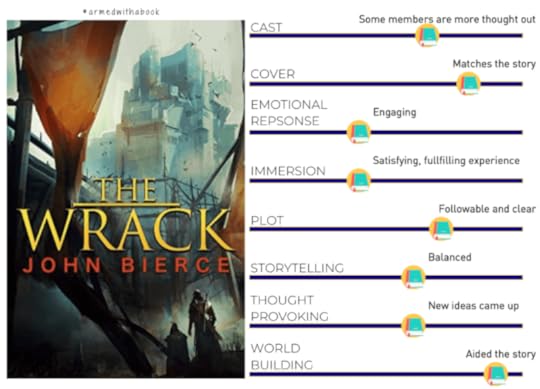
It takes a lot of imagination to look at a widespread pandemic situation from so many different angles. The Wrack is a commendable story and there is no doubt about the hard work that went into it! My only regrets – with the plethora of characters spread over a vast area, it was hard for me to connect with them. I wish I could have been on a longer journey with some characters. I also found the pace a bit slow and the conclusion a little bit hurried.
How close does this come to COVID, you may be wondering. It isn’t the same level and we aren’t living in that world. So, it really won’t be that terrifying a read! If you are looking for a light quick Fantasy, The Wrack is not the book for you. If you want to dive deep into the human psyche and what happens when a pandemic no one understand unleashes out of nowhere, then do pick up this book!
Many thanks to the author for providing a complimentary review copy of the book as part of blog tour organized by Storytellers on Tour.
Reading Experience:
It takes a lot of imagination to look at a widespread pandemic situation from so many different angles. The Wrack is a commendable story and there is no doubt about the hard work that went into it! My only regrets – with the plethora of characters spread over a vast area, it was hard for me to connect with them. I wish I could have been on a longer journey with some characters. I also found the pace a bit slow and the conclusion a little bit hurried.
How close does this come to COVID, you may be wondering. It isn’t the same level and we aren’t living in that world. So, it really won’t be that terrifying a read! If you are looking for a light quick Fantasy, The Wrack is not the book for you. If you want to dive deep into the human psyche and what happens when a pandemic no one understand unleashes out of nowhere, then do pick up this book!
Many thanks to the author for providing a complimentary review copy of the book as part of blog tour organized by Storytellers on Tour.

February 22, 2022
Excellent Read
Engrossing fantasy story about a plague (with actual, real science underlying the fiction) sweeping across a world. There are a only a few recurring characters, stationed in three (iirc) key places, but many more one-shot vignettes showing a variety of other characters around the world that helps flesh out the details, major and minor.
Engrossing fantasy story about a plague (with actual, real science underlying the fiction) sweeping across a world. There are a only a few recurring characters, stationed in three (iirc) key places, but many more one-shot vignettes showing a variety of other characters around the world that helps flesh out the details, major and minor.

May 18, 2020
3.5 Stars: An interesting approach to a fantasy novel, this book is about the progression of an unknown plague told through a series of short snippets set in a well crafted fantasy universe. Much like how lives are cut short and responsibilities transferred prematurely in a time of plague, sometimes the snippets are threads carried through a few chapters, and other times they are left to stand alone, leaving you wondering what became of it's subjects. As a whole, it weaves a compelling thread throughout the book, creating a gestalt of fast paced epidemiological storytelling and creative world building.
But I also found myself time and time again being disappointed by the lack of follow up on a character or plot, and feeling that the standalone chapters did not always see themselves to a proper conclusion within the micro-story format. Bierce does such an amazing job of condensing the creation of a unique character and environment into a so few pages (although the "strong females" felt a little cut and paste by the end), that I would often get into a story only to not really have any closure. It sometimes felt like a compilation of half-finished storylines meant to serve as vectors for building the world, but not quite for building a plot.
This vignette format didn't not work entirely though - as I think the threads that were followed to a conclusion were strong, compelling, and helped bring to life the progression of the Wrack from some interesting perspectives.
Although it can suffer under its own weight at times (especially for someone like me who has a hard time juggling names and countries and factions etc.), what really shines is the obvious detail and attention paid to the world building. The semaphore network and the scrying methods were really cool, and very well thought out pieces that give the world a unique identity. The different religious classes were also very well thought out, and although I'm still a little confused as to what the relationships between them are, they helped flesh out the realistic conflicts that might arise during a plague.
As a fan of epidemiological stories, I really thought the chapters on solving the mystery of transmission provided a good conclusion to the book (shoutout to The Ghost Map!). For me, that was the most interesting part, and I would've loved to see those characters and how they came to their conclusions expanded upon.
I am both a friend of the author, and also someone who almost never reads fantasy, so hopefully the biases canceled each other out here. I tend to shy away from books where there is a lot of fictional politics and geography to think about and remember, but it's safe to say that those things did not detract enough for me to not thoroughly enjoy this book. It feels a bit rushed, but as it's early in Bierce's career as a novelist, this is still a great starting point, and I know the refinement will only get better over time (and I also haven't read the Mage Errant books yet to compare it to). I look forward to reading more books from him set in this universe and others, especially if his bottomless nerd knowledge is further used to create great science-based fantasy!
But I also found myself time and time again being disappointed by the lack of follow up on a character or plot, and feeling that the standalone chapters did not always see themselves to a proper conclusion within the micro-story format. Bierce does such an amazing job of condensing the creation of a unique character and environment into a so few pages (although the "strong females" felt a little cut and paste by the end), that I would often get into a story only to not really have any closure. It sometimes felt like a compilation of half-finished storylines meant to serve as vectors for building the world, but not quite for building a plot.
This vignette format didn't not work entirely though - as I think the threads that were followed to a conclusion were strong, compelling, and helped bring to life the progression of the Wrack from some interesting perspectives.
Although it can suffer under its own weight at times (especially for someone like me who has a hard time juggling names and countries and factions etc.), what really shines is the obvious detail and attention paid to the world building. The semaphore network and the scrying methods were really cool, and very well thought out pieces that give the world a unique identity. The different religious classes were also very well thought out, and although I'm still a little confused as to what the relationships between them are, they helped flesh out the realistic conflicts that might arise during a plague.
As a fan of epidemiological stories, I really thought the chapters on solving the mystery of transmission provided a good conclusion to the book (shoutout to The Ghost Map!). For me, that was the most interesting part, and I would've loved to see those characters and how they came to their conclusions expanded upon.
I am both a friend of the author, and also someone who almost never reads fantasy, so hopefully the biases canceled each other out here. I tend to shy away from books where there is a lot of fictional politics and geography to think about and remember, but it's safe to say that those things did not detract enough for me to not thoroughly enjoy this book. It feels a bit rushed, but as it's early in Bierce's career as a novelist, this is still a great starting point, and I know the refinement will only get better over time (and I also haven't read the Mage Errant books yet to compare it to). I look forward to reading more books from him set in this universe and others, especially if his bottomless nerd knowledge is further used to create great science-based fantasy!

July 27, 2020
This is an interesting fantasy take on a pandemic. I loved the concept of the world, especially the magic system, with the focusing crystals, the hierarchy and the communication system, and there seemed to be loads of potential for political intrigue.
Unfortunately the story itself seemed a bit haphazard, jumping from place to place and not quite connecting. The plot seemed to take second place to world building exposition, whilst characters settled way in third. I really loved getting to know several of the characters - but as there's not really a main character and we move quickly onto new people, I never really got to follow the people who seemed interesting. At first I was excited to meet and connect with characters and to follow their story, then disappointed when we never returned to them. Their stories felt unfinished, their promise never met.
I would definitely like to read more set in this world, especially with this magic system. There is an absolute ton of potential here and I hope we return to this world in the future, following just a few characters this time!
Unfortunately the story itself seemed a bit haphazard, jumping from place to place and not quite connecting. The plot seemed to take second place to world building exposition, whilst characters settled way in third. I really loved getting to know several of the characters - but as there's not really a main character and we move quickly onto new people, I never really got to follow the people who seemed interesting. At first I was excited to meet and connect with characters and to follow their story, then disappointed when we never returned to them. Their stories felt unfinished, their promise never met.
I would definitely like to read more set in this world, especially with this magic system. There is an absolute ton of potential here and I hope we return to this world in the future, following just a few characters this time!

April 24, 2020
A powerful and troubling read. I enjoyed Bierce's other works a lot, but they didn't prepare me for how great a story this would be. He's truly stepped up his game. This tale of a mysterious pandemic comes at an interesting time, and I'm curious as to whether it will be a net positive or negative for the book that it releases during our own pandemic. For me, it helped provide an extra emotional punch.

August 7, 2021
This is one of my favorite books that I've read this year. I also completely understand why this book seems not to have worked for many of my fellow reviewers. It's not a traditional narrative with characters who have arcs. The main focus of the book is The Wrack, a mysterious illness that is sweeping the world. The reader follows The Wrack as it progresses from patient zero all the way to it's eventual resolution.
Bierce has 3 very difficult jobs to do in a little over 200 pages:
He needs to establish a fantasy world and it's rules. Magic is a thing in this world and I think that's an excellent choice for reasons I'll elaborate on later.
He needs to explain the disease, it's symptoms, and it's spread.
He needs to show how different cultures and political structures react to the disease.
The text throws a lot at you in the beginning and expects you to keep up. Things slow down in the middle. We take a break from the major players on the front lines of fighting the disease to view a series of vignette chapters that tell the stories of individuals living through this time from vastly different perspectives. Things pick back up again toward the final act as we follow a new cast of main players who ultimately unravel the mystery of the disease.
The book gives the reader a God's-eye-view of The Wrack epidemic. Zooming in and out as needed. This is not going to be to everyone's taste, but I loved the way it came together.
Bierce obviously did his homework for this novel. There are so many parallels to real life disease and outbreak. The mystery in this book plays out like an Agatha Christie novel. The clues are there. The mystery is solvable, but the revelation still made me go "aha!"
I happened to read this book at a time when I had just lived *fingers crossed* through a pandemic, and was also masochistically reading about The Black Death. Telling a story like this in a fantasy setting where magic is demonstrably real is such a great way to show how disorienting plague outbreaks must have been to people in the past.
I think if a reader is willing to accept this book on it's own terms, and not go in with too many preconceived notions about how a fantasy book should be structured, it is very interesting. I would definitely recommend it to anyone who likes serious fantasy aimed at an adult (as opposed to young adult) audience.
Bierce has 3 very difficult jobs to do in a little over 200 pages:
He needs to establish a fantasy world and it's rules. Magic is a thing in this world and I think that's an excellent choice for reasons I'll elaborate on later.
He needs to explain the disease, it's symptoms, and it's spread.
He needs to show how different cultures and political structures react to the disease.
The text throws a lot at you in the beginning and expects you to keep up. Things slow down in the middle. We take a break from the major players on the front lines of fighting the disease to view a series of vignette chapters that tell the stories of individuals living through this time from vastly different perspectives. Things pick back up again toward the final act as we follow a new cast of main players who ultimately unravel the mystery of the disease.
The book gives the reader a God's-eye-view of The Wrack epidemic. Zooming in and out as needed. This is not going to be to everyone's taste, but I loved the way it came together.
Bierce obviously did his homework for this novel. There are so many parallels to real life disease and outbreak. The mystery in this book plays out like an Agatha Christie novel. The clues are there. The mystery is solvable, but the revelation still made me go "aha!"
I happened to read this book at a time when I had just lived *fingers crossed* through a pandemic, and was also masochistically reading about The Black Death. Telling a story like this in a fantasy setting where magic is demonstrably real is such a great way to show how disorienting plague outbreaks must have been to people in the past.
I think if a reader is willing to accept this book on it's own terms, and not go in with too many preconceived notions about how a fantasy book should be structured, it is very interesting. I would definitely recommend it to anyone who likes serious fantasy aimed at an adult (as opposed to young adult) audience.

September 12, 2022
Full review: https://vueltaspodcast.wordpress.com/...
Interview with John Bierce: https://vueltaspodcast.wordpress.com/...
Score: 4 out of 5 stars
The Wrack is a really interesting novel by John Bierce, author of the Mage Errant series. The premise of a plague invading a city and the consequences after it, and how the people react was something that really attracted me, and John Bierce delivered all he promised and more.
And well, after a two-year pandemic still ongoing, you would say that The Wrack is inspired by that. And here comes one of the most shocking facts about the novel, it was written in 2019; and it feels kinda terrific how accurate to the development of the pandemic. Part of its shining comes from it, as it is a rather unique novel, as the author defines "epidemiological fantasy".
So let's talk about the aspects of this book that made me love it. As a book that shares the universe with the Mage Errant, Teringia is amazingly built, and in general, is full of small details that make it feel alive. And this is something that I consider especially important when you are going to unleash a plague over there. The Wrack is unleashed at the start of the book, and we will become spectators of how it spreads around the world.
But we are also contemplating humans, and something we can learn about our current situation is that the world won't stop because a plague is still spreading. Despite the plague being the main factor during the novel, I feel it is only a way to see how human nature reacts to an extreme situation, and how despite this shocking event, we can observe how the events don't stop after that. Magistrally, Bierce shows how ambitions and fear overcome common sense, writing a novel that could be defined as a sociological study.
It is true that it might not be the most hooking novel, and that the pace sometimes feels awkward, and it's probably why I can't give it a better score, but despite these small inconveniences, I think it's a really solid work.
In summary, I think The Wrack is a really accurate novel, that reflects how the group reacts to extreme situations. I didn't know that I needed this kind of "epidemiological fantasy" in my life, but I certainly enjoyed it so much (and some of the details in the book, such as the appendixes are great).
Interview with John Bierce: https://vueltaspodcast.wordpress.com/...
Score: 4 out of 5 stars
The Wrack is a really interesting novel by John Bierce, author of the Mage Errant series. The premise of a plague invading a city and the consequences after it, and how the people react was something that really attracted me, and John Bierce delivered all he promised and more.
And well, after a two-year pandemic still ongoing, you would say that The Wrack is inspired by that. And here comes one of the most shocking facts about the novel, it was written in 2019; and it feels kinda terrific how accurate to the development of the pandemic. Part of its shining comes from it, as it is a rather unique novel, as the author defines "epidemiological fantasy".
So let's talk about the aspects of this book that made me love it. As a book that shares the universe with the Mage Errant, Teringia is amazingly built, and in general, is full of small details that make it feel alive. And this is something that I consider especially important when you are going to unleash a plague over there. The Wrack is unleashed at the start of the book, and we will become spectators of how it spreads around the world.
But we are also contemplating humans, and something we can learn about our current situation is that the world won't stop because a plague is still spreading. Despite the plague being the main factor during the novel, I feel it is only a way to see how human nature reacts to an extreme situation, and how despite this shocking event, we can observe how the events don't stop after that. Magistrally, Bierce shows how ambitions and fear overcome common sense, writing a novel that could be defined as a sociological study.
It is true that it might not be the most hooking novel, and that the pace sometimes feels awkward, and it's probably why I can't give it a better score, but despite these small inconveniences, I think it's a really solid work.
In summary, I think The Wrack is a really accurate novel, that reflects how the group reacts to extreme situations. I didn't know that I needed this kind of "epidemiological fantasy" in my life, but I certainly enjoyed it so much (and some of the details in the book, such as the appendixes are great).

June 24, 2020
Plague stories don't particularly interest me. You would think they would with the abundant deaths and misery. I haven't come across too many. The best I can think of would be Mask of the Red Death by Poe. I'd seen Outbreak once in Middle School and have never watched Contagion. I don't go hunting them down is what I'm trying to say. My willingness to read this one was because it sounded different from everything I've read in recent years. A plague set in a fantasy world that didn't revolve around rats. How did it fare?
The Wrack is a shipwreck in a perfect storm. It was a struggle to get through this when it should not have been.
I believe the reason why it took me three days to finish this instead of what should easily have been one short night was the structure of the story itself. The story of the plague as it develops is nothing to argue with. It is the choice to make each chapter its own short story with self-contained characters that wounded my interest. Further in that respect The Wrack also doesn't adhere to that rule either.
The first few chapters of the book focus on certain characters as the plague starts to affect those around them. The king's son is the first victim and it is initially believed to be the work of poison. A healer is summoned who quickly realizes that this is a sickness whose cure is beyond their reach. A plague. It becomes evident that they are in grave danger and the healer rushes to dispatch a warning as well as alert the King his son is dead.
After that start, you would imagine that this book would be remarkably good. It is an excellent beginning. Things become jumpy from here on out. I was hooked, armed, and ready. I stood on those front lines waiting for greatness. Then I was forced to sit down. As I type this I'm reminded of so many unresolved story lines. It hurts because what we are given is good. The problem is as soon as I become invested in these people, their chapter ends and I'm given over to others. If this book was intended as a collection of short stories that would end each section with the horrors of the plague as it affects each group of people, that would almost have been better. The use of certain characters for multiple chapters, then dropping them for most of the book, only to bring them back later on for one or two more, then to drop them again before the ending results in a very jumbled feeling book.
Out of all those random middle chapters, two particularly stood out for me. One of which three people travel throughout a city going door to door to record the names of the deceased. There is a poignant moment when the person who had been doing the writing realizes his book has no more room and after being kind and composed the entire time to those suffering he finally loses his calmness and runs off screaming. One of his partners picks up his abandoned book and returns to the temple to get a blank notebook and only then does she feel the weight of what she is truly holding. The weight of their souls exists in those words. Otherwise, they would be lost. Only memories to be erased.
The other involves crew members on a ship. They discover a ghost ship filled with the dead. One member wants to burn the ship while another wants the crew to take it and return with two ships. Words get exchanged and they duel to the death. It is an odd story because the two crew members are a man and woman who it is believed are interested in each other. The instances from getting along to a sudden death match come quickly, and then the female remains after having stabbed her once-possible suitor. In the end, with the help of another crew member, they carry the fallen up to the ship's crows nest so his dying sight can be of the land. I'm not sure why this story spoke to me especially as none of these characters return or are mentioned in the rest of the book.
Much of the chapters are short and, to me at least, were irrelevant. When we finally return to the people who interested me at the beginning of the book, strangers come into the town and declare the nobility has to pay and atone for their deeds. This goes nowhere. There's also a mist that contains monsters which is also largely unimportant except for I believe in the end it's revealed the monsters transmitted the Wrack to cattle which in turn affected everyone else. Talk of these monsters comes up a few times in descriptions but there's no larger story about these creatures. With all literature, we get the story that is told to us. What I wanted was a larger conflict. It was a cool idea that didn't amount to anything.
Another moment that bothered me was that at the beginning of the book we are introduced to a Seer which are people with special sight gained through the use of various gem glass eyes. It is mentioned that not a lot of people are willing to become Seers because of the cost of losing an eye but throughout the book, we are introduced to quite a lot of them. It is something that stuck out and dragged me through the rest of the book.
After the first few chapters, we meet Yusef. His introduction made it seem like he would have a great presence in the book until he tells his daughter to investigate the plague in his stead. He does have one more chapter later on in the book but then disappears from the story forever. His daughter is another sporadic character that has her chapter and then disappears largely.
The plague is what connects these disjointed chapters but it doesn't pay off. Not when the inhabitants of this world are interesting and I want to read more but there is not enough. That's the fault in this book. It is only twenty-five chapters when it would have benefited from being fifty or sixty. I wouldn't have minded all of the single stories if the main ones were fleshed out more. The Wrack doesn't reach the promise of what it is capable of. The writer took me to the Cheesecake factory, sat me next to the case, and wouldn't let me order a slice.
The Wrack is a shipwreck in a perfect storm. It was a struggle to get through this when it should not have been.
I believe the reason why it took me three days to finish this instead of what should easily have been one short night was the structure of the story itself. The story of the plague as it develops is nothing to argue with. It is the choice to make each chapter its own short story with self-contained characters that wounded my interest. Further in that respect The Wrack also doesn't adhere to that rule either.
The first few chapters of the book focus on certain characters as the plague starts to affect those around them. The king's son is the first victim and it is initially believed to be the work of poison. A healer is summoned who quickly realizes that this is a sickness whose cure is beyond their reach. A plague. It becomes evident that they are in grave danger and the healer rushes to dispatch a warning as well as alert the King his son is dead.
After that start, you would imagine that this book would be remarkably good. It is an excellent beginning. Things become jumpy from here on out. I was hooked, armed, and ready. I stood on those front lines waiting for greatness. Then I was forced to sit down. As I type this I'm reminded of so many unresolved story lines. It hurts because what we are given is good. The problem is as soon as I become invested in these people, their chapter ends and I'm given over to others. If this book was intended as a collection of short stories that would end each section with the horrors of the plague as it affects each group of people, that would almost have been better. The use of certain characters for multiple chapters, then dropping them for most of the book, only to bring them back later on for one or two more, then to drop them again before the ending results in a very jumbled feeling book.
Out of all those random middle chapters, two particularly stood out for me. One of which three people travel throughout a city going door to door to record the names of the deceased. There is a poignant moment when the person who had been doing the writing realizes his book has no more room and after being kind and composed the entire time to those suffering he finally loses his calmness and runs off screaming. One of his partners picks up his abandoned book and returns to the temple to get a blank notebook and only then does she feel the weight of what she is truly holding. The weight of their souls exists in those words. Otherwise, they would be lost. Only memories to be erased.
The other involves crew members on a ship. They discover a ghost ship filled with the dead. One member wants to burn the ship while another wants the crew to take it and return with two ships. Words get exchanged and they duel to the death. It is an odd story because the two crew members are a man and woman who it is believed are interested in each other. The instances from getting along to a sudden death match come quickly, and then the female remains after having stabbed her once-possible suitor. In the end, with the help of another crew member, they carry the fallen up to the ship's crows nest so his dying sight can be of the land. I'm not sure why this story spoke to me especially as none of these characters return or are mentioned in the rest of the book.
Much of the chapters are short and, to me at least, were irrelevant. When we finally return to the people who interested me at the beginning of the book, strangers come into the town and declare the nobility has to pay and atone for their deeds. This goes nowhere. There's also a mist that contains monsters which is also largely unimportant except for I believe in the end it's revealed the monsters transmitted the Wrack to cattle which in turn affected everyone else. Talk of these monsters comes up a few times in descriptions but there's no larger story about these creatures. With all literature, we get the story that is told to us. What I wanted was a larger conflict. It was a cool idea that didn't amount to anything.
Another moment that bothered me was that at the beginning of the book we are introduced to a Seer which are people with special sight gained through the use of various gem glass eyes. It is mentioned that not a lot of people are willing to become Seers because of the cost of losing an eye but throughout the book, we are introduced to quite a lot of them. It is something that stuck out and dragged me through the rest of the book.
After the first few chapters, we meet Yusef. His introduction made it seem like he would have a great presence in the book until he tells his daughter to investigate the plague in his stead. He does have one more chapter later on in the book but then disappears from the story forever. His daughter is another sporadic character that has her chapter and then disappears largely.
The plague is what connects these disjointed chapters but it doesn't pay off. Not when the inhabitants of this world are interesting and I want to read more but there is not enough. That's the fault in this book. It is only twenty-five chapters when it would have benefited from being fifty or sixty. I wouldn't have minded all of the single stories if the main ones were fleshed out more. The Wrack doesn't reach the promise of what it is capable of. The writer took me to the Cheesecake factory, sat me next to the case, and wouldn't let me order a slice.

September 10, 2022
I really tried to like this, but it just ended up being too boring. The story had the right tone going about it with it being all about a plague, but like others have said you literally aren't able to get attached to any characters whatsoever and the story is like 90% worldbuilding. After reading this I would easily still be interested in reading something set in this world, but only if we got more character work because as it stands outside of a few chapters I really couldn't have cared less when somebody died.
The worst part is that we get to see a few characters a couple of times and then we never see them again. They didn't necessarily die or anything they just don't show up again. It just feels so incomplete. I just recently read a short story that was similar to this in the sense that it didn't have enough character work because it was so short and this is literally 10 times the length of that and basically had the same problem. Besides all that the author could be way too descriptive to the point where I would literally skim half a chapter because they were describing every single little thing happening in the scene and I just really didn't need to know the details.
Those are my thoughts. I wouldn't not recommend this I just don't think the massive amount of worldbuilding was enough to carry the story for me.
The worst part is that we get to see a few characters a couple of times and then we never see them again. They didn't necessarily die or anything they just don't show up again. It just feels so incomplete. I just recently read a short story that was similar to this in the sense that it didn't have enough character work because it was so short and this is literally 10 times the length of that and basically had the same problem. Besides all that the author could be way too descriptive to the point where I would literally skim half a chapter because they were describing every single little thing happening in the scene and I just really didn't need to know the details.
Those are my thoughts. I wouldn't not recommend this I just don't think the massive amount of worldbuilding was enough to carry the story for me.

August 8, 2021
Had to be really weird writing a book about a pandemic right before a pandemic struck. A fantasy world with some minor magical elements that's experiencing a plague. None of the medical stuff struck me as implausible or idiotic which is great because it shows the author put time into researching his craft. There's a lot of solid world building here and a neat magic system. Just be aware that there is no "main character" or individual character arcs. That's not the purpose of the book. So tailor your expectations accordingly. This is a book about the plague and various points of society responding to it.
I'm just going to say if the author decided to write 9 more volumes set in this world chronically the history of this world through various eras... I'd read it. I'd buy it in hard cover and put it on a book shelf and pretend that I'm a learned man while wearing a smoking jacket. I'd recommend this book, is what I'm trying to say.
If you want to hear more we're covering this book on words about books 8/15/21 at https://podcast.wordsaboutbooks.ninja/
I'm just going to say if the author decided to write 9 more volumes set in this world chronically the history of this world through various eras... I'd read it. I'd buy it in hard cover and put it on a book shelf and pretend that I'm a learned man while wearing a smoking jacket. I'd recommend this book, is what I'm trying to say.
If you want to hear more we're covering this book on words about books 8/15/21 at https://podcast.wordsaboutbooks.ninja/

February 13, 2021
What can I say except: Wow.
The care and attention to detail that went into writing this is incredible. The peoples, their traditions, how individuals conform to and buck their traditions. Places having deep histories, and that being conveyed expertly. It all comes together, giving the sense of this being real.
What I want to praise most is the beautiful handling of loss. The Wrack is a disease that brings about tragedy on a mass scale. But the author made sure not to lose sight of how it affects people on a personal level. I never felt like it was taken lightly.
Also for posterity, I'm currently living through a pandemic, and boy were some aspects very real. The author wrote this before COVID-19, but seems to have captured the varied reactions to the pandemic. There are moments of fear, hope, denial, camaraderie, cowardice, inventiveness - all captured in vignettes that are told with unique voices.
I loved it.
The care and attention to detail that went into writing this is incredible. The peoples, their traditions, how individuals conform to and buck their traditions. Places having deep histories, and that being conveyed expertly. It all comes together, giving the sense of this being real.
What I want to praise most is the beautiful handling of loss. The Wrack is a disease that brings about tragedy on a mass scale. But the author made sure not to lose sight of how it affects people on a personal level. I never felt like it was taken lightly.
Also for posterity, I'm currently living through a pandemic, and boy were some aspects very real. The author wrote this before COVID-19, but seems to have captured the varied reactions to the pandemic. There are moments of fear, hope, denial, camaraderie, cowardice, inventiveness - all captured in vignettes that are told with unique voices.
I loved it.

September 18, 2020
I really enjoyed this book.
The many vignettes of characters throughout this story were a very refreshing way to learn this world the author builds. I'm especially into slice-of-life stories and really enjoyed reading them within this fantasy world. There were a handful of main characters we get to follow through this story and each time the story left off I couldn't wait to get back to their story but was immediately immersed in the next story! I was pulled through and intrigued the whole time. The concepts were unique and exciting. This story would lend well to the screen. I keep thinking about the fictional words from this book that seem so real now that they've a foothold in my mind. This book will be fun to revisit.
The many vignettes of characters throughout this story were a very refreshing way to learn this world the author builds. I'm especially into slice-of-life stories and really enjoyed reading them within this fantasy world. There were a handful of main characters we get to follow through this story and each time the story left off I couldn't wait to get back to their story but was immediately immersed in the next story! I was pulled through and intrigued the whole time. The concepts were unique and exciting. This story would lend well to the screen. I keep thinking about the fictional words from this book that seem so real now that they've a foothold in my mind. This book will be fun to revisit.
October 25, 2020
I'm one of those people that enjoys disaster fic, post-apocalypse, and dystopian fic during stressful times. The Wrack hit the right balance between plausibly frightening with its realistic depiction of the spread of pandemic and the hope of people surviving and making better. Bierce is unflinching in portraying the onset and effects of the Wrack but never lingers in a way that feels like trauma porn. I particularly enjoyed seeing how the lives of many different people in the setting's different cultures and classes were affected, as well as the interesting ways the magic system is used. The way it wrapped up was satisfying and realistic, and the appendices made me want to learn more about the multiverse of Bierce's novels. 4.5 out of 5 stars.
Displaying 1 - 30 of 83 reviews