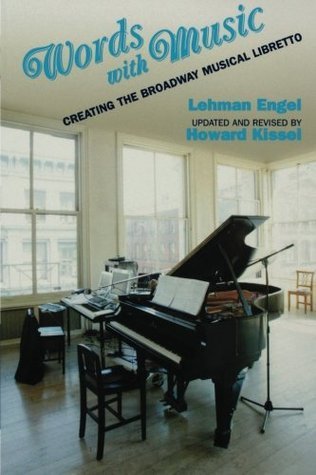
I am a longtime musical theater enthusiast. I purchased Words with Music by Lehman Engel because I saw an interview with an award-winning musical theater composer who said the book was his greatest influence, and it had taught him how to write a musical. Knowing Engel’s reputation as a Broadway conductor and cast album producer—and the fact he held a very successful series of workshops on the writing of musicals—I was curious. The newest edition of the book includes commentary passages by Howard Kissel. Engel’s book was written several decades ago, while Kissel’s commentary came a few decades after that. And thus, this book begins being outdated in terms of today’s musical theater. That is not to say it doesn’t have value. Engel’s opinions are valid to a point and Kissel’s commentary on them is enlightening. But ultimately the book, for me, was a bore. I did learn a few things I didn’t know, read a few anecdotes that were amusing, and gained from the opinions of two men who wrote long ago. Engel’s outlook on musical theater is so outdated that it has little relevance to today’s theater. And Kissel ends his commentaries with The Light in the Piazza, so he brings no commentary about any sense of today’s musical theater, as that show was produced in 2003. A lot has been produced in the two decades that is both like Engel’s models and unlike his models, and yet those shows have been quite successful. I think the most irritating thing about Engel’s book is that he was so very opinionated. Particularly, he hated, hated, hated the musical Hair. The show, no doubt, was so far from his concept of musical theater and so radical in its production, not to mention its rock music, that Engel could not wrap his mind around it. In fact, though, Engel seems to hate all rock musicals of that period. Furthermore, he was not a fan of Hello Dolly!, The Music Man, nor Mame. He is quite convinced those shows are thin without much plot. And he apparently hated Carol Channing’s performance as Dolly, a role she performed thousands of times during her life, never failing to entertain the masses who went to see the show. I grew very tired of Engel “dissing” shows that I and others have embraced. He predicted a short lifespan for the aforementioned shows, and yet Hello Dolly! had a recent triumphal return with Bette Midler and Bernadette Peters in the title role, Mame is continually performed and delights me each time I see it, and Hair once again came to Broadway just in the last few years. With a man who despised these shows, one has to wonder about his opinion of how to write a “good” show. And his book really is so full of his own negative opinions that it is hard to discern his advice as to how to write a show. As for the commentary, it is easier to take, but again, it is dated. It took me forever to read this book—and I admit I skimmed the last two chapters because I didn’t want to spend another moment on it—so perhaps I missed something because I just wasn’t into it. That saddens me because I rarely read about musical theater without being enthralled.