

What do you think?

Daredevil (1964) #185-191, 219
Daredevil by Frank Miller & Klaus Janson, Vol. 3
Two assassins. One hero. It didn't end well. But Elektra's death was only the foundation for one of Frank Miller's most staggering sagas of the Man Without Fear! The Hand and the Chaste are in a race for Elektra, body and soul, and Natasha Romanova, the Black Widow, almost follows her rival into the grave while Daredevil's trapped in a coffin of his own design! Can his sarcastic sensei Stick rescue him from sensory overload, just in time for hand-to-Hand combat? Plus, the continuing tragedy of Heather Glenn, Foggy Nelson's foray into organized crime, a path not taken to the S.H.I.E.L.D. Helicarrier, and the only villain who gets less respect than Stilt-Man...a second Stilt-Man! Featuring the Kingpin, Bullseye, and Hydra! Collects Daredevil #185-191, #219; Daredevil: Love & War, and What If? #28
283 pages, Paperback
First published January 1, 2007
About the author
Frank Miller
1,362 books5,632 followersFrank Miller is an American writer, artist and film director best known for his film noir-style comic book stories. He is one of the most widely-recognized and popular creators in comics, and is one of the most influential comics creators of his generation. His most notable works include Sin City, The Dark Knight Returns, Batman Year One and 300.
Librarian Note: There is more than one author in the Goodreads database with this name.
Librarian Note: There is more than one author in the Goodreads database with this name.
Ratings & Reviews
Friends & Following
Create a free account to discover what your friends think of this book!
Community Reviews
Displaying 1 - 30 of 77 reviews

May 26, 2019
Daredevil by Frank MIller & Klaus Janson Volume 3 collects Daredevil #185-191, 219, Daredevil: Love & War, and What If #28.
Frank Miller and Klaus Janson's groundbreaking run on Daredevil concludes in this volume. Daredevil tangles with the Hand, a new Stiltman, and the Kingpin. His relationship with Heather ends and Elektra is resurrected by The Hand. As with the last volume, these are more character driven stories, exploring the inner workings of Matt Murdock.
Frank Miller hands off most of the art chores to Klaus Janson in this volume but the transition is almost seamless. Miller's Batman work is more well-regarded than what he's done on Daredevil but I think his Daredevil stuff is better. It's more powerful, more raw, and it doesn't feel like he's working with a safety net.
The final three issues in this collection don't feature Klaus Janson at all. Were they included for filler? Anyway, the What If is okay but the others are great. The John Buscema penciled tale feels like a western. Matt Murdock wanders into a New Jersey town and settles some shit, reminiscent o f Red Harvest. Love and Death, the Bill Sienkewicz illustrated tale, is primarily about the Kingpin's obsession with his mute wife.
For better or worse, Frank Miller and Klaus Janson's run is responsible for the Daredevil we have now. It holds up well by today's standards and is a must for any Daredevil fan. 4.5 out of five stars.
Frank Miller and Klaus Janson's groundbreaking run on Daredevil concludes in this volume. Daredevil tangles with the Hand, a new Stiltman, and the Kingpin. His relationship with Heather ends and Elektra is resurrected by The Hand. As with the last volume, these are more character driven stories, exploring the inner workings of Matt Murdock.
Frank Miller hands off most of the art chores to Klaus Janson in this volume but the transition is almost seamless. Miller's Batman work is more well-regarded than what he's done on Daredevil but I think his Daredevil stuff is better. It's more powerful, more raw, and it doesn't feel like he's working with a safety net.
The final three issues in this collection don't feature Klaus Janson at all. Were they included for filler? Anyway, the What If is okay but the others are great. The John Buscema penciled tale feels like a western. Matt Murdock wanders into a New Jersey town and settles some shit, reminiscent o f Red Harvest. Love and Death, the Bill Sienkewicz illustrated tale, is primarily about the Kingpin's obsession with his mute wife.
For better or worse, Frank Miller and Klaus Janson's run is responsible for the Daredevil we have now. It holds up well by today's standards and is a must for any Daredevil fan. 4.5 out of five stars.

May 18, 2024
(This review is for the whole series)
This is a hard one to write, because I love this run. It's not just essential for both Daredevil and Frank Miller (although it is, and those are two things I love), it's one of the most essential comic runs of all time. And, even more importantly, it reinvigorated my interest in comics when I was starting to get tired of them (on a re-read, no less)
I first read Daredevil Visionaries: Frank Miller Vol. 2 somewhat early into my comics adventure since my library had it and I was planning to get into Daredevil for a while then. I found it on the shelf, audibly gasped and muttered something along the lines of "no way!", and RAN to check it out. It was a pure hit of dopamine and a wave of joy to open it up and see Miller's art. It's not the best art of it's kind, but it's pure superhero comic book. The bright colors, the creative costumes, the shocking feats of strength; it was perfect. I eagerly consumed the entire volume.
But, unfortunately, I wasn't able to return to the series for a good chunk of time, until I found the volume I'm reviewing right now (at $15!) and bought the missing issues on Kindle. I read the first volume, checked out Visionaries 2 for a re-read (which was equally exciting as the first time, and a wonderful change of pace after some of the dissapointing stuff I'd been reading), and after that, read the stuff I had bought.
And now that things become less anecdotal, I lose my words, as always happens when I have too much love for a series. It's just so fantastic. Miller balances Daredevil's heroics perfectly with his mistakes, obsession, and guilt. I've had more fun with the action in this series than anything other than The Mask (except maybe Zdarsky's Daredevil), although for very different reasons. The villains are perfect (Bullseye is my fave, and if you don't read this, you're missing out severely on DD's best villain and his best stories).
The show is fantastic, but it shies away from the comic-book-iness of it all for that gritty feel. It's missing the colorful costumes! The superhero crossovers! The billy club's true potential! Plus, Elektra is SO much better in the comic. The only thing that the show does better is probably Foggy. I don't care for his comic counterpart.
The biggest flaw I can think of is The Hand. It's iconic to the Miller run, but the ending to the arc is extremely weak. Plots that seem important are ended before they go anywhere, and the resolution just makes no sense. How does THAT defeat the elite ninjas, but stronger people couldn't do the same thing? It was just a big fizzle, although I like the Elektra stuff in that issue.
The last issue (not counting Love and War) feels so fitting as an ending while being stand-alone and disconnected from any other Daredevil lore. It's just such a comfortable, quiet send-off for Miller's time on the main title. It's lovely, and a very fun issue.
Love and War is great, but definitley not perfect. I like how Miller writes the inside of the head of an insane person (although I wonder if it would be considered politically incorrect in some way), and I LOVE the art, of course. Vanessa's word at the end of the issue is impactful, too. But other than that, there's nothing else I care about.
I just... Agh, read it. I originally decided on 4.5, but just talking about it got me excited enough to raise it to a 5. It really is a special run. I can't wait for Born Again.
This is a hard one to write, because I love this run. It's not just essential for both Daredevil and Frank Miller (although it is, and those are two things I love), it's one of the most essential comic runs of all time. And, even more importantly, it reinvigorated my interest in comics when I was starting to get tired of them (on a re-read, no less)
I first read Daredevil Visionaries: Frank Miller Vol. 2 somewhat early into my comics adventure since my library had it and I was planning to get into Daredevil for a while then. I found it on the shelf, audibly gasped and muttered something along the lines of "no way!", and RAN to check it out. It was a pure hit of dopamine and a wave of joy to open it up and see Miller's art. It's not the best art of it's kind, but it's pure superhero comic book. The bright colors, the creative costumes, the shocking feats of strength; it was perfect. I eagerly consumed the entire volume.
But, unfortunately, I wasn't able to return to the series for a good chunk of time, until I found the volume I'm reviewing right now (at $15!) and bought the missing issues on Kindle. I read the first volume, checked out Visionaries 2 for a re-read (which was equally exciting as the first time, and a wonderful change of pace after some of the dissapointing stuff I'd been reading), and after that, read the stuff I had bought.
And now that things become less anecdotal, I lose my words, as always happens when I have too much love for a series. It's just so fantastic. Miller balances Daredevil's heroics perfectly with his mistakes, obsession, and guilt. I've had more fun with the action in this series than anything other than The Mask (except maybe Zdarsky's Daredevil), although for very different reasons. The villains are perfect (Bullseye is my fave, and if you don't read this, you're missing out severely on DD's best villain and his best stories).
The show is fantastic, but it shies away from the comic-book-iness of it all for that gritty feel. It's missing the colorful costumes! The superhero crossovers! The billy club's true potential! Plus, Elektra is SO much better in the comic. The only thing that the show does better is probably Foggy. I don't care for his comic counterpart.
The biggest flaw I can think of is The Hand. It's iconic to the Miller run, but the ending to the arc is extremely weak. Plots that seem important are ended before they go anywhere, and the resolution just makes no sense. How does THAT defeat the elite ninjas, but stronger people couldn't do the same thing? It was just a big fizzle, although I like the Elektra stuff in that issue.
The last issue (not counting Love and War) feels so fitting as an ending while being stand-alone and disconnected from any other Daredevil lore. It's just such a comfortable, quiet send-off for Miller's time on the main title. It's lovely, and a very fun issue.
Love and War is great, but definitley not perfect. I like how Miller writes the inside of the head of an insane person (although I wonder if it would be considered politically incorrect in some way), and I LOVE the art, of course. Vanessa's word at the end of the issue is impactful, too. But other than that, there's nothing else I care about.
I just... Agh, read it. I originally decided on 4.5, but just talking about it got me excited enough to raise it to a 5. It really is a special run. I can't wait for Born Again.

December 12, 2015
Well, the final volume of Miller's main DD run is not quite as strong but there's still a lot to enjoy. Matt acts bizarrely for a fair part of this and the various subplots get shuffled to the background. But Ninjas! And Stick. And Turk, who gets a brief moment of power before his arse is handed to him again. That running gag has not got old. The final issue Roulette is a perfect end to the whole Elektra based arc. I thought the art was losing a little of the gritty edge compared to the last volume but it's still pretty neat.
The What if? story is lame though and the Love and War graphic novel looks amazing but falters with the concept. I quite liked the later issue pencilled by John Buscema but it could be about anyone.
If I had my way, I'd like an omnibus that starts when Miller and Janson took sole charge, focused on Kingpin, Elektra, Bullseye and running through to here. Get rid of the earlier filler in volume one when Miller was just on pencils and skip the final few stand alone stories that close this volume. In fact, throw in Born Again and Man Without Fear and that would be an awesome collection.
These stories are far beyond the rest of the Marvel output at the time. DD has in recent years become my second favorite behind the true love of my life Spider-Man and frankly this blows most of SMs creative runs out of the water.
Time to dig out the Bendis/Maleev run.
The What if? story is lame though and the Love and War graphic novel looks amazing but falters with the concept. I quite liked the later issue pencilled by John Buscema but it could be about anyone.
If I had my way, I'd like an omnibus that starts when Miller and Janson took sole charge, focused on Kingpin, Elektra, Bullseye and running through to here. Get rid of the earlier filler in volume one when Miller was just on pencils and skip the final few stand alone stories that close this volume. In fact, throw in Born Again and Man Without Fear and that would be an awesome collection.
These stories are far beyond the rest of the Marvel output at the time. DD has in recent years become my second favorite behind the true love of my life Spider-Man and frankly this blows most of SMs creative runs out of the water.
Time to dig out the Bendis/Maleev run.

November 20, 2020
SPOILERS
As this volume covers the rest of Frank Miller and Klaus Janson’s run on Daredevil, there is a change with the artistry as Janson, who has always been the inker on the book – even before Miller’s involvement – has now been promoted to penciller. No doubt that Miller’s art-style has influenced Janson and although his issues as an artist aren’t as well-crafted as Miller’s, there is still a kinetic energy that has defined this run.
The first twos issues of this volume are more comedic fodder from a Foggy Nelson-centric story to another story where Turk briefly becomes the new Stilt-Man. Even within Miller’s darker narrative, he can still include one of the silliest villains in all of the Marvel universe.
Following Elektra’s death, the red ninja clan known as the Hand remains a threat as Daredevil’s mentor Stick wants to recruit him to be part of the Chaste, a mystical martial arts enclave whose primary function is to combat the Hand. Although they are not as compelling villains as the Kingpin and Bullseye, they are red ninjas that provide plenty of really good action with Daredevil and his former partner Black Widow battle their way to prevent the Hand’s plan of resurrection. The second-to-last issue titled “Resurrection” is visually impressive, especially how it bookends with the return of Elektra as she climbs up the snowy mountains where she reveals her white outfit.
However, the final issue of Miller’s initial run is just as good as issue #181 (the death of Elektra) as he both writes and pencils, whilst Terry Austin is doing the inking. Visiting the paralysed Bullseye, the troubled Daredevil begins to play Russian Roulette with his helpless foe while he tells him the story of a client, who is a very strict and possibly abusive father to a boy who is obsessed over Daredevil. Taking place over three different time frames – including a new wrinkle in Matt Murdock’s backstory – much of the dialogue in done through Daredevil’s signature internal monologue, whilst Miller is at his artistic best here, notably his cinematic panel layouts.
The next two issues feel more like filler, such as a “What If” issue about Matt Murdock becoming an agent of S.H.I.E.L.D., and the other issue that Miller and artist John Buscema did for the Daredevil title, taking place in a crime-ridden town in New Jersey.
Concluding this volume is the Marvel graphic novel Daredevil: Love and War, in which the Kingpin hires someone to kidnap a doctor’s blind wife, in order for the doctor bringing the Kingpin’s wife Vanessa back to full health. Daredevil does appear, as well as a henchman who becomes obsessed over the blind wife, and the story itself is ultimately about crimes of passion, it gets overshadowed by the stunning art by Bill Sienkiewicz, whose style is a combination of abstraction and watercolouring, though the book can leave you cold. That said, Sienkiewicz's rendition of the Kingpin is a clear influence on the character’s depiction in Spider-Man: Into the Spider-Verse.
As this volume covers the rest of Frank Miller and Klaus Janson’s run on Daredevil, there is a change with the artistry as Janson, who has always been the inker on the book – even before Miller’s involvement – has now been promoted to penciller. No doubt that Miller’s art-style has influenced Janson and although his issues as an artist aren’t as well-crafted as Miller’s, there is still a kinetic energy that has defined this run.
The first twos issues of this volume are more comedic fodder from a Foggy Nelson-centric story to another story where Turk briefly becomes the new Stilt-Man. Even within Miller’s darker narrative, he can still include one of the silliest villains in all of the Marvel universe.
Following Elektra’s death, the red ninja clan known as the Hand remains a threat as Daredevil’s mentor Stick wants to recruit him to be part of the Chaste, a mystical martial arts enclave whose primary function is to combat the Hand. Although they are not as compelling villains as the Kingpin and Bullseye, they are red ninjas that provide plenty of really good action with Daredevil and his former partner Black Widow battle their way to prevent the Hand’s plan of resurrection. The second-to-last issue titled “Resurrection” is visually impressive, especially how it bookends with the return of Elektra as she climbs up the snowy mountains where she reveals her white outfit.
However, the final issue of Miller’s initial run is just as good as issue #181 (the death of Elektra) as he both writes and pencils, whilst Terry Austin is doing the inking. Visiting the paralysed Bullseye, the troubled Daredevil begins to play Russian Roulette with his helpless foe while he tells him the story of a client, who is a very strict and possibly abusive father to a boy who is obsessed over Daredevil. Taking place over three different time frames – including a new wrinkle in Matt Murdock’s backstory – much of the dialogue in done through Daredevil’s signature internal monologue, whilst Miller is at his artistic best here, notably his cinematic panel layouts.
The next two issues feel more like filler, such as a “What If” issue about Matt Murdock becoming an agent of S.H.I.E.L.D., and the other issue that Miller and artist John Buscema did for the Daredevil title, taking place in a crime-ridden town in New Jersey.
Concluding this volume is the Marvel graphic novel Daredevil: Love and War, in which the Kingpin hires someone to kidnap a doctor’s blind wife, in order for the doctor bringing the Kingpin’s wife Vanessa back to full health. Daredevil does appear, as well as a henchman who becomes obsessed over the blind wife, and the story itself is ultimately about crimes of passion, it gets overshadowed by the stunning art by Bill Sienkiewicz, whose style is a combination of abstraction and watercolouring, though the book can leave you cold. That said, Sienkiewicz's rendition of the Kingpin is a clear influence on the character’s depiction in Spider-Man: Into the Spider-Verse.

July 26, 2015
People go "Oh, we should have seen Frank Miller's insanity coming with The Dark Knight Returns" but honestly? Drops of it were already leaking out when he ended his legendary run of Daredevil. This third omnibus collects the final issues he did, plus a single stand-alone issue where Matt Murdock is a Sergio Leone like strange wanderer in a small town lookin' to right some wrongs, and the graphic novel "Daredevil: Love & War" with art by Bill Sienkiewicz.
The culmination of the Hand storyline and Murdock's engagement to useless princess Heather Glenn are full of uncomfortable "women are untrustworthy and unPURE" bullhickey, but I really dropped the star for the half-assed way the Hand is defeated. Stick and his gang ("The CHASTE" -- haha) are suddenly mystical energy plot-devices, and the resurrection of horrible monster ninja Kirigi ends in a wet fart.
Art is awesome as in the previous two, which also goes for the highly stylized Sienkiewicz GN included. Highlights include Turk's brief stint as Stilt-Man (Turk powering up and getting his ass kicked is a running gag the Netflix series would do well to incorporate) and Foggy as a gangsta.
The culmination of the Hand storyline and Murdock's engagement to useless princess Heather Glenn are full of uncomfortable "women are untrustworthy and unPURE" bullhickey, but I really dropped the star for the half-assed way the Hand is defeated. Stick and his gang ("The CHASTE" -- haha) are suddenly mystical energy plot-devices, and the resurrection of horrible monster ninja Kirigi ends in a wet fart.
Art is awesome as in the previous two, which also goes for the highly stylized Sienkiewicz GN included. Highlights include Turk's brief stint as Stilt-Man (Turk powering up and getting his ass kicked is a running gag the Netflix series would do well to incorporate) and Foggy as a gangsta.

February 12, 2018
The end of Frank Miller’s work on Daredevil. (Until Born Again) I expected a lot from this book and wanted certain things and plot points to tied up. This is definitely weaker than Vol. 2, better than the first 3/4 of Vol. 1 (for sure), and not as good as the last 1/4 where Miller took over writing in Vol. 1. This Volume delves deeper into the Ninja and The Hand. Now all the character relationships seem to be at their worst and it really made me want things to work out. I have A LOT of negatives with the last 7 issues of Miller’s run. But I don’t want to sound like a disliked the book. I actually really liked it and found the issues to be perfectly entertaining. But these are the most flawed issues that Miller wrote in his run. The inclusion of Black Widow was a good idea, because it was a nice friendship that gave you something to root for.
The ninja vs Hand scenes are pretty damn fun to read, especially the giant-sized issue Resurrection. That issue ends in a great deal of ambiguity. You don’t for sure know if the last page takes place in the past or the present. Stick was as badass as usual, but a MAJOR decision was made with his character that was in my opinion, uncalled for and could have been handled better. Something that has been nagging at me for a while reading this run is how easy it is for men and thugs to kill people. Even if that person is an assassin or an opponent, on several occasions the thugs utter “Let’s kill her”, or “I dunno Kill him.” Killing has a mental price and is not easy to do. That being said I do love and always have loved the way Daredevil is treated in the underworld. If Daredevil is pissed and storms into Josie’s bar, the thugs and robbers know not to mess with him. But if for one second Daredevil is not at his best or noticeably vulnerable they will go apeshit on him. The writing gets majorly lazy when characters are about to execute a huge decision with seemingly nothing to hold them back, and then because they are “weary” (or something to that extent) they stop, and pussy out. Jesus Christ I thought we were past that clichéd crap. If you are going to come to a huge writing decision Frank, have a good frickin reason to all of the sudden abandon that decision or just don’t have it at all.
The combat is always well done in these Daredevil books but never really shows the the true consequence of a hard kick to the nose, or a billy club slammed against your jaw. I get it. These are just “bad guys” with no purpose but to get the shit beaten out of them, and I know the comics code authority was a stickler about heavy violence. But I’m sorry it would be cool to see Daredevil’s punches deliver true shocking pain, rather than the usual flash of superhero might.
The last issue entitled Roulette is super deep, in the moment, and brings up a really good question. Does Daredevil also inspire violence or make his own villains? He sits beside Bullseye and weaves a game of Russian Roulette and a story together. Daredevil brings up many points about the role of a superhero and what that title means. Daredevil inspires a child to do hurt his enemies brutally and essentially ruins the boy for most of his life. The ending of the issue is usual Frank Miller brilliance, that shows one of the few differences between Daredevil and Bullseye. Daredevil’s reluctance to intentionally kill someone in cold blood. (Totally not like Batman) It is a great moment because Daredevil knows Bullseye is responsible for his mental pain about Elektra. This is unfortunately also the end of the run, a few major plot points get left for the readers to figure out.
I didn’t know that Matt Murdock had minor telepathic abilities. It took me way off guard. I was like “what the shite?” I guess training with Stick for a really long time allowed them to so perfectly predict each others thoughts they could communicate through their minds. I dunno. Stilts was a lame ass useless villain. Did not care for that at all. And the plot points I mentioned that get left in the dust at the end of the book are Matt and Foggy’s deteriorating friendship, and Matt and Heather’s marriage. First of all to kill two birds with one stone, Foggy Nelson makes a DICK MOVE. That was totally out of character and angered me. Especially since I know nothing will come from it in this book. It is true Matt Murdock was dragging Foggy Nelson through the mud by missing appointments and ultimately vanishing from the face of the earth, and putting a lot of pressure on Heather with this whole marriage concept, BUT what Foggy does to fix all that was kind of idiotic. The marriage plot point between Matt and Heather just felt unnecessary now that I look back at it, because every once and a while the characters would mention the plot point, but it really amounted to nothing great. The ninja and Hand’s ability to resurrect a body seemed verrrrry convenient. Very convenient indeed. If the ability was explained in a way that made more sense and illustrated how long this ability would take to master, I would have been fine with it But especially with Black Widow, this new ability that can magically bring back people made me role my eyes sometimes.
Kingpin’s last words to Daredevil in this book annoyed me because I don’t like that the Daredevil has earned Kingpin’s respect. It really betrays stories like Born Again. (last time I bring up that story.) Ras Al Ghul’s respect for Batman for example, is something different. Because Batman has saved his daughter and has shown to be able to beat Ras physically. You could argue that the Daredevil did save his wife and that earned Daredevil his respect, but to me, the comment was too friendly. Last point. Klaus Janson’s penciling is damn good. Almost as amazing as Miller’s. But there is one thing. I hat about the art. Janson re-uses panels on several occasions. Just seems a little lazy y’now? Miller’s last issue of his legendary run were enjoyable, but I was disappointed to have so many damn problems with it. Miller failed on wrapping certain plot points up, and brilliantly wrapped up other plots with many good questions. (GOOD questions) Frank Miller absolutely DEFINED the character of Daredevil. He made Matt Murdock, his friends, his villains and his city feel so immersive. Daredevil is the most relatable and compelling superhero along with Batman. And this run altogether transported me into this amazing vigilante world of crime, love, loss, and friendship, and I thank Miller and Janson for that.
Letter Grade (B+)
Daredevil Love and War Collected into Daredevil Vol.3
by:Frank Miller and Bill Sienkiewicz
In all honesty I don’t get this story at all. And the experience of reading it was rather frustrating, because this is some of Frank Miller’s worst most REPETITIVE writing ever! Holy shit. How many goddamn times are you going to say “not Monday” and “eggs” before the reader goes frickin insane? I know how obsessed the guy is with the repetition thing. Sometimes it works. Here it’s frickin annoying. The story concept is good. Kingpin forcing someone to help his wife. But most of the story is about this creepy messed up doctor who is stalking another man’s wife saying “cheryl” probably more than 150 times in the small portion of the GN collected alone. I didn’t give a crap about this homicidal maniac. And most of the story centers around this asshole so I didn’t care about what I was reading. When Matt Murdock or Daredevil does show up, it’s nothing great, but just seeing Daredevil is good when it comes to this confusing ass story. Bill Sienkiewicz’s luminous pencils work mostly for a noir-ish feel. Not all of it works, however, because many panels and pages are unclear and get muddled with the massive amount of inks. Letter Grade: (-D)
The ninja vs Hand scenes are pretty damn fun to read, especially the giant-sized issue Resurrection. That issue ends in a great deal of ambiguity. You don’t for sure know if the last page takes place in the past or the present. Stick was as badass as usual, but a MAJOR decision was made with his character that was in my opinion, uncalled for and could have been handled better. Something that has been nagging at me for a while reading this run is how easy it is for men and thugs to kill people. Even if that person is an assassin or an opponent, on several occasions the thugs utter “Let’s kill her”, or “I dunno Kill him.” Killing has a mental price and is not easy to do. That being said I do love and always have loved the way Daredevil is treated in the underworld. If Daredevil is pissed and storms into Josie’s bar, the thugs and robbers know not to mess with him. But if for one second Daredevil is not at his best or noticeably vulnerable they will go apeshit on him. The writing gets majorly lazy when characters are about to execute a huge decision with seemingly nothing to hold them back, and then because they are “weary” (or something to that extent) they stop, and pussy out. Jesus Christ I thought we were past that clichéd crap. If you are going to come to a huge writing decision Frank, have a good frickin reason to all of the sudden abandon that decision or just don’t have it at all.
The combat is always well done in these Daredevil books but never really shows the the true consequence of a hard kick to the nose, or a billy club slammed against your jaw. I get it. These are just “bad guys” with no purpose but to get the shit beaten out of them, and I know the comics code authority was a stickler about heavy violence. But I’m sorry it would be cool to see Daredevil’s punches deliver true shocking pain, rather than the usual flash of superhero might.
The last issue entitled Roulette is super deep, in the moment, and brings up a really good question. Does Daredevil also inspire violence or make his own villains? He sits beside Bullseye and weaves a game of Russian Roulette and a story together. Daredevil brings up many points about the role of a superhero and what that title means. Daredevil inspires a child to do hurt his enemies brutally and essentially ruins the boy for most of his life. The ending of the issue is usual Frank Miller brilliance, that shows one of the few differences between Daredevil and Bullseye. Daredevil’s reluctance to intentionally kill someone in cold blood. (Totally not like Batman) It is a great moment because Daredevil knows Bullseye is responsible for his mental pain about Elektra. This is unfortunately also the end of the run, a few major plot points get left for the readers to figure out.
I didn’t know that Matt Murdock had minor telepathic abilities. It took me way off guard. I was like “what the shite?” I guess training with Stick for a really long time allowed them to so perfectly predict each others thoughts they could communicate through their minds. I dunno. Stilts was a lame ass useless villain. Did not care for that at all. And the plot points I mentioned that get left in the dust at the end of the book are Matt and Foggy’s deteriorating friendship, and Matt and Heather’s marriage. First of all to kill two birds with one stone, Foggy Nelson makes a DICK MOVE. That was totally out of character and angered me. Especially since I know nothing will come from it in this book. It is true Matt Murdock was dragging Foggy Nelson through the mud by missing appointments and ultimately vanishing from the face of the earth, and putting a lot of pressure on Heather with this whole marriage concept, BUT what Foggy does to fix all that was kind of idiotic. The marriage plot point between Matt and Heather just felt unnecessary now that I look back at it, because every once and a while the characters would mention the plot point, but it really amounted to nothing great. The ninja and Hand’s ability to resurrect a body seemed verrrrry convenient. Very convenient indeed. If the ability was explained in a way that made more sense and illustrated how long this ability would take to master, I would have been fine with it But especially with Black Widow, this new ability that can magically bring back people made me role my eyes sometimes.
Kingpin’s last words to Daredevil in this book annoyed me because I don’t like that the Daredevil has earned Kingpin’s respect. It really betrays stories like Born Again. (last time I bring up that story.) Ras Al Ghul’s respect for Batman for example, is something different. Because Batman has saved his daughter and has shown to be able to beat Ras physically. You could argue that the Daredevil did save his wife and that earned Daredevil his respect, but to me, the comment was too friendly. Last point. Klaus Janson’s penciling is damn good. Almost as amazing as Miller’s. But there is one thing. I hat about the art. Janson re-uses panels on several occasions. Just seems a little lazy y’now? Miller’s last issue of his legendary run were enjoyable, but I was disappointed to have so many damn problems with it. Miller failed on wrapping certain plot points up, and brilliantly wrapped up other plots with many good questions. (GOOD questions) Frank Miller absolutely DEFINED the character of Daredevil. He made Matt Murdock, his friends, his villains and his city feel so immersive. Daredevil is the most relatable and compelling superhero along with Batman. And this run altogether transported me into this amazing vigilante world of crime, love, loss, and friendship, and I thank Miller and Janson for that.
Letter Grade (B+)
Daredevil Love and War Collected into Daredevil Vol.3
by:Frank Miller and Bill Sienkiewicz
In all honesty I don’t get this story at all. And the experience of reading it was rather frustrating, because this is some of Frank Miller’s worst most REPETITIVE writing ever! Holy shit. How many goddamn times are you going to say “not Monday” and “eggs” before the reader goes frickin insane? I know how obsessed the guy is with the repetition thing. Sometimes it works. Here it’s frickin annoying. The story concept is good. Kingpin forcing someone to help his wife. But most of the story is about this creepy messed up doctor who is stalking another man’s wife saying “cheryl” probably more than 150 times in the small portion of the GN collected alone. I didn’t give a crap about this homicidal maniac. And most of the story centers around this asshole so I didn’t care about what I was reading. When Matt Murdock or Daredevil does show up, it’s nothing great, but just seeing Daredevil is good when it comes to this confusing ass story. Bill Sienkiewicz’s luminous pencils work mostly for a noir-ish feel. Not all of it works, however, because many panels and pages are unclear and get muddled with the massive amount of inks. Letter Grade: (-D)

July 22, 2017
Este terceiro volume contém a conclusão da Saga de Elektra, onde Frank Miller experimentou um tipo de grafismo altamente estilizado e alicerçado em rigorosos enquadramentos dinâmicos, que viria a explorar ao máximo em Sin City e 300. Contém ainda como bónus uma graphic novel onde Miller passou a ilustração a Bill Sienkiewicz, o que se traduz num momento gráfico extraordinário. Mas reflita-se que a Marvel nunca percebeu muito bem o conceito de graphic novel, quer como forma de atrair novos através da exploração de grafismos vanguardistas, ou dar novas dimensões às suas personagens. As graphic novels da Marvel raramente se distinguiam da continuidade normal das revistas, e esta, apesar do arrojo visual, não foi exceção.

January 29, 2022
The finale of the Miller & Janson run, and it does feel like an ending and a closing of a chapter, even if it sets up many things to come, which is very satisfactory. Elektra and Daredevil get the new starts they needed, regardless of the pain, and the thematic relationships with Daredevil and his foes are strengthened. The Kingpin looms over the book, but its Bullseye that's the narrative foil. Roulette is the grim tale of them, stuck with each other in hatred.
I recommend the Miller era to all any any fans of Daredevil, as it sets the emotional core for the hero and is both the birth of Elektra and the actualization of Bullseye and Kingpin.
I recommend the Miller era to all any any fans of Daredevil, as it sets the emotional core for the hero and is both the birth of Elektra and the actualization of Bullseye and Kingpin.

August 2, 2026
— issue #185: This issue was SO funny. I loved seeing Foggy doing some detective work. Literally crazy how he ended up face-to-face with the KINGPIN and BLUFFED his way out of that situation — whilst Daredevil did side quests to protect him. Your honor, my client is clinically insane. I love him dearly.
— issue #190: ELEKTRA IS FINALLY BACK I had missed her! Got me emotional how Matt tried to bring her back to life himself, with no care if it would kill him HE LOVES HER SO MUCH :(
Also loved to read more about Elektra’s origin story. The fact she trained with Stick AND the Hand is incredible, she’s so strong! Although it is sad how Stick rejected her and the Hand manipulated and tricked her, she deserved so much better. I need to personally kill all who ever wronged her. I’m so excited to see where her story goes from here!
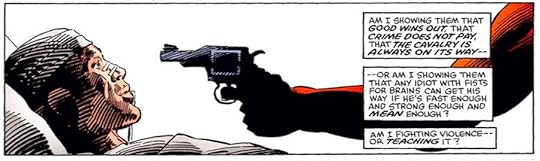
— issue #191: This issue was so interesting in how it showed Matt’s doubts over how he’s fighting crime. Are his actions helping? Or is he harming the people around him? He has learned violence from his father — Battlin’ Jack, who fought relentlessly, fearlessly, to make sure Matt had a better life than his.
“Am I fighting violence or teaching it?” that is the question Matt can’t answer. But in the end, ig the answer doesn’t matter, because Matt won’t stop fighting, he can’t stop. He hates criminals like Bullseye, and fighting them feels right. He won’t kill — that’s the only line he won’t cross, because he believes in the law and because he won’t commit that kind of sin — so he’s stuck in this cycle of violence that he inadvertently created and in which he brought other people into.
— issue #190: ELEKTRA IS FINALLY BACK I had missed her! Got me emotional how Matt tried to bring her back to life himself, with no care if it would kill him HE LOVES HER SO MUCH :(
Also loved to read more about Elektra’s origin story. The fact she trained with Stick AND the Hand is incredible, she’s so strong! Although it is sad how Stick rejected her and the Hand manipulated and tricked her, she deserved so much better. I need to personally kill all who ever wronged her. I’m so excited to see where her story goes from here!
— issue #191: This issue was so interesting in how it showed Matt’s doubts over how he’s fighting crime. Are his actions helping? Or is he harming the people around him? He has learned violence from his father — Battlin’ Jack, who fought relentlessly, fearlessly, to make sure Matt had a better life than his.
“Am I fighting violence or teaching it?” that is the question Matt can’t answer. But in the end, ig the answer doesn’t matter, because Matt won’t stop fighting, he can’t stop. He hates criminals like Bullseye, and fighting them feels right. He won’t kill — that’s the only line he won’t cross, because he believes in the law and because he won’t commit that kind of sin — so he’s stuck in this cycle of violence that he inadvertently created and in which he brought other people into.
This entire review has been hidden because of spoilers.

November 3, 2015
Ο τρίτος τόμος συνεχίζει ακριβώς εκεί που σταματάει ο δεύτερος. Μια αλλαγή υπάρχει στο δημιουργικό κομμάτι, καθώς ο Μίλερ αφοσιώνεται πλήρως στο συγγραφικό κομμάτι, επιφορτίζοντας τον Κλάους με το επιπλέον κομμάτι του σχεδιασμού. Κάτι το οποίο κάνει εξίσου καλά. Με κέφι και μεράκι, συνεχίζει να παραλλάζει ελαφρώς τις γραμμές του από τεύχος σε τεύχος. το αποτέλεσμα, όμως, είναι πάντα όμορφα κι όχι μακριά από τα σχέδια του δεύτερου τόμου.
Ωστόσο, αν κι όλα ακούγονται ιδανικά, η ομάδα νομίζω δεν παραδίνει εξίσου καλές ιστορίες. Ναι, ο Ντέαρντεβιλ βυθίζεται ολοένα σε μια σύγχυση, προσπαθώντας να ξεπεράσει την χαμό της Ηλέκτρας, κάτι που κάνει την διήγηση περισσότερο εμβριθή. Υπάρχουν όμως πολλές σεναριακές ευκολίες, ο αποσυντονισμός του ήρωα δεν μεταφέρεται μέσα από τα καρέ στον αναγνώστη, αλλά μάλλον επιβάλλεται από τα σχόλια των ανθρώπων που ενδιαφέρονται για αυτόν. Κάποιες ανεξήγητες σεναριακές γκάφες συνεχίζονται όταν το Χέρι, αιώνιος εχθρός του Στικ και των ατρόμητων νίντζα του, αποδεκατίζονται από μια ομάδα οπλοφόρων. Εγώ νόμιζα πως οι τύποι ήταν αήττητοι, αλλά καμιά δεκαριά πολυβόλα τους έβγαλαν εκτός παιχνιδιού, σε μια ένδειξη πνεύματος συνεργασίας από την πλευρά του Κινγκπιν.
Ο θεματικός κύκλος που είχε ξεκινήσει από όταν πήρε την σεναριακή σκυτάλη ο Μίλερ, κλείνει στα μισά του τόμου. Στο υπόλοιπο μισό ο αναγνώστης θα διαβάσει μια σαχλούτσικη ιστορία μιας εναλλακτικής εκδοχής του Ντέαρντεβιλ ως μέλος του SHIELD, μια ατμοσφαιρική, καλογραμμένη διήγηση του τιμωρού να επισκέπτεται ως ξένος μια μικρή πόλη και να τα κάνει μπάχαλο. Και τέλος, τον τιμωρό σε ένα αισθησιακό και λίγο κρυπτικό για τα γούστα μου, παραμύθι από την πένα Bill Sienkiewicz.
Ο τόμος "χάνει" εξαιτίας του Μίλερ που εδώ δείχνει λίγο κουρασμένος. Βιάζεται να κλείσει το κεφάλαιο Ντέαρντεβιλ, πιθανώς νιώθοντας έτοιμος να μεταπηδήσει στον σαφώς ανώτερο Μπάτμαν (τον οποίο και απογείωσε). Και, τουλάχιστον, για μένα, αν και παραμένει ένας διασκεδαστικός τόμος, και κατά πολύ ανώτερος του πρώτου, που ασθενούσε από τις πρώτες, παιδικές ιστορίες, το αποτέλεσμα είναι μάλλον άνισο. Απέχει πολύ από το να είναι κακός, αλλά μάλλον δεν λειτουργεί τόσο ομαλά όσο θα ήθελα ως συνέχεια του εξαιρετικού 2ου τόμου.
Ωστόσο, αν κι όλα ακούγονται ιδανικά, η ομάδα νομίζω δεν παραδίνει εξίσου καλές ιστορίες. Ναι, ο Ντέαρντεβιλ βυθίζεται ολοένα σε μια σύγχυση, προσπαθώντας να ξεπεράσει την χαμό της Ηλέκτρας, κάτι που κάνει την διήγηση περισσότερο εμβριθή. Υπάρχουν όμως πολλές σεναριακές ευκολίες, ο αποσυντονισμός του ήρωα δεν μεταφέρεται μέσα από τα καρέ στον αναγνώστη, αλλά μάλλον επιβάλλεται από τα σχόλια των ανθρώπων που ενδιαφέρονται για αυτόν. Κάποιες ανεξήγητες σεναριακές γκάφες συνεχίζονται όταν το Χέρι, αιώνιος εχθρός του Στικ και των ατρόμητων νίντζα του, αποδεκατίζονται από μια ομάδα οπλοφόρων. Εγώ νόμιζα πως οι τύποι ήταν αήττητοι, αλλά καμιά δεκαριά πολυβόλα τους έβγαλαν εκτός παιχνιδιού, σε μια ένδειξη πνεύματος συνεργασίας από την πλευρά του Κινγκπιν.
Ο θεματικός κύκλος που είχε ξεκινήσει από όταν πήρε την σεναριακή σκυτάλη ο Μίλερ, κλείνει στα μισά του τόμου. Στο υπόλοιπο μισό ο αναγνώστης θα διαβάσει μια σαχλούτσικη ιστορία μιας εναλλακτικής εκδοχής του Ντέαρντεβιλ ως μέλος του SHIELD, μια ατμοσφαιρική, καλογραμμένη διήγηση του τιμωρού να επισκέπτεται ως ξένος μια μικρή πόλη και να τα κάνει μπάχαλο. Και τέλος, τον τιμωρό σε ένα αισθησιακό και λίγο κρυπτικό για τα γούστα μου, παραμύθι από την πένα Bill Sienkiewicz.
Ο τόμος "χάνει" εξαιτίας του Μίλερ που εδώ δείχνει λίγο κουρασμένος. Βιάζεται να κλείσει το κεφάλαιο Ντέαρντεβιλ, πιθανώς νιώθοντας έτοιμος να μεταπηδήσει στον σαφώς ανώτερο Μπάτμαν (τον οποίο και απογείωσε). Και, τουλάχιστον, για μένα, αν και παραμένει ένας διασκεδαστικός τόμος, και κατά πολύ ανώτερος του πρώτου, που ασθενούσε από τις πρώτες, παιδικές ιστορίες, το αποτέλεσμα είναι μάλλον άνισο. Απέχει πολύ από το να είναι κακός, αλλά μάλλον δεν λειτουργεί τόσο ομαλά όσο θα ήθελα ως συνέχεια του εξαιρετικού 2ου τόμου.
May 29, 2022
Finalizando a saga de Miller pela HQ do Demolidor com o desejo de quero mais 🥺
Foi um ótimo encadernado para encerrar essa incrível fase do Miller pelo herói escarlate. As histórias deram peso e profundidade ao Matt, trazendo reflexões do personagem sobre suas ações quanto Demolidor e como isso afetava as pessoas a sua volta.
O grande destaque desse volume fica por conta da história Roleta russa. É incrível, traz uma discussão a respeito do que a figura do Demolidor significa e qual seu impacto nas pessoas, fazendo um paralelo com a simbologia do Mercenário. Os diálogos são sensacionais.
Foi um ótimo encadernado para encerrar essa incrível fase do Miller pelo herói escarlate. As histórias deram peso e profundidade ao Matt, trazendo reflexões do personagem sobre suas ações quanto Demolidor e como isso afetava as pessoas a sua volta.
O grande destaque desse volume fica por conta da história Roleta russa. É incrível, traz uma discussão a respeito do que a figura do Demolidor significa e qual seu impacto nas pessoas, fazendo um paralelo com a simbologia do Mercenário. Os diálogos são sensacionais.

July 5, 2019
If you ask me, it’s hard to even conceive a better superhero than Daredevil. He’s got it all, and just in the right amount: Supernatural skills that essentially fall short compared to the set of skills he’s acquired through hard work and discipline, yet enough hot-headedness to screw up said hard work and discipline, a childhood trauma on top of another childhood trauma, plenty of brooding to last him five lifetimes and enough moral ambiguousness to save him from being disgustingly good. So much drama! Such tension! And his (new) costume is really cool, too.
That being said, Frank Miller and Daredevil suit each other like Johnnie Walker and a dark and stormy night. I am not aflutter about all of his works, but Miller does have the right kind of touch for fast-paced action and noir(-ish) atmosphere that “Daredevil” needs. And by the time he takes over, the standard early Marvel nonsense in form of obscure single-appearance characters and equally obscure plots and settings is history, so we can all focus on Hell Kitchen’s guardian devil and vigilante going against the mob and a shadowy ninja order.
The first issues in the Miller-Janson run are quite a challenge. You have to get past Daredevil being somewhat of Spiderman’s sidekick or nanny or whatever, which is beyond ridiculous. How does a highly-educated grown man with admirable boxing ninja abilities end up running after an annoying brat? After their affiliation has ended, “Daredevil” is still left with poor hand-me down villains and flat one-shot episodes. The (maybe unintentionally) comical Otto Octavius might be an apt antagonist for a hero adequately adored by five-year-olds, but not for someone at war against social and political scheming in the underworld.
As soon as the Kingpin, a devious spider of a mob boss who has sucked himself fat on the blood of his prey, is adopted into the “Daredevil” comics, as soon as Bullseye becomes not only unfathomably skilled but also completely deranged, so that none of his actions and motifs could possibly be grasped, as soon as Elektra is, paradoxically enough, consumed not only by personal rage but even more by emotional detachment, not unlike Daredevil himself, this become a proper comic for adult readers. One about personal profit and interests, spent passions and ideals, an underworld network spreading its tentacles throughout the city like a Kraken, and personal relationships reaching from dysfunctional to exploitative. In a way, the best thing about the general plot in Miller’s “Daredevil” is that it would work just as brilliantly without any superpowers, supermutations or super-gadgets. On top of that, you get great artwork with well-chosen perspective to match the dynamics of the action. Visually, this is simply an eighties gem of a superhero comic which look exactly like an eighties gem of a superhero comic.
In a sea of good things to offer, Miller’s grand feat is probably turning Daredevil into an antihero above anything else. He is determined to obsession, undoubtedly intelligent, a compete jackass, manipulative and self-absorbed, and you’re still dying to see what happens next. Miller’s only fail, on the other hand, are the unnecessary and completely moronic comic reliefs, in which inherently half-witted characters like Turk, Iron First or Luke Cage are propelled into unfathomable heights of imbecility, and an intelligent and compassionate man like Franklin Nelson becomes the butt of every idiotic schoolyard joke. Seriously, humour neither contributes to every situation nor should everyone consider themselves funny. So why (almost…) ruin something so perfect with embarrassingly dumb stunts?
That being said, Frank Miller and Daredevil suit each other like Johnnie Walker and a dark and stormy night. I am not aflutter about all of his works, but Miller does have the right kind of touch for fast-paced action and noir(-ish) atmosphere that “Daredevil” needs. And by the time he takes over, the standard early Marvel nonsense in form of obscure single-appearance characters and equally obscure plots and settings is history, so we can all focus on Hell Kitchen’s guardian devil and vigilante going against the mob and a shadowy ninja order.
The first issues in the Miller-Janson run are quite a challenge. You have to get past Daredevil being somewhat of Spiderman’s sidekick or nanny or whatever, which is beyond ridiculous. How does a highly-educated grown man with admirable boxing ninja abilities end up running after an annoying brat? After their affiliation has ended, “Daredevil” is still left with poor hand-me down villains and flat one-shot episodes. The (maybe unintentionally) comical Otto Octavius might be an apt antagonist for a hero adequately adored by five-year-olds, but not for someone at war against social and political scheming in the underworld.
As soon as the Kingpin, a devious spider of a mob boss who has sucked himself fat on the blood of his prey, is adopted into the “Daredevil” comics, as soon as Bullseye becomes not only unfathomably skilled but also completely deranged, so that none of his actions and motifs could possibly be grasped, as soon as Elektra is, paradoxically enough, consumed not only by personal rage but even more by emotional detachment, not unlike Daredevil himself, this become a proper comic for adult readers. One about personal profit and interests, spent passions and ideals, an underworld network spreading its tentacles throughout the city like a Kraken, and personal relationships reaching from dysfunctional to exploitative. In a way, the best thing about the general plot in Miller’s “Daredevil” is that it would work just as brilliantly without any superpowers, supermutations or super-gadgets. On top of that, you get great artwork with well-chosen perspective to match the dynamics of the action. Visually, this is simply an eighties gem of a superhero comic which look exactly like an eighties gem of a superhero comic.
In a sea of good things to offer, Miller’s grand feat is probably turning Daredevil into an antihero above anything else. He is determined to obsession, undoubtedly intelligent, a compete jackass, manipulative and self-absorbed, and you’re still dying to see what happens next. Miller’s only fail, on the other hand, are the unnecessary and completely moronic comic reliefs, in which inherently half-witted characters like Turk, Iron First or Luke Cage are propelled into unfathomable heights of imbecility, and an intelligent and compassionate man like Franklin Nelson becomes the butt of every idiotic schoolyard joke. Seriously, humour neither contributes to every situation nor should everyone consider themselves funny. So why (almost…) ruin something so perfect with embarrassingly dumb stunts?

August 13, 2025
The biggest flaw of this particular volume is the giant jump across more than 20 issues. That was mighty frustrating and made me glad I have the Love's Labor Lost trade paperback and Marvel Unlimited to fall back on. There are some decent enough stories floating in there that help build things towards Born Again that are no easy to come by otherwise.
It's too bad because this whole Frank Miller era, and the Denny O'Neil stuff that plugs the gap is mostly great material to read. I suppose we'll get it all in Epic format eventually though, and that will be a grand day indeed.
Oh, and because it's also collected in here, the OGN Love and War is an incredible standalone piece. I'm not sure where it's supposed to fit in continuity so I read it after Born Again was over and that seems to work well enough. It's a great story though, and has some of my favorite comic art ever courtesy of Bill Sienkiewicz. His painted and collaged style is on display here like no other. I love how he uses what looks like wallpaper patterns for Kingpin's vests, or the page with all the mimeographed newspaper clippings and a Polaroid of a library. It's just super creative, especially for the time.
So yeah, a flawed collection, but one that does hit what it promises to hit.
It's too bad because this whole Frank Miller era, and the Denny O'Neil stuff that plugs the gap is mostly great material to read. I suppose we'll get it all in Epic format eventually though, and that will be a grand day indeed.
Oh, and because it's also collected in here, the OGN Love and War is an incredible standalone piece. I'm not sure where it's supposed to fit in continuity so I read it after Born Again was over and that seems to work well enough. It's a great story though, and has some of my favorite comic art ever courtesy of Bill Sienkiewicz. His painted and collaged style is on display here like no other. I love how he uses what looks like wallpaper patterns for Kingpin's vests, or the page with all the mimeographed newspaper clippings and a Polaroid of a library. It's just super creative, especially for the time.
So yeah, a flawed collection, but one that does hit what it promises to hit.

July 17, 2025
4.5 Stars
This is an iconic DD run for sure. I wanted to dive into some classics and check off some books on many top 10 lists or GOAT titles and I've read a good chunk of Daredevil over the years, but I've never really been into reading 70's-80's books and to be fair my comic book reading journey started in the 2000's (probably just looked at the pic's in the 90's), but I have to say this is a damn good story for a modern day reader to pick up and enjoy. No nostalgia required.
Miller sets the gritty New York Hells Kitchen vibe with grimy dark streets often sheets of rain pouring in the back round, and fills it with seedy criminals and assassin ninjas. Klaus Janson is great on art and inking over Miller's pencils. The writing is nicely introspective, and the action is lit as hell when the ninja Stars start flying and swords are flashing and DD is tumbling all over the page with great affect. These sequences are the star of the show.
I'm enjoying these more than the last So I'll have to see where Miller picks up again in the series
This is an iconic DD run for sure. I wanted to dive into some classics and check off some books on many top 10 lists or GOAT titles and I've read a good chunk of Daredevil over the years, but I've never really been into reading 70's-80's books and to be fair my comic book reading journey started in the 2000's (probably just looked at the pic's in the 90's), but I have to say this is a damn good story for a modern day reader to pick up and enjoy. No nostalgia required.
Miller sets the gritty New York Hells Kitchen vibe with grimy dark streets often sheets of rain pouring in the back round, and fills it with seedy criminals and assassin ninjas. Klaus Janson is great on art and inking over Miller's pencils. The writing is nicely introspective, and the action is lit as hell when the ninja Stars start flying and swords are flashing and DD is tumbling all over the page with great affect. These sequences are the star of the show.
I'm enjoying these more than the last So I'll have to see where Miller picks up again in the series

July 3, 2026
Enfim encerro a fase de Frank Miller. Já gostava muito do personagem devido à série da Netflix (acompanhei antes de ser um leitor de quadrinhos) e agora fico mais fã ainda.
Esse volume se aprofunda ainda mais no misticismo introduzido anteriormente, mais camadas dos personagens são apresentadas e aquilo que já era bom fica ainda melhor. Vemos um pouco mais da história do Stick, do Tentáculo, Elektra e participações de outros personagens da Marvel, como Viúva Negra e Justiceiro.
O único ponto negativo para mim foi o capítulo narrado pelo Foggy Nelson. Não senti que se encaixou com o clima do restante da fase, que é mais séria e sombria. Parecia um episódio do Mr. Bean de tão bobinho, e não acrescenta em nada à trama principal.
Por outro lado, o último capítulo (Roleta Russa) compensa essa queda. Acho todos esses momentos do Matt se questionando sobre a necessidade do Demolidor sensacional.
Uma grande história de um grande personagem, contada por grandes artistas e que me deixou com a sensação de quero mais.
Esse volume se aprofunda ainda mais no misticismo introduzido anteriormente, mais camadas dos personagens são apresentadas e aquilo que já era bom fica ainda melhor. Vemos um pouco mais da história do Stick, do Tentáculo, Elektra e participações de outros personagens da Marvel, como Viúva Negra e Justiceiro.
O único ponto negativo para mim foi o capítulo narrado pelo Foggy Nelson. Não senti que se encaixou com o clima do restante da fase, que é mais séria e sombria. Parecia um episódio do Mr. Bean de tão bobinho, e não acrescenta em nada à trama principal.
Por outro lado, o último capítulo (Roleta Russa) compensa essa queda. Acho todos esses momentos do Matt se questionando sobre a necessidade do Demolidor sensacional.
Uma grande história de um grande personagem, contada por grandes artistas e que me deixou com a sensação de quero mais.

March 16, 2025
There's some cool stuff in here, although it can be a little disjointed and there are a lot of loose threads and subplots unaddressed. Daredevil is overwhelmed by his super senses, faces off against the Hand, Black Widow reappears, there's a plot to resurrect Elektra. 219 is a very unusual single issue story unrelated to anything else, and the What If story is fine, but not as good as What If Elektra Hadn't Died (which isn't included here but should be). Daredevil: Love and War is a highlight -- its story is strange and I can't tell where or how it fits into continuity but the art by Bill Sienkiewicz is classic dimension-twisting Sienkiewicz.
This entire review has been hidden because of spoilers.

June 26, 2024
Not a lot to say about this one. Pretty average all around.
Main story line and subplots weren’t overly interesting. Love and War story was not great. What If issues art and writing wasn’t great.
Only thing that made me consider making this a 4 star was the art in Love and War. I found that quite interesting. Reminded me a lot of Arkham Asylum and Riddler: Year One.
Main story line and subplots weren’t overly interesting. Love and War story was not great. What If issues art and writing wasn’t great.
Only thing that made me consider making this a 4 star was the art in Love and War. I found that quite interesting. Reminded me a lot of Arkham Asylum and Riddler: Year One.

May 1, 2023
me gustó un poco menos que el anterior, pero sigue siendo genial, feliz de haber terminado este run de Daredevil
September 13, 2026
Não é tão bom quanto o segundo, mas só a edição 191, que foi a última do Miller nessa fase, é um espetáculo a parte. Umas as melhores single issues que já li
June 15, 2026
quite inspired early work from miller, the story has so many ups and downs but the episodic type range of variation works well for the comic

July 14, 2015
Continuing on with Frank Miller’s character-defining run on Daredevil… as gripping, dark, and mysterious as the previous volume. Matt Murdock begins losing touch with reality and himself as the stress and grief go to his head, leading him to do some nasty, out-of-character things—namely, a display of horrible chauvinism toward fiancé Heather Glenn. At first it’s confusing to the reader (and especially offensive to any female reader), but Natasha Romanov and Foggy Nelson thankfully pop up to go, “Yes, fair reader, you are correct. Matt’s acting like a total dick.” Then they take action. Whew. Bless you, Black Widow.
Anyway, after the stuff with Heather Glenn isn’t at the forefront… I particularly liked issue #190 (Resurrection), which resurrected recently departed Elektra and added a layer to Elektra’s story, making her character’s motives a lot more clear. Issue #191 (Roulette) is untouchable and my favorite DD story of Miller’s run. Suspenseful and brutal, it has all the elements of what I like the most about Daredevil as a character. It’s him at his darkest, but also his most merciful. Five out of five.
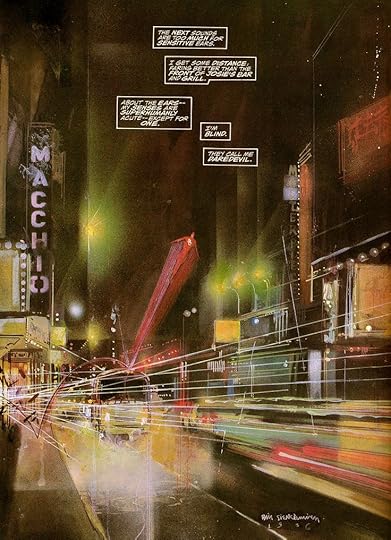
The only reason this volume gets four stars is because the rest of it was lacking. The final three stories are basically unconnected with any major Daredevil arc, one of which is an okay ‘what-if’ story. The final, Love and War, features fantastic surreal artwork from Bill Sienkiewicz, but I really wasn’t a fan of the story and found it a bit pretentious.
Still, this page is stunning:
Anyway, after the stuff with Heather Glenn isn’t at the forefront… I particularly liked issue #190 (Resurrection), which resurrected recently departed Elektra and added a layer to Elektra’s story, making her character’s motives a lot more clear. Issue #191 (Roulette) is untouchable and my favorite DD story of Miller’s run. Suspenseful and brutal, it has all the elements of what I like the most about Daredevil as a character. It’s him at his darkest, but also his most merciful. Five out of five.
The only reason this volume gets four stars is because the rest of it was lacking. The final three stories are basically unconnected with any major Daredevil arc, one of which is an okay ‘what-if’ story. The final, Love and War, features fantastic surreal artwork from Bill Sienkiewicz, but I really wasn’t a fan of the story and found it a bit pretentious.
Still, this page is stunning:
June 27, 2026
Rating: 4.7/5
This volume feels like the culmination of everything Frank Miller and Klaus Janson had been building throughout the run. Matt’s legal life, personal relationships, moral beliefs and existence as Daredevil all begin crashing into one another, creating a conclusion that is exciting but also deeply focused on his flaws.
One of the strongest parts of the volume is the continued use of the Kingpin. He rarely treats Daredevil as a simple enemy who must be defeated directly. Instead, he studies Matt, understands the kind of person he is and repeatedly finds ways to manipulate his sense of responsibility. To Kingpin, there are no permanent allies or enemies, only people who can be useful in a particular situation. Even when Daredevil disrupts his plans, Fisk can redirect him toward another threat or create circumstances where Matt unknowingly benefits his empire.
This becomes especially effective in issue #190. I loved the way Matt and Kingpin temporarily work toward the same goal without either man forgetting what the other represents. Kingpin considers the advantages and disadvantages of the situation before choosing to help, not because he has suddenly developed sympathy, but because cooperation serves his interests. It perfectly demonstrates how he views Daredevil as both an obstacle and a tool that can sometimes be pointed in a useful direction.
The resurrection storyline itself is handled beautifully. It brings together the Hand, Stick’s teachings and Matt’s love for Elektra without reducing the conclusion to a simple romantic reunion. Matt’s role in what happens is emotionally powerful, but Elektra’s return does not mean that she immediately comes back into his life. Allowing her to move forward separately gives the story a more satisfying and mature ending. Matt’s love matters, but it does not grant him ownership over her future.
Issue #191 was another major highlight and one of the finest conclusions to a comic run I have read. Instead of ending with a large battle, it takes us inside Matt’s mind and forces him to examine what Daredevil represents. We see his anger, guilt and fear that his violence may inspire the wrong lessons in the people who admire him. The issue understands that Matt is not a perfect symbol of justice. He is a deeply flawed man who constantly has to question whether his actions are genuinely heroic or simply another form of violence.
Foggy is another standout. His investigation into Glenn Industries is both hilarious and genuinely impressive. Even without powers, he proves that he is courageous, intelligent and capable of walking into dangerous situations when someone needs his help. Foggy is not simply Matt’s comic relief or the partner who stays behind at the office. He is one of the emotional foundations of Matt’s life.
Natasha also remains important. Although she still carries feelings for Matt, she does not allow those feelings to prevent her from recognising when he is behaving destructively. Both she and Foggy continue helping him during moments when he is incapable of handling his own life properly.
My biggest problem with the volume is Matt’s treatment of Heather. His grief and obsession cause him to ignore her concerns, even when she comes to him asking for help. Rather than supporting her or helping her salvage what remains of her father’s company, he contributes to the complete destruction of that part of her life.
The corruption within Glenn Industries clearly needed to be exposed, but Matt behaves as though destroying everything is the only solution. He could have helped Heather separate herself from the corruption, preserve what was still legitimate or rebuild something new. Instead, he leaves her with almost nothing except him and then pressures her toward marriage. Whether or not he consciously planned every consequence, the result is deeply manipulative.
What makes it worse is that Matt never properly recognises or repairs the damage himself. Foggy and Natasha have to intervene because they can see how unhealthy the relationship has become. Their solution is also dishonest, but the fact that they feel forced to act shows how badly Matt has failed Heather. This storyline exposes one of Matt’s ugliest traits: he can convince himself that controlling someone’s life is acceptable when he believes he knows what is best for them.
Despite that frustration, the volume succeeds because it does not present Matt’s behaviour as unquestionably correct. His compassion, bravery and desire for justice exist alongside selfishness, obsession and emotional cruelty. Miller and Janson allow him to be heroic without cleaning away the parts of him that are difficult to admire.
Overall, this is an excellent final volume and a powerful conclusion to the run. Issue #190 delivers an emotional resolution to the Elektra and Hand storyline, while issue #191 closes the book with an intimate examination of Matt Murdock’s morality. Together, they demonstrate why this run is remembered not only for redefining Daredevil’s world, but for understanding the complicated, imperfect man beneath the mask.
This volume feels like the culmination of everything Frank Miller and Klaus Janson had been building throughout the run. Matt’s legal life, personal relationships, moral beliefs and existence as Daredevil all begin crashing into one another, creating a conclusion that is exciting but also deeply focused on his flaws.
One of the strongest parts of the volume is the continued use of the Kingpin. He rarely treats Daredevil as a simple enemy who must be defeated directly. Instead, he studies Matt, understands the kind of person he is and repeatedly finds ways to manipulate his sense of responsibility. To Kingpin, there are no permanent allies or enemies, only people who can be useful in a particular situation. Even when Daredevil disrupts his plans, Fisk can redirect him toward another threat or create circumstances where Matt unknowingly benefits his empire.
This becomes especially effective in issue #190. I loved the way Matt and Kingpin temporarily work toward the same goal without either man forgetting what the other represents. Kingpin considers the advantages and disadvantages of the situation before choosing to help, not because he has suddenly developed sympathy, but because cooperation serves his interests. It perfectly demonstrates how he views Daredevil as both an obstacle and a tool that can sometimes be pointed in a useful direction.
The resurrection storyline itself is handled beautifully. It brings together the Hand, Stick’s teachings and Matt’s love for Elektra without reducing the conclusion to a simple romantic reunion. Matt’s role in what happens is emotionally powerful, but Elektra’s return does not mean that she immediately comes back into his life. Allowing her to move forward separately gives the story a more satisfying and mature ending. Matt’s love matters, but it does not grant him ownership over her future.
Issue #191 was another major highlight and one of the finest conclusions to a comic run I have read. Instead of ending with a large battle, it takes us inside Matt’s mind and forces him to examine what Daredevil represents. We see his anger, guilt and fear that his violence may inspire the wrong lessons in the people who admire him. The issue understands that Matt is not a perfect symbol of justice. He is a deeply flawed man who constantly has to question whether his actions are genuinely heroic or simply another form of violence.
Foggy is another standout. His investigation into Glenn Industries is both hilarious and genuinely impressive. Even without powers, he proves that he is courageous, intelligent and capable of walking into dangerous situations when someone needs his help. Foggy is not simply Matt’s comic relief or the partner who stays behind at the office. He is one of the emotional foundations of Matt’s life.
Natasha also remains important. Although she still carries feelings for Matt, she does not allow those feelings to prevent her from recognising when he is behaving destructively. Both she and Foggy continue helping him during moments when he is incapable of handling his own life properly.
My biggest problem with the volume is Matt’s treatment of Heather. His grief and obsession cause him to ignore her concerns, even when she comes to him asking for help. Rather than supporting her or helping her salvage what remains of her father’s company, he contributes to the complete destruction of that part of her life.
The corruption within Glenn Industries clearly needed to be exposed, but Matt behaves as though destroying everything is the only solution. He could have helped Heather separate herself from the corruption, preserve what was still legitimate or rebuild something new. Instead, he leaves her with almost nothing except him and then pressures her toward marriage. Whether or not he consciously planned every consequence, the result is deeply manipulative.
What makes it worse is that Matt never properly recognises or repairs the damage himself. Foggy and Natasha have to intervene because they can see how unhealthy the relationship has become. Their solution is also dishonest, but the fact that they feel forced to act shows how badly Matt has failed Heather. This storyline exposes one of Matt’s ugliest traits: he can convince himself that controlling someone’s life is acceptable when he believes he knows what is best for them.
Despite that frustration, the volume succeeds because it does not present Matt’s behaviour as unquestionably correct. His compassion, bravery and desire for justice exist alongside selfishness, obsession and emotional cruelty. Miller and Janson allow him to be heroic without cleaning away the parts of him that are difficult to admire.
Overall, this is an excellent final volume and a powerful conclusion to the run. Issue #190 delivers an emotional resolution to the Elektra and Hand storyline, while issue #191 closes the book with an intimate examination of Matt Murdock’s morality. Together, they demonstrate why this run is remembered not only for redefining Daredevil’s world, but for understanding the complicated, imperfect man beneath the mask.
This entire review has been hidden because of spoilers.
June 7, 2026
This is my first experience with reading a collected edition of a comic book run, and since it reminded me of an episodic tv show, I thought it would be best to cover each arc, one by one. It's a shame that I couldn't read everything leading up to this final volume, but this is all my dad had in his collection, so oh well.
"Guts & Stilts" comprises of a surprisingly humorous fish-out-of-water story, and an issue about a hired gun who uses stilts. The first involves Foggy Nelson's descent into the underbelly of Hell's Kitchen, and Daredevil's attempt to keep him out of trouble, and manages to be a good time all the way through. Almost a necessary piece of levity due to how dark this run can get. The whole Stilt Man story (or whatever his name is), didn't really do much for me outside of introducing Matt's senses getting all off balance again.
"Widow's Bite" is good insofar as it explores Daredevil's relationship with various people he's met along his life. Watching him interact with his mentor Stick again shows us his flaws as a character: too cocky and too young to be nearly as powerful as Stick and his fellow marital artists. Even if I didn't find Natasha that captivating of a character, it was nice to further explore Matt's web of connections. It's kind of weird how women will just run to Daredevil / Matt like they're his savior, though. Anyways, the best issue from this is the double-sized one, which explores Elektra's origins as an assassin, her own internal struggles, and introduces us to introspective Daredevil again. Oh, and the action is pretty neat and stylized in this one.
"Roulette" is a masterpiece. The final issue in Frank Miller's original run (before Born Again and all that), it is a gripping tale covering Daredevil's moral code, his emotional turmoil, and the negative consequences when one identifies with a superhero (or supervillain) too much. It is not just one of the best single issues of a comic book I've read so far, it's one of the best short stories I've ever read. I almost want to rate the single issue on here just to tell my friends to read it.
And then what else comes next but an issue of "What If?" In case anyone was wondering, it's about whether Daredevil became an Agent of S.H.I.E.L.D. instead of being the gritty crimefighter he is. Frank Miller is obviously phoning it in with this one, as it feels like regular ol' comic book slop. It's kind of a shame, really; there's a lot of avenues you could explore in an "alternate universe" version of Daredevil, and he just doesn't.
"Badlands" is basically a Neo-Western that takes place in New Jersey. As a certified New Jersey hater who has now become a Daredevil lover, that is a great combination. Not really much to add other than it tells its archetype (the man who wanders into a town) and tells it well.
Love and War is a later graphic novel collaboration between Miller and illustrator Bill Sienkiewicz. My goodness the artwork on here is amazing. Sienkiewicz was part of the wave of illustrators who embraced painterly techniques in his images, and his abstract, almost expressionistic style really immerses the reader, and gave the story such a psychological depth to it that was practically demanded by Miller's writing. It manages to explore Kingpin's inner rage and perpetual dissatisfaction, as well as giving a very street-level view of Daredevil's crimefighting. And then there's Victor, a no-name bounty hunter who becomes increasingly psychotic due to a drug addiction. This might be the shining moment of the graphic novel, actually, and, through its perfect marriage of words and art, is an unflinching portrait into someone losing their grip with reality. Probably the closest thing I've read to replicate a stream-of-consciousness style. Also, between Daredevil's mortality staring him right in the face, and Kingpin's dissatisfaction due to his life of sin, it is one of the more Catholic Daredevil stories Miller wrote.
"Guts & Stilts" comprises of a surprisingly humorous fish-out-of-water story, and an issue about a hired gun who uses stilts. The first involves Foggy Nelson's descent into the underbelly of Hell's Kitchen, and Daredevil's attempt to keep him out of trouble, and manages to be a good time all the way through. Almost a necessary piece of levity due to how dark this run can get. The whole Stilt Man story (or whatever his name is), didn't really do much for me outside of introducing Matt's senses getting all off balance again.
"Widow's Bite" is good insofar as it explores Daredevil's relationship with various people he's met along his life. Watching him interact with his mentor Stick again shows us his flaws as a character: too cocky and too young to be nearly as powerful as Stick and his fellow marital artists. Even if I didn't find Natasha that captivating of a character, it was nice to further explore Matt's web of connections. It's kind of weird how women will just run to Daredevil / Matt like they're his savior, though. Anyways, the best issue from this is the double-sized one, which explores Elektra's origins as an assassin, her own internal struggles, and introduces us to introspective Daredevil again. Oh, and the action is pretty neat and stylized in this one.
"Roulette" is a masterpiece. The final issue in Frank Miller's original run (before Born Again and all that), it is a gripping tale covering Daredevil's moral code, his emotional turmoil, and the negative consequences when one identifies with a superhero (or supervillain) too much. It is not just one of the best single issues of a comic book I've read so far, it's one of the best short stories I've ever read. I almost want to rate the single issue on here just to tell my friends to read it.
And then what else comes next but an issue of "What If?" In case anyone was wondering, it's about whether Daredevil became an Agent of S.H.I.E.L.D. instead of being the gritty crimefighter he is. Frank Miller is obviously phoning it in with this one, as it feels like regular ol' comic book slop. It's kind of a shame, really; there's a lot of avenues you could explore in an "alternate universe" version of Daredevil, and he just doesn't.
"Badlands" is basically a Neo-Western that takes place in New Jersey. As a certified New Jersey hater who has now become a Daredevil lover, that is a great combination. Not really much to add other than it tells its archetype (the man who wanders into a town) and tells it well.
Love and War is a later graphic novel collaboration between Miller and illustrator Bill Sienkiewicz. My goodness the artwork on here is amazing. Sienkiewicz was part of the wave of illustrators who embraced painterly techniques in his images, and his abstract, almost expressionistic style really immerses the reader, and gave the story such a psychological depth to it that was practically demanded by Miller's writing. It manages to explore Kingpin's inner rage and perpetual dissatisfaction, as well as giving a very street-level view of Daredevil's crimefighting. And then there's Victor, a no-name bounty hunter who becomes increasingly psychotic due to a drug addiction. This might be the shining moment of the graphic novel, actually, and, through its perfect marriage of words and art, is an unflinching portrait into someone losing their grip with reality. Probably the closest thing I've read to replicate a stream-of-consciousness style. Also, between Daredevil's mortality staring him right in the face, and Kingpin's dissatisfaction due to his life of sin, it is one of the more Catholic Daredevil stories Miller wrote.

June 25, 2024
Forget that right-wing Hollywood sell out that calls himself Frank Miller in 2011, and journey with me to the past. A past where a young, hungry artist helps push the medium to the limits, challenging the now defunct Comics Code Authority. A past where this creator, who earned fame, fortune and notoriety, went on to fight for the rights of his fellow creators to try and help them get a fairer share of the pie. Fortunately, I can separate the art from the artist, and was still able to enjoy this book.
This is the first time that I've read Miller's legendary run on the title, and it has aged well. Everyone that I know that read these issues off of the stands ranks them among their all-time favorite comic books. While I wouldn't go that far, these are damn fine reads. I am not a huge Frank Miller fan, and I prefer his writing to his artwork. He turns over the lion's share of the artwork over to Klaus Janson during this run, sticking to roughs and layouts. This might bother some people but not me.
Miller's love of film noir/ pulp crime becomes apparent but begins to wear on you. Again, I realize that he was playing this song 30 years ago, and it has since been copped by every writer that has come down the pike since then. Crime comics have become a dime a dozen in the last few years, and I suspect that most of them owe a huge debt to this title. Frank Miller was one of the pioneers of the dark and gritty crap that would overtake my beloved Silver Age flavor in superhero comic books, and the shock-waves from this are still being felt today. I absolve the pioneers of any trend in entertainment, because they had an original vision that was later strip-mined and rendered impotent by their followers. Miller turned this into a hard-boiled crime comic, filled with gray areas and questionable motives for the hero. It was the later generation of comic book creators that seem to have missed the point of what he was going for.
I think that this book gave me a rash, with it's terrible 2001 gradient shades. Daredevil looks orange rather than red, because primary colors are stupid. Most Marvel Comics from a decade ago use softer colors, lots of pastels and other muted tones, and I hate them. This hack job recoloring has not aged well, and I yearn for the Masterworks to reach this run.
This is the first time that I've read Miller's legendary run on the title, and it has aged well. Everyone that I know that read these issues off of the stands ranks them among their all-time favorite comic books. While I wouldn't go that far, these are damn fine reads. I am not a huge Frank Miller fan, and I prefer his writing to his artwork. He turns over the lion's share of the artwork over to Klaus Janson during this run, sticking to roughs and layouts. This might bother some people but not me.
Miller's love of film noir/ pulp crime becomes apparent but begins to wear on you. Again, I realize that he was playing this song 30 years ago, and it has since been copped by every writer that has come down the pike since then. Crime comics have become a dime a dozen in the last few years, and I suspect that most of them owe a huge debt to this title. Frank Miller was one of the pioneers of the dark and gritty crap that would overtake my beloved Silver Age flavor in superhero comic books, and the shock-waves from this are still being felt today. I absolve the pioneers of any trend in entertainment, because they had an original vision that was later strip-mined and rendered impotent by their followers. Miller turned this into a hard-boiled crime comic, filled with gray areas and questionable motives for the hero. It was the later generation of comic book creators that seem to have missed the point of what he was going for.
I think that this book gave me a rash, with it's terrible 2001 gradient shades. Daredevil looks orange rather than red, because primary colors are stupid. Most Marvel Comics from a decade ago use softer colors, lots of pastels and other muted tones, and I hate them. This hack job recoloring has not aged well, and I yearn for the Masterworks to reach this run.

December 3, 2017
The third volume of Frank Miller's Daredevil ends not with a bang but a whimper. There's some good moments throughout the story but none of them reach the same level of heights as the second volume. There's also some unnecessary additions to this story including "What if Daredevil became an agent of SHIELD?" While technically part of Frank Miller's Daredevil run, it's not really what people expected from this collection and another sign this could have just been a single or double volume.
The heart of the book is the introduction of the Chaste, the secret organization which Daredevil's mentor Stick is a member of. No sooner is the organization introduced than they're mostly wiped out. We also have the famous "resurrection of Elektra" story that had the potential to return one of the most popular female characters of all time. Sadly, neither plot really ends up adding much to the story as Elektra doesn't return to being a regular part of the cast.
Really, the biggest thing I can say about this volume is it's underwhelming. None of the plotlines have the sense of gravitas or character building that the others did. This includes a stylistic story built around Wilson Fisk taking a prominent psychologist's wife hostage to force him to "cure" his brain damaged wife Vanessa. It's a story with a confusing narrative, minimal stakes, and no real role for Daredevil himself.
Indeed, the biggest issue of the story is the Kingpin himself. As much of an excellent antagonist he is, he isn't a character which is allowed any growth or change. The storyline which focused so heavily on exploring Matt Murdock's character is hurt by the fact the Kingpin is untouchable and just serves as the face of crime in the books. Daredevil and the Kingpin circle around each other with no real change to the point it takes the absent "Born Again" storyline to change things.
In conclusion, I think while the first volume had some "misses" and the second volume was gold, this one is just unnecessary. I think most readers were expecting the immortal Born Again storyline and its absence was extremely noticeable. Oh well, they can't all be winners.
The heart of the book is the introduction of the Chaste, the secret organization which Daredevil's mentor Stick is a member of. No sooner is the organization introduced than they're mostly wiped out. We also have the famous "resurrection of Elektra" story that had the potential to return one of the most popular female characters of all time. Sadly, neither plot really ends up adding much to the story as Elektra doesn't return to being a regular part of the cast.
Really, the biggest thing I can say about this volume is it's underwhelming. None of the plotlines have the sense of gravitas or character building that the others did. This includes a stylistic story built around Wilson Fisk taking a prominent psychologist's wife hostage to force him to "cure" his brain damaged wife Vanessa. It's a story with a confusing narrative, minimal stakes, and no real role for Daredevil himself.
Indeed, the biggest issue of the story is the Kingpin himself. As much of an excellent antagonist he is, he isn't a character which is allowed any growth or change. The storyline which focused so heavily on exploring Matt Murdock's character is hurt by the fact the Kingpin is untouchable and just serves as the face of crime in the books. Daredevil and the Kingpin circle around each other with no real change to the point it takes the absent "Born Again" storyline to change things.
In conclusion, I think while the first volume had some "misses" and the second volume was gold, this one is just unnecessary. I think most readers were expecting the immortal Born Again storyline and its absence was extremely noticeable. Oh well, they can't all be winners.

October 12, 2023
A step down from the truly legendary stuff contained in the second volume, but very much worth reading.
By this point in the run, Frank Miller had mostly relinquished his penciling duties, which is a bit of a bummer. The first several stories also feel a bit like filler, but are still fun to read. The highlight is when Stilt Man, a Silver Age relic, is brilliantly updated for a new era. It shouldn't work, but it does.
After the initial five issues, we get to the double-sized #190, which is a bombshell and feels truly important; resolving the Elektra saga. The follow-up, #191, goes in an entirely different direction, and sees Miller pick up the pencils again for the swan song of his initial run on the character. There's a heavy psychological bend to it, and the whole thing is narrated by Daredevil to a still-paralyzed Bullseye. It's excellent.
The book is padded out by a far-fetched story from What If? that features some bonus Jack Murdock character assassination (yeah, didn't care for this one), and issue #219 and the Love and War OGN; both one-off returns to Daredevil for Miller. I didn't care much at all for #219—it's needlessly dense and wordy, and John Buscema's art doesn't work for me. I like the angle of Matt not speaking at all in the issue (it reminds me of one of my favorite Batman stories), but aside from that one cool idea, it's mostly a dud. Love and War is a lot better—Bill Sienkiewicz's eccentric art style is rad... although I wish the story was more about Kingpin and Vanessa than it was. Regardless, it felt like it tied up some loose ends and was actually consequential.
By this point in the run, Frank Miller had mostly relinquished his penciling duties, which is a bit of a bummer. The first several stories also feel a bit like filler, but are still fun to read. The highlight is when Stilt Man, a Silver Age relic, is brilliantly updated for a new era. It shouldn't work, but it does.
After the initial five issues, we get to the double-sized #190, which is a bombshell and feels truly important; resolving the Elektra saga. The follow-up, #191, goes in an entirely different direction, and sees Miller pick up the pencils again for the swan song of his initial run on the character. There's a heavy psychological bend to it, and the whole thing is narrated by Daredevil to a still-paralyzed Bullseye. It's excellent.
The book is padded out by a far-fetched story from What If? that features some bonus Jack Murdock character assassination (yeah, didn't care for this one), and issue #219 and the Love and War OGN; both one-off returns to Daredevil for Miller. I didn't care much at all for #219—it's needlessly dense and wordy, and John Buscema's art doesn't work for me. I like the angle of Matt not speaking at all in the issue (it reminds me of one of my favorite Batman stories), but aside from that one cool idea, it's mostly a dud. Love and War is a lot better—Bill Sienkiewicz's eccentric art style is rad... although I wish the story was more about Kingpin and Vanessa than it was. Regardless, it felt like it tied up some loose ends and was actually consequential.

May 22, 2017
This collection is something of a mixed bag. The first few issues are pretty good, but not the best. 188-191 are all fantastic though and serve as a great end to Miller's run. After that, there's a What if? issue about Matt joining SHIELD, which is enjoyable, but nothing too special. #219 features Miller as a guest writer, so it's included in this collection. It's one of the more baffling stories I've read. There's nothing that explicitly connects this story to Daredevil. The protagonist, referred to as "The Stranger," kind of looks like Matt Murdock, and is implied to be him, based on the fact that it is a Daredevil comic, but really, it's basically a crappy crime story. This collection concludes with a graphic novel, War and Peace, about the Kingpin trying to heal his brain damaged wife. While this could have been good, it largely focuses on a crazy dude working for Kingpin and really isn't interesting. Bill Sienkewicz does the art for this story. While I like his surrealist art, I didn't care for it here. While the first 7 or so issues in this collection are worth reading, the final third of the book feels like a waste. I'd give the first part somewhere in between four and five stars and the back part two stars, which is why this book, as a whole gets a three from me.
The best thing about this collection is it shows the beginning of Matt slowly becoming unhinged, which plays a huge part in the Bendis/Maleev Daredevil run, which is what I consider to be the best Daredevil run.
The best thing about this collection is it shows the beginning of Matt slowly becoming unhinged, which plays a huge part in the Bendis/Maleev Daredevil run, which is what I consider to be the best Daredevil run.

August 17, 2018
This collection is something of a mixed bag. The first few issues are pretty good, but not the best. 188-191 are all fantastic though and serve as a great end to Miller's run. After that, there's a What if? issue about Matt joining SHIELD, which is enjoyable, but nothing too special. #219 features Miller as a guest writer, so it's included in this collection. It's one of the more baffling stories I've read. There's nothing that explicitly connects this story to Daredevil. The protagonist, referred to as "The Stranger," kind of looks like Matt Murdock, and is implied to be him, based on the fact that it is a Daredevil comic, but really, it's basically a crappy crime story. This collection concludes with a graphic novel, War and Peace, about the Kingpin trying to heal his brain damaged wife. While this could have been good, it largely focuses on a crazy dude working for Kingpin and really isn't interesting. Bill Sienkewicz does the art for this story. While I like his surrealist art, I didn't care for it here. While the first 7 or so issues in this collection are worth reading, the final third of the book feels like a waste. I'd give the first part somewhere in between four and five stars and the back part two stars, which is why this book, as a whole gets a three from me.
The best thing about this collection is it shows the beginning of Matt slowly becoming unhinged, which plays a huge part in the Bendis/Maleev Daredevil run
The best thing about this collection is it shows the beginning of Matt slowly becoming unhinged, which plays a huge part in the Bendis/Maleev Daredevil run

April 16, 2025
I’ve finished the main Frank Miller run, which means Born Again is probably the only other Daredevil comic I’ll read and the only other Marvel comic I’ll read in general anytime soon—I’m just reading a lot of Miller stuff these days, and writing about the Daredevil TV show, so I wanted to hone in on this run specifically. Because I’m treating this volume as a conclusion, there is some abruptness at the end, but that’s just the nature of reading comics.
Besides, this actually does provide some real conclusions for some of the arcs, albeit in deliberately unsatisfying or dark ways: Matt seemingly takes down Heather’s family company just to manipulate her into relying on him and marrying him? And then they break up for good based on a deceit from Foggy and Black Widow? Kind of wild! Elektra actually getting resurrected, but with the caveat that she and Matt will never meet again? Also kind of wild.
Love & War is a completely different style, obviously, and I’ll admit I read it very quickly because I was in a rush, so I maybe didn’t enjoy it quite as much as I would’ve otherwise. The abstractions and perspective-hopping can be a little disorienting and even confusing, but I did love the art itself, and that dreamy atmosphere.
Besides, this actually does provide some real conclusions for some of the arcs, albeit in deliberately unsatisfying or dark ways: Matt seemingly takes down Heather’s family company just to manipulate her into relying on him and marrying him? And then they break up for good based on a deceit from Foggy and Black Widow? Kind of wild! Elektra actually getting resurrected, but with the caveat that she and Matt will never meet again? Also kind of wild.
Love & War is a completely different style, obviously, and I’ll admit I read it very quickly because I was in a rush, so I maybe didn’t enjoy it quite as much as I would’ve otherwise. The abstractions and perspective-hopping can be a little disorienting and even confusing, but I did love the art itself, and that dreamy atmosphere.

February 22, 2017
Well, I have to start saying that issue #191 is the best single issue I have ever read. The story is touching and keeps the suspense until the very end. Daredevil takes a hard look at himself and wonders if what he does to fight crime is fighting violence or teaching it. This issue is a MUST-read for everyone, even if you don't like or don't know Daredevil at all.
Concerning the book, I really love Frank Miller's run on Daredevil. I liked the gags with someone flying through Josie's glass window, and Turk being Turk, they are classic. However, I found this third volume slightly weaker and I dumped one star because of the whole weird magic thing. The ninja plot between the Hand and the Chaste was nice, but I found weird all the magical stuff they made just to bring Kirigi and Elektra back from death. In my opinion, this mystical thing doesn't fit with the rest of the story. And Matt Murdock shows an awkward behavior toward his girlfriend (soon spotted by Foggy and Black Widow).
Moreover, the additional three stories didn't help at all to get that star back. They are uncorrelated, far from Miller's standards.
Concerning the book, I really love Frank Miller's run on Daredevil. I liked the gags with someone flying through Josie's glass window, and Turk being Turk, they are classic. However, I found this third volume slightly weaker and I dumped one star because of the whole weird magic thing. The ninja plot between the Hand and the Chaste was nice, but I found weird all the magical stuff they made just to bring Kirigi and Elektra back from death. In my opinion, this mystical thing doesn't fit with the rest of the story. And Matt Murdock shows an awkward behavior toward his girlfriend (soon spotted by Foggy and Black Widow).
Moreover, the additional three stories didn't help at all to get that star back. They are uncorrelated, far from Miller's standards.
Displaying 1 - 30 of 77 reviews