

What do you think?
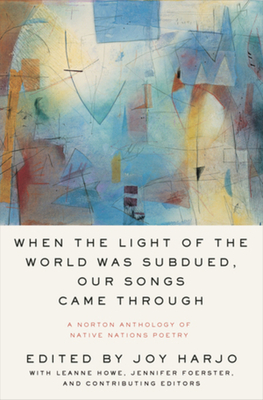
When the Light of the World Was Subdued, Our Songs Came Through: A Norton Anthology of Native Nations Poetry
United States Poet Laureate Joy Harjo gathers the work of more than 160 poets, representing nearly 100 indigenous nations, into the first historically comprehensive Native poetry anthology.
This landmark anthology celebrates the indigenous peoples of North America, the first poets of this country, whose literary traditions stretch back centuries. Opening with a blessing from Pulitzer Prize–winner N. Scott Momaday, the book contains powerful introductions from contributing editors who represent the five geographically organized sections. Each section begins with a poem from traditional oral literatures and closes with emerging poets, ranging from Eleazar, a seventeenth-century Native student at Harvard, to Jake Skeets, a young Diné poet born in 1991, and including renowned writers such as Luci Tapahanso, Natalie Diaz, Layli Long Soldier, and Ray Young Bear. When the Light of the World Was Subdued, Our Songs Came Through offers the extraordinary sweep of Native literature, without which no study of American poetry is complete.
This landmark anthology celebrates the indigenous peoples of North America, the first poets of this country, whose literary traditions stretch back centuries. Opening with a blessing from Pulitzer Prize–winner N. Scott Momaday, the book contains powerful introductions from contributing editors who represent the five geographically organized sections. Each section begins with a poem from traditional oral literatures and closes with emerging poets, ranging from Eleazar, a seventeenth-century Native student at Harvard, to Jake Skeets, a young Diné poet born in 1991, and including renowned writers such as Luci Tapahanso, Natalie Diaz, Layli Long Soldier, and Ray Young Bear. When the Light of the World Was Subdued, Our Songs Came Through offers the extraordinary sweep of Native literature, without which no study of American poetry is complete.
458 pages, Paperback
First published August 25, 2020
About the author
Joy Harjo
109 books2,072 followersBio Joy Harjo
Joy Harjo was born in Tulsa, Oklahoma and is a member of the Mvskoke Nation. She has released four award-winning CD's of original music and won a Native American Music Award (NAMMY) for Best Female Artist of the Year. She performs nationally and internationally solo and with her band, The Arrow Dynamics. She has appeared on HBO's Def Poetry Jam, in venues in every major U.S. city and internationally. Most recently she performed We Were There When Jazz Was Invented at the Chan Centre at UBC in Vancouver, BC, and appeared at the San Miguel Writer’s Conference in San Miguel de Allende, Mexico. Her one-woman show, Wings of Night Sky, Wings of Morning Light, which features guitarist Larry Mitchell premiered in Los Angeles in 2009, with recent performances at Joe’s Pub in New York City, LaJolla Playhouse as part of the Native Voices at the Autry, and the University of British Columbia. Her seven books of poetry include such well-known titles as How We Became Human- New and Selected Poems and She Had Some Horses. Her awards include the New Mexico Governor’s Award for Excellence in the Arts, the Lifetime Achievement Award from the Native Writers Circle of the Americas, and the William Carlos Williams Award from the Poetry Society of America. She was recently awarded 2011 Artist of the Year from the Mvskoke Women’s Leadership Initiative, and a Rasmuson US Artists Fellowship. She is a founding board member and treasurer of the Native Arts and Cultures Foundation. Harjo writes a column Comings and Goings for her tribal newspaper, the Muscogee Nation News. Soul Talk, Song Language, Conversations with Joy Harjo was recently released from Wesleyan University Press. Crazy Brave, a memoir is her newest publication from W.W. Norton, and a new album of music is being produced by the drummer/producer Barrett Martin. She is at work on a new shows: We Were There When Jazz Was Invented, a musical story that proves southeastern indigenous tribes were part of the origins of American music. She lives in the Mvskoke Nation of Oklahoma.
Joy Harjo was born in Tulsa, Oklahoma and is a member of the Mvskoke Nation. She has released four award-winning CD's of original music and won a Native American Music Award (NAMMY) for Best Female Artist of the Year. She performs nationally and internationally solo and with her band, The Arrow Dynamics. She has appeared on HBO's Def Poetry Jam, in venues in every major U.S. city and internationally. Most recently she performed We Were There When Jazz Was Invented at the Chan Centre at UBC in Vancouver, BC, and appeared at the San Miguel Writer’s Conference in San Miguel de Allende, Mexico. Her one-woman show, Wings of Night Sky, Wings of Morning Light, which features guitarist Larry Mitchell premiered in Los Angeles in 2009, with recent performances at Joe’s Pub in New York City, LaJolla Playhouse as part of the Native Voices at the Autry, and the University of British Columbia. Her seven books of poetry include such well-known titles as How We Became Human- New and Selected Poems and She Had Some Horses. Her awards include the New Mexico Governor’s Award for Excellence in the Arts, the Lifetime Achievement Award from the Native Writers Circle of the Americas, and the William Carlos Williams Award from the Poetry Society of America. She was recently awarded 2011 Artist of the Year from the Mvskoke Women’s Leadership Initiative, and a Rasmuson US Artists Fellowship. She is a founding board member and treasurer of the Native Arts and Cultures Foundation. Harjo writes a column Comings and Goings for her tribal newspaper, the Muscogee Nation News. Soul Talk, Song Language, Conversations with Joy Harjo was recently released from Wesleyan University Press. Crazy Brave, a memoir is her newest publication from W.W. Norton, and a new album of music is being produced by the drummer/producer Barrett Martin. She is at work on a new shows: We Were There When Jazz Was Invented, a musical story that proves southeastern indigenous tribes were part of the origins of American music. She lives in the Mvskoke Nation of Oklahoma.
Ratings & Reviews
Friends & Following
Create a free account to discover what your friends think of this book!
Community Reviews
Displaying 1 - 30 of 134 reviews

December 17, 2020
I bought this a few weeks ago as a Christmas gift for my poetry loving daughter. I started looking at a few of the poems and just kept reading, so it's a gift served twice. I fell in love with the title, it's so full of hope. I also loved that I finished it on the same day that the incoming Biden administration named Deb Haaland as Secretary of the Interior. Can't think of a better person to head this Department than this Native American woman. Brilliant pick imo.
Each of these poems in the anthology are preceded by a short bio of the post. Some of the poems are quite lengthy, other shorter but many speak to all, not just Native Americans. The book is edited by Not Harjo who is the Poet Laureate of the US.
Here is one of the shorter poems, but it was one I loved.
St. James Lake by James Thomas Stevens
"On a footbridge
crossing
the lake toward
Horse Guard Road,
I stop to listen
as dim twittering grow to a deafening roar.
This is how the body is,
suddenly aware of its own dull this.
Knowing, how our own song
completes the chorus. How each preened park-goer
carries a specific yet woefully similar call,
Sanctuary
Each of these poems in the anthology are preceded by a short bio of the post. Some of the poems are quite lengthy, other shorter but many speak to all, not just Native Americans. The book is edited by Not Harjo who is the Poet Laureate of the US.
Here is one of the shorter poems, but it was one I loved.
St. James Lake by James Thomas Stevens
"On a footbridge
crossing
the lake toward
Horse Guard Road,
I stop to listen
as dim twittering grow to a deafening roar.
This is how the body is,
suddenly aware of its own dull this.
Knowing, how our own song
completes the chorus. How each preened park-goer
carries a specific yet woefully similar call,
Sanctuary

May 5, 2021
I'll have to collect my thoughts and return here after having two discussions of this readalong anthology. Truly excellent.
Bits and pieces:
In Denise Sweet's poem, "Song for Discharming," pgs 60-62, I liked this little segment:
"I was, as you may expect, a human parenthesis.
There is no simple way to say this,
but drift closer, Invisible One, swim within this stream
of catastrophic history. Yours? Mine?
No, you decide....""
That phrase "human parenthesis" communicates so exactly what she means, that's one that will stick with me.
Diablo Canyon by John Trudell
"...Little did they understand
Squatting down in the earth
They placed me with my power
My power to laugh
Laugh at their righteous wrong
Their sneers and their taunts
Gave me clarity
To see their powerlessness...."
The poem "Casualties" by M.L. Smoker was very good, and not the first poem to speak to the losses - not only language, but also language. Tanaya Winder's poem "Learning to Say I Love You" is a good pairing with "Casualties."
And just from a general poetry standpoint, my favorite poem is probably "The Milky Way Escapes my Mouth," another poem from Tanaya Winder, who I definitely would like to read more of.
"There is No Word for Goodbye" by Mary Tallmountain was lovely because of the sentiment but also because of what it teaches us about how differently time and relationships are thought of in native populations. It definitely hearkened back to some of the novels and memoirs I read. To me, it also points to why forced relocation is even more painful!
The only other poem I marked was "A Poem for the Háawtnin' & Héwlekipx [The Holy Ghost of You, The Space & Thin Air] by Michael Wasson. It is super contemporary (I will be seeking out more by this poet!) but also feels so grounded in tradition. The words are so crunchy, loved how it felt to read it out loud.
Skinology by Adrian C. Louis, loved this one because of the contrasts. It ends with this stanza:
"Bad Indians do
not go to hell.
They are marched
to the molten core
of the sun & then
beamed back to
their families,
purified, whole
& Holy as hell."
"The Wall" by Anita Endrezze is a real standout. I would like to know if it was written pre or during Trump.
"This is How They Were Placed For Us" by Luci Tapahonso is one I loved because it reminded me of a boat tour of Lost Lake, which is Cherokee country, where you learn the mountains were named for the shape of a woman lying down, which you can definitely see.
Bits and pieces:
In Denise Sweet's poem, "Song for Discharming," pgs 60-62, I liked this little segment:
"I was, as you may expect, a human parenthesis.
There is no simple way to say this,
but drift closer, Invisible One, swim within this stream
of catastrophic history. Yours? Mine?
No, you decide....""
That phrase "human parenthesis" communicates so exactly what she means, that's one that will stick with me.
Diablo Canyon by John Trudell
"...Little did they understand
Squatting down in the earth
They placed me with my power
My power to laugh
Laugh at their righteous wrong
Their sneers and their taunts
Gave me clarity
To see their powerlessness...."
The poem "Casualties" by M.L. Smoker was very good, and not the first poem to speak to the losses - not only language, but also language. Tanaya Winder's poem "Learning to Say I Love You" is a good pairing with "Casualties."
And just from a general poetry standpoint, my favorite poem is probably "The Milky Way Escapes my Mouth," another poem from Tanaya Winder, who I definitely would like to read more of.
"There is No Word for Goodbye" by Mary Tallmountain was lovely because of the sentiment but also because of what it teaches us about how differently time and relationships are thought of in native populations. It definitely hearkened back to some of the novels and memoirs I read. To me, it also points to why forced relocation is even more painful!
The only other poem I marked was "A Poem for the Háawtnin' & Héwlekipx [The Holy Ghost of You, The Space & Thin Air] by Michael Wasson. It is super contemporary (I will be seeking out more by this poet!) but also feels so grounded in tradition. The words are so crunchy, loved how it felt to read it out loud.
Skinology by Adrian C. Louis, loved this one because of the contrasts. It ends with this stanza:
"Bad Indians do
not go to hell.
They are marched
to the molten core
of the sun & then
beamed back to
their families,
purified, whole
& Holy as hell."
"The Wall" by Anita Endrezze is a real standout. I would like to know if it was written pre or during Trump.
"This is How They Were Placed For Us" by Luci Tapahonso is one I loved because it reminded me of a boat tour of Lost Lake, which is Cherokee country, where you learn the mountains were named for the shape of a woman lying down, which you can definitely see.

September 13, 2020
“The United States is a very young country and has been in existence for only a few hundred years. Indigenous peoples have been here for thousands upon thousands of years and we are still here.Like the Mahabharata of the Hindu religion or the Iliad of ancient Greece, every culture, every tradition has its literature that guides and defines it—and the cultures indigenous to North America are no different.
What is shared with all tribal nations in North America is the knowledge that the earth is a living being, and a belief in the power of language to create, to transform, and to establish change.
Walking through these poems is also a kind of homecoming. In a literal sense, our bodies carry traces of where we were born and raised: oxygen isotopes from the water we drank as children are stored within the buds of our teeth, formed before birth or during childhood. The poems in this volume carry, within their words and white spaces, indelible traces of the place where we emerged.
Before contact with European invaders we were estimated at over 112 million. By 1650 we were fewer than six million. Today we are one-half of one percent of the total population of the United States. Imagine the African continent with one-half of one percent of indigenous Africans and you might understand the immensity of the American holocaust.”
I had a long meditation on what this country and word could have been like, if American Indians colonized Europe instead. Or a peace loving religion like Taoism had worldwide dominion. I am of the perennial optimism that humans to their core are good, not evil, so the same trajectory should not have happened. It is a paradox, that Christianity in Europe pushed so many people to revolution and invention, but also to colonization, which was an evil spread far and wide. As Wallace Stegner says, where you find the greatest good, you will find the greatest evil because evil loves paradise as much as good. Lately there is talk about slavery being our original sin, but it is not, annihilation and theft of the land from Native Nations is.
Back to reality, some of these poems speak to the legacy of the annihilation perpetuated on American Indians, or Native Nations. And we learned about it at some point, and what did we think? What did we say? What did we do, or who did we tell? I think I was in Arizona reading about efforts to secure sovereignty for Native Nations in 1999, and reading Vine Deloria’s God is Red and falling more and more in love with my country, which was stolen from others, so is it even my country? I am in love with the land, the landscape, the sense of nature and being outside, in a mystical and meditative frame of mind. Some of the poems address that also. If you do nothing else, read Leslie Marmo Silko’s Long Time Ago. It made me sob in how it is describes what is wrong with the people that colonized this land, and it is still happening, in climate deniers, and people who can’t be bothered to protect the earth.
It is not so long ago, it is now, and my heart is breaking for the earth and the people who are already affected by terrible air and fires and erratic weather. Evil is taking over paradise, and while I am optimistic about humans, I am less so about the way our world is going. These poets have already experienced their annihilation, trying to make their way to wholeness and we have so much to learn from them. I think of a world populated by people who have a love of the land and hope we can get there, hoping against all hope.
Emily Pauline Johnston, Mohawk :
West wind, blow from your prairie nest,
Blow from the mountains, blow from the west.
The sail is idle, the sailor too;
O! wind of the west, we wait for you.
Blow, blow! I have wooed you so,
But never a favour you bestow.
You rock your cradle the hills between,
But scorn to notice my white lateen.
I stow the sail, unship the mast:
August is laughing across the sky,
PETER BLUE CLOUD, Mohawk
What we are given
sleeping plant sings the seed a beat
shaken in the globe of a rattle, to dance by
the quick breath of the singer warms and drum
and awakens the seed to life
And the sound Let us
now had a wholeness and a meaning shake the rattle
beyond questioning.
GAIL TREMBLAY, Onandaga and Mi’Kmaq
Light dances in the body, surrounds all living things— even the stones sing although their songs are infinitely slower than the ones we learn from trees. No human voice lasts long enough to make such music sound.
ROBERTA HILL WHITEMAN, Oneida
We still help earth walk
her spiral way, feeling
the flow of rivers
and their memories of turning
and change.
These rivers remember their ancient names,
Ha-ha Wa’-kpa, where people moved
in harmony thousands of years
before trade became more valuable than lives.
DENISE SWEET, Anishinaabe
Hear the voice of my song—it is my voice I speak to your naked heart. —Chippewa Charming Song
Like the back of your hand, he said to me,
you’ll learn the land by feel, each place
a name from memory, each stone
a fingerprint, and the winds:
they have their houses of cedar
KARENNE WOOD, Monacan
This is to say we continued. As though continuing changed us. As though continuing brought happiness as we had known.
Maybe evening wears into night. The stars that connect us
gather like sisters around her. We hear, They were hard times,
across the continuous land of our women, until as sun
rises above the droning flies and the garrulous chickens,
a voice speaks in our old language, which we do not know.
We sift through a history with dust on our hands,
the empty rocker creaking in the breeze.
Suzan Shown Harjo, Cheyenne /Hodulgee Muscogee
The Song that sang itself
had no language
it was a heartbeat that thundered
through the canyons of time
LOIS RED ELK, Isanti/Hunkpapa/Ihanktonwa
Our blood remembers. In vision he foresaw the demise of that man, the one with yellow hair. “Soldiers falling upside down into camp,” he saw. Champion of the people, a visionary, he taught us how to dream, this ancestor of our blood. He instructed, “Let us put our minds together to see what life we will make for our children”— those pure from God. Remember? Pure from God, the absolute gift, from our blood and blessed by heaven’s stars. And, we too, pure from God, our spirit, our blood, our minds and our tongues. The sun dancer knew this, showed us how to speak the words and walk the paths our children would follow. Remember?
GWEN NELL WESTERMAN, Dakota/Cherokee
Our creation story tells us we came from the stars to this place Bdote
where the Minnesota and Mississippi rivers converge,
our journey along the Wanaġi Caŋku,
in our universe,
that stargazers later called the Milky Way now disappearing
in the excessive glow of a million million urban uplights.
The original inhabitants of this place,
of our universe,
we are Wicaŋĥpi Oyate, Star People
and will remain here as long as
we can see ourselves
in the stars.
HEID E. ERDRICH, Anishimaabe
///NOTES OF PRE-OCCUPIED DIGRESSION: Descendants of the indigenous population of the US remain just a tad less than 1% of the population according to the 2010 census. If you add Native Hawaiians to the total we are 1.1% of the population. So, we are, more or less, the original 1% as well as the original 100%.
We were the land’s before we were.
Or the land was ours before you were a land.
Or this land was our land, it was not your land.
We were the land before we were people,
loamy roamers rising, so the stories go,
or formed of clay, spit into with breath reeking soul—
the land, not the least vaguely, realizing in all four directions,
still storied, art-filled, fully enhanves.
Such as she is , such as she will us to become.
TANAYA WINDER, Duckwater Shoshone, Southern Ute, Pyramid Lake Paiute
the milky way escapes my mouth
whenever two lips begin to form your
name I cough stars lodged deep within my lungs. They rush f
rom tongue weighted in dust, words
I didn’t ask
I am left stargazing five times a day for years.
I can’t navigate my way into understanding light years–
how we let darkness slip in.
Each night, I open mouth sky-wide to swallow stars and sing
to the moon a story about the light of two people
who continue to cross and uncross in their falling
no matter how unstable
in orbit.
ROBERT DAVIS HOFFMAN, Tlingit
In this place years ago they educated old language out of you, put you in line, in uniform, on your own two feet. They pointed you in the right direction but still you squint at that other place, that country hidden within a country.
This is what you know. This is how you move, leaving only a trace of yourself.
Years later you meet their qualifications– native scholar.
They give you a job, a corner office. Now you’re instructed to remember old language, bring back faded legend, anything that’s left. They keep looking in on you, sideways.
You don’t fit here, you no longer fit there. You got sick. They still talk of it, the cheap wine on your breath as you utter in restless sleep what I sketch at your bedside.
SHERMAN ALEXIE, Spokane
…I am told by many of you that I must forgive and so I shall after an Indian woman puts her shoulder to the Grand Coulee Dam and topples it. I am told by many of you that I must forgive and so I shall after the floodwaters burst each successive dam downriver from the Grand Coulee.
I am told by many of you that I must forgive and so I shall after the floodwaters find their way to the mouth of the Columbia River as it enters the Pacific and causes all of it to rise.
I am told by many of you that I must forgive and so I shall when I am dancing with my tribe during the powwow at the end of the world.
BRANDY NĀLANI MCDOUGALL, Kanaka Maoli, Hawaii
Think of all the lost words, still unspoken, waiting to be given use, again, claimed, or for newly born words to unburden them of their meanings. There are winds and rains who have lost their names, descending the slopes of every mountain, each lush valley’s mouth, and the songs of birds
English could never replace the land’s unfolding song, nor the ocean’s ancient oli, giving us use again.
SIMON ORTIZ, Acoma
I don’t know if my feet can make it; my soul is where it has always been; my heart is staggering somewhere in between.
LESLIE MARMON SILKO, Laguna
Long time ago
in the beginning
there were no white people in this world
there was nothing European.
And this world might have gone on like that
except for one thing: witchery.
These witch people got together.
Some came from far far away across oceans across mountains.
They all got together for a contest
the way people have baseball tournaments nowadays
except this was a contest in dark things.
The contest started like that.
Then some of them lifted the lids
on their big cooking pots,
calling the rest of them over
to take a look
Others untied skin bundles of disgusting objects:
dark flints, cinders from burning hogans where the dead lay
Finally there was only one who
hadn’t shown off charms or powers.
The witch stood in the shadows beyond the fire and
no one ever knew where this witch came from
which tribe
or if it was a woman or a man.
“What I have is a story.”
Caves across the ocean
in caves of dark hills
white skin people
like the belly of a fish
covered with hair.
Then they grow away from the earth
then they grow away from the sun
then they grow away from the plants and animals.
They see no life.
When they look
they see only objects.
The world is a dead thing for them
the trees and rivers are not alive
the mountains and stones are not alive.
The deer and the bear are objects.
They see no life.
They fear they fear the world.
They destroy what they fear.
They fear themselves.
The wind will blow them across the ocean thousands of them in giant boats
swarming like larva out of a crushed ant hill.
They will carry objects which can shoot death faster than the eye can see.
They will kill the things they fear.
They will poison the water
they will spin the water away and
there will be drought the people will starve.
They will fear what they find.
They will fear the people. They will kill what they fear.
Entire villages will be wiped out.
They will slaughter whole tribes.
Killing killing killing killing.
And those they do not kill
will die anyway
at the destruction they see
at the loss
at the loss of the children
the loss will destroy the rest.
Stolen rivers and mountains
the stolen land will eat their hearts
They will bring terrible diseases
the people have never known.
Entire tribes will die out covered with festering sores
shitting blood vomiting blood.
They will take this world from ocean to ocean
They will turn on each other
They will destroy each other
Up here
In these hills
They will find the rocks
Rocks with veins of green and yellow and black.
They will lay it across the world
And explode everything.
REX LEE JIM, Dine’
Ahóyéel’áágóó honishłǫ́ Yiską́ągo’ honishłǫ́ Dííjį́ honishłǫ́ Adą́´dą́ą́ honishłǫ́ Hodeeyáádą́ą́’ honishłǫ́ Saad shí nishłį́ Saad diyinii shí nishłį́ Saad diyinii díí shí nishłį́
I value different ways of living
I value different ways of doing
I value different soft goods
I value different hard goods
These are reasons why I gave myself over to the earth surface people
A holy people
A respected people
A compassionate people
When I sound from within them,
Without falling apart, life ceaselessly expands
These are reasons why I gave myself over to the earth surface people
Voice I am
Sacred voice I am
Sacred voice this I am
CASANDRA LÓPEZ, Cahuilla/Tongva, Luiseno
My words are always collapsing
upon themselves, too tight in my mouth. I want a new language. One with at least 50 words for grief
and 50 words for love, so I can offer them to the living who mourn the dead.
Ocean is the mouth of summer. Our shell fingers drive into sand, searching–we find tiny silver sand crabs, we scoop and scoop till we bore and go in search of tangy seaweed. We are salted sun. How we brown to earth. Our warm flesh flowering.
In this new language our bones say
sun and sea, reminding us of an old
language our mouths have forgotten, but
our marrow remembers.
What is shared with all tribal nations in North America is the knowledge that the earth is a living being, and a belief in the power of language to create, to transform, and to establish change.
Walking through these poems is also a kind of homecoming. In a literal sense, our bodies carry traces of where we were born and raised: oxygen isotopes from the water we drank as children are stored within the buds of our teeth, formed before birth or during childhood. The poems in this volume carry, within their words and white spaces, indelible traces of the place where we emerged.
Before contact with European invaders we were estimated at over 112 million. By 1650 we were fewer than six million. Today we are one-half of one percent of the total population of the United States. Imagine the African continent with one-half of one percent of indigenous Africans and you might understand the immensity of the American holocaust.”
I had a long meditation on what this country and word could have been like, if American Indians colonized Europe instead. Or a peace loving religion like Taoism had worldwide dominion. I am of the perennial optimism that humans to their core are good, not evil, so the same trajectory should not have happened. It is a paradox, that Christianity in Europe pushed so many people to revolution and invention, but also to colonization, which was an evil spread far and wide. As Wallace Stegner says, where you find the greatest good, you will find the greatest evil because evil loves paradise as much as good. Lately there is talk about slavery being our original sin, but it is not, annihilation and theft of the land from Native Nations is.
Back to reality, some of these poems speak to the legacy of the annihilation perpetuated on American Indians, or Native Nations. And we learned about it at some point, and what did we think? What did we say? What did we do, or who did we tell? I think I was in Arizona reading about efforts to secure sovereignty for Native Nations in 1999, and reading Vine Deloria’s God is Red and falling more and more in love with my country, which was stolen from others, so is it even my country? I am in love with the land, the landscape, the sense of nature and being outside, in a mystical and meditative frame of mind. Some of the poems address that also. If you do nothing else, read Leslie Marmo Silko’s Long Time Ago. It made me sob in how it is describes what is wrong with the people that colonized this land, and it is still happening, in climate deniers, and people who can’t be bothered to protect the earth.
It is not so long ago, it is now, and my heart is breaking for the earth and the people who are already affected by terrible air and fires and erratic weather. Evil is taking over paradise, and while I am optimistic about humans, I am less so about the way our world is going. These poets have already experienced their annihilation, trying to make their way to wholeness and we have so much to learn from them. I think of a world populated by people who have a love of the land and hope we can get there, hoping against all hope.
Emily Pauline Johnston, Mohawk :
West wind, blow from your prairie nest,
Blow from the mountains, blow from the west.
The sail is idle, the sailor too;
O! wind of the west, we wait for you.
Blow, blow! I have wooed you so,
But never a favour you bestow.
You rock your cradle the hills between,
But scorn to notice my white lateen.
I stow the sail, unship the mast:
August is laughing across the sky,
PETER BLUE CLOUD, Mohawk
What we are given
sleeping plant sings the seed a beat
shaken in the globe of a rattle, to dance by
the quick breath of the singer warms and drum
and awakens the seed to life
And the sound Let us
now had a wholeness and a meaning shake the rattle
beyond questioning.
GAIL TREMBLAY, Onandaga and Mi’Kmaq
Light dances in the body, surrounds all living things— even the stones sing although their songs are infinitely slower than the ones we learn from trees. No human voice lasts long enough to make such music sound.
ROBERTA HILL WHITEMAN, Oneida
We still help earth walk
her spiral way, feeling
the flow of rivers
and their memories of turning
and change.
These rivers remember their ancient names,
Ha-ha Wa’-kpa, where people moved
in harmony thousands of years
before trade became more valuable than lives.
DENISE SWEET, Anishinaabe
Hear the voice of my song—it is my voice I speak to your naked heart. —Chippewa Charming Song
Like the back of your hand, he said to me,
you’ll learn the land by feel, each place
a name from memory, each stone
a fingerprint, and the winds:
they have their houses of cedar
KARENNE WOOD, Monacan
This is to say we continued. As though continuing changed us. As though continuing brought happiness as we had known.
Maybe evening wears into night. The stars that connect us
gather like sisters around her. We hear, They were hard times,
across the continuous land of our women, until as sun
rises above the droning flies and the garrulous chickens,
a voice speaks in our old language, which we do not know.
We sift through a history with dust on our hands,
the empty rocker creaking in the breeze.
Suzan Shown Harjo, Cheyenne /Hodulgee Muscogee
The Song that sang itself
had no language
it was a heartbeat that thundered
through the canyons of time
LOIS RED ELK, Isanti/Hunkpapa/Ihanktonwa
Our blood remembers. In vision he foresaw the demise of that man, the one with yellow hair. “Soldiers falling upside down into camp,” he saw. Champion of the people, a visionary, he taught us how to dream, this ancestor of our blood. He instructed, “Let us put our minds together to see what life we will make for our children”— those pure from God. Remember? Pure from God, the absolute gift, from our blood and blessed by heaven’s stars. And, we too, pure from God, our spirit, our blood, our minds and our tongues. The sun dancer knew this, showed us how to speak the words and walk the paths our children would follow. Remember?
GWEN NELL WESTERMAN, Dakota/Cherokee
Our creation story tells us we came from the stars to this place Bdote
where the Minnesota and Mississippi rivers converge,
our journey along the Wanaġi Caŋku,
in our universe,
that stargazers later called the Milky Way now disappearing
in the excessive glow of a million million urban uplights.
The original inhabitants of this place,
of our universe,
we are Wicaŋĥpi Oyate, Star People
and will remain here as long as
we can see ourselves
in the stars.
HEID E. ERDRICH, Anishimaabe
///NOTES OF PRE-OCCUPIED DIGRESSION: Descendants of the indigenous population of the US remain just a tad less than 1% of the population according to the 2010 census. If you add Native Hawaiians to the total we are 1.1% of the population. So, we are, more or less, the original 1% as well as the original 100%.
We were the land’s before we were.
Or the land was ours before you were a land.
Or this land was our land, it was not your land.
We were the land before we were people,
loamy roamers rising, so the stories go,
or formed of clay, spit into with breath reeking soul—
the land, not the least vaguely, realizing in all four directions,
still storied, art-filled, fully enhanves.
Such as she is , such as she will us to become.
TANAYA WINDER, Duckwater Shoshone, Southern Ute, Pyramid Lake Paiute
the milky way escapes my mouth
whenever two lips begin to form your
name I cough stars lodged deep within my lungs. They rush f
rom tongue weighted in dust, words
I didn’t ask
I am left stargazing five times a day for years.
I can’t navigate my way into understanding light years–
how we let darkness slip in.
Each night, I open mouth sky-wide to swallow stars and sing
to the moon a story about the light of two people
who continue to cross and uncross in their falling
no matter how unstable
in orbit.
ROBERT DAVIS HOFFMAN, Tlingit
In this place years ago they educated old language out of you, put you in line, in uniform, on your own two feet. They pointed you in the right direction but still you squint at that other place, that country hidden within a country.
This is what you know. This is how you move, leaving only a trace of yourself.
Years later you meet their qualifications– native scholar.
They give you a job, a corner office. Now you’re instructed to remember old language, bring back faded legend, anything that’s left. They keep looking in on you, sideways.
You don’t fit here, you no longer fit there. You got sick. They still talk of it, the cheap wine on your breath as you utter in restless sleep what I sketch at your bedside.
SHERMAN ALEXIE, Spokane
…I am told by many of you that I must forgive and so I shall after an Indian woman puts her shoulder to the Grand Coulee Dam and topples it. I am told by many of you that I must forgive and so I shall after the floodwaters burst each successive dam downriver from the Grand Coulee.
I am told by many of you that I must forgive and so I shall after the floodwaters find their way to the mouth of the Columbia River as it enters the Pacific and causes all of it to rise.
I am told by many of you that I must forgive and so I shall when I am dancing with my tribe during the powwow at the end of the world.
BRANDY NĀLANI MCDOUGALL, Kanaka Maoli, Hawaii
Think of all the lost words, still unspoken, waiting to be given use, again, claimed, or for newly born words to unburden them of their meanings. There are winds and rains who have lost their names, descending the slopes of every mountain, each lush valley’s mouth, and the songs of birds
English could never replace the land’s unfolding song, nor the ocean’s ancient oli, giving us use again.
SIMON ORTIZ, Acoma
I don’t know if my feet can make it; my soul is where it has always been; my heart is staggering somewhere in between.
LESLIE MARMON SILKO, Laguna
Long time ago
in the beginning
there were no white people in this world
there was nothing European.
And this world might have gone on like that
except for one thing: witchery.
These witch people got together.
Some came from far far away across oceans across mountains.
They all got together for a contest
the way people have baseball tournaments nowadays
except this was a contest in dark things.
The contest started like that.
Then some of them lifted the lids
on their big cooking pots,
calling the rest of them over
to take a look
Others untied skin bundles of disgusting objects:
dark flints, cinders from burning hogans where the dead lay
Finally there was only one who
hadn’t shown off charms or powers.
The witch stood in the shadows beyond the fire and
no one ever knew where this witch came from
which tribe
or if it was a woman or a man.
“What I have is a story.”
Caves across the ocean
in caves of dark hills
white skin people
like the belly of a fish
covered with hair.
Then they grow away from the earth
then they grow away from the sun
then they grow away from the plants and animals.
They see no life.
When they look
they see only objects.
The world is a dead thing for them
the trees and rivers are not alive
the mountains and stones are not alive.
The deer and the bear are objects.
They see no life.
They fear they fear the world.
They destroy what they fear.
They fear themselves.
The wind will blow them across the ocean thousands of them in giant boats
swarming like larva out of a crushed ant hill.
They will carry objects which can shoot death faster than the eye can see.
They will kill the things they fear.
They will poison the water
they will spin the water away and
there will be drought the people will starve.
They will fear what they find.
They will fear the people. They will kill what they fear.
Entire villages will be wiped out.
They will slaughter whole tribes.
Killing killing killing killing.
And those they do not kill
will die anyway
at the destruction they see
at the loss
at the loss of the children
the loss will destroy the rest.
Stolen rivers and mountains
the stolen land will eat their hearts
They will bring terrible diseases
the people have never known.
Entire tribes will die out covered with festering sores
shitting blood vomiting blood.
They will take this world from ocean to ocean
They will turn on each other
They will destroy each other
Up here
In these hills
They will find the rocks
Rocks with veins of green and yellow and black.
They will lay it across the world
And explode everything.
REX LEE JIM, Dine’
Ahóyéel’áágóó honishłǫ́ Yiską́ągo’ honishłǫ́ Dííjį́ honishłǫ́ Adą́´dą́ą́ honishłǫ́ Hodeeyáádą́ą́’ honishłǫ́ Saad shí nishłį́ Saad diyinii shí nishłį́ Saad diyinii díí shí nishłį́
I value different ways of living
I value different ways of doing
I value different soft goods
I value different hard goods
These are reasons why I gave myself over to the earth surface people
A holy people
A respected people
A compassionate people
When I sound from within them,
Without falling apart, life ceaselessly expands
These are reasons why I gave myself over to the earth surface people
Voice I am
Sacred voice I am
Sacred voice this I am
CASANDRA LÓPEZ, Cahuilla/Tongva, Luiseno
My words are always collapsing
upon themselves, too tight in my mouth. I want a new language. One with at least 50 words for grief
and 50 words for love, so I can offer them to the living who mourn the dead.
Ocean is the mouth of summer. Our shell fingers drive into sand, searching–we find tiny silver sand crabs, we scoop and scoop till we bore and go in search of tangy seaweed. We are salted sun. How we brown to earth. Our warm flesh flowering.
In this new language our bones say
sun and sea, reminding us of an old
language our mouths have forgotten, but
our marrow remembers.

May 23, 2021
An amazing collection. I can't believe I read it all in a couple of months.
I read a few poems every night. I made a lot of notes of authors I'd love to revisit and explore more of their work. I learned a lot about various native nations spread throughout the States. I love that many of the poems are written in their original language. While I can't understand it, it is nice to see the rhythm of the words. I found myself typing words into google translate to get the nuances of the meaning.
The poems definitely encompass a large swath of native nations, but a commonality is the ripping away of identity and the seeking of voice. Loss is theme found throughout, but so is redemption and reclamation.
Thanks to Jenny of The Reading Envy podcast for hosting the read along.
I read a few poems every night. I made a lot of notes of authors I'd love to revisit and explore more of their work. I learned a lot about various native nations spread throughout the States. I love that many of the poems are written in their original language. While I can't understand it, it is nice to see the rhythm of the words. I found myself typing words into google translate to get the nuances of the meaning.
The poems definitely encompass a large swath of native nations, but a commonality is the ripping away of identity and the seeking of voice. Loss is theme found throughout, but so is redemption and reclamation.
Thanks to Jenny of The Reading Envy podcast for hosting the read along.

November 12, 2020
I've renewed this as many times as the library would let me, but it still doesn't feel like enough! This is a beautiful collection of Native Nations poetry. It includes poets from the 1600s through today. The poetry is sorted into basic American geography, like "Northeast and Midwest", "Plains and Mountains," etc.
Here are a couple of my favorite lines from a couple of my favorite poems:
Chrystos, "The Real Indian Leans Against"
"I want turkeys to keep their feathers
& the non-feathered variety to shut up
I want to bury these Indians dressed like cartoons
of our long dead
I want to live
somewhere
where nobody is sold."
Kimberly Wensaut, "Prodigal Daughter"
"Home is elusive.
It shapeshifts with the currents
of my heart and its will.
Home is a trickster changing
according to the medicine
of the season and its lesson."
Moses Jumper Jr, "Simplicity"
"The long, graceful jumps of the sleek, green frog,
The short, choppy hops of the lumpy toad,
The agileness and grace of the otter,
The awkward wing flapping of the crane....
I saw all these things, and many more, and I know they were right."
Here are a couple of my favorite lines from a couple of my favorite poems:
Chrystos, "The Real Indian Leans Against"
"I want turkeys to keep their feathers
& the non-feathered variety to shut up
I want to bury these Indians dressed like cartoons
of our long dead
I want to live
somewhere
where nobody is sold."
Kimberly Wensaut, "Prodigal Daughter"
"Home is elusive.
It shapeshifts with the currents
of my heart and its will.
Home is a trickster changing
according to the medicine
of the season and its lesson."
Moses Jumper Jr, "Simplicity"
"The long, graceful jumps of the sleek, green frog,
The short, choppy hops of the lumpy toad,
The agileness and grace of the otter,
The awkward wing flapping of the crane....
I saw all these things, and many more, and I know they were right."
March 31, 2021
Norton Anthology of Native Nations Poetry.
I have been making my way through this book for the last six months or so.
It’s very different from what I was expecting and unlike any poems that I have ever read.
I bought anthologies from four different poets that were featured in this particular collection. I always love when I discover authors who are knew to me.
The Pacific Northwest, Alaska, and Pacific Island section was the hardest for me to get through—though I can not say definitively why.
The Dakota 38 was something I’ve never heard of—I really enjoy learning new things about our nation’s history.
I never would have read this and in fact had never even heard of this book until Oprah selected it last, tumultuous fall.
I have been making my way through this book for the last six months or so.
It’s very different from what I was expecting and unlike any poems that I have ever read.
I bought anthologies from four different poets that were featured in this particular collection. I always love when I discover authors who are knew to me.
The Pacific Northwest, Alaska, and Pacific Island section was the hardest for me to get through—though I can not say definitively why.
The Dakota 38 was something I’ve never heard of—I really enjoy learning new things about our nation’s history.
I never would have read this and in fact had never even heard of this book until Oprah selected it last, tumultuous fall.
library-to-read
April 17, 2021Not surprisingly, Debbie Reese highly recommends.

December 1, 2021
** 3.75 stars **
This is a strong anthology with a wide-ranging array of indigenous U.S. poets. It is organized by region and then roughly chronologically within each section, beginning with the earliest examples of Native poetry from the region and working forward to contemporary poets. While I didn't like all of the poems equally well, there were many I enjoyed and I was introduced to many poets and poems I wouldn't have known about otherwise. I would definitely recommend this volume for lovers of poetry and/or readers interested in the work of Native writers.
This is a strong anthology with a wide-ranging array of indigenous U.S. poets. It is organized by region and then roughly chronologically within each section, beginning with the earliest examples of Native poetry from the region and working forward to contemporary poets. While I didn't like all of the poems equally well, there were many I enjoyed and I was introduced to many poets and poems I wouldn't have known about otherwise. I would definitely recommend this volume for lovers of poetry and/or readers interested in the work of Native writers.

July 19, 2023
This poetry inspired me so deeply - Joy Harjo's Rabbit poem was my favourite but I loved all of the poetry - this book was a delight to read in June and July when the land is bursting with characters of every kind.

January 21, 2024
the talent and creativity!!! you could read this book for years, digging into each section, each poem.
this anthology is a beautiful collection of storytelling. so much important indigenous history here, but also an ode to the present & future.
i had so so many favorites. i tried to write them all down and the list got so long. one of my favorite excerpts from a poem called “Earthquake Weather” by Janice Gould, “when September comes with its hot, electric winds, I will think of you and know somewhere in the world the earth is breaking open.”
??? how am i supposed to go on after reading this ???
loved loved loved.
this anthology is a beautiful collection of storytelling. so much important indigenous history here, but also an ode to the present & future.
i had so so many favorites. i tried to write them all down and the list got so long. one of my favorite excerpts from a poem called “Earthquake Weather” by Janice Gould, “when September comes with its hot, electric winds, I will think of you and know somewhere in the world the earth is breaking open.”
??? how am i supposed to go on after reading this ???
loved loved loved.

December 28, 2020
Edited by U.S. Poet Laureate Joy Harjo, this Norton anthology of Native Nations poetry is long overdue but a masterpiece. More than 160 poets from more than 100 different indigenous nations are represented in an anthology that covers over a hundred years of written poetry, rich in tradition from centuries before. At times heartbreaking and infuriating, the poems do not shy away from the historical treatment of native peoples but do find hope and affirmation. Highly recommended.

Read
April 11, 2022“The ironwoods lean down their dark needles / to the beach, long strings of / broken white coral and shells that ebb / to the north and west, and wait / dreaming the bent blue backs of waves.”
“The Song that sang itself / had no language / it was a heartbeat that thundered / through the canyons of time”
“. . . a voice speaks in our old language, which we do not know. / We sift through a history with dust on our hands, / the empty rocker creaking in the breeze.”
“The Song that sang itself / had no language / it was a heartbeat that thundered / through the canyons of time”
“. . . a voice speaks in our old language, which we do not know. / We sift through a history with dust on our hands, / the empty rocker creaking in the breeze.”

January 27, 2022
So. I don't think I like poetry enough for this. I really weirdly liked the introductions to each person, I liked seeing the snap shot into all these people's creative lives. And some poems slapped, were just good. But for the most part this wasn't my favorite.

March 22, 2023
Will never stop reading this collection!!!!

July 3, 2024
For Reading the Western Landscape Community Book Discussion on June 26, 2024, the small group walked up to Tallac Knoll at the Los Angeles County Arboretum and Botanic Garden with each of us telling about a favorite place or two in the West we have experienced. Once settled in on the top of the knoll we had a wonderful time reading our favorite poems from the book to each other. At the end walking down the stairs after sunset we saw a great horned owl fly by and then greeted it in the very large Coast Live Oak next to the staircase. I speculated from its size and slight fluffiness that it might have been one of this year's juveniles. I'm guessing the owl was speculating why these people were in the Arboretum after the daily closing. It was an evening charged with our sense of place in this world.

May 11, 2021
I want to thank Jenny at Reading Envy for choosing this book for a read along. I would never have picked this up. Broken up into geographic areas we are given beautiful poetry by the native people of those areas. So heartbreaking, touching, and incredibly enlightening.
These poems should be taught in schools they tell so much that has been buried into our own idea of native culture.
My daughter is a junior high English/Social Studies teacher in Chicago. She was teaching a unit on Native culture and was trying to find resources that were not the "white washed" resources that have always been taught. I picked out some of the poems from this collection and she used the short biographies of the authors and their poems.
An important collection.
These poems should be taught in schools they tell so much that has been buried into our own idea of native culture.
My daughter is a junior high English/Social Studies teacher in Chicago. She was teaching a unit on Native culture and was trying to find resources that were not the "white washed" resources that have always been taught. I picked out some of the poems from this collection and she used the short biographies of the authors and their poems.
An important collection.

April 29, 2021
I read this collection by reading a handful of poems a day and I'm so grateful I did. I was woefully ignorant about the poetry traditions of Native nations poets and I will be incorporating so many poems/poets from this anthology into my poetry class. The intro is outstanding, as well.

August 7, 2021
I continue to dip around in this anthology. Like all anthologies, some poems resonate and others don't. The main intro and section intros are important. A book to learn from for years to come.

December 20, 2021
4 stars. I'm so happy Norton finally did an anthology like this. I wish I had been introduced to Native Nations poetry way way way earlier in my literary education. Joy Harjo is a fantastic editor.

December 23, 2021
Wonderful collection of Native American poets and poetry.

February 3, 2022
4.5/5 stars!

March 11, 2023
Fantastic anthology!!

Want to Read
January 16, 2024811.008 Whe

June 18, 2024
A remarkable collection of voices singing the same song with an astonishing range of voices and lyrics and languages. Grateful to have spent many mornings listening to understand.

July 19, 2022
This is a really excellent, diverse, and well-picked anthology. The poetry ranges from Romantic to postmodern and experimental in a variety of regions and languages. There's an intro to each regional section and an author bio. I think this should be a must in the classroom, particularly in an American Literature or Poetry course.

June 17, 2023
This is a lovely collection of poetry by indigenous authors.
June 4, 2026
I read this for a class! This is such a phenomenal collection and the sheer amount of work it collects is incredible. Really, I still wanted more! Especially because I’m from the area, I wanted to hear more of the voices coming out of Wind River in Wyoming, but there weren’t any at all. Hopefully there will be a second anthology in the future!

June 22, 2024
I hadn’t purchased a Norton Anthology since college. I couldn’t resist the Norton Anthology of Native Nations Poetry, which was edited by Joyce Harjo and several others. It’s called, When the Light of the World was Subdued, Our Songs Came Through.
I encountered several wonderful songs (poems) and an overwhelming majority new-to-me poets. Harjo and her colleagues organized the anthology by geographic region and included poems from men, women, and twospirits from today and countless yesterdays. They included brief biographies of the contributors, which made me wonder why it has taken so long for me to encounter them.
I encountered several wonderful songs (poems) and an overwhelming majority new-to-me poets. Harjo and her colleagues organized the anthology by geographic region and included poems from men, women, and twospirits from today and countless yesterdays. They included brief biographies of the contributors, which made me wonder why it has taken so long for me to encounter them.
February 6, 2024
Beautiful curation, the poems are as diverse as their authors. I was going to include a list of favorite poems but ended up with too many. The editing and accompanying introductions to each section are thoughtful and provide a valuable context to understanding some of the poems as well, cementing this anthology as a history lesson just as much as an art collection.

March 4, 2021
An incredible anthology celebrating the breadth and depth of poetry from indigenous North Americans, edited by Joy Harjo. Divided by region, there is every sort of poem, feeling, and theme here. As with any collection this all-encompassing, there were poems I loved and poems I didn't enjoy as much, but the anthology as a whole is a masterpiece of native art and culture across centuries and space.
Displaying 1 - 30 of 134 reviews