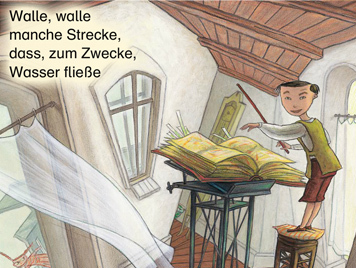
Тича, без да сяда, носи, без да спре! Ах, реки хиляда сливат се в море!
*** Йохан Волфганг Гьоте (1749 – 1832) е писател, поет, драматург, хуманист, учен, философ и политик. Вдъхновява Чарлз Дарвин с антропологичните си изследвания. Най-известното му произведение е „Фауст“. Пише поемата „Чиракът магьосник“ през 1797 г., която след това е пресъздавана многократно от различни артисти – в музиката, киното, видеоигрите, литературата, дори в Комунистическия манифест на Маркс и Енгелс. Уолт Дисни използва историята за анимацията с Мики Маус „Фантазия“.
A master of poetry, drama, and the novel, German writer and scientist Johann Wolfgang von Goethe spent 50 years on his two-part dramatic poem Faust, published in 1808 and 1832, also conducted scientific research in various fields, notably botany, and held several governmental positions.
George Eliot called him "Germany's greatest man of letters... and the last true polymath to walk the earth." Works span the fields of literature, theology, and humanism. People laud this magnum opus as one of the peaks of world literature. Other well-known literary works include his numerous poems, the Bildungsroman Wilhelm Meister's Apprenticeship and the epistolary novel The Sorrows of Young Werther.
With this key figure of German literature, the movement of Weimar classicism in the late 18th and early 19th centuries coincided with Enlightenment, sentimentality (Empfindsamkeit), Sturm und Drang, and Romanticism. The author of the scientific text Theory of Colours, he influenced Darwin with his focus on plant morphology. He also long served as the privy councilor ("Geheimrat") of the duchy of Weimar.
Goethe took great interest in the literatures of England, France, Italy, classical Greece, Persia, and Arabia and originated the concept of Weltliteratur ("world literature"). Despite his major, virtually immeasurable influence on German philosophy especially on the generation of Georg Wilhelm Friedrich Hegel and Friedrich Wilhelm Joseph von Schelling, he expressly and decidedly refrained from practicing philosophy in the rarefied sense.
Influence spread across Europe, and for the next century, his works inspired much music, drama, poetry and philosophy. Many persons consider Goethe the most important writer in the German language and one of the most important thinkers in western culture as well. Early in his career, however, he wondered about painting, perhaps his true vocation; late in his life, he expressed the expectation that people ultimately would remember his work in optics.
This was one of the first poems I read with my children in their toddler years, and we still cherish it, often quoting whole passages from it when domestic disasters strike.
Now turning into teenagers, they all of a sudden see the hidden political message underneath the funny drama of the sorcerer's apprentice who tries to copy the master while he is gone.
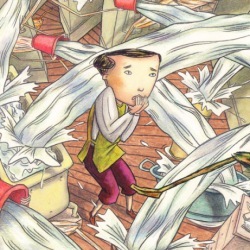
The apprentice creates a stupid army of living broomsticks who carry water until he must fear for his life. Whenever he tries to destroy them, they split in half and double up. Not being properly trained for the sorcerer's job, the apprentice has forgotten the spell to stop the disaster:
"Stop now, hear me! Ample measure Of your treasure We have gotten! Ah, I see it, dear me, dear me. Master’s word I have forgotten!
Ah, the word with which the master Makes the broom a broom once more! Ah, he runs and fetches faster! Be a broomstick as before! Ever new the torrents That by him are fed, Ah, a hundred currents Pour upon my head!"
The end of the story is hilarious for children, and quite a hopelessly utopian scenario for grown-ups who are forever watching apprentices waving wands in the world: THE MASTER steps in and ends the curse, reprimanding the naughty boy for his careless insolence!
A classic poem, and a wonderful introduction to the world of Goethe for children, it contains so many more layers to explore. As my oldest son reads Goethe poetry in school at the moment, we dusted off our illustrated version of it and enjoyed the rhythm of the language that we remember reading long ago in toddler times:
"Walle, walle", my younger children used to chime in, laughing at the apprentice's frustration with the broom:
"Stock, der du gewesen, Steh doch wieder still!"
All of us chimed in for the dramatic end:
"Ach, da kommt der Meister! Herr, die Not ist groß! Die ich rief, die Geister werd ich nun nicht los. "In die Ecke, Besen, Besen! Seids gewesen. Denn als Geister ruft euch nur zu diesem Zwecke, erst hervor der alte Meister."
Goethe had a brilliant feeling for the moments when humans step from curiosity and inventiveness to hubris and incompetent failure. His Faust: First Part is the perfect grown-up example of the life ennui that triggers reckless behaviour, and leads to playing with dangerous weapons that can only be controlled by experienced, well educated masters without the need to shine and brag!
Wouldn't it be nice, my son mused, if we could call upon old master Goethe to put the out-of-control brooms where they belong again, and to send the apprentice back to school, with a well-deserved detention?
"Besen, Besen! Seids gewesen. Denn als Geister ruft euch nur zu diesem Zwecke, erst hervor der alte Meister."
In der Schule Pflichtprogramm war es dennoch ein Gedicht, das ich sehr gerne lernte, auch wenn seine zahlreichen Strophen mich während des Vortrags vor der Klasse stolpern ließen, in dem ich einfach eine vergaß. Ich glaube, was mich als Kind faszinierte, war die enorme Bewegung und der versteckte Humor in der Handlung. Um so mehr freue ich mich, dass es inzwischen auch als Kinderbuch vorliegt, ebenso wie der Osterspaziergang. Für mich ist es das effektivste Einstiegswerk, um einen jungen Menschen den doch so oft sehr schwülstig Verse schmiedenden Herrn von Goethe näher zu bringen.
Allein die Illustrationen sind nicht ganz nach meinem Geschmack.
Йохан Волфганг фон Гьоте едва ли е сред първите имена, които ви хрумват, когато става въпрос за детска литература, но в своята книжна поредица „Детски шедьоври от велики писатели” изд. „Лист” рядко се спира на очевидните избори. С нов превод от Любомир Илиев и приказни илюстрации от Сотир Гелев, „Чиракът магьосник” е чисто книжно вълшебство! Прочетете ревюто на "Книжни Криле": https://knijnikrile.wordpress.com/202...
This poem is a classic and has inspired many a pop culture scenes and references. I first read the poem in primary school and learnt it off by heart, but can recite only a few bits now. My book club had "magic" as a theme and I dug out this poem, which was lovely to read again.
Leí Prometeo para seguir la secuencia. Es bello ver el desarrollo intelectual de Goethe, técnicamente es un dotado. Eso no implica madurez, solo talento. En Prometeo (1974) aún se nota la impresión, más no entendimiento. En Aprendiz de Mago (1797) el aprendizaje se expone, ya no es un apartarse de Zeus, sino un integrarse a lo divino. Me pregunto si habrá un tercer poema, donde el entendimiento sea muestre impúdico. Algo intuyo en su elegancia, pero habrá que seguir investigando la obra.
I just watched Sorcerer's Apprentice (2010) and wanted to know the original. Turns out it's Goethe's poem and I didn't know about it! Shame on my philologist self. Definitely was interesting to find out. And that scene with mops and water makes more sense now.
Thoroughly enjoyed this poem after discovering it thanks to a tip from my professor, and definitely one I can recommend. I’m going to check out Goethe’s other poetry as this has made me wanting for more ^^
I don't really have any strong feelings towards this book; it was fine for a poem, but it was a bit difficult to follow (at least in the translation I used).
Goethe, autor alemão, um dos maiores nomes da literatura mundial, conhecido, por exemplo, pelas obras Fausto e Os sofrimentos do jovem Werther, recolheu este conto da tradição oral em 1797. É um clássico já recontado inúmeras vezes, até na música (Paul Dukas, 1897) e no cinema, em um desenho animado de Walt Disney, protagonizado pelo Mickey! A edição é bilíngue, muito bom para quem já tem uma noção de alemão, mas é ótima mesmo para um primeiro contato com o autor e poeta.
Mônica Rodrigues da Costa é escritora, professora e jornalista. Foi editora do caderno infantil “Folhinha”, da Folha de S. Paulo por dez anos.
Nelson Cruz é um excelente e premiado artista mineiro. Já acumula respeitável trabalho como autor e ilustrador. As páginas são maravilhosas, as ilustrações precisam ser absorvidas aos poucos. Nelson usa conceitos do artista holandês M. C. Escher, e só apresentar Escher aos leitores já é mais um ponto alto do trabalho!
Ao final, muito bons apêndices com o original em alemão, glossário, informações sobre o autor, a tradutora e o ilustrador.
É um livro em formato grande, em capa dura, em edição muito bem cuidada, marca da Cosac Naify, uma importante editora que revolucionou o mercado editorial brasileiro. Infelizmente, anunciou o encerramento de suas atividades ao final de 2015. Então, os títulos tendem a se esgotar com o tempo e não serem reimpressos. Assim, é aconselhável adquirir os que interessem enquanto estão disponíveis.
Integra a excelente Coleção "Dedinho de Prosa", da Cosac Naify, de livros com textos integrais e completamente ilustrados, perfeita para apresentar a leitores jovens alguns grandes nomes da literatura brasileira e mundial. Veja todos os títulos:
1. Conto de Escola, de Machado de Assis, ilustrado por Nelson Cruz *** R
5. Vingança em Veneza, de Giovanni Boccaccio, ilustrado por Carlos Nine *** R 6. Será o Benedito!, de Mario de Andrade, ilustrado por Odilon Moraes *** R
Das Buch "Der Zauberlehrling" macht eindrücklich sichtbar, wie der Mensch Entwicklungen entfacht, die er weder kontrollieren noch seinem eigenen Willen vollständig unterwerfen kann – eine zeitlose Lektion über Macht, Verantwortung und die Folgen unbedachter Handlung.
Hat der alte Hexenmeister sich doch einmal wegbegeben! Und nun sollen seine Geister auch nach meinem Willen leben!
I had to read it in school as we were producing it as an musical :) I remember it to be great fun :D
The poem is about a young student of witchcraft who doesn´t understandt why his teacher never let him perfom magic on his own. He highly dislikes that so he decides to do it in secret when his master is gone... As you can guess he fails completly and everything goes wrong and he destroys the entire house :D
This poem is a masterpiece of Goethe but not to difficult to understandt...actually pretty easy as long as you understand German. It stands for the rebellion of the young generation, learning later that listening to the elder and wiser isn´t too bad at all.
This entire review has been hidden because of spoilers.
O, du Ausgeburt der Hölle! Soll das ganze Haus ersaufen?
What an interesting language! Old fashioned German verses describing the misshapes of the Sorcerer's Apprentice... How the broom went from getting water to flooding the whole place! Haha!
I loved this segment from Disney's Fantasia with Mickey Mouse as the Sorcerer's Apprentice. Very funny.
almost a three star because i don't like the illustrations. but they work, because they are so unusual that children are hooked and get to know goethe's famous ballad.