

What do you think?
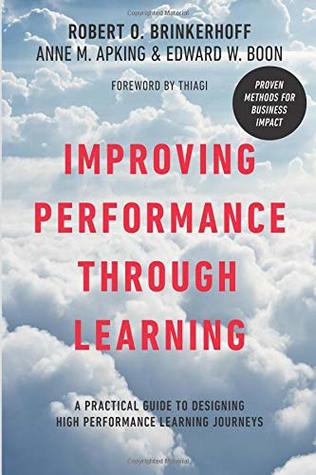
Improving Performance Through Learning: A Practical Guide for Designing High Performance Learning Journeys
There is a revolution underway in employee workforce development, trending away from face-to-face to digital learning and away from event-based multiday workshops to technology-supported “learning journeys.” This shift is tremendously promising, and it is reshaping the future of learning and development (L&D). However, it represents a considerable challenge and is fraught with risk. Improving Performance Through Learning will help you navigate this revolution but stay true to the mission of impactful workplace learning. Building on Brinkerhoff and Apking’s breakthrough work on High Impact Learning, this book presents the High Performance Learning Journey (HPLJ) approach to driving performance improvement through learning. You will find practical guidance for designing robust learning journeys that overcome the perennial barriers to training transfer and deliver consistent, sustained behavioral change and business impact. More than five years in the making, the HPLJ learning design and delivery process is founded on decades of solid learning and performance research and has been implemented in dozens of organizations worldwide. Additionally, several hundred early adopters have received HPLJ certification training, and their experiences and insights have helped the authors provide clear and compelling illustrations to guide readers. The book includes – in one chapter each - authentic case examples of HPLJ at work in five international organizations across a representative range of industries and learning and development content.
246 pages, paperback
Published April 30, 2019
Ratings & Reviews
Friends & Following
Create a free account to discover what your friends think of this book!
Community Reviews
Displaying 1 - 4 of 4 reviews

April 13, 2023
Even a bad book—and this is one—is worth studying, however briefly.
Did any value survive?
What made it bad?
Where did the authors go wrong?
What would have made it more useful?
Did any value survive?
Unless abnormally curious, you’re only considering reading this book because you make training courses as part of your job. I was assigned to read it for my team; I have worked in the field for seven years. We want to improve our results, and on that basis, here are the useful bits from this book.
1. “We increasingly see a demand for training to be spread out over time, delivered in smaller, ‘bite-sized’ chunks, interspersed with practice exercises and on-the-job application, . . employees have an ever-increasing set of skills and knowledge to master in a shorter time frame, and less time to devote to anything other than doing their jobs.”
2. Consider
“Who are the program participants? What are they going to learn? How are they going to use what they learn? Why are they going to learn it? (That is, what Performance Outcomes and business goals will the applications of their learning achieve for their organization?)”
[Too long, reduce to 1. Who is our audience? 2. What do we want that audience to do?]
3. Establish how success will be measured before designing the training. Make certain the measure is objective. Subjective self-reporting will not impress any savvy executive. The one—and only one—solid example in the book was a significant decrease in employee absences after training, designed to make employees feel invested in their company. This occurred at European grocery chain Willys.
4. Force your students to Do Something, such as teach back the information, as opposed to merely sitting through the training, then returning to work.
In practical terms of making you a better trainer, that’s the whole package. I just saved you a tortuous reading experience, spanning 234 pages. You’re welcome.
What made it bad?
Endless repetition and substitution of jargon terms “High Performance Learning Journey (HPLJ), Program Performance Path (PPP)” for simple English. Many business books establish gibberish like this on the first page, a clear signal the author intends to waste your time. In the future I will stop reading right there and move on.
Where did the authors go wrong?
Keep it Simple, Stupid! Business people need no help appreciating how complex their jobs are. Genuinely complex processes can only be managed when those processes are designed simply, using the fewest possible components, phases, steps. As the late talk show host Tom Snyder once remarked, “I don’t want to hear anybody say, ‘I don’t want to oversimplify this.’ I think it’s high time we oversimplified things.” The authors of this book do not keep it simple. Everything is presented in the most dense, heavy prose possible, such as:
“In summary, impact from training is accomplished when effective application of a skill or knowledge intersects with a high-leverage part of the program participant’s job, thus leading to a worthy contribution to a business goal.”
What does this mean? It means, “When the student improves job performance, the training may be judged successful.” 35 words reduced to 12.
Perhaps more importantly, the authors misjudged the relative value of distinctions and similarities. We are prone to amazement when someone lists many things they know and tells us how different each mental object is from every other. The authors imitate this approach, perhaps to make their writing appear smart and important. In order to improve real business outcomes, the opposite approach is critical; focus on similarities, not distinctions. Similarities fuel pattern recognition, which human brains are remarkably good at and which yields powerful results.
Let’s compare and contrast: If you like to travel, you can spend all your time studying the distinct and separate culture of each country you visit, and resist any comparison to any other country. Alternatively, you can look for ways in which countries are alike. Here is the big question: What can you do with what you learned? Remember our memories are limited. We travel with a wallet, not a trunk. Let’s say you’re an American, thinking about Britain and Japan. Consider two bits of information.
1. English and Japanese are quite dissimilar, using different alphabets and sharing almost no words.
2. Both countries drive on the left side of the road.
What can you do with #1? You can lecture your state-bound relatives about how different Japanese is from English.
What can you do with #2? You can know where to stand to catch a bus and cross a street safely on both sides of Eurasia.
During World War II, the Allies employed teams of women to listen to coded German military transmissions. The women could not decipher the code; they did not know what was being sent. Instead, they listened for the pattern of each sender’s hand on the code key, which they called “their fist,” and each pattern was given a name, such as “Oscar.” This careful listening allowed the Allies to track the movement of German armies, because “last month Oscar transmitted from Prague, but now he’s signaling from North Africa.” You may learn more about these operations in Anthony Cave Brown’s excellent book, “Bodyguard of Lies: The extraordinary, true story of the clandestine war of intricate deceptions that hid the secrets of D-Day from Hitler and sealed the Allied victory.”
What would have made it more useful?
Get To The Point. Write shorter sentences, use fewer modifiers that add nothing but reading time. Instead of attempting to elevate descriptions out of common language and experience, lower them; relate ideas to the reader’s actual work life. Instead of laying out a labyrinth of separate components, terms, concepts, keep the number of categories and subjects to an absolute minimum. Concentrate on similarities, not differences. Similarities are useful, differences are obstacles. The writer who can connect knowledge with other knowledge strengthens the reader. The writer who disconnects knowledge from other knowledge attempts to build himself up by weakening the reader.
In conclusion, my suggestion is to skip books when you notice these tendencies. You won’t have to search deeply; they often appear near the beginning, as they did in the case of “Improving Performance Through Learning.”
Did any value survive?
What made it bad?
Where did the authors go wrong?
What would have made it more useful?
Did any value survive?
Unless abnormally curious, you’re only considering reading this book because you make training courses as part of your job. I was assigned to read it for my team; I have worked in the field for seven years. We want to improve our results, and on that basis, here are the useful bits from this book.
1. “We increasingly see a demand for training to be spread out over time, delivered in smaller, ‘bite-sized’ chunks, interspersed with practice exercises and on-the-job application, . . employees have an ever-increasing set of skills and knowledge to master in a shorter time frame, and less time to devote to anything other than doing their jobs.”
2. Consider
“Who are the program participants? What are they going to learn? How are they going to use what they learn? Why are they going to learn it? (That is, what Performance Outcomes and business goals will the applications of their learning achieve for their organization?)”
[Too long, reduce to 1. Who is our audience? 2. What do we want that audience to do?]
3. Establish how success will be measured before designing the training. Make certain the measure is objective. Subjective self-reporting will not impress any savvy executive. The one—and only one—solid example in the book was a significant decrease in employee absences after training, designed to make employees feel invested in their company. This occurred at European grocery chain Willys.
4. Force your students to Do Something, such as teach back the information, as opposed to merely sitting through the training, then returning to work.
In practical terms of making you a better trainer, that’s the whole package. I just saved you a tortuous reading experience, spanning 234 pages. You’re welcome.
What made it bad?
Endless repetition and substitution of jargon terms “High Performance Learning Journey (HPLJ), Program Performance Path (PPP)” for simple English. Many business books establish gibberish like this on the first page, a clear signal the author intends to waste your time. In the future I will stop reading right there and move on.
Where did the authors go wrong?
Keep it Simple, Stupid! Business people need no help appreciating how complex their jobs are. Genuinely complex processes can only be managed when those processes are designed simply, using the fewest possible components, phases, steps. As the late talk show host Tom Snyder once remarked, “I don’t want to hear anybody say, ‘I don’t want to oversimplify this.’ I think it’s high time we oversimplified things.” The authors of this book do not keep it simple. Everything is presented in the most dense, heavy prose possible, such as:
“In summary, impact from training is accomplished when effective application of a skill or knowledge intersects with a high-leverage part of the program participant’s job, thus leading to a worthy contribution to a business goal.”
What does this mean? It means, “When the student improves job performance, the training may be judged successful.” 35 words reduced to 12.
Perhaps more importantly, the authors misjudged the relative value of distinctions and similarities. We are prone to amazement when someone lists many things they know and tells us how different each mental object is from every other. The authors imitate this approach, perhaps to make their writing appear smart and important. In order to improve real business outcomes, the opposite approach is critical; focus on similarities, not distinctions. Similarities fuel pattern recognition, which human brains are remarkably good at and which yields powerful results.
Let’s compare and contrast: If you like to travel, you can spend all your time studying the distinct and separate culture of each country you visit, and resist any comparison to any other country. Alternatively, you can look for ways in which countries are alike. Here is the big question: What can you do with what you learned? Remember our memories are limited. We travel with a wallet, not a trunk. Let’s say you’re an American, thinking about Britain and Japan. Consider two bits of information.
1. English and Japanese are quite dissimilar, using different alphabets and sharing almost no words.
2. Both countries drive on the left side of the road.
What can you do with #1? You can lecture your state-bound relatives about how different Japanese is from English.
What can you do with #2? You can know where to stand to catch a bus and cross a street safely on both sides of Eurasia.
During World War II, the Allies employed teams of women to listen to coded German military transmissions. The women could not decipher the code; they did not know what was being sent. Instead, they listened for the pattern of each sender’s hand on the code key, which they called “their fist,” and each pattern was given a name, such as “Oscar.” This careful listening allowed the Allies to track the movement of German armies, because “last month Oscar transmitted from Prague, but now he’s signaling from North Africa.” You may learn more about these operations in Anthony Cave Brown’s excellent book, “Bodyguard of Lies: The extraordinary, true story of the clandestine war of intricate deceptions that hid the secrets of D-Day from Hitler and sealed the Allied victory.”
What would have made it more useful?
Get To The Point. Write shorter sentences, use fewer modifiers that add nothing but reading time. Instead of attempting to elevate descriptions out of common language and experience, lower them; relate ideas to the reader’s actual work life. Instead of laying out a labyrinth of separate components, terms, concepts, keep the number of categories and subjects to an absolute minimum. Concentrate on similarities, not differences. Similarities are useful, differences are obstacles. The writer who can connect knowledge with other knowledge strengthens the reader. The writer who disconnects knowledge from other knowledge attempts to build himself up by weakening the reader.
In conclusion, my suggestion is to skip books when you notice these tendencies. You won’t have to search deeply; they often appear near the beginning, as they did in the case of “Improving Performance Through Learning.”

July 13, 2023
I am not a fan of the "American" way to look at learning and training in the workplace, because these books can sometimes simplify learning too much. However, this book is solid and nuanced and you can sense the professional experience of the author with many wise considerations and useful tips and tricks.
This book will present a "method", but it is not a one-size-fits-all, on the contrary, it presents a nuanced way of analyzing, assessing, and executing training plans through their concept of learning journey.
I find the book easy to apply to my work and with a lot of tips that will allow you to identify all the relevant stakeholders and also how to communicate with them.
In fact, there is an emphasis on how learning and development professionals can communicate effectively with the part of the organization that is more focused on the monetary dimension.
However, it has the style and language of an American book with a tendency to over-explain concepts and quantify results that are not easy or even possible to quantify.
This book will present a "method", but it is not a one-size-fits-all, on the contrary, it presents a nuanced way of analyzing, assessing, and executing training plans through their concept of learning journey.
I find the book easy to apply to my work and with a lot of tips that will allow you to identify all the relevant stakeholders and also how to communicate with them.
In fact, there is an emphasis on how learning and development professionals can communicate effectively with the part of the organization that is more focused on the monetary dimension.
However, it has the style and language of an American book with a tendency to over-explain concepts and quantify results that are not easy or even possible to quantify.

September 17, 2022
A useful and recommended read if you work with human resources, especially if you are in charge of staff education and training. I stumbled upon this book by accident and although I am more interested in learning/teaching techniques and science, this book was useful for me in terms of getting ideas and insights into adult learning and education.
October 29, 2022
Super book
Best learning and development book I've read in a long time. It is logical, hands-on, practical and makes absolute sense.
Best learning and development book I've read in a long time. It is logical, hands-on, practical and makes absolute sense.
Displaying 1 - 4 of 4 reviews