

What do you think?

The Cat and The City
In Tokyo – one of the world’s largest megacities – a stray cat is wending her way through the back alleys. And, with each detour, she brushes up against the seemingly disparate lives of the city-dwellers, connecting them in unexpected ways.
But the city is changing. As it does, it pushes her to the margins where she chances upon a series of apparent strangers – from a homeless man squatting in an abandoned hotel, to a shut-in hermit afraid to leave his house, to a convenience store worker searching for love. The cat orbits Tokyo’s denizens, drawing them ever closer.
But the city is changing. As it does, it pushes her to the margins where she chances upon a series of apparent strangers – from a homeless man squatting in an abandoned hotel, to a shut-in hermit afraid to leave his house, to a convenience store worker searching for love. The cat orbits Tokyo’s denizens, drawing them ever closer.
291 pages, Hardcover
First published June 4, 2020
About the author
Nick Bradley
2 books455 followersNick Bradley holds a PhD from UEA focussing on the figure of the cat in Japanese literature. He lived in Japan for many years where he worked as a translator, and currently teaches on the Creative Writing master's programme at the University of Cambridge. His debut novel, The Cat and The City, was published in 2020.
Four Seasons in Japan is his second, and was published in the UK on June 22nd 2023 by Doubleday. His work has been translated into fourteen languages.
Four Seasons in Japan is his second, and was published in the UK on June 22nd 2023 by Doubleday. His work has been translated into fourteen languages.
Ratings & Reviews
Friends & Following
Create a free account to discover what your friends think of this book!
Community Reviews
Displaying 1 - 30 of 1,819 reviews

June 19, 2021
This book is one long bruh moment. There's a few interesting stories and characters - the robot cat is a fun one, and the hikikomori story incorporating a small comic is quite sweet, but most of the stories are really seedy and misogynistic with zero sense of self-awareness. This book has a severe case of written-by-a-man disease and despite depicting a harsh and melancholy Tokyo, it still manages to romanticise it through what feels like a cringy Western lens to me. The book has a weird obsession with portraying gross sex stuff and Japanese-woman-white-man relationships, and one of the stories is literally from the perspective of a guy who loves to drug women.
The author mentions in his acknowledgements that he has a PhD, and I would like to now formally rescind this PhD for crimes against women and literature.
The author mentions in his acknowledgements that he has a PhD, and I would like to now formally rescind this PhD for crimes against women and literature.

July 25, 2020
"You look back at every choice you ever made in life, and all you can see are the mistakes. The things you did that brought you to where you are."
From the opening story where a freshly inked tattoo mysteriously comes to life, I was completely beguiled. Even more so, as a tiny calico cat appears to be moving to different parts of this breathing work of art, much to the tattoo artist's consternation.
Quirky and magical.
Tokyo is the backdrop. A thriving metropolis. The city is a pulsing magnetic creature, with a heartbeat all its own.
The neon lights of the city at night. The bars, the karaoke clubs, the pedestrian traffic, the bustling train stations. Office workers, company men, taxi drivers, the homeless, yakuza. A shut in hermit and an awkward youth. A disgruntled process line worker. A cross section of society across the sprawling urban landscape.
"The city never stopped, just kept moving forward without a care."
In contrast, there's the tranquility of the cherry blossom season. Sakura. Nature at her best. Petals falling to the earth like soft snow. Where time seems to stand still. People stop and pause for a while. Tradition versus modernity.
The stories intersect and overlap. Characters who are the focus of one story, are then in the background of others. Bit players. But still integral to the narrative. We join the dots. It is done so cleverly and so seamlessly. Sometimes the threads are so gossamer thin, that you can barely see them. Other times they are like a chain link fence. Impossible to ignore. This collection tells of the fragility of family and relationships. Longing and loneliness. Loss. Regret. Old friendships, new friendships. Forgiveness. Jealousy. And love. And all the emotions in between.
And through it all, our tiny calico cat is always there. Leaving pawprints across the pages of each of these stories 🐾 Green stare. Tail aloft. Whether it’s a fleeting glimpse of seeing her strolling down an alleyway, hopping off a train, or having a bigger part to play, plenty of feline serendipity occurs.
”Those beautiful green eyes, what had they seen…Imagine all the secrets and lies it had been privy to, the things that humans get up to when they think no one is looking.”
I couldn't help but think repeatedly of the phrase "six degrees of separation" while reading this. How whether through fate or intention, we each have such an impact on other people's lives.
Many of the stories will break your heart. Others will make you laugh. Some will give you hope that there's the chance for things to change. They're all written with acute observation, and a razor sharp eye.
”This city is too big, too many people, too much craziness going on that goes unnoticed or ignored.”
The mix of writing styles and artistic media is wonderfully creative. There's some haiku, a bit of hard-boiled noir, manga, photographs, calligraphy. It just works.
This is a sparkling, brilliant début by Nick Bradley. Love, love, loved ♡ He has captured a vibe and a moment in these stories. To me, they are sheer magic. You simply have to experience this book for yourself.
I am so looking forward to whatever Nick writes next. This book is going straight to my "favourites" shelf. I’ll definitely re-visit it one day. Perfection. It goes without saying that this is a full 5 ☆ read for me.
I envy anyone who's yet to read this. You're in for such a treat.
*** Enjoy ***
Trigger warnings!
There's a fair bit of swearing, and drunken, loutish behaviour (nothing like a night out at a Karaoke bar, right). One of the chapters is sexually graphic, which seems incongruous with the gentle, artistic cover. Perhaps not the ideal choice for younger readers who the cover may appeal to. And our delightful calico cat is injured in one of the stories, which is distressing (though I'm relieved to say, she heals beautifully, and helps others to heal by default).
"The muscles in the cat's back flexed to life...Its business was done here...It stood up and leapt lazily onto a neighbouring roof…Lost once again, into the city."
From the opening story where a freshly inked tattoo mysteriously comes to life, I was completely beguiled. Even more so, as a tiny calico cat appears to be moving to different parts of this breathing work of art, much to the tattoo artist's consternation.
Quirky and magical.
Tokyo is the backdrop. A thriving metropolis. The city is a pulsing magnetic creature, with a heartbeat all its own.
The neon lights of the city at night. The bars, the karaoke clubs, the pedestrian traffic, the bustling train stations. Office workers, company men, taxi drivers, the homeless, yakuza. A shut in hermit and an awkward youth. A disgruntled process line worker. A cross section of society across the sprawling urban landscape.
"The city never stopped, just kept moving forward without a care."
In contrast, there's the tranquility of the cherry blossom season. Sakura. Nature at her best. Petals falling to the earth like soft snow. Where time seems to stand still. People stop and pause for a while. Tradition versus modernity.
The stories intersect and overlap. Characters who are the focus of one story, are then in the background of others. Bit players. But still integral to the narrative. We join the dots. It is done so cleverly and so seamlessly. Sometimes the threads are so gossamer thin, that you can barely see them. Other times they are like a chain link fence. Impossible to ignore. This collection tells of the fragility of family and relationships. Longing and loneliness. Loss. Regret. Old friendships, new friendships. Forgiveness. Jealousy. And love. And all the emotions in between.
And through it all, our tiny calico cat is always there. Leaving pawprints across the pages of each of these stories 🐾 Green stare. Tail aloft. Whether it’s a fleeting glimpse of seeing her strolling down an alleyway, hopping off a train, or having a bigger part to play, plenty of feline serendipity occurs.
”Those beautiful green eyes, what had they seen…Imagine all the secrets and lies it had been privy to, the things that humans get up to when they think no one is looking.”
I couldn't help but think repeatedly of the phrase "six degrees of separation" while reading this. How whether through fate or intention, we each have such an impact on other people's lives.
Many of the stories will break your heart. Others will make you laugh. Some will give you hope that there's the chance for things to change. They're all written with acute observation, and a razor sharp eye.
”This city is too big, too many people, too much craziness going on that goes unnoticed or ignored.”
The mix of writing styles and artistic media is wonderfully creative. There's some haiku, a bit of hard-boiled noir, manga, photographs, calligraphy. It just works.
This is a sparkling, brilliant début by Nick Bradley. Love, love, loved ♡ He has captured a vibe and a moment in these stories. To me, they are sheer magic. You simply have to experience this book for yourself.
I am so looking forward to whatever Nick writes next. This book is going straight to my "favourites" shelf. I’ll definitely re-visit it one day. Perfection. It goes without saying that this is a full 5 ☆ read for me.
I envy anyone who's yet to read this. You're in for such a treat.
*** Enjoy ***
Trigger warnings!
There's a fair bit of swearing, and drunken, loutish behaviour (nothing like a night out at a Karaoke bar, right). One of the chapters is sexually graphic, which seems incongruous with the gentle, artistic cover. Perhaps not the ideal choice for younger readers who the cover may appeal to. And our delightful calico cat is injured in one of the stories, which is distressing (though I'm relieved to say, she heals beautifully, and helps others to heal by default).
"The muscles in the cat's back flexed to life...Its business was done here...It stood up and leapt lazily onto a neighbouring roof…Lost once again, into the city."
March 5, 2021
Me, I am a nobody. And this is my own personal reaction, your mileage may vary.
I like cats, and I am fascinated by eastern cultures and their radically different to western approaches to understanding life and the world we live in.
But I need to read blurbs more carefully. "Inventive", "A love letter to Japan". I diligently read the Guardian review before I bought the book, and it seemed to promise depth, but really was a warning about not much more here than the obvious people affect each other without knowing it or the consequences. It even said:
"Flo, the translator, sees herself as a “Japanologist” rather than a “Japanophile”, she says, and it seems that Bradley feels the same way. His author biography reveals that he speaks fluent Japanese and has a PhD focusing on the figure of the cat in the country’s literature. For any readers who want to know more about Japan, calico cats, loneliness or the interconnectedness of fractured lives, this intriguing debut is an excellent place to start. "https://www.theguardian.com/books/202..."
So I was really looking forward to it.
But the book repeatedly pissed me off. The author, Nick Bradley, according to his own website, was born in Germany and grew up in Bath, England. He has a Masters degree in English literature. An Englishman through and through. He spent all of a decade in Japan. (I've spent over 30 years in Germany as an American expat, married to a German, parent to kids growing up in Germany, and to this day there are things I know I don't understand or appreciate in the depth a German native does).
He has not written a book, however, that dwells deeply on what he might be thought to know deeply about - maybe a foreigner's experience in a deeply nationalistic country, or what he sees as the underlying differences in culture and history or even literatures. Instead, he gives us a very shallow view of Japan as imagined perhaps by what seems to me could be a casual tourist or reader of western magazines about Japan, but through supposedly Japanese characters. Government cleanups of hobo settlements to clear for the Olympics and the associated human costs in, oh shock, prisons for hobos, and gee whiz, families that reject problematic members (as if that weren't a universal phenomenon). Yakusa tattoo parlors with magical tattoos and a magical half-real life, half moving tattoo image cat. A hikikomori "saved" by a child's intrusion into his closeted life due to said cat. And on and on. Tourist snapshots by western ad agencies.
Worse, he repeatedly puts side comments into Japanese mouths that are very flattering specifically to Englishmen! How simple can you be as a novelist? How condescending can you be to your imagined audience?
Maybe with the variety of short stories within an overall framework and manifold interconnections, he is trying to imitate a particular Japanese literary form. I don't know. He did not seem to be exploring any other overall theme than, gee Tokyo is a big city with a lot of different exotic types in it!! Golly gee! "Interconnectedness of fractured lives" turns out to mean a bunch of broken people meet each other and do things western readers find appropriate - save each other, forgive each other, you get the idea.
The content came across to me very much as western ideas in pretty Japanese oil-paper dressing - pure kitsch. Nothing like David Mitchell's "The Thousand Autums of Jacob de Zoet" or Ruth Ozeki's "For the Time Being", each of which is rightly literature, and in its own way are western confrontations with the other that is Japan.
But gee. If you are looking for pretty, slightly "exotic" entertainment in the old, entitled colonialist manner, maybe it’s a fine book.
I like cats, and I am fascinated by eastern cultures and their radically different to western approaches to understanding life and the world we live in.
But I need to read blurbs more carefully. "Inventive", "A love letter to Japan". I diligently read the Guardian review before I bought the book, and it seemed to promise depth, but really was a warning about not much more here than the obvious people affect each other without knowing it or the consequences. It even said:
"Flo, the translator, sees herself as a “Japanologist” rather than a “Japanophile”, she says, and it seems that Bradley feels the same way. His author biography reveals that he speaks fluent Japanese and has a PhD focusing on the figure of the cat in the country’s literature. For any readers who want to know more about Japan, calico cats, loneliness or the interconnectedness of fractured lives, this intriguing debut is an excellent place to start. "https://www.theguardian.com/books/202..."
So I was really looking forward to it.
But the book repeatedly pissed me off. The author, Nick Bradley, according to his own website, was born in Germany and grew up in Bath, England. He has a Masters degree in English literature. An Englishman through and through. He spent all of a decade in Japan. (I've spent over 30 years in Germany as an American expat, married to a German, parent to kids growing up in Germany, and to this day there are things I know I don't understand or appreciate in the depth a German native does).
He has not written a book, however, that dwells deeply on what he might be thought to know deeply about - maybe a foreigner's experience in a deeply nationalistic country, or what he sees as the underlying differences in culture and history or even literatures. Instead, he gives us a very shallow view of Japan as imagined perhaps by what seems to me could be a casual tourist or reader of western magazines about Japan, but through supposedly Japanese characters. Government cleanups of hobo settlements to clear for the Olympics and the associated human costs in, oh shock, prisons for hobos, and gee whiz, families that reject problematic members (as if that weren't a universal phenomenon). Yakusa tattoo parlors with magical tattoos and a magical half-real life, half moving tattoo image cat. A hikikomori "saved" by a child's intrusion into his closeted life due to said cat. And on and on. Tourist snapshots by western ad agencies.
Worse, he repeatedly puts side comments into Japanese mouths that are very flattering specifically to Englishmen! How simple can you be as a novelist? How condescending can you be to your imagined audience?
Maybe with the variety of short stories within an overall framework and manifold interconnections, he is trying to imitate a particular Japanese literary form. I don't know. He did not seem to be exploring any other overall theme than, gee Tokyo is a big city with a lot of different exotic types in it!! Golly gee! "Interconnectedness of fractured lives" turns out to mean a bunch of broken people meet each other and do things western readers find appropriate - save each other, forgive each other, you get the idea.
The content came across to me very much as western ideas in pretty Japanese oil-paper dressing - pure kitsch. Nothing like David Mitchell's "The Thousand Autums of Jacob de Zoet" or Ruth Ozeki's "For the Time Being", each of which is rightly literature, and in its own way are western confrontations with the other that is Japan.
But gee. If you are looking for pretty, slightly "exotic" entertainment in the old, entitled colonialist manner, maybe it’s a fine book.

July 4, 2022
Needed more cat and less city. And less men in the city. Preferably none.

January 15, 2020
Flo had hundreds of these thoughts that swam around in her head throughout the day, but no one to share them with. But she would always tell herself, who needs friends, when you have books. Her bookcases were filled with not just her favourite fiction, but also tomes of linguistic textbooks, dictionaries and reference books, all relating to Japanese language and culture. She considered herself a Japanologist, rather than a Japanophile. To her, there was a big difference.
Japanophiles were people who just loved Japan without asking questions. They were people who thought Japan could do no wrong, who lived in a fantasy world of anime and manga. Flo preferred to identify herself with Japanologists. She respected the language and culture, in the same way that she felt every culture and language should be respected. But she recognized within herself a deep-seated need to get to the bottom of every question she had. A quest for knowledge concerning Japan. To learn, to study, to absorb.
The book is a series of linked short stories of a series of characters in a 2019-2020 Tokyo, preparing for the Olympics (not least with an attempt to clean up the City streets of undesirables) – the characters linked not just by a mysterious and magical stray cat which features in all the stories but by a web of connections both strong (relatives, close friends, colleagues) but also fleeing (shared glances, taxi-ride interactions, overheard conversations, street encounters).
Around a third of the way through the book – and despite my enjoyment of it, my enthusiasm was starting to wane. The links seemed a little too superficial/gratuitous and further the vivid portrait that the book paints of Tokyo and Japanese culture, began to feel a little too vivid and recognisable.
Every remarkable (to a Westerner) feature of that City and culture is, in fact, remarked upon. And most of the remarks are by natives. At times it felt like the equivalent a book written by a Japanese person about Londoners who spend most of their time thinking about “mind the gap”, bendy-buses, Black cabs, Boris-bikes, after-work pub trips, Tesco Express, Greggs, curries etc, rather than those things forming an accepted and familiar scene which stays in the background.
I felt the book was in danger of being The Cliché and The City.
Just at that point, a rather sordid tale (which turns the book into Sex and The City) formed a break and after that the book I felt that the book emerged into its true strength – the writing style began to broaden out with some different sections including a manga strip, but in particular a translated short story and a detective case notes which not only added further links, but served to bring all of the stories together.
This book is written by a debut author who I think was painting himself in the opening quote – an Anglo-Saxon who lived in Japan working as among other things a video game translator, a lover of Japanese language, literature, culture (high and low) – but one who wants to hold that culture up for study and examination.
A highly entertaining debut novel, ideal for fans of early David Mitchell (especially those who would perhaps prefer he stick not just to Japan but to the modern day) and Murakami (especially those who would prefer that he had more in the way of a coherent and relatable macro-plot to his later books).
My thanks to Atlantic Books for an ARC via NetGalley.

January 29, 2021
Много изненадваща книга. Започнах я с неособено големи очаквания, а тя ме грабна и заплени още в първите си страници. Героите са толкова пъстри и разнообразни, историите и съдбите им интригуващи, а Токио и животът в него са описани красиво и завладяващо.
Авторът Ник Брадли се е постарал да разгърне на тези 336 страници една палитра от хора от кажи-речи почти всички социални прослойки. Като всеки от тях е изграден адекватно и достоверно спрямо психологическия си профил. И още по-изненадващото към всичко е, че книгата е дебютна за автора, а той се е справил блестящо с нея.
Япония и японската култура са пресъздадени реално и атмосферата им се усеща истински.
Историята (или историите) в „Котката и градът“ протича по-доста интересен начин. Всяка глава (общо 15) е разказ, разгръщащ живота на различен персонаж, като наред с това се застъпва и с историята на персонаж(и) от предходен разказ, като се доизяснява съдбата му. И в един момент героите се оказват свързани един с друг или пътищата им се пресичат по интересен начин. Точно това много ми хареса. А навсякъде около тези хора витае и една загадъчна улична котка.
Книгата наистина е изградена по невероятно интересен начин. Например в разказа „Хикикомори, Футоко & Неко“ една част от историята тук е разказана под формата на манга и това някак я прави още по-въздействаща. Друг особено любопитен разказ е „Copy Cat“ (тук има учен, робот и клонирана котка), който всъщност е разказ в разказа. Оказва се случайно изгубен превод на персонаж от предишна глава, а авторът на разказа пък е свързан с част от други персонажи в книгата.
Темите в „Котката и градът“ наистина са всеобхватни. От персонажи фенове на компютърни игри, бездомници, таксиметрови шофьори и офис служители до особняци и изключително странни типажи.
По отношение на корицата харесвам и двете – и английската, и българската. И двете са уловили духа на книгата и го пресъздават точно.
- стр. 70
„Винаги я бях възприемал като типичната офис дама, която се събира с другите офис дами на обяд, за да говорят за шопинг, грим или за каквото там си говорят момичетата. Не ме разбирайте погрешно, мъжете също говорят за глупости – като бейзбол и киабакура. Не мога да понасям тая простотия – хора, говорещи за неща, за които трябва да говорят, само за да не са социално неадекватни.“
- стр. 85
„Много би ми се искало да си събера багажа и да замина за провинцията, но не мога да се измъкна. Заклещен съм тук. Детска градина, начално училище, прогимназия, гимназия, университет, стаж, от стаж към служба, от служба към пенсия, от пенсия към смърт. Това е животът ми, вече предначертан. Моят и на милионите други хора, покрай които минавам всеки ден. Градът има нужда от нас и ние – от него. Симбиоза един път.“
- стр. 140
„Работя, работя, работя и все за нищо. Всеки ден е еднакъв, без цвят, без светлина, без надежда. И този град ме изяжда отвътре. Толкова е голям, толкова студен и безчувствен. Тук някакъв мъж може да ми причини това и никой не обръща внимание. Никой не се интересува, никой не го спира, просто гледат как се случва, оставят го да се случи… съучастници са. Всички тези хора, животите им… толкова са вглъбени в себе си. Не забелязват нуждата на другите… Кой знае, може би всички страдат. Не бива да ги съдя.“
- стр. 227
„И аз ли бях остарял така? Виждаше ли той промени във външния ми вид? Когато погледнех в огледалото, не виждах нищо. Времето сякаш се случваше на другите хора.“
Авторът Ник Брадли се е постарал да разгърне на тези 336 страници една палитра от хора от кажи-речи почти всички социални прослойки. Като всеки от тях е изграден адекватно и достоверно спрямо психологическия си профил. И още по-изненадващото към всичко е, че книгата е дебютна за автора, а той се е справил блестящо с нея.
Япония и японската култура са пресъздадени реално и атмосферата им се усеща истински.
Историята (или историите) в „Котката и градът“ протича по-доста интересен начин. Всяка глава (общо 15) е разказ, разгръщащ живота на различен персонаж, като наред с това се застъпва и с историята на персонаж(и) от предходен разказ, като се доизяснява съдбата му. И в един момент героите се оказват свързани един с друг или пътищата им се пресичат по интересен начин. Точно това много ми хареса. А навсякъде около тези хора витае и една загадъчна улична котка.
Книгата наистина е изградена по невероятно интересен начин. Например в разказа „Хикикомори, Футоко & Неко“ една част от историята тук е разказана под формата на манга и това някак я прави още по-въздействаща. Друг особено любопитен разказ е „Copy Cat“ (тук има учен, робот и клонирана котка), който всъщност е разказ в разказа. Оказва се случайно изгубен превод на персонаж от предишна глава, а авторът на разказа пък е свързан с част от други персонажи в книгата.
Темите в „Котката и градът“ наистина са всеобхватни. От персонажи фенове на компютърни игри, бездомници, таксиметрови шофьори и офис служители до особняци и изключително странни типажи.
По отношение на корицата харесвам и двете – и английската, и българската. И двете са уловили духа на книгата и го пресъздават точно.
- стр. 70
„Винаги я бях възприемал като типичната офис дама, която се събира с другите офис дами на обяд, за да говорят за шопинг, грим или за каквото там си говорят момичетата. Не ме разбирайте погрешно, мъжете също говорят за глупости – като бейзбол и киабакура. Не мога да понасям тая простотия – хора, говорещи за неща, за които трябва да говорят, само за да не са социално неадекватни.“
- стр. 85
„Много би ми се искало да си събера багажа и да замина за провинцията, но не мога да се измъкна. Заклещен съм тук. Детска градина, начално училище, прогимназия, гимназия, университет, стаж, от стаж към служба, от служба към пенсия, от пенсия към смърт. Това е животът ми, вече предначертан. Моят и на милионите други хора, покрай които минавам всеки ден. Градът има нужда от нас и ние – от него. Симбиоза един път.“
- стр. 140
„Работя, работя, работя и все за нищо. Всеки ден е еднакъв, без цвят, без светлина, без надежда. И този град ме изяжда отвътре. Толкова е голям, толкова студен и безчувствен. Тук някакъв мъж може да ми причини това и никой не обръща внимание. Никой не се интересува, никой не го спира, просто гледат как се случва, оставят го да се случи… съучастници са. Всички тези хора, животите им… толкова са вглъбени в себе си. Не забелязват нуждата на другите… Кой знае, може би всички страдат. Не бива да ги съдя.“
- стр. 227
„И аз ли бях остарял така? Виждаше ли той промени във външния ми вид? Когато погледнех в огледалото, не виждах нищо. Времето сякаш се случваше на другите хора.“

October 25, 2022
The Cat and the City is an imaginative and quirky collection of linked stories set in Tokyo at the time when Japan was about to host the 2020 Olympic Games.
Naomi, an eighteen-year-old girl with light green eyes, wanted a large-scale tattoo. Upon her demand, a seedy but highly skilled traditional tattoo master took a few years to edge, by hand, the city of Tokyo onto her back. She insisted there should be no people in the city tattoo. On a whim, the tattooist secretly added a little calico cat. A charming touch? Not really. ‘It was during the shading of the tattoo that Kentaro really began to lose his mind.’
The story of the tattoo set in motion a chain of stories involving a crew of individuals whose fractured lives will connect in unexpected and surreal ways. Amongst them are: an old, homeless Rakugo storyteller (Ohashi) living with regrets of his wasted life; a pair of colleagues prowling the city at night to play ‘Street Fighter (Turbo); a taxi driver (Taro) who gave up writing poetry to earn a living to support his wife and daughter; a private detective (Ishikawa) cracking cases of missing cats and children, and cheating spouses; an American woman translator (Flo) constantly being groped while riding the train to work and battling loneliness; a British photographer (George) working as an English teacher who had a sexual vulture for a Japanese girlfriend (Mari); an agoraphobic man addicted to gaming; a school-refusing young lad who rescued an injured cat; and a handful of disgusting maniacs who watched porn, drugged hostesses, and flashed their private parts in public baths (onsens).
As their stories unfolded, my eyes kept watch for a green-eyed calico cat that made its appearance in every story. This little creature brought help and comfort to several of the characters; it also howled at cruel folks. Soon, I also expected to see the girl with the tattoo who seemed to pop up everywhere.
There is an eeriness to these stories with a touch of magical realism. Naomi was the name of the cat that belonged to a writer (Nishi Furuni) who was obsessed with cats. He wrote a science fiction book titled ‘Copy Cat’ which Flo translated from Japanese to English. Here we have a story within a story. ‘Copy Cat’ is my favorite in this collection. I have a theory about the relationship between the tattooed girl and the calico cat. It scared me a bit whenever a pair of green eyes flashed in the dark.
There is a seediness that oozed out of the pores of several characters that I dislike reading about. I was rather shocked by the explicit and crude sex talk and graphic depiction of sex.
There is a seriousness too about these stories. It captures brilliantly the soulless existence in a big city. This is the sobering picture: ‘The city is built on work. Tokyo’s the kind of place where if you stop working for even just a second, you’ll be swallowed up and forgotten… The city doesn’t rest, ever. Especially at night. Sleep is just something Tokyo fits in around work.’ In such a city, human connections are hard to forge and, when found, hard-earned. It was interesting to read about the effort Tokyo put in to rid itself of the homeless and stray cats in readiness to host the 2020 Olympic Games. The stories depicted fractured families, which raised questions, such as “Do we have any control over our lives? How can I change the future? Are we marked for life by the mistakes we make?”
Lastly, there is beauty in the description of the four seasons in Tokyo. When Naomi’s tattoo was finished, the city came to life on her back: ‘The city was becoming like a patchwork quilt of the seasons.’. I was charmed by the hanami season when cherry blossoms were in full bloom. Taro, the taxi driver, ate his bento lunch in the shade of a cherry tree with the petals ‘falling down onto the windshield like a blizzard of cherry-colored snowflakes.’ How lovely!
The Cat and the City is an impressive debut work. It comes complete with photographs, stories within stories, and a short manga section. The ending to most stories is left open to the imagination. It seems to work given the quirky tone of this novel. The unusual tales were at times charming and touching, at other times gross and revolting, but they held my attention.
One day, I would like to visit Tokyo, hopefully, during the hanami season, and treat myself to okonomiyaki and maybe even shochu.
Naomi, an eighteen-year-old girl with light green eyes, wanted a large-scale tattoo. Upon her demand, a seedy but highly skilled traditional tattoo master took a few years to edge, by hand, the city of Tokyo onto her back. She insisted there should be no people in the city tattoo. On a whim, the tattooist secretly added a little calico cat. A charming touch? Not really. ‘It was during the shading of the tattoo that Kentaro really began to lose his mind.’
The story of the tattoo set in motion a chain of stories involving a crew of individuals whose fractured lives will connect in unexpected and surreal ways. Amongst them are: an old, homeless Rakugo storyteller (Ohashi) living with regrets of his wasted life; a pair of colleagues prowling the city at night to play ‘Street Fighter (Turbo); a taxi driver (Taro) who gave up writing poetry to earn a living to support his wife and daughter; a private detective (Ishikawa) cracking cases of missing cats and children, and cheating spouses; an American woman translator (Flo) constantly being groped while riding the train to work and battling loneliness; a British photographer (George) working as an English teacher who had a sexual vulture for a Japanese girlfriend (Mari); an agoraphobic man addicted to gaming; a school-refusing young lad who rescued an injured cat; and a handful of disgusting maniacs who watched porn, drugged hostesses, and flashed their private parts in public baths (onsens).
As their stories unfolded, my eyes kept watch for a green-eyed calico cat that made its appearance in every story. This little creature brought help and comfort to several of the characters; it also howled at cruel folks. Soon, I also expected to see the girl with the tattoo who seemed to pop up everywhere.
There is an eeriness to these stories with a touch of magical realism. Naomi was the name of the cat that belonged to a writer (Nishi Furuni) who was obsessed with cats. He wrote a science fiction book titled ‘Copy Cat’ which Flo translated from Japanese to English. Here we have a story within a story. ‘Copy Cat’ is my favorite in this collection. I have a theory about the relationship between the tattooed girl and the calico cat. It scared me a bit whenever a pair of green eyes flashed in the dark.
There is a seediness that oozed out of the pores of several characters that I dislike reading about. I was rather shocked by the explicit and crude sex talk and graphic depiction of sex.
There is a seriousness too about these stories. It captures brilliantly the soulless existence in a big city. This is the sobering picture: ‘The city is built on work. Tokyo’s the kind of place where if you stop working for even just a second, you’ll be swallowed up and forgotten… The city doesn’t rest, ever. Especially at night. Sleep is just something Tokyo fits in around work.’ In such a city, human connections are hard to forge and, when found, hard-earned. It was interesting to read about the effort Tokyo put in to rid itself of the homeless and stray cats in readiness to host the 2020 Olympic Games. The stories depicted fractured families, which raised questions, such as “Do we have any control over our lives? How can I change the future? Are we marked for life by the mistakes we make?”
Lastly, there is beauty in the description of the four seasons in Tokyo. When Naomi’s tattoo was finished, the city came to life on her back: ‘The city was becoming like a patchwork quilt of the seasons.’. I was charmed by the hanami season when cherry blossoms were in full bloom. Taro, the taxi driver, ate his bento lunch in the shade of a cherry tree with the petals ‘falling down onto the windshield like a blizzard of cherry-colored snowflakes.’ How lovely!
The Cat and the City is an impressive debut work. It comes complete with photographs, stories within stories, and a short manga section. The ending to most stories is left open to the imagination. It seems to work given the quirky tone of this novel. The unusual tales were at times charming and touching, at other times gross and revolting, but they held my attention.
One day, I would like to visit Tokyo, hopefully, during the hanami season, and treat myself to okonomiyaki and maybe even shochu.

August 3, 2021
This book is one of those books where I was wowed by the concept but disappointed - and sometimes even uncomfortable - with the execution. Which is a shame, because it ticks nearly all of my 'good book' tropes: disparate but connected stories that are bittersweet yet hopeful, cats, trying to explore the core of humanity, everything linking up in a clever way at the end etc.
But the way it's written is...deeply troubling. I'm not the sort to shy away from books that are sexually explicit but the blatant misogyny in this one that goes along with the often rather obseen descriptions of sexual acts just doesnt appeal to me. Often it seemed to be added for just 'shock value', such as the chapter 'Autumn Leaves' which opens 'I want you to slap me in the face and force me to suck your cock'.
At first, I thought this would only appear in a few stories and perhaps was the author trying to say something clever about sexuality or misogyny these characters. Instead it's clear by the time he starts talking from a female perspective this is just the way he views the world. The book is littered with little side comments like this one 'Flo Cringed. Kawaii - cute - was one of the most overused words in Japanese (particularly by girls she had to admit)' to subtly knock down women. Further unlike the men in the book women are not allowed to have nuanced problems, instead they have traditional, stock female problems: groping on trains, husbands cheating, abortion. None of which are really explored in any detail and are often glossed over entirely. It's a very underlying version of misogyny, it's not blatant, it feels more thoughtless. But it really pulled me out of the narrative.
I also felt like the book had very little original to say even on the theme it was supposedly going for. 'Cities are lonely' is hardly a novel concept, and like I said, there are all these sexual themes which would have been interesting to explore but are ultimately neglected, used for shock value and not developed or nuanced. This book I would say is overall rather pessimistic and melancholy which isnt necessarily a bad thing, but it's not something I found engaging or even something I thought was demonstrated by the books many stories very well. It wasnt saying anything other than 'life is bad sometimes' rather than telling us why life is bad or perhaps pointing to how it can be better.
There were a few things I liked about this book: like I said, the way all the stories eventually connect is wonderful, as is the focus on individuals without feeling the need to go back; just little snapshots. I also adored the chapter with the comic book, which was really sweet.
But overall this book...just didnt work for me. I wanted to like it, but it just didnt.
But the way it's written is...deeply troubling. I'm not the sort to shy away from books that are sexually explicit but the blatant misogyny in this one that goes along with the often rather obseen descriptions of sexual acts just doesnt appeal to me. Often it seemed to be added for just 'shock value', such as the chapter 'Autumn Leaves' which opens 'I want you to slap me in the face and force me to suck your cock'.
At first, I thought this would only appear in a few stories and perhaps was the author trying to say something clever about sexuality or misogyny these characters. Instead it's clear by the time he starts talking from a female perspective this is just the way he views the world. The book is littered with little side comments like this one 'Flo Cringed. Kawaii - cute - was one of the most overused words in Japanese (particularly by girls she had to admit)' to subtly knock down women. Further unlike the men in the book women are not allowed to have nuanced problems, instead they have traditional, stock female problems: groping on trains, husbands cheating, abortion. None of which are really explored in any detail and are often glossed over entirely. It's a very underlying version of misogyny, it's not blatant, it feels more thoughtless. But it really pulled me out of the narrative.
I also felt like the book had very little original to say even on the theme it was supposedly going for. 'Cities are lonely' is hardly a novel concept, and like I said, there are all these sexual themes which would have been interesting to explore but are ultimately neglected, used for shock value and not developed or nuanced. This book I would say is overall rather pessimistic and melancholy which isnt necessarily a bad thing, but it's not something I found engaging or even something I thought was demonstrated by the books many stories very well. It wasnt saying anything other than 'life is bad sometimes' rather than telling us why life is bad or perhaps pointing to how it can be better.
There were a few things I liked about this book: like I said, the way all the stories eventually connect is wonderful, as is the focus on individuals without feeling the need to go back; just little snapshots. I also adored the chapter with the comic book, which was really sweet.
But overall this book...just didnt work for me. I wanted to like it, but it just didnt.

March 26, 2021
4.5 звезди
От известно време ми се беше отписало за книги, изчоплях си по някой час да си ги чета в тишина и самотата на това занимание ми беше най-важна.
ОБАЧЕ се натъкнах съвсем случайно, каквито са най-хубавите срещи, на нещо с жестоко рандъм заглавието "Котката и градът", спъвайки се лекичко във фразите от резюмето: "Котката и градът" е реверанс към японската култура и литература" и "Дебютният роман на Ник Брадли е неповторима амалгама от магически реализъм, научна фантастика, трилър, криминале и романс, сравним с Дейвид Мичъл и Мураками."
Моментално я направих част от библиотеката си, а тя от своя страна ме направи силно книжно щастлива. Накратко книгата е амалгама от различни истории, всички се развиват в Токио (това е Градът), а някои от героите им прескачат от случка в случка, но мноогоо леко и загатнато, на моменти буквално трябва да се взираш в шпациите, за да ги откриеш и навържеш, което от своя страна увеличава удоволствието от четенето. През всички истроии меко преминава и една улична котка. Но японска, сдържана, студена, не лигаво анимационна в стил мечетата-с-нежни-сърца.
Без да съм детайлен познавач на японската култура ми се струва, че Ник Брадли е уловил доста верни щрихи от нея, без да парадира или натрапва знанията си. Пише изчистено и добре, за дебютен роман се е справил чудесно. За да съм честна трябва да кажа, че определено Дейвид Мичъл не е, но пък се оказа много приятна Мураками Light версия, без подражание, просто като дух и цялостна фантазност на книгата. Има и манга комикс, има и истории с доста мрачновати дълбини. Абе, яко ме изкефи, дано си е проличало от това, което написах. Хич не чувам да се говори за нея, така че вижте я непременно.
От известно време ми се беше отписало за книги, изчоплях си по някой час да си ги чета в тишина и самотата на това занимание ми беше най-важна.
ОБАЧЕ се натъкнах съвсем случайно, каквито са най-хубавите срещи, на нещо с жестоко рандъм заглавието "Котката и градът", спъвайки се лекичко във фразите от резюмето: "Котката и градът" е реверанс към японската култура и литература" и "Дебютният роман на Ник Брадли е неповторима амалгама от магически реализъм, научна фантастика, трилър, криминале и романс, сравним с Дейвид Мичъл и Мураками."
Моментално я направих част от библиотеката си, а тя от своя страна ме направи силно книжно щастлива. Накратко книгата е амалгама от различни истории, всички се развиват в Токио (това е Градът), а някои от героите им прескачат от случка в случка, но мноогоо леко и загатнато, на моменти буквално трябва да се взираш в шпациите, за да ги откриеш и навържеш, което от своя страна увеличава удоволствието от четенето. През всички истроии меко преминава и една улична котка. Но японска, сдържана, студена, не лигаво анимационна в стил мечетата-с-нежни-сърца.
Без да съм детайлен познавач на японската култура ми се струва, че Ник Брадли е уловил доста верни щрихи от нея, без да парадира или натрапва знанията си. Пише изчистено и добре, за дебютен роман се е справил чудесно. За да съм честна трябва да кажа, че определено Дейвид Мичъл не е, но пък се оказа много приятна Мураками Light версия, без подражание, просто като дух и цялостна фантазност на книгата. Има и манга комикс, има и истории с доста мрачновати дълбини. Абе, яко ме изкефи, дано си е проличало от това, което написах. Хич не чувам да се говори за нея, така че вижте я непременно.

June 4, 2020
The Cat and the City is Nick Bradley’s debut novel, or a series of short stories linked by a stray cat, and as both a life-long Japanophile and ailurophile, I had a feeling this would really resonate with me; however, what I didn't fully anticipate was quite how much I would adore it. This is an impressive first foray into the literary game for the author and I must say it felt so comforting to pick up; it was a sheer delight from beginning to denouement and a stunning slice of escapism many are seeking right now in these strange times. Undoubtedly one of the most charming and enjoyable reading treats of the past decade, this is a potent and mesmerising amalgamation of some of my favourite things: fabulous furry felines and both Japanese literature and the wider culture. I cannot recommend these quirky and wonderfully woven tales highly enough. If you read merely one book this summer make sure it’s this masterpiece. Simply exquisite. Many thanks to Atlantic Books for an ARC.

April 11, 2024
A Cidade Dura
O título Um Gato em Tóquio leva-nos a crer que o protagonismo desta história será, eventualmente, exclusivo dalgum gato. Porém, este livro é, acima de tudo, uma viagem por Tóquio. E é uma viagem realizada não sob a perspectiva do turista de máquina fotográfica mas sim sob o prisma das suas gentes, gatos inclusive. E a ideia que transparece é a duma cidade implacável, onde impera a lei do trabalho, a solidariedade é rara e onde é fácil chegar a velho na indigência ou na loucura
Assim, após a leitura deste livro eu reescreveria o título como:
Gentes de Tóquio e Algo Mais
NOTA: o Algo Mais tem a ver com os gatos que andam por lá (um deles robô) e… as célebres sakura (cerejeiras de Tóquio) :)
O título Um Gato em Tóquio leva-nos a crer que o protagonismo desta história será, eventualmente, exclusivo dalgum gato. Porém, este livro é, acima de tudo, uma viagem por Tóquio. E é uma viagem realizada não sob a perspectiva do turista de máquina fotográfica mas sim sob o prisma das suas gentes, gatos inclusive. E a ideia que transparece é a duma cidade implacável, onde impera a lei do trabalho, a solidariedade é rara e onde é fácil chegar a velho na indigência ou na loucura
Assim, após a leitura deste livro eu reescreveria o título como:
Gentes de Tóquio e Algo Mais
NOTA: o Algo Mais tem a ver com os gatos que andam por lá (um deles robô) e… as célebres sakura (cerejeiras de Tóquio) :)

March 11, 2022
Edit: It’s almost Christmas season so I was considering being nice and loosen my asshole rating but then I remembered I don’t fucking celebrate Christmas 😌 merry christmas tho 👋🎄🎅
A Fucking Cat-astrophe
(pun intended because we all need at least one good thing out of this)
i am stuck between wanting to write a long rant listing out all the bullshit but i also feel like this book has already drained any semblance of willpower out of me and i am out of commission for life.
from the title, cover and the blurb, i was promised a good cat and city story reminiscing the more heartwarming The Travelling Cat Chronicles. Guys, I've been HAD. I've been CHEATED AND SCAMMED. This is my villain origin story.
since I'm feeling quite generous: 1.5* rounded up for the prefaces below:
1) i like interwoven stories, they're fun to pick up (though this was less subtle and feels try hard but like i said im generous)
2) the robot cat story in particular
3) some of the cat puns (even though they're down right cheesy and the rest of them scattered in the novel is pretty too on the nose and close to cringey)
4) interesting variations of medium in some chapters: comic strips, "translated novels" (after you disregard the ironic meta-ness), online posts (after you get through the shit character), poems etc.
At first when I realised that this wasn't going well, I thought "ok cool this can be a fun book to trash and he at least gets a reader so its a win/win" but then the more I read the more tired I get and i feel sucked out of my will to live and i dont think its win/win anymore guys I'VE BEEN HAD AGAIN
SOME things that made my experience of this book crashed and burn:
1) this just reads like a very wannabe japanese literature piece without the good things and only keeping the misogyny and flat characters
2) I'm up for shitty unlikeable characters - but they have to have some sort of purpose and actually be well-written. this is just *not it* chief. there's just too much seedy characters and "implied messages" that are so condescending for me NOT to suspect the author bleeding into the characters.
3) case in point: the Japanophile vs Japanologist shpiel. Oh shut up, you're just a weeb with a university degree
4) I guess the author wanted to "showcase the other side of Japan" but the things he brings up are supposedly nuanced - something that he couldn't catch with his white upbringing and western lens. There was no significant depth in this - man, even I can gather all those from just watching better written anime and manga that you're so against.
5) How cringey is your writing for you to remind me of my very own cringey ass 17-year-old fanfiction ???? dont answer that
6) I need to talk to the editor of this book pronto - how did the author hurt you so much for you to let this book be published this way? which of his enemies paid you? did you know that your revenge against this man has affected everyone else? did you know that humanity has stepped back a few decades by this book?
The more I write, the more angry I feel. Here are reviews that better explains why this book is shit. I highly recommend reading these before you (for whatever reason, you do you) want to try this book:
1. Lilly | mothcub's - "This book is one long bruh moment. [...] The author mentions in his acknowledgements that he has a PhD, and I would like to now formally rescind this PhD for crimes against women and literature."
2. Tamara - "I'm just surprised because in the acknowledgement section, there are a LOT of people mentioned, and it's hard to believe not a single one of them pulled Bradley up on the use of the c-slur (pg. 206)."
3. Lisa - "Flo, the translator, sees herself as a “Japanologist” rather than a “Japanophile”, she says, and it seems that Bradley feels the same way."
You can read through my progress statuses for particular shitty parts of the book but I'm warning you it's a doozy (i didn't even add all of my highlights and notes man) and you are basically witnessing me spiral to the end of my wits
question for those who enjoyed it: please tell me how ?? what made it good to you?? serious answers only i am really curious to know bcs i wanted to like this sm
-------
Bottom line: Please consider donating to my GoFundMe so I can hire a lawyer to fight Bradley and Co. to make him pay reparations for the crimes against the rest of society.
P/S: While typing this I changed my mind and I'm rounding this down. Don't read this if you want to have a good time.
A Fucking Cat-astrophe
(pun intended because we all need at least one good thing out of this)
i am stuck between wanting to write a long rant listing out all the bullshit but i also feel like this book has already drained any semblance of willpower out of me and i am out of commission for life.
from the title, cover and the blurb, i was promised a good cat and city story reminiscing the more heartwarming The Travelling Cat Chronicles. Guys, I've been HAD. I've been CHEATED AND SCAMMED. This is my villain origin story.
since I'm feeling quite generous: 1.5* rounded up for the prefaces below:
1) i like interwoven stories, they're fun to pick up (though this was less subtle and feels try hard but like i said im generous)
2) the robot cat story in particular
3) some of the cat puns (even though they're down right cheesy and the rest of them scattered in the novel is pretty too on the nose and close to cringey)
4) interesting variations of medium in some chapters: comic strips, "translated novels" (after you disregard the ironic meta-ness), online posts (after you get through the shit character), poems etc.
At first when I realised that this wasn't going well, I thought "ok cool this can be a fun book to trash and he at least gets a reader so its a win/win" but then the more I read the more tired I get and i feel sucked out of my will to live and i dont think its win/win anymore guys I'VE BEEN HAD AGAIN
SOME things that made my experience of this book crashed and burn:
1) this just reads like a very wannabe japanese literature piece without the good things and only keeping the misogyny and flat characters
2) I'm up for shitty unlikeable characters - but they have to have some sort of purpose and actually be well-written. this is just *not it* chief. there's just too much seedy characters and "implied messages" that are so condescending for me NOT to suspect the author bleeding into the characters.
3) case in point: the Japanophile vs Japanologist shpiel. Oh shut up, you're just a weeb with a university degree
4) I guess the author wanted to "showcase the other side of Japan" but the things he brings up are supposedly nuanced - something that he couldn't catch with his white upbringing and western lens. There was no significant depth in this - man, even I can gather all those from just watching better written anime and manga that you're so against.
5) How cringey is your writing for you to remind me of my very own cringey ass 17-year-old fanfiction ???? dont answer that
6) I need to talk to the editor of this book pronto - how did the author hurt you so much for you to let this book be published this way? which of his enemies paid you? did you know that your revenge against this man has affected everyone else? did you know that humanity has stepped back a few decades by this book?
The more I write, the more angry I feel. Here are reviews that better explains why this book is shit. I highly recommend reading these before you (for whatever reason, you do you) want to try this book:
1. Lilly | mothcub's - "This book is one long bruh moment. [...] The author mentions in his acknowledgements that he has a PhD, and I would like to now formally rescind this PhD for crimes against women and literature."
2. Tamara - "I'm just surprised because in the acknowledgement section, there are a LOT of people mentioned, and it's hard to believe not a single one of them pulled Bradley up on the use of the c-slur (pg. 206)."
3. Lisa - "Flo, the translator, sees herself as a “Japanologist” rather than a “Japanophile”, she says, and it seems that Bradley feels the same way."
You can read through my progress statuses for particular shitty parts of the book but I'm warning you it's a doozy (i didn't even add all of my highlights and notes man) and you are basically witnessing me spiral to the end of my wits
question for those who enjoyed it: please tell me how ?? what made it good to you?? serious answers only i am really curious to know bcs i wanted to like this sm
-------
Bottom line: Please consider donating to my GoFundMe so I can hire a lawyer to fight Bradley and Co. to make him pay reparations for the crimes against the rest of society.
P/S: While typing this I changed my mind and I'm rounding this down. Don't read this if you want to have a good time.

September 4, 2021
This short story collection describes the lives of outsiders in Tokyo but works too much with its cliches. I love Japanese literature and I don't know how to feel about this book. Even though I liked few stories (Bakaneko and Trophallaxis), I couldn't really connect to the rest. Furthermore, I'm not sure who the target group for this book should be? Maybe for people who are into light entertainment dealing with the exotic side of Japan. It is a mixed bag and the stories range from 2 to 4 stars.
Additionally, I wonder why a non-Japanese person would try to write Japanese stories which lack some deeper understanding of Japan's culture. I was actually expecting to see some different insight into Eastern culture maybe? But there was no new interpretation or outlook. On the cover, the Guardian says "Touching, surprising and sometimes heartbreaking". In fact, the stories were just ok or not good enough. If you are searching for real Japanese stories, please go look for other stories. You could try "Die Katzen von Shinjuku" for instance written by Tetsuya Sukegawa. If you are looking for entertainment with Japanese elements, you may be ok with this.
Additionally, I wonder why a non-Japanese person would try to write Japanese stories which lack some deeper understanding of Japan's culture. I was actually expecting to see some different insight into Eastern culture maybe? But there was no new interpretation or outlook. On the cover, the Guardian says "Touching, surprising and sometimes heartbreaking". In fact, the stories were just ok or not good enough. If you are searching for real Japanese stories, please go look for other stories. You could try "Die Katzen von Shinjuku" for instance written by Tetsuya Sukegawa. If you are looking for entertainment with Japanese elements, you may be ok with this.

October 14, 2022
Ok apparently I'm in my character-driven story era now because this structure really did it for me
and yet at the same time I hated so many things about the writing
I cannot make my mind up on whether I loved or hated this
follow for more super comprehensive (read useless and unhelpful) reviews!!!
and yet at the same time I hated so many things about the writing
I cannot make my mind up on whether I loved or hated this
follow for more super comprehensive (read useless and unhelpful) reviews!!!

January 11, 2020
Unless he opened his eyes, he would be stuck like this. Looping round and round, zooming in on the city forever, trapped. But he kept them shut. For when he opened them, he would see that there was no longer space for him to sign his name in the roof of his parlour. It would be filled with a real red roof. He’d be faced with a city, with the millions and millions of people moving in and around, through subway stations and buildings, parks and highways, living their lives. The city pumped their shit around in pipes, it transported their bodies around in metal containers, and it held their secrets, their hopes, their dreams. And he’d no longer be sitting on the other side watching through a screen. He’d be part of it too. He’d be one of those people.
With his eyes still shut, he reached under the table, hand scrambling desperately for the knife. He trembled as he opened his eyes. The muscles in Naomi’s back flexed and came to life. And so too, did the city.
The Cat and The City's epigraph is the 1923 poem 青猫 (Blue Cat) by Hagiwara Sakutaro, presented both in the original and in translation:
To be in love with this city is a good thing
To love the city’s buildings, a good thing
And all those kind women
All those noble lives
Passing through these busy streets
Lined with cherry trees on either side
From whose branches countless sparrows chirp.
Ah! The only thing that can sleep in this vast city night
Is the shadow of a single blue cat
The shadow of a cat that tells the sad history of humanity
The blue shade of happiness I long for.
Forever I chase any shadow,
I thought I wanted Tokyo even on a snowy day
But look there – that cold ragged beggar in the alleyway
Leaning against a wall – what dream is he dreaming?
Cats, of course feature heavily in Japanese literature, and the author's thesis is on the same subject, focusing particularly on Natsume Sōseki, Tanizaki Jun’ichiro, and Murakami Haruki.
The novel begins with a tattooist, one of the last to practice the traditional arts, receiving an unusual commission: first his customer, Naomi, is a young woman rather than his usual yakuza clientele, and second her desired design is his most complex yet, a detailed recreation of Tokyo. She wants the city to be uninhabitated, but he inserts a small cat outside Shibuya station, alongside the statue of Hachiko. But when she returns for each future session, he finds, to his astonishment, that the cat has moved to different places in the cityscape.
The tale that follows is a series of what at first seem separate short stories, but one where the character reoccur and the plotlines converge. And linking them all together is a cat that reappears in each scene, but this is no ordinary cat. As an American translator learns from her Japanese teacher:
貓 P.S. I have a new Chinese character for you to learn. Do you know this one?
Flo looked at the character and thought about it for a second. She was pretty sure it was neko –cat –but had to check. She pulled out her well-thumbed kanji dictionary from a shelf of books on her desk and flipped through the pages. Yes, there it was, neko –cat. But it was different to how it was written normally. The normal way to write the character was 猫–with this radical 犭on the left. The character Ogawa had sent had 豸on the left. That was the tanuki radical. This must be an older version, relating the cat to other shapeshifting animals like the badger, fox and tanuki.
The publisher's blurb describes the novel as "formally inventive and slyly political".
The inventiveness in narration includes a chapter told as a manga cartoon, another as a translated Japanese short-story (actually one invented for the novel) with footnotes, social media posts (example below) and the case notes of a detective, which at first appears detached from the other stories but serves to pull the threads together.
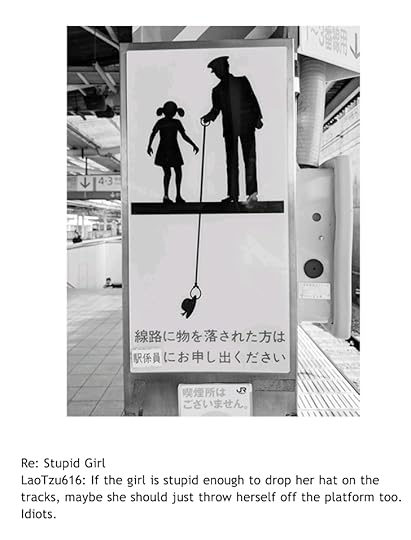
Although I perhaps felt this aspect of the novel could have been developed a little further and indeed earlier in the novel.
The "slyly political" side of the novel includes anti-Zainichi prejudice and the clean-up campaign against the homeless associated with the 2020 Olympics, although Tokyo Ueno Station is a more powerful exploration of this theme.
But the strength to me of The Cat and the City is its evocation of Tokyo, perhaps the best I have read, as someone who has historically spent a lot of time in the city, for example this from Ueno Park in April immediately takes me back to the same sights 20 years earlier:
The revellers are out in full today. They sit beneath the blossoms, drinking beers, eating bento, passing around plastic containers of fried chicken from the convenience store. Some of the older men are drunk already –fallen asleep on the blue tarpaulins spread across the ground. Everyone’s lined their shoes up neatly by the tarps. Hundreds and hundreds of shoes –mostly the black shoes of salarymen, but there are sandals, high heels and sneakers too. I wonder how many people lose shoes in the hanami chaos.
Indeed one could almost play Tokyo bingo, as Bradley incorporates many aspects of living, working and playing, in the city in to his narrative. Amongst others (many of which I have experienced, but I should say not all, particularly the most salacious)
4 stars
My thanks to the publisher via Netgalley for the ARC.
With his eyes still shut, he reached under the table, hand scrambling desperately for the knife. He trembled as he opened his eyes. The muscles in Naomi’s back flexed and came to life. And so too, did the city.
The Cat and The City's epigraph is the 1923 poem 青猫 (Blue Cat) by Hagiwara Sakutaro, presented both in the original and in translation:
To be in love with this city is a good thing
To love the city’s buildings, a good thing
And all those kind women
All those noble lives
Passing through these busy streets
Lined with cherry trees on either side
From whose branches countless sparrows chirp.
Ah! The only thing that can sleep in this vast city night
Is the shadow of a single blue cat
The shadow of a cat that tells the sad history of humanity
The blue shade of happiness I long for.
Forever I chase any shadow,
I thought I wanted Tokyo even on a snowy day
But look there – that cold ragged beggar in the alleyway
Leaning against a wall – what dream is he dreaming?
Cats, of course feature heavily in Japanese literature, and the author's thesis is on the same subject, focusing particularly on Natsume Sōseki, Tanizaki Jun’ichiro, and Murakami Haruki.
The novel begins with a tattooist, one of the last to practice the traditional arts, receiving an unusual commission: first his customer, Naomi, is a young woman rather than his usual yakuza clientele, and second her desired design is his most complex yet, a detailed recreation of Tokyo. She wants the city to be uninhabitated, but he inserts a small cat outside Shibuya station, alongside the statue of Hachiko. But when she returns for each future session, he finds, to his astonishment, that the cat has moved to different places in the cityscape.
The tale that follows is a series of what at first seem separate short stories, but one where the character reoccur and the plotlines converge. And linking them all together is a cat that reappears in each scene, but this is no ordinary cat. As an American translator learns from her Japanese teacher:
貓 P.S. I have a new Chinese character for you to learn. Do you know this one?
Flo looked at the character and thought about it for a second. She was pretty sure it was neko –cat –but had to check. She pulled out her well-thumbed kanji dictionary from a shelf of books on her desk and flipped through the pages. Yes, there it was, neko –cat. But it was different to how it was written normally. The normal way to write the character was 猫–with this radical 犭on the left. The character Ogawa had sent had 豸on the left. That was the tanuki radical. This must be an older version, relating the cat to other shapeshifting animals like the badger, fox and tanuki.
The publisher's blurb describes the novel as "formally inventive and slyly political".
The inventiveness in narration includes a chapter told as a manga cartoon, another as a translated Japanese short-story (actually one invented for the novel) with footnotes, social media posts (example below) and the case notes of a detective, which at first appears detached from the other stories but serves to pull the threads together.
Although I perhaps felt this aspect of the novel could have been developed a little further and indeed earlier in the novel.
The "slyly political" side of the novel includes anti-Zainichi prejudice and the clean-up campaign against the homeless associated with the 2020 Olympics, although Tokyo Ueno Station is a more powerful exploration of this theme.
But the strength to me of The Cat and the City is its evocation of Tokyo, perhaps the best I have read, as someone who has historically spent a lot of time in the city, for example this from Ueno Park in April immediately takes me back to the same sights 20 years earlier:
The revellers are out in full today. They sit beneath the blossoms, drinking beers, eating bento, passing around plastic containers of fried chicken from the convenience store. Some of the older men are drunk already –fallen asleep on the blue tarpaulins spread across the ground. Everyone’s lined their shoes up neatly by the tarps. Hundreds and hundreds of shoes –mostly the black shoes of salarymen, but there are sandals, high heels and sneakers too. I wonder how many people lose shoes in the hanami chaos.
Indeed one could almost play Tokyo bingo, as Bradley incorporates many aspects of living, working and playing, in the city in to his narrative. Amongst others (many of which I have experienced, but I should say not all, particularly the most salacious)
Roppongi hostess barsOverall an enjoyable and atmospheric read.
Yakitori
Love hotels
Yakuza, complete with tattoos and incomplete with missing fingertips
Shibuya and Shinjuku night life
Driver-operated passenger doors on taxis
Ramen
Long commutes to the satellite towns
Haiku
Soaplands
Shogi Chess
Daikon radishes
Sensō-ji temple in Asakusa
Homeless people collecting aluminium cans for the recycling fee
Compulsory after-work collegiate Karaoke parties
Onsen
Harajuku shopping malls
Genkan at the entrance to an apartment
Manga
Hello Kitty
Sumo Wrestlers
Kawaii
The Golden Pavilion in Kyoto
Chikan pests on packed trains
Rakugo story tellers
Takeshima Island (or, rather, Dok-do!)
Tokyo tower
Udon
The long trip from Narita airport
Kanji
Hachiko the Dog
Video games
Lawson convenience stores
Capsule hotels
Katakana
Views of Mount Fuji on a clear winter day
Cherry blossom parties in Ueno Park
The JR Yamanote line
School boys in suits and girls in sailor suits
Preprepared peanut butter sandwiches on crustless white bread
Shochu
Gaijin
Onokomiyaki
Onigiri
Shinjuku Station
Coffee in cans
Vending machines
4 stars
My thanks to the publisher via Netgalley for the ARC.

January 13, 2020
A lot of the fun to be had reading this book is in spotting the connections between the characters and the stories. And it has to be said, doing that is a LOT of fun.
In the first story, Naomi arrives at at a tattoo parlour and asks for an unusual tattoo, a detailed map of Tokyo all over her back. Kentaro, the tattooist, includes a cat and, much to his surprise, discovers that tattooed cat seems to have a life of its own as it moves around the tattoo he is working on, appearing in a different place each time Naomi arrives for her next session.
This introduction triggers a series of stories, all of which feature a cat in one way or another. To begin with, it feels like a short story collection. But, by about halfway through, it starts to feel more like a novel because so many characters are connected and re-appear in different stories. Some are related to others, some employed by others, some friends with others, some a combination of these relationships and more. It falls to the reader to spot the connections and, as you do that, several different plot lines gradually come into focus. Since spotting these is a large part of the enjoyment in the book, I am not going to discuss any of them here!
I finished the book definitely feeling more that I had read a novel than that I had read a short story collection. Yes, the pieces are often loosely connected. Yes, the timeline as presented is jumbled up. I’d like to re-read the book and “mind map” the connections because what we end up with is a group of people living different lives in one of the world’s busiest cities, but with all of their lives overlapping and crossing one another. It put me in mind of the movie Magnolia which tracks several different people living in a city who are connected in all kinds of ways, most of which they are unaware of (I think - it’s a long time since I watched that film).
And I think that’s part of the pleasure of reading the book, these connections, both known and unknown (sometimes as fleeting as two people sitting on a bus or train at the same time and catching one another’s eye), but connections in the hustle and bustle of a mega-city.
There is a lot of talk of the upcoming 2020 Olympics and the preparations being made across the city (I am not an expert on Japan, but I imagine this is where the “slyly political” blurb comment comes from, at least in part, as the city goes about “clearing up” by taking people off the streets). There are several mentions of people doing their best not to stand out (because the nail that stands out gets hammered). There is a portrait of Tokyo which feels very atmospheric, although I have never been there so I have no way to know if it is accurate.
For the first third of the book, I found myself slightly distracted by the number of Japanese terms that I didn’t understand. Most of them I could work out from the context, although I still felt compelled to Google them to check I had understood correctly. If you want to avoid as much internet searching as I did, my advice would be “things mean what you think they mean, so run with that”. This will make your experience of the book smoother and, probably, better.
That said, I really enjoyed reading this. I am not quite sure where the “formally inventive” description comes from. There are some unusual sections (e.g. a manga cartoon and some social media posts), but this didn’t feel especially inventive to me. And there is one story that feels like it is running separately from the others but ends up pulling several storylines together. Again, this is interesting, but is it “inventive”?
Whether it is inventive or not, it is a lot of fun and worth reading for that and its evocation of Tokyo that feels, to someone completely ignorant, authentic.
In the first story, Naomi arrives at at a tattoo parlour and asks for an unusual tattoo, a detailed map of Tokyo all over her back. Kentaro, the tattooist, includes a cat and, much to his surprise, discovers that tattooed cat seems to have a life of its own as it moves around the tattoo he is working on, appearing in a different place each time Naomi arrives for her next session.
This introduction triggers a series of stories, all of which feature a cat in one way or another. To begin with, it feels like a short story collection. But, by about halfway through, it starts to feel more like a novel because so many characters are connected and re-appear in different stories. Some are related to others, some employed by others, some friends with others, some a combination of these relationships and more. It falls to the reader to spot the connections and, as you do that, several different plot lines gradually come into focus. Since spotting these is a large part of the enjoyment in the book, I am not going to discuss any of them here!
I finished the book definitely feeling more that I had read a novel than that I had read a short story collection. Yes, the pieces are often loosely connected. Yes, the timeline as presented is jumbled up. I’d like to re-read the book and “mind map” the connections because what we end up with is a group of people living different lives in one of the world’s busiest cities, but with all of their lives overlapping and crossing one another. It put me in mind of the movie Magnolia which tracks several different people living in a city who are connected in all kinds of ways, most of which they are unaware of (I think - it’s a long time since I watched that film).
And I think that’s part of the pleasure of reading the book, these connections, both known and unknown (sometimes as fleeting as two people sitting on a bus or train at the same time and catching one another’s eye), but connections in the hustle and bustle of a mega-city.
There is a lot of talk of the upcoming 2020 Olympics and the preparations being made across the city (I am not an expert on Japan, but I imagine this is where the “slyly political” blurb comment comes from, at least in part, as the city goes about “clearing up” by taking people off the streets). There are several mentions of people doing their best not to stand out (because the nail that stands out gets hammered). There is a portrait of Tokyo which feels very atmospheric, although I have never been there so I have no way to know if it is accurate.
For the first third of the book, I found myself slightly distracted by the number of Japanese terms that I didn’t understand. Most of them I could work out from the context, although I still felt compelled to Google them to check I had understood correctly. If you want to avoid as much internet searching as I did, my advice would be “things mean what you think they mean, so run with that”. This will make your experience of the book smoother and, probably, better.
That said, I really enjoyed reading this. I am not quite sure where the “formally inventive” description comes from. There are some unusual sections (e.g. a manga cartoon and some social media posts), but this didn’t feel especially inventive to me. And there is one story that feels like it is running separately from the others but ends up pulling several storylines together. Again, this is interesting, but is it “inventive”?
Whether it is inventive or not, it is a lot of fun and worth reading for that and its evocation of Tokyo that feels, to someone completely ignorant, authentic.

April 14, 2023
Kedi ve Şehir benim Yaşam ve Yazgı’nın hem yüreğimin hem de bileklerimin kaldıramadığı ağırlığından dolayı eşlikçi tercihiyle başladığım bir kitaptı.
Öncelikle şunu söylemeliyim ki kitap muazzam bir merak unsuru üzerine kurulu. Daha ilk bölümden itibaren “BURADA NELER OLUYOR?” heyecanını içinize ekiyor ve bölümler ilerledikçe hayatların birbirine teması, bir görünüp bir kaybolan kedi ile temposunu hiç kaybetmiyor.
Anlatının temel zamanı Tokyo 2020 Olimpiyatları ve öncesindeki hazırlık dönemini kapsıyor. Bir yandan olimpiyat-ya da benzeri dünya kupası vb- organizasyonların ülkeler, şehirler ve insanlar üzerindeki hem ekonomik hem de toplumsal düzen üzerindeki etkilerini anlatıyor. Diğer yandansa Uzakdoğu -burada tabii ki Japonya özelinde- ülkelerindeki çalışma kültürü ve kadının toplumsal konumu hakkında oldukça rahatsız edici gerçeklere değiniyor. Ama bu detayların kitap üzerinde hem iyi hem de kötü etkileri var. Kitabın belli bir bölününe kadar “goodreadste kesin 5 yıldızla oylayacağım” diye geldim ancak bir kırılım noktasında “üçe doğru gidiyoruz”a döndü fikrim. Çünkü kadınların durumunu anlatırken bir noktada bu toplumsal bir baskının sonucundan ziyade kadınların kendi tercihi gibi hissettiren bir iki kısım var. Diğer bir nokta ise bu kadar özel ve zengin bir konuda sona doğru hikayenin gidişi fazla basit bir “feel good” kategorisi kitaplara dönüşüyor. Yine de farklı konu tercihi ve merakı canlı tutması açısından oldukça keyifli bir kitaptı. Özellikle zorlayıcı bir okumamın yanında çok iyi geldi.
Öncelikle şunu söylemeliyim ki kitap muazzam bir merak unsuru üzerine kurulu. Daha ilk bölümden itibaren “BURADA NELER OLUYOR?” heyecanını içinize ekiyor ve bölümler ilerledikçe hayatların birbirine teması, bir görünüp bir kaybolan kedi ile temposunu hiç kaybetmiyor.
Anlatının temel zamanı Tokyo 2020 Olimpiyatları ve öncesindeki hazırlık dönemini kapsıyor. Bir yandan olimpiyat-ya da benzeri dünya kupası vb- organizasyonların ülkeler, şehirler ve insanlar üzerindeki hem ekonomik hem de toplumsal düzen üzerindeki etkilerini anlatıyor. Diğer yandansa Uzakdoğu -burada tabii ki Japonya özelinde- ülkelerindeki çalışma kültürü ve kadının toplumsal konumu hakkında oldukça rahatsız edici gerçeklere değiniyor. Ama bu detayların kitap üzerinde hem iyi hem de kötü etkileri var. Kitabın belli bir bölününe kadar “goodreadste kesin 5 yıldızla oylayacağım” diye geldim ancak bir kırılım noktasında “üçe doğru gidiyoruz”a döndü fikrim. Çünkü kadınların durumunu anlatırken bir noktada bu toplumsal bir baskının sonucundan ziyade kadınların kendi tercihi gibi hissettiren bir iki kısım var. Diğer bir nokta ise bu kadar özel ve zengin bir konuda sona doğru hikayenin gidişi fazla basit bir “feel good” kategorisi kitaplara dönüşüyor. Yine de farklı konu tercihi ve merakı canlı tutması açısından oldukça keyifli bir kitaptı. Özellikle zorlayıcı bir okumamın yanında çok iyi geldi.

September 13, 2020
I really wanted to love this book but was sadly disappointed.
Perhaps it was my expectation of what it was going to be. I assumed it was a collection of interconnected stories that were weaved together by the cat, however I couldn't really get into the flow of reading this as there was far too many stories, characters, different writing styles, and many stories were just discarded altogether. I think the book may have worked better with a smaller amount of stories that were told in more detail. The cat was also quite minor in the story.
However, I do think the book touched on some important issues, like the government's attack on the homeless prior to the 2020 Olympic Games (despite the games not going ahead due to Covid). I also thought it did successfully evoke the loneliness of people in big cities, especially in Tokyo.
However though, overall I found myself skim reading and disinterested, unable to connect with the many characters and storylines. So just 2 stars from me!
Perhaps it was my expectation of what it was going to be. I assumed it was a collection of interconnected stories that were weaved together by the cat, however I couldn't really get into the flow of reading this as there was far too many stories, characters, different writing styles, and many stories were just discarded altogether. I think the book may have worked better with a smaller amount of stories that were told in more detail. The cat was also quite minor in the story.
However, I do think the book touched on some important issues, like the government's attack on the homeless prior to the 2020 Olympic Games (despite the games not going ahead due to Covid). I also thought it did successfully evoke the loneliness of people in big cities, especially in Tokyo.
However though, overall I found myself skim reading and disinterested, unable to connect with the many characters and storylines. So just 2 stars from me!

December 20, 2024
Book club review from tonight:
During pre-discussion, we contemplated renaming our BC, “Dedicated to Hatred” due to the number of times we pick promising books that turn out to be duds. Or so we think. But apologies this time…this one was highly rated, for us. Ahem…my selection. So, what’s the tea?
Firstly, to deal with the structure. It was not quite a novel, not quite a short story collection. It was a mass-integration of characters. The links became clearer as it went on. As a group, we were in between: spending the time investing in a character and then it’s over to enjoying working out the puzzle of who knows who and why. But were mostly passively running with the story than figuring it all out.
The characterisation: was generally 2D, the younger characters worked better. It was more about their experiences, journeys and day-to-day life that hit home than their dialogue and interactions.
The writing: in a good way, it was pedestrian/basic, not too florid. But we reflected that with stories where it’s so florid, it takes you out of the picture, so being simpler was strategic and it was right for the stories.
The point: not quite sure, it was set leading up to and as the Tokyo Olympics began so one theme was the ridding of the slums and its people but there was more to it, but the main vision was lost on us. The journey was nice snapshot of Tokyo.
The darkness: hehe. It got darker as it went. There were some weirdos to begin with, but we met some dangerous others as it went on. Most of us loved that. We generally like weird Japanese stories, and this was no exception. Two of us said, it was like David Mitchell but less wild.
The cat: I won’t spoil it. All were happy about the cat. Anyone thinking of reading it for the cat – it’s ok to do so.
The author/Japanese setting: the author spent ten years there, rather than having been born and raised there. We discussed whether the POV was from an outsider looking in, or someone who knows the less-publicised Japan. No answer.
The ratings: my 3.5, 3.5, 3.5, 3.5 and 2. Fairly consistent for us. As it was a middle-ground rating, there was lots to discuss, with differences in what was liked/disliked. Our outlier differed in not getting into the switching between characters/chapters, the 2D-ality. BC recommended.
During pre-discussion, we contemplated renaming our BC, “Dedicated to Hatred” due to the number of times we pick promising books that turn out to be duds. Or so we think. But apologies this time…this one was highly rated, for us. Ahem…my selection. So, what’s the tea?
Firstly, to deal with the structure. It was not quite a novel, not quite a short story collection. It was a mass-integration of characters. The links became clearer as it went on. As a group, we were in between: spending the time investing in a character and then it’s over to enjoying working out the puzzle of who knows who and why. But were mostly passively running with the story than figuring it all out.
The characterisation: was generally 2D, the younger characters worked better. It was more about their experiences, journeys and day-to-day life that hit home than their dialogue and interactions.
The writing: in a good way, it was pedestrian/basic, not too florid. But we reflected that with stories where it’s so florid, it takes you out of the picture, so being simpler was strategic and it was right for the stories.
The point: not quite sure, it was set leading up to and as the Tokyo Olympics began so one theme was the ridding of the slums and its people but there was more to it, but the main vision was lost on us. The journey was nice snapshot of Tokyo.
The darkness: hehe. It got darker as it went. There were some weirdos to begin with, but we met some dangerous others as it went on. Most of us loved that. We generally like weird Japanese stories, and this was no exception. Two of us said, it was like David Mitchell but less wild.
The cat: I won’t spoil it. All were happy about the cat. Anyone thinking of reading it for the cat – it’s ok to do so.
The author/Japanese setting: the author spent ten years there, rather than having been born and raised there. We discussed whether the POV was from an outsider looking in, or someone who knows the less-publicised Japan. No answer.
The ratings: my 3.5, 3.5, 3.5, 3.5 and 2. Fairly consistent for us. As it was a middle-ground rating, there was lots to discuss, with differences in what was liked/disliked. Our outlier differed in not getting into the switching between characters/chapters, the 2D-ality. BC recommended.
July 14, 2020
I’m going to take it as easy as I can because I really respect anyone creating art and putting it out there, and this is a great accomplishment.
Having said that, I would like to say why I found this a disheartening read and reiterate another commenters point on the potential offence taken by a Japanese reader, particularly a female one.
My personal issue is that this book, which intertwined several related narratives of people living in Tokyo, takes us to page 93 before we get a female perspective, and she is American. Up to and after this point, all of the Japanese (and other female characters) are highly sexualised/oversimplified cliches of women from their respective cultures- ie ..
Mari who tells her English boyfriend to be sexually violent to her (and incidentally has high cheekbones and a short haircut) and Natasha the Russian ‘angel’ sex worker with blonde hair, blue eyes and white breasts that ‘swell’. Incidentally all the non Japanese women have blonde hair and blue eyes.
Not only are the women apparently without feelings or ideas, they are subject to a disproportionate (I hope) amount of sexual violence either in the actual book or the internal monologue of the male characters. The two women who have a story with less sexual violence (Flo and Ogawa) have their narrative revolve around the male author within the book. Incidentally, Flo’s story isn’t about sexual violence but does begin with her begin molested on the train.
I’ve lived in Japan for five years so I’m familiar with the tropes and archetypes he talks about from my first year (including the ‘chikan’ train molesters, although I always found England more dangerous personally). After that I developed friendships and relationships with people who are unrecognizable in any of these characters. I don’t ask for another romanticized view of the East but I also don’t see any of the goodness, kindness and complexity in the culture that I’ve experienced.
There are reasons behind why people behave the way they do and to portray half the human race (my half) as empty headed sex robots is not a revolutionary tactic in literature and this was a disappointment. Also, sex work is something women generally do as a very last resort. It’s not freedom, it’s not an expression of your natural desires, it’s a difficult, dangerous, self abnigating job. I can’t see a cat doing it.
I don’t want to fall back on the old ‘how would you feel if this was your daughter?’ Tactic of asking a man to imagine a woman he ‘owns’ rather than simply how any woman might feel, but here we go.
If I have a daughter she will likely be half Japanese if my husband is anything to go by. I wouldn’t want her reading this book, unless maybe as a home patriarchy comprehension exercise. The book is a world so richly populated with characters in the city she would grow up in, with people representing both her cultures and women who offer her two options- have high cheekbones/green eyes/white skin and work in a brothel or dedicate your life to a man’s creative output, ps you will be sexually abused whichever route you go. I will give my daughter Okakura Kakuzo’s ‘The Book of Tea’ and Anne Bronte’s ‘The Tenant of Wildfell Hall’ and I highly recommend reading these if you haven’t, and need a little faith restoring after this.
Having said that, I would like to say why I found this a disheartening read and reiterate another commenters point on the potential offence taken by a Japanese reader, particularly a female one.
My personal issue is that this book, which intertwined several related narratives of people living in Tokyo, takes us to page 93 before we get a female perspective, and she is American. Up to and after this point, all of the Japanese (and other female characters) are highly sexualised/oversimplified cliches of women from their respective cultures- ie ..
Mari who tells her English boyfriend to be sexually violent to her (and incidentally has high cheekbones and a short haircut) and Natasha the Russian ‘angel’ sex worker with blonde hair, blue eyes and white breasts that ‘swell’. Incidentally all the non Japanese women have blonde hair and blue eyes.
Not only are the women apparently without feelings or ideas, they are subject to a disproportionate (I hope) amount of sexual violence either in the actual book or the internal monologue of the male characters. The two women who have a story with less sexual violence (Flo and Ogawa) have their narrative revolve around the male author within the book. Incidentally, Flo’s story isn’t about sexual violence but does begin with her begin molested on the train.
I’ve lived in Japan for five years so I’m familiar with the tropes and archetypes he talks about from my first year (including the ‘chikan’ train molesters, although I always found England more dangerous personally). After that I developed friendships and relationships with people who are unrecognizable in any of these characters. I don’t ask for another romanticized view of the East but I also don’t see any of the goodness, kindness and complexity in the culture that I’ve experienced.
There are reasons behind why people behave the way they do and to portray half the human race (my half) as empty headed sex robots is not a revolutionary tactic in literature and this was a disappointment. Also, sex work is something women generally do as a very last resort. It’s not freedom, it’s not an expression of your natural desires, it’s a difficult, dangerous, self abnigating job. I can’t see a cat doing it.
I don’t want to fall back on the old ‘how would you feel if this was your daughter?’ Tactic of asking a man to imagine a woman he ‘owns’ rather than simply how any woman might feel, but here we go.
If I have a daughter she will likely be half Japanese if my husband is anything to go by. I wouldn’t want her reading this book, unless maybe as a home patriarchy comprehension exercise. The book is a world so richly populated with characters in the city she would grow up in, with people representing both her cultures and women who offer her two options- have high cheekbones/green eyes/white skin and work in a brothel or dedicate your life to a man’s creative output, ps you will be sexually abused whichever route you go. I will give my daughter Okakura Kakuzo’s ‘The Book of Tea’ and Anne Bronte’s ‘The Tenant of Wildfell Hall’ and I highly recommend reading these if you haven’t, and need a little faith restoring after this.

June 2, 2020

Visit the locations in the novel here
Magical!
If I were to write a one word review, that would be it. A cat appears in story one and then disappears (in the most magical of ways) only to appear again later on. Following this cat soon became my obsession. No, I’m not going mad, this novel is a whimsical story of magical realism and it’s a wonderful way of storytelling. I have since learned that the cat is almost revered in Japan as if it were some kind of god like figure. Now, I understand why and why the symbolism of this cat brings even more to the story that you might realise at first.
This might have been a series of stories, but the way they interlinked and wrapped around each other really does build a rewarding whole. Each character had their own unique voice, the stories meandered like a smooth rippling river and the city of Tokyo sparkled under the pen of the author. So, you can tell how much this book got to me!
I finished the book and had to think about what I ‘d just read. What I’d read about and how it made me feel. These stories build layers of stories about human nature, relationships, life in the big city and the changing face of Japan itself. We meet the human face of Tokyo, of Japan from a homeless man to a woman in a temple. The way the novel is presented also differs which was fascinating to experience. There’s stories and even manga strips at the end. I read this on a kindle. I have to buy the book!
The author clearly knows,loves and ‘gets’ Japan. I’ve never had a tour like this before. Never does he show you sights and describe sounds of the city, yet he evokes them with his pen. There’s lots of language anecdotes to which warmed the novel even more and placed it firmly on the literary map. To be fair, it was there already.
This is a wonderful reading experience I will never forget. I’m shivering with excitement just thinking about it!

May 21, 2021
Каква странна книга! Много японска и загадъчно котешка.
Ако трийсетмилионно Токио можеше да говори, какви ли истории щеше да разкаже за годината на Олимпиадата? Накъсаните, често окаяни, понякога привидно бляскави, рядко щастливи парчета съдба на обитаващите го затворници, втурнали се в безумната и неспирна въртележка на ежедневието, което убива. Безброй фрагменти, които преливат и се наслагват в изплъзваща се картина, пронизана от гигантската невронна мрежа от улици, метростанции и тайни кътчета на града.
Сюрреалистична (или не дотам) улична токийска котка калико води читателя в студио за татуировки, необикновен изоставен хотел, лъскав офис, нощни заведения и клубове, таксита, котешко кафене, фабрика, стари къщи под вишневи дървета и даже детективка агенция. Налитаме на всякакви чудаци, които на повърхността си са нормални хора, но всеки си носи собствената мъка или лудост, самота, мечта, или просто жажда за обич. Свободата и щастието са почти толкова призрачни, колкото и е главната героиня - котката, а плетеницата от лица е водовъртеж от съдби насред бесен трафик и цъфнала сакура.
Картата на Токио е на разположение на читателя - и я няма в справочниците.
⭐️4,5 звезди⭐️
П.П. Липсата на редакторски бележки за японските имена, понятия и реплики наистина е изключително дразнеща!
Ако трийсетмилионно Токио можеше да говори, какви ли истории щеше да разкаже за годината на Олимпиадата? Накъсаните, често окаяни, понякога привидно бляскави, рядко щастливи парчета съдба на обитаващите го затворници, втурнали се в безумната и неспирна въртележка на ежедневието, което убива. Безброй фрагменти, които преливат и се наслагват в изплъзваща се картина, пронизана от гигантската невронна мрежа от улици, метростанции и тайни кътчета на града.
Сюрреалистична (или не дотам) улична токийска котка калико води читателя в студио за татуировки, необикновен изоставен хотел, лъскав офис, нощни заведения и клубове, таксита, котешко кафене, фабрика, стари къщи под вишневи дървета и даже детективка агенция. Налитаме на всякакви чудаци, които на повърхността си са нормални хора, но всеки си носи собствената мъка или лудост, самота, мечта, или просто жажда за обич. Свободата и щастието са почти толкова призрачни, колкото и е главната героиня - котката, а плетеницата от лица е водовъртеж от съдби насред бесен трафик и цъфнала сакура.
Картата на Токио е на разположение на читателя - и я няма в справочниците.
⭐️4,5 звезди⭐️
П.П. Липсата на редакторски бележки за японските имена, понятия и реплики наистина е изключително дразнеща!

April 5, 2021
100 ⭐⭐⭐ (дори те са малко за тази книга)
Не знам от къде да започна...може би от факта, че обожавам котки и си взех книгата първо заради невероятно вълшебната корица на Живко Петров (БЛАГОДАРЯ)...А на допир тази корица възпламенява всички сетива на четящият историите вътре!
Какво да кажа за книгата? Кратките отделни разкази са толкова свързани един с друг, че настръхваш докато ги четеш! Автора проследява различни хора от обществото като фино и брилянтно преплита историите и живота им на фона на 30 милионният Токио...със анимето, манга, сакура (черешовото цъфнало дръвче) и всичките красоти, които съдържа тази култура, прави книгата едно малко невероятно бижу в личната ми библиотека!
Да не пропусна само да кажа, че повече от 10 години съм фен на Корея и Япония и като цяло културата и философията им на живот, та това допринесе също за желанието да притежавам тази красота! ❤
Не знам от къде да започна...може би от факта, че обожавам котки и си взех книгата първо заради невероятно вълшебната корица на Живко Петров (БЛАГОДАРЯ)...А на допир тази корица възпламенява всички сетива на четящият историите вътре!
Какво да кажа за книгата? Кратките отделни разкази са толкова свързани един с друг, че настръхваш докато ги четеш! Автора проследява различни хора от обществото като фино и брилянтно преплита историите и живота им на фона на 30 милионният Токио...със анимето, манга, сакура (черешовото цъфнало дръвче) и всичките красоти, които съдържа тази култура, прави книгата едно малко невероятно бижу в личната ми библиотека!
Да не пропусна само да кажа, че повече от 10 години съм фен на Корея и Япония и като цяло културата и философията им на живот, та това допринесе също за желанието да притежавам тази красота! ❤

April 27, 2026
The Cat and the City unfolds with a quiet confidence, inviting the reader into a version of Tokyo that feels like a shifting constellation of lives. as I moved through its pages, I became increasingly aware of how deliberately the novel resists narrative neatness. it is structured as a series of interlinked glimpses and while that fragmentation might seem distancing at first, I found it gradually cultivating a kind of attentiveness in me. I wasn’t simply following a story; I was observing patterns, tracing echoes and noticing how seemingly incidental moments reverberate across different perspectives.
particularly impressive the author’s sensitivity to atmosphere. the city emerges not through grand descriptions, but through carefully chosen details, such as sounds half-heard, interactions cut short and the quiet weight of solitude in crowded spaces. I felt drawn into that rhythm, recognizing something truthful in the way the characters move alongside one another without always connecting directly. the book captures that peculiar urban paradox: the simultaneous closeness and distance between people who share the same physical space yet remain largely unknown to one another.
at times, I did feel a slight sense of detachment. the rotating viewpoints, while thematically coherent, meant that certain characters slipped away just as I was beginning to understand them. I occasionally wanted more time, more depth and more sustained emotional engagement before being guided onward. that said, I also came to appreciate how this transience reflects the book's larger concerns. not every encounter in life offers closure and not every story unfolds long enough to fully grasp. in that sense, the structure feels less like a limitation and more like a deliberate artistic choice, even if it doesn’t always satisfy on an emotional level.
the cat itself threads through the narrative with an almost symbolic lightness. I found its presence intriguing, though somewhat elusive in its purpose. it connects the novel’s strands in a way that feels intuitive rather than fully defined and while I admired that subtlety, I occasionally wished for a clearer sense of its significance. still, its ambiguity contributes to the story's overall tone, one that leans toward suggestion rather than explanation.
by the time I reached the end, I wasn’t left with a single, defining impression so much as a layered one. I felt as though I had briefly stepped into a network of lives that intersect in subtle, often unspoken ways. while I didn’t feel completely immersed in every thread, I found enough moments of resonance to stay engaged and enough nuance to keep thinking about it afterward. it’s a novel that doesn’t insist on being memorable, yet quietly earns that distinction through its patience and its attention to the fleeting nature of connection.
particularly impressive the author’s sensitivity to atmosphere. the city emerges not through grand descriptions, but through carefully chosen details, such as sounds half-heard, interactions cut short and the quiet weight of solitude in crowded spaces. I felt drawn into that rhythm, recognizing something truthful in the way the characters move alongside one another without always connecting directly. the book captures that peculiar urban paradox: the simultaneous closeness and distance between people who share the same physical space yet remain largely unknown to one another.
at times, I did feel a slight sense of detachment. the rotating viewpoints, while thematically coherent, meant that certain characters slipped away just as I was beginning to understand them. I occasionally wanted more time, more depth and more sustained emotional engagement before being guided onward. that said, I also came to appreciate how this transience reflects the book's larger concerns. not every encounter in life offers closure and not every story unfolds long enough to fully grasp. in that sense, the structure feels less like a limitation and more like a deliberate artistic choice, even if it doesn’t always satisfy on an emotional level.
the cat itself threads through the narrative with an almost symbolic lightness. I found its presence intriguing, though somewhat elusive in its purpose. it connects the novel’s strands in a way that feels intuitive rather than fully defined and while I admired that subtlety, I occasionally wished for a clearer sense of its significance. still, its ambiguity contributes to the story's overall tone, one that leans toward suggestion rather than explanation.
by the time I reached the end, I wasn’t left with a single, defining impression so much as a layered one. I felt as though I had briefly stepped into a network of lives that intersect in subtle, often unspoken ways. while I didn’t feel completely immersed in every thread, I found enough moments of resonance to stay engaged and enough nuance to keep thinking about it afterward. it’s a novel that doesn’t insist on being memorable, yet quietly earns that distinction through its patience and its attention to the fleeting nature of connection.

June 4, 2021
Много симпатична и очарователна книга с прекрасни колоритни и закачливо навързани истории. Впечатлена съм от начина, по който Ник Брадли е уловил японския дух и го е предал с лекота. Авторът е изградил сюреалистична атмосфера, където главния герой всъщност е котка, която обикаля улиците на Токио. Котката държи града под око и посещава различни местенца, свързвайки по магичен начин отделните истории.
Честно казано, очаквах, че книгата ще е приятна, но не предполагах, че ще ми хареса толкова. Разкош 🥰
P.S: Единственото, което ме подразни е, че имаше доста думи и изрази на японски( написани на български), които не бяха обяснени какво значат. Като например- " Яппари гайджин вакаранай не"( стр 150). Иди разбери що е туй? Дори в Google translate не мога да го потърся, понеже е изписано така... 🙄
Честно казано, очаквах, че книгата ще е приятна, но не предполагах, че ще ми хареса толкова. Разкош 🥰
P.S: Единственото, което ме подразни е, че имаше доста думи и изрази на японски( написани на български), които не бяха обяснени какво значат. Като например- " Яппари гайджин вакаранай не"( стр 150). Иди разбери що е туй? Дори в Google translate не мога да го потърся, понеже е изписано така... 🙄

July 18, 2023
Epey beklentisiz başladım bu kitabı okumaya, tatmin de oldum. İngiliz yazar Nick Bradley'nin "Kedi ve Şehir" kitabı edebiyat açısından katiyen bir şölen filan sunmamakla beraber kendini okutmayı çok iyi beceriyor.
İlk bakışta birbirinden bağımsız gözüken kısa öyküler okuyoruz, sanki tek bağıntıları hepsinin 2020 Olimpiyatlarına hazırlanan Tokyo'da geçiyor olması ve aynı üç renkli kedinin her hikâyede görünmesi gibi geliyor ama okudukça aslında hikâyelerin iç içe geçtiğini anlıyoruz. Burada azıcık dikkatli olmak lazım ama çok değil, yazar bağıntıları açıkça kuruyor, pek gözden kaçacak gibi değil. Bir hikâyede kısaca beliren bir taksi şoförü diğer hikayenin baş kahramanı oluyor vs. Zaten de sona yaklaştıkça tüm öyküler bir biçimde iç içe geçip bütünleşiyor. Aslında çoğu birbirini tanımayan bir sürü insanın hayatlarının o devasa şehirde nasıl da kesiştiğini anlıyoruz. (Bülent Ortaçgil'i duyuyor musunuz, "Belki benim kağıt param bir şekilde döne dolaşa senin cebine girmiştir" diyor? Eylülcüm biraz ciddiyet lütfen)
Neyse evet, ciddiyet. Japon kültürüne ve bize epey yabancı adetlerine, Yakuza'ya, Tokyo'nun dinamiklerine dair çokça ilginç ayrıntı var. Ben tabii bunlara hakim olmadığım için yazar ne kadar Batılı gözüyle bakmış, ne kadar doğru aktarmış onu kestiremiyorum. Ama ne zaman Japonya'dan bir şeyler okusam özellikle cinsiyet ve cinsellik konularında alıştığımızdan ne kadar farklı olduklarına şaşırıyorum, yine oldu. Bir Mişima yahut Tanizaki kadar karanlık ve rahatsız edici olmasa da burada da bana çok acayip gelen detaylar vardı.
Ezcümle müthiş sürükleyici, belki birazcık sabun köpüğü ama birazcık, baya eğlenceli, kendini okutan, çok atmosferik, insanın merakını hep diri tutmayı beceren bir kitap bu. Sürekli belirip duran kediye dair öyküyü biraz daha somutlaştırıp bağlamasını isterdim. Belki ismi "Kedi ve Şehir" olduğu için beklentim bu yöndeydi ama kedinin hikâyesi biraz havada kalmış gibi geldi bana.
Tam kafa dağıtıp uzaklaşmalık kitap. Oradan oraya çok güzel akıyor, sevdim ben.
İlk bakışta birbirinden bağımsız gözüken kısa öyküler okuyoruz, sanki tek bağıntıları hepsinin 2020 Olimpiyatlarına hazırlanan Tokyo'da geçiyor olması ve aynı üç renkli kedinin her hikâyede görünmesi gibi geliyor ama okudukça aslında hikâyelerin iç içe geçtiğini anlıyoruz. Burada azıcık dikkatli olmak lazım ama çok değil, yazar bağıntıları açıkça kuruyor, pek gözden kaçacak gibi değil. Bir hikâyede kısaca beliren bir taksi şoförü diğer hikayenin baş kahramanı oluyor vs. Zaten de sona yaklaştıkça tüm öyküler bir biçimde iç içe geçip bütünleşiyor. Aslında çoğu birbirini tanımayan bir sürü insanın hayatlarının o devasa şehirde nasıl da kesiştiğini anlıyoruz. (Bülent Ortaçgil'i duyuyor musunuz, "Belki benim kağıt param bir şekilde döne dolaşa senin cebine girmiştir" diyor? Eylülcüm biraz ciddiyet lütfen)
Neyse evet, ciddiyet. Japon kültürüne ve bize epey yabancı adetlerine, Yakuza'ya, Tokyo'nun dinamiklerine dair çokça ilginç ayrıntı var. Ben tabii bunlara hakim olmadığım için yazar ne kadar Batılı gözüyle bakmış, ne kadar doğru aktarmış onu kestiremiyorum. Ama ne zaman Japonya'dan bir şeyler okusam özellikle cinsiyet ve cinsellik konularında alıştığımızdan ne kadar farklı olduklarına şaşırıyorum, yine oldu. Bir Mişima yahut Tanizaki kadar karanlık ve rahatsız edici olmasa da burada da bana çok acayip gelen detaylar vardı.
Ezcümle müthiş sürükleyici, belki birazcık sabun köpüğü ama birazcık, baya eğlenceli, kendini okutan, çok atmosferik, insanın merakını hep diri tutmayı beceren bir kitap bu. Sürekli belirip duran kediye dair öyküyü biraz daha somutlaştırıp bağlamasını isterdim. Belki ismi "Kedi ve Şehir" olduğu için beklentim bu yöndeydi ama kedinin hikâyesi biraz havada kalmış gibi geldi bana.
Tam kafa dağıtıp uzaklaşmalık kitap. Oradan oraya çok güzel akıyor, sevdim ben.

April 26, 2022
The Cat and the City is a book in which British author Nick Bradley collects his impressions of Japan, where he reportedly spent about a decade of his life. It is a collection of short stories that are, through the binding elements of a wandering cat and life in Tokyo, sometimes loosely sometimes closely connected to each other.
I don't know too much about Japan, I have never been there and my general knowledge does not go beyond a diffuse hodgepodge of bits of information I have from Jonathan Ross' Japanorama, the occasional Japanese books I read and movies I watch.
So I'm not sure if “loosely connected short stories” genre is typical Japanese, but I quite enjoyed it here; a side character in one of the stories will be the lead in another and someone mentioned somewhere incidentally will play a bigger part in the next story. I like that kind of connection and it kept me guessing who is who. I also liked the descriptions of a big city here, I sometimes felt like wandering around the city myself and peeping on other people's lives.
Despite this little amusement I have to say that I found most characters very surface level and without depth. I'm not sure if that was the aim here or not but I wished that I had a better link to them. Sometimes some characters felt stereotypical, but as I said, I'm not an expert and can't really differentiate what is intentional here and what is not. All in all, I enjoyed it as a light entertainment ad learned a thing or two about Tokyo.
I don't know too much about Japan, I have never been there and my general knowledge does not go beyond a diffuse hodgepodge of bits of information I have from Jonathan Ross' Japanorama, the occasional Japanese books I read and movies I watch.
So I'm not sure if “loosely connected short stories” genre is typical Japanese, but I quite enjoyed it here; a side character in one of the stories will be the lead in another and someone mentioned somewhere incidentally will play a bigger part in the next story. I like that kind of connection and it kept me guessing who is who. I also liked the descriptions of a big city here, I sometimes felt like wandering around the city myself and peeping on other people's lives.
Despite this little amusement I have to say that I found most characters very surface level and without depth. I'm not sure if that was the aim here or not but I wished that I had a better link to them. Sometimes some characters felt stereotypical, but as I said, I'm not an expert and can't really differentiate what is intentional here and what is not. All in all, I enjoyed it as a light entertainment ad learned a thing or two about Tokyo.

July 25, 2021
4.5
"Котката и градът" е съкровище, а за изкушените от японската култура и съвременните ѝ измерения си е същинска находка. Уж се води роман, но трудно бих я определила като такъв - по-скоро сборник с взаимосвързани разкази, чиито герои изскачат ту в една, ту в друга история.
Разнообразите от сюжети и жанрове е впечатляващо - детективски ноар, семейна драма, фентъзи и научна фантастика, та чак до манга. Нямаше разказ, който да не ми допаднa или да не ми беше интересен. Всички са запомнящи се, представят грабваща палитра от персонажи и съдби и обхващат многобройните и понякога противоречиви лица на Токио: от френетичния, смазващ бизнес свят до мистериозния и жесток ъндърграунд.
Накратко, прекрасна книга с отлично оползотворена концепция. Горещо препоръчвам!
П.П. Преводът е чудесен, но ми се ще да имаше повече бележки под линия, обясняващи различните японски термини, традиции и т.н.
"Котката и градът" е съкровище, а за изкушените от японската култура и съвременните ѝ измерения си е същинска находка. Уж се води роман, но трудно бих я определила като такъв - по-скоро сборник с взаимосвързани разкази, чиито герои изскачат ту в една, ту в друга история.
Разнообразите от сюжети и жанрове е впечатляващо - детективски ноар, семейна драма, фентъзи и научна фантастика, та чак до манга. Нямаше разказ, който да не ми допаднa или да не ми беше интересен. Всички са запомнящи се, представят грабваща палитра от персонажи и съдби и обхващат многобройните и понякога противоречиви лица на Токио: от френетичния, смазващ бизнес свят до мистериозния и жесток ъндърграунд.
Накратко, прекрасна книга с отлично оползотворена концепция. Горещо препоръчвам!
П.П. Преводът е чудесен, но ми се ще да имаше повече бележки под линия, обясняващи различните японски термини, традиции и т.н.

July 5, 2020
With Tokyo at its heart, Nick Bradley’s debut novel is a love letter to Japan and its literature. It begins with a tattooist who receives an unusual commission from Naomi, a girl with striking, mysterious green eyes. The design she desires is his most complex request yet: a recreation of Tokyo that will cover the entirety of her back. Despite her insistence on the city being uninhabited, the tattooist adds a small cat outside Shibuya station. However, as Naomi returns for future sessions, he notices, to his astonishment, that the cat is wandering around the inked cityscape. What follows is a series of quirky interconnected short stories linked by reoccurring characters and converging plotlines set in the run-up to the 2020 Olympics.
Bradley cleverly employs the mysterious calico cat and his remerging characters as threads to weave multiple stories together. Be it a relative, a work colleague, a fleeting shared glance, or an overheard conversation, for me, part of the pleasure of this book was recognising the subtle connections between characters, connected even amid the hustle and bustle of the megacity.
What’s more, each story explores various aspects of human nature and shares critiques on Japan’s modern society. Bradley covers an extensive list of cultural nuances: capsule hotels, video games, rush hour at busy Shinjuku station, and the cherry blossom trees, tinged with the palest pink. As someone who longs to visit Japan, I felt completely immersed in its culture, this book being a tangible evocation of Tokyo’s sights and sounds. That’s all to say, The Cat and the City is a charming book with a wistful air that is perfect for anyone who wants to armchair travel to Japan and take a tour around its most popular metropolis
4.5 stars
Bradley cleverly employs the mysterious calico cat and his remerging characters as threads to weave multiple stories together. Be it a relative, a work colleague, a fleeting shared glance, or an overheard conversation, for me, part of the pleasure of this book was recognising the subtle connections between characters, connected even amid the hustle and bustle of the megacity.
What’s more, each story explores various aspects of human nature and shares critiques on Japan’s modern society. Bradley covers an extensive list of cultural nuances: capsule hotels, video games, rush hour at busy Shinjuku station, and the cherry blossom trees, tinged with the palest pink. As someone who longs to visit Japan, I felt completely immersed in its culture, this book being a tangible evocation of Tokyo’s sights and sounds. That’s all to say, The Cat and the City is a charming book with a wistful air that is perfect for anyone who wants to armchair travel to Japan and take a tour around its most popular metropolis
4.5 stars
October 20, 2020
I hate to say this, but I disliked this book strongly. I hated the gross attitudes of the male characters and the blatant objectification. Even worse is the seedy behaviors. The writer portrays women as sexual objects intended for the gratification and fantasy of the male protagonists. I get that these kinds of attitudes are common in Japan and that there is darker side as well, but I felt like the author's use of it was completely reductive. The way it's written was reminiscent of a translated from Japanese to English work, because of its short sentences and stilted use of language.
I think the best story in this bunch was the second one. I get what the author was trying to do in using the cat as the narrative thread tying these stories together, but I felt the ending to many of the stories felt so unsatisfyingly open ended. Also, the good majority of these stories are sad and the protagonists are bland or terrible people. I'm glad that other people found this to be an enjoyable read, but sadly I was not one of those people.
I think the best story in this bunch was the second one. I get what the author was trying to do in using the cat as the narrative thread tying these stories together, but I felt the ending to many of the stories felt so unsatisfyingly open ended. Also, the good majority of these stories are sad and the protagonists are bland or terrible people. I'm glad that other people found this to be an enjoyable read, but sadly I was not one of those people.
Displaying 1 - 30 of 1,819 reviews