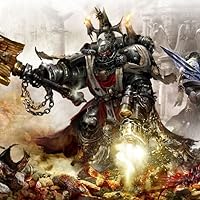
В битве с проклятым Легионом примарха Магнуса Рагнар Черная Грива не смог найти лучшего способа остановить прорыв вражеских сил, кроме как метнуть Копье Русса прямо в пасть Хаоса… Хаос, конечно, поперхнулся, но священнейшая реликвия Ордена Волков была утрачена, похоже, навсегда. Что это было - подвиг или преступление? Не придя к однозначному выводу, Великий Волк решает послать Рагнара куда-нибудь подальше. Точнее, на Терру - в качестве Волчьего Клинка, бойца и телохранителя для союзного Волкам Дома Навигаторов.
Древняя Терра, сердце Империума, открывает Космическому Волку свои объятия. Рагнару приходится быстро учиться - благословенная самим Императором планета оказывается на поверку самым большим змеиным гнездом в Галактике.
This is a great Warhammer 40k novel with surprising subtlety and the fourth in the "Space Wolves" series that focuses on the character Ragnar Blackmane. Sad to say, it is the last by the talented William King (with the next novel in the series being written by a new writer, Lee Lightner). This takes place on Earth, or "Holy Terra," where Ragnar has been assigned to a Navigator House as a "Wolf Blade," a special honor guard pledged to defend the house. In the course of his duty, Ragnar becomes embroiled in the skulduggery of the Navigator Houses. There are some interesting character development elements: Ragnar is forced to confront the reality that even on Holy Terra there are traitors, mutants, and heretics (in other words, a naive morality of good versus evil cannot survive into maturity). A quibble: the enemies weren't all that evil/scary compared to other Warhammer 40k novels. Because so much of this centered around the unfolding of a political conspiracy, the slavering, horned, red-eyed irredeemable enemy of Warhammer 40k space marine novels was absent. Maybe that's a good thing (it made for a little nuance), but it was unexpected. Overall, this was an appropriate end to the arc that King started in *Space Wolf* with an ignorant human Ragnar as aspirant.
Haven’t read a 40K book in ages and it was a much needed jump back into the dark ages of the 41st millennium. William King goes down more of a political intrigue route in this book and it made a nice change and develops Ragnar as a more interesting character as he starts to grow up a bit more and become more world-wise. Also Sven had about 3 lines of dialogue which were all just awful before we said goodbye to him for the rest of the book as Ragnar is sent to Holy Terra. Thank the emperor I didn’t have to read any more Sven for the rest of the book and it was a massive improvement without him.
To make up for this though the author subjects you to the seemingly endless and dull “banter” between Torin and Haegr which all consists of Torin liking mirrors and Haegr always eating. A good 30 pages of this probably could have been chopped out and the book would have been better for it.
Otherwise this was a super fast and fun read. It was really interesting to see Earth and learn more of the Navigators as well as getting into some philosophical territory. The part down in the undercity was really cool and I was getting full blown Star Wars KOTOR vibes which I’m always here for. Been great to be back in the 40K universe.
I would have given one more star if not for the unrealistic combat scenes and King’s usual tendency to linger too long on events that, in my opinion, could have been replaced with more interesting ones or cut short. Some parts of the story felt like filler—almost as if he had a set page count to reach, so he stretched certain sections and introduced events that didn’t add much to the overall plot.
Regarding the unrealistic combat, King isn’t the only writer guilty of this. Many authors write Space Marines as if they’ve never played the tabletop game or lack the imagination to realistically simulate certain events and small-team tactics. These moments break my immersion, which is a real letdown. The Wolves just charge into their enemies, slashing left and right as if they were some mindless horde of zombies. Try that in the tabletop game against someone who knows what they’re doing, and you’ll take a wound halfway through.
That said, I still enjoyed the story. Ragnar being sent to Terra to learn about politics and understand the inner workings of the Imperium is a fantastic arc of growth and experience on his path to greatness. Despite its flaws, the book left me wanting to know what happens next, so I’m definitely still invested in Ragnar’s saga.
I loved this book!Ragnar Blackmane is an interesting and easy to like character. I haven't read any of the other novels in the series, but I didn't need too. This book can easily be a stand alone novel as it doesn't necessarily relate to the other novels, but some references are made and fully explained. This is a nice action packed book full of gripping and sometimes suspenseful scenes and full of great characters. I highly recommend this to any one who likes or plays Space Wolves and recommend to any 40k fan in general. I'm not going to lie, this book made me want to play Space Wolves as a second army and buy Ragnar as my HQ.
In the fourth Ragnar adventure and, I think, the last by original author William King, our Young Wolf hero has been denied his desired promotion and sent instead to a new duty that is in practice half pilgrimage and half babysitting errand.
We're dealing with Navigators and assassination plots so the Dune influence is strong, but King also leans heavily on his own favoured tropes, including finding Ragnar new packmates to aimably bicker with, one of whom is gently ribbed throughout for his copious appetite.
Another enjoyable space romp that tells a similar story to previous entries, albeit in a very different setting this time around. Ragnar remains, to his credit, among the Space Marines most willing to ask questions, and this curiosity makes him far more relatable than many of his peers.
Ragnar Blackmane due to his actions from the last book is forced to serve on Holy Terra for house Belisarius. As a personal guard, he discovers the in-house fighting, backstabbing, and corruption that lives deep within Holy Terra and must battle within himself what his duty is while also growing to become the legend of the Space Wolves.
I enjoyed this book more because it's set on Terra so you really get to see what day-to-day life is like on the Holy World and experience how large but ultimately flawed the imperium is. I liked some of the new characters and the brotherhood that grows with it but I speed-read some parts as I thirsted for more Warhammer than politics.
Outstanding! This was exactly what I wanted with Ragnars story. A political wild ride. The first 3 novels of the omnibus were good, don’t get me wrong, but King absolutely delivered with Wolfblade. It’s rare to read a series that slowly gets better (let’s be honest) but King proved me wrong and showed it’s possible. It’s unfortunate that the #5 and #6 aren’t written by King but I have high hopes for those as well.
In summary, this is a must read - not only for fans of Ragnar and his story but for all 40k fans. (Can absolutely be read as a stand alone too)
God, I hate the high lords of Terra and all their politics lol.
Ragnar is sent off to Terra to be a Wolfblade as punishment, for losing the Spear of Russ, where he is sworn to protect the Celestarch of house Belisarius.
It’s a nice change of pace compared to the other Ragnar books. Seeing all the corruption and secrecy on Terra through Ragnars innocent eyes. Ragnar having to battle with his beliefs as he learns more about how not everything is as he was taught.
Ragnars fellow Wolfblades are great in this book. Each with a unique personality that had me actually caring for them by the end. I did miss the dynamic between Sven and Ragnar.
Saga totalmente dedicata al mondo di Warhammer. Se ne respirarono le ambientazioni, i personaggi, in quattro libri ben scritti e molto ben articolati.L'ambientazione è qualcosa di eccezionale e questo è dovuto in prima parte all'incredibile background che da quasi due decadi caratterizza le avventure degli Space Marine. Non posso far altro che consigliare questa saga ai fan di Warhammer ma anche a chi, appassionato di fantasy, è alla ricerca di una lettura scorrevole con un buon ritmo.Sempre lode all'imperatore!
Acquired: Half-Price Books Series: Warhammer 40,000 Novels Mass Market Paperback: 416 pages Publisher: Black Library Language: English
***** The Story: A Space Wolf Novel by William King.
The ancient Navigator House of Belisarius has long been bound to the mighty Space Wolves as allies. In return for the means to navigate the treacherous warp, the Space Wolves provide an honor guard of elite warriors - The Wolfblade - to protect the House.
When Ragnar takes up his duties on ancient Terra, he soon becomes embroiled in an assassination plot that reaches into the very depths of the Imperium! Unused to the delicate political machinations, Ragnar must resort to the howling fury of the Wolves if he is to save this noble dynasty and regain his honor.
The Review: After losing the Spear of Russ in the last volume, Ragnar Blackmane is banished from the chapter to serve in the Wolfblade on Holy Terra itself. Ostensibly, an honor, the Wolfblade is also a way to get Space Wolves who don’t quite fit in (but not enough to execute them) out of the Fang and out of the sight of the leaders of the chapter.
Ragnar is out of his element in this book and it really helps his character. Testing a character by putting them in unfamiliar situations is the best way to facilitate growth and hopefully prove there worth as a character. It works terrifically with Ragnar Blackmane. He knows that while it may have been for a good cause, he has cost the chapter greatly by losing the Spear of Russ and he must pay for it. Already, the character’s struggle has begun as the taste of his failure and disgrace lends to his motivation. In many parts of the story he is a like wide-eyed child who has been thrust into a much bigger world and in many respects Ragnar serves as an avatar for the audience of the book itself. The world building in this book is superb and for some the main attraction of the entire text. In the best kind of stories, the setting is as much a character as the people doing the talking. Holy Terra feels alive. That is a common thread in a lot of Warhammer 40k fiction, particularly on Hive Worlds, of which Holy Terra is said to be the ultimate.
(For the uninformed Hive Worlds are planets with massive metropolises home to billions of people, a staple of Warhammer Fiction)
Even the absurdly affluent Navigator quarters, seem to breathe and pulse with their own form of life, and Ragnar is swept away with it all along with the readers.
In other parts he is still the savage native of Fenris and member of one of the most feral chapters of the Adeptus Astartes. The characters that Ragnar meets on his journey are just as interesting as his surroundings. The people who make their homes on the Hub of the Imperium are quite different from the savage natives of Fenris.
The reader needn’t worry though, while the central theme of this book is the atmosphere, there is still plenty of action to satisfy the seasoned Warhammer 40k fans. The straight up bullet storms of other books are rare here, in exchange for subtler forms of combat which is a very interesting turn.
Is it flawless…no.
The pacing in this book is a little uneven. It would have helped if the book had been divided into certain sections like other Warhammer books. Some of the aft mentioned atmosphere is often all we really get in some chapters. All we are really doing is exploring Holy Terra along with Ragnar. Thankfully, what he is seeing is interesting enough to carry the chapter and there isn’t that many of that but it can get boring for some readers.
Another positive of this book is also one of its negatives: the characters. Characters such as Haegr and Torin, while memorable in how different they are from standard Space Wolves, are somewhat flat in their characterization. The reader does not really see a lot of their own stories or more facets of their personalities. Again, what we are presented with at hand is enough to keep readers interesting but there is still not much to the rest of the Wolfblade. Granted, this is the first of a series so we have the rest of the series to explore these characters more.
This flaw is averted by the character of Gabriella Belisarius, a navigator of great skill and the object of Ragnar Blackmane protection. She is given a very thorough examination throughout the book, which is to be expected as Ragnar is her bodyguard. She is described as pretty but in a severe, alien manner. She is also kindhearted in a way but she is well-versed in the nastier aspects of her livelihood. Some of Bookworm’s favorite moments in Warhammer 40k are when the Space Marines interact with mere mortals, and while Gabriella is not exactly a mere mortal, their interactions are very amusing to read. What makes it even more interesting is the fact that Gabriella is technically Ragnar’s superior. That is a rare position for an Adeptus Astartes, even more so for a Space Wolf.
Final Verdict: Wolfblade is a an exciting journey to the most oft mentioned world in all of Warhammer 40k. This book is saturated with life and atmosphere and boasts some very memorable characters.
Four out of Five Stars
I hope William King will write more tales of Space Wolves.
After Gaunt's Ghosts, Space Wolf is my favorite Warhammer 40,000 series and this volume did not let me down. Good humor (I want to see Haegr in future volumes, action, philosophical ponderings and all set on Holy Terra.
Space Vikings part 4. Action from the get go. Suspense and mystery added to it. Holy Terra. Different vibe but same great action as the rest of the series. Enjoyed this one from start to finish.
Throwing Ragnar into the intrigue-filled snakepit of Holy Terra is a nice change of pace, and bringing in some other more non-standard Space Wolves works well for that kind of shift.
I have now read every novel King wrote for Black Library pre-2010. This is definitely my favorite, edging out "Farseer." It's frustrating that King FINALLY found his groove with the Space Wolves, then decided to quit (or was fired? Are the details of why he left when he did out there anywhere?). I'll be honest, I was so unimpressed with most of the later Gotrek & Felix novels, I don't really remember his last one there. Was it Vampireslayer? If so, I guess that one wasn't bad, but still ... after the battle of Praag, the rest just felt incredibly cookie cutter to me (and I miss Max!). In any case ...
"Wolfblade" is the story of Ragnar being assigned to Terra as a semi-promotion, semi-exile after handling the Spear of Russ (a holy relic) at the end of the third novel. For the first time since "Space Wolf," Ragnar's navel-gazing serves a greater purpose than just, 'This is an introduction to the world of Warhammer 40K!' I'm not necessarily AGAINST that sort of writing, it's just ... tiresome after a while. Ragnar thinks a LOT about fairly common things in books 2 & 3. Here it really serves the undercurrent of paranoia that's in place. My one main issue with this, and it seems common in 40K stuff, is that there's a mystery ... and we're not really given any clues, we're just eventually TOLD who the traitor is. I don't necessarily need a parlor room scene, but I find it very ODD that King & McNeill especially like to write mysteries with either incredibly obvious or needlessly unexplained solutions. I could tell you the traitor before reading this book yourself & it would not make one whit of difference.
There's a new supporting cast here, as well, although the 'picking on each other' sort of dialogue is still in place, so you won't feel too sore about missing Sven for long. I really enjoyed the clearing of the decks & exploring something different. I really enjoyed finding out more about Terra. I thought it was fun that the Wolves work with House Belasarius, who play somewhat of a part in Farseer. I'll be very curious to see how Lee Lightner handles things from here on out.
Agotado mentalmente por algunas lecturas complejas. Me apetecía algo sencillo y disfrutable. Y creo que las novelas de Warhammer siempre cumplen con este objetivo.
Mucha acción y bastante bien narrada, buenos personajes secundarios y otra vez más acción.
El libro es de esos que se lee en tres ratos y se agradece que no use palabras raras.
En su contra, pues que la historia es más simple que el mecanismo de un botijo. Es obvio que esta clase de novelas no destacan por su completa trama, pero algo más si podrían haber sacado.
Lo mismo sucede con el final, simple y muy mejorable.
En definitiva, similar a una de esas pelis ochenteras de acción, cuya calidad sabemos que es regulera, pero que nos hace disfrutar.
Os dejo un enlace a mi blog por si queréis leer una reseña más detallada.
Yet another entry in the Space Wolf series. Well written and well-told, definitely in keeping with the quality of the other stories. The story here managed to build on the theme of politics and influence from the last story while still keeping a good chunk of action present. Wolfblade was an easy read, very enjoyable, though I would not venture to say that is a must-read for anyone besides Warhammer 40K fans.
This book was a pretty nice read. It was a bit slow at the beginning but picked up quickly. The way the author wrote it was easy to read and the descriptions in the book were short and sweet. Overall its a good read if you like scifi.
Jak to jest, że King pisze w sumie cieniutką książeczkę, która potrafi wciągnąć, aż do niespania, a wielu innych poci się na tysiącstronnicowymi tomiszczami, które nie są interesujące...